Contemplative Inquiry

This blog is about contemplative inquiry

Tag: Sufism

THE MYSTICISM OF SUFI MUSIC

“Music, the word we use in our everyday language, is nothing less than the picture of the Beloved. It is because music is the picture of the Beloved that we love music. But the question is: What is our Beloved, or where is our Beloved? The Beloved is that which is our source and goal. What we see of our Beloved before our physical eyes is the beauty of that which is before us. That part of our Beloved that is not before our physical eyes is that inner form of Beauty of which our Beloved speaks to us.” (1,2)

In these words, Hazrat Inayat Khan, musician, philosopher and Sufi teacher, explains the role of music in Sufi culture. Sufis seek a personal relationship, or union, with the Divine, which throughout their history has lead to conflicts with religious formalists within Islam. And whereas many of us who seek that connection, or union, find it in stillness and silence, Sufis often  seek and find it in music and movement – in states of expressive joy rather than quiet equanimity. Hazrat Inayat Khan continues:

“What makes … the musician sing beautiful songs? It is the inspiration that beauty gives. The Sufi has called this beauty Saqi, the divine Giver, who gives the wine of life to all. What is the wine of the Sufi? All beauty: in form, line and colour, in imagination, in sentiment, in manners – in all this he sees the one beauty. All these different forms are part of this Spirit of beauty, which is the life behind, always blessing … But among all the different arts, the art of music has been especially considered divine, because it is the exact miniature of the law working through the whole universe.

“Music inspires not only the soul of the great musician, but every infant, the instant it comes into the world, begins to move its little arms and legs with the rhythm of music. Therefore, it is no exaggeration to say that music is the language of beauty, the language of the One whom every living soul has loved. And we can understand that, if we realise the perfection of all this beauty as God, our Beloved, then it is natural that music, which we see in art and in the whole universe, should be called the Divine Art.”

The musical form above is called Qawwali. It arose in Hindustan, as a fusion of Persian, Arabic, Turkish and Indian traditions, for performance at Sufi shrines or dargahs. It is famous throughout Pakistan, India and Bangladesh. However the group featured above are from Birmingham, England. They have added to the fusion of Qawwali by introducing Western orchestral instruments and call their work ‘Orchestral Qawwali’. Man Kunto Maula is a well-known song in the modern Qawwali repertoire. The singer here is Abi Sampa and the production is by Rushil. This music does not directly reflect my personal practice, yet I feel moved and inspired by it when I listen.

(1) Hazrat Inayat Khan The Mysticism of Sound and Music: the Sufi Teaching of Hazrat Inayat Khan Delhi/Mumbai: Grapevine India, 2024 (Shambhala Dragon Editions)

(2) See also: https://contemplativeinquiry.blog/2025/01/21/the-way-of the heart/

THE WAY OF THE HEART

Sufism is often referred to as the Way of the Heart. Hazrat Inayat Khan was a Sufi teacher and musician from Gujarat, India, who took his teaching to the West in the early 20th century. His combination of spiritual teaching, philosophy and music was normal in this culture and tradition. In his own life and work, Hazrat Inayat Khan created a Universal Sufi movement independent of its Islamic origins, though always inspired by them. Practitioners from his movement created the Dances for Universal Peace.

The image above is the Ace of Cups from Ayeda Husain’s The Sufi Tarot (1). Ayeda Hussain is a teacher in the Ineyatiyya, a global organisation dedicated to Universal Sufism as taught by Hazrat Inayat Khan. She sees Sufism and Tarot as two systems of healing and transformation that can be valuably brought together. She treats Tarot as a vehicle for spiritual teaching, going so far as to include contemplations and affirmations for each card.

Referring to her Ace of Cups, she says: ‘In Sufi poetry, the cup is the heart that must be emptied before the beloved can pour the Divine nectar into it. Just as a cup that is filled cannot be poured into, neither can a heart filled with limiting impressions. The work of the mystic then, is to clear impressions that clutter and cloud the heart, so that it may be able to receive. As the heart opens, we become aware of new offers and opportunities in both love and spiritual growth’.

I came to The Sufi Tarot by an indirect route. When I began working with my Ceile De (2) beads, I didn’t at first expect to use them for mantra meditation and I looked at a collection of fuinn (sacred chants) as an option for working with the beads. Fuinn tend to be brief and I thought that a single fonn might work for me. They are in Scottish Gaelic and frequently use heart language, as in:

Gun tigeadh, solas nan solas

(Goon tee-guch, sol-us nan sol-us)

Air mo chridhe

(Air mo chree)

This translates into English as Come light of lights, to my heart.

I found this fonn beautiful though somehow not right for my purpose. But the phrase air mo chridhe would not leave me. As soon as I heard it, in the old language, it needed no translation, and I felt I had known it forever.

What I did in my own practice, having decided on the Soham mantra for the beads, was to create a version of the modern Druid peace prayer as a love prayer.

Deep within my innermost being, may I find love.

Silently in the stillness of this space, may I nurture love.

Heartfully, in the wider web of life, my I live in love.

Now using this prayer, I felt the desire for friendly guidance in this work of the heart. I felt prompted to search for ‘Sufi Tarot’, and was surprised when came up immediately. When I received the pack, I was quickly reassured that I had had been given what I asked for. I look forward to this new thread within my contemplative inquiry.

(1) Ayeda Husain The Sufi Tarot Carlsbad, CA; New York, NY; London; Sydney; New Delhi: Hay House, 2022. Art team Nazish Abbas, Hassaan Aftab, Momina Khan

(2) https://contemplativeinquiry.blog/2025/01/14

ESSENTIAL RUMI

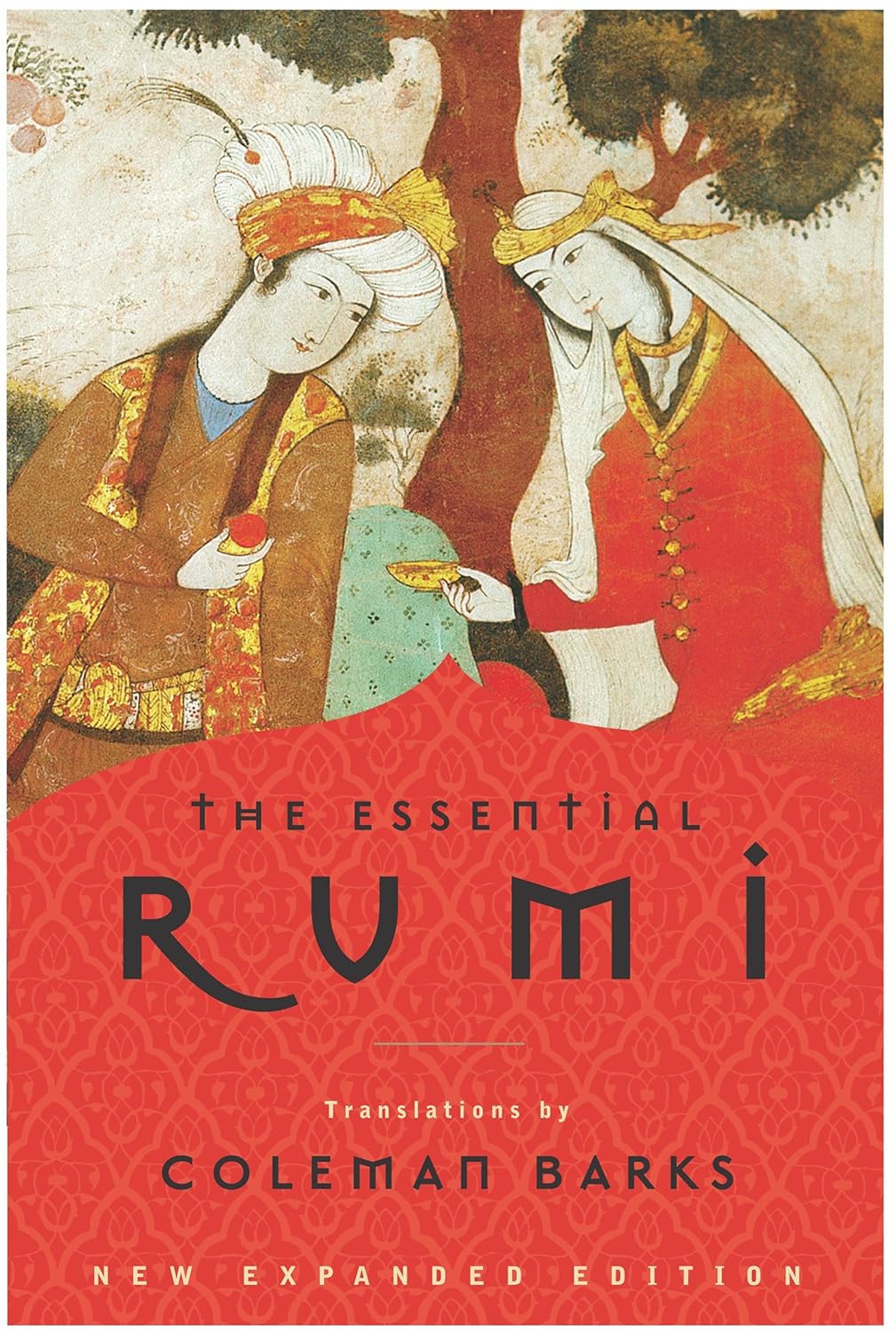
I have long been an admirer of Rumi’s poetry and have recently been dipping into my copy of Coleman Barks’ accessible English translations in his The Essential Rumi (1). This is a substantial volume of poetry and teaching – with the two aspects not really distinguishable.

It is not a new book. My edition is from 2004, and still in print. Coleman Barks provides good information about Rumi in the context of his life and spiritual path as a Sufi Dervish (2), which I have condensed into a note at the end of this post. I think that Barks’ translation works well for people on a spiritual journey, not necessarily Sufis themselves. This seems fitting because Rumi reached out well beyond the world of religious scholars and jurists. He was remarkably ecumenically minded, in a culture where people of many faiths lived side by side.

The poem I offer here is Solomon’s Crooked Crown. Here the archetypal wise ruler, who is also anyone and everyone, learns from his own errors. Solomon doesn’t represent wisdom through being right all the time. He isn’t. He needs to be called out on occasions by his ‘crown’, or higher power. He is wise because he recognises inconvenient truth and answers the call.

“Solomon was busy judging others,

when it was his personal thoughts

that were disrupting the community.

His crown slid crooked on his head,

He put it on straight, but the crown went

awry again. Eight times this happened.

Finally he talked to his headpiece.

‘Why do you keep tilting over my eyes?’

‘I have to. When your power loses compassion,

I have to show what such a condition looks like.’

Immediately Solomon recognised the truth.

He knelt and asked forgiveness.

The crown centered itself on his crown.

When something goes wrong,

Accuse yourself first.

Even the wisdom of Plato or Solomon

can wobble and go blind.

Listen when your crown reminds you

of what makes you cold towards others,

as you pamper the greedy energy inside.”

NOTE (taken largely from Coleman Barks’ introduction, On Rumi)

Rumi was born on September 30, 1207, in Balkh, Afghanistan. Iranians and Afghans call him Jelaluddin Balkhi. At that time, Balkh was part of the increasingly hard-pressed Abbasid Caliphate. Fleeing from invading Mongol armies, his family emigrated to Konya, in modern Turkey, sometime between 1215 and 1220.

The name Rumi means ‘from Roman Anatolia’, now in modern Turkey and already by Rumi’s day long lost to the Romans and their Byzantine successors. Rumi’s father was a theologian, jurist and mystic. On his death Rumi took over the position of sheikh in his dervish (2) learning community in Konya. Rumi’s life seems to have been a fairly normal one for a religious scholar – teaching, meditating, helping the poor – until 1244 when he met the wandering dervish Shams of Tabriz. Shams had spent years travelling throughout the Middle East searching and praying for one who could ‘endure my company’.

Their encounter, and the mystical friendship that ensued, influenced Rumi into becoming the artist we remember. “He turned into a poet. began listening to music, and sang, whirling around, hour after hour” (1). Shams disappeared in 1248. He was most likely murdered with the connivance of one of Rumi’s sons and other disciples. They thought of Shams as a bad influence on Rumi as well as themselves feeling excluded by Rumi and Shams’ relationship.

After the heartbreak of Shams’ death, Rumi went on to compose the Mathnawi, “that great work that shifts so fantastically from theory to folklore to jokes to ecstatic poetry (1)”.

(1) The Essential Rumi Translated by Coleman Barks, with Reynold Nicholson, A. J. Arberry, John Moyne. New York, NY: HarperOne, 2004 expended edition

(2) Dervish – member of a Muslim, specifically Sufi, religious order who has taken vows of poverty and austerity. Dervish orders first appeared in the 12th century CE. The Mevlevi Order of Whirling Dervishes was founded by followers of Rumi.

RUMI: TWO QUATRAINS ON NIGHT

“Night comes so people can sleep like fish

In black water. Then day.

Some people pick up their tools.

Others become the making itself.”

“Night goes back to where it was.

Everyone returns home sometime.

Night, when you get there,

Tell them how I love you.”

From the collection Unseen Rain: Quatrains of Rumi translated by John Moyne and Coleman Barks Putney, VT: Threshold Books, 1986. The translators note that “in some languages of the Middle East the word for ‘rain’ and the word for ‘grace’ are the same”.

I am very conscious at this time of year not just of darkness, but of a longer night. Here Sufi poet and teacher Rumi evokes qualities of night, suggesting potential forms of relationship with it.

BOOK REVIEW: THE GREATEST ACHIEVEMENT IN LIFE (REVISED AND UPDATED EDITION)

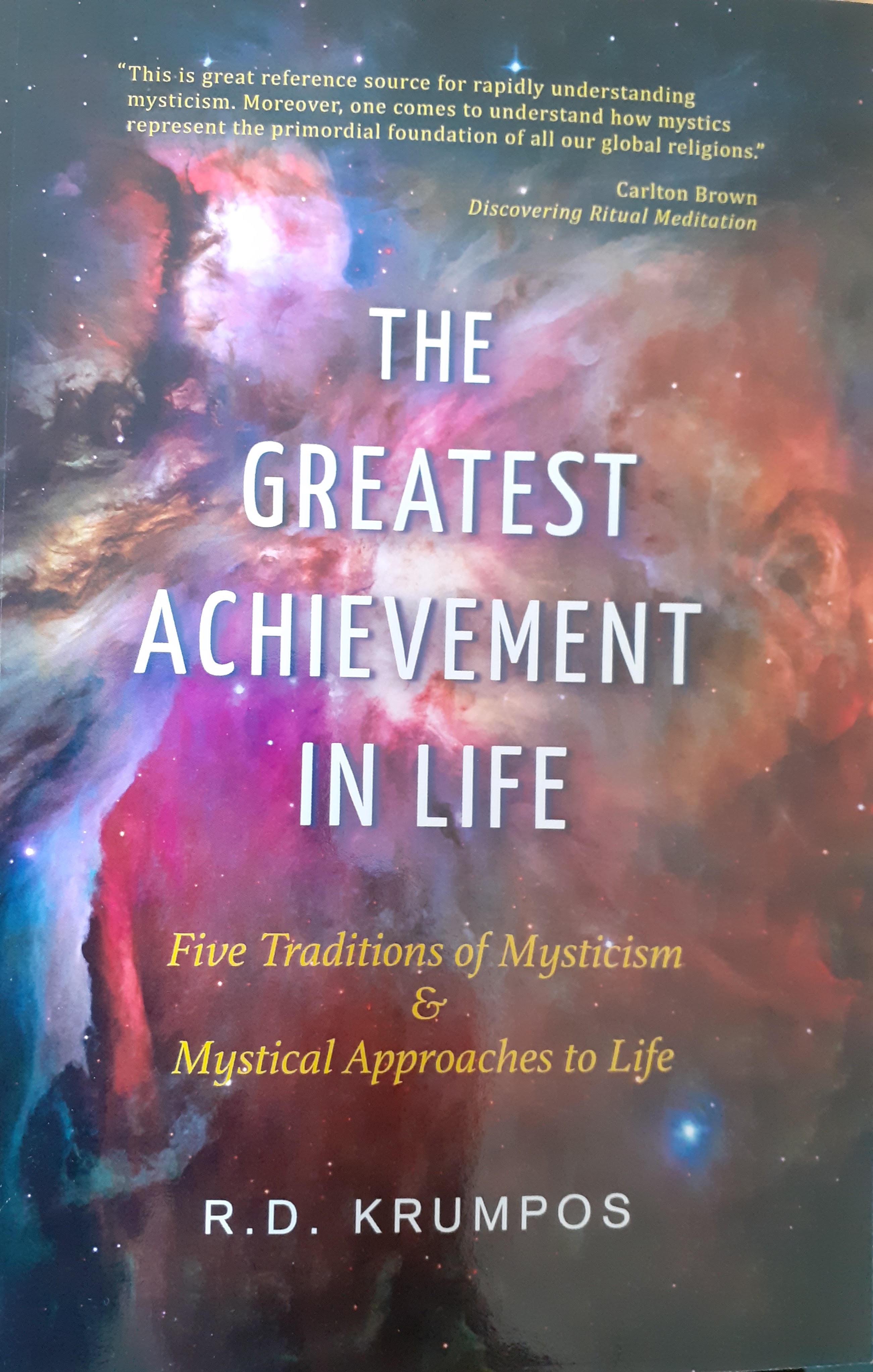
Highly recommended for anyone drawn to contemplative and mystical traditions. R. D. Krumpos’ The Greatest Achievement in Life: Five Traditions of Mysticism & Mystical Approaches to Life (1) is now available in print, in a new revised edition. I like having it now as an old-fashioned physical book that I can leaf through easily both for reference and for inspiration.

The book explores the mystical traditions embedded within Hinduism (Vedanta, Tantra), Buddhism (Zen, Vajrayana), Judaism (Hasidism, Kabbalah), Christianity (Gnostic and Contemplative currents) and Islam (Sufism). Krumpos shows how, underneath their manifold differences, they share an understanding of mysticism as the direct intuition or experience of God, or of an ultimate Reality not conceived as God.

Mystics are described as people whose spiritual lives are grounded “not merely on an accepted belief and practice, but on what they regard as first-hand knowledge”. Krumpos spells out the uncompromising idealism of this project. “Mysticism is the great quest for the ultimate ground of existence, the absolute nature of being itself. True mystics transcend apparent manifestations of the theatrical production called ‘this life’. Theirs is not simply a search for meaning, but discovery of what is i,e, the Real underlying the seeming realities. Their objective is not heaven, gardens, paradise or other celestial places. It is not being where the divine lives, but to be what the divine essence is here and now”.

The book is divided into two main sections: Five Traditions of Mysticism and Mystical Approaches to Life. Within these sections there is a further division into short essays, which can be read either in sequence or independently of the whole. The essays are based both on conversations with mystics and engagement with mystical literatures. Krumpos draws directly on the words of well-known mystics themselves, with 120 quotations interspersed with the essays. He also offers his own commentary and reflections. The book can either be seen as a source and reference book, or as a practitioner aide. It includes sentences and paragraphs that can themselves be used as a basis for formal contemplation. It is not just an ‘about’ book, though it serves that purpose well.

The traditions presented are seen as having much in common at the core, and The Great Achievement bears witness to that commonality. Yet there is enough interior diversity to make it clear that mystics in these traditions are not all the same, or saying the same thing, in the way that is sometimes lazily claimed. Overall Ron Krumpos’ sense of ‘direct experience’ and his definition of gnosis describe a gold standard for what ‘the greatest achievement’ is, based on the accounts of the mystics cited and discussed. In the second half of this book, the focus valuably shifts from the nature of mystical experience itself, to a consideration of its implications for how to live and serve.

For me, the cultural moment in which The Great Achievement has been offered is significant one. Perennialism’s ideas have been popularised and repackaged over the period since World War II at an ever increasing rate. There is now an extraordinary global spiritual hunger at least partly influenced by the spiritual paths that it includes – some, indeed, speak of a ‘spiritual market place’. This is a promising development, yet one with its downside. Krumpos’ work reminds us what these older traditions are and where they stand. For readers in new (or new-old) spiritual traditions with a different approach, the book offers opportunities for comparing and contrasting the fruits of the five traditions with those of their own chosen paths. Krumpos does acknowledge the value of shamanic and indigenous traditions, and practitioners within these traditions, reading this book, might be inspired to develop this conversation further.

(1) R. D. Krumpos The Greatest Achievement in Life: Five Traditions of Mysticism & Mystical Approaches to Life Tucson, AZ: Palomar Print Design, 2022. (Originally a free e-book available from http://www.suprarational.org/ as a printable pdf, published in 2012).

NB This review is a revision of my review of the original edition. See:

https://contemplativeinquiry.blog/2021/03/06/

BOOK REVIEW: THE GREATEST ACHIEVEMENT IN LIFE

The Greatest Achievement in Life is a free e-book available from http://www.suprarational.org/ as a printable pdf, published in 2012. Author R. D. Krumpos looks at five traditions of mysticism, in which mysticism is understood as a direct intuition or experience of God, or of an ultimate Reality not conceived as God. Mystics are described as people whose religion and life are grounded “not merely on an accepted belief and practice, but on what they regard as first-hand knowledge”. Krumpos himself speaks of finding that “preeminent Reality is the holy One in All and All in the wholly One”.

The five mystical traditions examined are those embedded within Hinduism (e.g. Vedanta, Tantra), Buddhism (Zen, Vajrayana), Judaism (e.g. Hasidism, Kabbalah), Christianity (e.g. Gnostic and Contemplative currents) and Islam (e.g. Sufism). I imagine that many people reading this blog will be working outside these traditions. But I recommend the book to anyone with a serious interest in mysticism, however you define it, given that the influence of these traditions is pervasive to the point where it can be virtually unconscious. As a person on a modern Druid path committed to inquiry and with a leaning towards mysticism, I have found Krumpos’ work very helpful in reminding myself of what the ‘five traditions’ are pointing to.

The book is brief and divided into two main sections: Five Traditions of Mysticism and Mystical Approached to Life. Within these sections there is a further division into short chapters, which can be read either in sequence or independently of the whole. Krumpos draws heavily on the words of well-known mystics themselves, as well as offering his own commentary and reflections. The book can either be seen as a source and reference book, or as a practitioner aide. It includes sentences and paragraphs that can themselves be used as a basis for formal contemplation. It is not just an ‘about’ book, though it serves that purpose well.

The traditions presented are seen as having much in common at the core, and The Great Achievement bears witness to that commonality. Yet there is enough interior diversity to make it clear that mystics in these traditions are not all the same, or saying the same thing, in the way that is sometimes lazily claimed. Overall Ron Krumpos’ sense of ‘direct experience’ and his definition of gnosis describe a gold standard for what ‘the greatest achievement’ is, based on the accounts of the mystics cited and discussed. In the second half of this book, the focus valuably shifts from the nature of mystical experience itself, to a consideration of its implications for how to live and serve.

For me, the cultural moment in which The Great Achievement has been offered is significant one. Perennialism’s ideas have been popularised and repackaged over the period since World War II at an ever increasing rate. There is now an extraordinary global spiritual hunger at least partly influenced by the spiritual paths that it includes – some, indeed, speak of a ‘spiritual market place’. This is a promising development, yet one with its downside. Krumpos’ work reminds us what these older traditions are and where they stand. For readers in new (or new-old) spiritual traditions with a different approach, the book offers opportunities for comparing and contrasting the fruits of the five traditions with those of their their own chosen paths. Krumpos does acknowledge the value of shamanic and indigenous traditions, and practitioners within these traditions, reading this book, might be inspired to develop this conversation further.

RUMI: IN PRAISE OF MATURE COMPANIONSHIP

I say, Bring the simple wine that makes me loose and free!

You say, There’s a hurricane coming.

And I say, Let’s have some wine then,

and sit here like old statues and watch.

From the collection Unseen Rain: Quatrains of Rumi translated by John Moyne and Coleman Barks Putney, VT: Threshold Books, 1986

RUMI: THE MORNING WIND

The morning wind spreads its fresh smell.

We must get up and take that in,

that wind that lets us live.

Breathe, before it’s gone.

From the collection Unseen Rain: Quatrains of Rumi translated by John Moyne and Coleman Barks Putney, VT: Threshold Books, 1986

RUMI: BEING HUMAN

This being human is a guesthouse.

Every morning is a new arrival.

A joy, a depression, a meanness,

some momentary awareness comes

as an unexpected visitor.

Welcome and entertain them all,

even if they’re a crowd of sorrows

who violently sweep your house

empty of its furniture.

Still, treat each guest as honourable.

He may be clearing you out

for some new delight.

The dark thought, the shame, the malice,

meet them at the door laughing,

and invite them in.

Be grateful for whoever comes,

because each has been sent

as a guide from beyond.

I discovered this poem when learning Focusing, a peer and reciprocal support system described by one group of practitioners as based on a ‘bio-spirituality’. As such ‘a guide from beyond’ would be described, rather, as ‘a guide from within’. From the perspective of the discursive mind, I find, it amounts to the same thing.

Focusing works on the understanding that we can hold every experience within a larger presence that is loving but not identified with the experience or lost in it. I am not ‘the dark thought, the shame, the malice’, but I can acknowledge it as something in me that I can lovingly welcome. I can keep it company. This welcoming and keeping company is the essence of the practice, discovering what unfolds – rather than trying to fix or banish the initially unwanted part. For there is a wisdom in the wound. As Leonard Cohen famously put it, ‘there is a crack in everything, that’s where the light comes in’.

For more information about Focusing, there are several useful websites:

https://focusingresources.com/

https://www.biospiritual.org/

http://www.focusing.org.uk/

https://www.livingfocusing.co.uk/


BOOK REVIEW: THE WAY OF THE LOVER

Highly recommended. The full title is: The Way of the Lover: Sufism, Shamanism and the Spiritual Art of Love. For me, the strength of this book is its successful synthesis of apparently diverse influences. As a road map for the spiritual journey throughout the life course, it has coherence, power and integrity.

Sufism is the ground. We are introduced to a cosmos saturated in divinity both in origin and manifestation. As Syed Hamraz Ahsan says in his introduction, “Sufis are divine lovers … the path begins at the heart and ends at the heart”. Yet “the pathway to love and the divine may not always be simple or clear”. Since everyone and everything embodies divinity, any relationship is a relationship with the divine.

Ross Heaven uses a medicine wheel structure for the human journey of life and love. Beginning at (or before) birth (East) it moves through youth (South) and mid-life (West) to age (North). Each stage has challenges. Fear can become a distorting part of the picture very early. As we grow up, we are challenged to discover our authentic power and its skillful use. Throughout our adult lives we are under pressure to navigate with clarity and vision through the stress and confusion that go with loving and being loved, and to evolve through loving service. At the Centre is the “true soul, the wise Elder and the newborn”. Within this structure he offers teaching stories; insights from humanistic, developmental and transpersonal psychology; personal anecdotes; and awareness exercises.

The stages of the journey, and several psychological models, are clearly spelled out. They are saved from over-prescription through the use of stories and their rich ambiguity, and by the over-arching presentation of an exploratory, free-spirited and non-controlling spirituality. The Way of the Lover offers something to readers with specific issues of concern and those with a more open and generalized interest in the journey. Ross Heaven distils considerable wisdom and experience within this book, not least when he ends by reminding us to move on and rely on our own experience.

Ross Heaven The Way of the Lover: Sufism, Shamanism and the Spiritual Art of Love Winchester UK & Washington USA: Moon Books, 2017 (Moon Books Classic)


Earth Eclectic

music that celebrates Earth and speaks to the heart

Sarah Fuhro Star-Flower Alchemy

Follow the Moon's Cycle

Muddy Feet

Meeting nature on nature's terms

Rosher.Net

A little bit of Mark Rosher in South Gloucestershire, England

Becoming Part of the Land

A monastic polytheist's and animist’s journal

selkiewife

Selkie Writing…

Charlotte Rodgers

Images and words set against a backdrop of outsider art.

Prof Jem Bendell

living with metacrisis and collapse

Towint

The pagan path. The Old Ways In New Times

The Druids Garden

Spiritual journeys in tending the living earth, permaculture, and nature-inspired arts

The Blog of Baphomet

a magickal dialogue between nature and culture

This Simple Life

The gentle art of living with less

Musings of a Scottish Hearth Druid and Heathen

Thoughts about living, loving and worshiping as an autistic Hearth Druid and Heathen. One woman's journey.

Wheel of the Year Blog

An place to read and share stories about the celtic seasonal festivals

Walking the Druid Path

Just another WordPress.com site

anima monday

Exploring our connection to the wider world

Grounded Space Focusing

Become more grounded and spacious with yourself and others, through your own body’s wisdom

The Earthbound Report

Good lives on our one planet

Hopeless Vendetta

News for the residents of Hopeless, Maine