October, 2024. Outside, leaves turn and fall. The days shorten, long evening walks no longer part of my day. But six months after her accident in Gran Canaria, my wife Elaine is re-learning to walk. A great blessing – we both wondered if she would.
A gift from Awen – three words tumbling into manifestation with no thinking effort from me: healing, peace power (1). A kind of Druid koan. Easy to see that peace might follow healing, and that healing might be a condition of true peace. But the power following on from that peace? – very different from the kinds of ‘power’ most visible in the world today. What do I need to learn?
I had a dream in which I read a map to get to a school. I arrived at the school and was happy enough with my experience. Then I read the map again and saw that it was the wrong school. The one I should have gone to was further away, to the north-west.
At Samhain, the culmination of October, we think of of the dead, and a loosening divide between the dead and the living. What can we say to them – ancestors and recent dead alike? What might they say to us?
Recently I have been contemplating both my understanding and my experience of Awen. Above is a picture of my Awen pendant, a modern Druid badge of belonging. It is based on the three ray symbol developed by Iolo Morganwg (Edward Thomas 1747-1826). It also depicts the three drops from Cerridwen’s cauldron in the Taliesin myth. Hanes Taliesin, popularised in Charlotte Guest’s 19th CE English translation of the tale, is now a significant influence on modern Druids.
Ten years ago I published Contemplative Druidry (1), a book based on interviews with active Druids about the place of contemplation within today’s Druidry. It included a chapter on Awen, and revealed a lack of consensus about what Awen actually meant to the interviewees. I wrote: “Awen is classically seen in Druidry as the power of inspiration, and in particular the creative force for poetry and prophecy … Many of the participants in this work uphold the tradition in its conventional form. Others seek to extend the traditional meaning better to express their own experiences and aspirations. Some don’t connect with Awen experientially and treat it as a convention – mainly a shared chant which brings Druids together.”
Since that time (2014), the evolution of modern Druidry has continued apace. In recent years, the most inspirational definition of Awen I have encountered is one by Kristoffer Hughes, Chief of the Anglesey Druid Order and a native Welsh speaker. He describes Awen as (2): “the creative, transformative force of divine inspiration that sings in praise of itself; it is the eternal song that sings all things into existence, and all things call to Awen inwardly”. For him, the personified deity intimately linked with Awen is Cerridwen, for him a goddess of “angular, bending magic” whose cauldron is “a vessel of inspiration, a transformative device, a vessel of testing”.
In a sense Hughes is the Pagan inheritor of the Unitarian Iolo Morganwg, who reframed St. John’s “In the beginning was the Word” (3) as ‘In the beginning was the Song’ – “all the universe leapt together into existence of life, with the triumph of a song of joy … and the sound of the song travelled as far as God and His existence are” (4). Hughes sees Iolo as a model of Awen’s influence in the world: “He carried the seeds of Awen and profoundly influenced a future that he could not imagine … He is testament to Awen’s consistent stream and how it too changed its countenance to meet the needs of different people at different times”. The Romantic period Iolo lived into was “a cauldron of new ideas”, with a new era of bardic tradition in its infancy and “occult fascination among the learned of the time increasing in popularity” (2).
Looking beyond Druidry, I think of the words of Kabir, the Indian 15th century CE poet/singer and mystic: “If you want the truth, I’ll tell you the truth. Listen to the secret sound, the real sound, which is inside you” (5). Kabir was a Muslim who was also heavily influenced by Indian Tantric/Vedantic culture. In this culture, OM is the primal originative sound. AUM (so like Awen) is its feminine form, the creative energy or Shakti of the Cosmos giving shape and substance to the material world. For me it is as if the sound itself holds the power, waiting to be discovered, and transcending any specific cultural context. It seems somehow inherently resonant and inspiring; an anchor for empowering states.
In my current practice I work with Awen both as chant (Aah-ooo-wen) and as mantra (inbreath Aah, outbreath wen). I have done this on and off for many years, and I have fairly recently returned to ‘on’. When I work energetically, I seem to become porous to the world. I experience a lightness and a loosening of boundaries. Reality is not fixed and locked down. Into this space Awen can enter, and I find myself in a place of healing, peace and power. This doesn’t have a direct cause-effect link with creative work in the world, but it does mobilise my capacity for such work. This is now my experience of Awen.
(1) James Nichol Contemplative Druidry: People, Practice and Potential Amazon/KDP, 2014 (Foreword by Philip Carr-Gomm)
(3) Holy Bible: King James Version Green World Classics edition, 2017
(4) J. Williams ab Ithel (editor) The Barddas of Iolo Morganwg: A Collection of Original Documents, Illustrative of the Theology, Wisdom, and Usages of the Bardo-Druidic System of the Isle of Britain Forgotten Books, 2007 (First published 1862, from notes and journals left by Iolo on his death at 79 years of age in 1826).
(5) Sally Kempton Meditation for the Love of It: Enjoying Your Own Deepest Experience Boulder, CO: Sounds True, 2011 (Foreword by Elizabeth Gilbert),
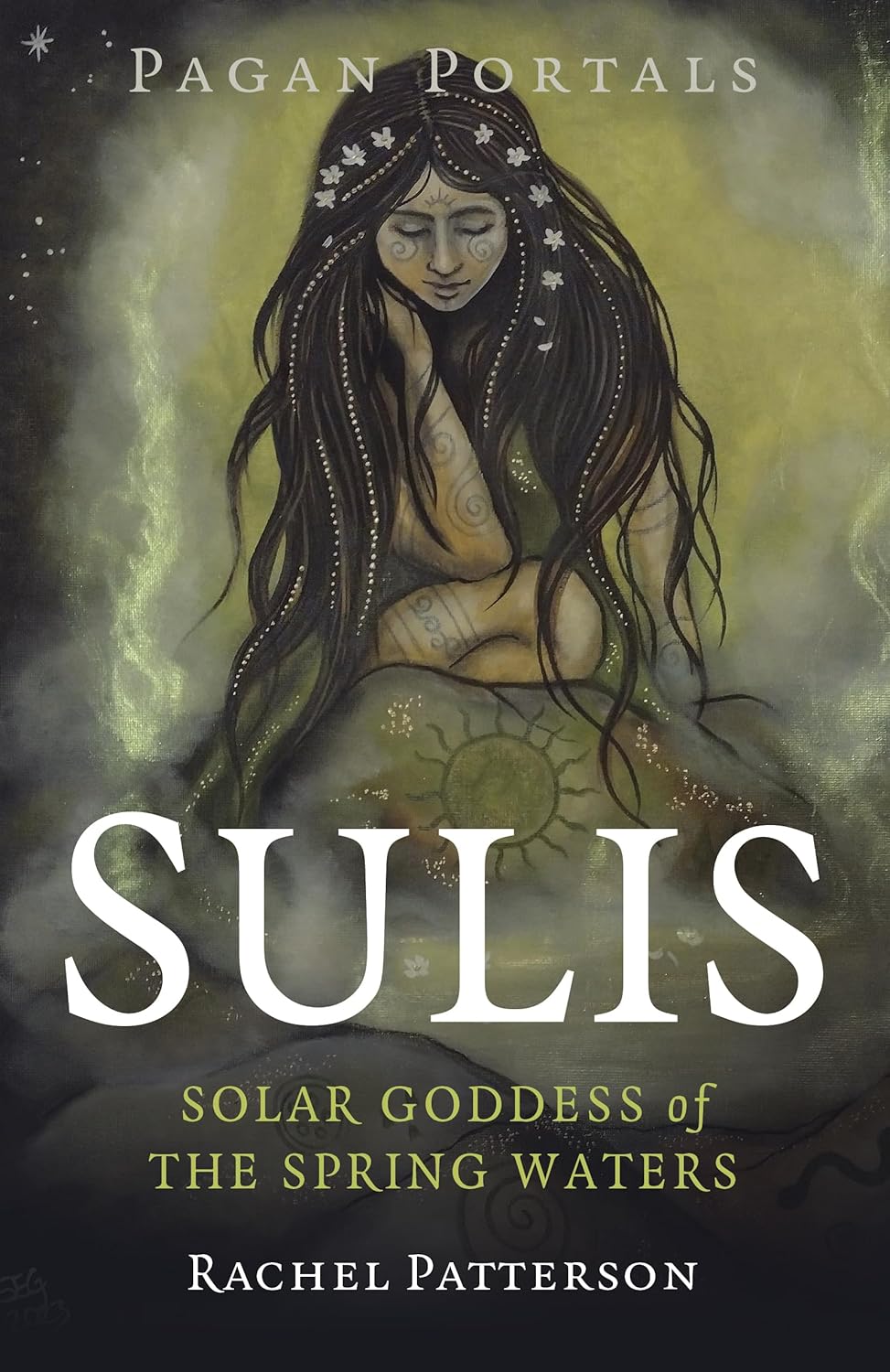
Recommended especially to two overlapping groups: first, readers interested in Sulis (later Sulis-Minerva) the presiding deity of the hot springs at Bath, UK; second, readers interested in polytheist Paganism in Britain, both ancient and modern. Author Rachel Patterson describes her heart as that of an English Kitchen Witch and her craft “a combination of old religion witchcraft, Wicca, hedge witchery and folk Magic”. Hence in this book she focuses not only on the history of Sulis and her springs but also on how to work with Sulis today.
The hot springs at Bath are the only ones in the country, appearing after the last Ice Age around 12,000 years ago. The people who re-settled the land as hunter gatherers began leaving offerings at the springs around 9,500 years ago. They continued to do so for several thousand years until the appearance of farming. We have no record of their beliefs, but for them the numinous power may well have been the living presence of the springs themselves, rather than a presiding deity.
The farmers, when they came, seem to have left the springs alone. But early in the first century CE a causeway of gravel and mud was placed in the main spring pool. Offerings were made, principally of coins minted by the local Celtic tribe, the Dobunni. Pottery was also found but there were no buildings. In 43 CE the Romans invaded Britain and quickly established themselves in the south. The Dobunni chose peace and an accommodation with the Romans, who soon created a spa, building on top of the natural springs. They adopted the local goddess Sulis, now to be known as Sulis Minerva. A town gradually grew up, named Aquae Sulis (The Waters of Sulis). A temple and sanctuary began to be built in 70 CE. The baths are now well-kept after an up-and-down history, and are open to visitors. See http://www.romanbaths.co.uk.
Rachel Patterson describes how the temple worked in the Roman period. Many of the extant records are written curses from people whose clothes and possessions were stolen while they bathed. They asked the Sulis for retributive action in return for offerings and the lost possessions themselves (1). Patterson also describes the decoration of the temple and artifacts from it. The best known was once called the gorgon’s head but is clearly the head of a male figure. He seems to be associated with a god named Belenus, who may in turn be connected with the legendary King Bladud included in Geoffrey of Monmouth’s History of the King’s of Britain (2,3).
The second half of Rachel Patterson’s book is about working with Sulis. It is a thorough and practical guide for readers who may want to go down that path. It includes sections on making candles and altars dedicated to Sulis; on finding Sulis; building a relationship with her; advice on oath-taking; and the development of rituals and meditations dedicated to her. There is relevant advice on the use of herbs, crystals, forms of divination, petitions and curses. There are sections on animal companions and (pigs and wild boar as the Celtic contribution, owls and dolphins related to Minerva). As a Kitchen Witch, Rachel Patterson also provides a number of recipes.
I have lived both the first and most recent 20 years of my life within a forty mile radius of Bath. I don’t go there very often. But I have known it from an early age and bathed in the waters during the more recent period. There is indeed something magical about them. So I’m glad to see Sulis taken more seriously. There is a familiar problem about limited information from the past and Rachel Patterson discusses this in her book But for me there is enough resonance from the old times, here, to dream the myth onwards. I can’t assess the practical guidance offered in Sulis: Solar Goddess of the Spring Waters because I don’t work in the same way. But I do know it is comprehensive and comes from a seasoned practitioner. It feels to me like a timely addition to the Pagan Portals series, and I am grateful to have it.
(1) Further information about religion in Roman Britain, and its rather transactional nature, can be found in Prof- Ronald Hutton’s Gresham College lecture on Paganism in Roman Britain. See https://contemplativeinquiry.blog/22/12/12/paganism-in-roman-britain/ – where a link to the lecture is provided,
(3) For creative treatments of the story of Bladud and the Goddess Sulis, see Kevan Manwaring’s account in The Bardic Handbook and two novels by Moyra Caldecott: The Winged Man and The Waters of Sul
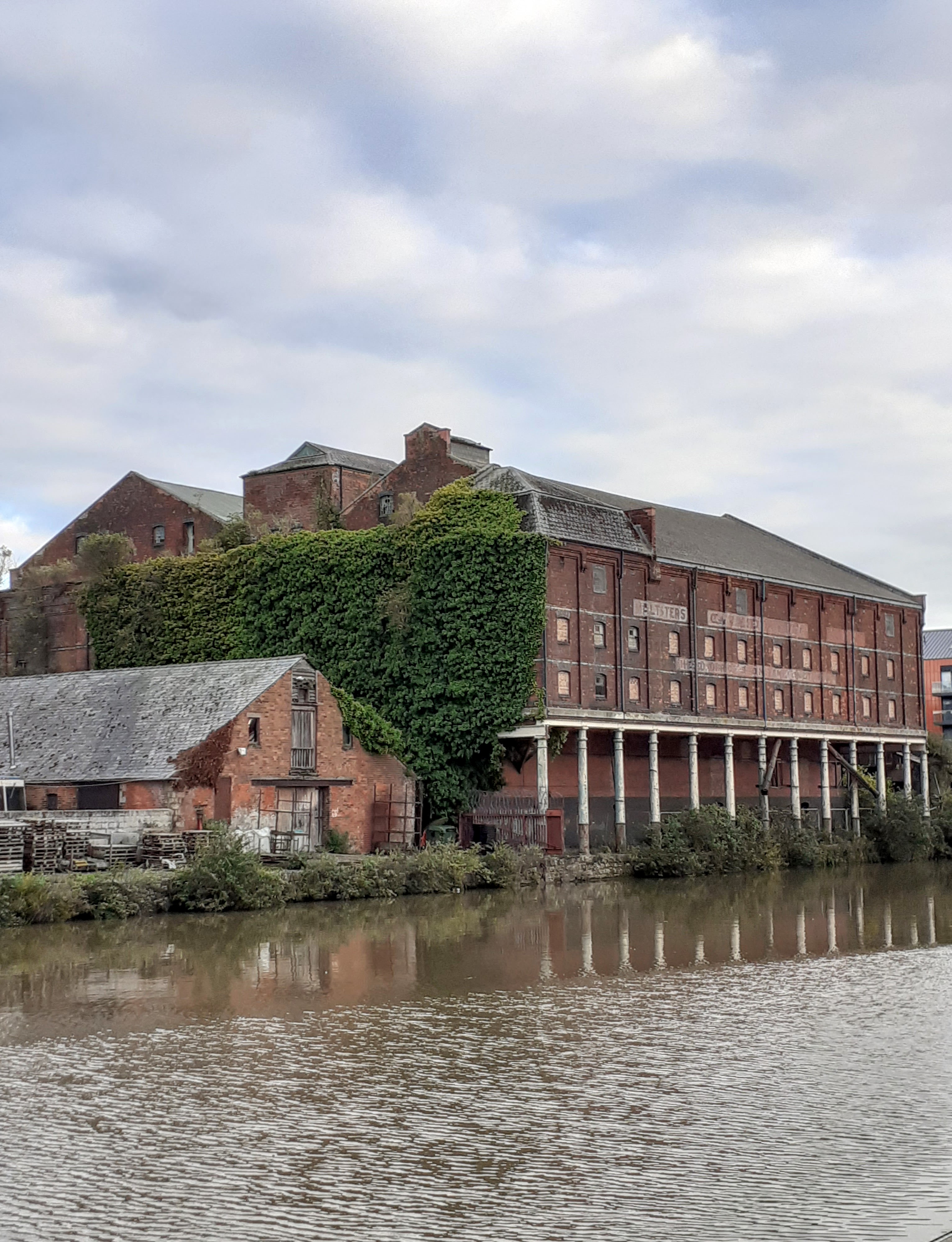
The stretch of water above leads from Gloucester Docks to the Gloucester-Sharpness Canal. The canal was completed in 1827 and the buildings (above) appeared a few years later. The larger, pillared building was known as Downing’s Malthouse and stayed in business until around 1980. For some years thereafter it was used for grain storage. Now it a a Grade II listed building awaiting another life.
From the far side of the canal, the erstwhile malthouse looks tranquil and attractively derelict – solid old brick with greenery on the walls. The forces of decay are relatively slow, and ‘listed’ status provides a degree of human protection. For a few moments I am charmed by by the view. I briefly wish that it could be frozen in time, through a flies-in-aspic form of conservation, admittedly sterile. But the thought doesn’t last. We earthlings experience time and life primarily in change, events and processes – through what happens, interacts and evolves (1). These buildings weren’t designed to be monuments.
So I am glad that people and activity will be returning to Downing’s Malthouse through the building of residential apartments. Housing is in short supply here and I find myself friendly to this kind of development. The shell of Downing’s Malthouse, and its distinctive pillars, will be retained. I dare say that the smaller building will go, and so I’m memorialising it in the picture below.
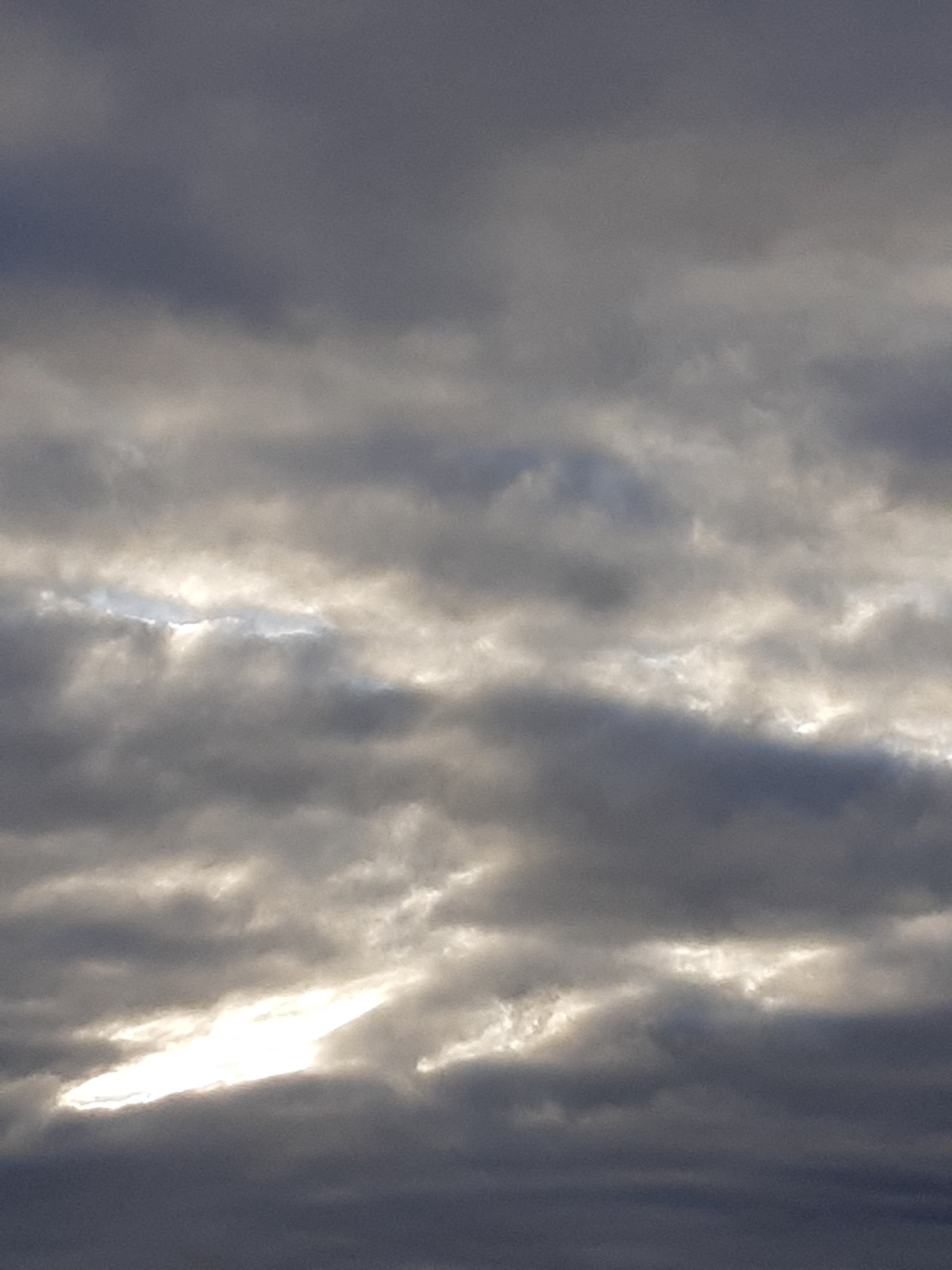
I took these pictures one recent evening in the wetlands of Alney Island, on the River Severn at Gloucester. It felt dark and broody most of the time. There was a threat of rain and storm though not the actuality. The feeling-tone suggested raw nature and remoteness: a place where I as a human didn’t exactly belong. Boggy land and turbulent sky were elementally indifferent to me and my concerns. I was simultaneously inspired and edgy.
Then the sky changed and I changed with it. I noticed the sun. It was declining but that didn’t matter. It was signalling its presence to me from a suitably safe distance. Comfort and familiarity returned. I was on a small reserve in the middle of a city. I had lost a moment of wildness and gained a perceived security. Being human, I both took the deal and wondered about the possibilities I may have abandoned..
When is ‘suicide’ something else? At the age of 80 Satish Kumar’s mother decided that her life was over and her duty done. She began a fast that lasted for five weeks before she died. Although suicide is stigmatised in most cultures, this was an honourable death in her Jain community in Rajasthan, India. Kumar, then already living in England, quotes the letter that gave him the news.
“At the age of eighty your mother felt that she had served the family and fulfilled all her duties and that now it was time for her to meet death. She decided to separate herself from her worn-out body by fasting. She believed that only death could bring new life and that she must die to live again. She went round the town, to family and friends, saying goodbye and asking forgiveness for any wrong she may have done. From the next day’s sunrise she took no more food or drink except a little boiled water. The news of your mother’s fast unto death spread by word of mouth. Monks came to bless her and be blessed, since it is considered to be brave and holy to die in this way – to embrace death rather than let it capture you unaware. Hundreds of people came to have her last darshan and to ask for forgiveness. She didn’t talk much but by her look acknowledged the receiving and giving of forgiveness. People sat outside singing songs and praying. After thirty-five days of fasting, your mother died.” (1)
I have written before about Jain ethics, in a review of Philip Carr-Gomm’s Seek Teachings from Everywhere (2). Both he and his Druid mentor Ross Nicholls had an interest in the Jain path with its values of ahimsa (non-violence/harm), aparigraha (non-attachment/possessiveness/acquisition) and anekant (non-absolutism/many-sidedness/multiple viewpoints). From a Jain perspective, Satish Kumar’s mother was in conformity with these principles when she chose death, with fasting (already a familiar practice) as her method. I value her story for its distinctive lens on a contentious subject. The depth of community support she received is for me the most moving aspect of this voluntary death. It became almost a celebration, and a kind of karmic harvesting for someone who believed that she “must die to live again”.
(1) Satish Kumar No Destination: Autobiography of a Pilgrim Cambridge: Green Books, 2014 (extended 4th edition – first edition 1992)
NOTE: “Satish Kumar (born 9 August 1936)[1] is an Indian British activist and speaker. He has been a Jain monk, nuclear disarmament advocate and pacifist.[3]Now living in England, Kumar is founder and Director of Programmes of the Schumacher College international center for ecological studies, and is Editor Emeritus of Resurgence & Ecologist magazine. His most notable accomplishment is the completion, together with a companion, E. P. Menon, of a peace walk of over 8,000 miles in June 1962 for two and a half years, from New Delhi to Moscow, Paris, London, and Washington, D.C., the capitals of the world’s earliest nuclear-armed countries.[4][5] He insists that reverence for nature should be at the heart of every political and social debate.” (Wikipedia)
In 1986, at the age of 50, Satish Kumar (1) went on an extended pilgrimage of British sacred sites. When staying overnight as a guest of the Bishop of Lincoln, he initiated a dialogue on divinity. In this discussion, divinity is described as God, and masculine language is used throughout. (In other contexts Satish Kumar has been happy to use Goddess references and language.) My own practice is largely non-theistic, yet I am Pagan enough to have been jolted by this limitation. Diverse images, stories and beliefs about the divine continue to inform my heart, mind and imagination. The two views articulated here (both eco-friendly in their way) point to very different experiences and understandings of the divine, and of the world: dualist and non-dualist in formal terms.
“‘It is with great pleasure that I welcome you, Satish, to Lincoln and my house, the Bishop said. ‘Going on a pilgrimage is an ancient tradition, but walking for four months around Britain to its sacred places is not so common.’
“‘I am honoured to be your guest,’ I said. ‘I have been inspired and renewed by being within many churches and cathedrals, but increasingly I am finding all places sacred and the presence of the divine everywhere.”
“‘The Bishop heard my comment with thoughtful silence, and then said, ‘For us, God is above and beyond his creation. We aspire to reach God, but God and the world are not the same.’
“‘In the Hindu tradition the world is understood to be the dance of the God Shiva, and the yet the dance and the dancer cannot be separated. The world is not like a painting, a finished object which when complete is seen as separate from the painter. The universe is a living dance and God in in the heart of all beings and things. We do not separate God and the world.’
“The Bishop pondered and in a gentle voice said, ‘I believe that the world is God’s creation and therefore it is sacred. Human beings must act as responsible guardians and caring stewards. We must love the land and look after the earth in its glorious diversity. We have no right to plunder, pollute, exploit, destroy, kill or in anyway disrespect God’s creation. Like in a family, God is the Father and we are his children, and all members of the family should live in harmony with each other. God’s family includes the animals and the natural world. If we are sensitive and caring, we can live with nature rather than against it. The advance of science and technology requires that human beings live with greater sensitivity than ever before, since we are now equipped with extremely powerful and destructive tools. This destructive impulse is not part of God. God is good and good only.’
“‘For me, Divinity is neither good nor bad,’ I said. ‘It is like pure water and pure air. The human soul is also pure. Good and bad is a matter of perception. For example, from nature’s point of view creeping buttercups and nettles are fine wherever they are; they will grow where the soil is ripe for them. From the human perspective, however, a gardener struggles to remove the buttercups and nettles; he regards them as weeds, and complains when they overtake flowers. The rose and the thorn are part of the same plant – we cannot have one without the other. The analytical mind attempts to separate the good and evil, the decorative and ugly, the useful and non-useful, the weed and the flower. I have seen during my journey people pulling out foxgloves in one area and carefully planting them in another. If we are to live in harmony with God’s family, we need to love the wilderness, the weeds and the wet.'”
From: Satish Kumar No Destination: Autobiography of a Pilgrim Cambridge: Green Books, 2014 (extended 4th edition – first edition 1992)
(1) “Satish Kumar (born 9 August 1936)[1] is an Indian British activist and speaker. He has been a Jain monk, nuclear disarmament advocate and pacifist.[3]Now living in England, Kumar is founder and Director of Programmes of the Schumacher College international center for ecological studies, and is Editor Emeritus of Resurgence & Ecologist magazine. His most notable accomplishment is the completion, together with a companion, E. P. Menon, of a peace walk of over 8,000 miles in June 1962 for two and a half years, from New Delhi to Moscow, Paris, London, and Washington, D.C., the capitals of the world’s earliest nuclear-armed countries.[4][5] He insists that reverence for nature should be at the heart of every political and social debate.” (Wikipedia)
Last Friday afternoon we were at the centre of a big storm. Lightning flashed dramatically just outside our windows. It was scary in the delicious way that can happen when linked to a subjective sense of safety. But we learned later in the day that one of the buildings in our estate had suffered a direct hit which the lightning conductors were unable to hold. There was a leak in the roof and water ran down the stair wells. I understand that the damage is not as severe as it might have been. But is certainly compromises any sense of immunity. It could have been worse and it could have been us.
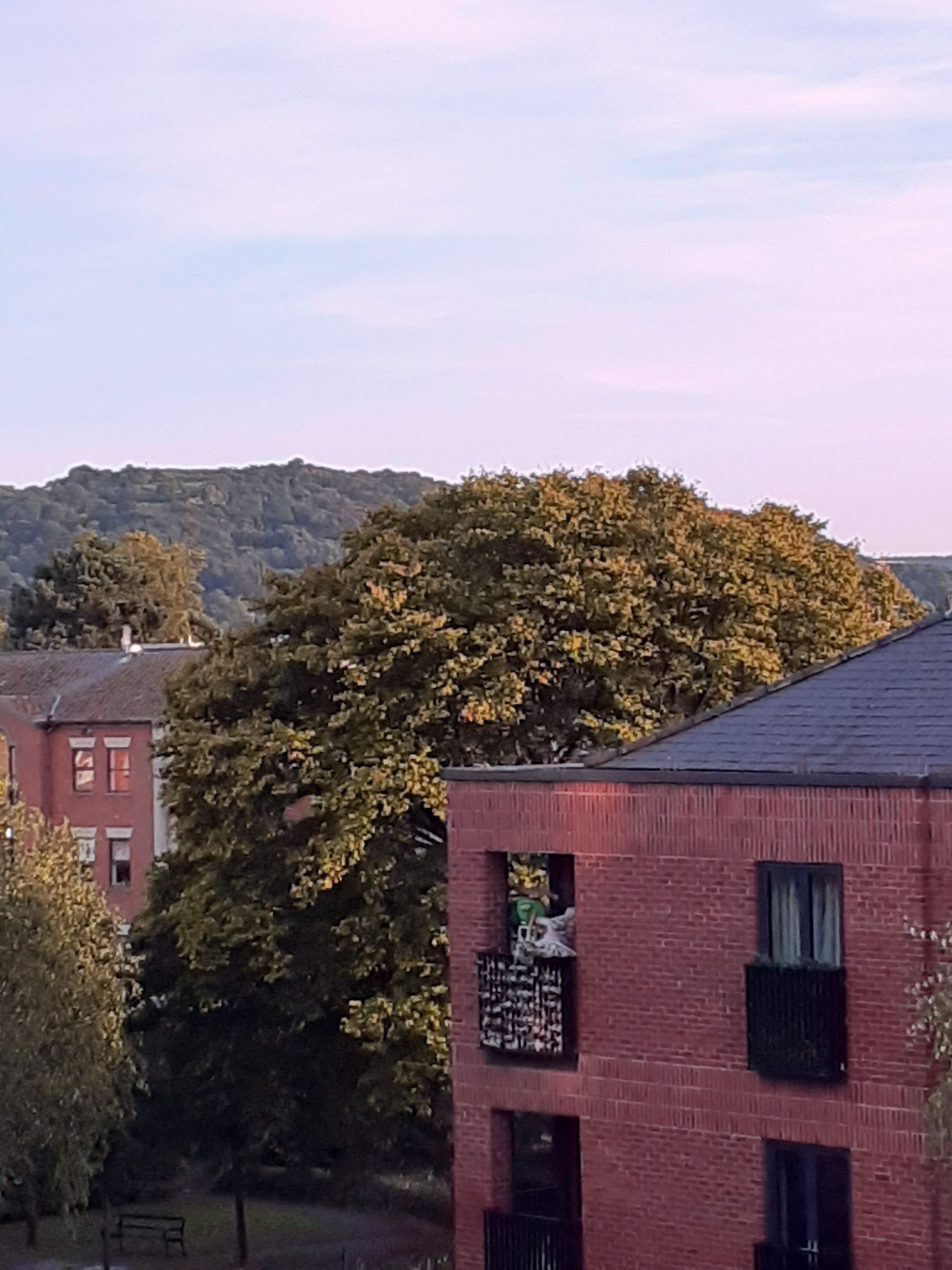
Now it is Sunday 22 September, generally marked as the Autumn Equinox in these parts. I am in a familiar space (1) but experiencing it in another way. The current clock time is about 7.45 am (an hour after sunrise) and I’m looking out on a distinctly misty morning. The background wooded hills are very sketchy. True, there is clear light and shade in the foreground and I feel calm after a time of storm and rain. But they will likely be back soon. The mist and murk in the east suggest that anything could emerge from the most benign of spaces: the world reveals itself as volatile and shifting.
This is not an exclusively equinoctial phenomenon, but I have always linked the equinoxes – especially in autumn – with this kind of dynamic mutability. The Lightning Flash is a great archetypal symbol, not least for Druids. In antique theory, we are supposed to be able to summon them, though I’ve never tried it myself. I do know how to find the opportunity in disruptive change, though at this time of my life I have ceased to look for it. I much prefer the calm.
An Tuagh celebrate early Norse as well as Gaelic traditions in northern Scotland. Not only Orkney and Shetland, but also the Western Isles and part of the Scottish mainland were officially in Norway for over two centuries in the early middle ages. Above is the An Tuagh version of Helvegen, featuring the voice of Chris Corrigan.
In an An Tuagh Facebook post on 20 march 2024, and also in a note appended to their YouTube video, Corrigan explains: “Bards and Skalds of ancient times sang songs for others’ birthdays, weddings, funerals and everything in between. This song asks a then pertinent question. Who will sing me (the bard) over to the other side when it is my turn to pass over?” Corrigan’s post includes a personal dedication and Norwegian and English versions of the lyrics.
A chill in the air today reminded me of Helvegen. In April of this year I posted An Tuagh’s version of The Song of Amergin in Old Irish (1). Here I add a representation of the Norse aspect of Scottish tradition as well, though Helvegen is not itself an old song. It was written by Einar Selvik in modern Norwegian in 2013, but using traditional themes. It became widely known through its appearance in the Vikings TV drama series on Netflix.






 Contemplative Inquiry