
Contemplative Inquiry

This blog is about contemplative inquiry

Tag: Spirituality

ONCE AND FUTURE WIZARD

I first encountered Merlin when I was nine years old, through T. H. White’s The Sword in the Stone. It includes a wonderful account of shape-shifting and indeed of education (as imaginative, experiential, self-reliant). As time went on I didn’t exactly get Arthur, the Wart’s, education. But I got enough to feed both memory and hope as enhancements of here-and-now experience rather than distractions from it. I didn’t forget, or if so, not completely. Thanks to Elen Sentier for reminding me in her recent book, which I plan to review soon.

“The thunder-clouds which usually go with hot weather were there, high columns of cumulus with glaring edges, but there was not going to be any thunder. It was too hot even for that. ‘If only’, thought the Wart, ‘I did not have to go into a stuffy classroom, but could take off my clothes and swim in the moat’.

“They crossed the courtyard, having almost to take deep breaths before they darted across it, as if they were going quickly through an oven. The shade of the gatehouse was cool, but the barbican, with its close walls, was hottest of all. In one last dash across the desert they had reached the drawbridge – could Merlyn have guessed what he was thinking? – and were staring down into the moat.

“It was the season of water-lilies. If Sir Ector had not kept one section free of them for the boys’ bathing, all the water would have been covered. As it was, about twenty yards on each side of the bridge were cut each year, and one could dive in from the bridge itself. The moat was deep. It was used as a stew, so that the inhabitants of the castle could have fish on Fridays, and for this reason the architects had been careful not to let the drains and sewers run into it. It was stocked with fish every year.

“’I wish I was a fish’, said the Wart

“’What sort of fish?’

It was almost too hot to think about this, but the Wart stared down into the cool amber depths where a school of small perch were aimlessly hanging about.

“’I think I should like to be a perch,’ he said. ‘They are braver than the silly roach, and not quite so slaughterous as the pike are.”

“Merlyn took off his hat, raised his staff of lignum vitae politely in the air, and said slowly, ‘snylrem stnemilpmoc ot enutpen dna lliw eh yldnik tpecca siht yob sa a hsif?’

“Immediately there was a loud blowing of sea-shells, conches and so forth, and a stout, jolly-looking gentleman appeared seated on a well-blown-up cloud above the battlements. He had an anchor tattooed on his stomach and a handsome mermaid with Mabel written under her on his chest. He ejected a quid of tobacco, nodded affably to Merlyn and pointed his trident at the Wart. The Wart found that he had tumbled off the drawbridge, landing with a smack on his side in the water. He found that the moat and the bridge had grown a hundred times bigger. He knew that he was turning into a fish.

“’Oh, Merlyn,’ he cried, ‘please come too.’

“’For this once,’ said a large and solemn tench beside his ear, ‘I will come but in future you will have to go by yourself. Education is experience, and the essence of experience is self-reliance.’”

(1) T. H. White The sword in the stone Volume 1 of The once and future King London: Collins, 1958

(2) Elen Sentier Merlin once & future wizard Winchester UK & Washington USA: Moon Books, 2016 (Pagan Portals series)
 

DOVE ENERGY

Guanyin is the Bodhisattva of compassion, who hears the cries of the world. In Chinese iconography, she is sometimes portrayed as seated on a lotus, holding a jar that contains pure water. It is the divine nectar of life, compassion and wisdom. She also has a small willow branch, to sprinkle on devotees and bless them with spiritual and physical peace. The willow teaches the wisdom of knowing how to bend rather than break, and has a history of use in Chinese shamanic and medical practice.

Often depicted as a woman in white (signifying purity and maternity) Guanyin may also have doves flying towards or around her. Doves are associated with fecundity, marital fidelity and longevity. There was a tradition of awarding a jade sceptre with the figure of a dove to people who reached the age of 70. Ritualized dove releases were used as a means of warding off evil. The Lotus Sutra (1) contains a chapter on the transformations of Avalokitesvara, Guanyin’s male alter-ego, travelling the world and “by resorting to a variety of shapes”, conveying beings to salvation.

I feel increasingly that Guanyin represents the same archetypal energy as Sophia, the Gnostic “mother of angels” (2). In my icon of Sophia, she holds a chalice at heart level, and a dove sits in it, facing out. When I had a Temple of Sophia practice, she often appeared in dove form rather than anthropomorphically. She inherits dove symbolism from the Goddesses of the Eastern Mediterranean, and from Jewish culture, again with dove symbolism, derives the role of revealing God’s inward thought, and communicating insight and knowledge to mankind.

For me it is as if a dove energy has relocated me to a new practice community. The opportunity to work more systematically on lovingkindness and compassion than heretofore, yet in a gentle unforced way. Hence the cultural change of garment from ‘Sophia’ to ‘Guanyin’. Early this year I had two episodes of active imagination (open waking dreams rather than structured guided meditations). In the first, I was a mouse in the talons of an owl, flying over water to an unknown destination. I knew that the owl was Sophia. In the second, I was under the tutelage of Sophia on a small ocean-going yacht. Here too, I didn’t know the destination. I remember her asking me to contemplate my existing resources, and I thought of Russel Williams talking about “stillness, pure consciousness, emptiness of being – based on sense-feeling, and filling the emptiness with lovingkindness” (3).

Some months later I contacted the Community of Interbeing. It’s a Mahayana Buddhist community, and so under the aegis of Guanyin, and is proving a good place to be. Beyond its regular meetings, there have been two spin-offs. The first is my Mindful Self-Compassion course (4). The second is a recent retreat with members and friends of my sangha. The theme was ‘embodiment’. The purpose was to make Buddhist practice more somatically aware and Earth honouring. We spent a significant amount of time outside and making use of local topography. It was very like my outdoor experiences of contemplative Druidry and included the same sensitivity to the politics of Deep Ecology In terms of Dove guidance, I feel that I have landed now, and I simply go on from here.

(1) The lotus sutra: saddharma-pundarika Translated by H. Kern, 1884 (Kindle edition)

(2) Jean-Yves Leloup The gospel of Philip: Jesus, Mary Magdalene, and the gnosis of the sacred union. Rochester, VT: Inner Traditions, 2003 (Translation and commentary from the Coptic. English translation, Joseph Rowe. Forward by Jacob Needleman)

(3) Russel Williams (2015) Not I, Not Other than I: the Life and Spiritual Teachings of Russel Williams (Edited by Steve Taylor) Winchester & Washington: O Books

(4) https://centerformsc.org/

POEM: THE JOURNEY

This poem by Mary Oliver is included in the material for my Mindful Self-Compassion course. I wonder how many readers feel some resonance with it.

One day you finally knew

what you had to do, and began,

though the voices around you

kept shouting

their bad advice–

though the whole house

began to tremble

and you felt the old tug

at your ankles.

“Mend my life!”

each voice cried.

But you didn’t stop.

You knew what you had to do,

though the wind pried

with its stiff fingers

at the very foundations……

though their melancholy

was terrible.


It was already late

enough, and a wild night,

and the road full of fallen

branches and stones.

But little by little,

as you left their voices behind,

the stars began to burn

through the sheets of clouds,

and there was a new voice

which you slowly

recognized as your own,

that kept you company

as you strode deeper and deeper

into the world,

determined to do

the only thing you could do–

determined to save

the only life you could save.

REDEMPTION SONG

In December 2010, Swithin Fry interviewed me for Stroud FM Radio. The focus was my spiritual path, combining Druid and Buddhist aspects. A shortened version is available at the OBOD website (1). The format was a bit like Desert Island Discs, and interspersed with music. The first piece I chose was Bob Marley’s Redemption Song, and I drew attention to the lines:

“Emancipate yourselves

from mental slavery.

None but ourselves can

free ours minds.”

Astonished that nearly seven years seem to have passed, I listened to my CD of the broadcast again today. What I noticed was a lot of continuity yet some difference of emphasis. At that time, the Buddhist influence – though strongly affirmed – was a bit sketchy. It was clear to me that Buddhist contemplative methods were a means of freeing the mind and seeing reality more clearly, but I talked much more about Earth spirituality and about Bardistry. These too have power to free the mind.

I see Marley as a major Bard of his generation, with a resonance beyond Rastafarianism and the slave-descended African diaspora in the Caribbean and the Americas. What makes him a Bard for me is his ability to speak for more than himself, and to provide a voice for the voiceless. Or even not exactly voiceless, but for people needing to have their experience reflected for them in a more telling, more powerful way, articulated somehow more fully. If strong enough, the song can potentially resonate for everyone, including those outside the specific cultural experience and heritage being referenced.

This isn’t quite the conventional definition of Bardistry. But it does have the sense of a public and performance oriented art that can influence people’s view of themselves and their world in emancipatory and expansive directions. It contradicts shutting down, isolation and contraction. I could call it a Bardistry for postmodern times, when issues of social and cultural identity are complex and stressed. It’s not about pleasing Chiefs any more, and hasn’t been for quite a while.

This is a thread I haven’t much engaged with since I started to specialize in the contemplative aspects of the path. However, the issues aren’t separate: freeing ourselves from mental slavery is for me the theme that binds them. I am now more fully engaged with specifically Buddhist practices than for a long time. But listening to this broadcast again, I still identify myself as a Dharma Druid rather than Buddhist tout court.

POEM: I CAN WADE GRIEF


I can wade Grief –

Whole pools of it

I’m used to that –

But the least push of Joy

Breaks up my feet

And I tip –

drunken


Emily Dickinson

EMBRACING INTERBEING

“If you are a poet, you will see clearly that there is a cloud floating in this sheet of paper. Without a cloud, there will be no rain; without rain, the trees cannot grow; and without trees, we cannot make paper. The cloud is essential for the trees to exist. If the cloud is not here, the sheet of paper cannot be here either. So we can see that the cloud and the paper inter-are. ‘Interbeing’ is a word that is not in the dictionary yet, but if we combine the prefix ‘inter‘ with the verb ‘to be’, we have a new verb ‘inter-be’” (1).

Thich Nath Hanh extends his proposition to include sunshine, the logger, the saw mill, the bread sustaining the logger (thus also wheat) and the logger’s parents. We are there too, because the paper is part of our perception. In fact, “you cannot point out one thing that is not here – time, space, the earth, the rain, the minerals in the soil, the sunshine, the cloud, the river, the heat. Everything co-exists with this sheet of paper. … You cannot just be by yourself alone. You have to inter-be with every other thing. This sheet of paper is, because everything else is. … As thin as this sheet of paper is, it contains everything in the universe in it.”

I have embraced ‘interbeing’. It is the most accessible and elegant way I know of talking about non-duality: clear, workable and sensitized to an ethics of empathy. It leans into the affirmation of embodiment, of loving relationship with the Earth, and a willingness to be socially engaged. I prefer this account to ones that tend in the direction of ‘I am the One’ or union with the Divine. We each seek the language with the most resonance and integrity for ourselves, whilst also knowing that any language is a finger pointing at the moon and not the moon itself.

For some time, I have been working towards a view like interbeing through my personal contemplative inquiry. My chapter in the compilation Pagan Planet is called Living presence in a field of living presence: practising contemplative Druidry (2). There I raise questions about paths that lack a felt sense of embodiment, inter-connectedness and inter-dependence even when they do valuably encourage agency, personal responsibility, self-cultivation and independence of mind.  I specifically note two apparently contrasting effects of meditation, beyond its being a “green anti-depressant”. The first is that it “makes me very aware of my fragility … and complete embeddedness in a web of interdependence, and the narrow limits of my usual consciousness and perception”. The second is to find myself almost melting “with love and gratitude for the miracle of being alive at all”, moved too “by the world’s seeming ability to be irrationally generous as well as unfairly hurtful (3)”.

I now have an outer court membership of Thich Nhat Hanh’s Community of Interbeing and have recently begun attending a weekly meditation session with the local sangha. It seems like a good place to be. It continues, in a new setting, an aspect of what I have already been doing in my contemplative inquiry.

(1) Thich Nhat Hanh The heart of understanding: commentaries on the Prajnaparamita Heart Sutra Berkeley, CA: Parallax Press, 2009 (20th anniversary ed. Editor Peter Levitt)

(2) James Nichol Living presence in a field of living presence: practicing contemplative Druidry in Nimue Brown (ed.) Pagan Planet: Being, believing and belonging in the 21st century Winchester, UK & Washington. USA: Moon Books, 2016

(3) http://www.newstatesman.com/culture/2014/12/rowan-williams-why-we-need-fairy-tales-now-more-ever

HERE-AND-NOW STONE

I am carefully sitting in a balance of warmth and shade. In the palm of my right hand is a small sandy brown stone. My four fingers are gently folded over it, the thumb resting beside them, unobtrusively pointing out. The stone is a good fit and the texture relatively smooth, with just enough variation to offer tactile interest. This is a pleasing stone to hold, as it exchanges warmth with my friendly hand. I feel in relationship with this stone, most likely collected from a beach though I don’t know when and where.

I am doing this as part of a formal exercise – you might think, a Druid one. I can recall ones very like it. But in this case, it is linked to a Mindful Self Compassion programme, research based but with an explicitly Buddhist inspiration. I’m asked to enjoy the stone. After some time I open my hand and gaze at the subtle variations in colour, and a dusting of tiny white crystalline spots. I pick the stone up and rub it against my skin. There’s just enough roughness in the contact to generate a real aliveness.  The taste is slightly salty. I am thoroughly engaged with the stone.

The framers of the exercise link this combination of focus and appreciation with coming home to the present moment, a place with no room for regret or worry, past or future. Their recommendation, going forward, is to keep the stone in my pocket, or somewhere handy. Then, whenever I feel swept up in hurt feelings or distracted ones, I can take myself back home by rubbing the stone with my fingers. I am sure that this is true and I will begin using it this way. Overnight, it can be the first stone on my Guanyin altar.

I also believe that my Druid background adds value. If I treat this action purely as a psychological exercise, it might come to seem a little calculated and Pavlovian. In my universe, I am entering a relationship with an entity from the mineral kingdom, receiving a gift, and hopefully offering one too. I believe that this understanding will add power, beauty and magic to an apparently simple activity.

POEM: SILENT ILLUMINATION


Silently and serenely, one forgets all words,

Clearly and vividly, it appears before you.

When one realizes it, time has no limits.

When experienced, your surroundings come to life.

Singularly illuminating this bright awareness,

Full of wonder is the pure illumination.

The moon’s appearance, a river of stars,

Snow-clad pines, clouds hovering on mountain peaks.

In darkness, they glow with brightness.

In shadows, they shine with a splendid light.

Like the dreaming of a crane flying in empty space,

Like the clear, still water of an autumn pool,

Endless eons dissolve into nothingness,

Each indistinguishable from the other.


Chan Master Sheng-Yen The Poetry of Enlightenment: poems by ancient Chan Masters New York: Dharma Drum Publications, 1987

This is the first section of a longer piece by Hongzhi (in this text transliterated as Hung Chi), who lived in China from 1097-1157. He developed a version of what we now call mindfulness meditation called Silent Illumination.


MINDFULNESS MUST BE ENGAGED

Social action: what to do and how to do it. An issue for any spiritual community ….

“When I was in Vietnam, so many of our villages were being bombed. Along with my monastic brothers and sisters, I had to decide what to do. Should we continue to practice in our monasteries, or should we leave the meditation halls in order to help the people who were suffering under the bombs? After careful reflection, we decided to do both – to go out to help people, and to do so in mindfulness. We called it engaged Buddhism. Mindfulness must be engaged. Once there is seeing, there must be acting. Otherwise, what is the use of seeing?

“We must be aware of the real problems of the world. Then, with mindfulness, we will know what to do and what not to do to be of help. If we maintain awareness of our breathing and continue to practice smiling, even in difficult situations, then many people, animals, and plants will benefit from our way of doing things. Are you massaging our Mother Earth every time your foot touches her? Are you planting seeds of joy and peace? I try to do exactly that with every step, and I know that our Mother Earth is most appreciative. Peace is every step. Shall we continue our journey?”

Thich Nhat Hanh Peace is every step: the path of mindfulness in daily life London: Rider, 1995

BOOK REVIEW: THE CRANE BAG

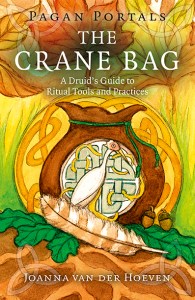
The Craane BagThe Crane Bag, Joanna van der Hoeven’s forthcoming book*, offers an introduction to the ritual tools and practices found in the Druid tradition. It achieves this briefly, simply and with a light touch – as books in the Pagan Portals series are designed to do. Yet it much more than a tick box guide. It provides context and meaning, showing the modern evolution of the Druid tradition itself.

The author makes it clear that she wants readers “to develop their own path in their own time in their own fashion”. Re-enchantment is both path and goal. With proper use, the crane bag “can further the Druid in working with the tides of nature, finding his or her own place in the environment, living in balance, harmony and peace”. The movement overall is “toward reintegration with the natural world”.

At its simplest, the crane bag is the container for Druid ritual tools and as such enables the practices. Bag and tools provide the practitioner with “something tangible to express the spiritual”, acting as a portable “map of the soul”. Behind the crane bag lies an ancient Irish story beginning with the contention between two sisters and the transformation of one of them, Aoife, into a crane. The story is beautifully told and its relevance clearly explained in the first chapter of the book.

In ritual, a period of time and an area of space are set apart and dedicated. This is not to create a lasting duality of sacred and mundane, but a step on the way to experiencing everything as sacred. “Ritual helps us to step back from the busyness, into another way of being. It is a change of consciousness, where we can shift our perception away from a singular view to a more plural view, realising that we are part of an ecosystem”. There is a clear preference for working outdoors, where awareness can shift more readily, though this is not insisted on.

A Druid’s tools will vary with the Druid. The book identifies the following: a silver branch; a staff; cups/bowls/cauldrons; drums; a sickle or knife; robes; altars; fire/candles; incense. People may make or buy them. Ethical sourcing of tools and materials is discussed in some detail, in line with the values of The Crane Bag overall.

What goes into a ritual is explored under the headings of call for peace; preparing the nemeton; honouring spirits of place, three worlds, four directions, ancestors, deities; ritual action; prayers and magic; offerings; eisteddfod; sacrifice; feast; closing. There’s encouragement to practitioners to craft what is right for them from within this set of suggestions and beyond it. The author adds, “I have been in circles with Christian Druids and Buddhist monks, as well as other religions from all over the world”. What matters in ritual is being present and performing the ritual with mindfulness, so that “any words that you speak, any gesture or movement you make will flow more easily, be more graceful and filled with meaning”.

There’s a final chapter on ‘altered states’. I don’t use the term myself, because it makes an ‘altered’ vs ‘normal’ distinction that doesn’t really work for me in my own life. But I recognise it as a term that is widely and usefully employed. Here, it facilitates valuable discussions of meditation, drumming, chanting and song, sensory deprivation, sacred landscape and sitting out. Three kinds of meditation are distinguished: calming the mind and re-tuning the body, journeying and problem solving. Guidance is offered on each kind. Different suggestions are also explored within the other topics. For sensory deprivation, there are two. One is the Celtic version of the sweat lodge, called teach an alais. The other is total immersion in darkness for a considerable period before being brought out into the light. The author refers to early medieval accounts of this, where it was done in aid of Bardic inspiration and prophesy: imbhas forosna.

I found The Crane Bag a very useful contribution to its topic and highly recommend it.


Joanna van der Hoeven The Crane Bag: a Druid’s guide to ritual tools and practices Winchester UK & Washington USA: Moon Books, 2017

*According to the publisher, the book is due for release on 28 July, and can be pre-ordered through Amazon US & UK, Indiebound and Hive.

Earth Eclectic

music that celebrates Earth and speaks to the heart

Sarah Fuhro Star-Flower Alchemy

Follow the Moon's Cycle

Muddy Feet

Meeting nature on nature's terms

Rosher.Net

A little bit of Mark Rosher in South Gloucestershire, England

Becoming Part of the Land

A monastic polytheist's and animist’s journal

selkiewife

Selkie Writing…

Charlotte Rodgers

Images and words set against a backdrop of outsider art.

Prof Jem Bendell

living with metacrisis and collapse

Towint

The pagan path. The Old Ways In New Times

The Druids Garden

Spiritual journeys in tending the living earth, permaculture, and nature-inspired arts

The Blog of Baphomet

a magickal dialogue between nature and culture

This Simple Life

The gentle art of living with less

Musings of a Scottish Hearth Druid and Heathen

Thoughts about living, loving and worshiping as an autistic Hearth Druid and Heathen. One woman's journey.

Wheel of the Year Blog

An place to read and share stories about the celtic seasonal festivals

Walking the Druid Path

Just another WordPress.com site

anima monday

Exploring our connection to the wider world

Grounded Space Focusing

Become more grounded and spacious with yourself and others, through your own body’s wisdom

The Earthbound Report

Good lives on our one planet

Hopeless Vendetta

News for the residents of Hopeless, Maine