Contemplative Inquiry

This blog is about contemplative inquiry

Tag: Spirituality

NEAR NATURE

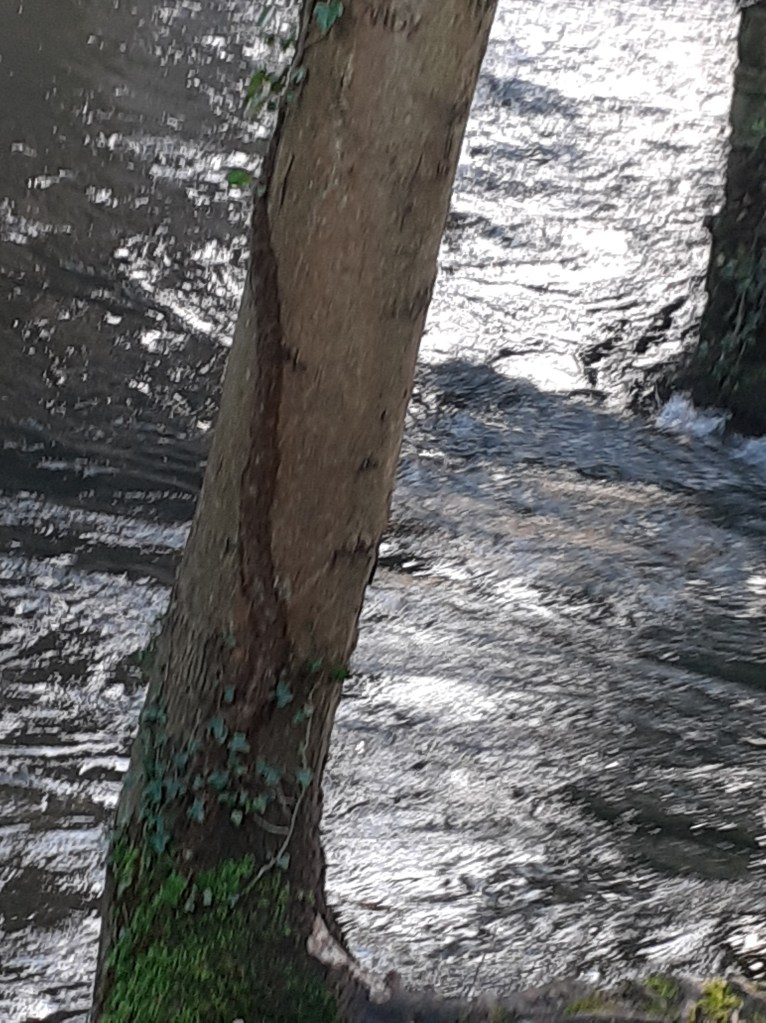
I have never been much of a wilderness person. In times past I have foolishly used this to feel like a lesser Druid. ‘Near nature’ is my habitat. It is a world of parks, streams, canals, accessible hills, woodlands and former rail tracks. Human artefacts of varying vintages are very much part of the scene. These places keep on giving. Over the last couple of days a touch of frost coupled with brighter light has changed the feeling tone of a generally wet and clouded winter. Pictures celebrate this bounty.

SCEPTICISM, OPENNESS AND FLOW

This post summarises where I stand philosophically at this stage of my inquiry, and how my stance affects my practice. When investigating the Direct Path (1) I realised that one possible destination might be radical scepticism about everything. Awakening to Awareness as ultimate ground of being is not the inevitable end point. The only Direct Path teacher who publicly discusses this is Greg Goode (2), who says: “Over the years, I had studied many philosophies and paths. I was aware of a variety of vocabularies. And now, unless I was explicitly playing the role of a direct path participant, none of these vocabularies seemed preferable in terms of truth or accuracy. When I was left to myself, experience didn’t show up as anything at all. There was nothing strictly true or strictly false to say about it”.

Goode reports a sense of confirmation on reading a privately circulated document attributed to Shri Atamananda Krishna Menon, founder of the Direct Path. According to Greg Goode, the gist is “that we can’t say anything at all … everything is paradoxical. We can’t even say that it’s consciousness or that anything exists! It’s a joyful, effusive case of saying without saying!” It helped Goode to get to his final position of ‘joyful irony’, which I have discussed in an earlier post. (3). His key point is that “the joyful ironist has found loving, open-hearted happiness without dogmatism”. For this to work “the joy and the irony must work together. If you’re joyful without being ironic, you’ll still have attachments to your own views of things. And if you’re ironic without being joyful, you may be bitter, cynical, sarcastic and pessimistic. Heartfelt wisdom includes both sides. Joy adds love to irony. Irony adds clarity to joy.” (2)

This sounds almost postmodern, but in fact echoes an ancient wisdom. Philip Carr-Gomm (4) shows its presence in Jain ethics, grounded in the three principles: ahimsa, aparigraha and anekant. Ahimsa is the doctrine of harmlessness or non-violence. Aparigraha is the doctrine of non-attachment, non-possessiveness or non-acquisition, Anekant is a doctrine of many-sidedness, multiple viewpoints, non-absolutism or non-one-sidedness. The three principles can be seen as completing each other, with non-absolutism as an intellectual aspect of non-violence and non-attachment, and hence a virtue.

Pyrrho of Elis, a Greek philosopher of the fourth century BCE, probably met both Jains and Buddhists, when accompanying Alexander ‘the Great’ to India. Indian influence is certainly evident the school of philosophy he created on his return home. In Greek culture this school was treated as a form of Scepticism, but unlike other Sceptics, Pyrrhonists “neither made truth claims nor denied the possibility of making them. Instead, they cultivated a deeply embedded attitude of suspension of judgement (epoche), allowing possibilities to stand open within the process of continuing inquiry. Such a turning away from the drive for intellectual closure enables peace of mind (ataraxia) in our engagement with the richness and diversity of experience” (5).  This teaching seems to combine the Jain view of non-absolutism and the Buddhist view of equanimity and freedom from dukka, (suffering or dis-ease).

As my contemplative inquiry has progressed, I have grown increasingly attracted to the wisdom of this view. I name it as openness, to keep my inquiry process appreciative rather than deconstructive. I have written about it before and this post builds on others. What I notice now is a greater clarity and confidence in this view, reinforcing my stance of At-Homeness in ‘the flowing moment’. Although not perfectly reliable, this At-Homeness is as close as I get to a place of safety. Everything else is uncertain. Everything else can be taken away. I treat ‘flowing moment’ as a simple description of living experience. I find stillness there if I slow down and attend to it. Stillness can be a portal to spontaneous joy and appreciation if I open up and am present to them . It is a good basis for coming back to Earth. From this space I can better connect with other beings, the wider world and the wheel of the year.

(1) A name given to the teachings inspired by Shri Atmananda Krishna Menon (1883 -1959).

(2) Greg Goode After Awareness: The End of the Path Oakland, CA: Non-Duality Press, 2016

(3) https://contemplativeinquiry.wordpress.com/2019/06/11/greg-goode-and-joyful-irony/

(4) Philip Carr-Gomm Seek Teachings Everywhere: Combining Druid Spirituality with Other Traditions Lewes, UK: Oak Tree Press, 2019 (Foreword by Peter Owen Jones)

(5) Arne Naess Scepticism Abingdon: Routledge, 2015 (First published 1968. Scepticism is the last book Arne Naess wrote as an academic philosopher, before going on to devote himself to the development of deep ecology, coining the term ecosophy to describe his stance.)

JANUARY DAYS

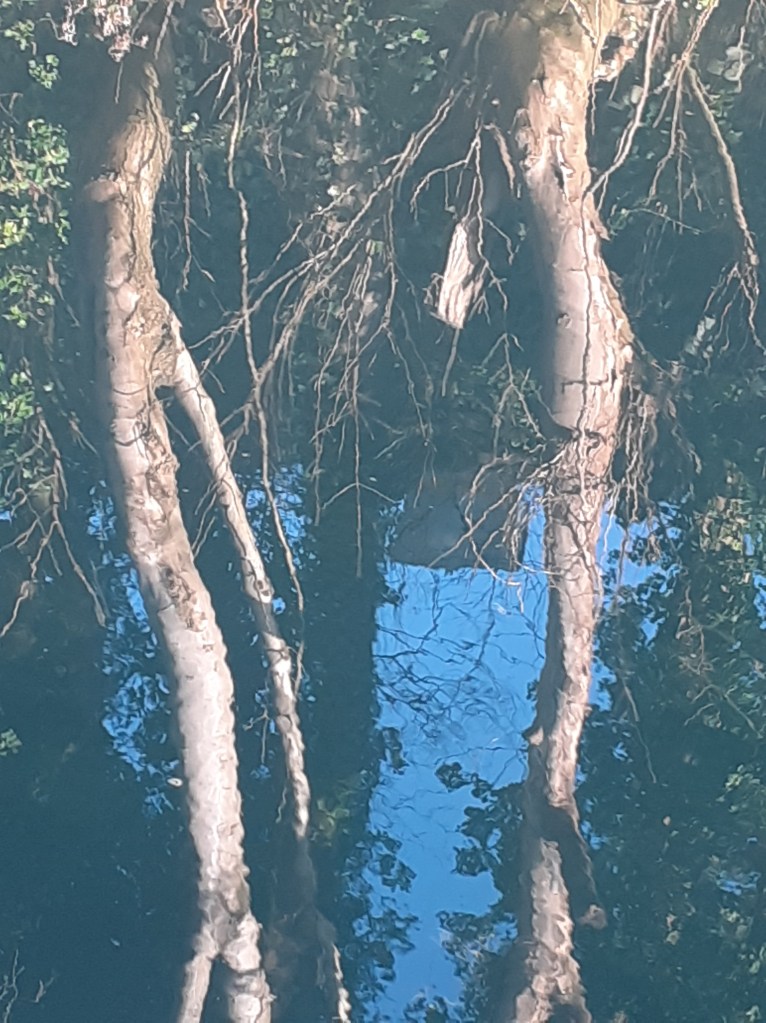
I am conscious now of moving beyond midwinter and towards Imbolc (1 February), the first celebration of returning light. For me, the-mid January period is held in the above image. Tree trunks reflected in water evoke depth rather than height. The image faithfully depicts their withdrawn winter life whilst hinting at other life below the surface, as the world turns over in its sleep.

DAVID ABRAM: RECIPROCITY

“Wander over to that oak, or a maple, or a sycamore, reach out your hand to feel the surface of a single many-pointed leaf between your thumb and fingers. Note the coolness of that leaf against your skin, the veined texture your fingertips discover as they roam across it. But notice, too, another slightly different sensation: that you are also being touched by the tree. That the leaf itself is gently exploring your fingers, its pores sampling the chemistry of your skin, feeling the smooth and bulging texture of your thumb even as the thumb moves upon it.

“As soon as we notice than our hands are being included within the tactile world, we are forced to notice this reciprocity: whenever we touch any entity, we are also being touched by that entity.

…..

“Such reciprocity is the very structure of perception. We experience the sensuous world only by rendering ourselves vulnerable to that world. Sensory perception is this ongoing interweavement: the terrain enters into us only to the extent that we allow ourselves to be taken up within that terrain.”

David Abram Becoming Animal: An Earthly Cosmology New York: Vintage Books, 2010

WORLD TREE: A HOLOTROPIC VISION

“The unified field of cosmic energy that I had experienced before now became a massive tree of radiant energy suspended in space. Larger than the largest galaxy, it was composed entirely of light. The core of the tree was lost to the brilliant display but limbs and leaves were visible around its edges. I experienced myself as one of the leaves, the lives of my family and close friends were clustered around me on a small branch. All of our distinguishing characteristics, what made us the individuals we were, appeared from this perspective to be quite minor, almost arbitrary variations of this fundamental energy.

“I was taken around the tree and shown how to move from one person’s experience to another and it was ridiculously easy. Different lives around the globe were simply different experiences the tree was having. … At this point, I was the tree. Not that I was having the full range of its experience, but I knew myself to be this single, encompassing Consciousness. I knew that its identity was my true identity. … To experience my true Identity filled me with a profound sense of numinous encounter”.

The above experience is reported by one of Stanislav Grof’s research subjects in his inquiry into “non-ordinary states of consciousness”. As a young psychiatrist in Soviet era Czechoslovakia Grof pioneered the therapeutic use of LSD. The authorities welcomed ‘progressive’ chemical treatments as an alternative to the bourgeois introspection of psychoanalysis. Seeking greater freedom, and given an opportunity to work in the USA, Grof became a Professor in the John Hopkins University School of Medicine. He continued his clinical and research work until it was banned in 1967 due to a moral panic about psychotropic drugs. His response was to invent holotropic breathing, a ‘natural’ and legal method of giving people access to the same states. Grof became a founder of the Transpersonal Association, which affirmed the place of spirituality in the therapeutic domain. Grof also developed a close association with the Esalen Institute in Big Sur, California, and became a leading figure in the counter-culture of the day.

Grof disliked the limitations he perceived in conventional scientific culture, in particular the view that “our boundaries were defined by the surface of the skin, and consciousness was seen as nothing more than the product of that thinking organ known as the brain”. He thought that scientific culture had developed in an ethnocentric way and was irrationally closed to information gained in non-ordinary states. For him, there was a limiting conflation of ‘objective reality’ and ‘consensus reality’. Anything referenced beyond this was open to dismissal “as the product of an overly active imagination or a mental disorder”, and thus delegitimised in conventional scientific discourse. Grof became interested in archetypal images like the world or cosmic tree because he found them coming up frequently in sessions, as phenomena inviting “numinous encounter”.

For me, reports of this kind add strength to the image of the world tree, though my personal experience of it is different. Some images, like that of the the world (or cosmic) tree, or tree of life, appear in many different cultures and historical periods. They are widely thought of as universal. But the specific ways in which they appear, and the meanings ascribed to them, vary with place, time and culture.

Stanislav Grof The Holotropic Mind: the Three Levels of Human Consciousness and How They Shape Our Lives San Francisco, CA: HarperSanFrancisco, 1993 (Written with Hal Zena Bennett)

NATURAL AND RITUAL PATTERNING

At the winter solstice, I began a year of enhanced attention to the wheel of the year. I have re-introduced the circle as container for my morning practice. The directions and elements are conventional for my location and tradition. The references are all naturalistic – with ‘heaven’ as the dome of the sky.

The journey around my circle begins and ends at the midwinter moment, in the north, domain of the powers of earth. The patterning is minimalist, though it still took awhile to get a language that feels just right. Now it grows in power and resonance with familiarity and repetition. For me, ritual patterning scarcely competes with complexity and flow of natural patterning, as I look at the pictures above and below. Compared with these, it is something of an abstraction. Yet I value it all the same. This simple patterning embodies my commitment. It will walk with me through the year.

I stand, north, facing south, ring my bells and say: I arise today through the strength of heaven, light of sun, radiance of moon, splendour of fire, speed of lightning, swiftness of wind, depth of sea, stability of earth and firmness of rock.

North, facing outwards: I greet the powers of the north, element of earth, season of winter, time of dying and regeneration. Hail and welcome!

East, facing outwards: I greet the powers of the east, element of air, season of spring, time of early growth. Hail and welcome!

South, facing outwards: I greet the powers of the south, element of fire, season of summer, time of ripening. Hail and welcome!

West, facing outwards: I greet the powers of the west, element of water, season of autumn, time of bearing fruit. Hail and welcome!

Spiralling in to centre: I greet the power at the centre, the one world tree, giver of life and teacher of wisdom. Hail and welcome! Back north, I begin a full round of the circle, sunwise, and say I cast this circle in the sacred grove of Wisdom. May there be peace throughout the world!

My closing is a reversal of the opening, with an uncasting of the circle, a repetition of the opening words and a final ringing of the bells. In the address to the directions, the words ‘thank and ‘farewell’ replace ‘greet’ and ‘welcome’. I have noticed that the other parts of my morning practice are subtly enriched by this new container.

‘ABOUT’ FOR 2020

A happy New Year to all readers, as we begin to navigate the 2020’s! May we find compassionate and creative ways to flourish in the days ahead.

As my contemplative inquiry evolves, I update the ‘About’ section for this blog. Below is my revision for the beginning of 2020.

“I am James Nichol and I live in Stroud, Gloucestershire, England. The Contemplative Inquiry blog started in August 2012, and includes personal sharing, discursive writing, poetry and book reviews. I began my contemplative inquiry within modern British Druidry and my book, Contemplative Druidry: People, Practice and Potential, was published in 2014.  https://www.amazon.co.uk/contemplative-druidry-people-practice-potential/dp/1500807206/

“Over time my inquiry became a wider exploration of contemplative spirituality, identified for a period as a Sophian Way. It drew on the enduring wisdom of many times and places and I came to experience it as a path of healing, peace and illumination. In particular, my inquiry identified an ‘at-homeness’ in the flowing moment. Such at-homeness is not dependent on belief or circumstance, but on the ultimate acceptance that this is what is given. I have found that, for me, the realisation of this at-homeness has supported a spirit of openness, an ethic of interdependence and a life of abundant simplicity.

“The discovery of at-homeness emerged from an inward inquiry arc: noticing myself perceiving, making meaning, and finding a language to articulate my experience. Now I am on an outward arc. I am turning to a greater focus on relationships, community, culture, and the wider web of life. Druidry, as a modern eco-spirituality receptive to ancient wisdom, is renewing its importance in my life.”

WANDERER

The Wanderer is the Fool of the Wildwood Tarot (1). To become the Wanderer is to let go of formless potential and take on identity and aspiration. Entering the Wildwood world, I find myself at midwinter. As I gradually get my bearings, I lean towards the first signs of a strengthening sun, and the distant promise of spring.

In my first use of the cards, I chose an eight-card spread. Four of the cards belong to Vessels, the water suit (2). They include both ace and king. Where I live, this fits with two or three months of rain and flood, well beyond what used to be normal. The placement of these cards suggests reasons to be hopeful, at a price. Another card, indicated as a helpful resource, is the Pole Star, the name given to Major Trump 17 in this pack.

These results have triggered memories of two Anglo-Saxon poems, often anthologised together: The Wanderer and The Seafarer. Both are voices from a Christianised culture in the old northern world. The first part of The Seafarer, possibly a separate composition from the second, “has variously been regarded as literal or allegorical, and related to such figures as the pilgrim.” (3). The extract below emphasises endurance in the face of adverse conditions. I like the seafarer for being an ordinary man of his time, and not an idealised hero. He does what he needs to, and won’t give up. He can find beauty and communion with bird life, in a harsh and lonely setting. But he also owns feelings of distress, sorrow and complaint. He belongs to history rather than myth.

“I sing my own true story, tell my travels,

How I have often suffered times of hardship

In days of toil, and have experienced

Bitter anxiety. My troubled home

On many a ship has been the heaving waves,

Where grim night-watch has often been my lot

At the ship’s prow as it beat past the cliffs.

Oppressed by cold my feet were bound by frost

In icy bonds, while worries simmered hot

About my heart, and hunger from within

Tore the sea-weary spirit. He knows not,

Who lives most easily on land, how I

Have spent my winter on the ice-cold sea,

Wretched and anxious, in the paths of exile,

Lacking dear friends, hung round by icicles,

While hail flew past in showers. There heard I nothing,

But the resounding sea, the ice-cold waves.

Sometimes I made the song of the wild swan

My pleasure, or the gannet’s call, the cries

Of curlews for the missing mirth of men,

The singing gull, instead of mead in hall.

Storms beat the cliffs, and icy-winged

The tern replied, the horn-beaked eagle shrieked.

No patron had I there who might have soothed

My desolate spirit. He can little know

Who, proud and flushed with wine, has spent his time

With all the joys of life among the cities,

Safe from such fearful venturings, how I

Have often suffered weary on the seas.

(1) Mark Ryan & John Matthews The Wildwood Tarot Wherein Wisdom Resides London: Connections, 2011. Illustrations by Will Worthington

(2) See also https://contemplativeinquiry.wordpress.com/2019/12/30/

(3) Extract from The Seafarer in A Choice of Anglo-Saxon Verse London: Faber & Faber, 1970 (Selected with an introduction and a parallel verse translation by Richard Hamer)

WORLD TREE AND SOPHIA

The World Tree stands at 21, as the final trump in the Wildwood Tarot (1). It also has a specific link to wisdom. For some years I’ve thought of my path as a Sophian Way. So I assumed that the Tree would act as a Sophian card. But it doesn’t. The Tree feels fresh and new. For me, as I contemplate it now, it has nothing to do with Sophia. I knew this on my first significant seeing of the image, without needing to check it out any further or even know how I knew.

Then, in my first reading of the cards, I drew the 3 of Vessels (the water suit). Its placement in the western direction was linked to the question, ‘what do you leave behind you?’ The image shows three cranes dancing together in the air, with three vessels (golden, green and white) on the ground. In the narrative of the deck, the card represents joy, especially a familial or communal joy linked to favourable turns in circumstance. My first uncensored response was ‘no-why-me-it’s-not fair’. The second was ‘ah! They mean attachment to joy and not the experience itself. I know what to do about that.’ It didn’t help. Finally, I saw beyond the card and its narrative to my own deeper experience.

This is about letting go of my hitherto guiding archetypal image. This is about letting go of Sophia. Looking again at the card itself: 3, Vessels, West, Cranes, I found as good a Sophian reference as the pack can afford, given that the World Tree is not providing one. Once I recognised this, I started to recall how my recent attempts to articulate what Sophia means for me have become awkward and strained. If I have a sense of guidance from parts of me that my normal consciousness doesn’t seem to register, why not just say so? If my spirituality is about nurturing and developing a creative wisdom of the heart, why not just make that plain? If my contemplative inquiry is my main practice to this end, why don’t I just say that? Why call it a Sophian Way? Why use an image to point to something when I can point to it directly and make more sense?

I have never engaged wholeheartedly in a devotional religion. There have been times when my ama-aima mantra meditation, addressing Sophia as cosmic mother, has had flavour of this. But those times are gone. I have had to recognise that the image of Sophia has lost its power in my life. Right now, I have no sense of what this image is uniquely pointing to. I did not truly grasp this until the Wildwood Tarot showed me. The year’s journey will be taken without Sophia, and it is not what I expected.

(1) Mark Ryan & John Matthews The Wildwood Tarot Wherein Wisdom Resides London: Connections, 2011. Illustrations by Will Worthington

WORKING WITH TAROT IMAGES

One of my inquiry intentions this year is to live the wheel of the year with heightened attention. For the Innerworld aspect of this journey, I am working with the Wildwood Tarot (1). I like its strong wheel of the year orientation, its choice of imagery and its focus on resiliency.

Tarot images are often described as archetypes. The word is derived ultimately from Plato’s eidos – the ideal forms that he saw as building blocks of the universe. They can be abstract – Justice, Wisdom, Beauty – or concrete – Horse, Wheel, Tree. Without these ideal forms in the mind of a Creator, their worldly approximations could not exist. They are “the absolute changeless objects of knowledge.” (2)

In the early 20th. Century, C.G Jung brought the archetypes into the realm of human history and psychology. June Singer explains how, for Jung, “the term archetype indicates the presence of … a universal and collective image that has existed since the remotest times. Archetypes give rise to images in … tribal lore, in myths and fairy tales, and in contemporary media. They are, by definition, unconscious, and their presence can only be intuited in the powerful motifs and symbols that give definite form to psychic contents.” (3)

The shift from ‘archetype’ to ‘archetypal image’ is a helpful one for me and can be taken further. James Hillman, a modern Platonist, pupil of Jung’s, and founder of an Archetypal Psychology, asks what makes an image archetypal, and concludes that: “any image can be considered archetypal … by attaching archetypal to an image, we ennoble or empower the image with the widest, richest and deepest possible significance.” (4) ‘Archetypal’ is a word that gives value, influencing our own response to an image and the way we treat it, contemplating it carefully, taking it into our hearts, and letting it work with our senses, feelings, intuitions and thoughts arising from it. With this approach, the descent from heaven to earth is complete. We are free to understand archetypal images as products of human consciousness that have the power to move and change us. Extending our imaginations, they extend our realities.

This is how I am going to work with The Wildwood Tarot. I am aware that the images can be mapped onto the Western Mystery tradition’s version of the Kabbalist Tree of Life, a highly conscious and artful meta-archetype, or blueprint for the cosmos. The greater trumps are archetypal images; the classical elements are archetypal images; each number is an archetypal image; key figures in patriarchal royal courts are archetypal images. All are linked together in an elaborate web of archetypal imagery. The architecture and arrangement of the Wildwood Tarot are fairly conventional, if I take the Rider Waite Tarot, understood as the effective origin of the modern form, as my point of comparison. But the concern with the wheel of the year, aspects of the narrative, and much of the imagery point in a somewhat different direction. I feel able to engage in a fresh way that both honours tradition and feels empowered to enter new and unexpected spaces. This process has already begun, and forms part of my inquiry.

(1) Mark Ryan & John Matthews The Wildwood Tarot Wherein Wisdom Resides London: Connections, 2011. Illustrations by Will Worthington

(2) Thomas Mautner The Penguin Dictionary of Philosophy London: Penguin, 1996

(3) June Singer Androgyny: Towards A New Theory of Sexuality London: Routledge & Kegan Paul 1977

(4) The Essential James Hillman: A Blue Fire introduced and edited by Thomas Moore London: Routledge, 1990

Earth Eclectic

music that celebrates Earth and speaks to the heart

Sarah Fuhro Star-Flower Alchemy

Follow the Moon's Cycle

Muddy Feet

Meeting nature on nature's terms

Rosher.Net

A little bit of Mark Rosher in South Gloucestershire, England

Becoming Part of the Land

A monastic polytheist's and animist’s journal

selkiewife

Selkie Writing…

Charlotte Rodgers

Images and words set against a backdrop of outsider art.

Prof Jem Bendell

living with metacrisis and collapse

Towint

The pagan path. The Old Ways In New Times

The Druids Garden

Spiritual journeys in tending the living earth, permaculture, and nature-inspired arts

The Blog of Baphomet

a magickal dialogue between nature and culture

This Simple Life

The gentle art of living with less

Musings of a Scottish Hearth Druid and Heathen

Thoughts about living, loving and worshiping as an autistic Hearth Druid and Heathen. One woman's journey.

Wheel of the Year Blog

An place to read and share stories about the celtic seasonal festivals

Walking the Druid Path

Just another WordPress.com site

anima monday

Exploring our connection to the wider world

Grounded Space Focusing

Become more grounded and spacious with yourself and others, through your own body’s wisdom

The Earthbound Report

Good lives on our one planet

Hopeless Vendetta

News for the residents of Hopeless, Maine