Contemplative Inquiry

This blog is about contemplative inquiry

Tag: Spirituality

PATTERNS OF MIND

William Anderson’s Green Man poem (1) describes winter branches as like “veins in the brain” making “patterns of mind” on the sky. This is the bleak beauty I see through my bedroom window. Anderson uses imagery of this kind to affirm an aspect of his Green Man’s identity.

“I am thought of all plants”, says the Green Man.

“I am thought of all plants”, says he.

I am experiencing a beautiful bleakness right now, grounded, lethargic, and shut away from the world – yet keenly sensitive to “patterns of mind”, or rather bodymind. As I wrote in my last post (2) I strained my back two weeks ago, without any obvious triggering event, and have only just recovered my normal mobility. My recovery process has been slower, with more setbacks, than similar processes in the past, in part I am sure as a consequence of ageing. My sleeping patterns have been disrupted and not well calibrated to times of night and day. Within a weatherperson’s ‘dry spell’ on Wednesday, I found that simply being able to leave the house and sweep leaves off a garden path gave me a great sense of pleasure and accomplishment. I began to feel confident of recovery, and my recovery has gathered pace from that time.

At the same time, I believe there is a larger context for my sense of vulnerability to stresses and strains. My contemplative life is centrally about giving myself to the flowing moment, as living presence in a field of living presence. The moment holds everything. If the Green Man is ‘thought of all plants’, we as humans hold the life of the world, and its collective stresses and strains, within our extended sensitivities. At the personal level I ask myself, how much can I hold? Intuitively I answer that I am already holding more, like it or not, than I allow myself to realise. ‘Can’ doesn’t come into it. I speak from a place, individually, of relative safety and security, for which I am very grateful. But this personal life is only part of the story. I am involved, too, in a larger life. My current vulnerabilities have their own unique features, and also reflect the vulnerabilities of the world. I don’t feel alone in this experience. I believe that I share it with many other people, each with their own story about how it presents itself.

(1) William Anderson Green Man: archetype of our oneness with the Earth Harper Collins: London & San Francisco, 1990. See:

POEM: GREEN MAN

(2) https://contemplativeinquiry.blog/2020/11/10/bare-bones-bare-experience/

BARE BONES, BARE EXPERIENCE

Trees – at least the deciduous ones – are becoming skeletal in my neighbourhood. But I am grounded, after ‘doing my back in’ last Friday morning. I cannot go out among them and be present for their continuing transitions. Instead, my entry into the winter quarter this year is marked by lessons in bare experience.

During this period I have been able to lie and stand, with an element of clumsy ouchy drama when shifting between the two. I can walk, too, in an impaired and limited way. Today for the first time I can also sit on a chair, provided I don’t stay too long. I do best when I slow down and attend closely to my bodymind and environment as a single gestalt. I find this especially useful when moving. It is also a good alternative to roof brain chatter when I am lying down and not asleep. But I do not attempt to operate this way all the time. It is enough to be able to tune in at will. Distraction and diversion also have their place and I don’t want to fetishise special states of awareness. Awareness is already special.

I feel confirmed in my sense of contemplation, a sacrament of sentience, as a plain attentiveness that holds the apparent world in its embrace. The rest is lifestyle choice. A very stripped down form of experience, such as I am having now, is its own kind of blessing.

THE YEW AT SAMHAIN 2020

In my tree mandala of the year (1), yew is my Samhain tree, and to a large extent my November tree. It is an obvious choice, as I leave a quarter concerned with autumn and bearing fruit and enter one of winter and the dying of the year. Regeneration too, but that is some way off.

I admire the power and longevity of the yew, and am in some ways drawn to its energy. But I do not find the relationship easy. I can find it spiky and obscurely demanding. I can find myself resistant to the sensed demand. The alignment of tree and season alerts me to my own mortality and creates space for a reflective moment. But this year I’ve been alert to my mortality for much of the time. In reaction, at Samhain 2020, I feel naturally sluggish and drowsy. Something in me is happy to go down into the dark without too much awareness. Let the dying of the year be the dying of the year, it whispers. Just let it happen. Just let me go down into the dark and sleep.

The Green Man Tree Oracle (2) links the yew with perseverance, for ‘perseverance leads to achievement’. Right now I’m not much interested in achievement, but I notice that I can think of perseverance in another way. This has to do with sticking with the experience that presents itself, rather than life-coaching my way out of it.

I have been working with an intensified wheel of the year for the last 45 weeks. I have seen how easy it is to impose impose conventional or surface-willed patterns on my experience. The seasonal structure is real. I see, feel, hear, taste and smell it manifesting itself in the apparent world as the wheel turns. But the idea of the wheel still has the power to displace lived experience through formalised words, images and expectations. Perseverance on the path asks for two things, I think. One is permission to let go of any sense of project or practice when it loses authenticity. The other is to be truly sensitive and discriminating when I’m happy to be awake.

(1) NOTE: This mandala is based on my personal experience of trees in the neighbourhood as well as traditional lore. Moving around the wheel of the year from 1 November, the positions and dates of the trees are:

Yew, north-west, 1-23 November

Elder, north-north-west, 24 November – 16 December

Holly, north, 17 December – 7 January

Alder, north-north-east, 8 – 31 January

Birch, north-east, 1 – 22 February

Ash & Ivy, east-north-east, 23 Feb. – 16 March

Willow, east, 17 March – 7 April

Blackthorn, east-south-east, 8 – 30 April

Hawthorn, south-east, 1 – 23 May

Beech & Bluebell, south-south-east, 24 May – 15 June

Oak, south, 16 June – 8 July

Gorse, south-south-west, 9 – 31 July

Apple, south-west, 1 -23 August

Blackberry & Vine, west-south-west, 24 August – 15 September

Hazel, west, 19 September – 8 October

Rowan, west-north-west, 9 – 31 October.

See also https://contemplativeinquiry.blog/2020/autumn-equinox-2020-hazel-salmon-awen/

(2) John Matthews & Will Worthington The Green Man Oracle London: Connections, 2003. Also source of the image at the top.

HUNGRY GHOSTS

“These various spirits may live on the earth, beneath its surface, in the ocean or in the air. Although there are many different kinds, traditionally they are all pictured as one type, a kind of caricature expressing their hungry nature. They have tiny mouths, long thin necks and huge, swollen bellies, which can of course be a sign of starvation as well as greed. Their inability to satisfy their hunger manifests in different ways, according to whether they have distorted perceptions of the external world, of their own inner condition, or both.

“In the first cases, some search desperately for food and drink, but can never find any. Some imagine that they can see it in the distance, like a mirage, but when they get nearer, it turns out to be an illusion. Others can see a feast laid out for them and are just about to eat it when fearsome guards appear and chase them away.

“The second category of hungry ghosts have food available to them, but their mouths and throats are so small, and their stomach so large, that they would never be able to consume even a fraction of the amount they need. They have long, grasping fingers, with which they frantically grab and try to swallow whatever they can, but it only makes them feel more and more empty.

“Hungry ghosts in the third category are subject to various inner and outer hallucinations, so they cannot benefit from their food. For some of them, food and drink burst into flames inside them and burn them from within. For others, it turns into revolting substances like blood, pus and urine, which they eat; still others find that they are biting into their own flesh; and for some, food becomes inedible material, like iron or straw.

“The basic subjective feeling of this realm is overwhelming deprivation, a sense of poverty combined with greed. Paradoxically, the hungry ghosts are surrounded by an environment of richness and abundance; everything they want is already there, but their hunger prevents them from enjoying it. Self-preservation is very strong, so there is little sense of openness or relaxation. They are totally obsessed with trying to satisfy their own needs, so they cannot afford to feel the pain of others or arouse the slightest generous impulse. Birth in this condition of existence is the result of extreme avarice, meanness and stinginess.”

Francesca Freemantle Luminous Emptiness: Understanding the Tibetan Book of the Dead Boulder, CO: Shambhala, 2003

NOTE: In Tibetan Tantric Buddhism, there are six realms of existence in the wheel of life: two higher realms of gods and jealous gods, two intermediate realms of humans and animals, and two lower realms of hungry ghosts and hell-beings. Although not liberated from the wheel of life, the divine realms are places of reduced suffering and greater freedom. The results of positive actions outweigh the negative. In the lower realms, negative karma is very strong.

But these issues are not just something for another life. To Tantric Buddhists, nirvana and samsara are one. Every moment can be seen as a new birth. All realms are part of our lived experience, here and now. We do not have to look outside for hungry ghosts, or hell-beings (locked in a distorted logic of aggression that always puts the blame on others). They are part of us. There are times when we see them and times when we don’t.

LATER AUTUMN

Sunday 18 October, on a walk beginning at 7.20 am. This is a later start than on the previous week (1), and headed in the opposite direction. The day is overcast and the feeling-tone of this walk entirely different. Last week was magical and illuminative. This week is a time of relaxed enjoyment, of simple openness to the world as I find it. I can let go of agendas.

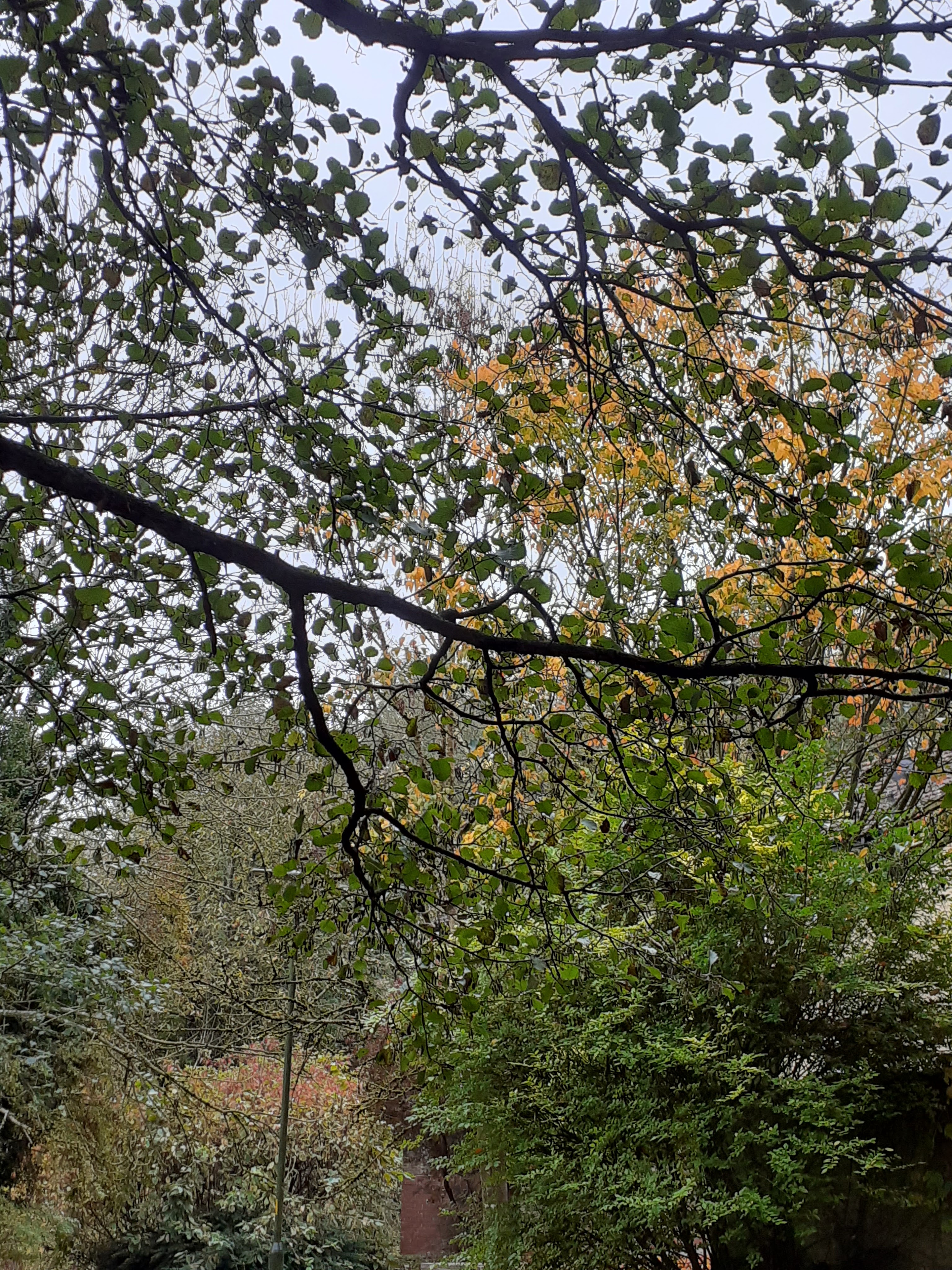
The fall here is still tentative. It mostly happens in November, though there are plenty of leaves falling gently to the ground, and a breeze to encourage them. Overhead, the gaps in the canopy let the light in. The remaining leaves form patterns that draw my attention and raise my spirits in a strange primordial way.

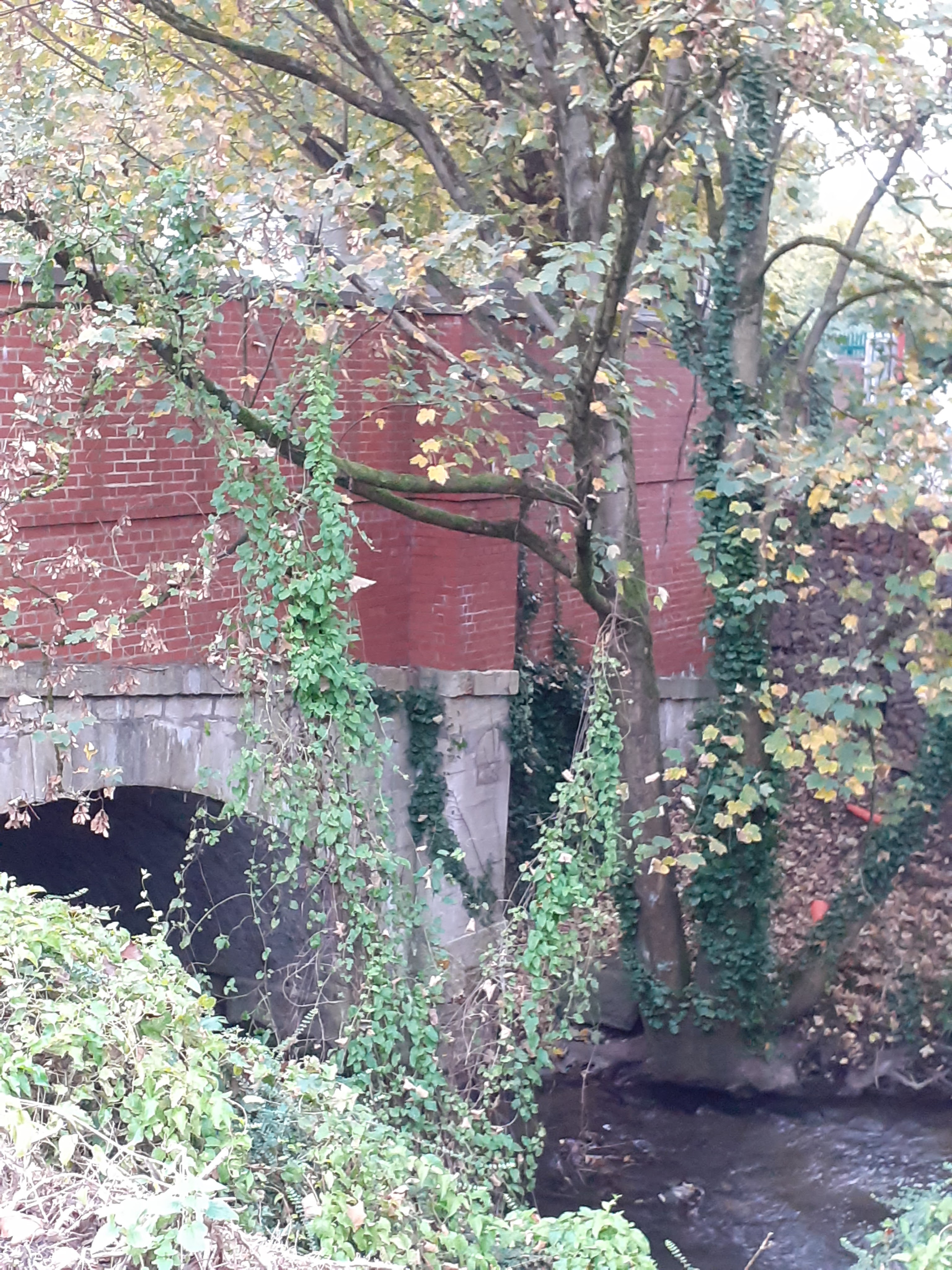
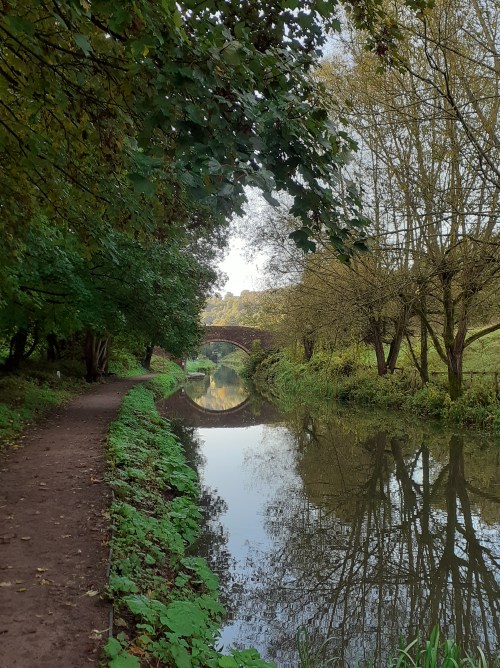
I enjoy built environments up to a certain level of density, when they become oppressive and too much. Here, a canal bridge blends in with ivy, water, trees and undergrowth without any sign of artificial arrangement. The place has been largely left to itself to make its own accommodations and adjustments. They are what they are. They haven’t been created for effect. I notice that I feel in tune with this space.

I live in an urban setting that is not at war with trees. The early morning absence of traffic helps me to appreciate the autumn colours opposite. Today is a day when I am easily pleased by life and I find myself caught up in a moment of spontaneous gratitude.

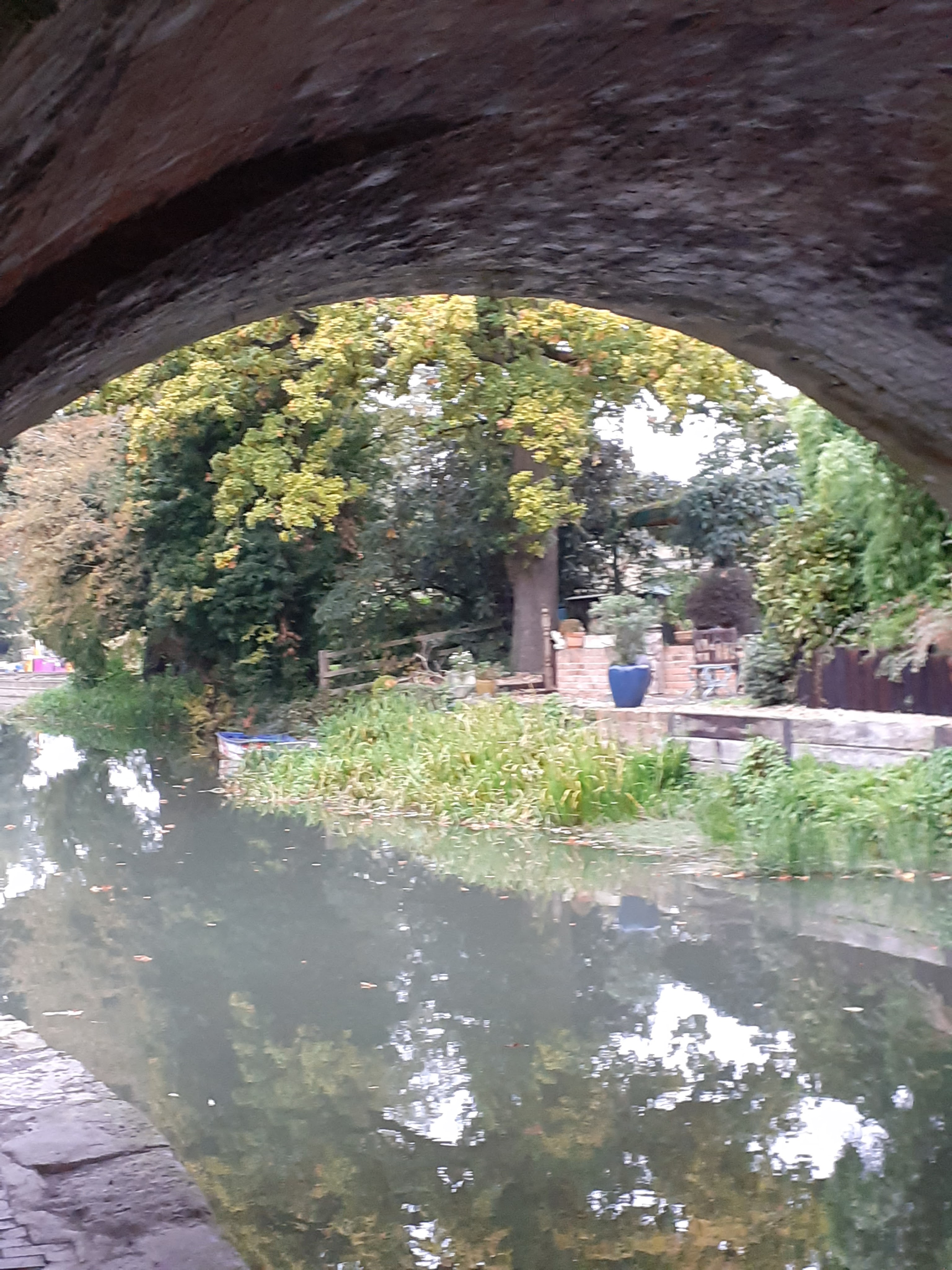
Now, I am under an arch, looking at the canal, at reflections in the water, and at a canal side entrance to somebody’s house. I have the sense of a congenial, inhabited space. The stretch that I have been walking on today is relatively built up, still part of the town. My walk has involved the interplay of town and country. In one way it has been very ordinary. In another it has been a trigger for happiness. I have enjoyed being part of it.

The picture above – somehow, for me, beyond words. I lose myself in it.

(1) https://contemplativeinquiry.blog/2020/10/14/walking-towards-sunrise/

INQUIRY NINE YEARS ON

My contemplative inquiry began as part of a Druid initiative launched nine years ago on 1 November 2011. The inquiry “soon broadened into a wider exploration of contemplative spiritualities, drawing on the enduring wisdom of many times and places.” (1)

By August 2018, I had anchored the discovery of “an ‘at-homeness’ in the flowing moment, which nourishes and illuminates my life. Such at-homeness is not dependent on belief or circumstance, but on the ultimate acceptance that this is what is given. I have found that, for me, the realisation of this at-homeness has supported a spirit of openness, an ethic of interdependence and a life of abundant simplicity.” (1)

This is still my core insight. It does not tell me to be a Druid, or not to be a Druid. It does not give me a metaphysical or religious foundation of any kind, though it is possible to build these around it. It does not make my existential choices for me. I do find myself distant from faith based and devotional approaches to contemplation and spirituality. Recently, I have lost interest in debates about consciousness as foundational, or in distinctions between ‘lower’ and ‘higher’ manifestations of it. I was drawn to this philosophical openness in part by the ancient Greek philosopher Pyrrho of Elis, himself influenced by (probably) Buddhist and Jain teachers in India (2).

Experientially, it is as if I exist within a field of awareness, or presence, whilst also living a human life between earth and sky. Here, I am intimate with the stream of experience, but not fused with it – allowing a space for compassion towards the apparently unwanted sensations, feelings, thoughts, images, and strings of cogitation that continue to arise. Stepping back from demands for ‘healing’ and ‘transformation’, I discover myself to be simply and securely held.

Looking out, I find a living world. I am part of the web of life, deeply interconnected with other lives and with the whole. Here I align myself to those Pagans, identified by Graham Harvey (3,4), who “use ‘animism’ as a shorthand reference to their efforts to re-imagine and re-direct human participation in the larger-than-human, multi-species community. This animism was relational, embodied, eco-activist and often ‘naturalist’ rather than metaphysical.”

Understandings like this have re-anchored me in Druidry and Paganism. The Wheel of the Year is a wonderful basis for outward attention in spirituality. I am now also strongly drawn to questions of culture, history and human imagination, which I will explore more in future. Here again, I find an open and inclusive Druid perspective to be a good base to work from.

I seem to have satisfied myself on the questions with which I started in 2011, though not in the way I expected to. But new questions arise, and I no longer see an end point to my contemplative inquiry.

(1) https://contemplativeinquiry.blog/about/

(2) https://contemplativeinquiry.blog/2019/04/27/pyrrho-scepticism-arne-naess/

(3) Graham Harvey (ed.) The Handbook of Contemporary Animism London & New York: Routledge, 2014 (First published by Acumen in 2013)

(4) https://contemplativeinquiry.blog/2020/02/22/animism-is-a-hard-working-word/

Share this:

DEATH (THE APPLE WOMAN)

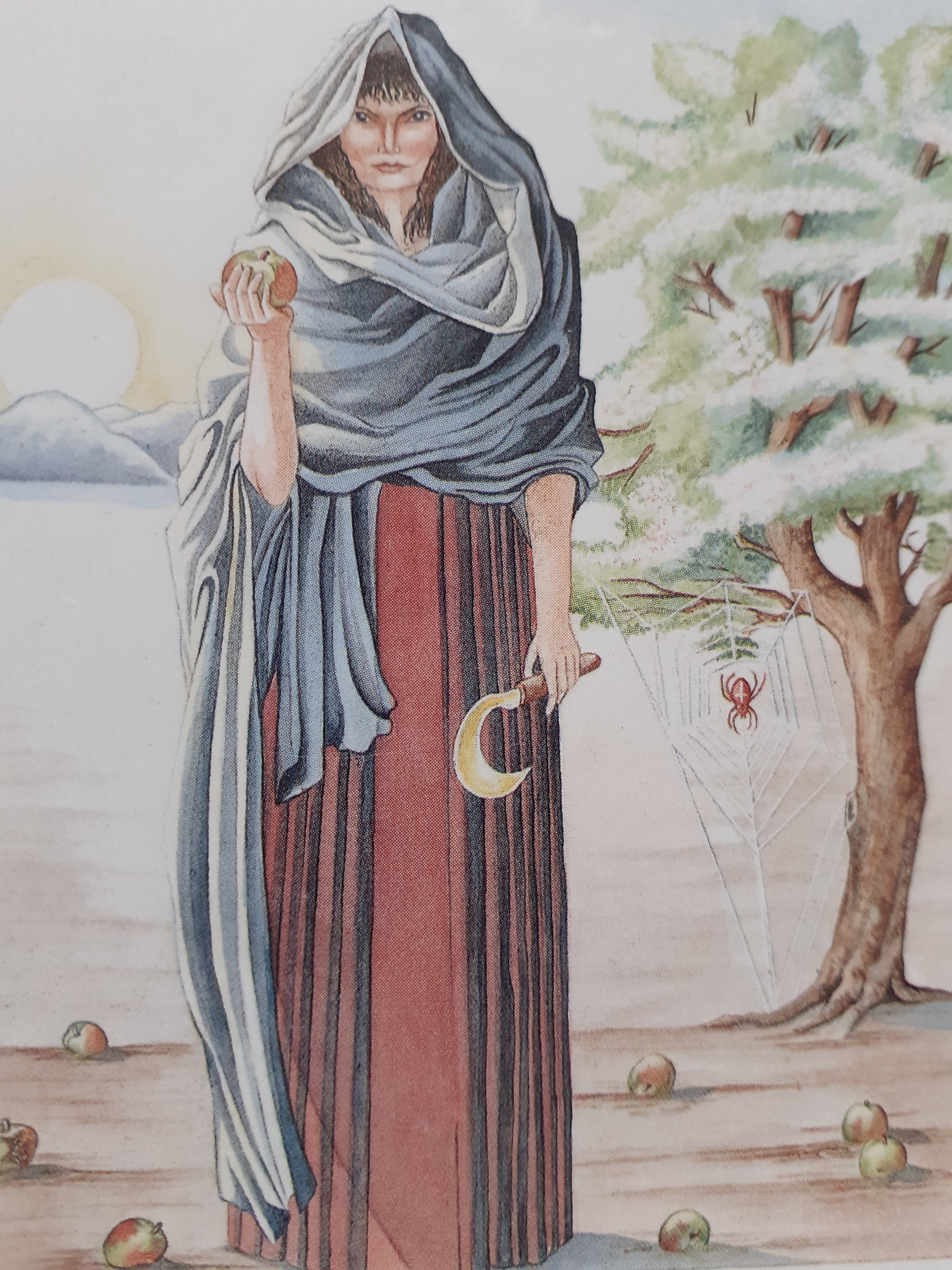
In the approach to Samhain, thoughts turn to death. In R. J. Stewart’s Merlin Tarot (1,2) the Death card has The Apple Woman as an alternate name.

Stewart explains that “the original image for Death is that of the taking or destroying Goddess”, for “who but the creatrix may truly destroy and withdraw created life?” He adds that, in Celtic tradition, she often appears as a female power offering magical fruit.

In his source text, Geoffrey of Monmouth’s Vita Merlini (Life of Merlin), we find a mysterious woman – ex-lover of Merlin – who lays out poisoned apples to entrap him. These apples, arranged “under a tree upon a pleasant green”, are eaten by Merlin’s boon companions: they are either killed or driven insane. Although Merlin escapes the apples, he does not escape his own later insanity in the Caledonian Forest, brought on by the traumatising Battle of Arfderydd.

For Stewart, the Apple Tree is one of the simplest expressions of the Tree of Life. “It is the Otherworld or Underworld Tree that reveals eternal potential, the fusion of ending and beginning in one paradoxical form”. The apples are the fruit of raw, untransformed power. Whereas Merlin’s companions snatch at the apples and eat them greedily, the legendary Thomas Rhymer volunteers to pick magic apples for the Fairy Queen, who recognises his gallantry by giving him the bread and wine that can nourish him. He wins the gift of prophecy and the tongue that cannot lie.

Both lover and killer, the Goddess of Death and Change is young and ancient, weaver and unweaver of a web that is the universe. She is destroyer of hope and giver of hope, for “in her hand she bears the fruit of perpetual life and rebirth, and the razor Sickle that cuts the tread of continuity”.

Stewart ends with this reflection: “perhaps Merlin’s sub-story of The Apple Woman simply means that adulthood is our most deluded period of life. We reject understanding and substitute self-image, habit and even dogma, in our convoluted attempts at survival; the hostility we experience is not that of the Goddess, but our own hostility reflected upon us. Reject love, risk poisoned apples – such fruits are deadly to the greedy and unprepared. But if we accept the fruit or any of its many transformations (such as bread and wine) from the Goddess, she blesses us with gifts of timeless understanding. These gifts may appear in the outer world as prophecy, attuning to the land; death itself is a timeless moment of understanding when all relative interactions cease. Ultimately, we are the fruit”.

(1) R. J. Stewart The Complete Merlin Tarot: Images, Insight and Wisdom from the Age of Merlin London: The Aquarian Press, 1992 . Illustrated by Miranda Grey ISBN 1 85538 091 9 No cards, but a full explanation and discussion of the system and its imagery.

(2) R. J Stewart The Merlin Tarot London: Element, 2003. Illustrated by Miranda Grey ISBN 000 716562 5 (First published by London: The Aquarian Press, 1992). Cards, handbook and notebook for record keeping.

WALKING TOWARDS SUNRISE

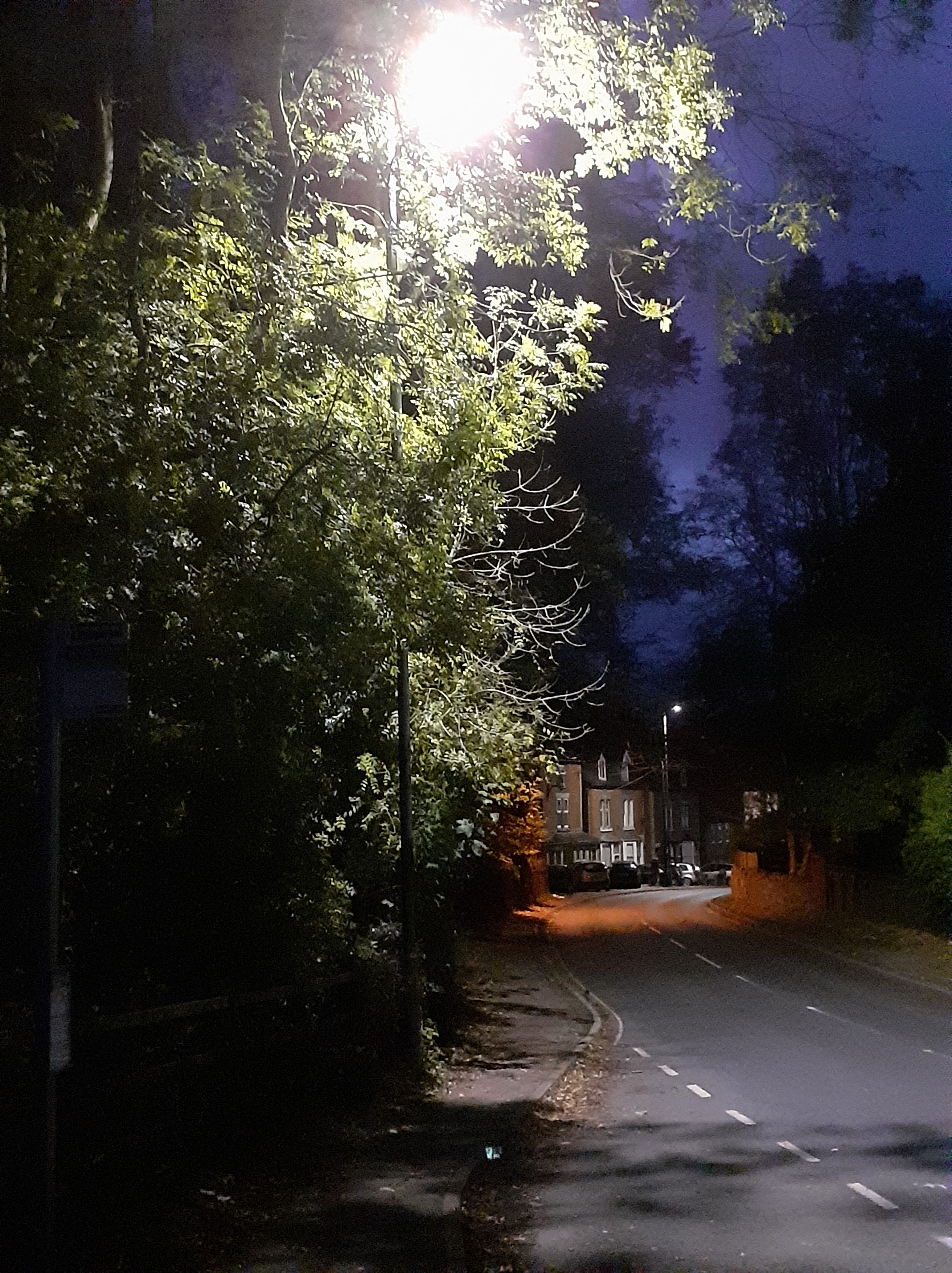
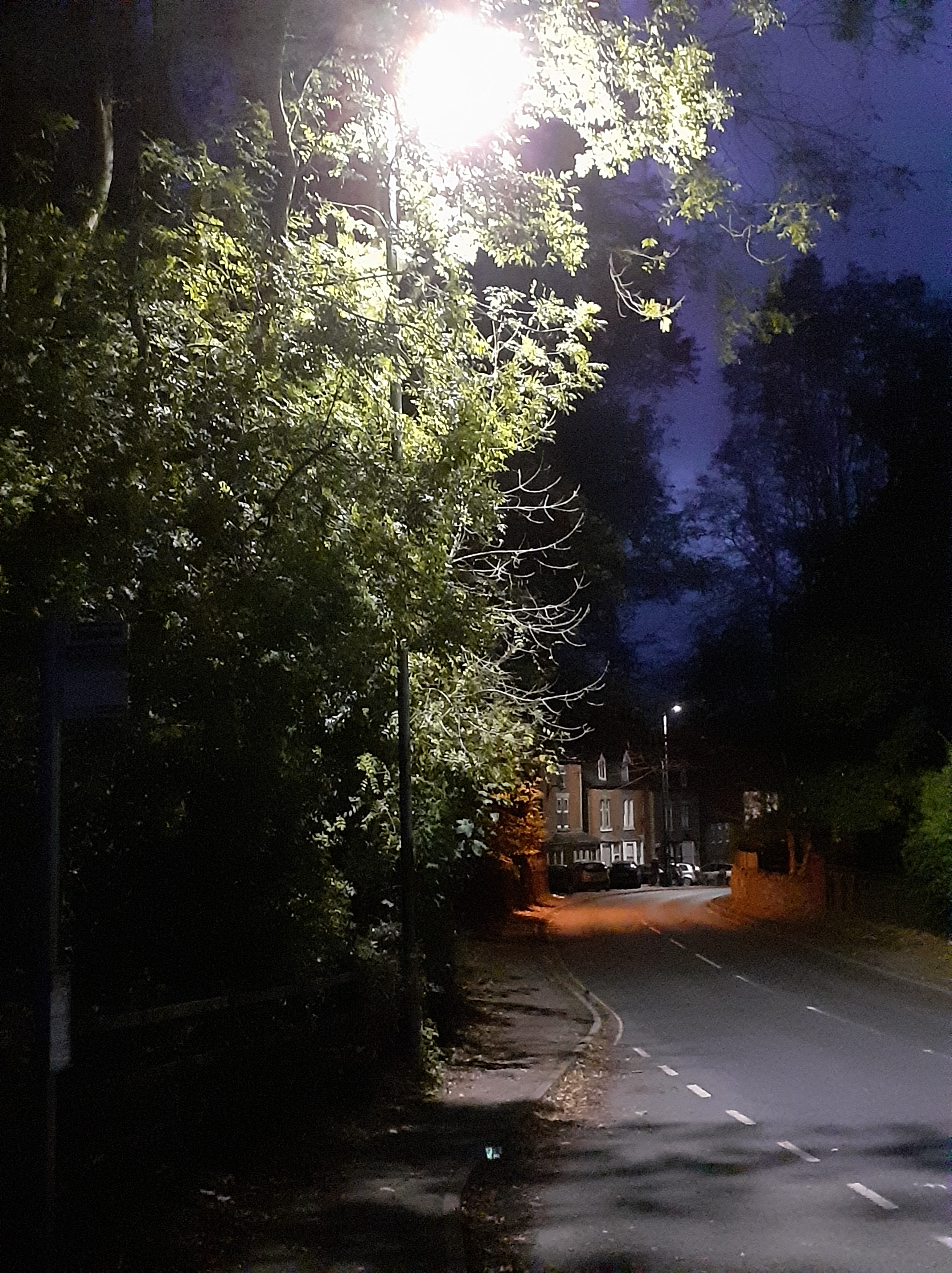
Sunday, 11 October, 6.40 am. My plan is to walk towards the dawn of a new day, but I take time to stop and photograph this liminal moment. It is still, on this normally busy road. It makes me almost nostalgic for the early days of lockdown in the spring.

In this moment, there are no cars and no other people. I am fine with the artificial light. I like the contrast of the street lights (bright and focused) with the softer light in the sky, dim yet with a promise of expansiveness. I enjoy the shadows and the presence, too, of outright darkness at this stage of my walk.

It takes me twenty minutes of enchanted meander to reach my next point, pictured above. The scene is inherently more spacious. Water and sky are prominent. It takes notable artefacts to make their presence felt. The main theme of the picture, as I look in a generally eastern direction, is the coming of the light. Clouds do not obscure it. The buildings have become more than silhouettes. There are the beginnings of colour and the detail it brings. I judge it OK to walk on the canal path itself, just visible on my right.

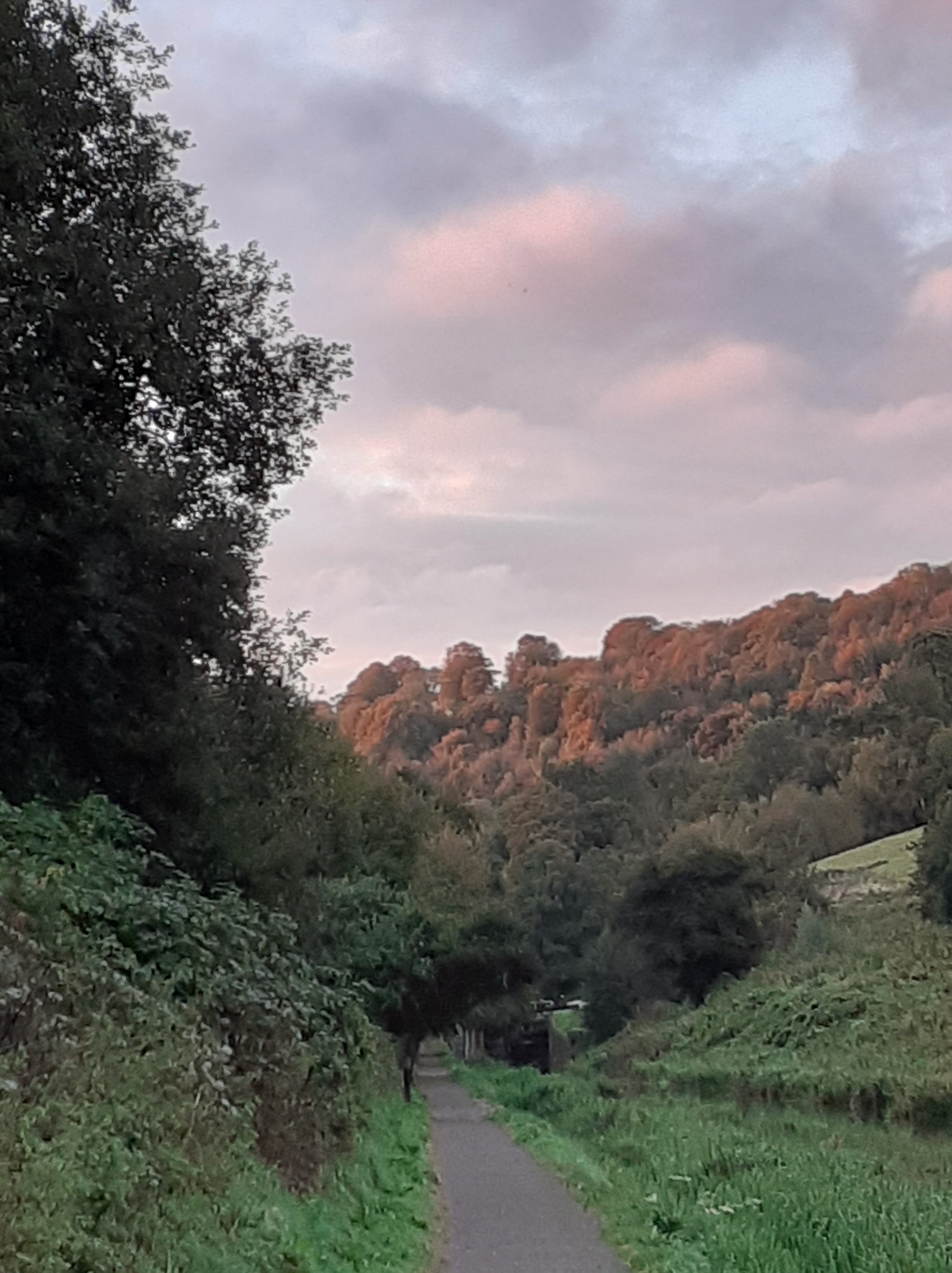
Another twenty minutes and the light seems to predominate, though I am not yet in full daylight. I am on the canal path. Even though the surroundings of the towpath are lushly green, the world I stand in is a little dusky, or dawny if there were such a word. Crepuscular. Looking up, I see pinkness in the sky, white clouds, hints of blue. I feel heartened and strangely moved by the effects of light on the autumn trees. They give me a warm sense of walking towards the sunrise, and encourage me to move on.

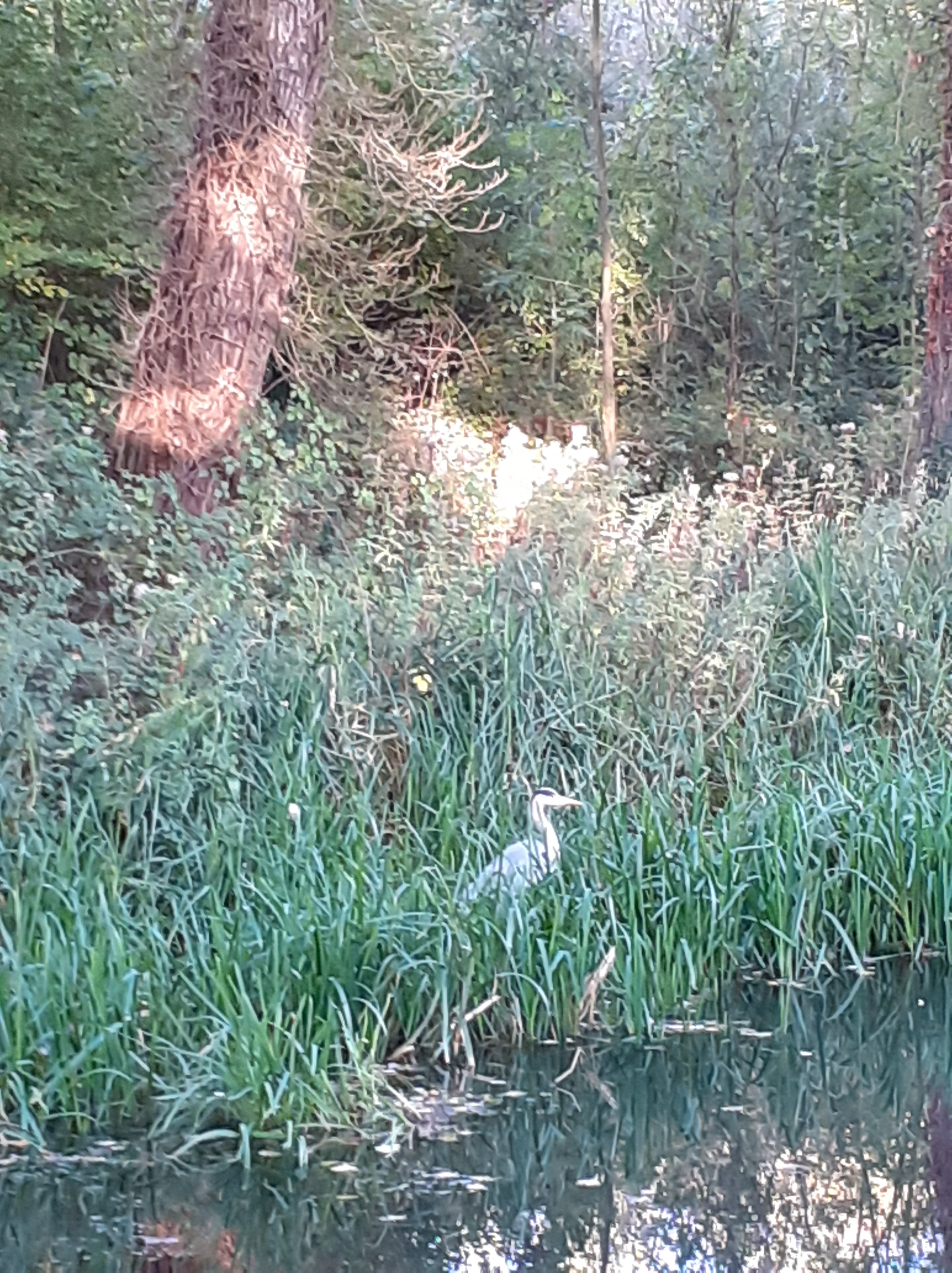
The picture immediately above is not part of my plan. It stems from delighted surprise followed by purposeful calm. Knowing about the heron in advance, I would likely have botched my picture in an anxious, clumsy effort to put the bird on record. I always have before. I think that herons fly away from me out of disdain rather than fear. This time I am a quiet human in a quiet world. I stand still for awhile and am almost elegant in my use of the phone. I wait for an intuited ‘right time’ before pressing the button. There is no drama at all. I do not know if the heron even notices me. The whole incident feels like a blessing of the still early morning.

Now, further on in my walk, the sun is on its ascent through the sky and I can picture it indirectly. The contrast between the sun kissed light areas and the shady ones is strong and vivid. I notice that, as the fading trees accept that their season is over, the ‘parasitic’ mistletoe – even the Druid Plant Oracle (1) calls it that – is gleefully green.

Now I am on my way back home. What draws my attention, after a little exploration, is the white owl. To me it looks very present and collected, situated just where it wants to be. It seems also to be acting as gatekeeper for its own arch.

I make stream of consciousness connections. I began my walk on the Bath Road. Bath is less than 30 miles away. There, the Romans turned a Celtic shrine into a city and called it Aquae Sulis (see http://www.romanbaths.co.uk/), acknowledging Sulis the Celtic goddess of the shrine. She was concerned with its waters and their healing potential whilst doubling up as a solar deity as well. The Romans called her Sulis Minerva, and that links her with owl wisdom. The white owl has a rich hinterland of associations for me. It makes the encounter significant. I note that two resonant avian images have met me on this walk into the sunrise, offering avenues for further contemplation.

(1) Philip & Stephanie Carr-Gomm The Druid Plant Oracle: Working with the Magical Flora of the Druid Tradition London: Connections, 2007. Illustrated by Will Worthington.

ATLANTIC ANCESTORS

I am beginning to feel the pull of Samhain. It is not here yet, but its themes are drawing my attention. One of these is the remembrance of ancestors.

A recent post by poet and awenydd Lorna Smithers (1) has prompted me to look again at Barry Cunliffe’s work, and the book I have to hand is Facing the Ocean (2). It is about early human history in Atlantic maritime Europe. including Britain and Ireland. One of its threads concerns living with the ocean. Another, related to the first, looks at communication by sea at a time when land travel was difficult. I will follow up these threads in future posts. In the meantime, Cunliffe’s sense of the interaction between nature and culture is shown in the extract below.

“To stand on a sea-washed promontory looking westwards at sunset over the Atlantic is to share a timeless human experience. We are in awe of the unchanging and unchangeable as all have been before us and all will be. Wonder is tempered with reassurance: it is an end, but we are content that the cycle will reproduce itself the sun will reappear. The sea below creates different, more conflicting, emotions. True, there is the comfortable inevitability of the tides, but there is also an unpredictability of mood, the sea constantly changing, sometimes erupting in crescendos of brute force destroying and remoulding the land and claiming human life. The sea is a balance of opposites. It gives and takes. It can destroy quickly and build new; it sustains life and it can kill. Small wonder that through time communities have sought to explain these forces in terms of myth and have attempted to gain some puny influence over them through propitiation.

“Nowhere is this relationship more apparent than in the legends and folk traditions of Brittany. In the howl of the wind can be heard the screams and laments of those drowned at sea, and much of human life – birth and the gender of the newborn and death – was believed to be conditioned by the tides. Below a thin veneer of Christianity lie beliefs deeply rooted in time. A century ago, in the parish of Ploulec’h on the north Breton coast, the first Sunday in May saw the people in procession climb to La Croix du Salut – an isolated landmark that could be seen from far out to sea offering assurance of the approach to a safe haven. Here the sailing community gave thanks for their safe returns before descending to the chapel of Notre-Dame across the bay on the headland of Le Yaudet. In the church today, fine model sailing ships hanging from the roof beams are among the more evocative offerings made to the Virgin by grateful mariners. The deep underlying awe of the ocean is poignantly expressed by the Breton poem

War vor peb ankenn

War vor peb peden

(Sur la mer toute angoisse, sur mer toute priere

At sea all is anguish, all is prayer).”

(1) https://lornasmithers.wordpress.com/2020/10/04/britain-begins-debunking-the-myth-of-celtic-invasions/

(2) Barry Cunliffe Facing the Ocean: The *Atlantic and Its Peoples 8000 BC-AD 1500 Oxford: the University Press, 2001

*NOTE: I wish the subtitle had specified ‘eastern Atlantic’, since every corner of the Americas has been populated for periods ranging from 12,000-24,000 years. The western Atlantic coastal people amongst them are not my focus, but in a post about ancestors I don’t want them to be implicitly erased.

A CONTEMPLATIVE LENS

As the autumn deepens, I find that my canal walking has slowed down and detached itself from notions of exercise. It has become spontaneously and informally meditative. I am simply noticing what is available, rather than striving to get to some other place in myself or in the world. Followers of the Headless Way (1) describe such attention as ‘being capacity for the world’, since the world knows itself through this awareness. One of the Headless Way’s poets, Colin Oliver, has the lines (2) “In the oneness of things/ I am nowhere in sight”. I am like that with my phone/camera. I rarely have it in the selfie mode, so it is a good device for the purpose.

My combined walking and photography have become a contemplative opportunity, an informal opening to the magic of what is given, here and now, which I sometimes refer to as ‘at-homeness in the flowing moment’. They have taken their place, unplanned, at the heart of my contemplative Druidry. They enable immersion in the apparent world, and provide a setting for what I like to call valley experiences, to distinguish them from the peak experiences more often discussed. I notice also an aversion to calling this activity a ‘spiritual practice’, a feeling that comes with the image of a caged bird. Not right for the context. Not right for that in me which does this.

Through this contemplative lens I can be appreciatively open even to appearances of dereliction and decay. They are simply part of what is. When I see an old and roofless building without this accepting contemplative gaze, I can become irritated and grumpy. Why isn’t it being renovated or pulled down, one or the other? Who is responsible? But in my picture taking mode, through the lens of contemplation, I am entirely at ease. The building has its place, just the way it is.

My meditative walk can highlight processes as well as still images. A decaying rose becomes a rose hip. The dying flower makes way for fruit, which will die back in its turn after seeding the next generation. ‘Decay’ is relative.

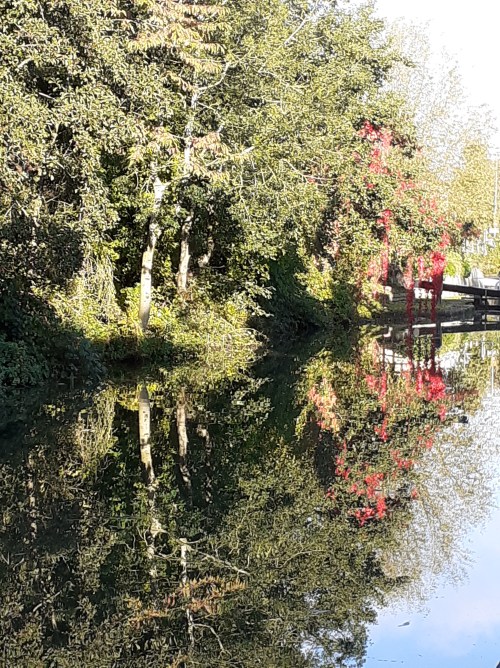
The lens of contemplation makes space for things that would be easy to miss otherwise. A waning moon, for example at 8 a.m. …

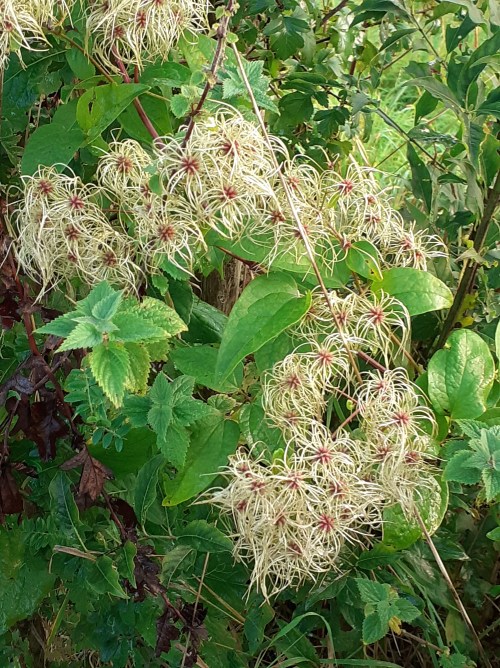
… or the delicacy, close-up, of old man’s beard …

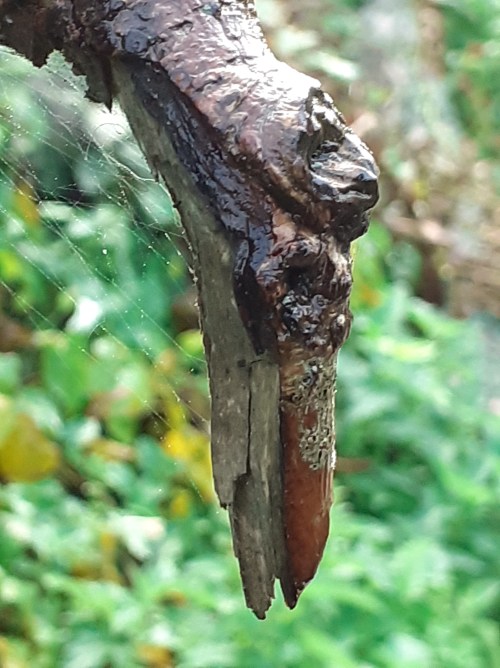
… or a naturally sculpted head of an unknown bird or reptile, which also offers space for a cobweb …

These walks have taught me a lot. There must have been a gestation period between the time I gave them up – what with Covid-19 and my concerns about narrow paths and passing – and the time I resumed them. Along the way I’ve gained a different perspective on their role in my contemplative life. I used to see them as ancillary. Now they seem central.

(1) http://www.headless.org/

(2) https://contemplativeinquiry.blog/2016/04/28/poem-the-oneness-of-things/

Earth Eclectic

music that celebrates Earth and speaks to the heart

Sarah Fuhro Star-Flower Alchemy

Follow the Moon's Cycle

Muddy Feet

Meeting nature on nature's terms

Rosher.Net

A little bit of Mark Rosher in South Gloucestershire, England

Becoming Part of the Land

A monastic polytheist's and animist’s journal

selkiewife

Selkie Writing…

Charlotte Rodgers

Images and words set against a backdrop of outsider art.

Prof Jem Bendell

living with metacrisis and collapse

Towint

The pagan path. The Old Ways In New Times

The Druids Garden

Spiritual journeys in tending the living earth, permaculture, and nature-inspired arts

The Blog of Baphomet

a magickal dialogue between nature and culture

This Simple Life

The gentle art of living with less

Musings of a Scottish Hearth Druid and Heathen

Thoughts about living, loving and worshiping as an autistic Hearth Druid and Heathen. One woman's journey.

Wheel of the Year Blog

An place to read and share stories about the celtic seasonal festivals

Walking the Druid Path

Just another WordPress.com site

anima monday

Exploring our connection to the wider world

Grounded Space Focusing

Become more grounded and spacious with yourself and others, through your own body’s wisdom

The Earthbound Report

Good lives on our one planet

Hopeless Vendetta

News for the residents of Hopeless, Maine