I am connecting with spring and its urgent affirmation of life – its green shine and fecundity. It is the sunrise season, the season of early growth. For me, where I live, the immediate pre-equinox period often generates a strong feeling of dynamism and emergent potential. I am in sync with the awakening earth.
Elaine’s return from hospital and the enhanced clinical support she is receiving are helping me to live this season more fully. In our joint lives we are both feeling more agency in shaping a new phase in our life together.
In this moment I feel refreshed and optimistic within my Druid contemplative path. I have adjusted my formal practice so that I have two practice sessions in the day, both of them roughly twenty minutes long. The first, at the beginning of the day and standing, is affirmative and dynamic. It includes body and energy work and a theme of healing and rejuvenation. The second, at the end of the day and sitting, is contemplative. It includes breathwork, a mantra meditation using beads, and prayer. In the modern Druid manner it includes a commitment to the collectively imperilled qualities of love, peace and justice. This shift is having a renewing and reinvigorating effect on me, as befits the season: another way of gratefully affirming the gift of a human life.
Celebrating a moment as sunlight floods the room. I am happy to point my phone camera more or less at the sun. It is not the done thing and the result may be odd. But it does reflect my experience of the moment itself.
My wife Elaine has just come home from a week in hospital. It was a necessary week, and she is the better for it. Nonetheless we both have a slight sadness that it coincided with the best and brightest weather of 2025 so far, while our attention was otherwise engaged.
This moment is one of celebration of her return to an apartment wearing its warmest and brightest face. It is a contemplative moment, extending in time until it morphs into gentle action. We go outside. Elaine basks in the sun, recuperating and healing.
I am energised and curious. I move closer to the blossoms I saw through the window and take a picture. I am grateful to be reunited with Elaine and freed from my own worst fears. I am grateful for a spring that is now offering both brightness and warmth. I am glad of this day.
4.30 pm, 25 February 2025. Sunrays are caught in willow branches. The sun is a little stronger today than it was in full winter. The willows have begun a tentative greening. But there is much shadow in this picture. The day has begun its decline.
The world retains a winter feel for me. I aware of the change in my local park, but I do not altogether trust this spring. In the moment of taking this picture, I see a world in shadow, softly darkened. This is partly because of where I have chosen to stand. It is the image I seem to want.
In the brighter picture below, I show daffodils growing among dead leaves. Daffodils are iconic harbingers of spring, yet not my sole focus. Both pictures were taken intuitively and without any mentally registered intent. It seems as if something in me wanted to make a statement.
I know and accept that I am in the winter of my life. In the wheel of my own life, I can’t quite see how my winter will move into spring, certainly in any personal sense. Dissolving into interbeing is easier to imagine.
My customised Druid liturgy names winter as the season of dying and regeneration. It has associations with law and faith. I understand law in a karmic or ‘natural law’ sense. But it can also be an acknowledgement of the nature we see around us. Faith, in part, concerns the willingness to accept dying and regeneration without knowing what they are like. In my last post, I discussed (1) ‘being nobody’. My current reflections take this suggestion a step further. Evidently, I still have much to learn.
According to Andrew Harvey (1), the translator of this brief poem by Kabir, “Kabir is far more than a poet; he is a universal initiatory field, as expansive as Rumi and as embodied, radical and ferocious as Jesus”. I certainly experience a creative shock in Kabir’s celebration of being ‘nobody’ in a world where being ‘somebody’ is such a highly valued social accomplishment. But what if the accomplishment distracts from something else, something of greater value? Kabir invites us to share the ‘ecstasy’ of being nobody. In another of his verses, which were performed as songs, Kabir links this ecstasy with love:
“You can’t grow love in gardens
Or sell it in markets.
Whether you’re a king or peasant
If you want it
Give your head and take it”.
In my experience, Kabir’s work opens a door to forms of contemplation and creativity in which my personality and personal biography are not the primary focus. Especially in darkening times, bearing witness to the way of the heart, and drawing strength from it, is a form of sacred activism. The liturgy of modern Druidry speaks of a love of justice and a love of all existences, embedded in a living relationship with Spirit. This for me is a commitment to live from.
(1) Kabir Turn Me To Gold: 108 Poems of Kabir Unity Village, MO: Unity Books, 2018 Translations by Andrew Harvey. Photographs by Brett Hurd.
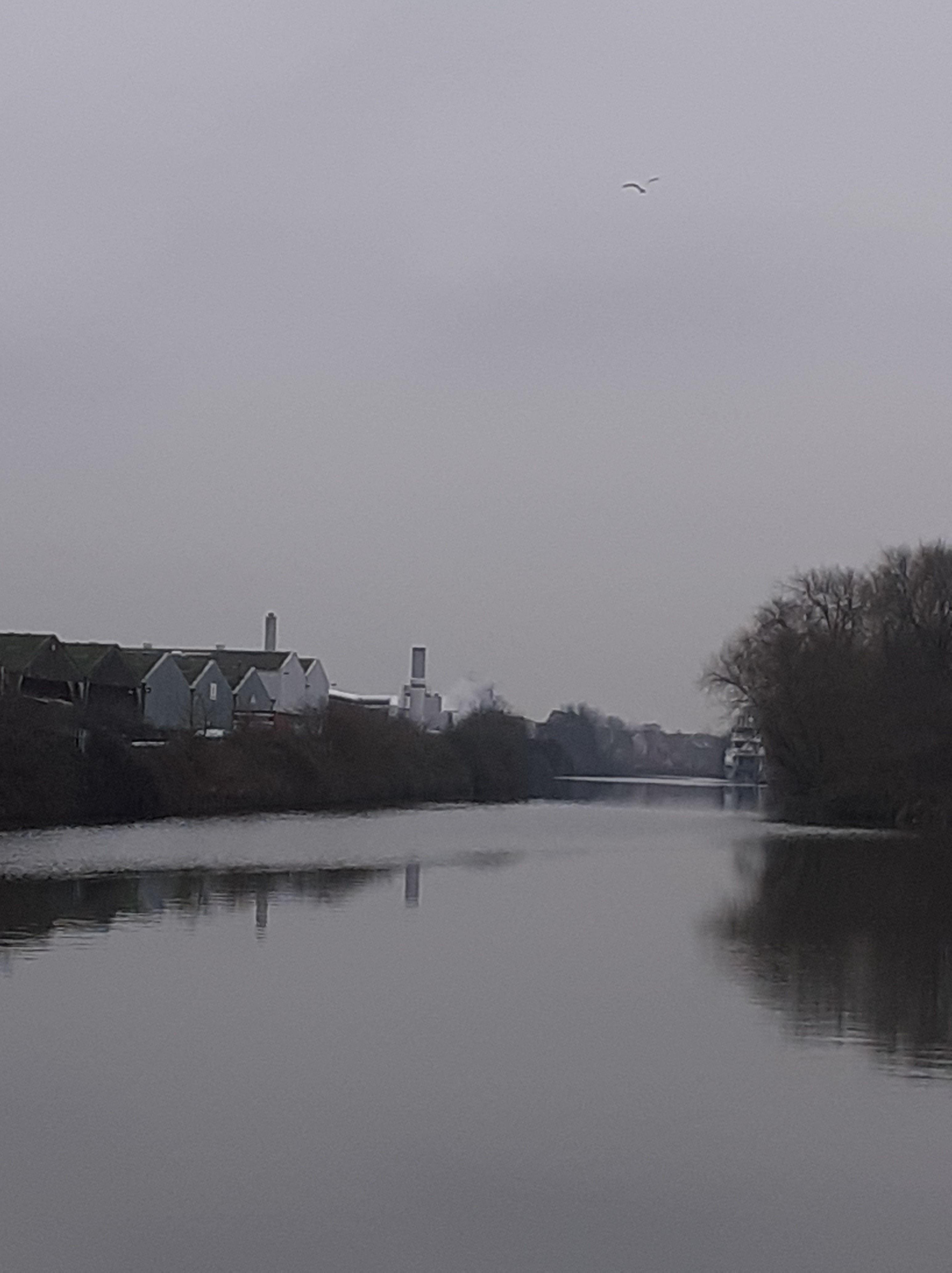
I am standing in a favourite spot, enjoying the expanse of water in front of me. I am missing the sun. I have been missing it for awhile, as the bright days of early February disappear into memory. I am living among shades of grey.
Standing in this space, I feel both sadness and reassurance. The late winter has turned gloomy and I am somewhat depleted. Not much energy or bounce. At the same time I continue to feel held, powerfully, within this landscape and my life.
Looking now at my apparently monochromatic picture, I see subtle variations within the grey. I am drawn to the ripples and reflections in the water. I am aware of the shapes of buildings and trees against a background leaden sky in which a seagull is flying. There are life and movement here, and their promise that the wheel of the year will continue to turn.
“Music, the word we use in our everyday language, is nothing less than the picture of the Beloved. It is because music is the picture of the Beloved that we love music. But the question is: What is our Beloved, or where is our Beloved? The Beloved is that which is our source and goal. What we see of our Beloved before our physical eyes is the beauty of that which is before us. That part of our Beloved that is not before our physical eyes is that inner form of Beauty of which our Beloved speaks to us.” (1,2)
In these words, Hazrat Inayat Khan, musician, philosopher and Sufi teacher, explains the role of music in Sufi culture. Sufis seek a personal relationship, or union, with the Divine, which throughout their history has lead to conflicts with religious formalists within Islam. And whereas many of us who seek that connection, or union, find it in stillness and silence, Sufis often seek and find it in music and movement – in states of expressive joy rather than quiet equanimity. Hazrat Inayat Khan continues:
“What makes … the musician sing beautiful songs? It is the inspiration that beauty gives. The Sufi has called this beauty Saqi, the divine Giver, who gives the wine of life to all. What is the wine of the Sufi? All beauty: in form, line and colour, in imagination, in sentiment, in manners – in all this he sees the one beauty. All these different forms are part of this Spirit of beauty, which is the life behind, always blessing … But among all the different arts, the art of music has been especially considered divine, because it is the exact miniature of the law working through the whole universe.
“Music inspires not only the soul of the great musician, but every infant, the instant it comes into the world, begins to move its little arms and legs with the rhythm of music. Therefore, it is no exaggeration to say that music is the language of beauty, the language of the One whom every living soul has loved. And we can understand that, if we realise the perfection of all this beauty as God, our Beloved, then it is natural that music, which we see in art and in the whole universe, should be called the Divine Art.”
The musical form above is called Qawwali. It arose in Hindustan, as a fusion of Persian, Arabic, Turkish and Indian traditions, for performance at Sufi shrines or dargahs. It is famous throughout Pakistan, India and Bangladesh. However the group featured above are from Birmingham, England. They have added to the fusion of Qawwali by introducing Western orchestral instruments and call their work ‘Orchestral Qawwali’. Man Kunto Maula is a well-known song in the modern Qawwali repertoire. The singer here is Abi Sampa and the production is by Rushil. This music does not directly reflect my personal practice, yet I feel moved and inspired by it when I listen.
(1) Hazrat Inayat Khan The Mysticism of Sound and Music: the Sufi Teaching of Hazrat Inayat Khan Delhi/Mumbai: Grapevine India, 2024 (Shambhala Dragon Editions)
This morning, 2 February, sunlight streamed into our flat. Soon we realised that warmth was coming in along with the light. There was no need for artifical heating.
This may not yet be spring, by most people’s reckoning. But the day has had a spring- like quality. Elaine and I both felt lifted. For me, it was as if a weight had come off my shoulders: a weight to which I had become acclimatised. I had stopped even noticing it until it was so gloriously removed.
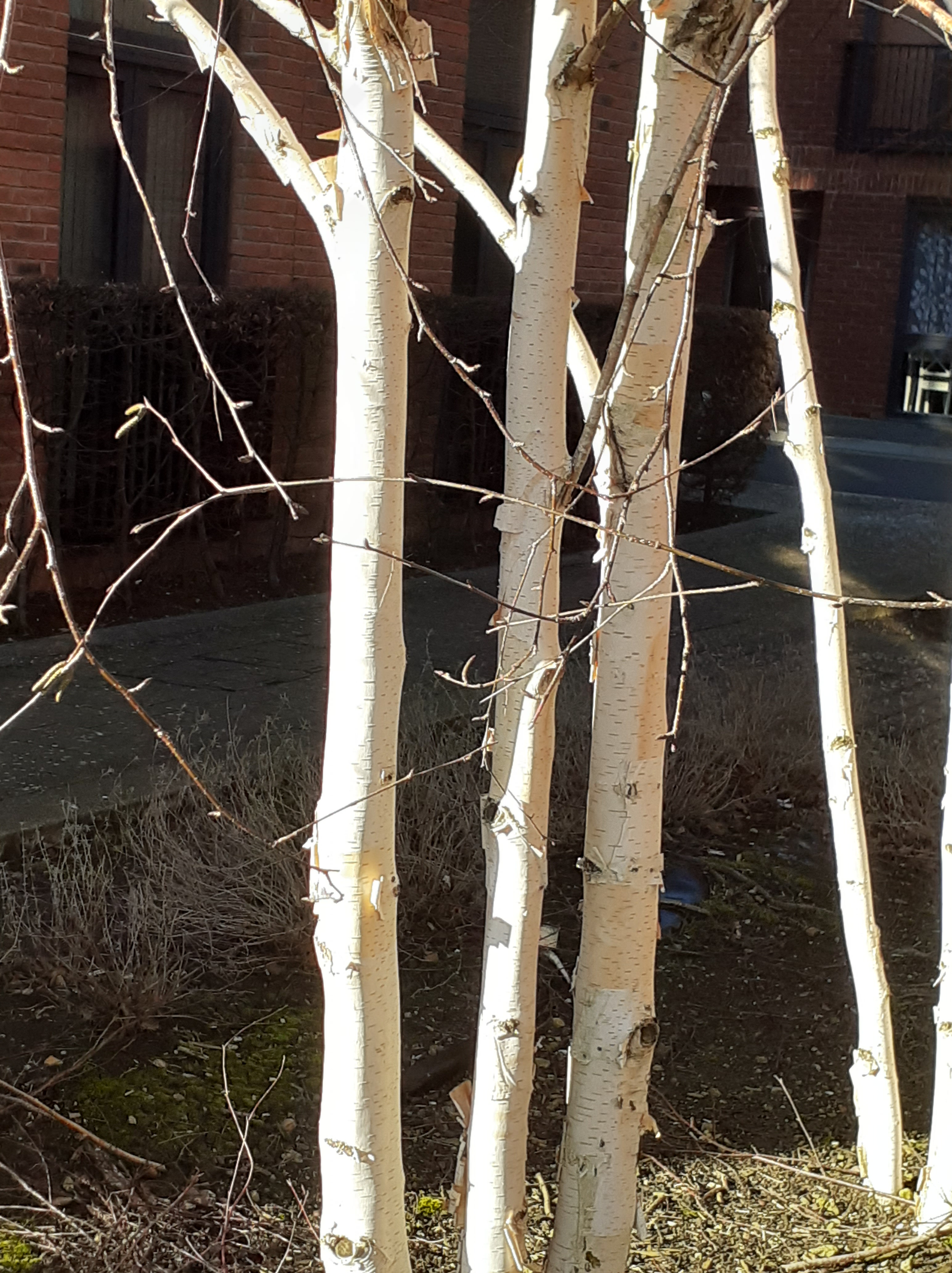
We made two trips out during the day. In the later morning we stayed near home. Elaine walked using her rollater and spent welcome time sitting in the sun. The same sun also shone on our adopted birches. Though it’s not shown in the picture below, the catkins are greener now.
In the afternoon, using the wheelchair, we visited Gloucester docks and sat there until not long before 4 pm. The heat was beginning to drain away by the time we left, and shadows were lengthening. Yet the two pictures below show, respectively, the dazzle of sunlight on water, and a canal barge lifting its solar panels to the sun.
A great day for a festival of lights, and a welcome opportunity for exuberance.
Imbolc/Candlemas is celebrated on either 1 or 2 February as part of the Celtic wheel of the year. It signals the loosening of winter’s grip. Brighid, Goddess of poets, smith-work and healing is its patron. Damh the Bard is a prominent member of OBOD (1), best known for his music. A singer song writer revisioning ancient Bardic tradition for modern times, he has been an inspirational and much loved force in modern Druidry and Paganism. His lyrics for this song are below as presented on YouTube.
There’s a tree by the well in the wood,
That’s covered in garlands,
Clooties and ribbons that drift,
In the cool morning air.
That’s where I met an old woman,
Who came from a far land.
Holding a flame o’er the well,
And chanting a prayer.
(Chorus) Goddess of fire, Goddess of healing,
Goddess of Spring, welcome again.
The told me she’d been a prisoner,
Trapped in a mountain,
Taken by the Queen of Winter,
At Summer’s end,
But in her prison, she heard the spell,
The people were chanting,
Three days of Summer,
And snowdrops are flowering again.
She spoke of the Cell of the Oak,
Where a fire is still burning,
Nineteen priestesses tend the Eternal Flame
Oh but of you, my Lady,
We are still learning,
Brighid, Brigantia,
The Goddess of many names.
Then I saw her reflection in the mirrored well,
And I looked deep in her face,
The old woman gone, a maiden now knelt in her place,
And from my pocket I pulled a ribbon,
And in honour of her maidenhood,
I tied it there to the tree by the well in the wood.
We have had a lot of wind and rain in recent days. Saturday was an exception. The sky was clear, vividly blue. The air seemed cleansed and fresh. I stood at the back of St. Mary de Crypt, above, and understood the sensibility that reaches up, aspirationally, to heaven. I could empathise with the yearning that goes with that, looking for something clear and bright and pure. It’s as if such a sky might hold a promise of peace, a peace that was alive and able to nurture beauty.
I am also glad that, by the standards of medieval churches (including others within walking distance) this St. Mary’s is modest and balanced in its upwards aspiration. It aspires, but does not run away from the earth. The picture below shows it as solidly grounded, and not altogether dwarfing the buildings that have been its neighbours for many years. The church is still consecrated and holds services from time to time. But now it functions largely as a busy community centre with a strong continuing role in Gloucester’s life. A solid presence in the heart of the city.
Looking in on the city park, I welcomed the same clear blue sky. But my eye was mostly drawn to the trees that it framed. Although this is still a winter scene, the colour of the willow suggests a strong presence of male catkins and the cycle of growth and change that is under way.
Leaving the park I made my way to the still living garden of the ruined Llanthony Secunda Priory, once the monks’ physic garden. It still feels like a place of healing and the present version is well maintained.
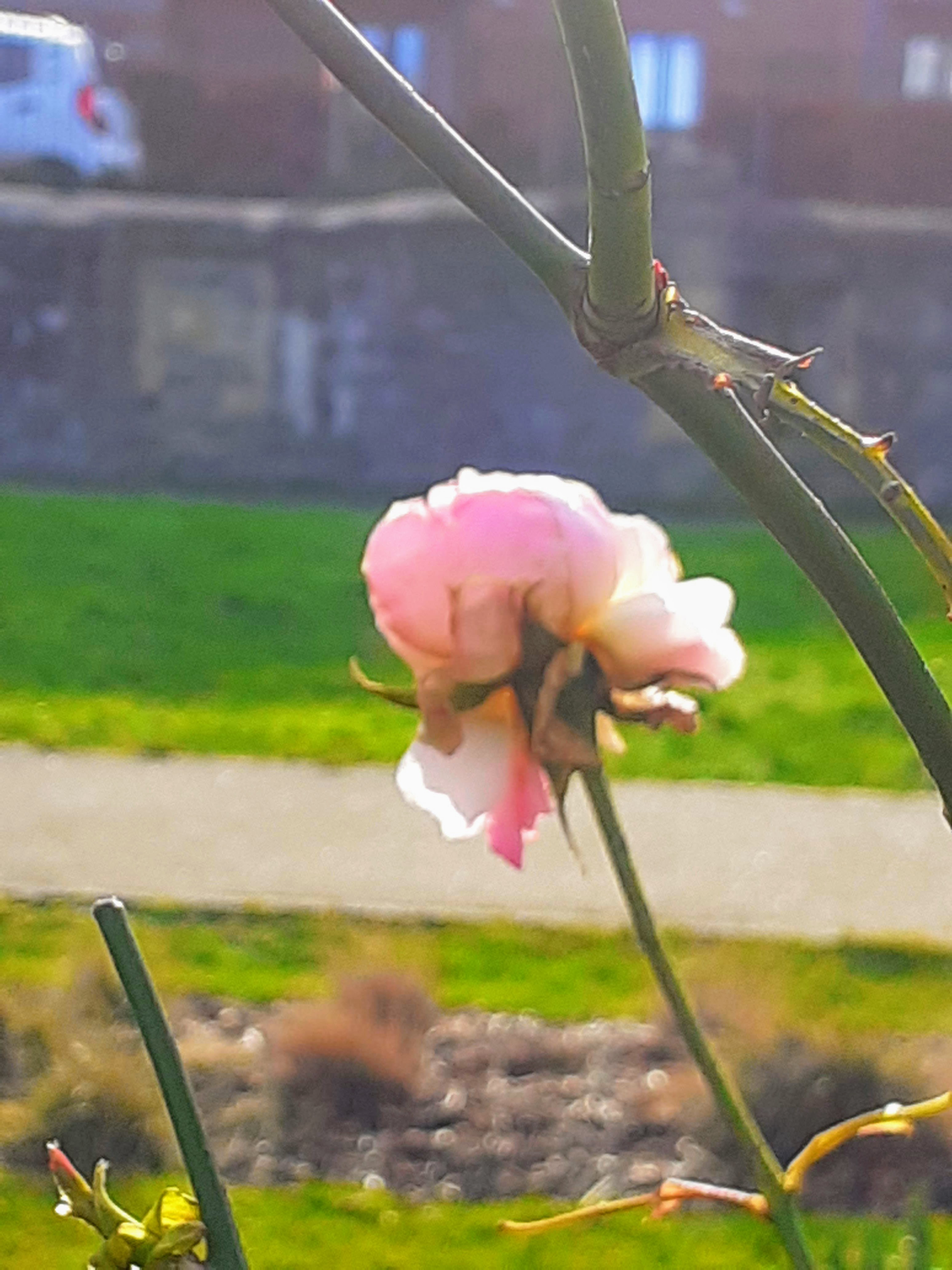
I was both surprised and delighted to see a rose in bloom. Roses have for a long time been a heart symbol for me, but I have generally associated them with summer and especially midsummer. I became aware of winter roses quite late last year and they were shop bought. I loved them but had some misgivings about their production. So I felt blessed to see one growing in the physic garden last Saturday. There’s no traditional link between Imbolc and roses that I know of. But seeing this rose in the ground, sunlight glinting on both petals and thorns, I had an Imbolc kind of feeling, as we approach the first festival of the rising year.
Sufism is often referred to as the Way of the Heart. Hazrat Inayat Khan was a Sufi teacher and musician from Gujarat, India, who took his teaching to the West in the early 20th century. His combination of spiritual teaching, philosophy and music was normal in this culture and tradition. In his own life and work, Hazrat Inayat Khan created a Universal Sufi movement independent of its Islamic origins, though always inspired by them. Practitioners from his movement created the Dances for Universal Peace.
The image above is the Ace of Cups from Ayeda Husain’s The Sufi Tarot (1). Ayeda Hussain is a teacher in the Ineyatiyya, a global organisation dedicated to Universal Sufism as taught by Hazrat Inayat Khan. She sees Sufism and Tarot as two systems of healing and transformation that can be valuably brought together. She treats Tarot as a vehicle for spiritual teaching, going so far as to include contemplations and affirmations for each card.
Referring to her Ace of Cups, she says: ‘In Sufi poetry, the cup is the heart that must be emptied before the beloved can pour the Divine nectar into it. Just as a cup that is filled cannot be poured into, neither can a heart filled with limiting impressions. The work of the mystic then, is to clear impressions that clutter and cloud the heart, so that it may be able to receive. As the heart opens, we become aware of new offers and opportunities in both love and spiritual growth’.
I came to The Sufi Tarot by an indirect route. When I began working with my Ceile De (2) beads, I didn’t at first expect to use them for mantra meditation and I looked at a collection of fuinn (sacred chants) as an option for working with the beads. Fuinn tend to be brief and I thought that a single fonn might work for me. They are in Scottish Gaelic and frequently use heart language, as in:
Gun tigeadh, solas nan solas
(Goon tee-guch, sol-us nan sol-us)
Air mo chridhe
(Air mo chree)
This translates into English as Come light of lights, to my heart.
I found this fonn beautiful though somehow not right for my purpose. But the phrase air mo chridhe would not leave me. As soon as I heard it, in the old language, it needed no translation, and I felt I had known it forever.
What I did in my own practice, having decided on the Soham mantra for the beads, was to create a version of the modern Druid peace prayer as a love prayer.
Deep within my innermost being, may I find love.
Silently in the stillness of this space, may I nurture love.
Heartfully, in the wider web of life, my I live in love.
Now using this prayer, I felt the desire for friendly guidance in this work of the heart. I felt prompted to search for ‘Sufi Tarot’, and was surprised when came up immediately. When I received the pack, I was quickly reassured that I had had been given what I asked for. I look forward to this new thread within my contemplative inquiry.
(1) Ayeda Husain The Sufi Tarot Carlsbad, CA; New York, NY; London; Sydney; New Delhi: Hay House, 2022. Art team Nazish Abbas, Hassaan Aftab, Momina Khan







 Contemplative Inquiry