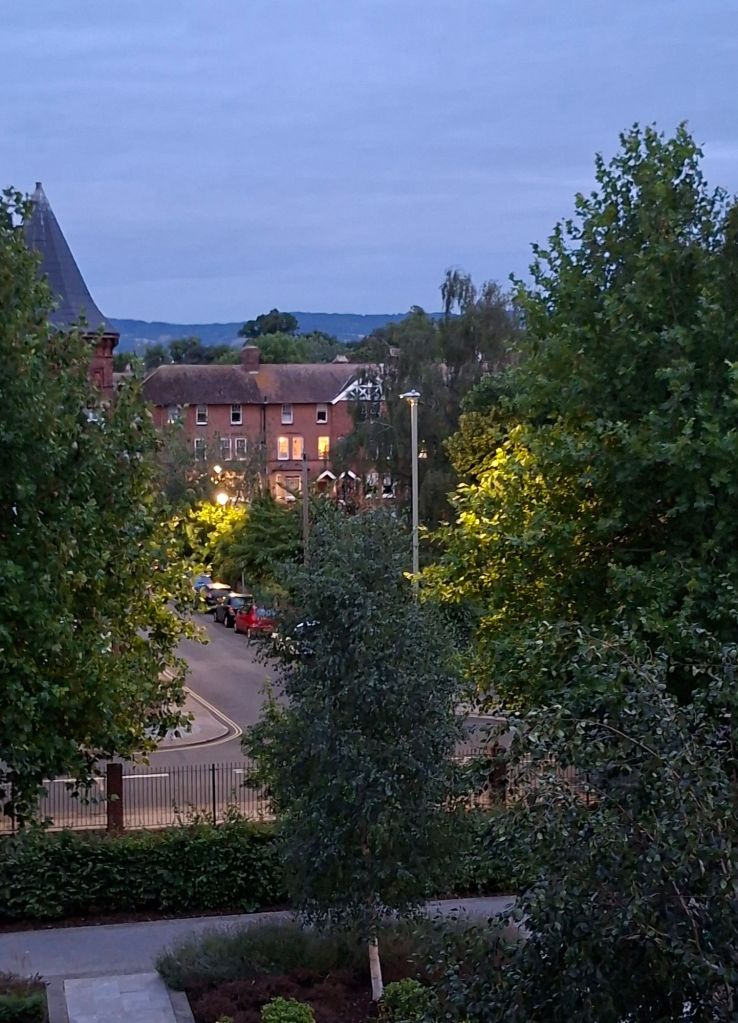
I see change in a familiar scene. Looking out from our apartment I contemplate a gentle twilight. It is modified by artificial light. During the recent heatwave I somehow had little consciousness of this moment in the day. But now, with lower temperatures and rain, my world is a tiny bit different. I discover myself in a twilit scene, and a twilight frame of mind, a little after sunset.
Although this sunset is only ten minutes earlier than the sunsets of the Solstice period, I feel, deep within me, the turning of the Wheel. It’s as if I am leaning in to the spirit of late summer, and the first of the harvest festivals that define the waning year. We are not there yet, though Lammas is but a fortnight away. I am simply becoming aware of a coming seasonal shift.
I am also aware of wanting to savour the sense of a change without wanting to hurry it on. Above, an image of trees, houses, hills and sky anchors me into a specific place and time. It’s a ‘now’ experience rather than an anticipation. Below, an image of birch leaves back-lit by electric light holds me in an appreciation of the pattern they make. I am held by the power of a simple pleasure.
It is a little after 7 pm, and the mellowing evening of a hot day. The sky is clear. On 12 July, there are still nearly two and a half hours before sunset. It is about 31C/87.8F with a light breeze. Elaine and I feel comfortable enough to go for a walk in town.
We start quietly in our own neighbourhood. We are, we think, towards the end of a hot period that peaked at 35C/95F. This counts as serious heat in England. For several days, we have been staying indoors for much of the day. There have been quick forays in the mornings, mostly to an air conditioned shopping centre nearby.
We needed to get out at the first opportunity. We are rewarded, in this evening, by a freshness grown unfamiliar, and by powerful contrasts of light and shade as seen in the priory ruins below.
To leave our Greyfriars estate, we walk down a narrow lane that separates a pub from a church. We enter Southgate Street in the old town through an archway. Entering the street, we are conscious again of vivid blue sky, and the mix of sunlight and shadow. The street is hardly crowded, but it is certainly peopled on this warm summer evening.
At this stage we are not sure of our destination. We just want to be free and mobile and outdoors. We decide to turn right. Soon we will be reaching the cross roads at the centre of the old town. If we turn left, we will find ourselves in Westgate Street*, with the Cathedral Close (College Green) as our likely destination.
Gloucester Cathedral, and in particular College Green, are a friendly space for us. It is still the dominant set of buildings in the town centre, just a little set apart from the shopping streets. Often a busy place, it is also a contemplative one. As we sit there enjoying the opportunity to be out, we notice that the temperature is cooling as we move towards 8 pm.
Eventually we decide to return home, leaving College Green through another alley, this one a location for shops and restaurants. It’s been a nurturing time in the high summer city.
When Gloucester was first established by the Romans in 97 AD as Colonia Glevum, it was built as a walled city with gates in each of the four cardinal directions. Hence the streets Eastgate, Southgate, Westgate and Northgate. I believe that Aethelflaed, Lady of Mercia, brought the street names back into use in their English form whilst based in Gloucester round about 900 AD.
An Interview with Frank McEowen (1) is the latest offering in Philip Carr-Gomm’s This Magical Life podcast. The overall aim of This Magical Life is to explore the intersection of Druidry, Psychology and Wisdom. Philip is a clinical psychologist and led OBOD (the Order of Bards, Ovates and Druids) for some 30 years. Frank is the author of, among other works, The Mist-Filled Path: Celtic Wisdom for Exiles, Wanderers and Seekers.
This wide-ranging interview covers three main topics: Celtic bards, Chinese hermit poets and politics in America today. All of these are tied into Frank’s journey and service. He was born in Mississippi, USA, of Irish, Scottish, Welsh and English ancestry. At an early age he experienced mystical encounters with the other world. These later prompted him to work with indigenous elders in North America, and later with teachers in Britain and Ireland, especially Ireland, opening himself also to the spirit(s) of place. He speaks of his journey as a whole as one of ‘soul retrieval’. His early books – The Mist-Filled Path, Meditations on the Irish Sprit Wheel, and The Spiral of Memory and Belonging, come out of this experience.
For reasons explained in the interview, Frank then made a decision to ‘disappear inward’, becoming a hermit and poet. As well as working in Celtic spirituality, Frank was also a student of Zen. He had a natural attraction to Chinese and Japanese wayfaring hermit poetry and modelled the life style as well as the art, adjusted to a different time and culture. This period led to three books of poetry published under the name of Frank LaRue Owen: The School of Soft Attention,The Temple of Warm Harmony and Stirrup of the Sun and Moon.
Like Philip, part of Frank’s service is in the field of psychological healing and personal development, principally as a student of Arnold Mindell. Mindell coined the term ‘Dream Body’ – a psycho-spiritual approach that is also Earth reverencing. It is within this framework that they talk about American politics today. First they identify distressed energies within the national psyche which the current President has uncorked and used in a darkly charismatic and disinhibited way. The discussion takes off from there, looking at issues of grief, loss (of democracy) and possible hope. Connecting this predicament to the bard/poet vocation, Frank quotes Ukrainian poet Ilya Kaminski: “the project of Empire is to dull the senses. The project of the poet is to wake up the senses”. Projects of Empire are not unique to the USA. There is something to reflect on for us all.
I recommend this podcast as a rich and varied conversation, covering a lot of ground in its 36 minutes.
(1) The YouTube post spells Frank’s surname as McEowen and the covers of his early books use MacEowen. I don’t know if he has altered the spelling over time.
I took the picture above at 8.35 pm on 2 July, a little less than an hour before sunset. The dial still hasn’t moved much since the Solstice. The days are still long and warm. The sky this evening is blue and clear. Sunlight plays in the trees. It is good to be here, now, and alive to this moment.
The moon, below, has reached its first quarter. The Anglo-Saxons called the July moon the Hay Moon. Celts called it, variously, the Claiming Moon, Mead Moon or Herb Moon. North American traditions speak of the Buck Moon and the Thunder Moon.
For me, contemplating this moon at its first quarter, it seems like empty potential and not ready for a name. There’s a sense of mystery here. I stand with that mystery as my world moves towards a high summer sunset.
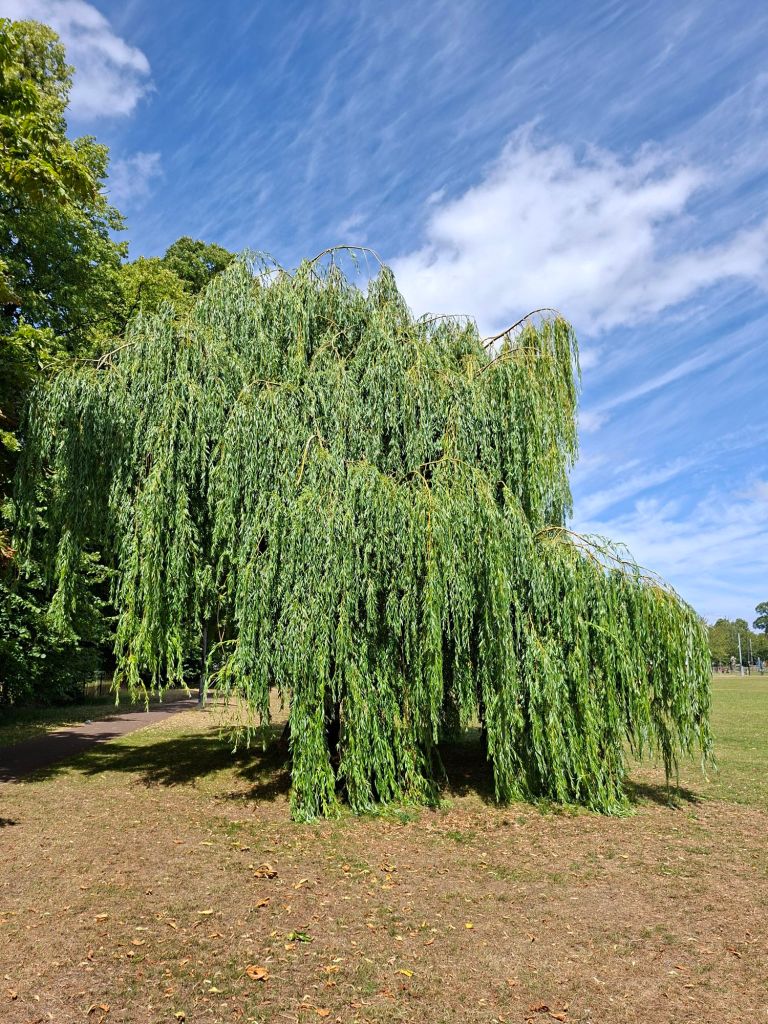
It’s a warm afternoon. The sun is strong. The park is parched. I could do with some moments of shelter. I walk towards a welcome willow tree.
I feel different under the tree’s lush canopy, as if in a benignly altered world. Its sturdy trunk upholds this precious space, embracing both light and shade. Although this space is small, I experience, here, more variety than in the expanse of park immediately surrounding it.
For awhile I cling to the cool softness of this world within the tree, feeling as well as seeing what the branches and leaves of a weeping willow can do. A taste of Nature’s magic. Then I return to the world of the park.
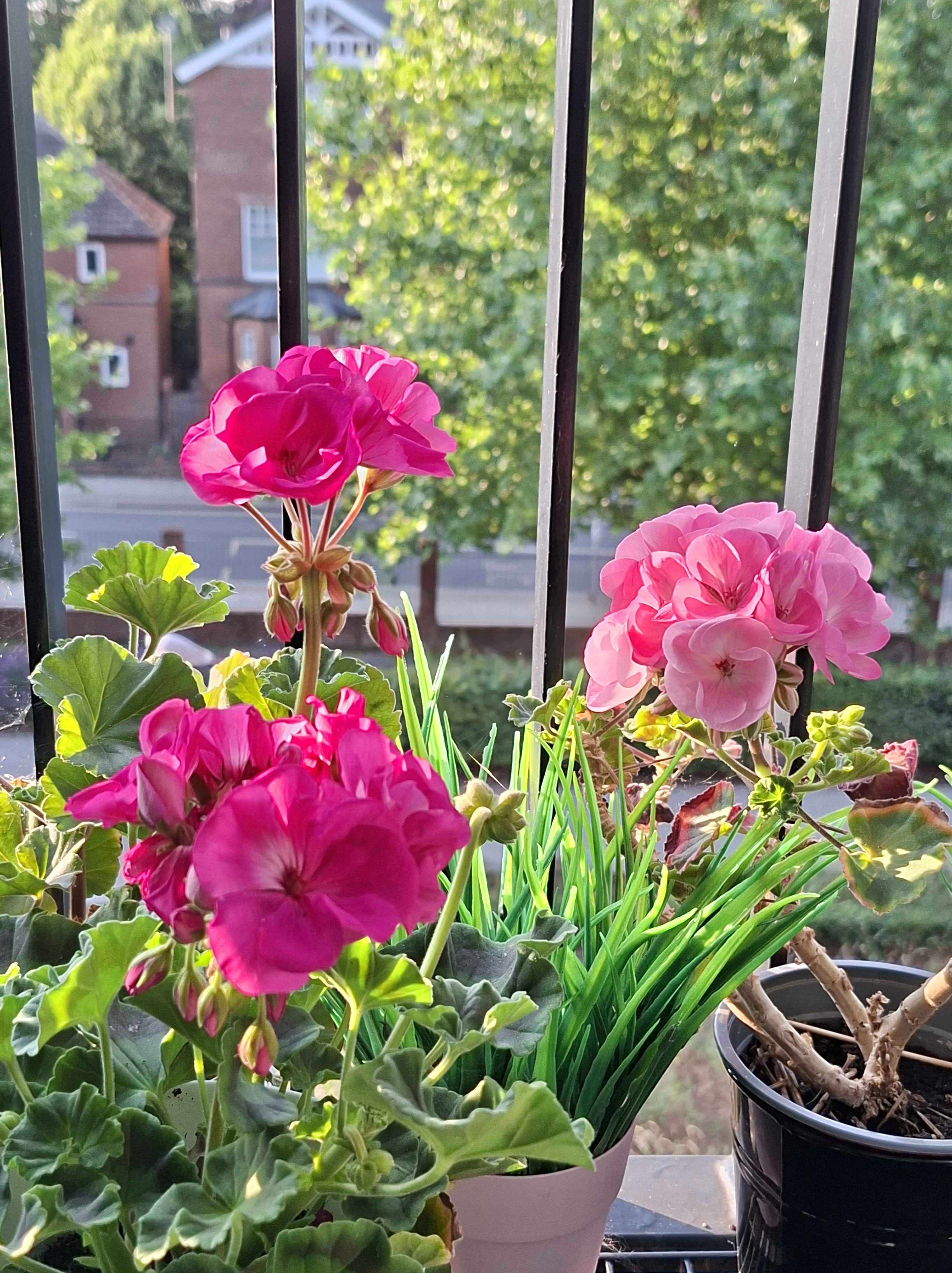
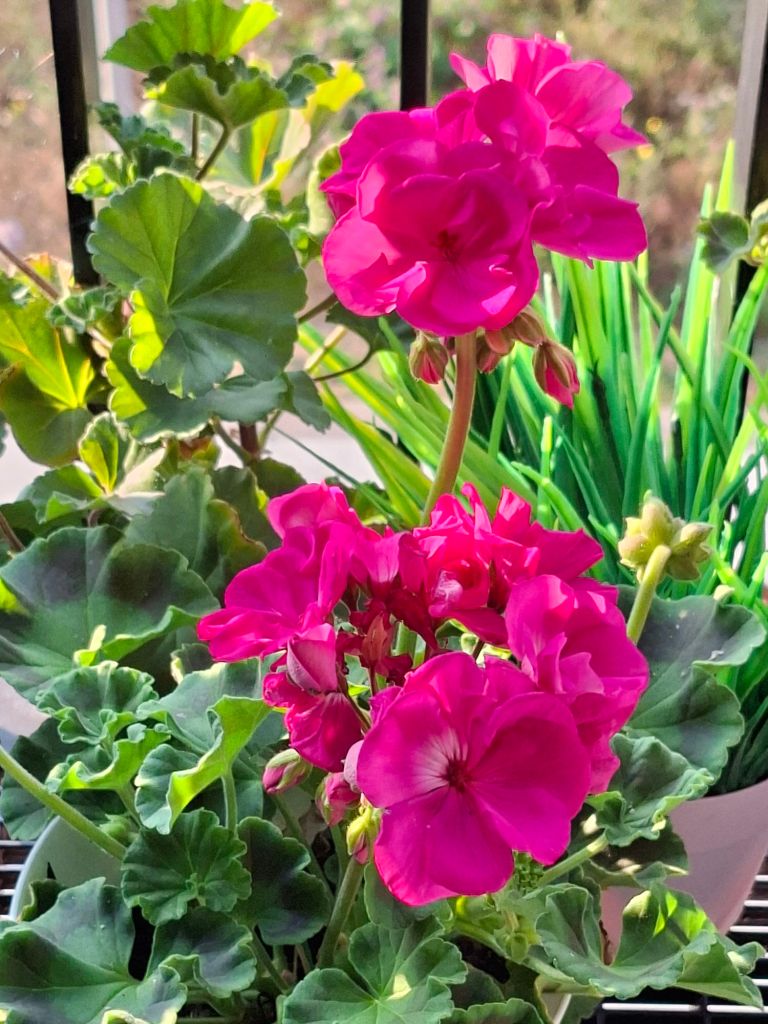
Early this morning I sat in contemplation of some geraniums in pots, for me a good Druid focus of attention. Purchased and tended by my wife Elaine, who is now mobile and active once more, they shone in the early morning light. This was about 6.45 am, some two hours after dawn, on 19 June. It is two days before the Solstice. Where did the time go?
I notice how my eye is drawn to plants and light effects. I find them nourishing and enabling. This has been a theme in my life for awhile. It is though sunlight and the plant world offer hope and reassurance in a bleak, shocking and disorienting historical moment. Life insists on flourishing. I can insist on flourishing too. I am not distracted from the wider world but resourced to engage with it.
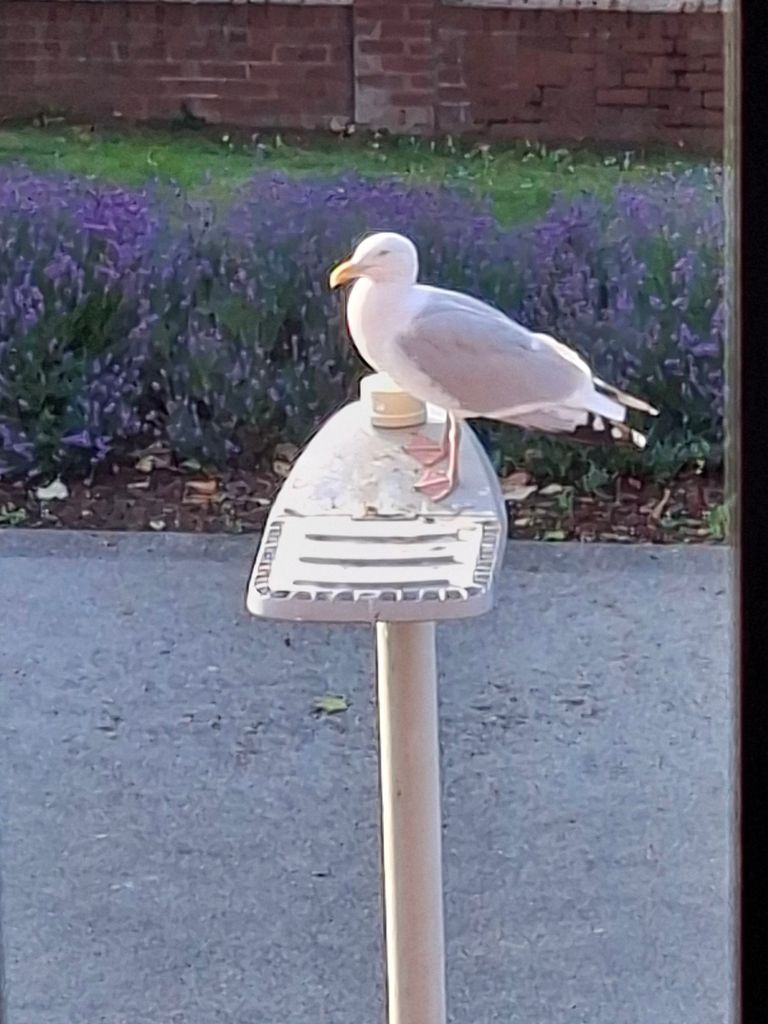
On a convenient lamp post, the seagull seeks an opportunity. This midsummer world is alive.
On completing a breath exercise I sometimes say, ‘I am the movements of the breath and stillness in the breath; living presence in a field of living presence in a more than human world: here, now, home’. This is both my most parsimonious and most spacious sense of home in a world where nothing lasts forever or stays the same. I find my ultimate feeling of home in simple breath and awareness.
Yet my body and feelings, my heart and my imagination cannot thrive on breath and awareness alone. I need love, loyalty and connection inside the turbulence and uncertainty of the world. For me, the risk of getting hurt is an acceptable price to pay.
Thinking simply of ‘home’ spaces, I have lived at my current address for two and a half years. Not long, but enough to establish familiarity and loyalty. The picture above was taken very close to the building I live in. Our estate has planted lavender and let the grasses grow wild. I have come to love this. Our public library building, opened in 1896, is in a simplified and elegant form of 19th century Gothic in its last stage. I know it as a busy and widely loved place. I also know that it won’t be used for its present purpose much longer. Yet I continue to experience it as ‘home’.
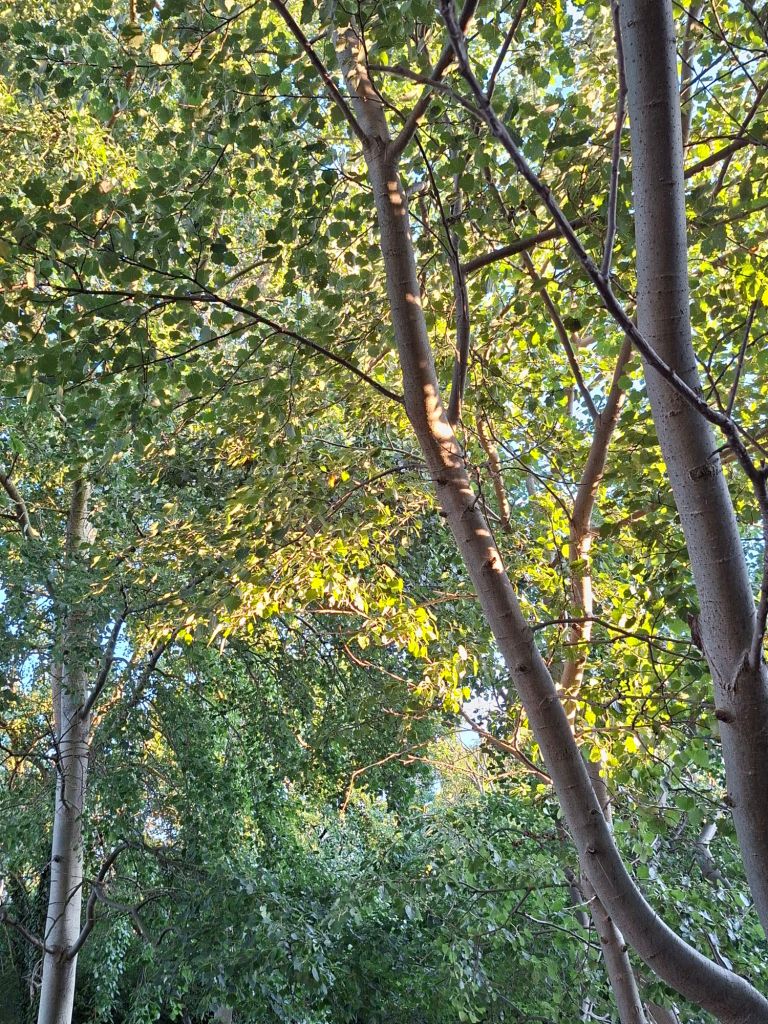
Earlier in the year, I wrote about a small group of birch trees growing up beside our flat. Then, they had a bare look apart from a few catkins (1). Now, in the picture below, they are in full leaf. I love the way they are now and also the way they have changed. Without impermanence and mutability nothing can happen. These very characteristics enable ‘living presence in a field of living presence in a more than human world’. They too are a necessary part of ‘home’.
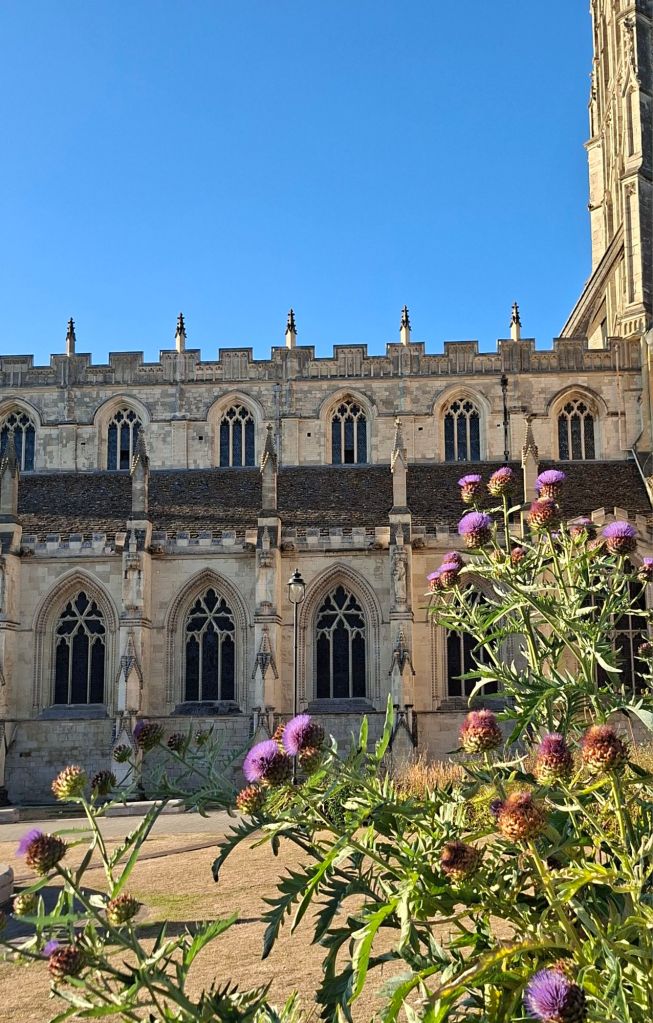
The garden in Gloucester Cathedral’s close is currently a magnificent riot. I was on a walk there with Elaine and we particularly noticed two powerful seeming plants that we couldn’t identify. We simply sat with them, unnamed, and bathed in their energy. It was a glorious 1 June, the first day of our official meteorological summer, and one to savour and enjoy. Only later did we do any research.
We are fairly sure that the plant above is yellow archangel and the plant below, looking like a giant thistle, is cardoon (canara cardunculus) aka prickly artichoke. Friendly feedback from readers on these identifications is welcome. If we are right both plants have long been recognised as sources of power and healing.
In our older traditions, yellow archangel was a symbol of harmony between flora and fauna. A custodian of wildlife, it fostered a bond that transcends mere survival. Herbalists still use this plant to relieve gout, sciatica and other pains of the joints and sinews. It has also been used to draw out splinters and thorns, clean and heal persistent sores, and to dissolve tumours. Yellow archangel can be used as food, in salads, soups and teas. In the wheel of our year, yellow archangel flowers fully after the bluebells die away.
Cardoon is also a plant of power. Traditionally associated with Mars, it has the virtues of strength, protection and abundance. It is has been credited with the power to ward off evil spirits. It is also connected to ideas of nourishment, the riches of nature and, latterly, sustainable gardening. The plant can grow to 2.5 metres in height. Its thick stalks are used as a vegetable. Its full flowering is in late summer and autumn, with thistle-like purple flowers.
These plants, in this garden, are a celebration of values as well as of nature and healing. I see our world through the lens of Modern Druidry and Paganism. The custodians of this space will have a Christian lens. I am happy to note that in this context they seem to be much the same. When in this space, I feel that I am in a beautiful and energising oasis in the city.