Contemplative Inquiry

This blog is about contemplative inquiry

Tag: Spiritual inquiry

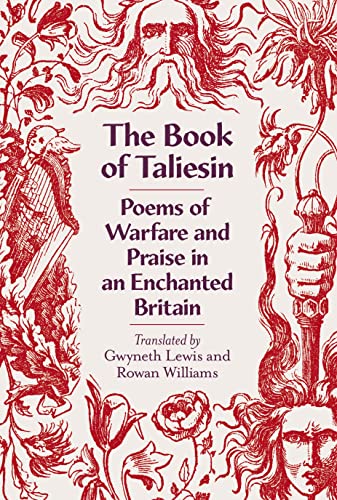
‘THE OLD NORTH’ IN THE BOOK OF TALIESIN

This is my second post about The Book of Taliesin: Poems of Warfare and Praise in an Enchanted Britain (1). The previous one introduced the book and included extracts from the poem A Song of the Wind. I am not qualified to judge the work of the translators Gwyneth Lewis and Rowan Williams. All I can say is that I find their their modern English version highly readable. I am also grateful for its detailed introduction, which has prompted me to write further posts drawing on it. This one shines a light on the ‘Old North’ (Hen Ogledd), a key location for this bardic tradition, and on poetry referencing the ‘heroic age’ of the 6th century CE (100 – 200 years after the Romans withdrew from Britain).

Llyvyr Taliessin is a 14th century manuscript bringing together “compositions ranging in date from the 9th century CE – possibly even the 6th – to the 13th century CE”. As such “it brings vividly into focus the history and culture of more than one unfamiliar world. It gathers together the kind of songs that might have been sung in the Northern British courts of the 6th century with the poems of Taliesin’s various anonymous successors in an ongoing bardic tradition, which transformed him into a North Welsh prophet, a kind of Christian shaman, and, eventually, an honorary laureate of Llewelyn the Great, the first medieval ruler to control practically the whole of an independent Wales” (1).

The oldest group of poems in the anthology, here grouped together as Heroic Poems, is linked to a Taliesin mentioned in chronicles of the early middle ages, a court bard of the 6th century ‘heroic age’. Here we find an “individual writer who appears in the chronicles and other early texts … celebrating the material and military exploits of a number of patrons, and enjoying the rich rewards of his work.” He is named in the early 9th century History of the Britons, composed in North Wales but showing considerable retrospective interest in in the struggles of various British rulers, some apparently from Cumbria and the Pennine regions, against the Angles of the territories that would by the later 7th century become the Kingdom of Northumbria.

The History of the Britons includes a list of five notable Bards said to have worked in that earlier period. These are Taliesin; Talhaearn, called ‘father of awen; Neirin (aka Aneirin); Blwchfardd; and Cian Guenith Guaut (Cian, wheat-harvest of song). Neirin is credited with the authorship of the Gododdin which laments the failure of a British King from Edinburgh, in or around the last decade of the 6th century, to defend or recapture territories from Northumbria. Taliesin is briefly mentioned in this poem as a contemporary. He is identified primarily as the court bard of King Urien of Rheged. Rheged was (probably, at least at times) an extensive territory including much of what is now north-west England and south-west Scotland. This Taliesin was concerned with warfare and praise rather than with enchantment.

The map below shows the heartlands of the culture that birthed this literature. Its northern border runs from modern Edinburgh to Dumbarton, along the Roman Antonine Wall. The people who lived between the two walls (Antonine in the north; Hadrian’s in the south) were not generally part of the Roman Empire but they were influenced by it. They identified as Britons, not Picts, who lived to the north of both walls and had always kept their independence. On the map everything to the east of the dotted line belongs to the Anglo-Saxons. The Britons hold the west, as far as the Mor Hafren/Bristol Channel. What isn’t shown on the map is the south-west peninsula, also mostly British at this time, but cut off by the fall of three crucial towns – Gloucester, Cirencester and Bath. The people who the West Saxons named as the West Welsh, and who remember their old identity in Cornwall to this day, seem to have no role in the literature that uses the name of Taliesin. Even within Wales, this literature has a northern orientation.

The role of court bard could be materially rewarding, as this extract from the poem Here At My Rest:

“Here at my rest

With the men of Rheged

Respect and welcome

And mead for me!

Mead for me

To mark his triumph,

Gifts of fine land

To win me wealth,

Wealth in plenty

Of glittering gold,

Golden good times

And high esteem.”

This is not just a personal boast. One way to make a patron look good was by pointing to his generosity. But the best way to show Urien to advantage was to describe his prowess as a warrior and war leader, as in the poem All Through One Year:

“Son, go to the door.

Listen to the noise.

What’s the commotion?

Is the earth shaking?

The sea rushing in?

Approaching, a tide

Of foot soldiers cry:

‘Foe on the hill,

Urien kills.

Foe in the vale,

Urien impales.

Foe on the mountain,

Urien smites him.

Foe on the slope,

Urien will slice him.

Foe on the ditch,

Urien will fright him.'”

Each of the poems extracted above has the same ending:

When I’m old, out breath,

Commanded by death,

I will feel delight

Praising Urien aright.”

This is formulaic completion of work in a very formal genre, though I find this translation fluid and lively. I have no idea of what it was like to be the person who wrote it, or even his real opinion of Urien. But that is not the point of these poems. The Brythonic Old North was situated within a world of warrior aristocracies and their ‘heroic’ values, in which the Britons were relentlessly harried by Angles, Saxons, Picts, Gaels and, to an extent, each other. In the context of time and place, the propagandist role of the court bards, and its importance to their warrior patrons, is very clear. What intrigues me more is the later transformation, where Taliesin morphs into the mythic shape-shifting figure described by Rowan Williams as a ‘Christian shaman’. I will write about this in a later post.

(1) Gwyneth Lewis and Rowan Williams The Book of Taliesin: Poems of Warfare and Praise in an Enchanted Britain Penguin Random House UK, 2020 (First published in hardback Penguin Classics in 2019)

For the two other posts about this translation, see: https://contemplativeinquiry.blog/2023/08/07 and:

https://contemplativeinquiry.blog/2023/08/12

THE BOOK OF TALIESIN: A SONG OF THE WIND

The Book of Taliesin: Poems of Warfare and Praise in an Enchanted Britain (1) is a modern English translation, first published in 2019, of the medieval Welsh collection brought together under the name The Book of Taliesin. It is translated and introduced by Gwyneth Lewis, National Poet of Wales 2005-6, who teaches at Middlebury College in Vermont, and Rowan Williams, formerly Archbishop of Canterbury and later Master of Magdalene College, Cambridge. Both are native Welsh speakers. I highly recommend this version to anyone who wants a translation tailored to a 21st century readership, and to improve their knowledge of the history and culture from which these poems spring.

The Song of the Wind, from which I present extracts, is an example of the Dyfalu (guessing) mode: the poet creates a sequence of riddles, metaphors and fanciful tropes in order to describe an object. When – as here – the answer is given by the title, the result is a performance of inventive paraphrase, designed to display the poet’s virtuosity. The evocation of the wind is connected to the part of Taliesin’s story in which Elffin, his patron, is imprisoned by Maelgwn Gwynedd in Deganwy Castle. Taleisin’s poetry conjures up a gale that demolishes the castle and frees Elffin. Evidently a capable bard could do that, back in the day.

“Guess who it is:

Made before the Flood,

A mighty creature,

No flesh, no bone,

No veins, no blood,

No head and no feet.

No older, no younger

Than he was before.

He’s not turned aside

By fear, nor by death.

He doesn’t experience

The needs of creatures.

…..

“He’s in fields, in woods,

With no hand, no foot;

Feels no age, isn’t struck

By pain or bad luck.

“And he wasn’t born,

So he can’t be seen.

He’s at sea and on land;

He’s unseeing and unseen.

“He’s brave, he’s bold

As he crosses the land.

He’s mute, he’s loud.

He’s full of sorrow,

He’s the noisiest one

On the face of the earth.

“He’s evil, he’s good,

He’s here, he’s there,

Creates a mess,

Makes no redress.

He makes no amends,

Because he’s blameless.

He’s wet, he’s dry;

He often comes by.”

(1) Gwyneth Lewis and Rowan Williams The Book of Taliesin: Poems of Warfare and Praise in an Enchanted Britain Penguin Random House UK, 2020 (First published in hardback Penguin Classics in 2019)

For the two other posts about this translation please see: https://contemplativeinquiry.blog/2023/08/10 and:

https://contemplativeinquiry.blog/2023/08/12

LUGNASADH 2023: INQUIRY HARVESTING

A circle is cast on sand. It is almost complete. The image is that of the Wheel, tenth major trump in the Druidcraft Tarot (1). Arianrhod, as Goddess associated with the Wheel and the Milky Way, is casting the Circle of Life. The adjacent cave has resonances of both womb and tomb. The seashore is a liminal space. The Celtic Otherworld is often linked to the sea and what lies underneath its surface. This image as a whole is associated with harvesting. Arianrhod carries a flail as well as a wand and a symbolic eight-spoked wheel.

It is Lugnasadh/Lammas, the first harvest-related festival of 2023. I am sitting with the notion of ‘winnowing’ in my inquiry. In agriculture, winnowing involves blowing a current of air through grain to remove the chaff remaining after threshing. We find a reference to winnowing towards the end of the medieval Welsh poem The Hostile Confederacy from The Book of Taliesin (2):

“I have been a grain discovered,

Which grew on a hill.

He that reaped me placed me,

Into a smoke hole driving me.

Exerting of the hand,

In afflicting me,

A hen received me,

With ruddy claws, (and) parting comb.

I rested nine nights.

In her womb, a child,

I have been matured,

I have been an offering before the Guledig.

I have been dead, I have been alive.

A branch there was to me of ivy,

I have been a convoy.

Before God, I have been poor.”

It seems that winnowing (or being winnowed) is far from an end point to our journeys. The processes of life go on, very likely in unexpected ways. Any state of peace has to be found within these processes, rather than in efforts to halt or break out of them.

At Lughnasadh 2023 I find myself at ease within Druidry, though I do also continue to refine lessons from other paths that enrich my practice of Druidry. The most significant, and the best embedded, is ‘interbeing’ as a spatial relationship and its temporal equivalent ‘impermanence’. It is like a kernel of grain I have winnowed from Mahayana Buddhism to grow into another life in my Druidry. The Druid soil is fertile for this purpose, as indicated through the image of the Wheel drawn on sand, and the passage from The Hostile Confederacy in The Book of Taliesin. For me, Thich Nhat Hanh simply provides a particularly persuasive languaging of this perspective.

He says (3): “The insight of interbeing is that nothing can exist by itself alone, that each thing exists only in relation to everything else … looking from the perspective of space, we call emptiness ‘interbeing’ [NB ’emptiness’ here = empty of a separate self] ; looking from the perspective of time we call it ‘impermanence’ … to be empty is to be alive, to breathe in and breathe out. Emptiness is impermanence, it is change. …When you have a kernel of corn and entrust it to the soil, you hope it will be a tall corn plant. If there is no impermanence, the kernel of corn will remain the kernel of corn forever and you will never have an ear of corn to eat. Impermanence is crucial in the life of everything”.

There is another level to this year’s inquiry harvest. Recently I have engaged more fully with the challenge of Thich Nhat Hanh’s understanding of the Mahayana emptiness teachings, which stand behind the interbeing/impermanence insight. In the light of this understanding he finds neither an individual nor a cosmic self – and hence no ultimate reality or ground of being. “Our notion of emptiness should be removed. It is empty”. Many teachers I have worked with in the past are on the other side of this debate, finding the Divine in ‘Presence’ (Eckhardt Tolle), Pure Awareness (Rupert Spira), and the ‘Clear Awake Space’ of Douglas Harding’s Headless Way. They find God as ‘No-Thing’. For Thich Nhat Hanh, no-thing is simply nothing.

I have been all over the place on this question, developing a language and practices compatible with both views, as I slipped and slid between them. This is fine in its way, but I have wanted some kind of resolution, if only to avoid the energy drain of uncertainty around something that matters to me and to many spiritual traditions. Tomas Sander, co-writing with Greg Goode (4) has also explored the Mahayana ’emptiness’ texts. He reports that “as a person who had been seeking truth and ultimate reality” he finds a “greater sense of ease” in the approach of these texts. Unlike Thich Nhat Hanh, he does not take away an active disbelief in a cosmic ground of being. Instead, he arrives at a relaxed unknowing, a place of ‘joyful freedom’. He says: “spiritual teachings tend to have notions of absolutes, which by their very nature seem to trump everything else. None of them can claim to have an absolute, transcendent truth on their side”.

Tomas Sander finds that “it was a wonderfully freeing moment to recognize that there is no one way that reality ‘really’ is, and therefore no way to miss out on it”. So he adopts different criteria for evaluating spiritual paths. “They need to prove themselves on the level of ordinary, conventional reality with practical questions like: who does the view serve and who is being marginalized? Is the view helpful, compassionate or humane?’ I have known of and entertained this view for some time, but it has only recently clicked with me as a good way of settling this question. Metaphysical speculation will no longer be part of my inquiry. This does indeed feel like winnowing, like blowing away the chaff. The promised harvest? Druidry as joyful freedom.

(1) Philip and Stephanie Carr-Gomm The Druidcraft Tarot: Use the Magic of Wicca and Druidry to Guide Your Life London: Connections, 2004 (Illustrated by Will Worthington)

(2) William F. Skene The Four Ancient Books of Wales Forgotten Books, 2007 (First published in Edinburgh 1868

(3) Thich Nhat Hanh The Other Shore: A New Translation of the Heart Sutra with Commentaries Berkeley, CA: Parallax Press, 2017

(4) Greg Goode and Tomas Sander Emptiness and Joyful Freedom Salisbury: Non-Duality Press, 2013 (Section written by Tomas Sander)

ANIMISM FOR OUR TIMES

This post looks at Animism as the guiding principal of my Druidry. The term itself comes from nineteenth century anthropology, and is somewhat problematic. Scholars from European and North American backgrounds , formed by a mix of Christian and secular ideas, were studying, and labelling, the traditional practices of other people. The people themselves were mostly in the process of becoming colonial subjects and living in cultures under stress. So ‘Animism’ started out as a top-down classification, which gave Animists a lowly position in the hierarchy of cultural and spiritual life. A stigma persists to this day.

Despite this dubious history, the word ‘Animism’ is now being turned around by people from the global north itself, spiritually hungry in our now palpably faltering 21st century world. Some years ago, research by Graham Harvey distinguished two positive uses of the term Animism among modern western Pagans. “Some Pagans identified Animism as a part of their religious practice or experience which involved encounters with tree-spirits, river-spirits or ancestor-spirits. This Animism was metaphysical. … Other Pagans seemed to use ‘Animism’ as a short-hand reference to their efforts to re-imagine and re-direct human participation in the larger-than-human, multi-species community. This Animism was relational, embodied, eco-activist and often ‘naturalist’ rather than metaphysical” (1).

My Animism draws primarily on the second of the two accounts above. But it is deepened by a Buddhist influence, especially that of the Vietnamese Zen Master Thich Nhat Hanh: “There is no absolute dividing line between living matter and inert matter. If we took the so-called inanimate elements out of you and me, we would not be able to live. We are made of non-human elements. This is what is taught in the Diamond Sutra, an ancient Buddhist text that could be considered the world’s first treatise on deep ecology. We cannot draw a hard distinction between human beings and other living beings, or between living beings and inert matter. There is vitality in everything. The entire cosmos is radiant with vitality. If we see the Earth as a block of matter lying outside of us, then we have not yet truly seen the Earth. The Earth is also alive” (2).

Thich Nhat Hanh follows an old tradition. In thirteenth century Japan, Zen Master Eihei Dogen had taught that enlightenment is just ‘intimacy with all things’. Elsewhere in his own text, Thich Nhat Hanh says: “Just as a wave doesn’t need to go looking for water, we don’t need to go looking for the ultimate. The wave is the water. You already are what you want to become. You are made of the sun, moon and stars. You have everything inside you”. Thich Nhat Hanh explains that a flower is made only of non-flower elements. We can say that the flower is empty of separate self-existence. But that doesn’t mean that the flower is not there. “When you perceive reality in this way, you will not discriminate against the garbage in favour of the rose” (2).

This Buddhist wisdom doesn’t seem to me to come directly out of the four noble truths or eightfold path. The Buddhists of south-east and east Asia were at ease with the traditional Animism of their cultures, and the views expressed above appear to me to be at least partly a cultural gift from the Animists. Japan, for example, was intensely influenced by Buddhism without any thought of displacing Shinto, and the traditions readily interwove.

It was otherwise in the west. Already, In the first century CE, the Roman philosopher Plutarch wrote of the death of Great Pan, after the time of Jesus but before the rise of Christianity. James Hillman comments: “With Pan dead, so was Echo; we could no longer capture consciousness through reflecting within our instincts. … The person of Pan the mediator, like an ether who invisibly enveloped all natural beings with personal meaning, with brightness, had vanished. Stones became only stones – trees, trees; things, places, animals no longer this god or that, but became ‘symbols’, or were said to ‘belong’ to one god or another. When Pan is alive, then nature is too – the owl’s hoot is Athena and the mollusc on the shore is Aphrodite … Whatever was eaten, smelled, walked upon or watched, all were sensuous presences of archetypal significance”.” (3).

James Hillman, after service as Director of Studies as the Jung Institute in Zurich, went on to develop his own form of archetypal psychology. He was a strong proponent of Panpsychism, a world view very similar to forms of Animism being articulated today. Panpsychism literally means the ensoulment of everything (from the Greek), though the sound ‘Pan’ also associates us with the god. At the same time this view broadly fits with the understanding of Zen Buddhist Thich Nhat Hanh, described above.

‘Animism’ is for me a word, not a thing, or a another religious banner to raise. It points to a wide range of experiences, understandings, and articulations. Pinned down to a single, dictionary definition, it would lose its power and energy. Yet Animism has become the word that best describes my way of being a modern Druid, both as view and as practice. I find it grounding and regenerative to have decisively adopted this word.

(1) Graham Harvey (ed.) The Handbook of Contemporary Animism London & New York: Routledge, 2014 (First published by Acumen in 2013)

(2) Thich Nhat Hanh The Art of Living London: Rider, 2017 (Rider is part of Penguin Random House)

(3) James Hillman The Essential James Hillman: A Blue fire London: Routledge, 1989 (Introduces and edited by Thomas Moore in collaboration with the author)

See also my recent post at https://contemplativeinquiry.blog/2023/07/02/animist-endarkenment which references Emma Restall Orr’s The Wakeful World: Animism, Mind and the Self in Nature

THE ROOKERY: MAGIC IN A FORMAL GARDEN

Streatham’s Rookery (1) is a formal garden within Streatham Common, one of south London’s many remarkable green spaces. I made a connection with it in 1992 when living close by.

About a year before I discovered OBOD Druidry, I was working with R. J. Stewart’s The Way of Merlin (2). This taught me, first of all, about sacred space. “Sacred space is space enlivened by consciousness. Let us be in no doubt that all space is sacred, all being. Yet if humans dedicate a zone, a location, something remarkable happens within that defined sphere of consciousness and energy. The space talks back”.

I was an urban seeker and used what the city gave me. From an early age I had been fed by imagery of secret and magical gardens. The Rookery, built in the then Spa village of Streatham (1) became my sacred space. Towards its centre, a wishing well testified to the power of healing waters. It was a good place to begin my journey. The space became more alive, and I, included within the gestalt, became more alive with it.

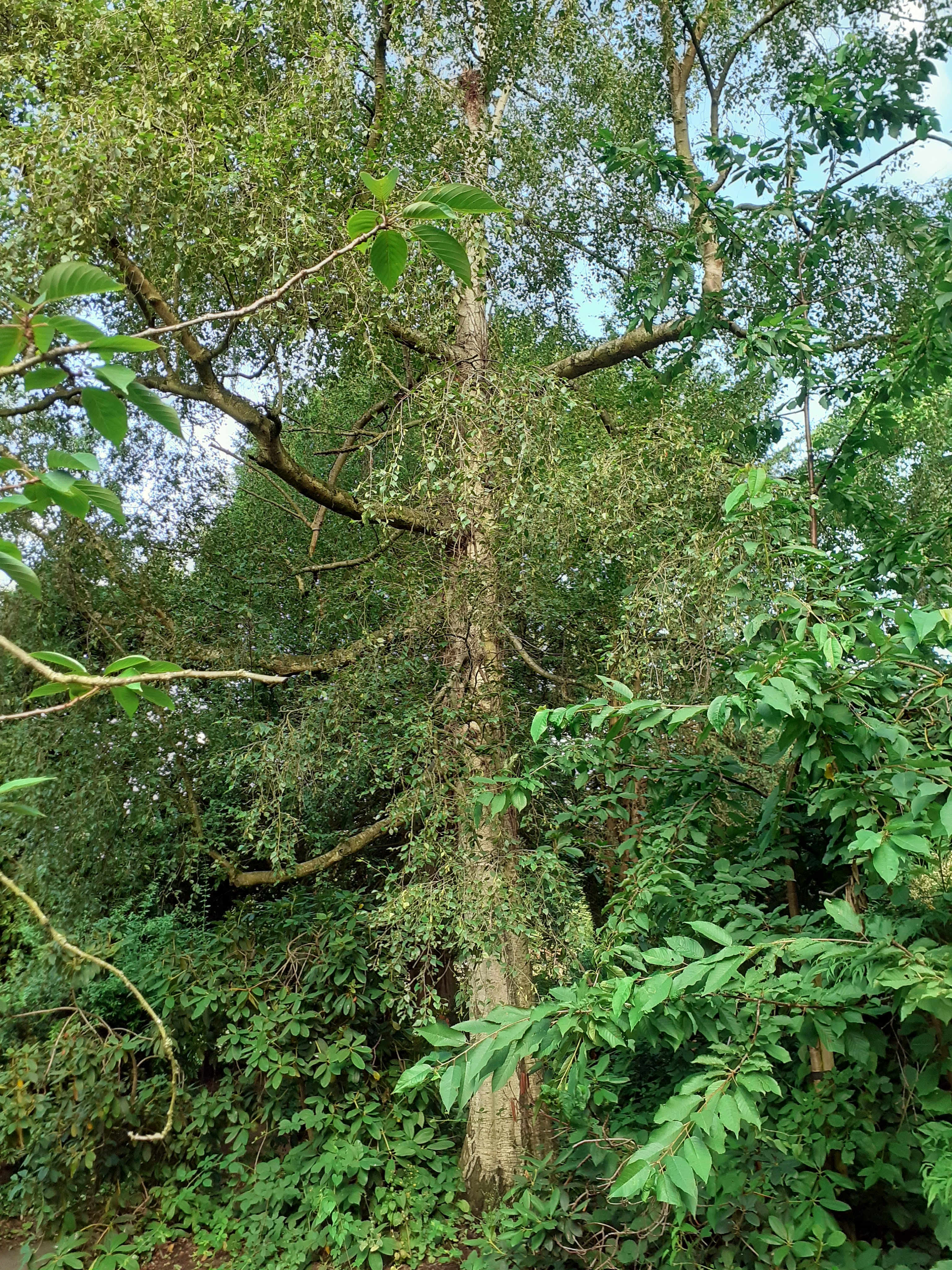
After establishing a sacred space, I was asked to begin a relationship with a spring and a tree. Stewart said: “we need to relate to such locations. This is a physical relationship first and foremost … we are one with the land, and trees, springs and caves are power points that tap into the energies of the land, and then reach into other dimensions altogether”. I found my spring quite easily (above). But there were almost too many trees to choose from, and I recall hesitating about my choice, to the point even of changing trees on my second or third visit. On my recent re-visit – woven into a rare family weekend in London – I found it easy to find the spring again but harder to remember my tree. I settled on the mature birch below, a good choice for a new, Goddess related undertaking (2). But I cannot vouch for it as my choice in 1992.

Sacred space (“the land talks back”), and befriending a spring and a tree: for me, these were the most powerful lessons from R. J. Stewart’s work. They were a helpful preparation for my later Druid training. I was very pleased to revisit this space in July 2023 and share it with family members.

(1) Streatham was in Surrey before becoming part of the County of London in 1889, and then Greater London in 1965. It began as a settlement around the old Roman road (Street Ham) from London to the south coast at Portslade, Brighton, the site a Roman port long lost to erosion. It appears in the Domesday Book of 1086 as Estreham. The village remained largely unchanged until the 18th century, when its natural springs, known as Streatham Wells, were first celebrated for their health-giving properties. The reputation of the spa, and improved turnpike roads, attracted wealthy city of London merchants to build their country residences in Streatham.

The Rookery began as a large private house with its own landscaped gardens. Much later, when the house and gardens were threatened with disposal and redevelopment, it was bought by public subscription and laid out as a formal open space, first opening to the general public in 1913. The Rookery is now one of the London Borough of Lambeth’s Green Flag Award-winning parks, directly managed by Streatham Common Cooperative (SCCoop), a local community-led enterprise.

(2) R. J. Stewart The Way of Merlin: The Prophet, The Goddess and the Land London: The Aquarian Press, 1991

MUIN: “GATHER IN WHAT IS DEAREST TO YOU.”

Muin (Ogham name for Blackberry) is one of four plants that have a place in both The Green Man Tree Oracle (1) and The Druid Plant Oracle (2). In the latter, from which the illustration is taken, it is called Bramble.

Muin is an important plant ally for me. At times I have identified closely with ‘Mr. Bramble’ (3). He is stubbornly resilient, with deep and extensive underground root systems. Above ground, he can create an almost impenetrable barrier of briars. He digs in. He is a survivor. He tests qualities and intentions. He protects the deep earth and undervalued dimensions of being. Yet he also grows abundant tasty fruit, that can be made into wine or gin.

Where I live, Muin’s time traditionally runs from Lammas/Lugnasadh to Michaelmas/Mabon – essentially the calendar months August and September. This year, as this time approaches, I am thinking of Muin as a teacher. The Green Man Tree Oracle offers words of ‘green man wisdom’ for all its trees. Muin’s words are: “gather in what is dearest to you“. I find “gather in” friendly and relational, very good to hear in a world where ‘harvesting’ is often cold, impersonal and mechanistic. Muin’s more warmly relational note is reinforced by the words “dearest to you”. We are invited to consider “riches of the soul and the things that give us inspiration” as our recommended harvest.

There are obvious questions here: what is ‘mine’ to ‘gather in’? what to I choose? what do I let go? But this is not, fundamentally, a questioning and list-making task. It is more about being open to Muin’s magic. This, I believe, is rooted in an unusual combination of qualities: tenacity, challenge, depth, an invitation to pleasure and, indeed, a certain kind of intoxication. Over the coming weeks, I will draw on Muin’s inspiration as I gather this harvest of the soul*.

(1) Philip and Stephanie Carr-Gomm The Druid Plant Oracle: Working with the Flora of Druid Tradition London: Connections, 2007 (Illustrated by Will Worthington)

(2) John Matthews & Will Worthington The Green Man Tree Oracle: Ancient Wisdom from the Greenwood London: Connections, 2003

(3) See: https://contemplativeinquiry.blog/2020/08/30/mr-bramble/

  • I think of soul as a process not an entity, though we don’t have the word ‘souling’.

A MOMENT OF GENTLE RAIN

Saturday morning, 8 July. Gloucester, England. I am warm. I am indoors. I am contentedly lethargic. My gaze turns to a balcony door.

I contemplate Elaine’s balcony garden. The flowers are less dramatic than during the solstice period. Their colours are softer. I see more green. I see raindrops on the other side of the door. They are evidence of a gentle rain falling on this tiny garden.

“I am the movement of the breath and stillness in the breath”, I say in my Druid contemplative liturgy. “Living presence in a field of living presence: here, now and home”. This can be true at any time, but some conditions are more helpful than others. Here and now, I become alive to the balcony garden, fully present. Knowing Elaine as creator of this garden extends my sense of connection. A simple nourishing moment.

Hours later, with a flash and a crash, the heavens opened and my world changed, heralding a new kind of experience.

Raindrops on glass,

Flowers in their pots.

Calm before the storm.

FIVE IMAGES: MIDSUMMER CELEBRATION 2023

The five images in this blog record a dedicated solstice walk, an evening walk beginning 8 pm on 20 June. For me, the solstice period lasts around a week ending on 25 June. I like to acknowledge the stasis (standstill) element. My festival practice is not about a moment in time so much as honouring an extended pause before the wheel turns, at first slowly, towards the dark.

I sought immersion in the unique and sacred flavour of this day at this time in this place. I do not believe my images ‘capture’ that flavour – now gone with the moment it belonged to. But the pictures do provide a suggestive record of that time. They help my memory. They remind me especially that my experience of this practice in 2023 differs from that of 2022, when I first undertook it as a solo, contemplative form of midsummer celebration. (See: https://contemplativeinquiry.blog/2022/06/24/.)

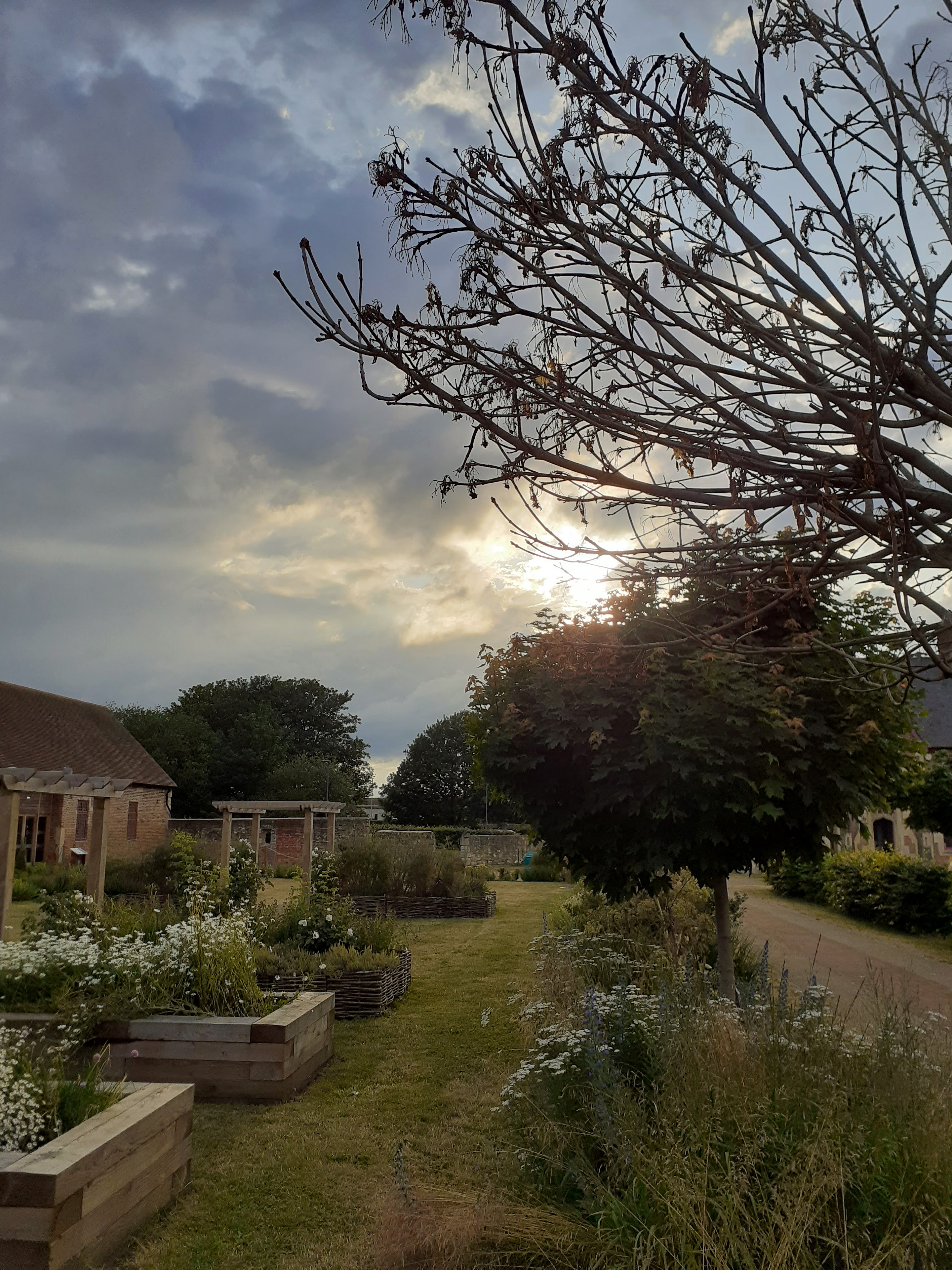
The first image (above) is of Llanthony Priory gardens, dominated this evening by a dramatic sky. Sunlight shines through heavy clouds, dark and suggestive of a storm that we had largely missed in Gloucester. Three canalside images (below) also display the energy of clouds with the sun backlighting them. I find both beauty and power here, indeed a strong sense of powers greater than mine, and indeed of ours collectively. This year, my seasonal immersion has an edge. A modern Druid, I celebrate the seasons and reverence the elements. But I certainly don’t own them, or decide how they are meant to be.

During my walk I spent a lot of time with my eyes turned upwards and skywards, with hints of both awe and foreboding. I understand how sky god spiritualites work. But I also looked across and down and found new life. A pair of swans and their cygnets were finding space on the water on a busy small marina. It is now surrounded by housing on three sides, yet they seemed flourishing and confident. Storm clouds of many kinds threaten. Life goes defiantly on.

BOOK REVIEW: STAFF OF LAUREL, STAFF OF ASH

“If our place is imperilled, so are our myths. If we heal the one, we heal the other … So said priestesses who long ago spoke in the voice of doves. So said the prophetic oaks they tended, who murmured to their suppliants through wind blown leaves.”(1)

Staff of Laurel, Staff of Ash: Sacred Landscapes in Ancient Nature Myth is an inspirational collection of interwoven contemplations on landscape and myth; on enchantment, disenchantment and re-enchantment. I strongly recommend it to anyone with an interest in these themes.

Author Dianna Rhyan says of her own approach to writing: “assembled, these pages refused to assemble, and so altogether, they form a series of sketches, fallen like samaras*, whose order is ultimately undetermined. The priestess of Apollo wrote her prophecies on leaves. When strong winds came, they scattered all over her cave. Did she mind? Amidst the leaves, voices of winds and voices of trees, lost and found, thread their way.” This review shares something of the book’s flavour, rather than attempting a linear account of what is covers.

Rhyan draws strength from wild and marginal spaces, especially the Cuyahoga River in north eastern Ohio. She describes her close relationship with the land but is all too aware of a sadness in its silence. The genocidal displacement of the people who once lived there has erased their stories about this land and their relationship with it. As a mythologist, she looks further afield for inspiration, especially ancient Mesopotamia (now Iraq) and the early Greek speaking world. Even four thousand years ago, in the early Sumerian world, people had doubts about ‘civilisation’. We find the contrasting influences of the laurel, which blooms, and the ash, “a battle-earned artifact”.

In the Epic of Gilgamesh (2) the hero destroys a forest and its guardian at an early stage of his “futile immortality quest” and then goes out of his way to offend the Mother Goddess Inanna. In The Descent of Inanna, she herself must experience death, losing her identity and powers as she descends through seven gates to the Underworld controlled by her sister Ereshkigal. Asking, at each gate, ‘Gatekeeper, why is this done?’, she receives the reply ‘Silence, Inanna. Do not open your mouth against custom. The rules of the Great Below are flawless. You may not question what is perfect.’ Rhyan’s reading of this ritualised and repeated reply finds a new order in which free nature, and the Goddess perceived as its embodiment, need to be rigorously controlled. She comments on the way in which perfection “deadens” and rules “disarm”. For three days Inanna hangs dead, a carcass on a hook. But the upper world needs Inanna in order to reproduce itself and flourish. The Wisdom God Enki sends emissaries to Ershkigal to secure Inanna’s release. She does not stay dead.

Rhyan also draws on Greek sources from different periods. One of them, from Sophocles’ last play, Oedipus at Colonus, is about the final days of Oedipus, after he has blinded himself and been been exiled from his erstwhile kingdom of Thebes. These misfortunes follow the discovery that he has (unwittingly) killed his father, married his mother and thereby, as a source of pollution, caused a plague in the city. He is told: “seek no more to master anything”.

Oedipus is now a pauper, wandering in a wasteland. Letting go of his civic and social identities and surrendering to this fate, he survives. He is reborn as a child of nature on the goddess haunted mountain Cithaeron. For his awakened inner vision has guided him to the place where he was once, as an infant, left out to die. The compassionate nymphs who nursed him then are perhaps looking out for him once more. He has journeyed from palace to periphery, freed from all power and self-determination. At that point, he is given a new role, as guardian of the sacred grove at Colonus. It is a place beloved by immortals, a place of lush growth, where the nightingale sings, and with “cool waters” that never fail. Here, as this new version of himself, he will live out his days.

Late on in her book, Dianna Rhyan says: “if we look over our shoulder, not only what we threw away as detritus is following us. What we had despaired we had lost forever, long ago in the depths of ancient ages, is following us too. We require myth, intensely alive myth, to see it. It is very good at not being seen.” I see her as making a great contribution to making ‘intensely alive myth’ visible once more.

(1) Dianna Rhyan Staff of Laurel, Staff of Ash: Sacred Landscapes in Ancient Nature Myth Winchester, UK & Washington, USA: Moon Books, 2023

(2) https://contemplativeinquiry.blog/2023/05/30/

*Samaras: here, the winged maple seeds found in the author’s local woodlands.

HOW PAGAN WAS MEDIEVAL BRITAIN?

How Pagan Was Medieval Britain? is the sixth and final lecture in Professor Ronald Hutton’s Gresham College series on early Pagan history in Britain (1). The simple answer, according to Hutton, is: not as much as was widely believed in the twentieth century, by scholars and the lay public alike. Some thought that full medieval Christianity was an upper class faith, with commoners, especially in the countryside, being ‘cheerful semi-Pagans’, Christian by day and following the old ways by night. Others thought that the two religions ran in parallel, with the latter being necessarily clandestine whilst some of its iconography was visible. Green Man and Sheela na Gig images, often present in the churches themselves, seemed to indicate the survival of a Pagan sensibility at the very least – canny concessions by the Church to the people. Witch persecutions were seen as evidence of an active, surviving woman centred nature religion. Indeed, such ideas influenced cultural and religious developments in the twentieth century itself – specifically, the rise of neo-Paganism; more broadly, the Feminist and Green movements that were dynamically emerging at the time.

However, turning to the medieval period itself, Hutton, does not find evidence of actually existing Pagan religion in the available sources. Witch trials have been carefully examined in recent years, and the victims don’t fit the profile. In Anglo-Saxon times, the legal codes and church councils stopped bothering to forbid Christian converts their old ways by 800 CE. The prohibitions reappeared in the tenth century, in relation to Viking settlers, but ceased again by 1030 CE. In the later middle ages there was serious concern over Christian heretics (Lollards) and some concern over ale-house cynics expressing anti-religious views. In medieval society people tended be nosy about other people’s business and there was social pressure to conform. There are court cases that draw on this kind of informal surveillance, but none concerned with Pagan religious practice. Hutton traces Sheela Na Gig images to the Church in France, saying that they had an anti-erotic intent. Likewise, Green Man, Wild Man and Jack in the Green figures have specific historical origins not concerned with any Pagan deity. Hutton quite reasonably offers no comment on their widely perceived role as archetypal images, because these are outside the remit of the empirical historian. His focus is on self-defined and organised Pagan religion during a specific period in Britain.

But it is true, according to Hutton, that the medieval church offered religious continuity in other ways. The veneration of saints, who were very diverse and numerous, allowed polytheist habits of mind to continue, especially in the realm of petitionary prayer. Individual saints might be local, or specialists in specific forms of help. For many people they seemed more approachable than the persons of the trinity. However in Britain there seem to have been no saints who had themselves once been gods*. Likewise Christians had holy wells, but they were different from the old Pagan ones, rather than the same ones repurposed. The temple of Sulis Minerva at Bath, for example, was left alone. Few temples or ancient religious sites became churches, even though Pope Gregory had recommended this approach when he sent his mission to Kent in 597 CE.

Church attendance was not compulsory in the middle ages. It is estimated that only around 50% of parishioners attended regularly, though they did turn up in much larger numbers for the major festivals. During these, ‘secular revelry’ was allowed, even encouraged, and the festivals raised a lot money for Parish churches, enabling them at times to abolish Parish rates. This widely beneficial outcome was seen as ‘cheating the Devil’. Even on normal days, the Church offered spectacle – with the mass, libations and incense. Local priests came from the people, didn’t have to be literate, and didn’t have to preach. That was done by specialist friars with notable performance skills, often very popular. Additionally, many people belonged to guilds linked to their churches, usually focused around a saint. There were lay religious guilds for both women and men, which had a variety of purposes, officered by their own lay members. Craft guilds performed plays at festival times. This form of Christian culture lasted in Britain until the middle of the sixteenth century, when the old church fragmented into a plurality of new ones over hard-fought time. Different kinds of Christian culture, generally even less Pagan friendly, emerged.

(1) https://www.gresham.ac.uk/watch-now/medieval-pagan/

* An exception would be the Gaelic speaking areas in Scotland and Brighid

Earth Eclectic

music that celebrates Earth and speaks to the heart

Sarah Fuhro Star-Flower Alchemy

Follow the Moon's Cycle

Muddy Feet

Meeting nature on nature's terms

Rosher.Net

A little bit of Mark Rosher in South Gloucestershire, England

Becoming Part of the Land

A monastic polytheist's and animist’s journal

selkiewife

Selkie Writing…

Charlotte Rodgers

Images and words set against a backdrop of outsider art.

Prof Jem Bendell

living with metacrisis and collapse

Towint

The pagan path. The Old Ways In New Times

The Druids Garden

Spiritual journeys in tending the living earth, permaculture, and nature-inspired arts

The Blog of Baphomet

a magickal dialogue between nature and culture

This Simple Life

The gentle art of living with less

Musings of a Scottish Hearth Druid and Heathen

Thoughts about living, loving and worshiping as an autistic Hearth Druid and Heathen. One woman's journey.

Wheel of the Year Blog

An place to read and share stories about the celtic seasonal festivals

Walking the Druid Path

Just another WordPress.com site

anima monday

Exploring our connection to the wider world

Grounded Space Focusing

Become more grounded and spacious with yourself and others, through your own body’s wisdom

The Earthbound Report

Good lives on our one planet

Hopeless Vendetta

News for the residents of Hopeless, Maine