Contemplative Inquiry

This blog is about contemplative inquiry

Tag: Spiritual inquiry

HEALTH PROBLEMS

We’ve lost the chance to sugar the pill.

This is a very bad result.

This situation won’t stay still.

This is a very bad result.

The problem came from an animalcule.

This is a very bad result.

Small and unseen – yet we look like fools

This is a very bad result.

Much more lethal than Covid 19

This is a very bad result.

The most toxic critter ever seen

This is a very bad result.

Coincidence it must surely be

This is a very bad result

That it came from my brother’s laboratory.

This is a very bad result.

Synchronicity? Cause and effect?

This is a very bad result.

Whatever the case we’re completely wrecked.

This is a very bad result.

One per cent will survive this thing.

This is a very bad result.

I hope it’s the one that I am in.

This is a very bad result.

I wrote this piece some months ago, still digesting the experience of the Covid 19 pandemic, the public health response to it, and the continuing presence of the virus in our world. I had also been reflecting on formal political messaging – government as public relations and media theatre, the intense pre-occupation with opinion polls and beauty contest elections – together with halting and inconsistent approaches to real-world problem-solving.

Writing of this kind is part of my Druid path and not a separate activity. My practice might have a contemplative foundation, but contemplation isn’t everything. The inheritance of Bardistry, and engagement with the wider world also matter. Currently, I feel a pull towards working for the healthy use of language, and challenging its corrupt and unhealthy deployments. T. S. Eliot once talked about poets being tasked to ‘purify the dialect of the tribe’. That’s not quite my language, but I can appreciate what he is pointing to.

I have recently been given another nudge, by Naomi Klein’s book Doppelganger: A Trip into the Mirror World (1) where she talks about the rise of ‘conspiracy influencers’ in a world where governments and corporations have deservedly lost our trust. “Conspiracy influencers perform what I have to think of as a doppelganger of investigative journalism, including many of its stylistic conventions, while hopping over its accuracy guardrails”. She goes on to say that “the end result of being surrounded by this kind of discourse is … a state of continuous disbelief” that replaces real threats with distorted versions of themselves. Hence the belief that “the problem with Covid was not a highly infectious disease being fought half-heartedly by for-profit drug companies and hollowed-out states, but an app that wanted to turn you into a slave”.

Klein also helps me to see a connection between the defence of language and contemplative spirituality. She speaks of calm as form of shock resistance. “When people and societies enter into a state of shock, they lose their identities and footing”. In the midst of such break down, the effect of conspiracy culture is to maintain panic and confusion. She suggests that some conspiracy culture influences are simply part of the panic and confusion. Others, more knowingly, manipulate it for ulterior ends. If shock induces a loss of identity, calm returns us to ourselves. “I write to tame the chaos in my surroundings, in my own mind, and – I hope – in the minds of my readers as well. The information is almost always distressing, and, for many, shocking, but in my view the goal should never be to put readers into a state of shock. It should be to pull them out of it”. Of her chosen work overall she says: “the role of the researcher-analyst is plain: to try and create some sense, some ordering of events, maps of power”. Clarity, calm and purpose support each other.

(1) Naomi Klein Doppelganger: A Trip into the Mirror World London: Penguin Random House, 2023

“DULL, DREAMY, MOON-STRUCK”

Contemplative states come in different varieties. In today’s culture, we tend to privilege an alert language of mindfulness, presence and awakening. Through these tools, we learn take more responsibility for our own experience – not so much for what happens (though our effective agency may improve), as in how we respond. At a deeper level, we learn to embrace the gift of experiencing, even when specific experiences are unwanted or painful. We lean in to the at times heart-breaking miracle of human life.

There are other, also potent, ways to contemplate. In the following extract from his magical realist novel Atlantis (1) John Cowper Powys presents an archaic, more than human world, with a very different take on consciousness and our place in the cosmos. We are on the island of Ithaca, in the later life of its King Odysseus, following his belated return from the siege of Troy and resumption of control at home. We begin in a moment of great collective foreboding – something terrible is happening or about to happen. This is coincident with the old king planning a final voyage. In this place and time, a young boy encounters Atropos, oldest and most powerful of the three Fates. He intuitively grasps that sentient beings help to weave their own destiny simply by falling into states “wherein we simply escape for a moment from the trouble of being a conscious creature at all”.

“The longer Nisos Naubolides looked into the eyes of Fate and the longer Fate looked into the eyes of Nisos Naubilides the more clearly did the later realize that the imperishable frame of Atropos, the ‘one who could not be turned’, was made of a substance drawn from a level of existence outside both time and space, though cunningly adapted to play its part in each of them.

“The boy proved how ‘clever’ he was by imbibing, like an inexhaustible draught of timeless experience, much more at that moment than the mere physical nature of the oldest of the Fates; for there came over him in a trance that was more than a trance the surprising knowledge – and this … was really with him to the day of his death – that Atropos helps us in the creation of our individual fate by an infinitely long series of what some would call nothing but blind, stupid, dull dreamy, moon-struck ‘brown studies’, many of which take place inside the walls of houses, and others when we are moving about on our ordinary errands outside.

“In these interruptions of our ordinary consciousness we fall into a brainless, idea-less moment of dull abstraction in which we cease to think of anything in particular but just stare blindly and dully at some particular physical object, no matter what, that happens to be there at the moment. This object, in itself of no particular interest, and never selected for its real purpose is merely an object to stare at, lean upon, rest against and use as a trance=background, or brown-study foreground, or, if you like, a shoal beneath a stranded consciousness, or a reef of brainless abstraction, wherein we simply escape for a moment from the trouble of being a conscious creature at all.

“Nisos showed how born he was to be an interpreter if not a prophet by his complete acceptance – as from the trunk of his spruce-fir he faced the Mistress of Fate as she leaned against the trunk of her spruce-fir – of the revelation that our individual destiny is made up of an accumulation of brainless, uninspired brown-study moments of abstraction wherein we cease to be organic living creatures and almost become … things of wood and stone and clay and dust and earth, almost become what we were before we were intelligent of instinctive creatures: almost – but not quite!

“For, as our young friend looked Atropos in the face, there was permitted to him what is permitted to few among us mortals during our lifetime, namely the realization of what actually happens to us when we fall, as we all do, into these day-dreams. At that moment as Nisos Naubolides now knew well, all over the surface of the earth there were living creatures, many of them men, women and children, many of them horses, cattle, lions, wolves, foxes, wild asses and tame pigs, sheep and goats, rats and mice, who were standing or crouching, lying or sitting in one of these brooding trances when dazed or dreaming, we are asleep and yet not asleep.”

(1) John Cowper Powys Atlantis London: Faber & Faber, 2011 ebook edition.

NOTE: John Cowper Powys (1872-1963) grew up mainly in the English West Country, went to Cambridge University and then became a teacher and lecturer, mostly in the USA where he lived for about 30 years. On returning to the UK, after a short spell in Dorset, he settled in Wales in 1935 where he lived for the rest of his life. His best known works are Wolf Solent, A Glastonbury Romance, Maiden Castle, Weymouth Sands, Owen Glendower, Porius and his Autobiography. His literary editors describe him as having a “weird, mystical, brilliant and obsessive imagination.”

See also:

JOHN COWPER POWYS: PORIUS AND TALIESIN

THE BLESSINGS OF TIME

UNDERWORLD DREAM

In the last segment of a complex dream, I am somehow bonded with a young woman. We are both at the end of our teens. We are not related and there’s no erotic buzz, or, if so, only a faint one. We are joined, rather, in a quest to visit the surface of the earth. No-one we know or know of has ever been there, but there are stories of such journeys in the past.

Our quest has been widely talked about in the busy, crowded underground community of which we are part. Opinions about its wisdom vary. There are longstanding fears of the uncanny Uplands. But this journey to the surface, and to a specific building traditionally understood to be or have been there, matters to many people. For us and our supporters, there’s a sense of pilgrimage about this enterprise. We understand it as a sacred mission. It might lead to consequential encounters – new and healing connections – contradicting our ingrained aversion to the open surface world. Or of course, in a variety of ways, it might not.

Our ascent will be either in an remarkably plush-looking lift or by climbing a long spiral staircase that looks shabby and undermaintained. Arrived at the bottom of the lift, we hesitate. An ancient AI, presenting as a humanoid robot, manages this lift. They sing its praises but we don’t trust them. Our instincts say that the staircase is the right way to go. My companion and I both suspect that whilst lift and staircase are adjacent at their underground departure point, they may be more distant at the top. They may lead to different destinations. The choice between them matters, and intuition is our only guide.

My companion moves decisively to the bottom of the stairs and begins to run up them. I follow, also running. We continue to bound up the stairs, regardless of possible weaknesses in their structure. I experience a flash of gratitude for the renewed youth that allows me to do this. Then I wake up.

EQUINOX TRANSITIONS 2023

I am grateful to the Druid community for its varied ways of working with the 8-fold wheel of the year – especially when the festivals are placed in the context of the gradually turning wheel. Within that patterning of both nature and experience, I find the equinoctial periods and my response to them the least predictable of times.

The picture above shows a pre-equinoctial evening in Weymouth harbour, Dorset, England, round about 6 pm. I found this moment gentle and relaxing. The soft sunlight on the houses, boats and water seemed like a welcome home. I was born only 30 miles from Weymouth and it is part of my childhood landscape, my motherland. I took the picture on 18 September, the first day of my first visit for decades. I felt as if I was in a final afterglow of summer, content on familiar ground.

My wife Elaine and I spent only four days in Weymouth. Even over this brief period, we both had a strong sense of the advancing dark, in the mornings and the evenings alike, a shifting alternation of night and day that increasingly favoured night. One of our days was also dominated by high winds and driving rain, followed by a night in which we felt damp and chilled to the bone, unused as we now are to old buildings.

That night I had a rare experience of broken sleep and uncanny dreams. Eventually I woke up fully to a startling level of condensation on old window panes, obscuring an otherwise stunning view. For me this equinoctial period has, at least psychically, emphasised a shift towards the dark rather than a moment of poise and balance. Not a full dark, perhaps, but drained of colour, direction unknown.

The turning of the wheel never stops. On 23 September, the morning of the equinox, I felt the pleasure that can come from enjoying home after a break. I also noticed that the world beyond our many balcony doors was very clearly proclaiming a victory for the darker half of the year. This will be the setting for my journey for some time to come.

Whereas in the world I feel currently secure, I am conscious of uncertainties within. I do not quite see my critical-creative direction. In my 75th year, I wonder about ‘creative ageing’ (an old catch-phrase for me) and ‘critical wisdom’ (a new one). Hot air? Or genuine signposts? The Weymouth visit has stirred me up, but to what specific purpose I don’t yet know.

DEEP ADAPTATION AND CRITICAL WISDOM

In recent months I have felt an increasing pull towards better understanding our current ecological, cultural and political crises. From a Druid perspective, I am mindful of my commitments to nature and all beings, and accountability to all our ancestors and descendants. From a contemplative perspective, I am bearing witness to the world in which I breathe: any ‘beyond’ is accessible only from within. From an inquiry perspective there is much to inquire about.

So Jem Bendall’s new book, Breaking Together: a Freedom Loving Response to Collapse (1), is important for me both to learn from and to write about. In this post I describe two concepts that I see as driving the book: ‘deep adaptation’ and ‘critical wisdom’. Bendall explains these concepts in a way that gives me questions to ask and tools to use. Boiled down, they are not complicated. The words that follow are his, not mine.

Deep Adaptation

“Deep Adaptation refers to the personal and collective changes that might help us to prepare for – and live with – a collapse of the societies we live within. Unlike mainstream work on adaptation to ecological and climate change, it doesn’t assume that our current economic, social and political systems can be resilient in the face of rapid climate change. The ethos is one of curious and compassionate engagement with this new reality, seeking to reduce harm and learn from the process, rather than turn away from the suffering of others and nature.

“There is an emphasis on dialogue, with four questions to help people explore how to be and what to do if they have this deep outlook on the future.

“What do we want to keep and how is a question of resilience.

“What do we need to let go of, so as not to make matters worse, is a question of relinquishment.

“What could we bring back to help us with these difficult times, is a question of restoration.

“With what and who shall we make peace as we awaken to our mutual mortality, is a question of reconciliation.”

Critical Wisdom

“What I term ‘critical wisdom’ is the elusive capability for understanding oneself in the world that combines insight from mindfulness, rationality, critical literacy, and intuition.

“A capability for mindfulness involves our awareness of the motivations for our thought, including our mind states, emotional reactions and why we might want to ‘know’ about phenomena.

“A capability for rationality involves an awareness of logic, logical fallacies and forms of bias.

“A capability for critical literacy involves awareness of how the tools by which we think, including linguistically constructed concepts and stories, are derived from, and reproduce, culture, including relationships of power.

“A capability for intuition involves awareness of insights from non-conceptual experiences including epiphanies and insights from non-ordinary states of consciousness.”

For me, Jem Bendall provides an invaluable set of questions to ask and tools to use under the headings of Deep Adaptation and Critical Wisdom. The questions refine my understanding of Deep Adaptation. The combination of understandings that lead to wisdom are, as a set, new to me, though I was already aware of the individual elements. ‘Critical Wisdom’ reframes my sense of wisdom, more clearly experienced as a dynamic processes of wise-ing.

(1) Jem Bendell Breaking Together: A Freedom-Loving Response to Collapse Bristol: Good Works, 2023 (Good Works is an imprint of the Schumacher Institute – see also https://www.schumacherinstitute.org.uk). I can certainly recommend this book now, on the grounds of both its wide knowledge and deep wisdom. I may write a full review in future.

NB: Jem Bendell is a world-renowned scholar on the break-down of modern societies due to environmental change. A full Professor with the University of Columbia, he is a sociologist specialising in critical integrative interdisciplinary research analysis on topics of major social concern. His Deep Adaptation paper influenced the growth of the EXtinction Rebellion movement in 2018, and he created a global network to reduce harm in the face of societal collapse (the Deep Adaptation Forum). Although recognised as a Young Global Leader by the World Economic Forum in 2012, Bendell has been increasingly critical of the globalist agenda on sustainable development.”

BOOK REVIEW: FORGIVING HUMANITY

Forgiving Humanity (1) is an extended essay rather than a book. I found it easy to read and hard to work with. Author Peter Russell is highly skilled at distilling data and making his case. His conclusion is that the near term extinction of the human species is inevitable, and not unnatural or to be faulted. “We are coming to the end of our species’ journey, spinning faster and faster into the center of an evolutionary spiral.”

Russell points to what he sees as our our natural-born drive for exponential growth and development. A dance of genetic and behavioural change led us to an enhanced brain, bi-pedal walking, manual dexterity, and a shift in the position of the larynx to enable complex speech. Cultural evolution then led to organised hunting with the throwing spear and, later, the bow. Later still, at an increasing rate of change, came agriculture, metallurgy, the industrial revolution (from steam to atomic power in not much more than a century) and, most recently, the accelerating information revolution now leading to the rise of AI. Quantum computing is on the horizon.

The problem according to Russell is that exponential growth is inherently predestined to run out of control. This is “the curse of exponential change.” Exponential growth is not like the linear growth that we can more comfortably imagine. In the domain of economics, for example, 3% annual growth rate in the world’s GDP, compounded over 100 years, would lead to a consumption of energy and resources at 20 times today’s rate. Russell started thinking about this problem as a young and gifted mathematician at the end of the 1960s. On his analysis, we would be fatally fouling our own nest even without the specific problem of the climate crisis. Climate change simply exacerbates and dramatises our predicament, hastening the process of breakdown.

Russell is aware of systemic injustices in our socio-economic system, but this book does not explore political mitigations. He expects major breakdown in this century. A remnant population in reduced circumstances will carry on for a while longer. But this human triggered extinction event, which has already claimed many other species, will still be rapid in planetary terms. In the immediate future, Russell sees a likelihood of continuing technological breakthroughs for some decades, in the midst of extensive cultural breakdown and a diminishing global population. I am not certain that he is right, but I fear that he may be. And I find him hard to read, trying to imagine what it would be like for different people in different places, and stepping into their boots down here in the trenches where embodied human life is lived until it’s gone.

Whilst the earlier sections of Forgiving Humanity are presented as if from the perspective of a distant cosmic scientist, there is a later turn to human experience and how to live in the new conditions. Peter Russell becomes one of us and shares his long-held view of consciousness and its possibilities, especially the affirmation that: “beneath our day-to-day experience lies a deeper sense of being, unperturbed by the goings on in the world, and our hopes and fears about them … meditative and self-enquiry processes … lead to greater calm and self-awareness, and … the more in touch we are with our inner being, the more considerate, compassionate, and caring we become – qualities that could prove invaluable in meeting the challenges ahead.” I also like his idea of remaining in service to the earth whenever we can, continuing to do our best for it even when knowing that our species is waning and likely to wink out. The notion of persevering with restorative efforts allows for limited local successes, seems like a healing process in itself and preserves a sense of positive agency in hard times. I am sure that people will continue to work in these ways whenever given half a chance.

For Russell, psycho-spiritual practices and communities are a key resiliency factor for navigating through heart-breaking conditions. We need to “find the acceptance that allows us to move into the unknown with courage and an open heart”. Russell says that facing our collective extinction is like facing our personal deaths, only more so because we are looking at the end of our kind. He borrows from a well-known map of how to work through five stages of grief – denial, anger, bargaining and depression – to a final acceptance. I have to note some reservations about schemes based on normative ideas about how we work through distress. People are very different – though many, it is true, are reassured by maps of this kind. I would also not want these suggestions to be misunderstood as an injunction to put on a mask of serenity when something else is going on in our body/mind. For me, the deeper acceptance is to recognise and accept our confusion and turbulence, if confusion and turbulence are what is happening. The spaciousness of deep acceptance then keeps company with them, avoiding both the false mask of serenity on the one hand, and immersed identification with our distress on the other. Nothing is denied.

I am not sure about the suggestion of ‘forgiving humanity’. If I take ‘humanity’ as simply the name of a species, I don’t feel that it’s my place either to forgive or withhold forgiveness from a species of which I am a member. If I take ‘Humanity’ as an idealised abstraction, or construct, then there’s no-one there to forgive outside my own imagination. For me, working as best as I can at deep acceptance and loving kindness, accepting with self-compassion that I will likely be wayward and inconsistent in my endeavours, is the better way to go. It keeps me in the world of lived interactions with other sentient beings and feels like a more engaged and grounded aspiration.

Despite some reservations, I value this work highly and recommend it to anyone concerned with the issues raised in it. We need voices like this, who move beyond deep adaptation to face into the possibility of no adaptation. Forgiving Humanity offers a distinctive lens on the crisis we are in, and it does so in a concise, readable and sadly persuasive way.

(1) Peter Russell Forgiving Humanity: How the Most Innovative Became the Most Dangerous Las Vegas, NV: Elf Rock Productions, 2023

NB Peter Russell studied mathematics and theoretical physics at the University of Cambridge but later changed to experimental psychology. After learning transcendental meditation (TM) with Maharishi Mahesh Yogi in India, he took up the first academic post ever offered in Britain on the psychology of meditation. He also has a postgraduate degree in computer science. In the 1970s he pioneered senior corporate management courses on meditation, creativity, stress management and sustainable development. Later he coined the term ‘global brain’ with the 1980’s best seller of that name in which he predicted the Internet and the impact it would have on humanity. I have reviewed a more recent book Letting Go of Nothing at:

THE WISDOM OF COMPASSION

“Toward all beings maintain unbiased thoughts and speak unbiased words. Toward all beings give birth to thoughts and words of kindness instead of anger, compassion instead of harm, joy instead of jealousy, equanimity instead of prejudice, humility instead of arrogance, sincerity instead of deceit, compromise instead of stubbornness, assistance rather than avoidance, liberation instead of obstruction, kinship instead of animosity.” (1,2)

Humanism extends our circle of care to all humans, clearly a high bar in our current state of culture. Druidry, certainly an animist Druidry embracing deep ecology, asks us to extend it further – to all beings. At first glance, it seems like a complicated and demanding ask in a world where life lives off other life, and where cooperation and competition necessarily co-arise. Yet for some people this stance towards the world is (or becomes) natural.

The passage in my first paragraph offers guidance on the Bodhisattva path in Mahayana Buddhism. Followers of the path let go of any quest for personal liberation to work for the liberation of all beings. Sometimes this is understood as a postponement of personal liberation, but the deeper insight is that ‘personal’ liberation makes no sense. In an interconnected and interdependent cosmos, only the liberation of all counts as any liberation at all.

In the Diamond Sutra (3) the definition of ‘beings’, put into the mouth of the Buddha himself, is as broad and inclusive as possible: “however many species of living beings there are – whether born from eggs, from the womb, from moisture, or spontaneously; whether they have form or no form; whether they have perceptions or do not have perceptions, we must lead all these beings to the ultimate nirvana so that they can be liberated.” Then the Buddha adds: “And when this innumerable, immeasurable, infinite number of beings has become liberated, we do not in truth think that a single being has been liberated”.

Thich Nhat Hanh (3) understands this last statement as saying “a true practitioner helps all living beings in a natural and spontaneous way, without distinguishing the one who is helping from the one who is being helped. When our left hand is injured, our right hand takes care of it right away. It doesn’t stop to say: ‘I am taking care of you. You are benefitting from my compassion’. The right hand knows very well that the left hand is also the right hand. There is no distinction between them. This is the principle of interbeing – co-existence, or mutual interdependence. ‘This is because that is’.”

I am not a Buddhist. I do not share the classical Buddhist views of karma and reincarnation. I do not associate final physical death with the term ‘liberation’. But I am aware of not, ever, being on my own – even when being, in the world’s terms, solitary. Apparent boundaries between me and my world are too soft: relationships are happening all the time. With this sense of the world in mind, the words below, repeated from the first paragraph, seem like common sense.

“Toward all beings maintain unbiased thoughts and speak unbiased words. Toward all beings give birth to thoughts and words of kindness instead of anger, compassion instead of harm, joy instead of jealousy, equanimity instead of prejudice, humility instead of arrogance, sincerity instead of deceit, compromise instead of stubbornness, assistance rather than avoidance, liberation instead of obstruction, kinship instead of animosity.” (1,2)

(1) From the Perfection of Wisdom in Twenty-five Thousand Lines translated into English by Edward Conze, Large Sutra on Perfect Wisdom Berkeley, CA: University of California Press, 1975 and cited in (2), below

(2) Red Pine, The Diamond Sutra: the Perfection of Wisdom. Text and Commentaries translated from Sanskrit and Chinese Berkeley, CA: Counterpoint, 2001 See: https://www.counterpointpress.com

(3) Thich Nhat Hanh The Diamond That Cuts Through Illusion: Commentaries on the Prajnaparamita Diamond Sutra Berkeley, CA Parallax Press, 201

NOTE: Versions of the Diamond Sutra appeared as written texts in Sanskrit in the 2nd century C.E. and this version was translated from Sanskrit into Chinese in the early 5th century C.E. Works of this kind were used more for recitation and chanting in monastic settings than they were for silent reading.

THE GINKGO TREE

“Higher up, … in the middle of a small clearing, there stood a gigantic ginkgo tree. In the scheme of tiny streets, this was practically the one single unoccupied space, and of course this plot of land was only precisely as big as was necessary for the ancient tree to exist, for it to get both air and sunlight, for it to have enough strength to spread out roots beneath the earth.

Every other plant on the upward inclining streets of the quarter of Fukuine belonged to either something or someone: it was the property, ornament, and decoration, the carefully guarded and cared-for treasure of one or another family building, reaching out from tiny pristine courtyards with blooming or budding branches, the perennially green foliage emerging suddenly next to the eaves of the tiny, hidden gates, or the regularly repeating fence slats …

Only … the ginkgo tree that belonged to nothing and to no one stood by itself in the clearing as if there were’t even anything that it could be tethered to, as if it couldn’t even belong to anything, a kind of unbridled, wild, dangerous being rising high above every building and roof and tree, already with its full fresh crown in the unaccustomedly gentle early spring and with its multitude of peculiar, fan-shaped leaves, or rather leaves that much more resembled a heart cracked down the middle, sighing with the gentle wind.

This was the ginkgo, bearing within itself the numbed depths of innumerable geochronological ages, its thick trunk only able to bear a Shinto rope with its paper streamers, and below, the wild proliferation of a holly bush grown out from one of its sides; the ginkgo, accordingly, was the only one that rose from this peaceful world, and was well visible from below as well, like a kind of tower, because everything else ended up concealing the other things, one house hiding another, one street hidden by another.

Only it – this colossal, and, among all the other plants, frighteningly alien and unknowable ginkgo tree – ascended, and unmistakably, as if it had not arrived her directly from a hundred million years ago, the dark Cretaceous era from which it had originated, so that someone would have to notice it, someone looking up from below, from the direction of the train station, who, having arrived, and searching for the correct direction, would take a look around.”

Extract from: Laszlo Krasznahorkai A Mountain to the North, a Lake to the South, Paths to the West, a River to the East London: Tuskar Rock Press, 2023. Translated from the Hungarian by Ottilie Mulzet.

NB I have done some minor pruning (…) to keep the focus on the ginkgo. For the sake legibility in this blog format, I have also divided the extract into paragraphs which do not appear in the original text.

COLOURS OF AUGUST, 2023

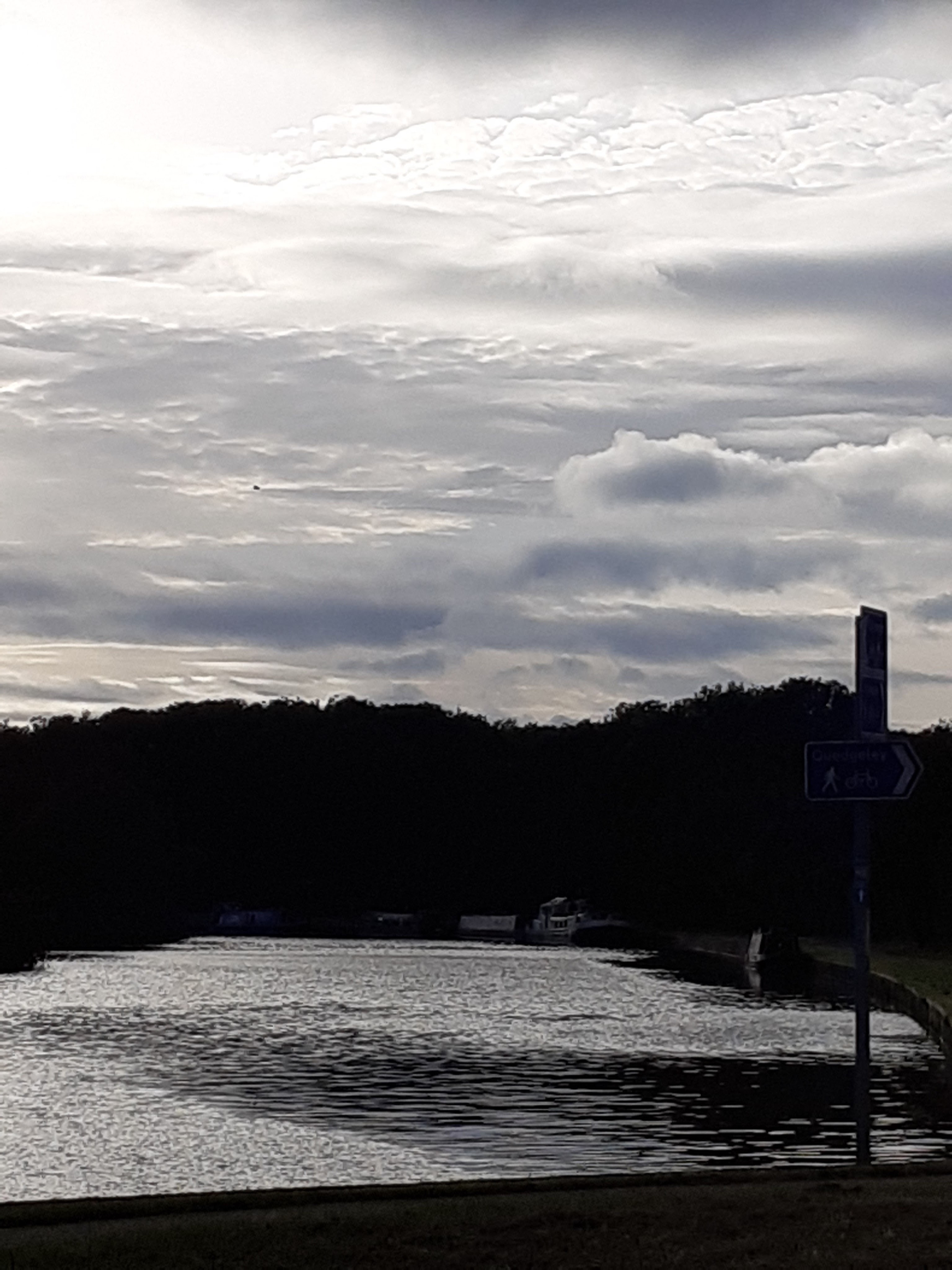
The haws are red and shiny on their hawthorn bushes. Blackberry remains tentative, its pale green fruit visible but still unripe. I see green leaves now leaning towards yellow. I am walking in a scrap of local woodland, bounded by a canal* on my left and housing some distance to my right. It is around 7.30 pm on 13 August, and I am opening up to the colours of late summer as they show themselves this year.

Looking up, I see a healthy crop of crab apples at different stages of ripening on their tree. The ripest apples are red, though their red is softer than that of the haws. The leaves of the apple tree are shinier than those in the background. I am aware of a light grey sky.

Nature in various forms finds a niche everywhere. This time has its own flowers, and again I see yellow. I am not the greatest botanist. and I cannot name with certainty these plucky if slightly battered blooms, saying hello from behind a fence. But I imagine them as poor relations of even the lesser celandine, and therefore almost certainly official weeds**. I hope and pray they remain safe here in these woods.

Below, looking at tangled leaves, I find a truly autumnal scene, in the yellowing and browning of leaves. It feels a bit early for this neighbourhood. The wheel of the year is still following its seasonal course, so far, but is becoming more erratic and unpredictable than in the past. I wonder about the future of the jet stream – and indeed the Gulf stream too. But in the moment, my heart opens and I love this pattern of plant life moving through its cycle and gradually, subtly, changing in appearance.

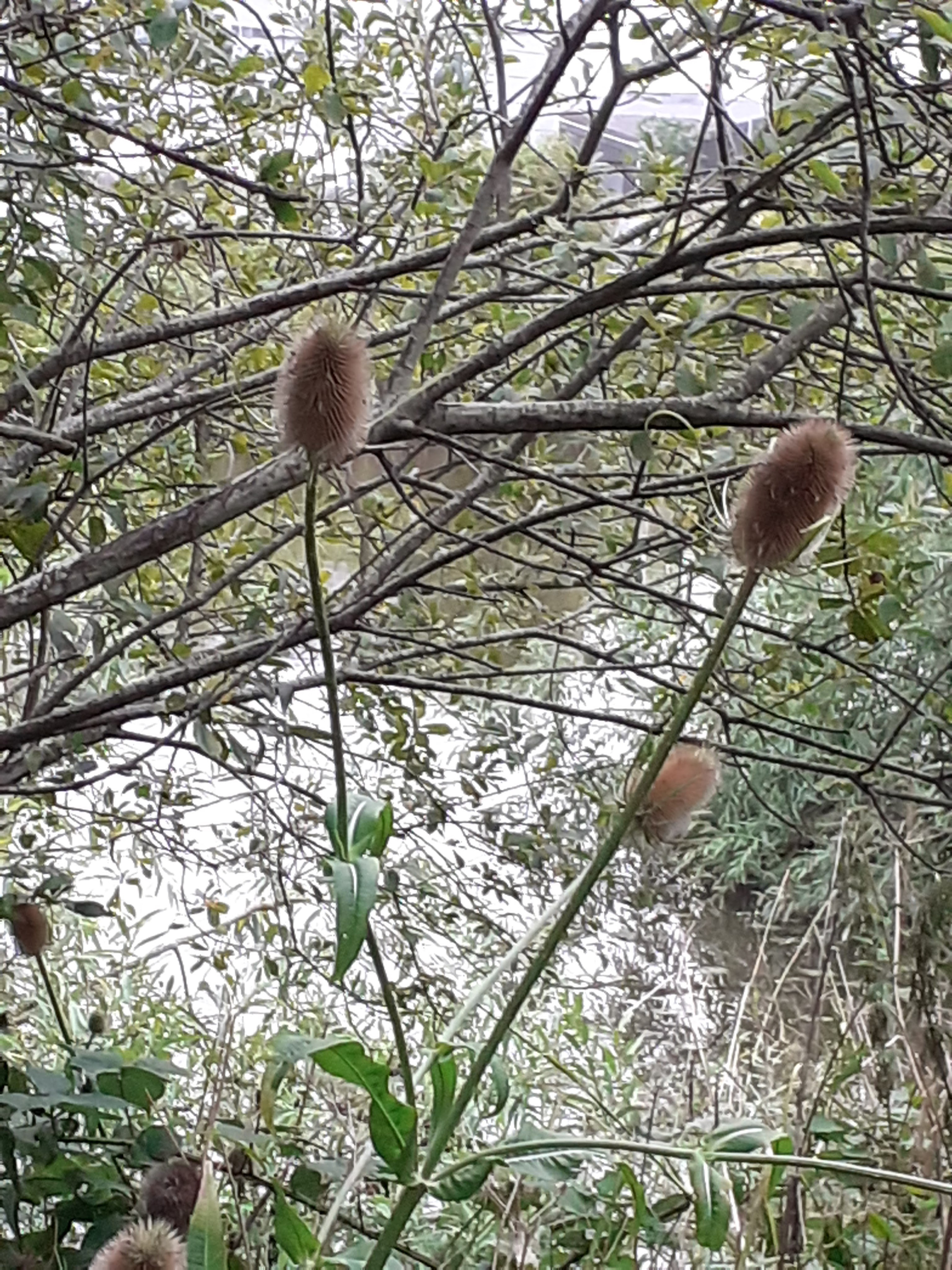
I photograph two teazel stalks, below, because I enjoy their shapes, because they are a further illustration of the browning theme, and also because of the visibility of the canal behind them. They don’t live in the canal, like bullrushes, but they like to be close. The image also includes an almost ghostly barge on the water below.

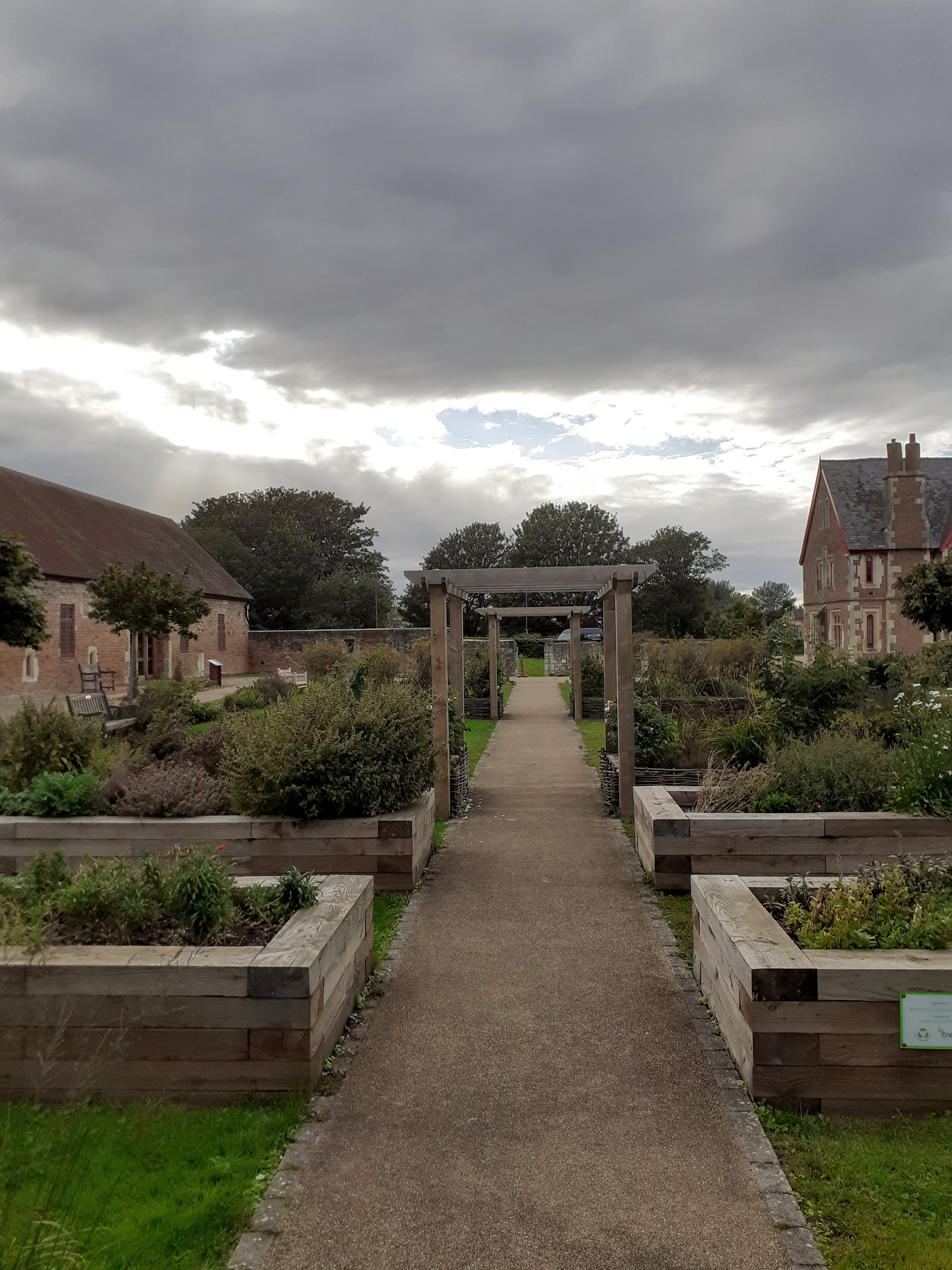
After leaving the woods, I am confronted (below) with the sky. I am facing west, across the Llanthony Priory gardens. I see dark stormy clouds, whose edgy brooding energy is somewhat modified by a blue opening in the distance. This dark grey, and the rain and storm it sometimes brings, have certainly been a feature of summer this year. There’s a strong contrast with last year at this time, when there was a heat wave, which for us still means C 30-35/F 86-95 with anything more being exceptional. In July 2022 part of the country briefly reached over C40/F 104 for the first time since records began. This year the grass is still green. Last year it burned up and the ground was parched and cracked.

Following the wheel of the year carefully, as it turns, is a valuable discipline for modern Druids, among others concerned with deep ecology (sacred ecology?) and the climate crisis. We don’t confine ourselves to celebrating our seasonal festivals, though we enjoy them too. For we now know experientially that the world is changing. The traditional rhythms of nature are not an eternal verity to rely on.

In some ways I find small personal observations emotionally more impactful than my limited knowledge of climate science and deep time geology. These are very helpful for context and framing, but personal experience is more immediate than these. It is also more deeply immediate, though less dramatic and disturbing, than reports of disaster elsewhere. Following the wheel of the year, we are doing more than making observations. We are celebrating and bearing witness to the life that surrounds us, offering our attention and energy to its continued flourishing. Blessings on the land.

*The Gloucester-Sharpness canal, England. Beyond the Gloucester docks, but not yet out of the city.

** A reader comments: “I think your mystery plant is ragwort, a much maligned ‘weed’ the destruction of which is encouraged by the UK government as it can be harmful to grazing animals yet is actually one of the best forage plants for pollinators”.

TALIESIN THE SHAPE SHIFTER

This is my third in a series of posts drawing on Gwyneth Lewis’ and Rowan Williams’ modern English version of The Book of Taliesin (1), an anthology of bardic poetry from medieval Wales. My first post introduced the book and offered extracts from A Song of the Wind (2). The second looked at the importance of ‘The Old North’ (territories in north-west England and southern Scotland that shared the same history, language and culture as the people of Wales) (3). This, final, post looks at the development of the Taliesin figure in the later middle ages. In particular, I focus on the anthology’s section entitled Legendary Poems and on the translators’ understandings of bardic poetry, shapeshifting and awen. I also look at their reasons for interpreting the Taliesin of these poems as “a kind of Christian shaman”.

In these poems, the use of shapeshifting language is presented as being a feature of competition between rival bards. “The Taliesin figure demonstrates his superiority … by spelling out at triumphant length the questions he can answer about which his rivals are ignorant, and by listing the various embodiments he has experienced”. The translators give an example of this in the opening of The Battle of the Trees.

“I was in many forms

Before my release:

I was a slim enchanted sword,

I believe in its play.

I was a drop in air,

The sparkling of stars,

A word inscribed,

A book in a priest’s hands,

A lantern shining

For a year and a half.

A bridge in crossing

Over threescore abers (= estuaries).

I was path, I was eagle,

I was a coracle at sea.

I was bubbles in beer,

I was a raindrop in a shower.

I was a sword in the hand;

I was a shield in battle.

I was a harp string,

Enchanted nine years

In water, foaming.

I was tinder in fire,

I was a forest ablaze”.

The editors comment: “these extraordinary poems reflect a sophisticated and complex understanding of poetic composition in which the concept of awen is central. It would be misleading to translate this idea of inspiration as ‘Muse’: it is better thought of as a state of altered consciousness in which the poet receives knowledge of matters beyond what can routinely be learned. According to Gerald of Wales’ description of the awenyddion, or inspired soothsayers, of the 12th century CE, the gift of awen produces the same kinds of extreme behaviour as are associated with spirit possession: loud shouting, trance and catalepsy, disconnected but also very elaborate speech, narrated experiences of supernatural encounters which trigger the exercise of this gift, and a subsequent inability to remember what was said under its influence”.

Poems like The Battle of the Trees may be “an attempt to reflect the style or register of such ecstatic states of consciousness”. However, the poems themselves may not be “transcriptions of specific compositions originating in altered states”. In cultures that have a “routine ritual space” for “ecstatic phenomena”, the irruption of the supernatural will follow a familiar pattern. “There will be expectations about both the actual expression and the transmission of what has been delivered”. If poetry is to be recognised as the authentic voice of ecstatic perception, “it must follow certain classical, normative exemplars of poetic ecstasy”. The Taliesin of these poems is a composite figure modelling how to speak as an awenydd. He demonstrates a particular way of being a poet and sounding like a poet of this kind.

Religious tensions appear in The Spoils of Annwfn. The bard rails against the ignorance of monks.

“And the monks herd together, a pack of dogs,

In the contest with those

Who have mastered the lore –

Whether wind takes one path,

Whether the sea is one water,

Whether fire’s unstoppable force is one spark.

The monks herd together, a pack of wolves,

In the contest with those who have mastered the lore –

They don’t know how darkness is severed from light,

They don’t know the course of the wind in its rushing,

Where the wind will lay waste, what land it strikes,

How many saints in the sky’s vault, and how many shrines.

I will praise the Prince, the Lord, the Great One.

Let me not be sad: Christ will repay me.”

The translators point out that the shapeshifter Taliesin of the 12th century CE, is “multifaceted” compared to the court bard of the 6th-9th centuries. The later literature links Taliesin “especially with stories involving the figure of the sorcerer Gwydion and the ‘children of Don'”. His status as dewin (sage or sorcerer) or occasionally derwyd (druid) is “so equal in importance to his standing as a poet that the two might more accurately be said to become inseparable”. But he is also shown, as in the extract above, dutifully commending his work to God and as “being familiar with theological questions, most notably those relating to the Incarnation, and with apocryphal traditions surrounding the biblical narratives”.

Lewis and Williams conclude that “this later Taliesin becomes a bridge figure between traditional Welsh lore and the cosmopolitan world of early medieval ecclesiastical learning”. The extract above reflects “a resentment of the new monastic foundations after the Norman Conquest, the Benedictine houses that sprang up in proximity to the new castles and settlements in the Welsh Marches (English/Welsh border counties). Monks from continental Europe are unlikely by this date to have been familiar with or sympathetic to the rather older style of clerical learning represented by the riddling and legendary elaborations of the Christian story found in the Irish or Anglo-Saxon texts of the early Middle Ages; Taliesin thus becomes a mouthpiece for this archaic Christian lore as well as the archetypal bard and seer”. This is why the translators characterise Taliesin in his shape-shifting period as a “Christian shaman”.

(1) Gwyneth Lewis and Rowan Williams The Book of Taliesin: Poems of Warfare and Praise in an Enchanted Britain Penguin Random House UK, 2020 (First published in hardback in Penguin Classics and 2019) Gwyneth Lewis was National Poet in Wales, 2005-6 and teaches at Middlebury College Vermont. Rowan Williams is a former Archbishop of Canterbury, subsequently Master of Magdalene College, Cambridge.

(2) https://contemplativeinquiry.blog/2023/08/07/

(3) https://contemplativeinquiry.blog/2023/08/10/

Earth Eclectic

music that celebrates Earth and speaks to the heart

Sarah Fuhro Star-Flower Alchemy

Follow the Moon's Cycle

Muddy Feet

Meeting nature on nature's terms

Rosher.Net

A little bit of Mark Rosher in South Gloucestershire, England

Becoming Part of the Land

A monastic polytheist's and animist’s journal

selkiewife

Selkie Writing…

Charlotte Rodgers

Images and words set against a backdrop of outsider art.

Prof Jem Bendell

living with metacrisis and collapse

Towint

The pagan path. The Old Ways In New Times

The Druids Garden

Spiritual journeys in tending the living earth, permaculture, and nature-inspired arts

The Blog of Baphomet

a magickal dialogue between nature and culture

This Simple Life

The gentle art of living with less

Musings of a Scottish Hearth Druid and Heathen

Thoughts about living, loving and worshiping as an autistic Hearth Druid and Heathen. One woman's journey.

Wheel of the Year Blog

An place to read and share stories about the celtic seasonal festivals

Walking the Druid Path

Just another WordPress.com site

anima monday

Exploring our connection to the wider world

Grounded Space Focusing

Become more grounded and spacious with yourself and others, through your own body’s wisdom

The Earthbound Report

Good lives on our one planet

Hopeless Vendetta

News for the residents of Hopeless, Maine