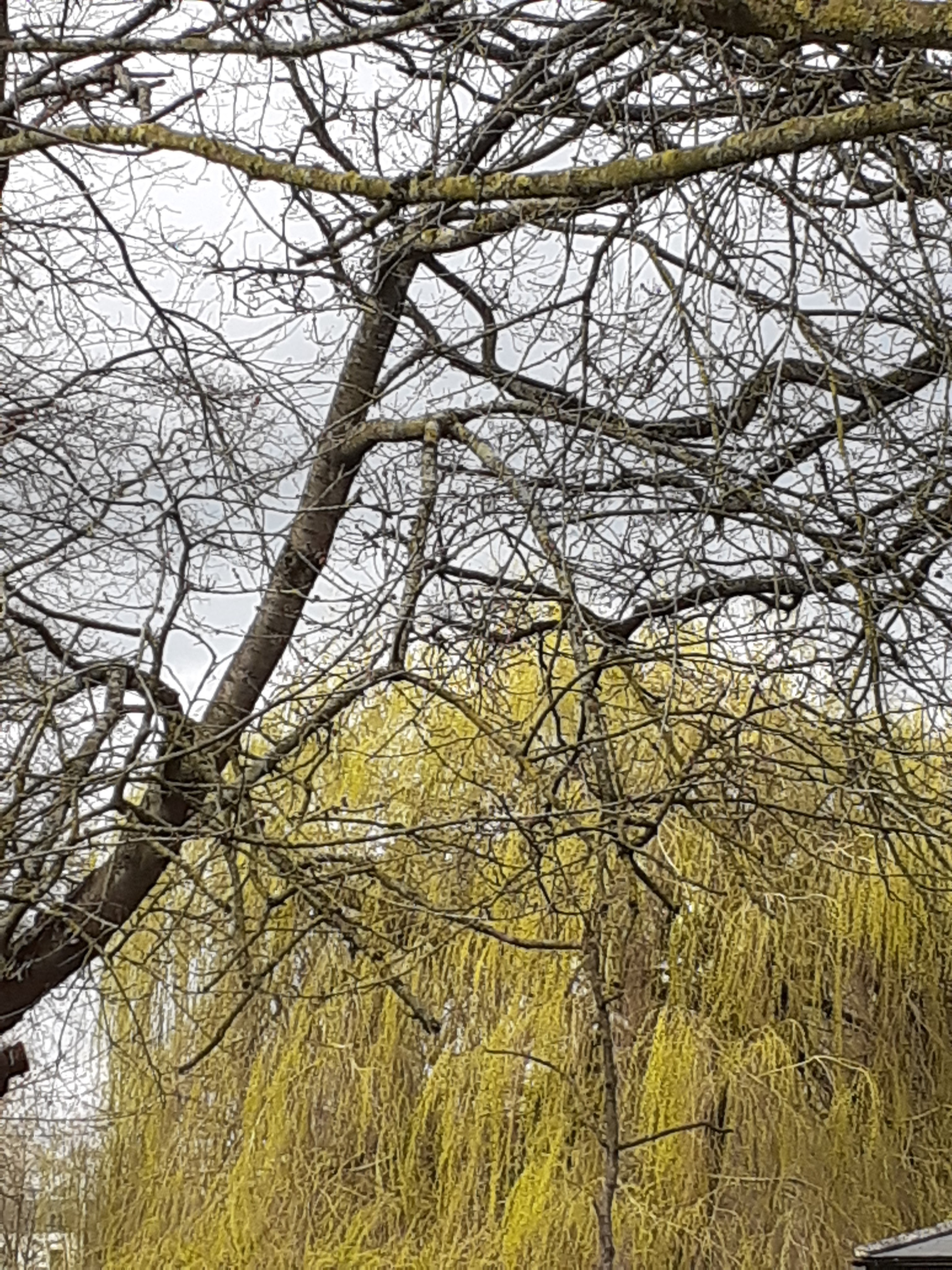
I spend time inside looking out. The sky changes a lot. Its shifts are rapid and dramatic. The trees change too, but over longer periods of time. The high levels of rain this year have encouraged an exceptional verdancy and abundance. Looking out, I can almost forget that I am in a block of newish flats in an old urban area. The person walking on the pavement below seems dwarfed by the splendour of the leaves. The road is very quiet for a late morning. The wheel of the year turns, approaching its summer zenith in this part of the world.
I am settling in to a higher number for my official age. In social gerontology, there are (or have been) three kinds of ‘old’: young-old (50-64), middle-old (65-74) and old-old (75+). I am now old-old and statistically immune from premature death. These classifications don’t quite fit my lived experience, but they are a sort of landmark all the same.
Elaine and I have been together for nine days following her repatriation and subsequent stay in a local hospital. We are learning how to live a new phase of our relationship where she has high needs and is housebound, and I am in a ‘caring’ role in the institutional sense of that term. We are learning as we go along and doing our best to be conscious about our experience as well as practical in an ‘activities of daily living’ sense. I think we are doing OK. We are establishing new patterns of day to day life and Elaine’s capacity is increasing.
Mostly I leave the flat only for shopping and other practical tasks and, because we are so well situated, these don’t take long. On Saturday Elaine and I both felt comfortable and confident with me going out on a one hour recreational walk. I continue with a regular practice and journaling. I still practice within a Druid circle (grove) and I find this healing and re-energising. At the same time my work has been referenced more to five personal commitments rather than to tribal membership, religious devotion or spiritual metaphysics. Recently I have been contemplating my commitments and checking out whether they still work for me. These are:
1. I will work from the stillness of the centre.
2. I will cultivate good will towards self, others, and the wider web of being.
3. I will cultivate positive health and well-being, within whatever constraints may apply.
4. I will cultivate discernment, creativity and wisdom, to the best of my understanding and capacity.
5. I will cultivate a life of abundance in simplicity, living lightly on the earth.
I do see a danger in lists like these: they can become a frozen and pious – an internal rhetorical performance. For me, contemplative inquiry keeps my commitments alive, suggesting revisions if necessary. This is my direction, going forward, in the unfolding chapter of my life.
On 12 May I wrote: “I hope soon to get some sense of how soon Elaine will come home, and what resources we will need for our lives going forward. It’s my 75th birthday on 25 May, and my best present would be to have Elaine home by then.” (1) Today is 25 May, and my wife Elaine is indeed coming home from the Gloucester Royal hospital. It has felt like a long absence for both of us and we are glad to move into a new chapter of our lives.
Yesterday evening I went Alney Island, a Gloucester wetland, for a brief contemplative walk. The footbridge near Gloucester docks has been repaired and after many months the island is easy to reach again. Back on the island, I loved its sense of growth and abundance in the summer evening light. I felt care-free. I had almost forgotten how much experiences like this nourish me.
This is a festive moment in my life: a significant birthday, Elaine’s return, celebrating a moment in the year that makes me glad to be alive. I feel refreshed, heartened and re-energised.
“A sign is what characterises the appearance of something, its form. If we recognise things based on their sign, we may think that this cloud is different from that cloud, the oak tree is not the acorn, the child is not the parent. At the level of relative truth, these things are helpful. But they may distract us from seeing the true nature of life, which transcends these signs.
” ….
“You are always changing form. You are browsing through a family photograph album, and come across a photo of yourself as a young child. Where is that little child now? You know that it is you. You have the same name, and yet it doesn’t look like you. Are you still that child or are you someone else? This is a practice of contemplating your own signlessness. Today you look, speak, act and think differently. Your form, feelings, perceptions and consciousness are all very different. You are not fixed and permanent. You are not the same person, but you are not a totally different person either. When you are no longer caught in specific images or appearances, you can see things more clearly. You can see that the little child is still alive in every cell of your body. It is possible still to listen and take care of the little boy or little girl in you at any time.” (1)
(1) Thich Nhat Hanh The Art of Living London: Penguin Random House UK, 2017
Ego sets me up, in both a narcissistic and rational way, to be the hero of my own journey. But it’s at least equally valuable to have a support role in someone else’s. On Monday 8 April my wife Elaine flew to Gran Canaria with her sister Glynis for a restful and undemanding holiday. It worked brilliantly for nearly three days. On Thursday 11 April Elaine had a fall resulting in a fractured femur. Instead of a restful and undemanding holiday, they were in a health disaster overseas.
Elaine was duly admitted to hospital. Other health complications – a characteristic of we older people – meant it took 9 days for Elaine to have a successful operation: not ideal given the problem being addressed. Glynis was the support person and champion at this stage. But soon it became evident that Elaine would not be well enough for repatriation for some time. An original plan for me to be the person who organised things at home was ditched, and I flew to Gran Canaria on 28 April allowing Glynis to go home.
In a way it wasn’t hard. But I was knocked around by Elaine’s predicament, which might have been fatal, and by the culture shock of being in a new place where, but for the kindness of strangers, I had the verbal and communication skills of, at best, a chimpanzee. I also had to be, or at least appear to be, competent in managing (influencing?) the hospital and insurance companies’ relationship both with Elaine and each other. A completely unfamiliar situation for me, and not one that I would want to be in again.
We managed somehow. Elaine and I know and love each other. We supported each other in our respective roles. I liked my hotel though its amenities were largely wasted on me. Its great virtue was in being 15 minutes easy walking distance from the hospital. I spent several hours a day with Elaine, but also had several on my own. I needed to be away from stimulation for a good deal of time. I did enjoy the warmth, and especially at sundown, the sky over Gran Canaria’s south coast.
The repatriation, when it came, felt almost sudden. We flew back, together with a wonderful paramedic and minder sent over for the purpose, on Friday 10 May. Elaine, whose left leg is not weight bearing at all, was trolleyed and chaired both on an off a commercial flight where she got her own row of three seats. The cabin crew were great.
The repatriation process ended with an ambulance journey to the Gloucester Royal hospital, where our paramedic had organised Elaine’s admission in advance and Elaine was wheeled straight onto the orthopaedic ward where she now is. This is also in walking distance from our home. At the moment she is largely being monitored and tested. A new phase will begin when the physiotherapists show up on Monday. I hope soon to get some sense of how soon Elaine will come home, and what resources we will need for our lives going forward. It’s my 75th birthday on 25 May, and my best present would be to have Elaine home by then.
This post has been a simple story, without much obviously contemplative, reflective or overtly ‘spiritual’ content. But I don’t in my own life and practice make much distinction between the spiritual and mundane, and I do know that this has been a life-changing event. A pilgrimage, of sorts.
The Song of Amergin, here sung in Old Irish Gaelic, is the oldest known extant song in the Atlantic Archipelago*. The performers here are An Tuagh, whose core focus is the Gaelic-Norse traditions of northern Scotland. They have a YouTube channel, a Facebook page and an Instagram presence. The Song of Amergin is featured in their album Bard and Skald, as is a Beith-Luis-Nun Ogham chant. If you subscribe to the An Tuagh YouTube channel, there are commentaries on both pieces. The one for the Song of Amergin includes both Irish and English texts. However versions vary widely and An Tuagh have copyrighted theirs. I have included an open source English version below, to give some impression of what is being sung.
I am the sea blast I am the tidal wave I am the thunderous surf I am the stag of the seven tines I am the cliff hawk I am the sunlit dewdrop I am the fairest of flowers I am the rampaging boar I am the swift-swimming salmon I am the placid lake I am the summit of art I am the vale echoing voices I am the battle-hardened spearhead I am the God who inflames desire Who gives you fire Who knows the secrets of the unhewn dolmen Who announces the ages of the moon Who knows where the sunset settles
I have listened to An Tuagh’s rendition of the Song of Amergin a number of times, sinking into a sense of shared presence with something preciously archaic and other. An Tuagh are the intermediaries, helping me to catch an after echo of that time. I don’t have fully to understand it, but simply respond. I am grateful both to the old culture, and to skillful modern bards.
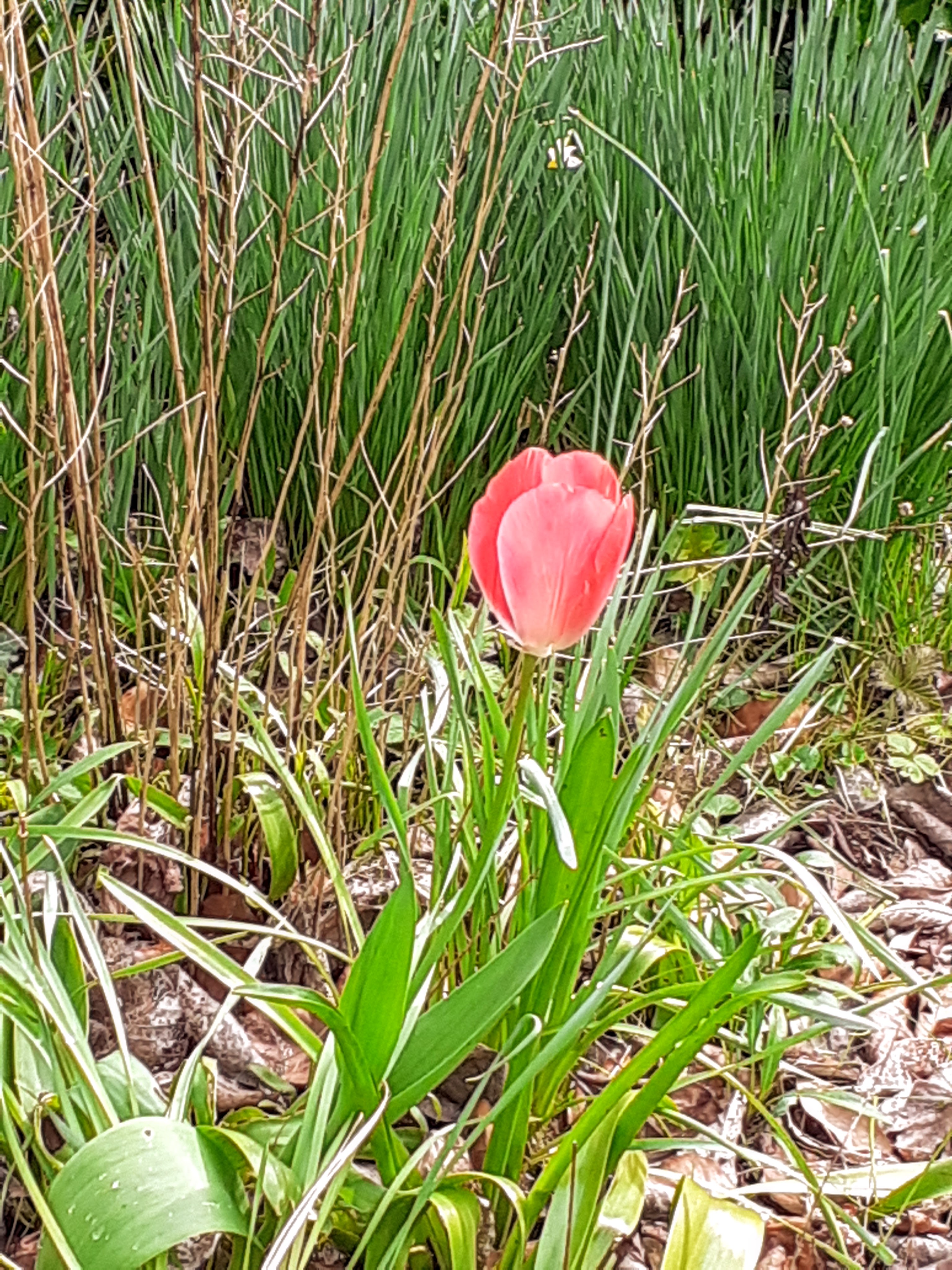
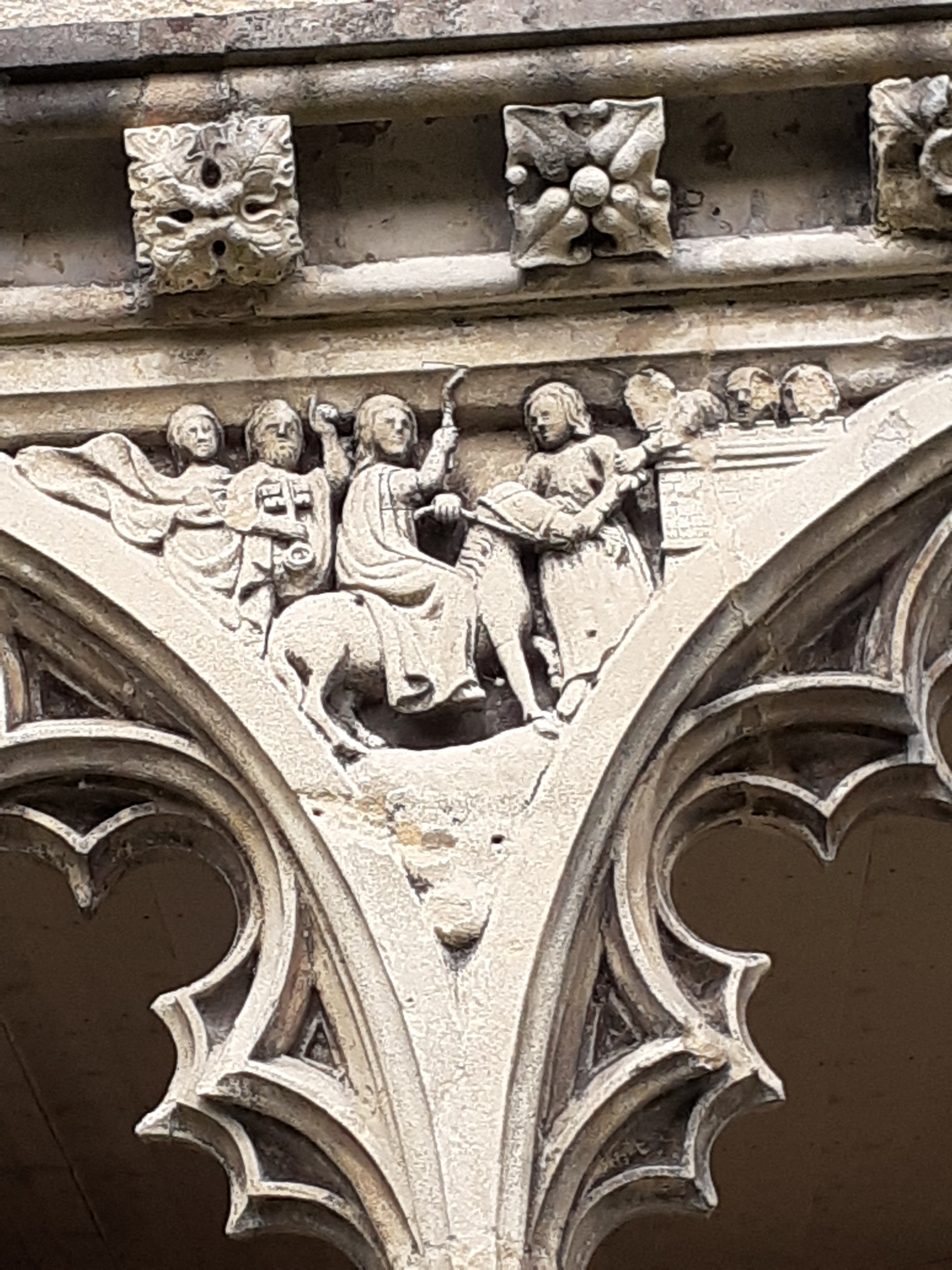
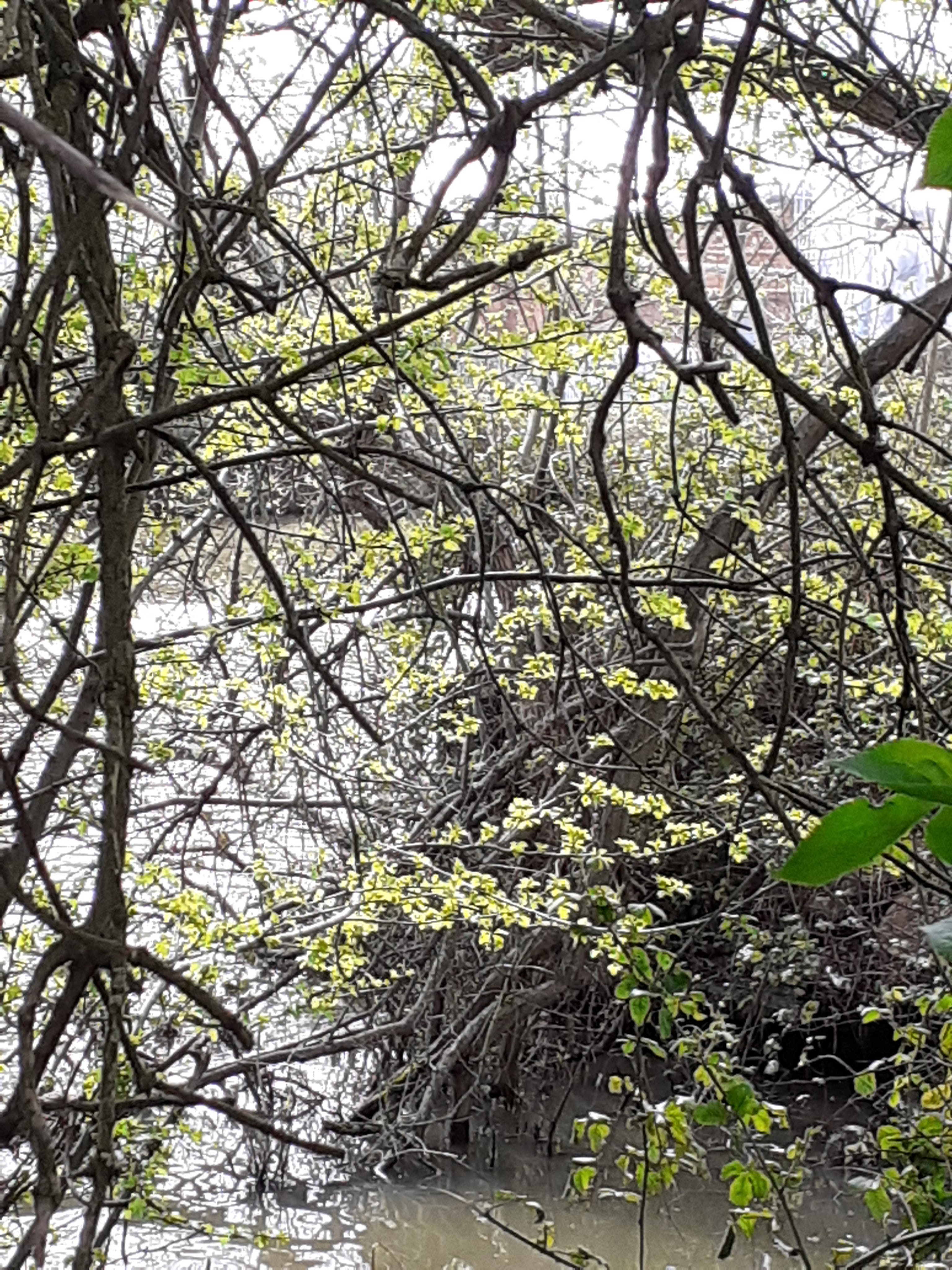
NOTE: At the beginning of April I discovered Hillfield Gardens – a little outside the centre of Gloucester, yet still in easy walking distance (or an easy bus ride) from where I live. Originally the gardens of a large house, Hillfield Gardens are about 1.6 hectares in extent. They are managed by a Friends Group on behalf of Gloucestershire County Council. For me the gardens are a tranquil space, different in feeling-tone from other local parks. Beyond that I don’t yet have a narrative about the gardens – more a set of discreet impressions. The pictures and words above are an attempt to share these impressions. The third picture is a detail from an 18th century gazebo using architectural details from a 14th century market house in Westgate Street demolished in 1780.
I am walking among trees, feeling refreshed and renewed after a long winter. This feeling is anchored by the return of leaves. I am present in, and to, the presence of new green. It comes every year, at slightly different times. I’m noticing the beginning of a beautiful verdant period. It’s re-appeared a little early this year and I experience this as a great blessing.
Where I live, the early spring has been wet and windy, often with dull skies. Nature has been alive and active throughout this period, but I have remained wintry in important respects. This weekend has changed me. I am aware of new green leaves and a strengthening sun. The latter may be visually dimmed by frequent of heavy cloud, but the leaves reassure me of its power in the rising year. Although we are still far from a full canopy in the woods, the life-force – in modern Druidry often called nwyfre – is strong. It’s a time for celebration.
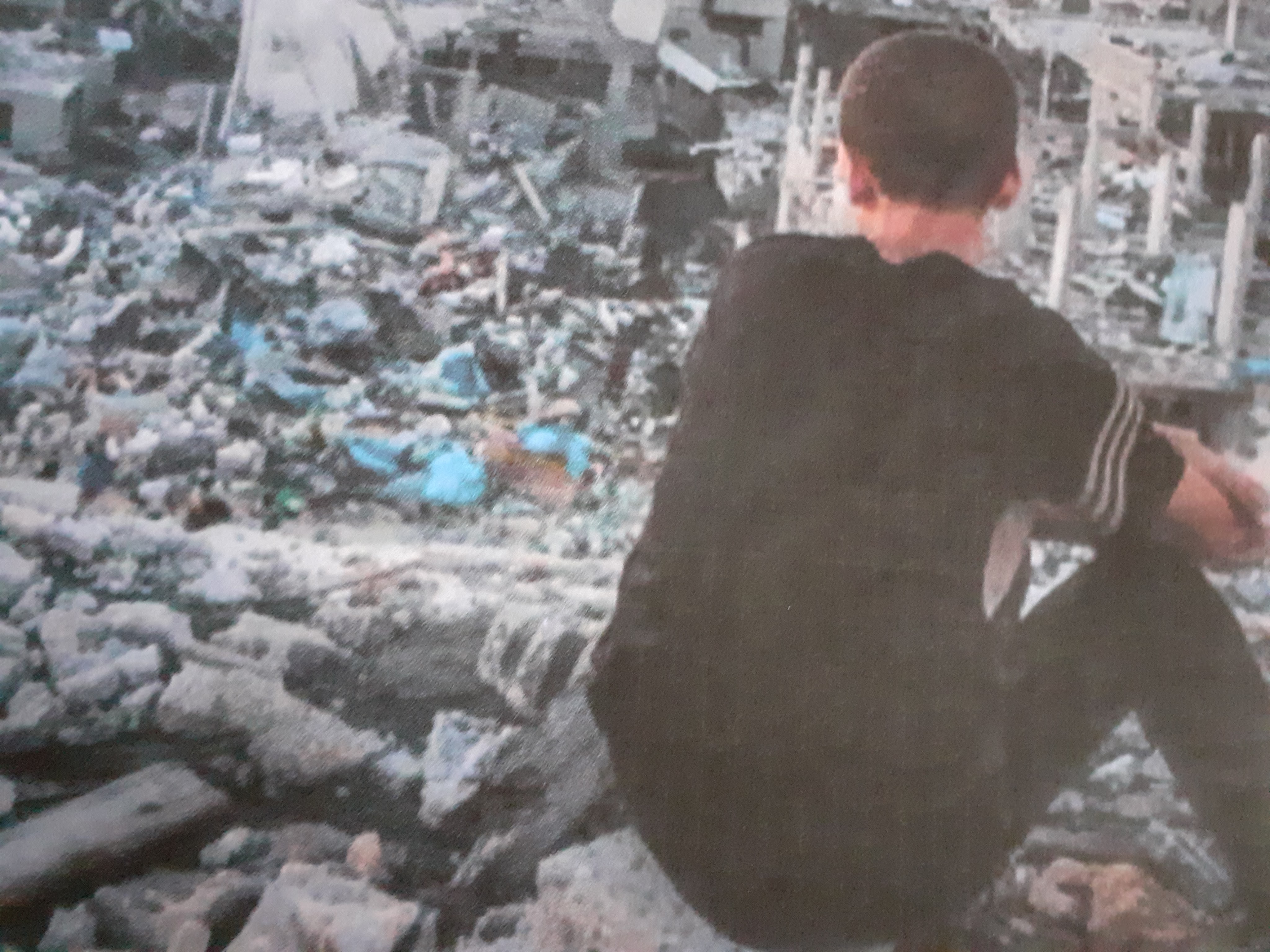
“In Gaza, there is no ‘post’ [traumatic] because the trauma is repetitive and ongoing and continuous.” Dr. Samah Habr is Head of Mental Health Unit, Palestine Ministry of Health. She wrote these words in 2021, after the 11 day Israeli day air assault carried out in May of that year. It was the fourth war since the beginning of the blockade of Gaza in 2007. Recently I attended a Zoom event, predominantly for Amnesty International volunteers (1). Dr. Habr gave a presentation about mental health in the Palestinian territories occupied by Israel since 1967, with a focus on Gaza from 2007-2021, where there is good enough data to process scientifically. Clearly the situation is much worse today.
The blockade itself created deep poverty, an ongoing water crisis and a severe curtailment of opportunities. A mental health study of children at that time showed that 80% of Gaza’s children had experienced personal trauma and 54% met the official diagnostic criteria for PTSD. Dr. Sabr describes this prevalence of psychological trauma as ‘the disaster of helplessness’ and identifies three forms of it at play:
chronic trauma prolonged. pervasive distressing events such as poverty and institutionalized discrimination
inter-generational trauma psychological trauma experienced by the descendents of a person who has survived a traumatic event
acute trauma an extremely distressing individual event
She goes on to use the word ‘humiliation’ to describe “the pervasive and fundamental experience of the Palestinian people as a whole, under occupation, underlying the varied military, social, economic, and human rights violations that have been imposed over generations”.
One of Dr. Sabah’s principles is that “we cannot treat what we do not acknowledge”. A psychiatrist herself, she says that the Western-based medical model of mental health, codified in the DSM series, is over-individualised. Palestine has few resources for mental health provision, and few mental health practitioners. (There have been some, even in Gaza – 12 of the 67 children killed in the 2021 action were participating in a trauma recovery program.)
Dr. Sabah introduces the concept of Sumud and defines it as a combination of of endurance and steadfastness, both individual and collective. A mental state as well as action oriented, it:
is prosocial and community oriented
fosters endurance and steadfastness
enables defiance against oppression
promotes solidarity
is committed to keep loving despite injustice
Dr. Habr suggests that historical/collective trauma needs to be reprocessed collectively. “It can be alleviated through cohesive and collective efforts such as recognition, remembrance, solidarity, creativity, community psychology and mass cooperation. In youth work particularly (the Palestinians are predominantly a young population), a suggested model is that trauma informed-teachers, medical staff and parents offer community-based interventions in safe spaces – open studios, symbolic expression, theatre of the oppressed).
Dr. Sabr concludes that positive mental health cannot be achieved without justice. “Human rights are the cornerstone upon which mental health flourishes. Without dignity, without freedom, without justice, our emotional well-being is torn apart, leaving us adrift in a sea of suffering.”
All of the crimes in Israel/Gaza from 7 October 2023 have haunted me. This is my second second post about ongoing destruction of Gaza and the deadly consequences for its people (2). Do such posts have an appropriate place in my contemplative inquiry? Yes. If I am held within interbeing (3), I cannot separate myself from these events. If they enter my head, heart and dreams, they are present anyway. I am asked to be conscious and mindful or I will be prey to disabling distress and unskilful ideation. In an outer ripple kind of way, they become an issue for my own mental and emotional wellbeing.
There’s not much I can do other than be conscious and bear witness. But that, at least, is something. On behalf of her people Dr. Habr has asked the people of the West not to abandon them. So today I am moved to write about an aspect of Palestinian experience even in ‘normal’ times.
I believe that Dr. Habr has also given a gift to us. Reading her account of Sumud, it seems to me that its population based take on mental health is portable. I am confident that it can be applied with appropriate cultural modifications in other settings with potentially emancipatory results.
(1) Amnesty International, as anon-partisan human rights organisation, does not take a position on what an eventual settlement in Israel/Palestine should look like. But it does advocate an immediate cease-fire, an embargo on military sales, and a dismantling of the apartheid system operating in the whole territory both for Arab Israelis and Palestinians living under occupation. The event I attended included presentations on possible pathways to peace and Jewish opposition to the current war. For general information about Amnesty in the UK, see https://amnesty.org.uk/
I’m walking in my local park. It’s a dull day in the first half of March. There have been many such days, and I could do with more sun. I certainly feel lifted when it comes. At the same time the days are longer and Mother Nature is busy with the work of spring: an abundance of willow catkins is testament to this.
I get my strongest impression of the strength and fecundity of willow when close up. The individual catkins are clearer, more prominent. The colours are stronger. There’s the sense of a rich and vibrant ecosystem, powerfully alive.
Still images don’t provide movement and sound, or indicate the presence of the March wind. I have tried to capture this in my short video below, illustrating another aspect of this moment in the year. It brought up fond childhood memories of Kenneth Grahame’s The Wind in the Willows which begins with spring cleaning and includes the gently Pagan chapter The Piper at the Gates of Dawn.
Willow became important to me in my early study and practice of Druidry. I began a special relationship with a particular willow in Bristol for many years (2), which continued after I left the city and continues sporadically to this day. I also developed a private tradition of following the wheel of the year through a mandala based on 16 trees, all in easy distance of where I lived, with Willow the focus from 17 March to 7 April, hence presiding over the spring equinox (3). Checking in with the willows is a continuing feature of my walks, though I was a little early this year.
(1) Kenneth Grahame The Wind in the Willows London: Dean, in association with Methuen’s Children’s Books, 1991. (Ist ed. 1908. Illustrated by E. H. Shepard)
Highly recommended to anyone interested in Chinese traditional poetry and culture, and the way it is received in China today. I looked at an aspect of Michael Wood’s In the Footsteps of Du Fu: China’s Greatest Poet (1) in my last post (2). This is a full book review. The back cover provides an accurate basic summary of its contents: “For a thousand years Du Fu (712-70 CE) has been China’s most loved poet. Born into the golden age of the Tang Dynasty, he saw his world collapse in famine, war and chaos. The poet and his family became impoverished refugees, but his profound vision and his empathy for the sufferings of humanity endured, and have endeared him to readers ever since. … Broadcaster and historian Michael Wood follows in Du Fu’s footsteps on a pilgrimage through the physical and emotional landscapes of his life and work”.
The book, lavishly illustrated, is divided into 24 chapters. Many of these are headed by place names. Michael Wood visited most of them on his own journey, talking with scholars and enthusiasts and also taking time to observe the very different China of today. The narrative is somewhat tilted towards the last 15 years of Du Fu’s life, when the War of An Lushan (3) displaced Du Fu and turned him into an internal refugee, constantly on the move, for the rest of his life. It is also seen as the period of his best poetry.
The first chapters of the book emphasise the easy optimism of Du Fu’s early years. A new Emperor, himself a painter, musician and poet, launched a cultural rebirth. He was a patron of libraries and scholars. He ruled a prosperous and peaceful country. Du Fu writes nostalgically of childhood years in which “rice was succulent … the granaries were full, and there was not a robber on the road in all the 9 provinces of China”. Growing up in the city of Gong-yi on the Yellow River, the son of an Imperial official, Du Fu looked forward to a successful life as both official and poet. “I’d read everything and I thought I was superb”. He went to Chang’an and took his exams for the Imperial service.
He failed them. “In the blue sky my wings failed me”. For some years he went on a series of family supported wanderings, honed his poetic skills and became interested in the Chinese version of Mahayana Buddhism. Returning to Chang’an he failed the exams again, but managed to get a lowly official job, married, and began to raise a family. He settled them in Fengxian near the capital, a place that featured hot springs. Although he had to be available at Chang’an, he visited often. At this point his poetry began to show a concern for ordinary people.
Here at the hot spring the emperor entertains his court
And music echoes around the hills.
Only the rich and powerful bathe here.
But the silk they wear was woven by people,
women whose husbands are beaten for their taxes.
In 755, even before war broke out, China was devasted by floods and a resultant famine. Du Fu lost an infant son to starvation and wrote that he was ashamed to be a father. Famine threatened again, on the road, after the rebel victory:
My little girl bit me in her hunger
And fearful that wolves or tigers would hear her cries
I hugged her to my chest, muffling her mouth,
But she struggled free and just cried more.
Michael Wood provides a map of the family’s subsequent movements, generally in the rugged, often spectacular and less populated west of China. They could never settle for very long, as political and military conditions remained volatile and unsafe. I describe Du Fu’s sojourn in Chengdu in my pervious post (2). Towards the end of his life, conditions seemed to be easing and the family began moving back east via the Yangtze river, in gradual steps. This gives Michael Wood the opportunity to describe his own experience of the hyper-modern city of Chongqing, though Kuizhou and the spectacular Three Gorges area are more important to Du Fu and his work. Wood says that, “in the Gorges, though it had been at great cost to himself, Du Fu’s gift was creative and imaginative freedom”. His output was prolific, and drew on a meditatively close encounter with nature.
Crescent moon stilled in the clear night
Half-abandoned to sleep, lamp wicks blossom
In echoing mountains unsettled deer stir
Falling leaves startle locusts.
By this time Du Fu was worn down by asthma, diabetes and years of hardship. Though he got a little further down river, he never made it to his original home. Nonetheless he was able to be defiantly celebratory:
Old and tired, my hair white, I dance and sing out:
Goosefoot cane, no sleep, catch me if you can!
Du Fu died at the age of 58 in Changsha in Hunan Province. Michael Wood went there simply to complete the journey, but was rewarded with a new lens on Du Fu’s work and the creative tradition he came from. He met Professor Yang Wu at the University there. One of her interests is “the living oral tradition of poetry and the possibility of reconstructing the ancient music that might have accompanied it”. Research on ancient poetry and music is an expanding subject in today’s China. Du Fu’s poetry has been preserved in Hunan oral tradition as well as in manuscripts. A local tradition of poetry clubs has survived the early Communist period. Now it is reviving and being encouraged. Professor Wu and her students have been busy with making replica’s of Tang dynasty instruments – for example the qin, a seven-stringed instrument with strings of twisted silk. They are finding manuscript records of early musical settings, and sound-recording local people’s singing. For me this adds another dimension to Du Fu’s work – where he can be understood , in part, as the lyricist for music that was performed in group and public settings.
In the Footsteps of Du Fu is highly informed and engagingly written. For me is also a beautiful artefact, though eminently portable, not at all a coffee table book. I rarely buy printed books now because the print is too small for me. But I was fine with this one and the illustrations are a joy. Another reason for my strong recommendation.
(1) Michael Wood In The Footsteps of Du Fu: China’s Greatest Poet London: Simon and Schuster, 2023
(3) In December 755 An Lushan, a Turkic general in the Imperial service, marched on China’s then capital city, Chang’an, from North China with a quarter of a million men. They inflicted a series of defeats on the Imperial army and occupied Chang’an in July 756. An Lushan was assassinated by his own son in 757 but the war continued for 7 years. Tang dynasty China, whilst nominally lasting for decades longer, was never the same again.
Personal note: Michael Wood’s introduction begins: “if you love literature of any kind, you will have had one of those moments when you encounter a book that opens a window onto a world you never dreamed existed. Mine was at school when I first encountered Du Fu in A. C. Graham’s wonderful Poems of the Late T’ang.” I had my own version of the same experience, and still have my battered old copy. Du Fu is transliterated in that and some other translations as Tu Fu. The price, in the top left corner of the cover (see picture) is 4/- (four shillings, or 20 pence in post-1970 UK money). I have never been a formal student or scholar in this domain, but modern English translations of classical Chinese poetry have left a deep impression on me. Another poem from this collection can be found in this blog at: https://contemplativeinquiry.blog/2016/02/04/poem-a-withered-tree/