Contemplative Inquiry

This blog is about contemplative inquiry

Tag: Seeing

BOOK REVIEW: ELEGANT SIMPLICITY
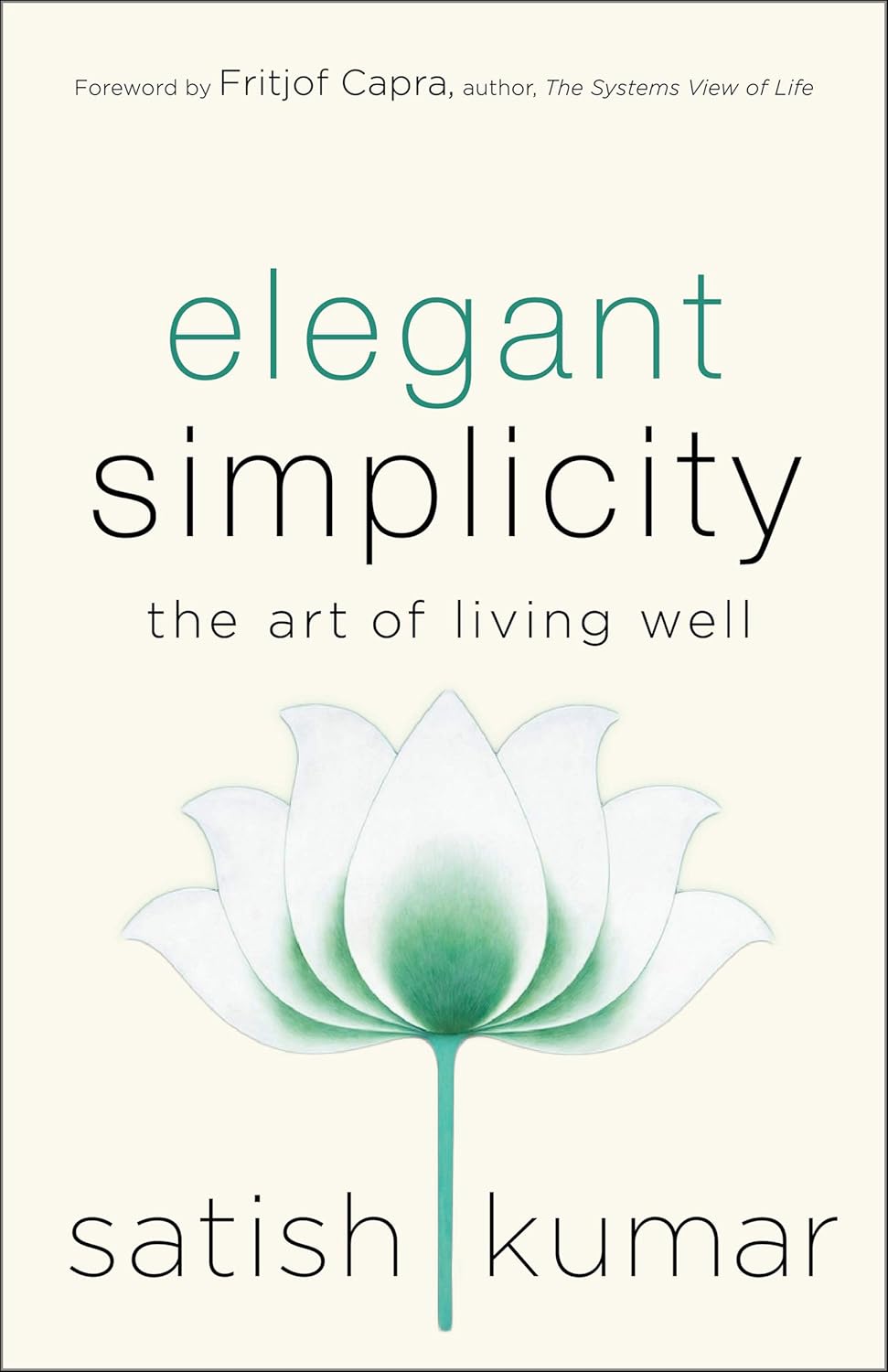
Highly recommended. Satish Kumar (born in 1936) published Elegant Simplicity: the Art of Living Well in 2019 (1). It begins with a foreword by Fritjof Capra and a preface by the author Let’s be Simple which quotes the 1848 Shaker song ‘Tis the gift to be simple, ‘Tis the gift to be free. The book summarises the author’s personal story as well as discussing his values. I have written posts based on some of his other work before (2). I especially recommend this book to anyone interested in knowing more about Satish Kumar’s practice (grounded in Jain spirituality and Gandhi’s non-violent activism) and his influence on deep ecology, creative arts and education.

Elegant Simplicity has a summarising quality, looking back on decades devoted to sacred activism in different forms. It is divided into fourteen chapters: Each is preceded by a brief and relevant quotation from another thinker. The chapter then becomes a meditation on the quote:

1 My Story: Beginnings – ‘True happiness lies in contentment’ Mahatma Gandhi.

2 Simplicity of Walking – ‘All truly great thoughts are conceived by walking’ Friedrich Nietzsche.

3 Life is a Pilgrimage – ‘Faith is not the clinging to a shrine but an endless pilgrimage of the heart’ Abraham Joshua Heschel.

4 Elegant Simplicity – ‘Any fool can make things complicated, it requires a genius to make them simple’ E. F. Schumacher.

5 A Society of Artists – ‘This world is but a canvas to our imagination’ Henry David Thoreau.

6 Yoga of Action – ‘Life is a process not a product’ Brian Goodwin.

7 Learning is Living – ‘Education is not preparation for life; education is life itself’ Thomas Dewey.

8 Right Relationships – ‘We are all related – relationships based on obligation lack dignity’ Wayne Dwyer.

9 Love Unlimited – ‘There is no charm equal to tenderness of the heart’ Jane Austin.

10 Power of Forgiveness – ‘It’s one of the greatest gifts you can give yourself, to forgive. Forgive everybody.’ Maya Angelou.

11 Dance of Opposites – ‘Life and death are one as the river and the sea are one’ Kahlil Gibran.

12 Deep Seeing – ‘To see clearly is poetry, prophecy, and religion, all in one’ John Ruskin.

13 Union of Science and Spirituality – ‘Science is not only compatible with spirituality; it is a profound source of spirituality’ Carl Sagan.

14 Soil, Soul and Society – ‘We live in an interconnected world and in an interconnected time so we need holistic solutions to our interconnected problems‘ Naomi Klein.

Fellow activist and author Vandana Shiva describes Elegant Simplicity as “the distillation” of Satish Kumar’s ideas and actions. “It shows the intimate connections between the inner and the outer world, soil, soul and society, beauty joy and non-violence. It indicates that the solutions to the big problems of our time – climate change, hate, violence, hopelessness and despair – lie in thinking and living with elegant simplicity, reducing our ecological footprint while enlarging our hearts and minds”.

For me, Satish Kumar is an inspiration rather than a direct model. Even in the conditions of the early 1960’s I would not have walked, or aspired to walk, from New Delhi to Washington DC without carrying any money. Yet Satish Kumar and his companion E. P. Menon succeeded and made a huge public impact at the time. Their peace pilgrimage gave oxygen to the campaign for nuclear disarmament. No state gave up its arms, but treaties limiting the numbers and testing of nuclear arms became normalised for some decades. Satish Kumar’s initiatives in deep ecology and education, especially the ‘small school’ and Schumacher College, have changed lives. Directly and indirectly, his influence has awakened many people from the dystopian trance of our dominant cultures. Satish Kumar is a widely revered elder: a peaceful warrior for a more liveable, generous and creative world.

(1) Satish Kumar Elegant Simplicity: The Art of Living Well New Society Publishers (https://www.newsociety.com): Gabriola Island, BC, Canada: 2019

(2) See previous posts:

NEWS OF A DEATH

TWO VIEWS OF THE DIVINE

OUTDOOR WALKING MEDITATION

NOTE: “Satish Kumar (born 9 August 1936)[1] is an Indian British activist and speaker. He has been a Jain monk, nuclear disarmament advocate and pacifist.[3]Now living in England, Kumar is founder and Director of Programmes of the Schumacher College international center for ecological studies, and is Editor Emeritus of Resurgence & Ecologist magazine. His most notable accomplishment is the completion, together with a companion, E. P. Menon, of a peace walk of over 8,000 miles in June 1962 for two and a half years, from New Delhi to MoscowParisLondon, and Washington, D.C., the capitals of the world’s earliest nuclear-armed countries.[4][5] He insists that reverence for nature should be at the heart of every political and social debate.” (Wikipedia)
ST DAVID’S DAY 2022: A WALK IN THE PARK

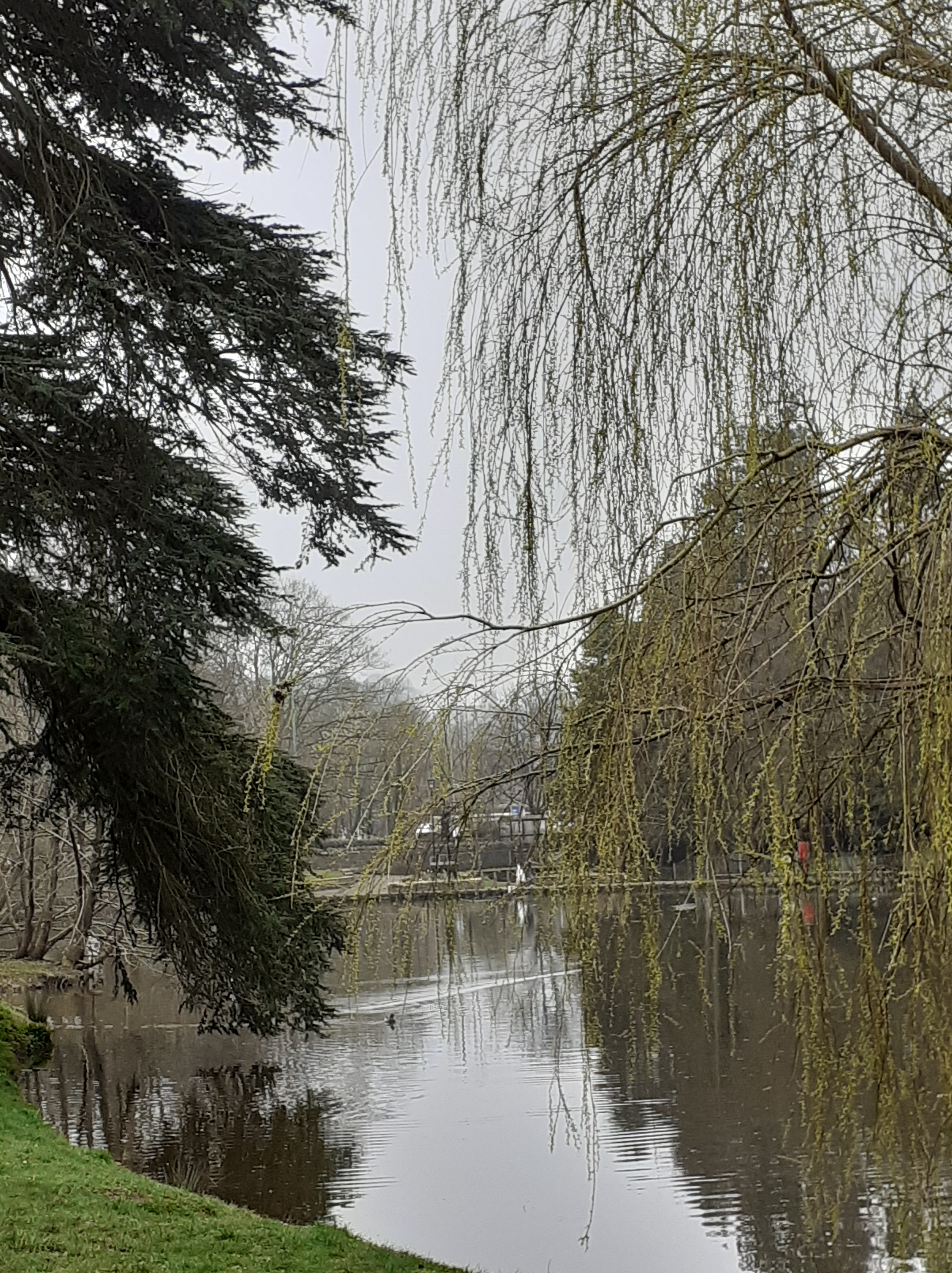
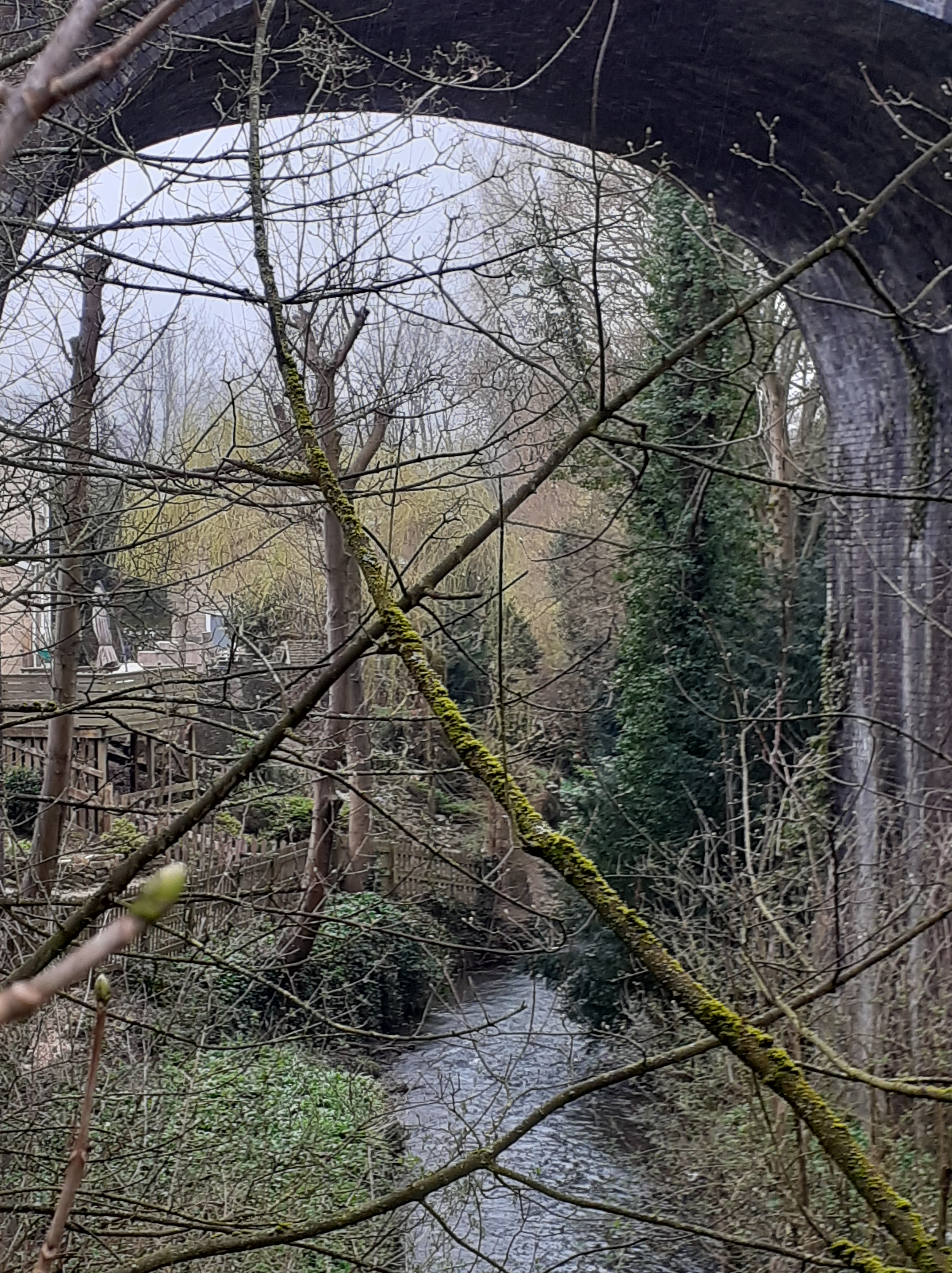
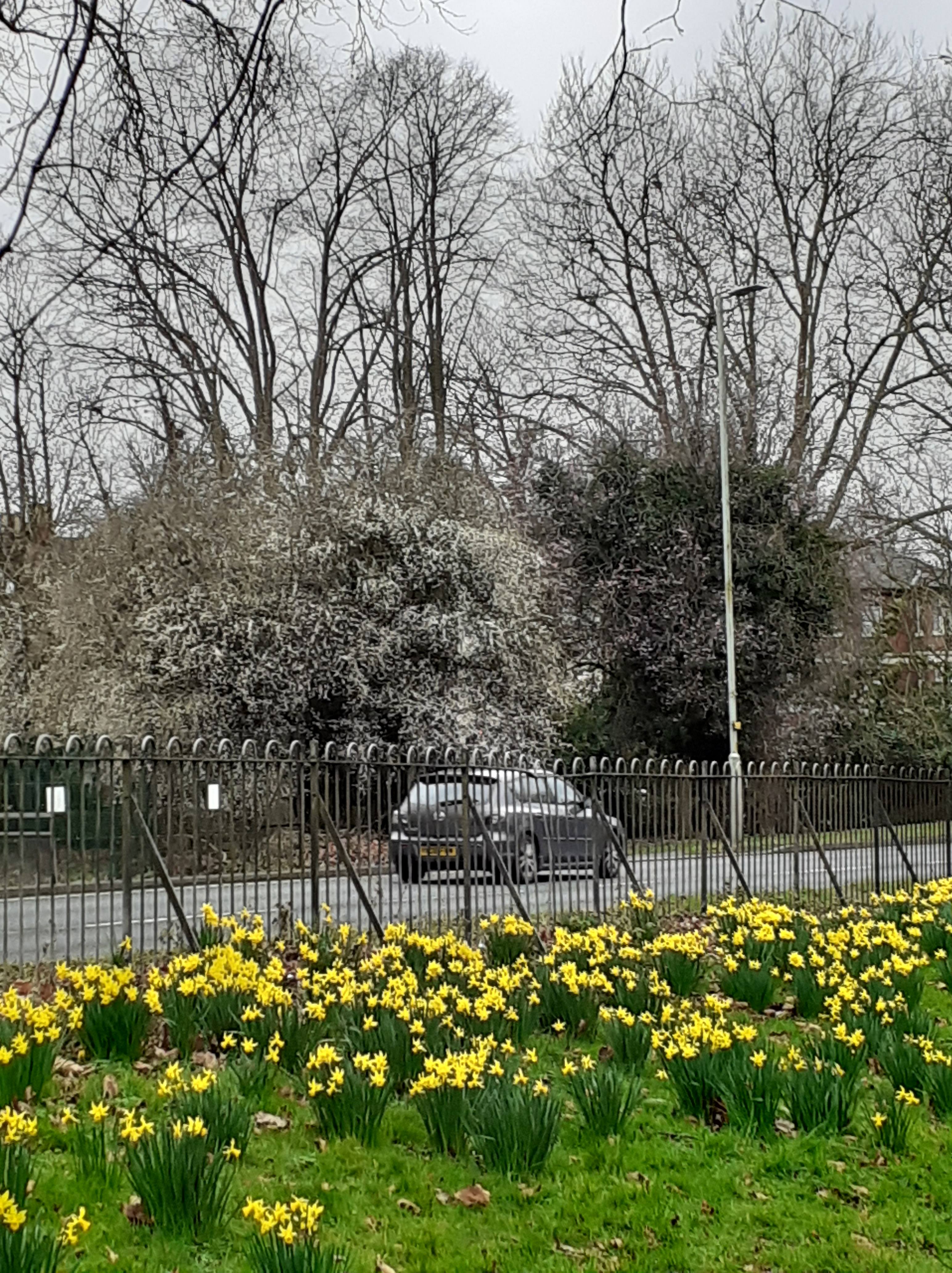
It is 1 March, a mixed day – bringing together grey sky, bare branches, emerging blossoms and vivid daffodils. It is chilly, and rain is likely, though not just yet. Daffodils (here the strongest sign of a changing year) are linked to St. David, the patron saint of Wales. 1 March is his feast day.

David lived during the sixth century CE, a flourishing time for Celtic Christianity. His defining early achievement was the founding of a Celtic monastic community at Glyn Rhosyn (the Vale of Roses) on the west headland of Pembrokeshire (Si Benfro) where St. David’s Cathedral now stands. He went on to become a Christian leader of great authority, and was eventually canonised in the twelfth century, a different historical period with the church under stronger Vatican control and Welsh identity under threat from the English. David became the patron saint of Wales and his day is celebrated in Wales with parades and other public events.

Gloucester is very much an English city, though not so very far from Wales. Today’s weather conditions would not be out of place there. My wife Elaine and I went out on a morning walk with a sense of the saint’s day and how both the day and the coming of March represent a shift in the year. I noticed, too, how I can honour a saint without thinking of sainthood as a model, or even remotely wanting to be one. I acknowledge that I am on different kind of path, less defined, less heroic, and less religious.

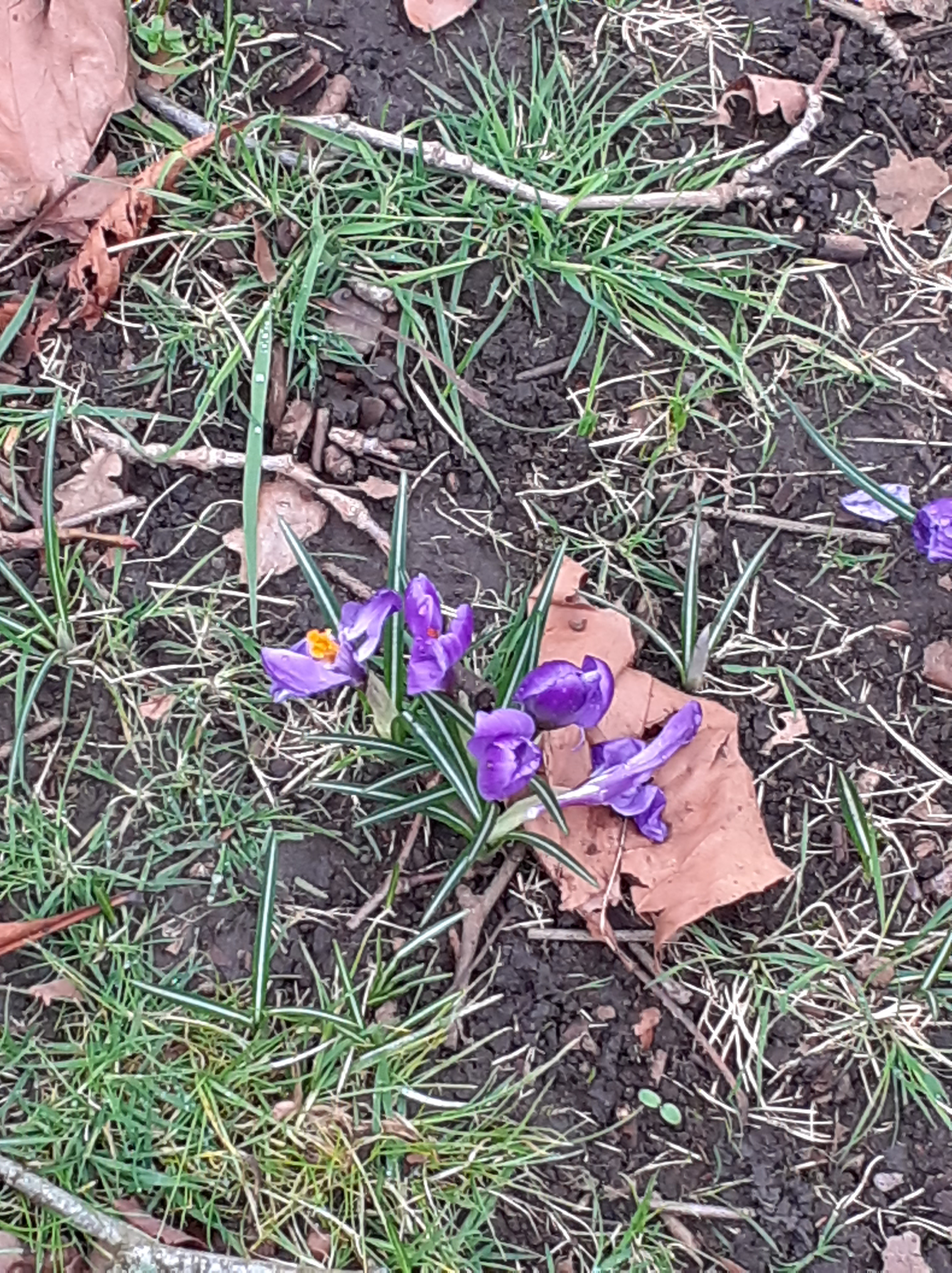
When out walking, I see how the ordinary world seems to transform in the light of a loving gaze. I am looking at the world as it is, not for signs of a creator’s hand or influence or expectations. For me, laid out below – at the micro level – I find grass, earth, twigs, purple crocus and dead leaves. They are simply themselves. All ordinary in an ordinary moment. But an ordinary moment, as we might conventionally call it, is an extraordinary event. It is a small miracle, in its naturalistic way, yet easy to access in a receptive frame of mind.

I do appreciate that a ‘receptive frame of mind’, as a private experience, is facilitated by favourable public conditions, like a well-managed public park. I may not be dependent on such external conditions, but they do make a difference. I am grateful for their current presence in an uncertain world.

A MIDSUMMER DAY’S DREAM

This post is about a midsummer day’s dream in the the Scottish border country, a dream which included a certain kind of waking up. I have written about it before (1,2) but this is the first illustrated version. Fourteen years have passed since that day, which in many ways determined the form which my expression of Druidry would take.

I was near Melrose. The wild rose was one of many on the banks of the Tweed. In this photograph, I am on a riverside path, with my back to the river. I keenly noticed then, as I notice now, the difference between a wild rose and the more familiar cultivated ones. I love both. But I remember feeling a particular delight at the simplicity of the native flower, a sense of easy integration into habitat, and of a plant not committed to being red or white.

Looking more deeply, I have said in my earlier writing how I had a momentary experience in which, gazing at a rose, subject/object distinctions disappeared and it is as if time intersected with eternity. I have identified this with the Seeing experience more systematically explored by Douglas Harding and the community built up around his work (http://www.headless.org). This was the beginning my sense that direct experience of the world, manifesting through a form of nature mysticism, would be my way forward, eventually becoming a contemplative Druidry and the backbone of my contemplative inquiry. I experience this as a direct and simple route to stillness, presence, resting in being., and identifying with source.

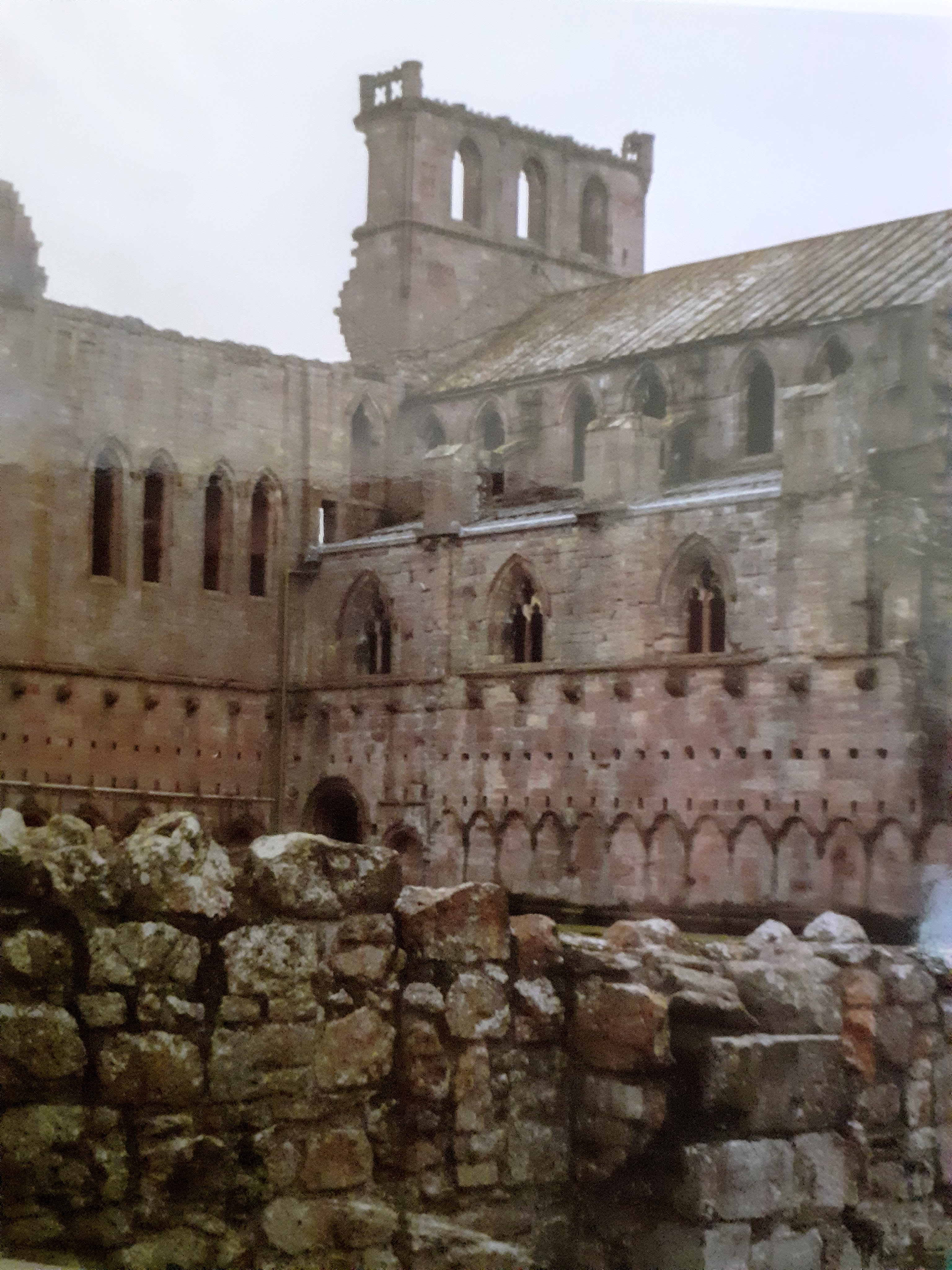
My walk amongst the wild roses had a prequel. Firstly, I had already spent time in the well-preserved ruins of Melrose Abbey. It was a building of Green Man carvings, but, sadly, neither the monks who occupied it nor the iconoclasts who abandoned it had access to the Gospel of Thomas (3) or the words:

“His disciples said to him:

‘When will the dead be at rest?’

‘When will the new world come?’

He answered them:

What you are waiting for has already come,

but you do not see it.” (3)

Here I see the abbey as a solid, material buildings, built with love and care. Even today, it belongs in its landscape, as much as the Tweed or the nearby Eildon Hills, with a semi-wild orchard of apple, pear and cherry trees. What I haven’t written before, in times when I was busy making distinctions between available paths, is that time and eternity intersect in this place too. But, on the day in question, I didn’t have that experience in the abbey grounds. I had it only among the wild roses, down by the river.

The Eildon Hills are also part of the same landscape, indeed a more primal one. But they are fairy hills and they can hide themselves. On that day, they hid from me. There was no invitation – or, rather command – from the Queen of Elfland, who had once ridden out to summon Thomas the Rhymer to her service:

“But you maun go wi’ me now Thomas

True Thomas ye maun go with me

For ye maun serve me seven years

Through weel or wae as may change to be.” (4)

At midsummer in 2007 I was looking for a spiritual home that offered both depth and simplicity. The grim half hidden hills were not appealing to me and I was closed to their magic, with an invitation or without one. I did not want to court danger by ascending into their conceivably treacherous mists. The low road by the river was the one for me.

It was a good decision, and good came of it. But I do also understand that on a different day, those hills could be seen in a different light. I do not now feel constrained to make a neat choice between a broad road, a narrow road and a bonny road. Two cycles of seven years on, well rooted in a nourishing life and practice, I find myself in a more open space, wondering what lessons this Otherworld might yet offer.

(1) James Nichol Contemplative Druidry: People, Practice and Potential Amazon/Kindle, 2014 See: https://www.amazon.co.uk/contemplative-druidry-people-practice-potential/dp/1500807206/

(2) https://contemplativeinquiry.blog/2019/07/16/seeing-contemplative-druidry/

(3) The Gospel of Thomas: the Gnostic Wisdom of Jesus (Translation from the Coptic, introduction and commentary by Jean-Yves LeLoup. English translation by Joseph Rowe. Foreword by Jacob Needleman) Rochester, VT: Inner Traditions, 2005

(4) R. J. Stewart The Underworld Initiation: A Journey Towards Psychic Transformation Wellingborough: The Aquarian Press, 1985

SIMPLY SEEING

Something happens when I simply see the world in front of me. Simply seeing involves the whole of my attention, with a de-cluttering of thoughts and other distractions. There is no tension in this spacious clarity.

But it doesn’t have to last long. Simply seeing is at heart a timeless act of recognition. There is no need to hold on to any particular state. I find it wiser to let the flow of experience move on.

If I am present to my immediate experience, it works as well for a photograph as it does in the original setting. Simply seeing the picture is not a recollection of my earlier walk. It is a unique moment of experience, and a joy in itself.

NON-DUALITY AND YOGA NIDRA

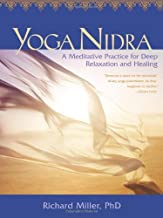
This post is built around Dr. Richard Miller’s approach to Yoga Nidra (1) and my response to it. The resource I am working with – a book and a CD – was published in 2005. My concern in writing is with how a “meditative practice for deep relaxation and healing” can also be what one reviewer (2) described as the “perfect tool” for the author’s non-dual teachings. For the recommended practices “require only presence, and as such represent both the path and the goal of non-dual practice.”

The word non-dual is a translation of the Sanskrit advaita, literally ‘not two’. I remember a podcast in which Peter Russell (3), a long-term practitioner and writer in this field, cautioned against a tendency to equate ‘not two’ with ‘one’. He then told an ancient Indian story about the making of clay pots. A potter takes a lump of clay and makes two pots. One clay; two pots. In the Indian tradition, this is a ‘consciousness first’ understanding, and modern versions draw on terms like presence, awareness, ground of being, or true nature to point to our ultimate identity as this consciousness. ‘God’ is also used in this way. The understanding is that we are never separate from this identity, though we may feel separate from it, or forget it, or ‘not believe’ in it. After all, most of our attention is on our individual life in the world with all its pulls, stresses and demands.

Early in his book, Richard Miller describes his first experience of Yoga Nidra:

“Our instructor led us through Shavasana, the traditional yogic pose for inducing deep relaxation while lying completely still on the floor. The instructor expertly guided us into being conscious of sensations throughout our body, as well as to opposing experiences, such as warmth-coolness, agitation-calmness, fear-equanimity, sorrow-joy, and separation-oneness. I was invited to rotate may attention through the sensations elicited by pairs of opposites until I was able to embody these opposing experiences with neither attachment or aversion to what I was experiencing.

“I drove home that evening feeling totally relaxed and expansively present. For the first time in years, I felt free of all conflict, radiantly joyful, and attuned wit the entire universe. I experienced life as being perfect just as it was and felt myself to be a spacious nonlocalized presence. Instead of my usual experience of being in the world, I was having a nonmental experience of the world being within me, similar to experiences I had known as a child”.

Miller’s motivation to continue was “a longing in me to consciously awaken into and fully abide as this sense of presence”. As well as becoming a yoga teacher and psychotherapist he has worked with Direct Path teachings as a student of Jean Klein. He describes the very term Yoga Nidra as a paradox, a play on the words ‘sleep’ and ‘awake’ as it means ‘the sleep of the Yogi’. The implication is that the normal person is asleep to their true nature through all states of consciousness – waking, dreaming and deep sleep – while the Yogi is one who is awake and knows his or her true nature across all states, including sleep. The practice therefore involves both deep relaxation and deep inquiry.

A full practice on Miller’s CD begins with two commitments – one to a form of mindfulness at the edge of sleep where, for the reasons pointed to above, it is OK to ‘fall asleep’ since there is a trust that the process will continue to run at other levels. The second is described as a ‘heartfelt prayer’, articulated as though it has already been fulfilled – for in the absolute, there is only now: Miller gives the example ‘my friend is whole, healed and healthy’. Then the meditation moves through seven stages, the first six of which address specific forms of awareness: body and sensation; breath and energy; feelings and emotions; thoughts, beliefs and images; desire, pleasure and joy; and witness/ego-I. The final stage (sahaj) is our natural state, ‘the awareness of changeless Being’. Each stage provides an opportunity to identify conventionally positive and conventionally negative experiences, and to hold both in a wider embrace. The sixth stage inquires into the very nature of the ‘I’ that believes itself to be a separate witness, enabling the simple being of the final stage. The whole practice lasts about 35 minutes.

I’ve been looking for an evening practice to complement my morning one. After only a week, it has the right feel, the right format and the right length for me at this point in my life. Over the last three or four years non-duality has become my common sense. During this period I have worked a good deal with the ‘Seeing’ experiments of Douglas Harding’s Headless Way (4) and also with substantial resources from Direct Path teachers Greg Goode (5) and Rupert Spira (6). A non-dual view, as a working assumption, is now both cognitively and experientially well installed.

I don’t have a deep interest in non-dualist metaphysics for its own sake. I am deeply committed to this world and my human life. What I find is that a non-dual model of reality adds to my experience of human life in the world, and cannot be separated from it. I find myself leaning in to this nourishing and illuminating possibility, and committed to commit to living by it. Roger Miller’s Yoga Nidra has met me where I am. I am very grateful for this gentle, life-affirming, and subtle practice, which helps to maintain me on this path.

(1) Richard Miller Yoga Nidra: A Meditative Practice for Deep Relaxation and Holding Boulder, CO: Sounds True, 2005

(2) Stephen Cope, author of Yoga and the Quest for the True Self and The Wisdom Of Yoga

(3) https://www.peterrussell.com/

(4) http://www.headless.org/

(5) Greg Goode The Direct Path: A User Guide Non-Duality Press, 2012 (UK edition)

(6) Rupert Spira Transparent Body: Luminous World: the Tantric Yoga of Sensation and Perception Oxford: Sahaja Publications, 2016

THE TEMPLE SPACE

“In this Temple Space (Aeon) you become all things,

and you see yourself no more;

and in that All-Other you become all things

and never cease to be yourself.

“Light and darkness, life and death, right and left, are brothers and sisters. They are inseparable.

“This is why goodness in not always good, violence not always violent, life not always enlivening, death not always deadly …

“All that is composite will decompose

and return to its Origin;

but those who are awake to the Reality

without beginning or end, will know the uncreated, the eternal.

“The words we give to earthly realities engender illusion; they turn the heart away from the Real to the unreal. The one who hears the word God does not perceive the Real, but an illusion or an image of the Real.

“It is impossible to see the everlasting Reality and not become like it.

The Truth is not realised like truth in the world:

those who see the sun do not become the sun;

those who see the sky, the earth or anything that exists, do not become what they see.

“But when you see something in this other space, you become it.

If you know the Breath, you are the Breath.

If you know the Christ, you become the Christ.

If you see the Father, you become the Father”.

Jean-Yves LeLoup The Gospel of Philip: Jesus, Mary Magdalene, And the Gnosis of Sacred Union Rochester, VT: Inner Traditions, 2004 (Translation from the Coptic and commentary by Jean-Yves Leloup; foreword by Jacob Needleman. English translation by John Rowe. Original French edition published 2003.)

Like the Gospel of Thomas, the Gospel of Philip is a Nag Hammadi text, and a central one for a nondual current within Christian Gnosticism. In places the text seems almost Taoist (the fluid inter-relatedness of polarities within a greater unity, the suspicion of words and naming). For me it also resonates with the practice of Seeing in the tradition of Douglas Harding (see http://www.headless.org) It is one of my ‘special books’(see https://contemplativeinquiry.wordpress.com/2019/07/15/

DOUGLAS HARDING ON STRESS

“The whole truth about you is three-fold. Instead of being the mere thing they told you you were, you turn out to be (i) No-thing at all, and (ii) the Totality of things (and, as these, altogether safe) and (iii) every particular thing that lies between (and, as such, altogether unsafe and at risk). Yes, you are wholly free from harm by your very nature as (i) and (ii), and wholly free from the stresses and strains of the world of things: and, by your very nature as (iii) wholly caught up in them. The difference between you as Container (i & ii) and as Contents (iii) is infinite, the separation is nil. On the one hand, each of those things counts as just itself, just one thing. You, on the other hand count as zero and an infinity of things, and each of them in particular, as well. As 0 and ∞ you are stress-free. As what lies between them you are stress-bound.” (1)

Harding goes on to describe how “the contents that fill your ever-peaceful Container build a Universe out of their clashing”, as a horseshoe takes shape from the downward blows of the hammer and the upthrust of the anvil. But does that mean that we have to take on all the world’s stress, “all its catastrophes and pain and alienation – even finding room for its terrible weight of greed and hate and fear? … How can you be the stress-free All without embracing every stressful part?”

Harding addresses these questions by looking at four people and their responses to personal and collective suffering.

The first is a Red Cross worker who showed an agony of stress in her voice and on her face. “She could not have cared more. Her involvement was complete, her detachment non-existent”. For Harding, it seemed that her wellbeing and effectiveness were compromised by a lack of access to that “interior Rest … which can not only receive without harm, but also transmute, all the world’s unrest”.

The second is Douglas Harding himself, on first becoming a Seer and discovering that Emptiness which gave “peace and a quiet joy, and the sensation of having dropped an intolerable burden”. He had learned the lesson of absolute detachment, but not yet the lesson of absolute involvement. He writes that his support of famine relief efforts in Bengal, where he was serving at the time (it was 1943), were real, but “uninvolved, detached, cool”.

The third is the Bengali saint and seer Anandamayi Ra, who Harding met at her ashram twenty years later. He remembers her ability to weep alongside a bereaved mother, fully sharing her grief, without losing her own serenity. “She took on the other’s grief by being herself free of grief, just as she took on the other’s face by being herself faceless. Fully to appreciate what this means in practice you have, like Ma, to see steadily Who you are. To get the point you have only to see, right now, how your own Emptiness is empty for these comments on her”. Harding concludes “Anandamayi Ra was neither attached to nor detached from the mother and her grief. She was both. Her message for her devotee, as for me then and ever since that memorable occasion was, I AM YOU”.

The fourth is Mother Teresa who, according to Harding, had “in her own fashion … broken through to confidence in place of fear, love in place of hate, abandon and detachment and surrender in place of craving.” She too had solved the problem of stress by immersion in it, “by being it absolutely and not being it absolutely”.

Harding concludes with three recommendations for day-to-day practice. The first is to “stop playing ostrich” about our own mortality and our collective human vulnerability to catastrophe, including catastrophes we create for ourselves. We have no reason to expect that “our troubles will somehow blow over. They won’t”. The second is to check in regularly with our place of safety – Who we really are, through Harding’s own exercises or some other means. The third, however, is not to get stuck in the Container at the expense of its contents, the world. Harding says that this isn’t a recommendation for moderation, but for extremism, and finding the unique role that best expresses “this truly amazing union of perfect freedom with total involvement … let us remember that living thus, consciously, is the very best thing we can do for our disaster-prone world”.

(1) Douglas Harding Head Off Stress: Beyond the Bottom-Line London: The Shollond Trust, 2009 (First published by Arkana in 1990)

See also: http://www.headless.org/

INQUIRY AND HEART

Recently I have noticed a change in my notion of inquiry. I experience, at the same time, both a greater precision and a softening in my understanding of ‘inquiry’. Rupert Spira (1) makes a helpful point.

“This path is sometimes referred to as self-inquiry or self-investigation. However, these terms – translations of the Sanskrit term atma vichara – are potentially misleading. They imply an activity of the mind rather than, as Ramana Maharshi described it, a sinking or relaxing of the mind into ‘the heart’, that is, into its source of pure Awareness and Consciousness. The term may, therefore, be more accurately be described as ‘self-abiding’ or ‘self-resting’, and is the essence of what is known in various spiritual and religious traditions as prayer, mediation, self-remembering, Hesychasm in the Greek Orthodox Church, or the practice of the presence of God in the mystical Christian tradition.”

At the time of writing, I have three means of heart inquiry by this definition. The first is quintessentially Sophian – a repetition, synchronised with the breath, of the name Ama-Aima (pronounced ahh-mah-ahee-mah). In its tradition of origin (2). this Aramaic name for the Divine Mother brings together Her transcendental and immanent aspects, and the repetition of the name invokes Her light energy and presence, which is the light energy and presence of the cosmos. As I breathe the name, entering into its pulse and vibration, I begin to find that this presence-energy is breathing me, until the distinctions themselves disappear. I treat this work formally, as a sacrament or mystery, and part of a daily practice.

The second is Seeing, and the practices of the Headless Way, described as ‘experiments’ in that family. – see www.headless.org/. I use a variety of these practices depending on the circumstances. The advantage of Seeing is that I can drop into it at any time during the day.

The third is the rawer approach laid out by Jeff Foster (https://lifewithoutacentre.com/ ), which turns the ‘Light of Oneness’, back onto the experience of the struggling human. It flows from his own journey of “venturing into the darkness of myself” (3), before “breaking through the veil of dualistic mind to a   Light that had been there all along”. Here, we enter into a loving encounter with whatever experience is happening and finding a way to accept  – not the content of the experience itself, which may be horrible and need resisting – but the reality that this is the experience that is happening, the one demanding attention. Loving attention to our struggles may not stop suffering but can make them more workable. As with Seeing, I can drop into this meditation at any time – by slowing down, breathing and just being there, with loving curiosity and attention. It works with mixed and good experiences too.

I find that a combination of these practices serves me well. Reading, writing and digital media of relevance to the practices support my sense od direction and my understanding.

(1) Rupert Spira Transparent Body, Luminous World: The Tantric Yoga of Sensation and Perception Oxford: Sahaja Publications, 2016

(2) Tau Malachi Gnosis of the Cosmic Christ: a Gnostic Christian Kabbalah Saint Paul, MN: Llewellyn Publications, 2005

(3) Jeff Foster The Joy of True Meditation: Words of Encouragement for Tired Minds and Wild Hearts Salisbury, UK: New Sarum Press, 2019

SEEING: CONTEMPLATIVE DRUIDRY

There is a dance between experience and meaning. Experience informs meaning, yet the meaning given to significant experiences can change over time, in the light of later experiences. Looking back at my introduction to Contemplative Druidry (1), I now sense that my contemplative journey was triggered by a kind of Wild Seeing, long before I encountered the work of Douglas Harding (www.headless.org/ ). Here is what I wrote.

“On 22 June 2007 my centre of gravity shifted. It was late morning. I was just outside the Scottish Border town of Melrose, drawn in three possible directions. One was up the hills at the back of the town – the Eildon Hills, the hollow hills where the Queen of Efland took Thomas the Rhymer; True Thomas as he became. The second was the fine, if half-ruined, Abbey and its grounds; a place of Green Man carvings, fruit trees, and the heart of Robert the Bruce. The third was the banks of the Tweed.

“I took the third option and walked into a wholly unexpected and not at all dramatic epiphany. It was triggered simply by noticing and contemplating a wild rose, growing on the banks of the river. It lasted a few moments, just long enough for me to register it, and to experience a subtle shift of awareness in consequence. For some weeks I woke up every day with a sense of joy and connection. Months later, I wrote the verse that expressed it:

I am Rose. I am wild Rose.

I am Rose at Midsummer.

The river flows by me.

Fragile, I shiver in the wind.

And I am the heart’s core, mover of mountains.”

I was aware at the time that I was contrasting three choices in a fairy tale kind of way. The first was the path of magic (the Queen of Elfland). The second was the path of contemplative religion (Melrose Abbey). The third was the path of direct experience (wild rose on the riverbank). I chose the third. The poem best shows the import of this deceptively simple experience, especially in the last line. ‘I am the heart’s core; mover of mountains’ is more than a nature mysticism. I speak not only as the rose, but as the heart’s core, mover of mountains. I speak from the source.

During its collective life, contemplative Druidry did take its stand in direct experience. It was also very open – we talked of being of like intent rather than like mind; there was no consensus cosmology or belief. On the whole we were naturalistic, but not quite in the humanist or materialist sense. The use of terms like ‘Earth spirituality. ‘nature mysticism’. pantheism’ and ‘animism’ pointed to something more expansive. Now my experiences of  Seeing, support the view advocated by Douglas Harding and described as nondualist and panentheist. In everyday terms we can say that we have two identities, one as humans and the other as the ground of being. Ultimately, there is no separation and so only one true identity. Seeing is offered as a skilful means of learning to recognise this identity, and then to live from it.

My Sophian Way is now firmly in this territory. My challenge is to cleave to the experiential practice and its fruits whilst staying open about metaphysical claims. The intelligence of the heart is nourished by this view and is attracted by the reassurance of a clear and simple narrative. The mind wants to stay agnostic and provisional. When mobilised, it can ferret out weaknesses in the view. The Sophian Way is a way of wisdom, as well as a salute to the cosmic mother and healer in the heart. Wisdom invites me to trust the process – maintaining just enough scepticism to avoid attachment to views.

(1) James Nichol , Contemplative Druidry: People, Practice and Potential, Amazon/Kindle, 2014.  https://www.amazon.co.uk/contemplative-druidry-people-practice-potential/dp/1500807206/

SPECIAL BOOKS

I’m thinking about special books. Many spiritual traditions have special books and they are given tremendous authority. For the committed practitioner, the prescribed way of working with them is some version of Lectio Divina. This goes beyond knowing what the book says and giving our assent. We need to bring the words alive through a contemplative immersion. As deep and devoted readers, we learn to identify layers of meaning and apply them in our lives. Checking out our experience in the light of what is written, we learn to mould our experience in accordance with the writing. There is no room for a mixed or negative assessment of the text itself or wish to depart from it. The furthest we can go in this direction is through a device like Hebrew midrash. This a form of commentary, sometimes taking the form of stories, that can stretch an original meaning or introduce a new perspective on it.

But for me, the direct value of texts lies in the extent to which they support my practice and experience. The practice and experience themselves are my authority. My original education was literary, reflecting the creative and critical values of the humanities. I am educated in what Samuel Johnson called ‘the art of true judgement’, and also understand that older texts need to be understood in relation to the cultures of their day. I don’t come to this work with a Lectio Divina mindset. But I still like the idea of having special books, of focusing in closely on a few texts of special value to me.

This is partly to counterbalance my natural tendency to be restless and mercurial in my reading. I move rapidly not just between books and ideas but kinds of books and ideas, with quite different understandings of life and the universe. I get multiple overviews at the risk of losing my own thread. I’m also like a magpie in identifying pieces of text that shine, which is great, but supports an attachment to shininess, aka psychoactive writing.

Hence, I now find myself wanting to slow down and consolidate, identifying a small number of special books, selected as Wisdom literature for this stage of my journey, and keeping company with them. I have chosen six. Three are from the ancient world and have been my friends for many years. Three are modern and discuss the Harding method of ‘Seeing’ ( www.headless.org/) , in which I am increasingly experiencing as a support for my Sophian Way. I’m not going to say more about them in this post, but I will feature them in future ones. Here is the list:

Lao Tzu Tao Te Ching: A Book about The Way and the Power of The Way Boston & London: Shambhala, 1998. (New English version by Ursula K. Le Guin with the collaboration of J.P. Seaton)

Thich Nhat Hanh The Other Shore Berkeley, CA: Palm Leaves Press, 2017 (A new translation of the Heart Sutra with Commentaries)

Alan Jacobs The Gnostic Gospels London: Watkins Publishing, 2005 ( My focus is on four texts: The Gospel of Thomas, The Fable of the Pearl, The Gospel of Philip and Thunder)

Douglas Harding Head Off Stress: Beyond the Bottom-Line London: The Shollond Trust, 2009 (First published by Arkana in 1990)

Douglas Harding Look for Yourself: The Science and Art of Self-Realisation London: The Shollond Trust, 2015 (First published by The Head Exchange Press in 1996)

Karin Visser The Freedom to Love: The Life and Vision of Catherine Harding Salisbury, UK: New Sarum Press, 2019 (First edition 2016

Earth Eclectic

music that celebrates Earth and speaks to the heart

Sarah Fuhro Star-Flower Alchemy

Follow the Moon's Cycle

Muddy Feet

Meeting nature on nature's terms

Rosher.Net

A little bit of Mark Rosher in South Gloucestershire, England

Becoming Part of the Land

A monastic polytheist's and animist’s journal

selkiewife

Selkie Writing…

Charlotte Rodgers

Images and words set against a backdrop of outsider art.

Prof Jem Bendell

living with metacrisis and collapse

Towint

The pagan path. The Old Ways In New Times

The Druids Garden

Spiritual journeys in tending the living earth, permaculture, and nature-inspired arts

The Blog of Baphomet

a magickal dialogue between nature and culture

This Simple Life

The gentle art of living with less

Musings of a Scottish Hearth Druid and Heathen

Thoughts about living, loving and worshiping as an autistic Hearth Druid and Heathen. One woman's journey.

Wheel of the Year Blog

An place to read and share stories about the celtic seasonal festivals

Walking the Druid Path

Just another WordPress.com site

anima monday

Exploring our connection to the wider world

Grounded Space Focusing

Become more grounded and spacious with yourself and others, through your own body’s wisdom

The Earthbound Report

Good lives on our one planet

Hopeless Vendetta

News for the residents of Hopeless, Maine