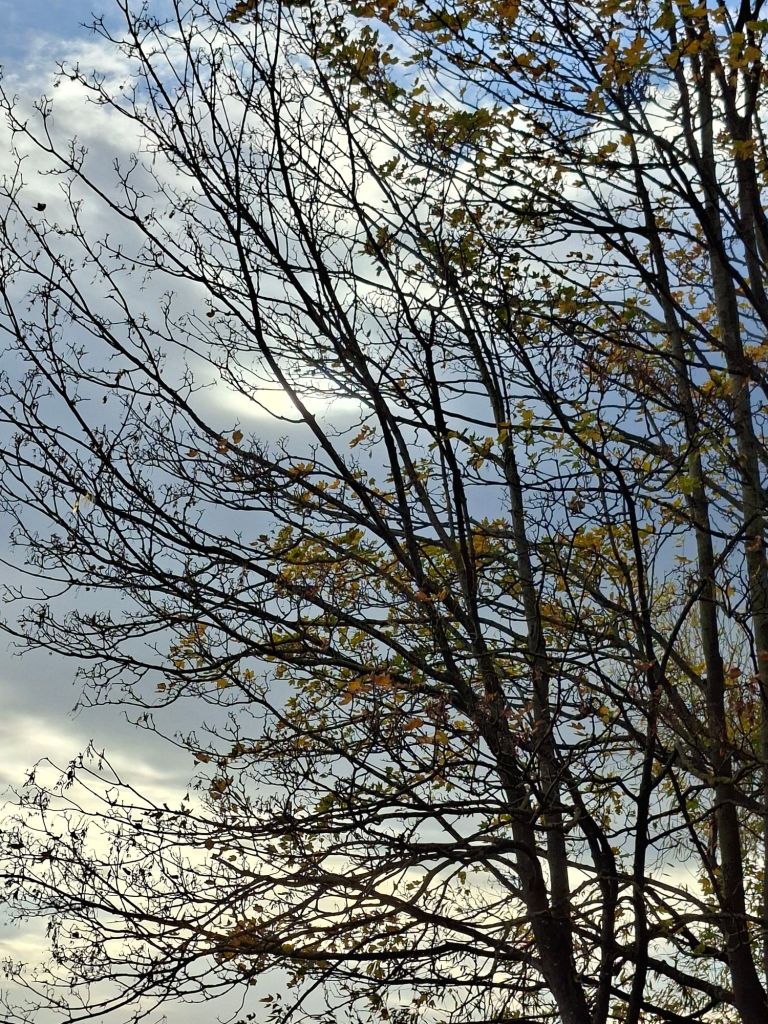
Where I live, autumn is becoming wintry. But winter has not yet come. Many leaves have fallen yet the trees are not yet bare. Whether standing against a severe sky or leaning in to water, they still witness their own vitality.
Along the canal bank, there are places where the green-gold beauty of autumn in this locality remains present, here on 5 November. I have a strong sense of continuing energy and life.
This feeling is most powerful for me when I hear the wind blowing through the trees and see leaves holding on even as the branches sway. Soon enough, these leaves will fall. Here and now, they are very much part of their trees.
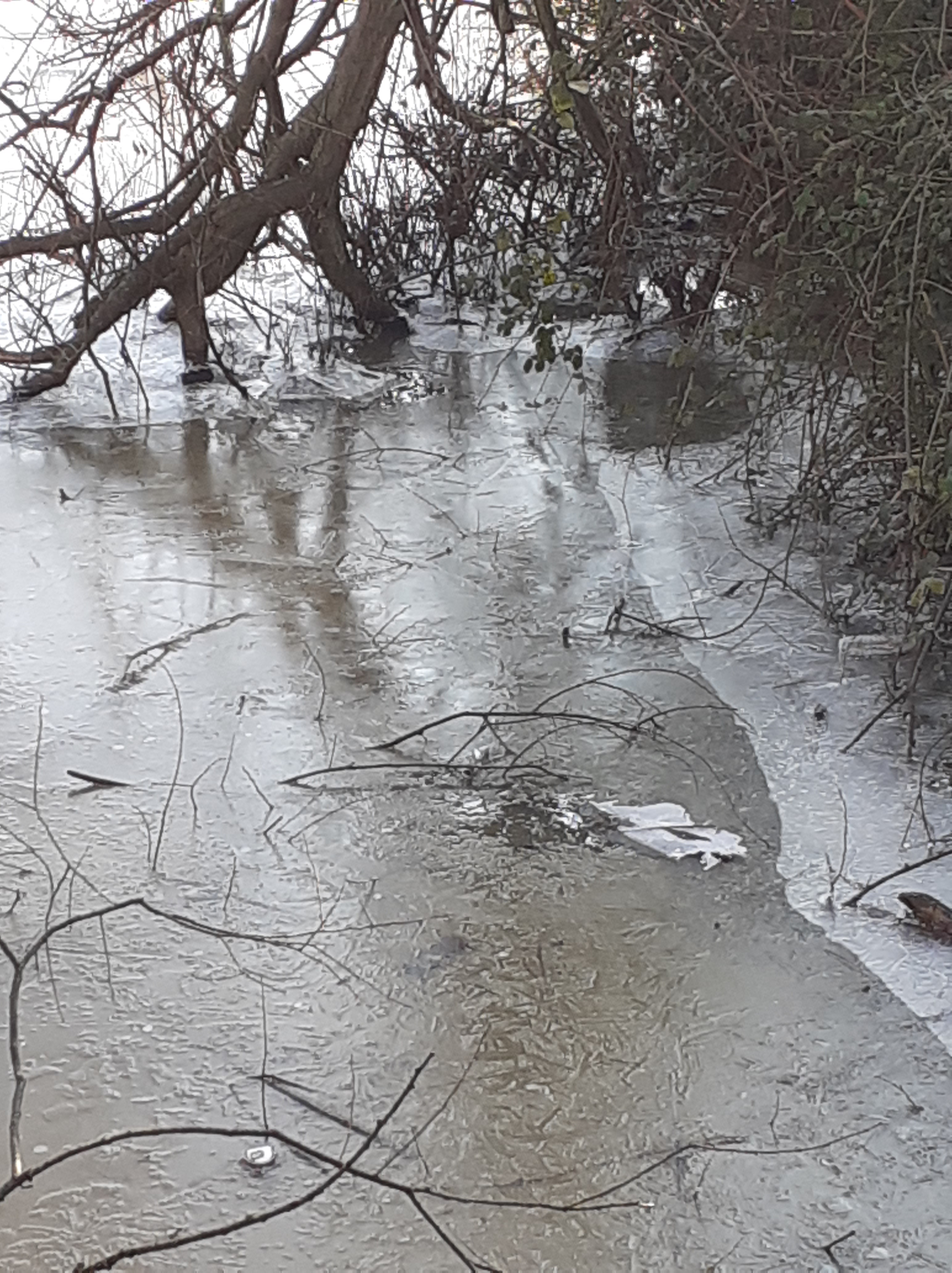
I am in a place and time of cold beauty. Beside the Gloucester-Sharpness canal, the water margin looks like a scene of suspended animation.
It isn’t true. There are fish in the water, underneath the ice. Trees are preparing for spring, protected by their bark. In the picture below evidence of the sun is seen on a tree trunk and on the thawing waters of the canal.
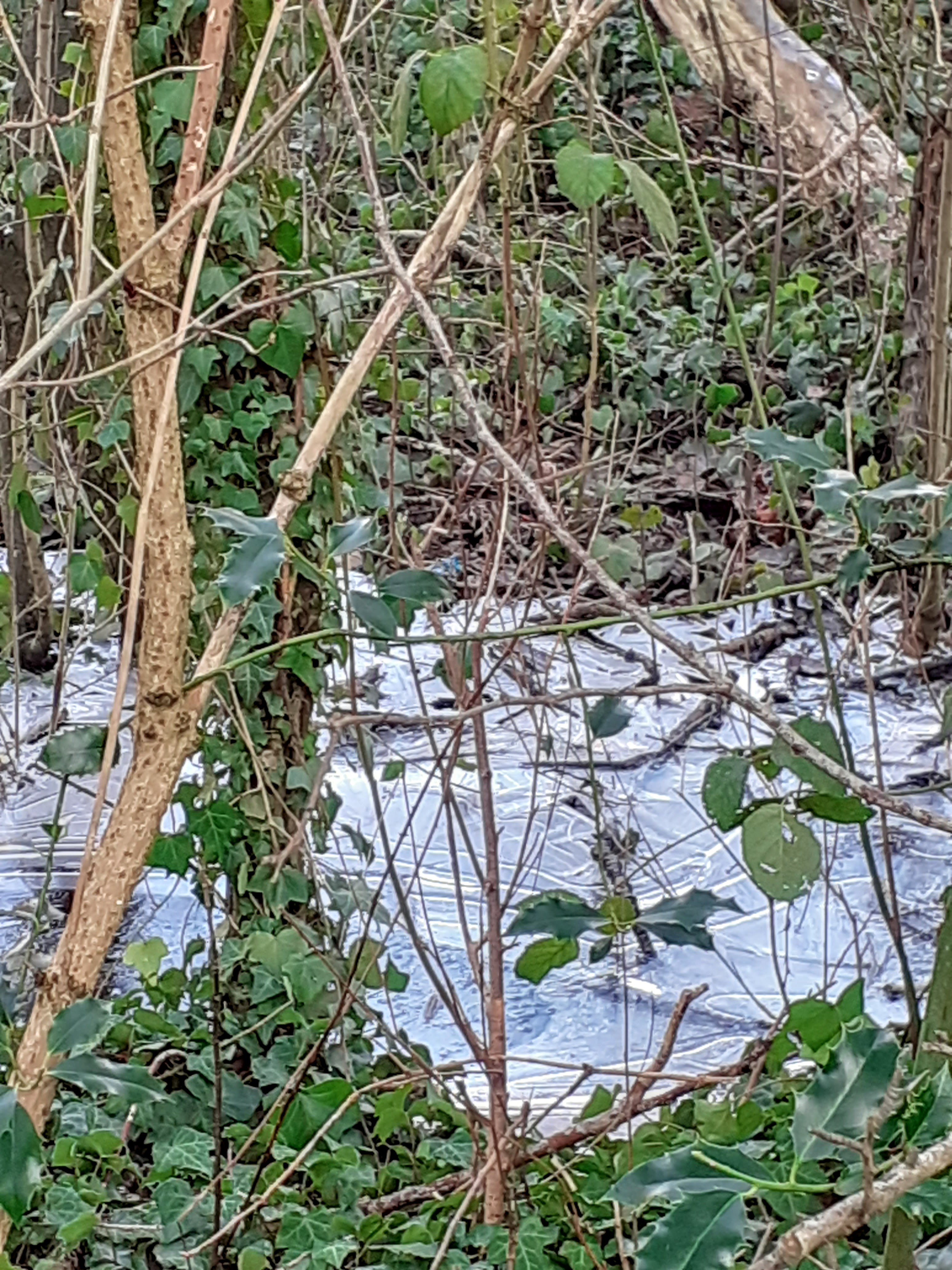
In woodlands beside the canal, I find an iced up inlet where the surrounding ivy lives up to its evergreen name. This small enclosed spot feels strongly alive, the frozen waters an adornment rather than a contrast.
Returning to the Docks, I notice that the seagulls aren’t acting as the confident, aggressively resourceful selves that I expect. The are neither at work, busily scavenging, or at play, gleefully flying or enjoying the water. They seem a bit bewildered by the thin ice that they are standing on.
On this walk I’m connecting rather than communing. I’m outwardly rather than inwardly focused, oriented to narrative and incident. There are different ways of observing and today I want to connect with the world and feel that I am part of it. I am endlessly fascinated with this small territory and the way it changes as the Wheel turns, and seasons come and go.
Recently I’ve been unwell and housebound, hardly even watching the world go by. But there came a day when I could go out again, a day that was blessed with sun. It seemed bright and new. I was almost blinded by its luminous presence on a white tree-patterned wall. I had entered late fall, a season with both autumnal and winter features.
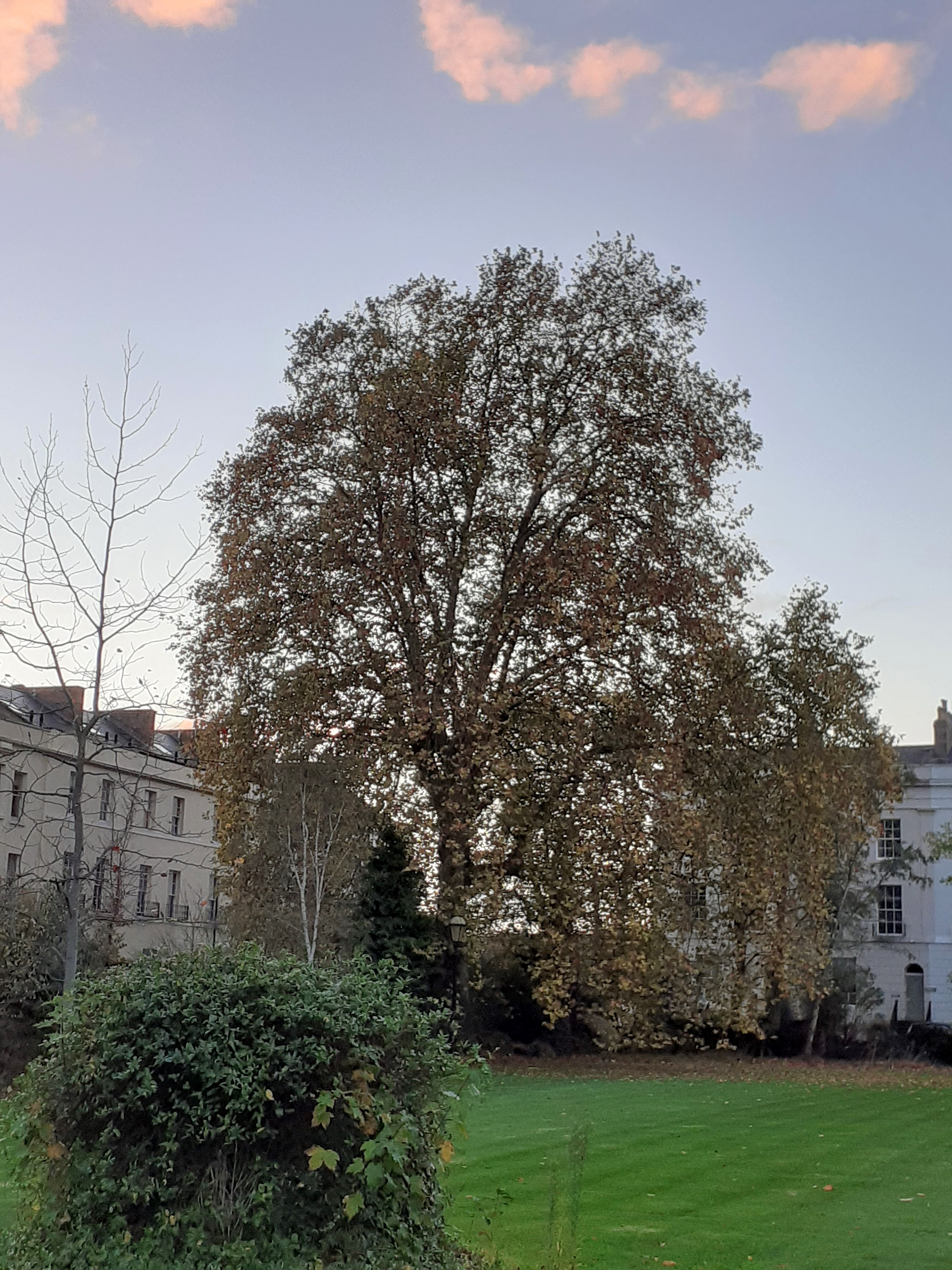
The sun shone on trees in Gloucester City Park which retained some of their foliage, but in an end-of-season way that signals austere changes to come. Leaves showed a fragile, lingering beauty, prior to their necessary descent.
The Brunswick Gardens, sitting under a clear blue sky, were home to trees where the leaves had already fallen, leaving the branches as patterns of quiescent arboreal bones. The leaves were on the lawn. Other, managed, flora continued to flourish.
In visual and tactile ways, after an indoor confinement, the neighbourhood was full of reward for me. But I felt cold, and it was indeed the coldest it’s been for many many months. I could not stay out for long. But I had encountered a moment in the year, of interbeing, of living presence – where the wheel is visibly and palpably turning. I was glad to be there, however briefly, available for a nurturing and healing experience.
It was 26 November 2022, 11 a.m. I was at the Gloucester end of the Gloucester-Sharpness canal. I found myself accepting the arrival of winter. I was observing three cygnets, now without their parents but still keeping company with each other. The underlying temperature was around 7 C (44.6 F) and good for walking, But I was feeling the pinch of a cold wind. In memory I am feeling it now. The water and sky looked grey. The trees were starting to feel skeletal, whilst still retaining some leaves. My lingering sense of autumn had finally drained away.
To accept winter’s arrival in the presence of swans felt numinous. Swans are otherworldly birds in Celtic tradition. The three together, not yet in their full adult plumage, seemed auspicious. They suggested coming opportunities for creativity, love and celebration. Winter can be a preparation for renewal, both as season and as state of mind. My acceptance goes with a faith in winter’s regenerative darkness, and the riches this can bring.
You can just see it, above the buildings, at the last breath of sunset. A sliver of light over murky cloud, the slender crescent of a new moon has appeared. I took the picture just after 6.45 pm on 28 October, still inside British Summer Time. I chose this time on this day because it was not yet dark. The sky is making room for a variety of effects, not just the stark duality of darkness and light. I stand at the cusp of the year’s endarkenment, before the festival of Samhain.
At this time of this year, I find myself tuning in to the lunar cycle as much as the solar one. To me, now, it feels subtler and more nuanced. Anne Baring and Jules Cashford describe its significance in a way I find illuminating:
“The moon was an image in the sky that was always changing yet was always the same. What endured was the cycle, whose totality could never be seen at any one moment. All that was visible was the constant interplay between light and dark, in an ever-recurring sequence. Implicitly, however, the early people must have seen every part of the cycle from the perspective of the whole.
“The individual phases could not be named, nor the relations between them expressed, without assuming the presence of the whole cycle. The whole was invisible, an enduring and unchanging circle, yet it contained the visible phases. Symbolically, it was as if the visible ‘came from’ and ‘returned to’ the invisible – like being born and dying, and being born again.” (1)
When out walking, I noticed that Christmas lights had started to appear. The ones below, at Gloucester Quays, seemed suitable for a new moon. They shifted on and off in a flowing, liquid kind of way, at slightly different times. They did not dazzle or glare or demand my whole attention. They illuminated the space without dominating it. They did not claim that their light was all that mattered.
If I tune in the another cycle, the wheel of the day, I remember how much to thank the sun for. Barely half an hour before I took the pictures above, I experienced the very different colours of the two immediately below. In the first, there is the pink of sunset cloud and some draining of blue from the sky – but, still, a sense of vivid green in the grass. An autumn evening in what is still the light of day.
The second shows a tree-lined street, with full autumn colours, fittingly sundown colours, against a misty looking autumn sky.
It seems that I am saying farewell to one season whilst welcoming another, and that my evening walk on 28 October, partially shared with my wife Elaine, somehow enabled this. There is a starkness and wildness in my last image from that walk, below, which draws me in, despite the remarkable contrast with what has gone before. Just to notice, to fully experience, and make meaning of, the cycles of moon, sun, day, year and life itself gains importance for me year by year, as the wheel turns.
(1) Anne Baring Anne and Jules Cashford The Myth of the Goddess: Evolution of an Image London: Penguin, Arkana Books, 1993
This is the face of dawn outside my window, just after 6.30 a.m. I welcome the mid September day, appreciating this moment in the year. I like the infusion of pink into grey clouds, and the suggestion of warmth in the old church tower.
I have now grown used to getting up in the dark, and to beginning my morning practice with an awareness of darkness outside. The nurturing dark and enabling light are both part of my experience. A transient time of balance has begun. It feels numinous to me, and a time of great potential. I am energetically alert and alive.
Later, a little before 9 a.m., I am walking by the Gloucester-Sharpness canal. I notice light on leaves, and its influence on the gaps between trunks. The view, here, is over water. But it is the influence of sunlight that makes the greatest impression on me – captured in the picture as well as in real time.
By contrast, the spaces furthest away from the light source are able to show their earthiness, their woodiness and the depth of their green. The light is everywhere, but it is subtle and not over-bearing. It reveals its influence in different ways. Rather than radiating raw power, it allows possibilities in this small, fragile habitat. Contemplating autumnal states of light, as I approach the autumn equinox, I have been shown something about power and its manifestation.
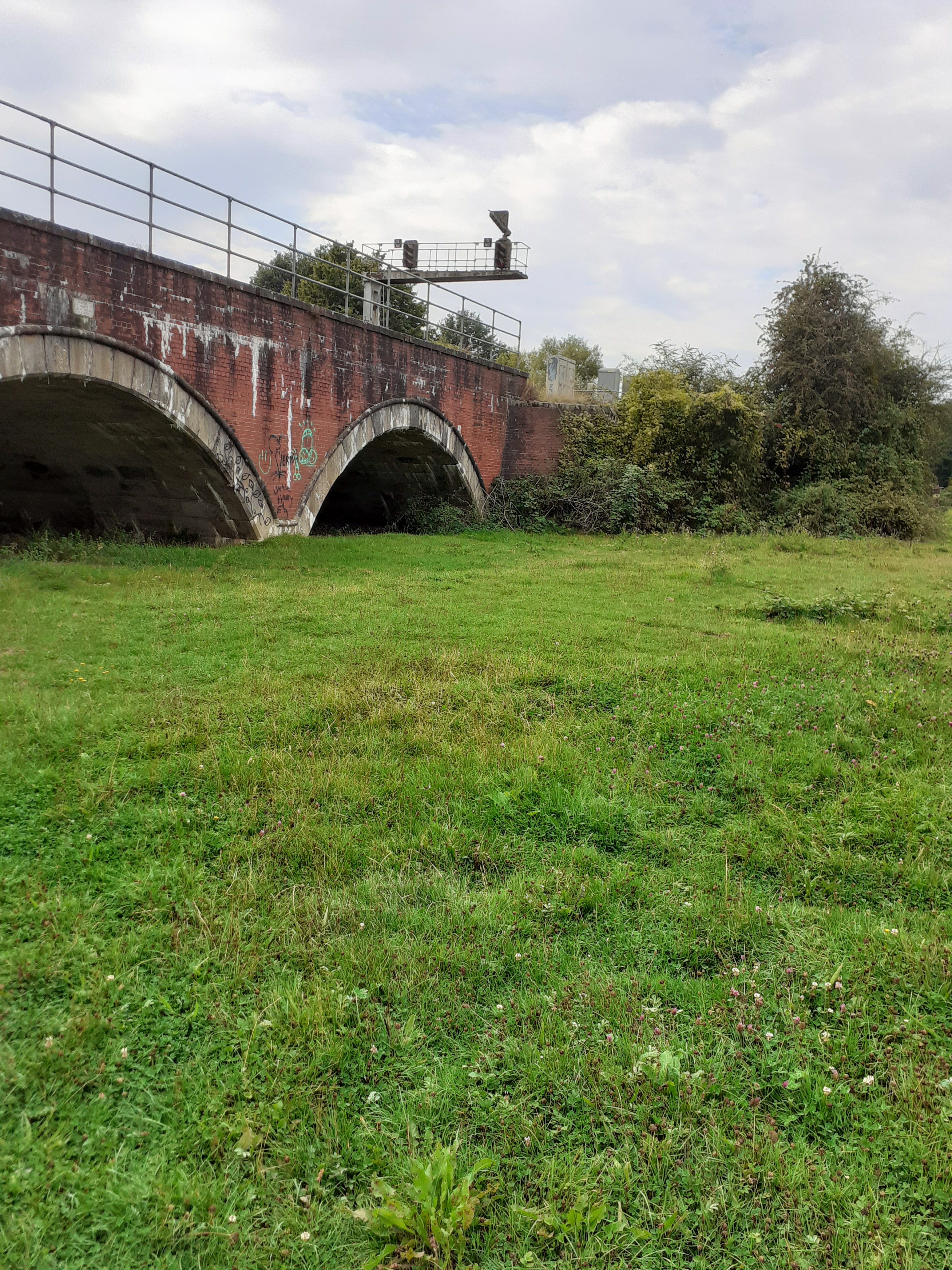
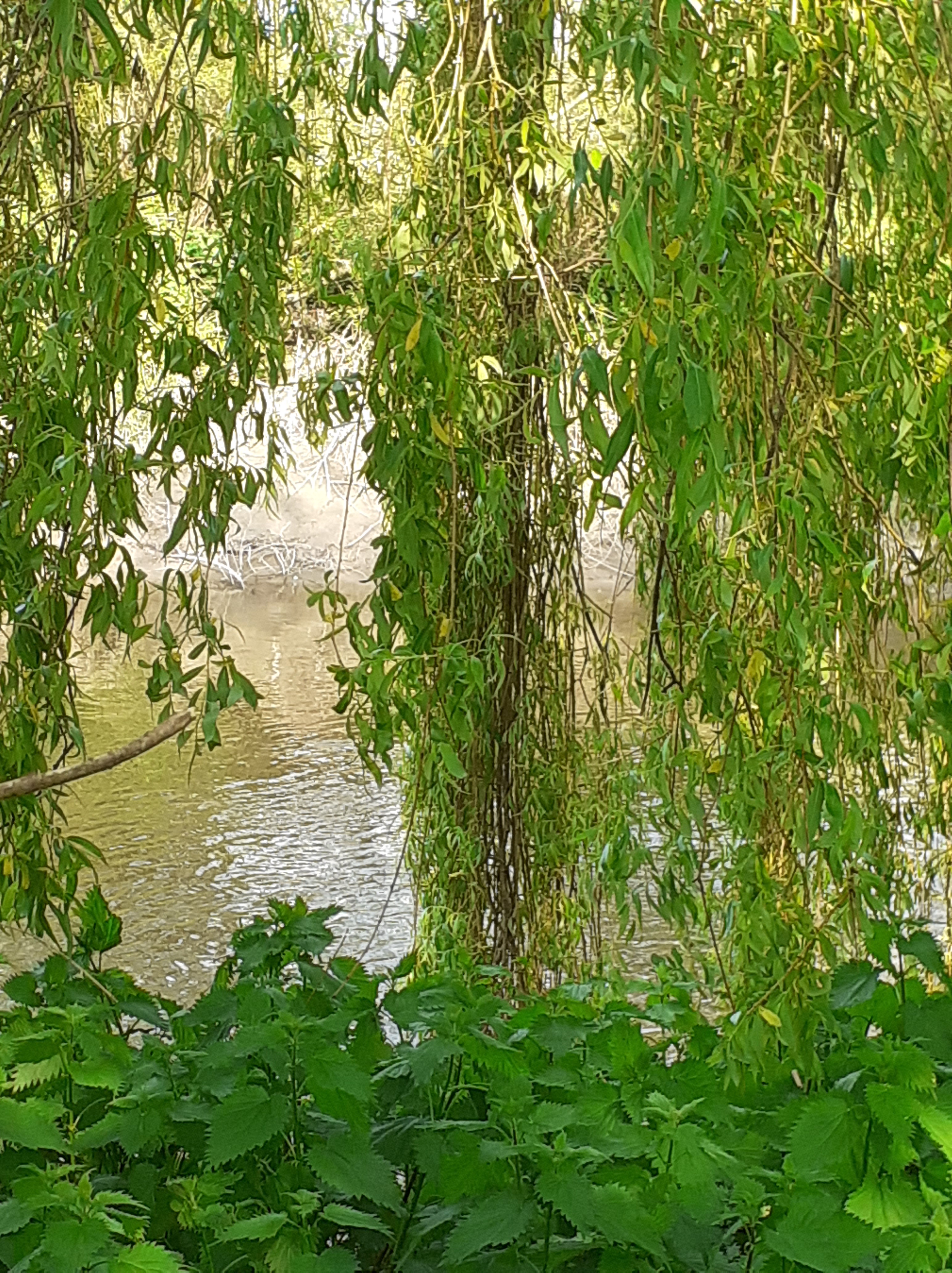
I am in Alney Island again, on the River Severn as it passes through the ancient city of Gloucester. Above, I am looking at the weaker, eastern channel of the river as it flows around the island. After rain, the water level seems adequate if relatively low, and the willows still seem lush. At first glance, as I walk past, the plant life seems healthy in this watery habitat. Stopping to look more closely, the scars of a summer both hot and dry become evident. The horse chestnut leaves, below, are dramatically shrivelled and their conkers are appearing early. Summer is becoming autumn swiftly and abruptly this year.
Much of Alney island is rough water meadow, as below, and it is a joy to see green grass. Normal? No longer a useful word in this, as other, contexts. In a time of climate chaos fatefully intertwined with runaway wealth, ‘normal’ loses shape and definition. Half-reluctantly, I am adjusting to a new, more dislocating and unpredictable reality.
On this walk I discovered a woodland on the island, shown below. It is far from ancient, being planted in 1983 to commemorate the 500th anniversary of a charter given to the people of Gloucester by King Richard III. A rare monument to the monarch in question.
Richard’s Wood is pleasant enough, although subject to somewhat whimsical curation. A decision was first made to plant non-native trees – red oak, turkey oak and horse chestnut; then to add native trees as well; and later still to thin out the trees so as to create a “wood/pasture habitat to contrast with the wetland meadows on the rest of the reserve”. ‘Rare breed’ cattle were introduced, though I have yet to see any.
I may be doing an injustice, but I get a sense of conservation by human taste and fancy, the manufacture of ‘scenery’ on a handy piece of wasteland that isn’t safe to build on. I don’t get any organic sense of the island, its history or its potential. I don’t get any sense of a wondering about what trees might be brought together to create a viable and self-sustaining woodland community, ‘native’ or otherwise. The horse chestnut, imported from Turkey in the sixteenth century, is now a well-loved English tree. The turkey oak is better suited to the southern England of today than the native species. I suspect they are a good choice. But I’m sorry about the thinning out. There’s no shortage of pasture in England. Overall I believe this kind of management to be a relatively innocent manifestation of the very mindset that is killing us.
Perhaps the trees will have a chance to develop in their own way. My feeling on being among them is gentle but muted. If I compare them with the crowded and chaotic wood that has grown up beside the Stroud cycle path, I sense a relative lack of viriditas – Hildegard of Bingen’s word for the green life energy in nature. It is a relative lack, not absolute. But as I go home, I feel a certain sadness all the same.
In these parts, there is a week at the end of April – St. George’s Day to Beltane Eve – that I would describe as mature spring. The rising year is leaning in to summer, but not quite there. I came close to missing it this year, at least as an outdoors event. I have made a good, if slightly fluctuating, recovery from the COPD flare-up described in recent posts. I met this moment, on this day, in the open air. At every level I feel better for the experience.
The location is Alney Island, now a nature reserve. The river Severn has divided into east and west channels, with Alney Island between them. Most of my pictures were taken near the (lesser) east channel, which flows into the Gloucester waterfront.
On 24 April 2022, I walked through this almost-city water margin. I was moved by its burgeoning growth, noticing the abundance of green in contrasting shades and forms. For awhile I had given up on going out during this delicious period. The experience, however fragile and transient both I and this space might be, was pure celebration. Taking pictures became an act of celebration, and also of giving thanks.
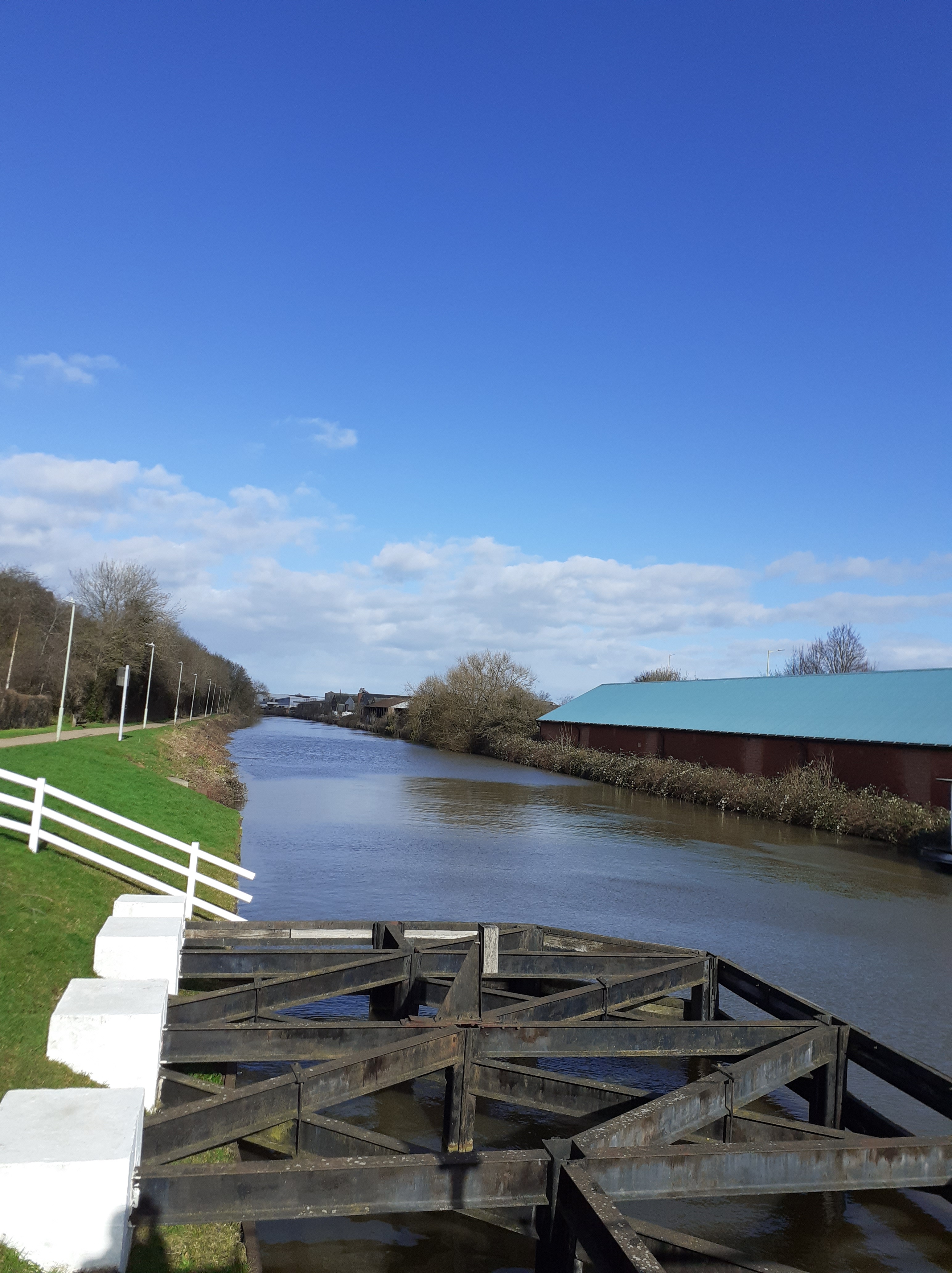
I was facing strong sunlight. I even felt warm. I risked taking a picture by angling down into the water. The water rewarded me with a patches of reflected light. I accepted a somewhat darkening effect in the photograph as a whole. The solar reality was brighter to my eyes, almost too much for them, flooding the path before me with intense light. When I looked back to where I had been, the light was gentler. My picture below shows a clear blue sky that I could confidently open up to include.
Though winter is not exactly over, I was experiencing an undoubtedly spring day. I was in a spring frame of mind, welcoming the change of season, as the wheel turns, and welcoming a still new landscape into my life. I have chosen this canal path as a place of regular walks and engagement. Over time, in the rising year, I will get to see and know it better. I seem to be a water margin Druid at heart, and I am finding possibilities in this new, more densely urban context. I find the energy of life everywhere I look – whether land, water, or sky.
I took this picture from an upstairs window before 9 a.m. on18 February 2022,. It shows blue sky and the tower of St Mary de Crypt, Gloucester. The image is calm, and I enjoy its simple beauty. But I am bracing for a severe storm, officially named ‘Storm Eunice’. We are on red alert, which is very rare in this country. I contemplate the tower, which stands both for longevity and impermanence.
It is 10.15 a.m. now and the wind, at first just playful, has moved into serious gusting. Paper and leaves blow about in a courtyard. The sky is grey and there are raindrops on my window pane. Taking another picture, I notice I have lowered my sights. I have included more material substance, roof tops in particular. The invitation to skyward contemplation, so poignantly encouraged by towers like this, isn’t so present for me in this moment. The theme now is embodied endurance and solidity, weathering the winds of the world. For they don’t seem at all celestial, their current force at least partly the result of our own collective behaviour. Strong walls and a decent roof are the focus of my desire. I am, after all, a Pagan.
I am an urban Druid now, more clearly than before. It gives me a different view of nature. On one hand I am reminded that everything is included in ‘nature’. But in so far as I make a city/country distinction, I do notice a different experience of the elements, seasons, and the varieties of life. In an old and relatively small city (pop. 165,000) it is easier to see the evolution of human culture as a gradual and organic process than in other built environments. Today is a special day because raw and conceivably violent nature is coming on a visit. Whilst I notice fears around this, and am distressed by the notion of harm to anyone, I also find an aspect of Spring, and renewal, in this. I do feel energised, now, just after 11 a.m., and this at least is welcome. I have no idea of how the day is going to play out here, or what I am going to feel about my experience of Storm Eunice at the days end.













 Contemplative Inquiry