Contemplative Inquiry

This blog is about contemplative inquiry

Tag: Science

BOOK REVIEW: ELEGANT SIMPLICITY
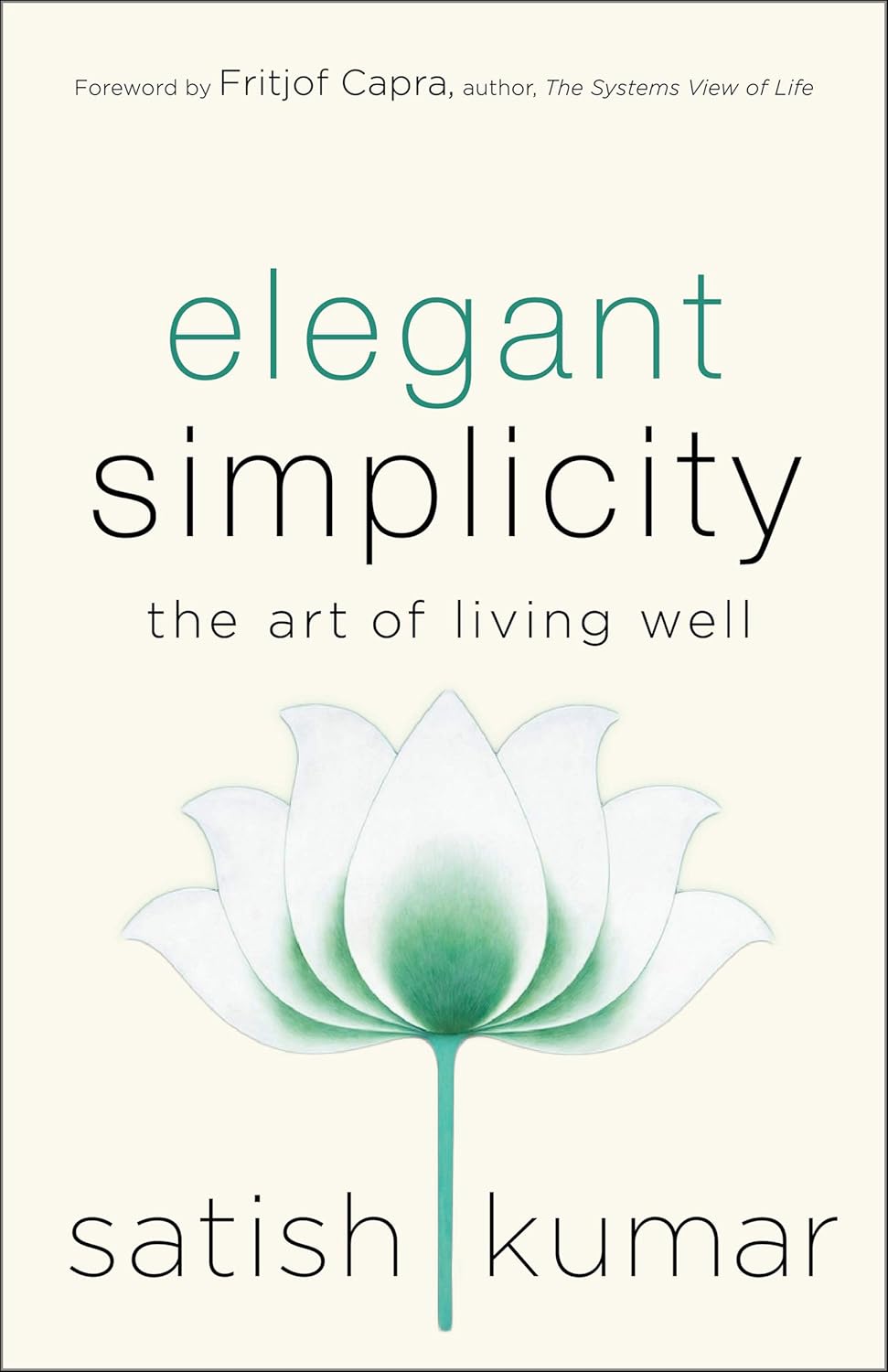
Highly recommended. Satish Kumar (born in 1936) published Elegant Simplicity: the Art of Living Well in 2019 (1). It begins with a foreword by Fritjof Capra and a preface by the author Let’s be Simple which quotes the 1848 Shaker song ‘Tis the gift to be simple, ‘Tis the gift to be free. The book summarises the author’s personal story as well as discussing his values. I have written posts based on some of his other work before (2). I especially recommend this book to anyone interested in knowing more about Satish Kumar’s practice (grounded in Jain spirituality and Gandhi’s non-violent activism) and his influence on deep ecology, creative arts and education.

Elegant Simplicity has a summarising quality, looking back on decades devoted to sacred activism in different forms. It is divided into fourteen chapters: Each is preceded by a brief and relevant quotation from another thinker. The chapter then becomes a meditation on the quote:

1 My Story: Beginnings – ‘True happiness lies in contentment’ Mahatma Gandhi.

2 Simplicity of Walking – ‘All truly great thoughts are conceived by walking’ Friedrich Nietzsche.

3 Life is a Pilgrimage – ‘Faith is not the clinging to a shrine but an endless pilgrimage of the heart’ Abraham Joshua Heschel.

4 Elegant Simplicity – ‘Any fool can make things complicated, it requires a genius to make them simple’ E. F. Schumacher.

5 A Society of Artists – ‘This world is but a canvas to our imagination’ Henry David Thoreau.

6 Yoga of Action – ‘Life is a process not a product’ Brian Goodwin.

7 Learning is Living – ‘Education is not preparation for life; education is life itself’ Thomas Dewey.

8 Right Relationships – ‘We are all related – relationships based on obligation lack dignity’ Wayne Dwyer.

9 Love Unlimited – ‘There is no charm equal to tenderness of the heart’ Jane Austin.

10 Power of Forgiveness – ‘It’s one of the greatest gifts you can give yourself, to forgive. Forgive everybody.’ Maya Angelou.

11 Dance of Opposites – ‘Life and death are one as the river and the sea are one’ Kahlil Gibran.

12 Deep Seeing – ‘To see clearly is poetry, prophecy, and religion, all in one’ John Ruskin.

13 Union of Science and Spirituality – ‘Science is not only compatible with spirituality; it is a profound source of spirituality’ Carl Sagan.

14 Soil, Soul and Society – ‘We live in an interconnected world and in an interconnected time so we need holistic solutions to our interconnected problems‘ Naomi Klein.

Fellow activist and author Vandana Shiva describes Elegant Simplicity as “the distillation” of Satish Kumar’s ideas and actions. “It shows the intimate connections between the inner and the outer world, soil, soul and society, beauty joy and non-violence. It indicates that the solutions to the big problems of our time – climate change, hate, violence, hopelessness and despair – lie in thinking and living with elegant simplicity, reducing our ecological footprint while enlarging our hearts and minds”.

For me, Satish Kumar is an inspiration rather than a direct model. Even in the conditions of the early 1960’s I would not have walked, or aspired to walk, from New Delhi to Washington DC without carrying any money. Yet Satish Kumar and his companion E. P. Menon succeeded and made a huge public impact at the time. Their peace pilgrimage gave oxygen to the campaign for nuclear disarmament. No state gave up its arms, but treaties limiting the numbers and testing of nuclear arms became normalised for some decades. Satish Kumar’s initiatives in deep ecology and education, especially the ‘small school’ and Schumacher College, have changed lives. Directly and indirectly, his influence has awakened many people from the dystopian trance of our dominant cultures. Satish Kumar is a widely revered elder: a peaceful warrior for a more liveable, generous and creative world.

(1) Satish Kumar Elegant Simplicity: The Art of Living Well New Society Publishers (https://www.newsociety.com): Gabriola Island, BC, Canada: 2019

(2) See previous posts:

NEWS OF A DEATH

TWO VIEWS OF THE DIVINE

OUTDOOR WALKING MEDITATION

NOTE: “Satish Kumar (born 9 August 1936)[1] is an Indian British activist and speaker. He has been a Jain monk, nuclear disarmament advocate and pacifist.[3]Now living in England, Kumar is founder and Director of Programmes of the Schumacher College international center for ecological studies, and is Editor Emeritus of Resurgence & Ecologist magazine. His most notable accomplishment is the completion, together with a companion, E. P. Menon, of a peace walk of over 8,000 miles in June 1962 for two and a half years, from New Delhi to MoscowParisLondon, and Washington, D.C., the capitals of the world’s earliest nuclear-armed countries.[4][5] He insists that reverence for nature should be at the heart of every political and social debate.” (Wikipedia)

‘CONCRETE SCIENCE’ IN NEOLITHIC CULTURES

Extract from The Dawn of Everything: A New History of Humanity by David Graeber and David Wengrow (1), exploring the notion of ‘concrete science’. The idea comes from the anthropologist Claude Levi-Strauss, who is quoted as saying that “there are two distinct modes of scientific thought … two strategic levels at which nature is accessible to scientific enquiry: one roughly adapted to that of perception and imagination: the other at a remove from it”. ‘Concrete science’ is the first. The specific focus, in this part of the book, is on the development of Early Neolithic societies in lowland parts of the Fertile Crescent, especially along the valleys of the Jordan and Euphrates rivers.

Graeber and Wengrow write: “It’s important to recall that most of humanity’s greatest scientific discoveries – the invention of farming, pottery, weaving, metallurgy, systems of maritime navigation, monumental architecture, the classification and indeed domestication of plants and animals. and so on” come out of ‘concrete science’. But what does such a science actually look like, in the archaeological record? “The answer lies precisely in its ‘concreteness’. Invention in one domain finds echoes and analogies across a whole range of others, which might otherwise seem completely unrelated”.

“We can see this clearly in early Neolithic cereal cultivation. Recall that flood-retreat farming required people to establish durable settlements in mud-based environments, like swamps and lake margins. Doing so meant becoming intimate with the properties of soils and clays, carefully observing their fertility under different conditions, but also experimenting with them as tectonic materials, or even as vehicles of abstract thought. As well as supporting new forms of cultivation, soil and clay – mixed with wheat and chaff – became basic materials of construction: essential in building the first permanent houses; used to make ovens, furniture and insulation – almost everything, in fact, except pottery, a later invention in this part of the world.

“But clay was also used, in the same times and places, to (literally) model relationships of utterly different kinds, between men and women, people and animals. People started using its plastic qualities to figure out mental problems, making small geometric tokens that many see as direct precursors to later systems of mathematical notation. Archaeologists find these tiny numerical devices in direct association with figurines of herd animals and full-bodied women: the kind of miniatures that stimulate so much speculation about Neolithic spirituality, and which find later echoes in myths about the demiurgic, life-giving properties of clay. As we’ll soon see, earth and clay even come to redefine relationships between the living and the dead.

“Seen this way, the ‘origins of farming’ start to look less like and economic transition and more like a media revolution, which was also a social revolution, encompassing everything from horticulture to architecture, mathematics to thermodynamics, and from religion to the remodelling of gender roles. And while we can’t know who exactly was doing what in this brave new world, it’s abundantly clear that women’s work and knowledge were central to its creation; that the whole process was a fairly leisurely, even playful one, not forced by any environmental catastrophe or demographic tipping point and unmarked by major violent conflict. What’s more, it was all carried out in ways that made radical inequality an extremely unlikely outcome”.

(1) David Graeber and David Wengrow The Dawn of Everything: A New History of Humanity Penguin Books, 2022 (First published in Great Britain by Allen Lane in 2021)

NOTE ABOUT THE AUTHORS David Graeber was a professor of anthropology at the London School of Economics. He is the author of Debt: The First 5,000 Years. As an activist, he also helped to make Occupy Wall Street (2011) an era-defining moment. He died on 2 September 2020. David Wengrow is a professor of comparative archaeology at University College London. He conducts fieldwork in Africa and the Middle East and is the author of What Makes Civilisation? Following David Graeber’s death shortly after the text of The Dawn of Everything was completed, David Wengrow has overseen its publication.

EXPLORING ‘EMPTINESS’: CARLO ROVELLI AND NAGARJUNA

A modern western humanist learns from an ancient Buddhist philosopher. Carlo Rovelli’s book Helgoland (1) is mostly about the development of quantum mechanics in the early to mid-twentieth century and the scientists who developed it. The title references ‘Werner Heisenberg’s sojourn on the remote island of Helgoland working on the maths. But one chapter concerns the second century CE Buddhist philosopher Nagarjuna, and how his work has helped Rovelli to frame a philosophical understanding of quantum phenomena.

“When speaking about quanta and their relational nature I had frequently met people who asked: Have you read Nagarjuna? … Though not widely read in the West, the work in question is hardly an obscure or minor one: it is one of the most important texts in Buddhist philosophy. … The central thesis of Nagarjuna’s book is simply that there is nothing that exists in itself, independently from something else.

“The resonance with quantum mechanics is immediate. Obviously Nagarjuna knew nothing, and could not have imagined anything, about quanta – that is not the point. The point is that philosophers offer original ways of re-thinking the world, and we can employ them if they turn out to be useful. The perspective offered by Nagarjuna make perhaps make it a little easier to think about the quantum world (2).

“If nothing exists in itself, everything exists only through dependence on something else, in relation to something else. The technical term used by Nagarjuna the absence of independent existence is ‘emptiness’ (sunyata): things are ‘empty’ in the sense of having no autonomous existence. They exist thanks to, as a function of, with respect to, in the perspective of, something else.

“If I look at a cloudy sky – to take a simplistic example – I can see a castle and a dragon. Does a castle and does a dragon really exist, up there in the sky? Obviously not: the dragon and the castle emerge from the encounter between the shape of the clouds and the sensations and thoughts in my head; in themselves they are empty entities, they do not exist. So far, so easy. But Nagarjuna also suggests that the clouds, the sky, sensations, thoughts and my own head are equally things that arise from the encounter with other things: they are empty entities.

“And myself, looking at the star, do I exist? No, not even I. So who is observing the star? No one says Nagarjuna. To see a star is a component of that set of interactions that I normally call my ‘self’. ‘What articulates language does not exist. The circle of thoughts does not exist.’ There is no ultimate or mysterious essence to understand that is the true essence of our being. ‘I’ is nothing other than the vast and interconnected set of phenomena that constitute it, each one dependent on something else. Centuries of Western speculation on the subject, and on the nature of consciousness, vanish like morning mist.

“Like much philosophy and much science, Nagarjuna distinguishes between two levels: conventional, apparent reality with its illusory and perspectival aspects, and ultimate reality. But in this case the distinction takes us in an unexpected direction: the ultimate reality, the essence, its absence, is vacuity. It does not exist.

“If every metaphysics seeks a primary substance, an essence on which everything may depend, the point of departure from which everything follows, Nagarjuna suggests that the ultimate substance, the point of departure … does not exist.

….

“The illusoriness of the world, its samsara, is a general theme of Buddhism; to recognize this is to reach nirvana, liberation and beatitude. For Nagarjuna, samsara and nirvana are the same thing: both empty of their own existence. Non-existent.

“So is emptiness the only reality? Is this, after all, the ultimate reality? No, writes Nagarjuna, in the most vertiginous chapter of the book: every perspective exists only in interdependence with something else, there is never an ultimate reality – and this is the case for his own perspective as well. Even emptiness is devoid of essence: it is conventional. No metaphysics survives. Emptiness is empty.

“Nagarjuna has given us a formidable conceptual tool for thinking about the relationality of quanta: we can think of interdependence without autonomous essence entering the equation, In fact interdependence – and this is the key argument made by Nagarjuna, requires us to forget all about autonomous essences.

“The long search for the ‘ultimate substance’ in physics has passed through matter, molecules, atoms, fields, elementary particles … and has been shipwrecked in the relational complexity of quantum field theory and general relativity. Is is possible that a philosopher from ancient India can provide us with a conceptual tool with which to extricate ourselves?”

“The fascination of Nagarjuna’s thought goes beyond questions raised by contemporary physics. His perspective has something dizzying about it. It resonates with the best of much Western philosophy, both classical and recent. … He speaks about reality, about its complexity and comprehensibility, but he defends us from the conceptual trap of wanting to find it an ultimate foundation.

“His is not metaphysical extravagance: it is sobriety. It recognizes the fact that to inquire about the ultimate foundation of everything is to ask a question that perhaps simply does not make sense.

“This does not shut down investigation. On the contrary, it liberates it. Nagarjuna is not a nihilist negating the reality of the world, and neither is he a sceptic denying that we can know anything about that reality. The world of phenomena is one that we can investigate, gradually improving our understanding of it. We may find general characteristics. But it is a world of interdependence and contingencies, not a world that we should trouble ourselves attempting to derive from an Absolute.

“I believe that one of the greatest mistakes made by human beings is to want certainties when trying to understand something. The search for knowledge is not nourished by certainty: it is nourished by a radical absence of certainty. Thanks to the acute awareness of our ignorance, we are open to doubt and can continue to learn and learn better. This has always been the strength of scientific thinking – thinking born of curiosity, revolt, change. There is no cardinal or final fixed point, philosophical or methodological, with which to anchor the adventure of knowledge.

“I am not a philosopher; I am a physicist: a simple mechanic. And this simple mechanic, who deals with quanta, is taught by Nagarjuna that it is possible to think of the manifestation of objects without having to ask what the object is in itself, independent from its manifestations.

“But Nagarjuna’s emptiness also nourishes an ethical stance that clears the sky of the endless disquietude: to understand that we do not exist as autonomous entities helps us free ourselves from attachments and suffering. Precisely because of its impermanence, because of the absence of any absolute, the now has meaning and is precious.

“For me as a human being, Nagarjuna teaches the serenity, the lightness and the shining beauty of the world: we are nothing but images of images. Reality, including ourselves, is nothing but a thin and fragile veil, beyond which … there is nothing.”

(1) Carlo Rovelli Helgoland global.penguinrandomhouse.com 2020 (Translated by Erica Segre & Simon Carnell, 2021) Carlo Rovelli is a theoretical physicist who has made significant contributions to the physics of space and time.

(2) The Fundamental Wisdom of the Middle Way: Nagarjuna’s Mulamadhyamakakarika: Translation and commentary by Jay L. Garfield. Oxford: The University Press, 1995. Nagarjuna, who lived in South India in approximately the second century CE, is the most important, influential and widely studied Mahayana Buddhist philosopher. At the time of publication Jay L. Garfield was Professor of Philosophy and Director of the Hampshire in India Program, an exchange program with the Tibetan Universities in exile, at Hampshire College, Amherst, Massachusetts. His translation is from a Tibetan, rather than Sanskrit, text.

SUZANNE SIMARD: FINDING THE MOTHER TREE

Dr. Suzanne Simard grew up in the Monashee Mountains of British Columbia, in a family of low impact traditional foresters. She worked for many years a researcher in the Canadian Forest Service, before moving into academia. She is currently Professor of Forest Ecology at the University of British Columbia’s Faculty of Forestry. Throughout her career she has had a leading role in changing the way that science thinks about trees and forests. Her research on tree connectivity, communication and cooperation – and their impact on the health and biodiversity of forests – has shown how the imposed monocultures of commercial forestry are a disaster for forests, forestry and the wider ecology of the planet.

Her book Finding the Mother Tree: Uncovering the Wisdom and Intelligence of the Forest was published by Penguin Books in the UK, USA, Canada, Ireland and Australia in 2021 in paper, kindle and audio versions. It describes both a personal journey and a scientific one, and shows how the work Simard came to do grew out of the place and culture in which she was raised. It is as if her achievement had her name on it even at the beginning. I highly recommend this book to any one with an interest in ecology and the sentience of trees.

I cannot do justice in to this inspiring book and its thesis in a single post. Instead, I refer readers to a TED talk on How Trees Talk To Each Other (1), which Simard gave in 2016, summarising her work and its implications in just over 16 minutes. If the talk whets your appetite, the book will likely satisfy it. It says more about Suzanne Simard’s personal and family journey. It describes her ground-breaking (though also fraught and frustrating) time within the Canadian Forest Service in some detail. It also says something about the ecological wisdom of the indigenous peoples of the forest and takes Simard’s own research up to 2020.

(1) http://www.ted.com/talks/suzanne_simard_how_trees_talk_to_each_other?language=en/

BOOK REVIEW: RIDERS ON THE STORM

“It is with the dignity of life on earth, and our human part in it, that the passion of this book is concerned.” Alistair McIntosh is a Scottish ecologist based on the Hebridean Isle of Lewis. Riders on the Storm (1) interweaves reflections on the scientific, social-ecological and spiritual aspects of the climate crisis. He writes from the standpoint of 2020, where this overarching existential threat enfolds the more limited and specific crisis of the Covid-19 pandemic.

The early chapters consider the current science, “sticking closely to the peer-reviewed publications of the U.N.’s Intergovernmental Panel on Climate Change (IPCC)”. There are individual chapters on land; oceans and ice; and on 1.5 degrees. They make it clear that scientific truth-telling in this complex domain is a work of establishing levels of confidence on how climate change is unfolding, and “narrowing uncertainty”, rather than establishing facts. McIntosh upholds the IPCC approach, “for all its limitations”, as a peer-reviewed, panel-appraised, consensus-settled science. He sees it as an outstanding model of co-operative working and the most reliable route to take.

The next chapters look at the wider community’s response to the scientific evidence, given the tension between what the science says and how different groups use it. McIntosh discusses the denialism spear-headed by lobby groups disguised as ‘think-tanks’ and their disastrous effects on public discourse, such as the false balance practised by media organisations, including until recently the BBC, in holding futile ‘debates’ between climate scientists and deniers. He also discusses the roles of climate change contrarianism and dismissal in the current moment when outright denial has become harder to maintain. McIntosh goes on to look at the psychology of denial amongst the wider public. He has a section on the intimidation of the scientists themselves, including the dissemination of conspiracy theories accusing their whole community of deliberate deception, and its psychological effects on them.

On the other side of the argument, McIntosh has a chapter on ‘rebellion and leadership in climate movements’. He sees Greta Thunberg as authentically taking on the traditional prophet’s role, which is “to pay heed to their inner calling, to read the outer signs of the times, and to speak to the conditions found upon the land to call the people and their leaders back to what gives life”. McIntosh does have concerns about ‘alarmism’ among some activists. Without giving it a false equivalence with denialism in terms of damage it may do, he sees a tendency to edge out of step with the science, “pushing a point to make a point”. He identifies this as a tendency within Extinction Rebellion (XR) (2), though not extending to XR as a whole. In this context, he also discusses the difference between his understanding of satyagraha, Mahatma Gandhi’s grounded way of peace and social transformation, and instrumentalist versions of non-violent direct action applied simply as a tactic.

After an ambivalent consideration of proposed technical solutions to climate change, the later chapters “shift into story-telling mode” in order to “enter further into depth psychology and beyond”. McIntosh asks questions familiar from his other work (3): what does it take to reconnect with the earth, with spirituality, and with one another – with soil, soul and society? McIntosh’s own work is grounded in close-to-the-ground community development informed by the lens of human ecology, with its strong focus on interactions between the social environment and the natural environment in which we live. McIntosh emphasises grass roots led consensus building and decision making, drawing on emancipatory action research methodologies developed largely in the global south. The spiritual dimension of this, for McIntosh, lies essentially in “the interiority of outward things”, the profound interconnection of all things, and “the meanings of life as love made manifest”. Traditional stories and the wisdom they hold have a valuable role to play in such a project. In an earlier post (4) I extracted a Chinese rainmaker story presented in Riders in the Storm. Within the book, the value of traditional wisdoms is explored through a meeting between Hebridean and Melanesian community leaders and activists when the latter visited Lewis as guests of the former.

I found this book a rich and dense exploration of where we now stand with the existential threat posed by climate crisis. It does not read like a novel but is worth the effort and a great resource. McIntosh himself urges readers to use it in whatever way we want. To anyone committed to “the dignity of life on earth, and our human part in it”, this book has something to say.

(1) Alastair McIntosh Riders on the Storm: the Climate Crisis and the Survival of Being Edinburgh, Scotland: Birlinn, 2020

(2) For a review by an XR insider, see https://earthbound.report/2020/08/24/book-review-riders-on-the-storm-by-alastair-mcintosh/

(3)Alastair McIntosh Soil and Soul: People versus Corporate Power London, England: Aurum Press, 2001

(4) https://contemplativeinquiry.blog/2020/09/11/rainmaker/

POEM: NOTIONS

I like this poem for its depiction of a young person’s best efforts, leading to the experience of ‘discourse by dismissal’ and a counter-affirmation of the ‘vigour of heresy’.

Pluralitas non est ponenda sine necessitate

Plurality should not be posited without necessity

                William of Ockam

In my first serious essay

For Religious Studies

I apply Occam’s razor

(Choice of budding scientist)

To God’s reputation:

All power to do all things,

All essence in all things,

All guidance for all things,

Past, present, future.

Keeping it simple, I favour

The universe as it is, in its cycles

Of boom and dust, orbits

And double-helix feats, all

Loosed by laws of urge

And reaction, lure and strife,

First seed, last song,

Billiard balls colliding

Ad infinitum, no recourse

To maker or judge.

I await appreciation

Of insight and logic, but

None comes, others praised

In a covenant of dogma,

My first taste of discourse

By dismissal, my first vow

For the vigour of heresy.

Earl Livings Libation Port Adelaide, AUS: Ginninderra Press, 2018 www.ginninderapress.com.au

NOTE: Earl Livings lives in Melbourne, Australia and edited Divan, Australia’s first all-Australian online poetry journal from 1999 to 2013. His first poetry collection Further than Night, was published in 2000, and in 2005 he won the Melbourne Poets Union International Poetry Competition. His poetry and fiction have been published in journals and anthologies in Australia, Britain, Canada, the USA and Germany. He is currently working on a Dark Ages novel and his next poetry collection.

My thanks to Nimue Brown for drawing attention to the Libation collection at http://druidlife.wordpress.com/2020/03/29/

SCIENCE AND SPIRITUAL PRACTICE

As part of my contemplative inquiry, I have been looking at recent work by Rupert Sheldrake (1, 2). He identifies himself as “not a guru but an explorer”. I like that notion of ‘explorer’, with its sense that there is always space for new learning and development.

Sheldrake’s affirms that spiritual practice and research are “entirely consistent with the scientific method, which involves the formation of hypotheses – guesses about the way the world works – and then testing them experimentally. The ultimate arbiter is experience, not theory. In French, the word experience means both ‘experience’ and ‘experiment’. The Greek word for experience is empeiria, the root of our English word ‘empirical’. The exploration of consciousness through consciousness itself is literally empirical, based on experience. Spiritual practices provide ways in which consciousness can be explored empirically.”

In recent years, Sheldrake (1,2) has written two books based on this approach. Each discusses seven different practices that have been investigated empirically, both by the practitioners themselves and by scientists studying the effects of those practices. Every practice gets a chapter. The first book, Science and Spiritual Practices, offers:

  1. Meditation and the Nature of Minds
  2. The Flow of Gratitude
  3. Reconnecting with the More-Than-Human World
  4. Relating to Plants
  5. Rituals and the Presence of the Past
  6. Singing, Chanting and the Power of Music
  7. Pilgrimages and Holy Places

The second Book, Ways To Go Beyond, covers:

  1. The Spiritual Side of Sports
  2. Learning from Animals
  3. Fasting
  4. Cannabis, Psychedelics and Spiritual Openings
  5. Powers of Prayer
  6. Holy Days and Festivals
  7. Cultivating Good Habits, Avoiding Bad Habits, and Being Kind

Sheldrake’s choices are all practices he has taken part in, which have also been studied scientifically. He looks at both the ‘subjective’ experience and the ‘objective’ evidence and discusses the ways in which the practices seem to work. He also offers guidance to readers about engaging with the practices. He is very clear that the two books “do not constitute a comprehensive survey of all spiritual practices, emphasising his point by listing others that have been left out: “yoga, service to others, tai chi, chi gong, devotional worship or bhakti, tantric sex, caring for dying people, dream yoga, and the practices of the arts”. He makes it clear that “some practices are better at some times of life than others, and all religious traditions  have their own combinations”. I have already discussed Sheldrake’s work on gratitude at www.contemplativeinquiry.blog/2020/03/14/ and will discuss others in future posts.

Sheldrake’s overall purpose is “to show that there is a wide variety of ways to connect to greater conscious realities, however we conceive of them, and that the effects of these practices can be investigated empirically”. Sheldrake is an optimist about the possibilities of science and spirituality working together in the service of human flourishing. “We are on the threshold of a new era of the exploration of consciousness, both through a revival of spiritual practices and also through the scientific study of them. After several generations in which science and spirituality seemed to be in opposition, they are becoming complementary. Together they are contributing to an unprecedented phase of spiritual evolution, beginning now.”

(1) Rupert Sheldrake Science and Spiritual Practice: Reconnecting Through Direct Experience Coronet, 2017

(2) Rupert Sheldrake Ways to Go Beyond, and Why They Work Coronet, 2019

NOTE: Rupert Sheldrake is a biologist and author of more than eighty technical papers and ten books, including A New Science of Life. He was a Fellow of Clare College, Cambridge, where he was Director of Studies in cell biology, and was also a Research Fellow of the Royal Society.

Sheldrake resigned his position at Clare and went to work on the physiology of tropical crops in Hyderabad, India, as principal plant physiologist at the International Crops Research Institute for the Semi-Arid Tropics (ICRISAT) from 1974 to 1978. There he published on crop physiology] and co-authored a book on the anatomy of the pigeonpea. Sheldrake left ICRISAT to focus on writing A New Science of Life, during which time he spent a year and a half in the Saccidananda Ashram of Bede Griffiths, a Benedictine monk.

From 2005-2010 he was the Director of the Perrott-Warwick Project for research on unexplained human abilities, funded from Trinity College, Cambridge. He is currently a Fellow of the Institute of Noetic Sciences in California, and a Visiting Professor at the Graduate Institute in Connecticut.

His website is www.sheldrake.org/

POEM: FIELD

They will not mesh, the very small and the large.

They will not converge.

On that side of the mirror, flickering fringes –

Superposition, quantum probabilities,

Shimmering light and dark; on this,

Nature has made its choice.

Time, space –

They will not bend both ways at once.

When the little ideas slip into bodies like clothes

They step through the mirror, enter

An irreducible level of noise –

Gravitational decoherence, dependent on mass.

Worlds, how sad we are to leave our dreaming behind.

So lovely we were then, so light, so playful.

But how compelling to have a body. In fact,

Irresistible.

From: Katrina Porteous Edge Hexham, Northumberland: Bloodaxe Books, 2019

Blurb note: “Edge contains three poem sequences, Field, Sun and the title sequence, which extend Porteous’s previous work on nature, place and time beyond the human scale. They take the reader from the micro quantum worlds underlying the whole Universe, to the macro workings of our local star, the potential for primitive life elsewhere in the solar system on moons such as Enceladus, and finally to the development of complex consciousness on our own planet. As scientific inquiry reveals the beauty and poetry of the Universe, Edge celebrates the almost-miraculous local circumstances which enable us to begin to understand it. All thre pieces were commissioned for performance in Life Science Centre Planetarium, Newcastle, between 2013 and 2016, with electronic music by Peter Zinovieff.”

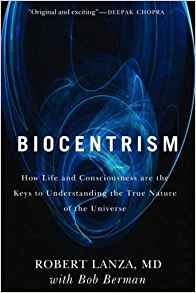
BIOCENTRISM

Biocentrism (1) and the follow-up Beyond Biocentrism (2) are science-referenced explorations of cosmos and consciousness. Unusually, they present a ‘consciousness first’ view. In the first book authors Robert Lanza and Bob Berman work through the evidence and identify seven principles of biocentrism.

“If one removes space and time as actual entities rather than subjective, relative and observer-created phenomena, it pulls the rug from the notion that an external world exists within its own independent skeleton. Where is this external objective existence if it has neither time nor space? we can, at this point formulate seven principles:

“First Principle of Biocentrism: What we perceive as reality is a process that involves our consciousness. An ‘external’ reality if it existed, would – by definition – have to exist in space. But this is meaningless, because space and time are not absolute realities but rather tools of the human and animal mind.

“Second Principle of Biocentrism: Our external and internal perceptions are inextricably intertwined. They are different sides of the same coin and cannot be divorced from one another.

“Third Principle of Biocentrism: The behaviour of subatomic particles – indeed all particles and objects – is inextricably linked to the presence of an observer. Without the presence of a conscious observer, they at best exist in an undetermined state of probability waves.

“Fourth Principle of Biocentrism: without consciousness, ‘matter’ dwells in an undetermined state of probability. Any universe that could have preceded consciousness only existed in a probability state.

“Fifth Principle of Biocentrism: the structure of the universe is explainable only through biocentrism. The universe is fine-tuned for life, which makes perfect sense as life creates the universe, not the other way around. The ‘universe’ is simply the complete spatio-temporal logic of the self.

“Sixth Principle of Biocentrism: Time does not have a real existence outside of animal-sense perception. It is the process by which we perceive changes in the universe.

“Seventh Principle of Biocentrism: Space, like time, is not an object or a thing. Space is another form of our animal understanding and does not have an independent reality. We carry space and time around with us like turtles with shells. Thus, there is no absolute self-existing matrix in which physical events occur independent of life.”

Beyond Biocentrism summarises and extends Biocentrism. It does not repeat the principles, but elegantly summarises the perspective of biocentrism and takes the argument into new territory. An appendix to the book lists its major topics as: the exploration of time; the unreality of death; the nonreality of space; the nature of consciousness; science proofs of biocentrism; asking about awareness in machines (probably no) and plants (certainly yes).

When I contemplate biocentric thinking, I feel engaged and intrigued – without taking a stance on its truth claims. I can see how the universe of the space/time continuum, and within it the earth that I love, may be but a bubble of local, provisional reality. In the light of this narrative, simply experiencing life, being part of it, feels vividly magical. The effect is to ground me even more in my earth spirituality, gratefully celebrating the experienced here and now.

(1) Robert Lanza, MD, with Bob Berman Biocentrism: How Life and Consciousness are the Keys to Understanding the True Nature of the Universe Dallas, TX: Benbella Books, 2009

(2) Robert Lanza, MD, with Bob Berman Beyond Biocentrism: Rethinking Time, Space, Consciousness, and the Illusion of Death Dallas, TX: Benbella Books, 2016

WORLD TREE: A HOLOTROPIC VISION

“The unified field of cosmic energy that I had experienced before now became a massive tree of radiant energy suspended in space. Larger than the largest galaxy, it was composed entirely of light. The core of the tree was lost to the brilliant display but limbs and leaves were visible around its edges. I experienced myself as one of the leaves, the lives of my family and close friends were clustered around me on a small branch. All of our distinguishing characteristics, what made us the individuals we were, appeared from this perspective to be quite minor, almost arbitrary variations of this fundamental energy.

“I was taken around the tree and shown how to move from one person’s experience to another and it was ridiculously easy. Different lives around the globe were simply different experiences the tree was having. … At this point, I was the tree. Not that I was having the full range of its experience, but I knew myself to be this single, encompassing Consciousness. I knew that its identity was my true identity. … To experience my true Identity filled me with a profound sense of numinous encounter”.

The above experience is reported by one of Stanislav Grof’s research subjects in his inquiry into “non-ordinary states of consciousness”. As a young psychiatrist in Soviet era Czechoslovakia Grof pioneered the therapeutic use of LSD. The authorities welcomed ‘progressive’ chemical treatments as an alternative to the bourgeois introspection of psychoanalysis. Seeking greater freedom, and given an opportunity to work in the USA, Grof became a Professor in the John Hopkins University School of Medicine. He continued his clinical and research work until it was banned in 1967 due to a moral panic about psychotropic drugs. His response was to invent holotropic breathing, a ‘natural’ and legal method of giving people access to the same states. Grof became a founder of the Transpersonal Association, which affirmed the place of spirituality in the therapeutic domain. Grof also developed a close association with the Esalen Institute in Big Sur, California, and became a leading figure in the counter-culture of the day.

Grof disliked the limitations he perceived in conventional scientific culture, in particular the view that “our boundaries were defined by the surface of the skin, and consciousness was seen as nothing more than the product of that thinking organ known as the brain”. He thought that scientific culture had developed in an ethnocentric way and was irrationally closed to information gained in non-ordinary states. For him, there was a limiting conflation of ‘objective reality’ and ‘consensus reality’. Anything referenced beyond this was open to dismissal “as the product of an overly active imagination or a mental disorder”, and thus delegitimised in conventional scientific discourse. Grof became interested in archetypal images like the world or cosmic tree because he found them coming up frequently in sessions, as phenomena inviting “numinous encounter”.

For me, reports of this kind add strength to the image of the world tree, though my personal experience of it is different. Some images, like that of the the world (or cosmic) tree, or tree of life, appear in many different cultures and historical periods. They are widely thought of as universal. But the specific ways in which they appear, and the meanings ascribed to them, vary with place, time and culture.

Stanislav Grof The Holotropic Mind: the Three Levels of Human Consciousness and How They Shape Our Lives San Francisco, CA: HarperSanFrancisco, 1993 (Written with Hal Zena Bennett)

Earth Eclectic

music that celebrates Earth and speaks to the heart

Sarah Fuhro Star-Flower Alchemy

Follow the Moon's Cycle

Muddy Feet

Meeting nature on nature's terms

Rosher.Net

A little bit of Mark Rosher in South Gloucestershire, England

Becoming Part of the Land

A monastic polytheist's and animist’s journal

selkiewife

Selkie Writing…

Charlotte Rodgers

Images and words set against a backdrop of outsider art.

Prof Jem Bendell

living with metacrisis and collapse

Towint

The pagan path. The Old Ways In New Times

The Druids Garden

Spiritual journeys in tending the living earth, permaculture, and nature-inspired arts

The Blog of Baphomet

a magickal dialogue between nature and culture

This Simple Life

The gentle art of living with less

Musings of a Scottish Hearth Druid and Heathen

Thoughts about living, loving and worshiping as an autistic Hearth Druid and Heathen. One woman's journey.

Wheel of the Year Blog

An place to read and share stories about the celtic seasonal festivals

Walking the Druid Path

Just another WordPress.com site

anima monday

Exploring our connection to the wider world

Grounded Space Focusing

Become more grounded and spacious with yourself and others, through your own body’s wisdom

The Earthbound Report

Good lives on our one planet

Hopeless Vendetta

News for the residents of Hopeless, Maine