Contemplative Inquiry

This blog is about contemplative inquiry

Tag: Satish Kumar

WORKING WITH BEADS

Recently I wrote about the balanced cross (1), linking it to the paidirean (pahj-urinn) prayer beads of the Ceile De (Culdees), a modern monastic order based in Scotland. This post is about the beads and my work with them. Beads like this were part of the original Ceile De tradition and are known to have been used in the days of Columcille (St. Columba).

There are 150 beads, each about 5 mm wide.  They are made of unstained rosewood and were left immersed in rose damask oil for a month.  As well as scenting the beads, the oil gives the beads a pinkish colour. A cross hangs from the beads – at heart level when worn as a necklace.

Each Paidirean is ceremonially strung in Scotland by a Ceile De Order member.  The process takes two hours and involves prayer, meditation and continuous chanting during the stringing.  Then a blessing is spoken over the completed Paidirean which is anointed with water and with oil from a local holy well, used for at least 1500 years. The Paidirean is an object of power as well as beauty. 

I am not a member of the Ceile De, and when I acquired the Paidirean they knew that I would work with the beads in my own way. I bring together meditation and prayer. I work with the Soham mantra, with Satish Kumar’s understanding (2) that it means ‘you are, therefore I AM’. Whilst I am mindful to my breath, to the mantra and to the movements of the beads, mindfulness is a means and not the purpose of the practice.

The purpose is to make an offering to Spirit – an offering from one lamp to the light, one wave to the ocean. After some hesitation and experiment, I have adopted the word Spirit, rather than Goddess or God, to address the Divine. It is more universal and inclusive as, for me, befits a panentheist view. In making my offering, I am aware that Soham also works laterally, including relations between all beings within the web of life, just as the Druid prayer speaks of  ‘the love of all existences’. Ultimately, we are recognising the divinity in each other.

Spirit is not beyond us in some other realm. It is here, now, and everywhere.  When I work with the beads, I am making both an offering and an affirmation.

(1) https://contemplativeinquiry.blog/2025/01/04/the-balanced-cross

(2) Satish Kumar You Are therefore I AM: A Declaration of Dependence Totnes: Green Books, 2002

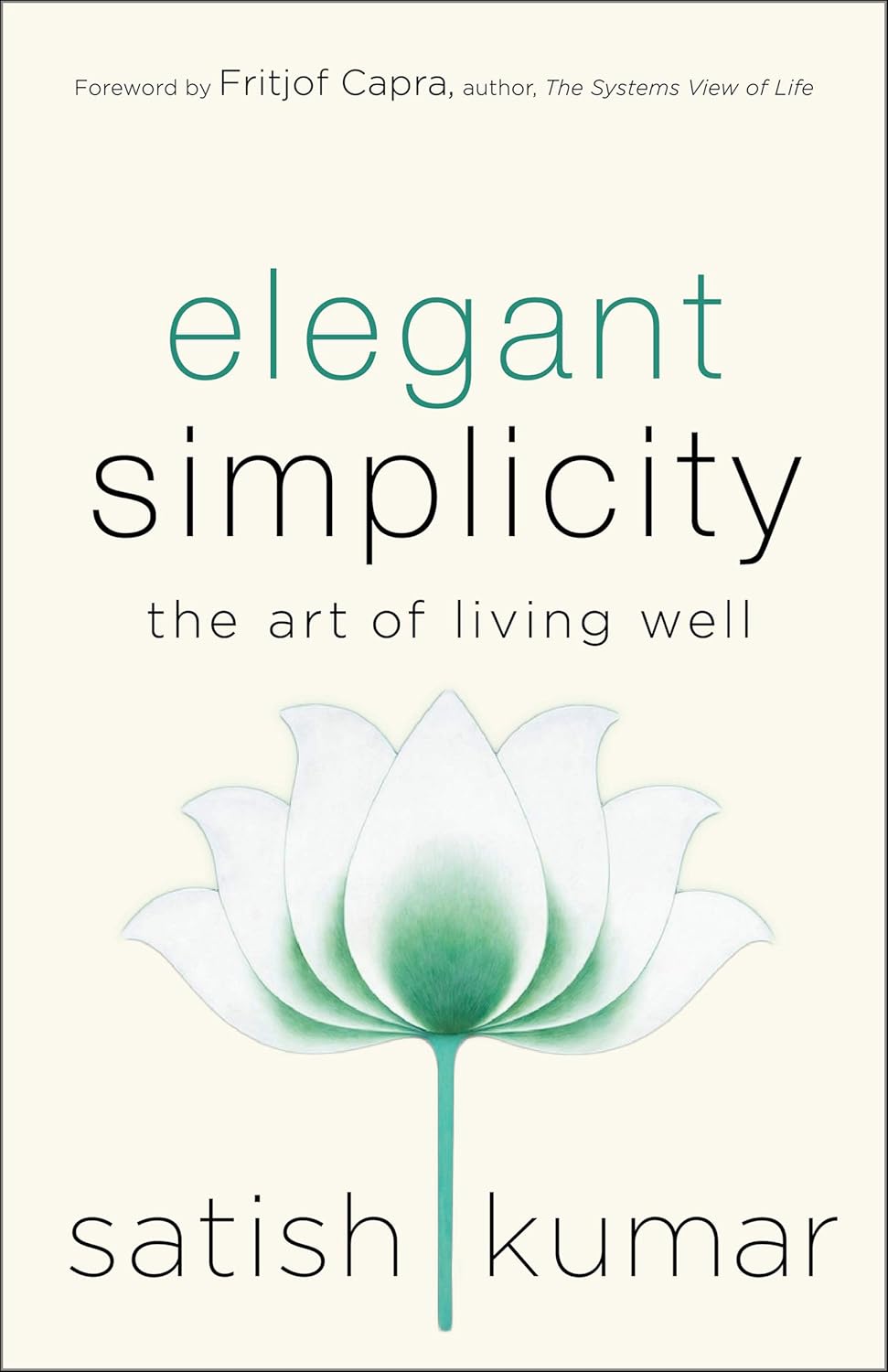
BOOK REVIEW: ELEGANT SIMPLICITY

Highly recommended. Satish Kumar (born in 1936) published Elegant Simplicity: the Art of Living Well in 2019 (1). It begins with a foreword by Fritjof Capra and a preface by the author Let’s be Simple which quotes the 1848 Shaker song ‘Tis the gift to be simple, ‘Tis the gift to be free. The book summarises the author’s personal story as well as discussing his values. I have written posts based on some of his other work before (2). I especially recommend this book to anyone interested in knowing more about Satish Kumar’s practice (grounded in Jain spirituality and Gandhi’s non-violent activism) and his influence on deep ecology, creative arts and education.

Elegant Simplicity has a summarising quality, looking back on decades devoted to sacred activism in different forms. It is divided into fourteen chapters: Each is preceded by a brief and relevant quotation from another thinker. The chapter then becomes a meditation on the quote:

1 My Story: Beginnings – ‘True happiness lies in contentment’ Mahatma Gandhi.

2 Simplicity of Walking – ‘All truly great thoughts are conceived by walking’ Friedrich Nietzsche.

3 Life is a Pilgrimage – ‘Faith is not the clinging to a shrine but an endless pilgrimage of the heart’ Abraham Joshua Heschel.

4 Elegant Simplicity – ‘Any fool can make things complicated, it requires a genius to make them simple’ E. F. Schumacher.

5 A Society of Artists – ‘This world is but a canvas to our imagination’ Henry David Thoreau.

6 Yoga of Action – ‘Life is a process not a product’ Brian Goodwin.

7 Learning is Living – ‘Education is not preparation for life; education is life itself’ Thomas Dewey.

8 Right Relationships – ‘We are all related – relationships based on obligation lack dignity’ Wayne Dwyer.

9 Love Unlimited – ‘There is no charm equal to tenderness of the heart’ Jane Austin.

10 Power of Forgiveness – ‘It’s one of the greatest gifts you can give yourself, to forgive. Forgive everybody.’ Maya Angelou.

11 Dance of Opposites – ‘Life and death are one as the river and the sea are one’ Kahlil Gibran.

12 Deep Seeing – ‘To see clearly is poetry, prophecy, and religion, all in one’ John Ruskin.

13 Union of Science and Spirituality – ‘Science is not only compatible with spirituality; it is a profound source of spirituality’ Carl Sagan.

14 Soil, Soul and Society – ‘We live in an interconnected world and in an interconnected time so we need holistic solutions to our interconnected problems‘ Naomi Klein.

Fellow activist and author Vandana Shiva describes Elegant Simplicity as “the distillation” of Satish Kumar’s ideas and actions. “It shows the intimate connections between the inner and the outer world, soil, soul and society, beauty joy and non-violence. It indicates that the solutions to the big problems of our time – climate change, hate, violence, hopelessness and despair – lie in thinking and living with elegant simplicity, reducing our ecological footprint while enlarging our hearts and minds”.

For me, Satish Kumar is an inspiration rather than a direct model. Even in the conditions of the early 1960’s I would not have walked, or aspired to walk, from New Delhi to Washington DC without carrying any money. Yet Satish Kumar and his companion E. P. Menon succeeded and made a huge public impact at the time. Their peace pilgrimage gave oxygen to the campaign for nuclear disarmament. No state gave up its arms, but treaties limiting the numbers and testing of nuclear arms became normalised for some decades. Satish Kumar’s initiatives in deep ecology and education, especially the ‘small school’ and Schumacher College, have changed lives. Directly and indirectly, his influence has awakened many people from the dystopian trance of our dominant cultures. Satish Kumar is a widely revered elder: a peaceful warrior for a more liveable, generous and creative world.

(1) Satish Kumar Elegant Simplicity: The Art of Living Well New Society Publishers (https://www.newsociety.com): Gabriola Island, BC, Canada: 2019

(2) See previous posts:

NEWS OF A DEATH

TWO VIEWS OF THE DIVINE

OUTDOOR WALKING MEDITATION

NOTE: “Satish Kumar (born 9 August 1936)[1] is an Indian British activist and speaker. He has been a Jain monk, nuclear disarmament advocate and pacifist.[3]Now living in England, Kumar is founder and Director of Programmes of the Schumacher College international center for ecological studies, and is Editor Emeritus of Resurgence & Ecologist magazine. His most notable accomplishment is the completion, together with a companion, E. P. Menon, of a peace walk of over 8,000 miles in June 1962 for two and a half years, from New Delhi to MoscowParisLondon, and Washington, D.C., the capitals of the world’s earliest nuclear-armed countries.[4][5] He insists that reverence for nature should be at the heart of every political and social debate.” (Wikipedia)


NEWS OF A DEATH

When is ‘suicide’ something else? At the age of 80 Satish Kumar’s mother decided that her life was over and her duty done. She began a fast that lasted for five weeks before she died. Although suicide is stigmatised in most cultures, this was an honourable death in her Jain community in Rajasthan, India. Kumar, then already living in England, quotes the letter that gave him the news.

“At the age of eighty your mother felt that she had served the family and fulfilled all her duties and that now it was time for her to meet death. She decided to separate herself from her worn-out body by fasting. She believed that only death could bring new life and that she must die to live again. She went round the town, to family and friends, saying goodbye and asking forgiveness for any wrong she may have done. From the next day’s sunrise she took no more food or drink except a little boiled water. The news of your mother’s fast unto death spread by word of mouth. Monks came to bless her and be blessed, since it is considered to be brave and holy to die in this way – to embrace death rather than let it capture you unaware. Hundreds of people came to have her last darshan and to ask for forgiveness. She didn’t talk much but by her look acknowledged the receiving and giving of forgiveness. People sat outside singing songs and praying. After thirty-five days of fasting, your mother died.” (1)

I have written before about Jain ethics, in a review of Philip Carr-Gomm’s Seek Teachings from Everywhere (2). Both he and his Druid mentor Ross Nicholls had an interest in the Jain path with its values of ahimsa (non-violence/harm), aparigraha (non-attachment/possessiveness/acquisition) and anekant (non-absolutism/many-sidedness/multiple viewpoints). From a Jain perspective, Satish Kumar’s mother was in conformity with these principles when she chose death, with fasting (already a familiar practice) as her method. I value her story for its distinctive lens on a contentious subject. The depth of community support she received is for me the most moving aspect of this voluntary death. It became almost a celebration, and a kind of karmic harvesting for someone who believed that she “must die to live again”.

(1) Satish Kumar No Destination: Autobiography of a Pilgrim Cambridge: Green Books, 2014 (extended 4th edition – first edition 1992)

(2) See: https://contemplativeinquiry.blog/2019/10/02/book-review-seek-teachings-everywhere/

NOTE: “Satish Kumar (born 9 August 1936)[1] is an Indian British activist and speaker. He has been a Jain monk, nuclear disarmament advocate and pacifist.[3]Now living in England, Kumar is founder and Director of Programmes of the Schumacher College international center for ecological studies, and is Editor Emeritus of Resurgence & Ecologist magazine. His most notable accomplishment is the completion, together with a companion, E. P. Menon, of a peace walk of over 8,000 miles in June 1962 for two and a half years, from New Delhi to MoscowParisLondon, and Washington, D.C., the capitals of the world’s earliest nuclear-armed countries.[4][5] He insists that reverence for nature should be at the heart of every political and social debate.” (Wikipedia)
TWO VIEWS OF THE DIVINE

In 1986, at the age of 50, Satish Kumar (1) went on an extended pilgrimage of British sacred sites. When staying overnight as a guest of the Bishop of Lincoln, he initiated a dialogue on divinity. In this discussion, divinity is described as God, and masculine language is used throughout. (In other contexts Satish Kumar has been happy to use Goddess references and language.) My own practice is largely non-theistic, yet I am Pagan enough to have been jolted by this limitation. Diverse images, stories and beliefs about the divine continue to inform my heart, mind and imagination. The two views articulated here (both eco-friendly in their way) point to very different experiences and understandings of the divine, and of the world: dualist and non-dualist in formal terms.

“‘It is with great pleasure that I welcome you, Satish, to Lincoln and my house, the Bishop said. ‘Going on a pilgrimage is an ancient tradition, but walking for four months around Britain to its sacred places is not so common.’

“‘I am honoured to be your guest,’ I said. ‘I have been inspired and renewed by being within many churches and cathedrals, but increasingly I am finding all places sacred and the presence of the divine everywhere.”

“‘The Bishop heard my comment with thoughtful silence, and then said, ‘For us, God is above and beyond his creation. We aspire to reach God, but God and the world are not the same.’

“‘In the Hindu tradition the world is understood to be the dance of the God Shiva, and the yet the dance and the dancer cannot be separated. The world is not like a painting, a finished object which when complete is seen as separate from the painter. The universe is a living dance and God in in the heart of all beings and things. We do not separate God and the world.’

“The Bishop pondered and in a gentle voice said, ‘I believe that the world is God’s creation and therefore it is sacred. Human beings must act as responsible guardians and caring stewards. We must love the land and look after the earth in its glorious diversity. We have no right to plunder, pollute, exploit, destroy, kill or in anyway disrespect God’s creation. Like in a family, God is the Father and we are his children, and all members of the family should live in harmony with each other. God’s family includes the animals and the natural world. If we are sensitive and caring, we can live with nature rather than against it. The advance of science and technology requires that human beings live with greater sensitivity than ever before, since we are now equipped with extremely powerful and destructive tools. This destructive impulse is not part of God. God is good and good only.’

“‘For me, Divinity is neither good nor bad,’ I said. ‘It is like pure water and pure air. The human soul is also pure. Good and bad is a matter of perception. For example, from nature’s point of view creeping buttercups and nettles are fine wherever they are; they will grow where the soil is ripe for them. From the human perspective, however, a gardener struggles to remove the buttercups and nettles; he regards them as weeds, and complains when they overtake flowers. The rose and the thorn are part of the same plant – we cannot have one without the other. The analytical mind attempts to separate the good and evil, the decorative and ugly, the useful and non-useful, the weed and the flower. I have seen during my journey people pulling out foxgloves in one area and carefully planting them in another. If we are to live in harmony with God’s family, we need to love the wilderness, the weeds and the wet.'”

From: Satish Kumar No Destination: Autobiography of a Pilgrim Cambridge: Green Books, 2014 (extended 4th edition – first edition 1992)

(1) “Satish Kumar (born 9 August 1936)[1] is an Indian British activist and speaker. He has been a Jain monk, nuclear disarmament advocate and pacifist.[3]Now living in England, Kumar is founder and Director of Programmes of the Schumacher College international center for ecological studies, and is Editor Emeritus of Resurgence & Ecologist magazine. His most notable accomplishment is the completion, together with a companion, E. P. Menon, of a peace walk of over 8,000 miles in June 1962 for two and a half years, from New Delhi to MoscowParisLondon, and Washington, D.C., the capitals of the world’s earliest nuclear-armed countries.[4][5] He insists that reverence for nature should be at the heart of every political and social debate.” (Wikipedia)

ANNIVERSARY CELEBRATION

I first registered Contemplative Inquiry on 28 August 2012 and WordPress have sent me 12th anniversary greetings. That’s a long-term project by my historic standards. True, the first two years were tentative and I took an 8 month break in 2018/9. But my contemplative inquiry, both as blog and as practice, now feels like a settled part of my life. I continue to ground it in a form of modern Druidry with, Janus-like, both pagan and universalist faces.

Through my inquiry, I came over the years to understand myself as, at heart, ‘living presence in a field of living presence in a more than human world’. This may sound like something of a formula, but it is at least my own formula, providing a compressed account of my experience and understanding, It is not connected to any particular belief system, and arose through a simple recognition of what seems to be given to us, in joy and sorrow alike.

When I open and deepen to living presence, a gestalt of self-and-world, not just self, reveals itself in a sometimes transfiguring way. It is not complicated to practice or experience. In consequence I have found myself nudged, however haltingly, towards a spirit of openness, an acceptance that nothing stays the same, an ethic of interdependence and a life of abundant simplicity.

I no longer think of the inquiry as a path or journey. It is more like a deepening, or maturation, in place. Looking back at early blog posts I find seeds of my current view right at the beginning of my inquiry. As early as 2 September 2012 I wrote about Satish Kumar’s experience (1,2) of outdoor walking meditation. It made a strong impression on me. The difference today is that I have internalised it and given it my own unique flavour. This year I celebrate a clearer understanding and a more confident voice. I am grateful both to influences like Satish Kumar and to the version of me who launched this inquiry twelve years ago..

(1) https://contemplativeinquiry.blog/2012/09/02/outdoor-walking-meditation/

(2) Satish Kumar You Are, Therefore I AM; A Declaration of Dependence Totnes, 2002: Green Books

Earth Eclectic

music that celebrates Earth and speaks to the heart

Sarah Fuhro Star-Flower Alchemy

Follow the Moon's Cycle

Muddy Feet

Meeting nature on nature's terms

Rosher.Net

A little bit of Mark Rosher in South Gloucestershire, England

Becoming Part of the Land

A monastic polytheist's and animist’s journal

selkiewife

Selkie Writing…

Charlotte Rodgers

Images and words set against a backdrop of outsider art.

Prof Jem Bendell

living with metacrisis and collapse

Towint

The pagan path. The Old Ways In New Times

The Druids Garden

Spiritual journeys in tending the living earth, permaculture, and nature-inspired arts

The Blog of Baphomet

a magickal dialogue between nature and culture

This Simple Life

The gentle art of living with less

Musings of a Scottish Hearth Druid and Heathen

Thoughts about living, loving and worshiping as an autistic Hearth Druid and Heathen. One woman's journey.

Wheel of the Year Blog

An place to read and share stories about the celtic seasonal festivals

Walking the Druid Path

Just another WordPress.com site

anima monday

Exploring our connection to the wider world

Grounded Space Focusing

Become more grounded and spacious with yourself and others, through your own body’s wisdom

The Earthbound Report

Good lives on our one planet

Hopeless Vendetta

News for the residents of Hopeless, Maine