Contemplative Inquiry

This blog is about contemplative inquiry

Tag: Samhain

DEEP AUTUMN 2025

“All things ripen and rot that rose up at first,

And so the year runs away in yesterdays many,

And here winter wends again, as by the way of the world it ought,

Until the Michaelmas moon has winters boding brought.” (1)

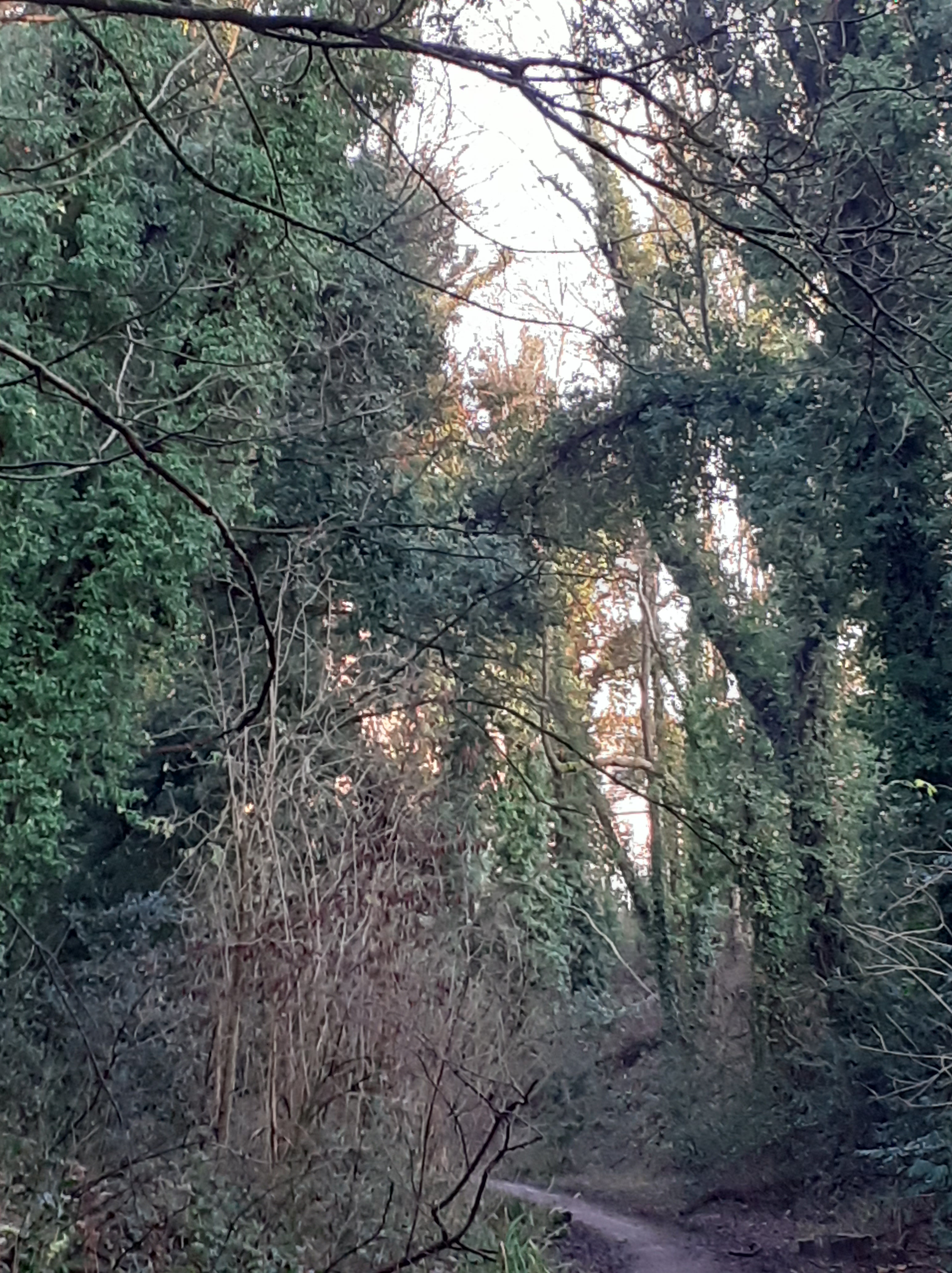
Even today, deep autumn opens the door to winter. This was even more the case in the North Staffordshire and Derbyshire regions of 14th century England, where Sir Gawain and the Green Knight was written. Even in castles, people were less sheltered from the growing cold and damp than we are. So readers and listeners of the period are reminded that the coming of winter is both natually and divinely ordained.

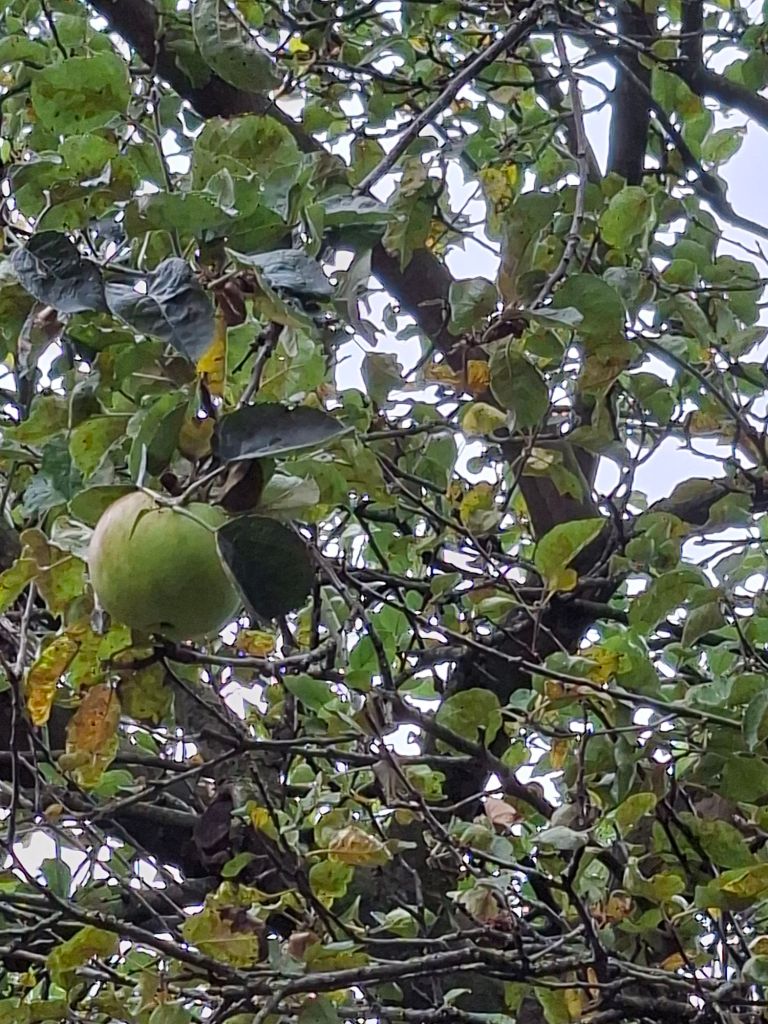
Here and now, the sight of the apple harvest in its later stages (pictured above) seems quite different than in the early ones (2) – less bright, less novel, less shiny. Rotting apples lie on the ground, now fallen outside the wall of  Gloucester Cathedral’s orchard. From Nature’s exuberant perspective, this is all part of the plan.  Waste is built in.

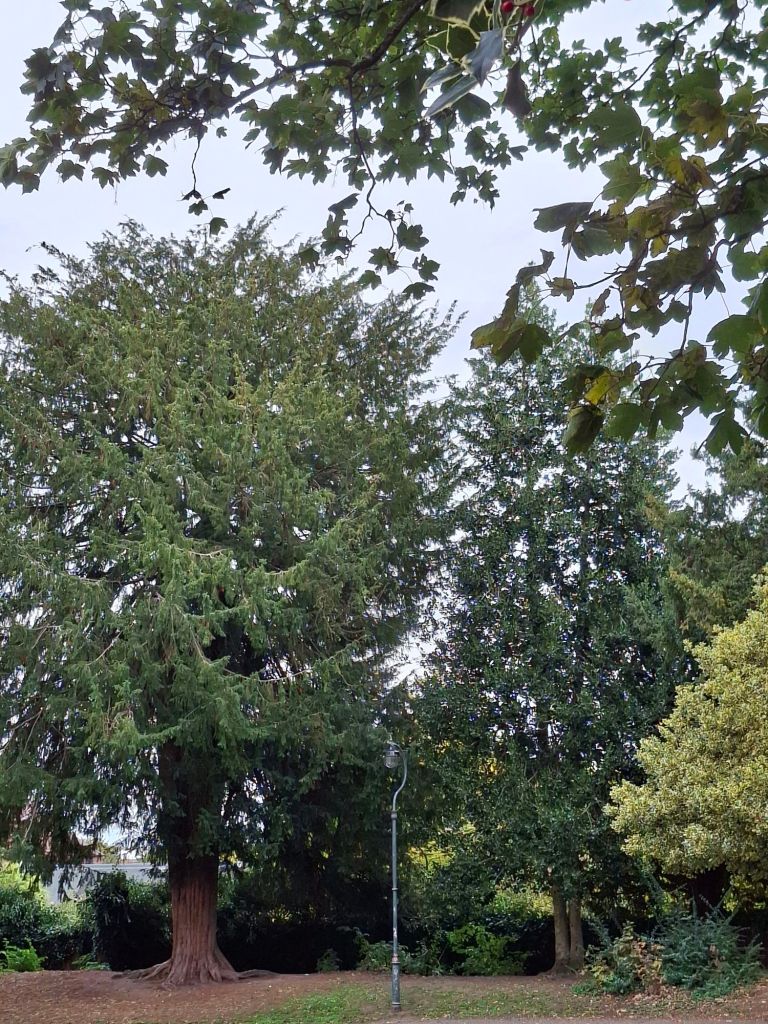
This time draws me further into the declining year. I am in the cathedral’s  grounds, now looking at a yew tree and its associations with death. I’m thinking of the approach of Samhain (aka Halloween/All Hallows) at the turn of the month. Once it marked the 3rd harvest of the year – the blood harvest, where animals were slaughtered in preparation for winter. Now it is more a time to remember our ancestors, and our dead more widely.

Yet the seasonal moment, and the yew, can also be linked to wisdom and transformative change in life. I launched my contemplative inquiry at Samhain 2011. Like many people, I find that this period can be a resonant and creative time.

Below the yew, I have included a section of the cathedral itself. I have old personal associations linking medieval Gothic architecture with the feeling-tone of the declining year. I am also aware that this building is linked to the trees I picture and discuss. Gloucester Cathedral was a monastery when Sir Gawain and the Green Knight was written but many of its features were already in place.
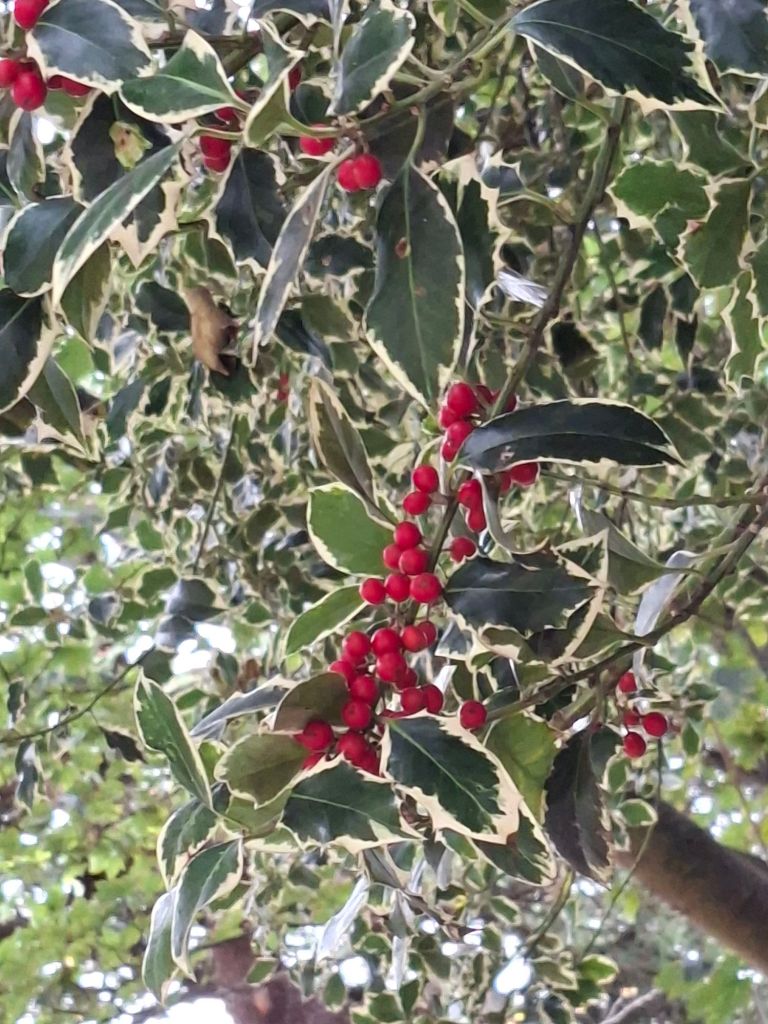
In the same space, I find both holly and ivy, with berries on the holly tree.  I immediately thought of the Christmas carol The Holly and the Ivy. It is an ancient folk carol, which interweaves Christian themes and others that belong with the land. The version which is now popular was collected by Cecil Sharp in 1909 in Gloucestershire from Mary  Clayton.

Many people think that the indigenous Pagan themes are the oldest, and that the central focus here is on the holly. The authors of The Green Man Tree Oracle say: “Holly’s connection with the Green Man is especially strong. In his guise as the Holly King – an ancient giant and symbol of fertility – the Green Man makes a notable appearance in the 14th century poem Gawain and d the Green Knight. Here he takes the form of a fearsome knight, who comes to King Arthur’s court to offer a midwinter challenge, carrying a club of holly and wearing a holly crown (as symbols of his true identity).” This challenge happens every year, where the Green Man/Holly King demands that we encounter him through our dealings with the natural world.

Elaine and I went to the Gloucester Cathedral Close and its surroundings on Saturday afternoon 18 October to outrun an  extended period of gloom, wind and rain. We are now in it, so the lessons of the trees in deep autumn, anticipating the coming of winter, are not lost on us. The dark of the year is on its way.
(1) J.R R. Tolkien (translation of anonymous texts) Sir Gawain and the Green Knight, Pearl, Sir Orfeo New York: Ballantine Books, 1980.

(2) https://contemplativeinquiry.blog/2025/08/22/ (3rd photo)

(3) John Matthews & Will Worthington The Green Man Tree Oracle: Ancient Wisdom from the Greenwood London: Connections, 2003

MY OCTOBER 2024

October, 2024. Outside, leaves turn and fall. The days shorten, long evening walks no longer part of my day. But six months after her accident in Gran Canaria, my wife Elaine is re-learning to walk. A great blessing – we both wondered if she would.

A gift from Awen – three words tumbling into manifestation with no thinking effort from me: healing, peace power (1). A kind of Druid koan. Easy to see that peace might follow healing, and that healing might be a condition of true peace. But the power following on from that peace? – very different from the kinds of ‘power’ most visible in the world today. What do I need to learn?

I had a dream in which I read a map to get to a school. I arrived at the school and was happy enough with my experience. Then I read the map again and saw that it was the wrong school. The one I should have gone to was further away, to the north-west.

At Samhain, the culmination of October, we think of of the dead, and a loosening divide between the dead and the living. What can we say to them – ancestors and recent dead alike? What might they say to us?

(1) see: https://contemplativeinquiry.blog/2024/10/17/awen

A SAMHAIN SHIFT

An old man, left handed like me, pauses over his writing. He is held in his concentration, and somewhat lost to the world. He faces away from the sky and the crescent moon. He relies on an interior candle to light him. But the moon sees and influences him anyway. None of the seven swords is drawn for martial combat. He wields a quill instead: the metaphorical sword of discrimination is an essential feature of thinking and writing, and sometimes it can bite. The number seven suggests a level of experience and resource, perhaps also a creative pleasure in his task. He’s been around a bit, taken a few knocks, and had his epiphanies as well. He perseveres on the journey, come what may.

The image comes from the first of a three card Druidcraft Tarot (1) reading. I did it on 26 October, early in the run up to Samhain and before the October moon was full. I had just completed a ritual that ended my formal contemplative inquiry within and beyond Druidry. I am still a Druid. I am still temperamentally inclined to contemplation and inquiry, both separately and together. There will be a great of deal continuity in my practice. But the structure of a dedicated project has quietly disintegrated, now redundant, and this needed a formal recognition. The image above reveals a constellation of consciousness, energy and activity that is now in the background. There, it has a continuing presence and influence – as a kind of internal ancestry. In the foreground, something new has the freedom to emerge.

The card below indicates how I stand now. Whereas I found it easy to identify with the Seven of Swords image, the Prince of Pentacles came as a shock. But the teaching behind the Tarot is that time runs differently in the psychic realms and doesn’t exist in the causal. Child and youthful parts of me still live. The young adult depicted here is at home and confident in the material world. He is not a compulsive warrior like some of his brothers but will take a stand when needed, using skilful means. He is an Earth defender. Health, home and material security matter to him and in these domains he leans toward practicality and realism about the world he is living in. He turns towards this world, not away from it, and does not position himself as above the battle. He is a counterweight to some of the spiritual movements I have explored in my inquiry, which would think of him as ‘unevolved’. He has, however, been an active presence over my last couple of years of relocation and now steps forward to reclaim an acknowledged space in my life.

The third card of the triad is the Six of Wands, and traditionally indicates what may be emerging. The sixes are all auspicious, suggestive of balance, union, and integration. In the active energised fire element, it suggests success, through the image of a landowner and his servants returning home after a successful outing with his hawk. The card seems to ask me what I understand by success at this time in my life, and how much I value it. What motivates and energises me to be successful by my current criteria? What skills, resources and help might I need to achieve successful outcomes? What role might magic play?

I notice, here and now, an unfamiliarity with this way of approaching life. I have thought of myself as too old, with no worldly ambition and nothing I need to prove. This card may be challenging me to review those understandings. Have I lapsed into limiting self-caricature? Have I overdone retirement? Asking those questions I find that I do still have energy and resources, and that I am also concerned about overestimating them. Balance and proportion matter, and I do not want to be consumed or over-taxed by a new project. Nonetheless, this reading opens up space and potential for new active ventures in the world. This reading, overall, has facilitated a significant Samhain shift in my sense of possible futures. For this is a season of not only endings, but of beginnings too.

(1) Philip and Stephanie Carr-Gomm The Druidcraft Tarot: Use the Magic of Wicca and Druidry to Guide Your Life London: Connections, 2004 (Illustrated by Will Worthington)

LIMINAL BEAUTY AND THE FAITH OF A DRUID

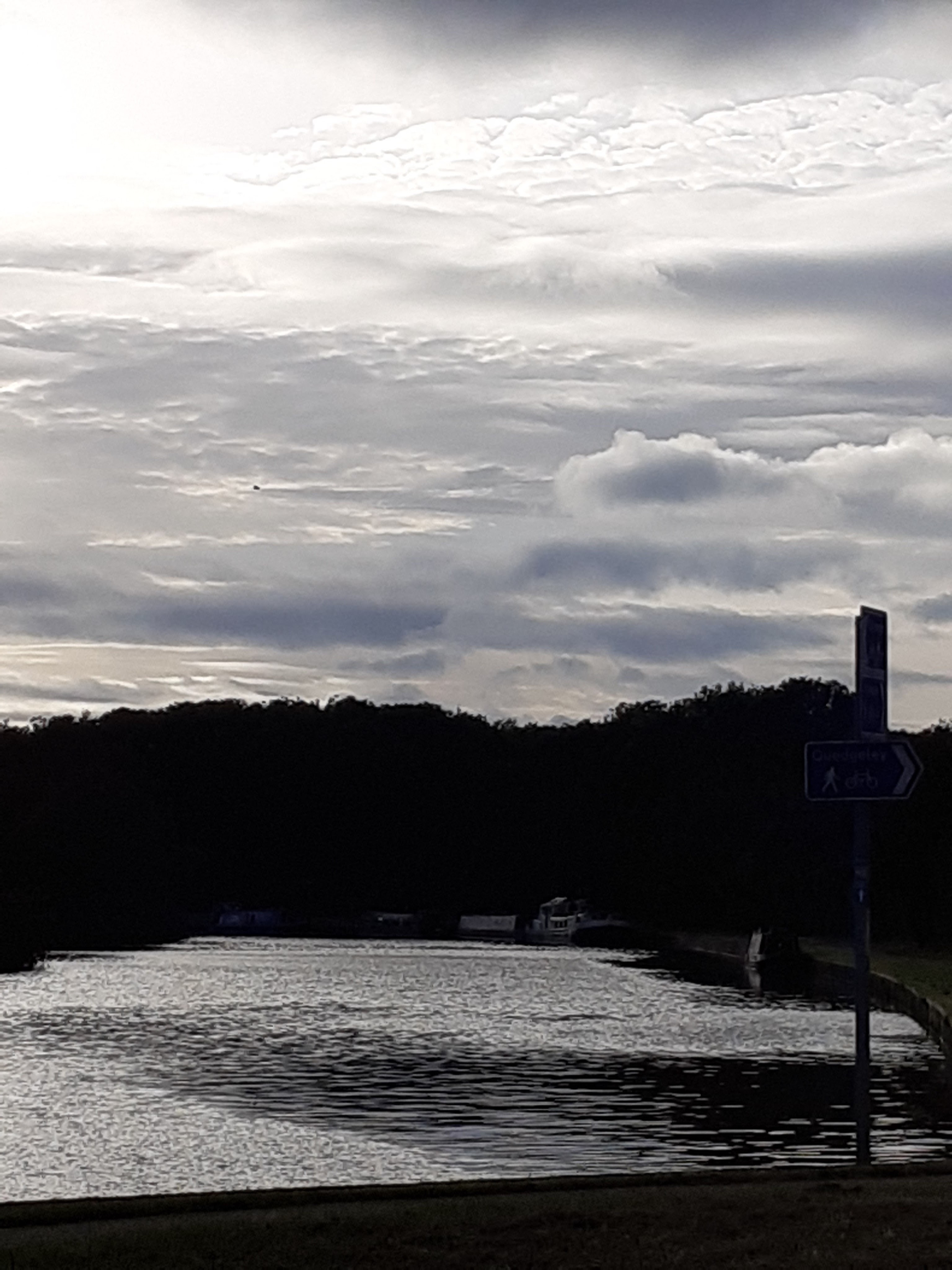
6.15 pm, 6 October 2023. The experience has gone. The images remain. At a surface level, I can use them to trigger memories of my early evening walk. Chiefly, I remember being surprised at how early the twilight was. I hadn’t caught up with the year and was almost shocked. I have caught up now, nearly a week later, as the darkening process speeds up and we approach Samhain. In today’s world, my country will experience a dramatic boost on 29 October as our clocks ‘fall back’. The 6.15 of one day will become the 5.15 of the next.

Looking at the images more deeply, really looking, and giving them time, I can let them nourish me. I connect with their liminal beauty. Both images present me with land, water, sky, and hints of the fiery sun. But they do so in different ways.

In the image above, I am mostly drawn to the energy of water. The variation in shade emphasises movement and different ripple effects. Land, trees, and artifacts are all in silhouette, but the water has light and shade. It is the water that feels most alive. There is variation in the clouds too, with their patterned layers and subtle access to sunlight just above the trees. But they are not as mobile as the water. The sunlight itself seems very subdued. It’s still there, though very much in the background.This is not yet a night sky.

In the image below the water is strong too, but my eyes are drawn above to the clouds, which here are more dramatic. The residual power of waning sunlight is very clearly present. For me, there’s a sense of the tree tops yearning upwards as they reach for the gifts of the sun whilst it still retains a presence. Although I am contemplating images and not immersed in the landscape I have a strong sense of living presence in a field of living presence. In this state I feel a conceivably irrational confidence in life and the world.. A fragile kind of faith, that my heart cannot resist.

ON THE CUSP OF SAMHAIN: A NEW MOON

You can just see it, above the buildings, at the last breath of sunset. A sliver of light over murky cloud, the slender crescent of a new moon has appeared. I took the picture just after 6.45 pm on 28 October, still inside British Summer Time. I chose this time on this day because it was not yet dark. The sky is making room for a variety of effects, not just the stark duality of darkness and light. I stand at the cusp of the year’s endarkenment, before the festival of Samhain.

At this time of this year, I find myself tuning in to the lunar cycle as much as the solar one. To me, now, it feels subtler and more nuanced. Anne Baring and Jules Cashford describe its significance in a way I find illuminating:

“The moon was an image in the sky that was always changing yet was always the same. What endured was the cycle, whose totality could never be seen at any one moment. All that was visible was the constant interplay between light and dark, in an ever-recurring sequence. Implicitly, however, the early people must have seen every part of the cycle from the perspective of the whole.

“The individual phases could not be named, nor the relations between them expressed, without assuming the presence of the whole cycle. The whole was invisible, an enduring and unchanging circle, yet it contained the visible phases. Symbolically, it was as if the visible ‘came from’ and ‘returned to’ the invisible – like being born and dying, and being born again.” (1)

When out walking, I noticed that Christmas lights had started to appear. The ones below, at Gloucester Quays, seemed suitable for a new moon. They shifted on and off in a flowing, liquid kind of way, at slightly different times. They did not dazzle or glare or demand my whole attention. They illuminated the space without dominating it. They did not claim that their light was all that mattered.

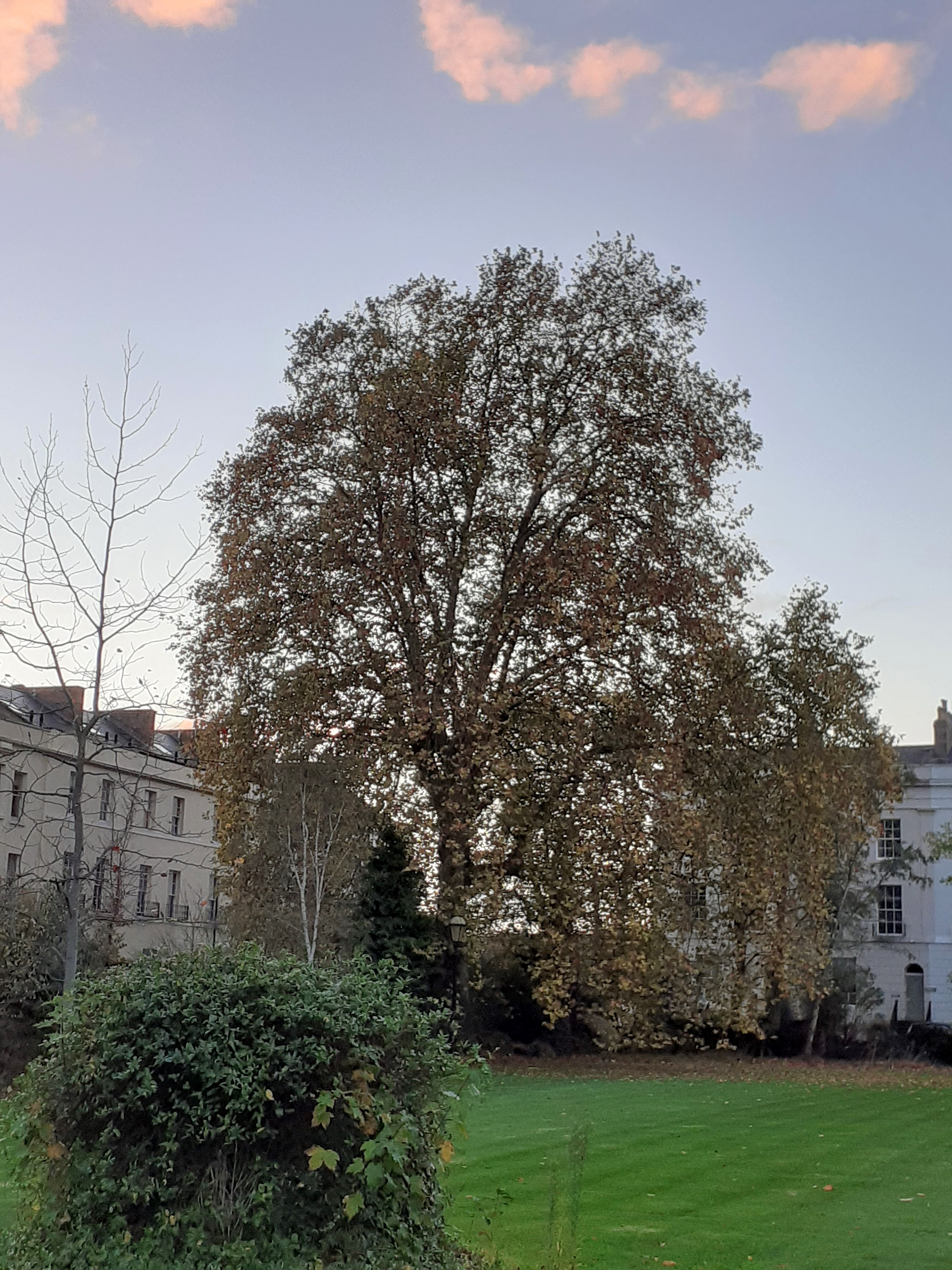
If I tune in the another cycle, the wheel of the day, I remember how much to thank the sun for. Barely half an hour before I took the pictures above, I experienced the very different colours of the two immediately below. In the first, there is the pink of sunset cloud and some draining of blue from the sky – but, still, a sense of vivid green in the grass. An autumn evening in what is still the light of day.

The second shows a tree-lined street, with full autumn colours, fittingly sundown colours, against a misty looking autumn sky.

It seems that I am saying farewell to one season whilst welcoming another, and that my evening walk on 28 October, partially shared with my wife Elaine, somehow enabled this. There is a starkness and wildness in my last image from that walk, below, which draws me in, despite the remarkable contrast with what has gone before. Just to notice, to fully experience, and make meaning of, the cycles of moon, sun, day, year and life itself gains importance for me year by year, as the wheel turns.

(1) Anne Baring Anne and Jules Cashford The Myth of the Goddess: Evolution of an Image London: Penguin, Arkana Books, 1993

A DANCE OF LIGHT AND SHADE

Sunday, 31 October. Hallowe’en. Greetings of the season! A chance for a ghost tree to move and dance?

Where I live, a change in clock time has made the morning a little lighter, wet and gloomy though it might be. The evening, of course, will be darker. It will launch an endarkening seven weeks for those open to the spiritual opportunities of this time.

I am noticing a dance of light and shade, at moments not defined by heavy cloud and rain. In these recent pictures I sense a yin/yang contrast where clear shafts of light illuminate, but do not dominate, spaces inclined to be shady. For me there is a living balance here – one thing that still pictures do not show is that the detail is constantly changing.

I celebrate the miracle of existence – my ability, or life’s ability, to see a world and be immersed in it. To respond to it and to share it. Sometimes this seems enough, with no need for any framework to explain or contextualise this astonishing fact. Here, from identifying a dance of light and shade, I can notice how this dance has different effects in different settings, a small sample of the vast diversity in our living world. As we move without illusions into the Cop26 summit, may it be preserved and protected!

text

text

TOWARDS SAMHAIN 2021

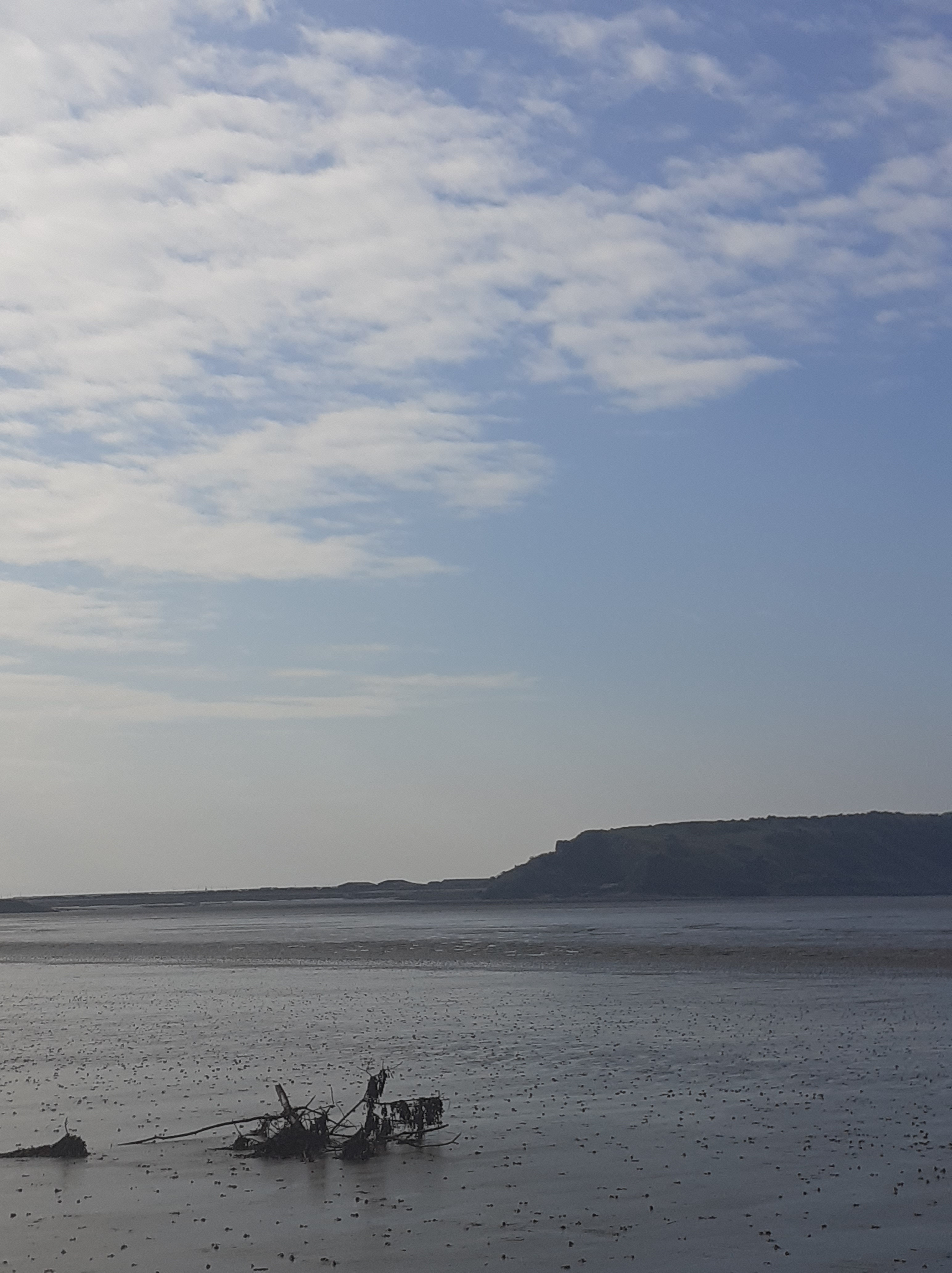
Approaching Samhain, I feel drawn to themes of paring down and letting go. Pictures from a recent visit to Weston beach reflect this minimalist mood. The tide was out, leaving an expanse of flat muddy beach, not easy to distinguish from the sea. Sea-wrack and bare wooden posts were prominent features here. I enjoyed the clarity and immediacy of this setting, and also a sense of a quiet latency, before the water returned.

Samhain initiates a time of endings and transitions. Where I live, the dying of the year is generally not dramatic, but there is nonetheless considerable change. This speaks to something in me. My notion of a ‘contemplative inquiry’ is morphing as it strips down to essentials, and dissolves into a gentle holding and observation of experience in flow. I will give this morphing process space, and see what emerges from the descent of the year. I expect to post less frequently for a period of time.

MORE AT HOME: APRIL 2021

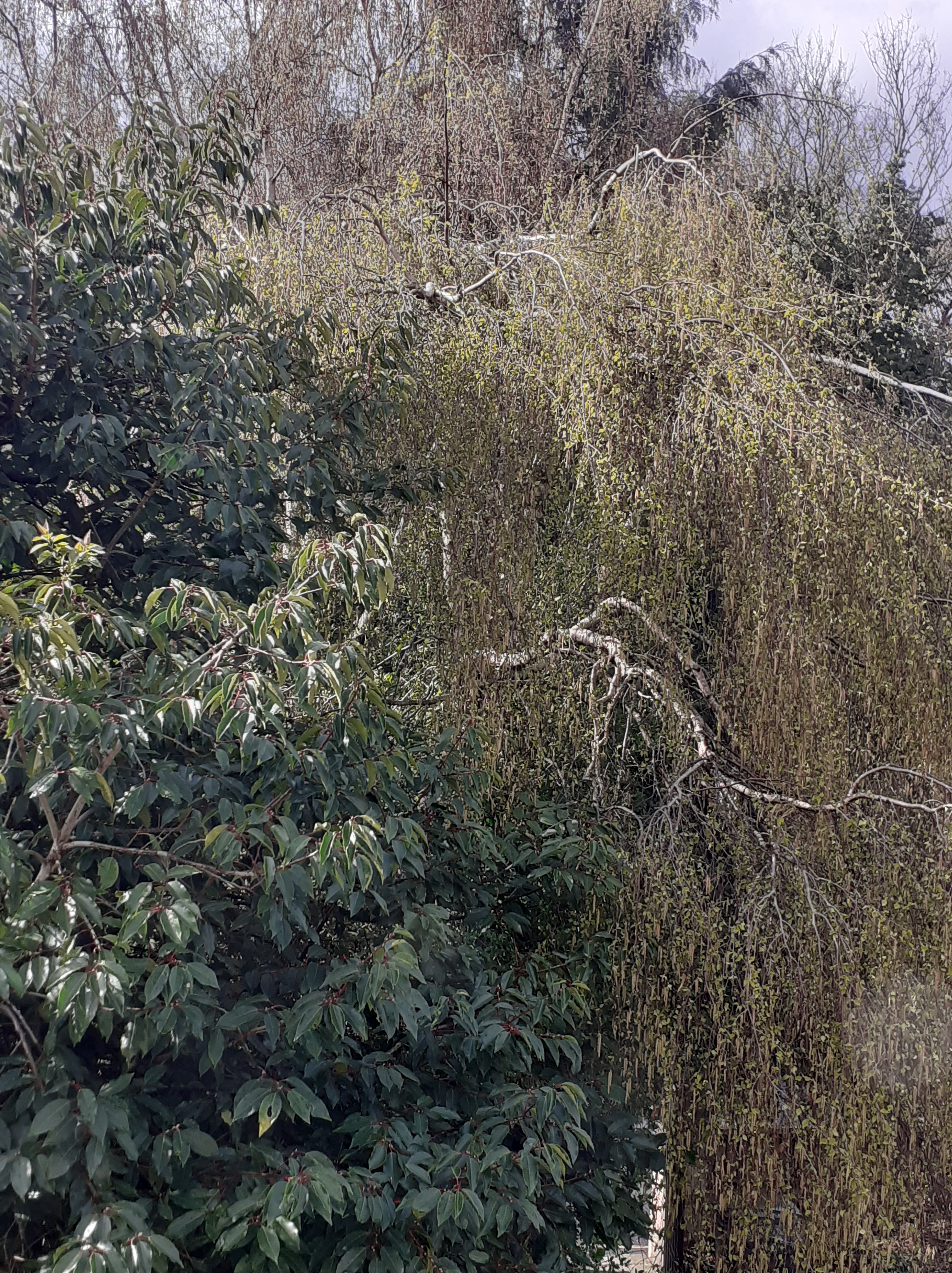
I am feeling more at home in a number of ways. A much loved view through a bedroom window is enough. I can look out and lose myself, holding an image both of continuity and change as the seasons move. One way in which I experience the year is in two halves. Beltane initiates the summer half of a two season year, with Samhain beginning winter.

I often find the extended six months ‘winter’ to be productive for my contemplative inquiry. In the six months now about to end, I have completed an important shift, a shift that reframes an inquiry insight dating from 2018. At that time I said: “I discovered an ‘at-homeness’ in the flowing moment, which nourishes and illuminates my life. Such at-homeness is not dependent on belief or circumstance, but on the ultimate acceptance that this is what is given.”

My view then was that it is best to steer away from metaphysical commitments, as the Buddha is said to have done. “At-homeness in the flowing moment” could work as a dignified existential choice for a humanist, an agnostic or a person with a stance of ‘sustainable nihilism’ (1). It could also work for people firmly based in contemplative versions of monotheist and polytheist spiritual traditions. Indeed it could work for anyone and would be blissfully light on doctrine and opportunities for argument and dissension.

That said, whist still fully embracing the original insight, I now find it incomplete. I have for some time been filled with the sense of a living cosmos, in a way that cuts across the grain of the culture I come from, with its parsimonious definition of ‘life’. I am animist in sharing Thich Nhat Hanh’s understanding of ‘Interbeing’, where everything is interconnected and nothing is really born, lives or dies in a state of separate selfhood (2). Life just changes. Now I have taken to heart the sense that the life which changes has a Source, or ground of Being, in which the whole web of life is embedded.

Hence I am human and I am also that ground of Being. Being cannot be found as an object, but I can apprehend Being in two ways. One is by looking in and finding my primordial and true nature in and as Being. The second is by looking out and finding Being everywhere and in everything. In each case, the inside/outside distinction finally dissolves. Humanly, I am distinct but not separate from Being, temporarily individuated in the world of space and time, as is everything else in this world. At the deepest level, as Being, I am no thing and yet present in and as everything.

I have reached a commitment to this view partly as a result of contemplative inquiry and partly as an act of faith, trusting my deepest understanding. In the wider world, this understanding is called ‘non-dual’ or ‘panentheist’. It is neither demonstrable nor falsifiable as a proposition, and I continue to appreciate that the map is not the territory. All words feel somehow wrong, just as the Tao Te Ching warns when it begins with “the name you can say isn’t the real name” (3). Yet Lao Tzu persisted with his writing, and gave the world one of its most loved scriptures. From time to time, the effort with language has to be made.

Modern movements (4,5) have made the experiential recognition of our true nature, or ultimate divinity, available to ordinary people through skilful means developed for our time. I have made connections with such movements, but I still anchor myself in Druidry. Humanly, a conscious I-I relationship with Source, or dwelling in and as Source, is not everything to me. I am drawn, too, to I-Thou relationship, honouring a devotional need that wants to be expressed. The Indian sages who first developed non-duality as a spiritual philosophy did not challenge or abandon the flourishing polytheism of their culture. They continued the practice of deity yoga. It serves the dance of being and becoming in this world. This, I believe, is the role of the Goddess in my life (6). I have much still to learn here. Meanwhile my at-homeness grows stronger.

(1) http://jonnyfluffypunk.co.uk/

(2) Thich Nhat Hanh The Other Shore: a New Translation of the Heart Sutra with Commentaries Berkeley, CA: Parallax Press, 2017

(3) Lao Tzu Tao Te Ching: A Book About the Way and the Power of the Way Boston & London: Shambhala, 1998 (New English version by Ursula K. Le Guin with the collaboration of J. P. Seaton)

(4) http://www.headless.org/

(5) https://eckharttolle.com/

(6) https://contemplativeinquiry.blog/2021/02/24/who-is-the-goddess-I-pray-to/

LIGHT RENEWED

I have now landed in 2021. I can see the renewal of the light; however tentative it might be. The winter quarter, from Samhain to Imbolc, is a season of dying and regeneration. I have glimpsed regeneration in nature and in myself – potentially in culture too. The collective crisis is deep, and projects remain on hold. But I can sense opportunity, and possibilities for creative change.

I have noticed a major transition in my work. I have entered a phase where contemplative inquiry is a strand in my life rather than a project called ‘Contemplative Inquiry’. I look back and see this transition as an accomplishment of 2020. Certain questions have been answered and won’t need much revisiting. I began an ended the project within a modern Druid orbit – saturnine in distance, perhaps, but still part of the family.

My view, values and practice have largely settled. A lightning-flash experience, or transformative encounter, might cause me to change them, for I retain a commitment to openness. But the project of Contemplative Inquiry will not. I am much less engaged with teachers, teachings and traditions than in former years, whether through literature, groups or events (live and virtual). Instead, I want to work more deeply and congruently within the frameworks I have already learned and developed. I tend to be a solitary practitioner at heart, though I also like some link to companions and community along my spiritually hermit way.

The great gift in this is the opportunity to live a life of ‘abundance in simplicity’ at the level of ideas as well as material goods and activities – to pare down in the very area where I am most tempted to seek variety and feast on new input. There is Sufi story in which the crazy wisdom master Shams persuades the more conventionally trained Rumi to throw all his religious texts down a well. I do not plan to go so far. But I recognise the time for a change in emphasis. As a trade-off, my monkey mind is freed for other subjects. I look forward to seeing how this new direction works, and how it affects this blog.

THE YEW AT SAMHAIN 2020

In my tree mandala of the year (1), yew is my Samhain tree, and to a large extent my November tree. It is an obvious choice, as I leave a quarter concerned with autumn and bearing fruit and enter one of winter and the dying of the year. Regeneration too, but that is some way off.

I admire the power and longevity of the yew, and am in some ways drawn to its energy. But I do not find the relationship easy. I can find it spiky and obscurely demanding. I can find myself resistant to the sensed demand. The alignment of tree and season alerts me to my own mortality and creates space for a reflective moment. But this year I’ve been alert to my mortality for much of the time. In reaction, at Samhain 2020, I feel naturally sluggish and drowsy. Something in me is happy to go down into the dark without too much awareness. Let the dying of the year be the dying of the year, it whispers. Just let it happen. Just let me go down into the dark and sleep.

The Green Man Tree Oracle (2) links the yew with perseverance, for ‘perseverance leads to achievement’. Right now I’m not much interested in achievement, but I notice that I can think of perseverance in another way. This has to do with sticking with the experience that presents itself, rather than life-coaching my way out of it.

I have been working with an intensified wheel of the year for the last 45 weeks. I have seen how easy it is to impose impose conventional or surface-willed patterns on my experience. The seasonal structure is real. I see, feel, hear, taste and smell it manifesting itself in the apparent world as the wheel turns. But the idea of the wheel still has the power to displace lived experience through formalised words, images and expectations. Perseverance on the path asks for two things, I think. One is permission to let go of any sense of project or practice when it loses authenticity. The other is to be truly sensitive and discriminating when I’m happy to be awake.

(1) NOTE: This mandala is based on my personal experience of trees in the neighbourhood as well as traditional lore. Moving around the wheel of the year from 1 November, the positions and dates of the trees are:

Yew, north-west, 1-23 November

Elder, north-north-west, 24 November – 16 December

Holly, north, 17 December – 7 January

Alder, north-north-east, 8 – 31 January

Birch, north-east, 1 – 22 February

Ash & Ivy, east-north-east, 23 Feb. – 16 March

Willow, east, 17 March – 7 April

Blackthorn, east-south-east, 8 – 30 April

Hawthorn, south-east, 1 – 23 May

Beech & Bluebell, south-south-east, 24 May – 15 June

Oak, south, 16 June – 8 July

Gorse, south-south-west, 9 – 31 July

Apple, south-west, 1 -23 August

Blackberry & Vine, west-south-west, 24 August – 15 September

Hazel, west, 19 September – 8 October

Rowan, west-north-west, 9 – 31 October.

See also https://contemplativeinquiry.blog/2020/autumn-equinox-2020-hazel-salmon-awen/

(2) John Matthews & Will Worthington The Green Man Oracle London: Connections, 2003. Also source of the image at the top.

Earth Eclectic

music that celebrates Earth and speaks to the heart

Sarah Fuhro Star-Flower Alchemy

Follow the Moon's Cycle

Muddy Feet

Meeting nature on nature's terms

Rosher.Net

A little bit of Mark Rosher in South Gloucestershire, England

Becoming Part of the Land

A monastic polytheist's and animist’s journal

selkiewife

Selkie Writing…

Charlotte Rodgers

Images and words set against a backdrop of outsider art.

Prof Jem Bendell

living with metacrisis and collapse

Towint

The pagan path. The Old Ways In New Times

The Druids Garden

Spiritual journeys in tending the living earth, permaculture, and nature-inspired arts

The Blog of Baphomet

a magickal dialogue between nature and culture

This Simple Life

The gentle art of living with less

Musings of a Scottish Hearth Druid and Heathen

Thoughts about living, loving and worshiping as an autistic Hearth Druid and Heathen. One woman's journey.

Wheel of the Year Blog

An place to read and share stories about the celtic seasonal festivals

Walking the Druid Path

Just another WordPress.com site

anima monday

Exploring our connection to the wider world

Grounded Space Focusing

Become more grounded and spacious with yourself and others, through your own body’s wisdom

The Earthbound Report

Good lives on our one planet

Hopeless Vendetta

News for the residents of Hopeless, Maine