Contemplative Inquiry

This blog is about contemplative inquiry

Tag: Sacred trees

ROWAN’S LATE SUMMER SIGN

Where I live, late summer is often the warmest time of year, and the driest. This is likely to be the case in 2025, already a warm dry year. But in the sun’s apparent annual journey, it is also a time of waning. Sunrise is an hour later than at the solstice, and sunset is forty-five minutes earlier. This change will accelerate from now on.

I do not see waning as negative. There is power and beauty in this ‘waning’. In the rowan (aka mountain ash) picture above, the berries are moving from tentative orange to bright scarlet, an effect of the seasonal changes in the light. Rowan is an ogham tree, linking a group of indigenous Irish and British trees to an ancient Irish alphabet. Its Gaelic name luis means bright or flame.

Looking at the year as a whole, some of the berries will still be holding on beyond midwinter, by which time the tree, which can live for up to 200 years, will be making its annual comeback. At that time, as described in William Anderson’s justly venerated in Green Man poem (1):

The hungry birds harry the last berries of rowan

But white is her bark in the darkness of rain

‘I rise with the sap’, says the Green Man

‘I rise with the sap’ says he. (1)

The resilience of the tree runs throughout its year and lifetime. In  late summer specifially, this resilience is manifested in berries at their brightest, against the backdrop of a still blue evening sky.

Traditionally Rowan has strong associations with protection, spiritual  protection not least. According to The Green Man Tree Oracle (2), ‘it can also offer insight into danger through the invocation of higher wisdom’. Ancient Druid shamans were said to breathe in the smoke from rowan fires to initiate a trance state that allowed them to predict coming danger.

The Druids also planted rowan, as well as oak and ash, in their sacred groves. But Celtic Druids were not the only people to place a high value on the rowan tree. Our modern word rowan is probably descended from the Norse runas – narrowly translated as ‘charm’ but in fact bringing the wider runic and Norse traditions with it.

When I encountered the rowan I was strongly moved by it. It stood out from everything else.   I had previously decided not to take pictures on my walk, but felt compelled to change my mind. I didn’t need ancient lore to feel more alert and heartened. It’s just that the framing it provides added cultural depth.  The encounter with rowan put a spring in my step and was a highlight of my evening.

(1) William Anderson Green Man: archetype of our oneness with the Earth Harper Collins: London & San Francisco, 1990

(2) John Matthews & Will Worthington The Green Man Tree Oracle: ancient wisdom from the greenwood  London: Connections, 2003
MARCH 2024: WIND IN THE WILLOWS

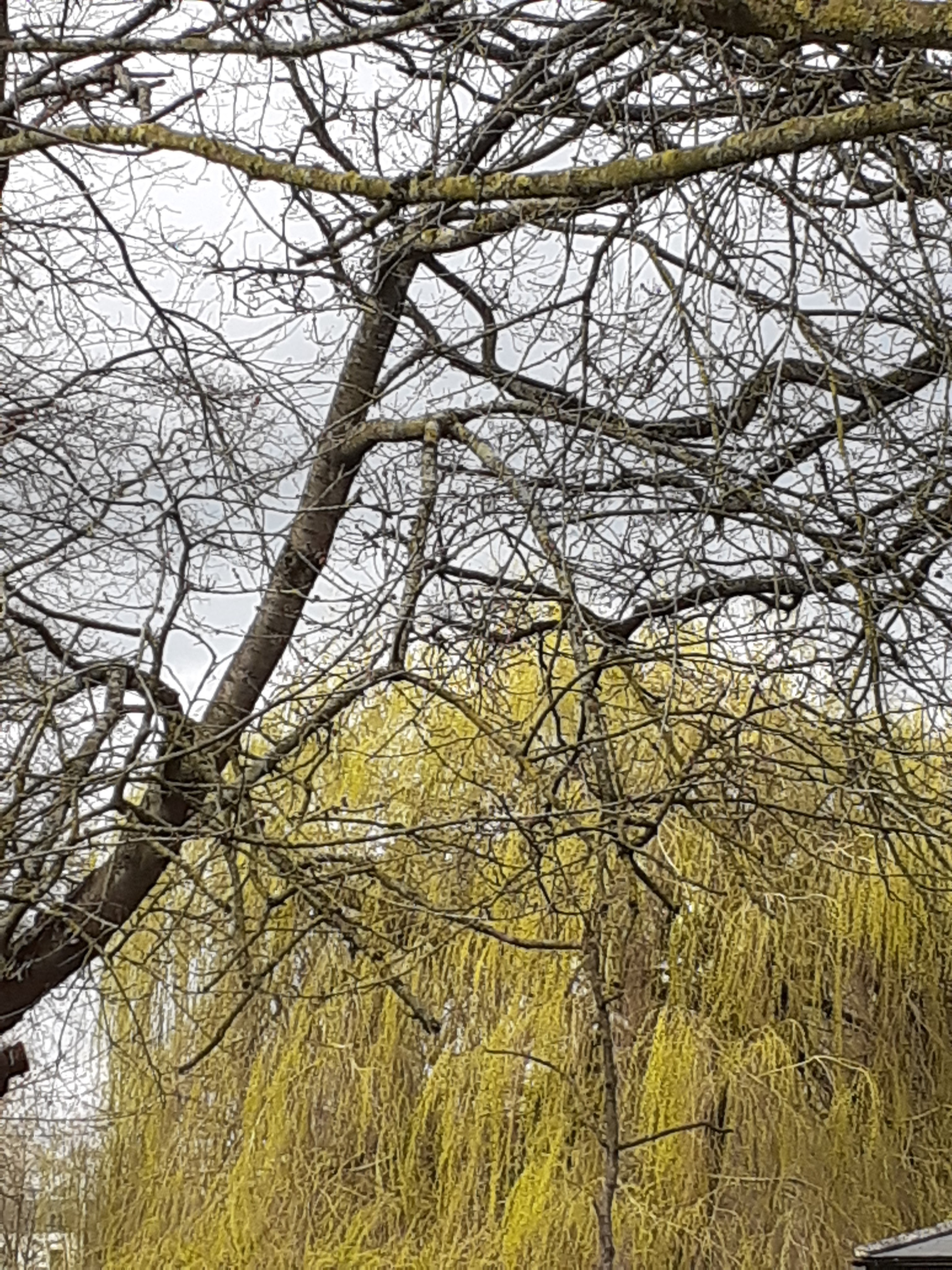
I’m walking in my local park. It’s a dull day in the first half of March. There have been many such days, and I could do with more sun. I certainly feel lifted when it comes. At the same time the days are longer and Mother Nature is busy with the work of spring: an abundance of willow catkins is testament to this.

I get my strongest impression of the strength and fecundity of willow when close up. The individual catkins are clearer, more prominent. The colours are stronger. There’s the sense of a rich and vibrant ecosystem, powerfully alive.

Still images don’t provide movement and sound, or indicate the presence of the March wind. I have tried to capture this in my short video below, illustrating another aspect of this moment in the year. It brought up fond childhood memories of Kenneth Grahame’s The Wind in the Willows which begins with spring cleaning and includes the gently Pagan chapter The Piper at the Gates of Dawn.

Willow became important to me in my early study and practice of Druidry. I began a special relationship with a particular willow in Bristol for many years (2), which continued after I left the city and continues sporadically to this day. I also developed a private tradition of following the wheel of the year through a mandala based on 16 trees, all in easy distance of where I lived, with Willow the focus from 17 March to 7 April, hence presiding over the spring equinox (3). Checking in with the willows is a continuing feature of my walks, though I was a little early this year.

(1) Kenneth Grahame The Wind in the Willows London: Dean, in association with Methuen’s Children’s Books, 1991. (Ist ed. 1908. Illustrated by E. H. Shepard)

(2) https://contemplativeinquiry.blog/2013/1/31/willow/

(3) https://contemplativeinquiry.blog/2021/03/17/tree-mandala-willow/

BOOK REVIEW: STAFF OF LAUREL, STAFF OF ASH

“If our place is imperilled, so are our myths. If we heal the one, we heal the other … So said priestesses who long ago spoke in the voice of doves. So said the prophetic oaks they tended, who murmured to their suppliants through wind blown leaves.”(1)

Staff of Laurel, Staff of Ash: Sacred Landscapes in Ancient Nature Myth is an inspirational collection of interwoven contemplations on landscape and myth; on enchantment, disenchantment and re-enchantment. I strongly recommend it to anyone with an interest in these themes.

Author Dianna Rhyan says of her own approach to writing: “assembled, these pages refused to assemble, and so altogether, they form a series of sketches, fallen like samaras*, whose order is ultimately undetermined. The priestess of Apollo wrote her prophecies on leaves. When strong winds came, they scattered all over her cave. Did she mind? Amidst the leaves, voices of winds and voices of trees, lost and found, thread their way.” This review shares something of the book’s flavour, rather than attempting a linear account of what is covers.

Rhyan draws strength from wild and marginal spaces, especially the Cuyahoga River in north eastern Ohio. She describes her close relationship with the land but is all too aware of a sadness in its silence. The genocidal displacement of the people who once lived there has erased their stories about this land and their relationship with it. As a mythologist, she looks further afield for inspiration, especially ancient Mesopotamia (now Iraq) and the early Greek speaking world. Even four thousand years ago, in the early Sumerian world, people had doubts about ‘civilisation’. We find the contrasting influences of the laurel, which blooms, and the ash, “a battle-earned artifact”.

In the Epic of Gilgamesh (2) the hero destroys a forest and its guardian at an early stage of his “futile immortality quest” and then goes out of his way to offend the Mother Goddess Inanna. In The Descent of Inanna, she herself must experience death, losing her identity and powers as she descends through seven gates to the Underworld controlled by her sister Ereshkigal. Asking, at each gate, ‘Gatekeeper, why is this done?’, she receives the reply ‘Silence, Inanna. Do not open your mouth against custom. The rules of the Great Below are flawless. You may not question what is perfect.’ Rhyan’s reading of this ritualised and repeated reply finds a new order in which free nature, and the Goddess perceived as its embodiment, need to be rigorously controlled. She comments on the way in which perfection “deadens” and rules “disarm”. For three days Inanna hangs dead, a carcass on a hook. But the upper world needs Inanna in order to reproduce itself and flourish. The Wisdom God Enki sends emissaries to Ershkigal to secure Inanna’s release. She does not stay dead.

Rhyan also draws on Greek sources from different periods. One of them, from Sophocles’ last play, Oedipus at Colonus, is about the final days of Oedipus, after he has blinded himself and been been exiled from his erstwhile kingdom of Thebes. These misfortunes follow the discovery that he has (unwittingly) killed his father, married his mother and thereby, as a source of pollution, caused a plague in the city. He is told: “seek no more to master anything”.

Oedipus is now a pauper, wandering in a wasteland. Letting go of his civic and social identities and surrendering to this fate, he survives. He is reborn as a child of nature on the goddess haunted mountain Cithaeron. For his awakened inner vision has guided him to the place where he was once, as an infant, left out to die. The compassionate nymphs who nursed him then are perhaps looking out for him once more. He has journeyed from palace to periphery, freed from all power and self-determination. At that point, he is given a new role, as guardian of the sacred grove at Colonus. It is a place beloved by immortals, a place of lush growth, where the nightingale sings, and with “cool waters” that never fail. Here, as this new version of himself, he will live out his days.

Late on in her book, Dianna Rhyan says: “if we look over our shoulder, not only what we threw away as detritus is following us. What we had despaired we had lost forever, long ago in the depths of ancient ages, is following us too. We require myth, intensely alive myth, to see it. It is very good at not being seen.” I see her as making a great contribution to making ‘intensely alive myth’ visible once more.

(1) Dianna Rhyan Staff of Laurel, Staff of Ash: Sacred Landscapes in Ancient Nature Myth Winchester, UK & Washington, USA: Moon Books, 2023

(2) https://contemplativeinquiry.blog/2023/05/30/

*Samaras: here, the winged maple seeds found in the author’s local woodlands.

INNERWORLD HARVESTING

The Innerworld has its own times and seasons. When I attune myself carefully, it speaks to me through images in the DruidCraft Tarot (1). Today (20 July) I encountered the 7 of Pentacles (above), with its image of winter harvest. A Druid, equipped with a golden sickle, takes mistletoe from a tree. Where is the wisdom here? What am I being told?

‘Take note of the obvious’ is an early thought. ‘Be willing to state it’. After ten years of contemplative inquiry, I am still anchored in Druidry. Yes: my practice forms are idiosyncratic and contemplatively inclined. Yes: my inquiry process is personal and self-directing. Yes: I continue to learn from other traditions and sources outside the traditions. But what I do comes out of an immersive OBOD training of many years and would not be the same without it. I continue to belong to the Order and identify with the modern Druid tradition. Being clear about this is a fruit of my inquiry.

The form of words that we know as the St. Patricks’ Prayer, alternatively as the Cry of the Deer, runs: “I arise today through the strength of heaven, light of sun, radiance of moon, splendour of fire, speed of lightning, swiftness of wind, depth of sea, stability of earth and firmness of rock”. In my own usage I think of ‘heaven’ simply as a sky or firmament word, majestically naturalistic. But my greatest sense of support comes from the words ‘stability of earth and firmness of rock’. The 7 of Pentacles Tarot image includes seven pentacle signs carved on to mossy rock. It is a strongly earth-related image. I feel grounded and affirmed by this powerfully Pagan imagery.

There is much more to be learned from the 7 of Pentacles image, but these obvious recognitions, easily taken for granted and thus overlooked, are a good place to start. They have allowed me to identify some fundamental understandings that my inquiry has provided, and to clarify its direction for the future.

(1) Philip and Stephanie Carr-Gomm The DruidCraft Tarot: Use the Magic of Wicca and Druidry to Guide Your Life London: Connections, 2004 (Illustrated by Will Worthington)

TREE MANDALA: GORSE

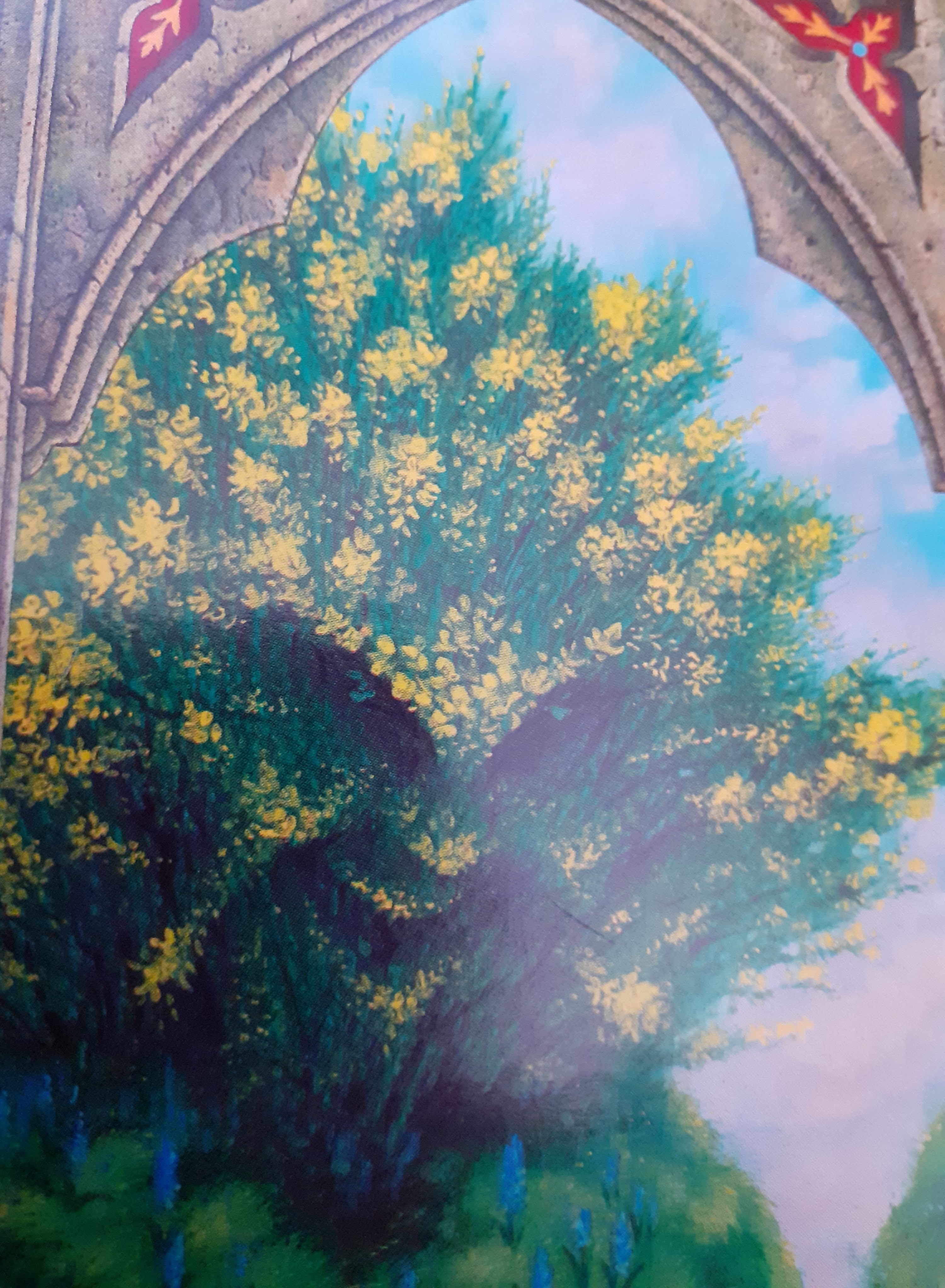
In my wheel of the year tree mandala (1), gorse covers the period from 9-31 July. It is the last tree of the summer quarter, handing over to apple at Lughnasadh/Lammas on 1 August. The illustration is from The Green Man Tree Oracle (2).

I know from my childhood that gorse can make a tame, gently sloping hill seem wild and edgy. Navigating through gorse requires an eye to self-care. Flowering gorse is not confined to summer, but for me it is anchored to summer in memory. Seen from afar, gorse was a vivid harbinger of the summer holidays with days of warmth (rising to heat) and freedom to roam. It carried a hint of adventure and disinhibition. Sometimes the promise was fulfilled. Sometimes there was a hot heavy dullness broken by only storms, and a degree of frustration. July days were unpredictable.

Gorse (ogham name Onn) was sacred to the Irish god Lugh, and thus to light, to all manner of skills, and to the fire in the head of ecstatic creativity. Lugh has a trickster aspect, and can be seen in certain lights as more a god of lightning than of the sun. He has a cousinship with the Brythonic Lleu Llaw Gyffes, the warrior magician of the fourth branch of the Mabinogi. He has also been linked to the Norse Loki, for tricksterism is an aspect of the smouldering fertile mind.

Gorse makes good fuel and so has an obvious role in fire festivals. In Brittany, 1 August was marked by the Festival of the Golden Gorse and gorse has has strong associations with the faery folk. It is a plant of power. We cannot make assumptions about how we stand with it. A wary respect might be wise.

NOTE: This post brings to an end a year in which I have featured the sixteen trees in this mandala. I began on 16 July 2020 with an out-of-sequence Rowan (3), because I had had a vivid encounter with a rowan tree in the woods. (Its time in the mandala is 9-31 October.). Then I moved on to apple (4) and blackberry (5). From the Autumn Equinox (1) the enterprise became more systematic. As a blogger, I won’t be repeating the cycle in the same way in the coming year. Once for the record feels enough.

(1) This mandala is based on my personal experience of trees in the neighbourhood as well as traditional lore. Moving around the summer quarter from Beltane, 1 May, the positions and dates of the four trees are: Hawthorn, south-east, 1-23 May; Beech & Bluebell, south-south-east, 24 May – 15 June; Oak, south, 16 June – 8 July; Gorse, south-south-west, 9 – 31 July. The autumn quarter then starts with Apple at Lughnasadh/Lammas. For a complete list of the sixteen trees, see https://contemplativeinquiry.blog/2020/autumn-equinox-2020-hazel-salmon-awen/

(2) John Matthews & Will Worthington The Green Man Tree Oracle London: Connections, 2003

(3) https://contemplativeinquiry.blog/2020/rowan/

(4) https://contemplativeinquiry.blog/2020/three-trees/

(5) https://contemplativeinquiry.blog/2020/mr-bramble/

TREE MANDALA: OAK

“Green man becomes grown man as flames of the oak

As its crown forms his mask and its leafage his features;

‘I speak through the oak’, says the Green Man.

‘I speak through the oak says he'” (1)

In my wheel of the year tree mandala (2), oak covers the period from 16 June-8 July and thus includes Alban Hefin, the summer solstice. I am starting to bring it in. The oak has many associations – regal strength, for example – but for me the sense of the green man, the archetype of our oneness with the earth, speaking through the oak, is the most numinous. At Dodona in ancient Greece (3) an oak shrine was “guarded by priestesses who interpreted the future from the rustling of leaves on the great tree, the voice of the sacred spring that rose at its root and the behaviour of birds in its branches”. Celtic tradition describes a number of sacred oak trees, themselves roosting places for sacred birds. I like the sense that the oak does not stand alone and autonomous in these stories. For leaves to rustle, the wind is needed. Birds and springs may also participate in the ecology, of a distributed wisdom – a wisdom of interdependence, of interbeing. The oak’s great branches are matched by still greater roots, and therefore an underground network of communication and exchange that we now know sustains a mature forest (4).

The ogham name for oak, duir, means door in both Sanskrit and Gaelic (5). This can bespeak solidity and protection, for the oak can survive lightning. It was sacred to Taranis, the Celtic god of lightning and storms, to Thor in the Nordic pantheon. and to Zeus among the Greeks. But a door isn’t just defensive. It is there to be opened as well, with a sense of welcome and relationship. Dagda, father god of Ireland, was associated with the oak and never failed to give hospitality to those who asked for it.

For Druids (whose name means ‘oak wisdom’) oak was the central tree in their mysteries. There is a theme, in these mysteries, of communication between worlds, with a sensed Otherworld being less than a heart beat away. The power of the oak combines strength and sensitivity. My mandala links oak to the period in which the light has its greatest expression, and then gives way, at first very slowly, to its necessary descent into the dark. The tree bears witness as the wheel continues to turn.

(1) William Anderson Green Man: Archetype of Our Oneness with the Earth Harper Collins: London & San Francisco, 1990.

(2) This mandala is based on my personal experience of trees in the neighbourhood as well as traditional lore. Moving around the summer quarter from Beltane, 1 May, the positions and dates of the four trees are: Hawthorn, south-east, 1-23 May; Beech & Bluebell, south-south-east, 24 May – 15 June; Oak, south, 16 June – 8 July; Gorse, south-south-west, 9 – 31 July. The autumn quarter then starts with Apple at Lughnasadh/Lammas. For a complete list of the sixteen trees, see https://contemplativeinquiry.blog/2020/autumn-equinox-2020-hazel-salmon-awen/

(3) John Matthews & Will Worthington The Green Man Tree Oracle London: Connections, 2003.

(4) https://contemplativeinquiry.blog/2021/05/23/suzanne-simard-finding-the-mother-tree/

(5) Liz & Colin Murray The Celtic Tree Oracle: a System of Divination London: Eddison/Sadd Editions, 1988 (Illustrated by Vanessa Card)

TREE MANDALA: BEECH AND BLUEBELL

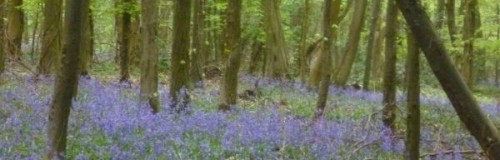
In my wheel of the year tree mandala (1), beech and bluebell together cover the period from 24 May-15 June – taking over from hawthorn and handing on to oak. In this instance, I am drawn by the powerful visual effects of bluebells carpeting woodland in which beech is the dominant tree.

The picture above is an old one. The last year in which Elaine and I went into this space (2018 or 2019) the wood felt weird. Part of it – not quite the area in the picture – was a scene of desolation. A lot of the trees had been taken down, with a kind of ragged insensitivity. It felt like a bad moment in Lord of the Rings. I don’t know the story behind this. Perhaps there was disease, or some other genuine need for a thinning out of trees. It was certainly systematic, with notices about the work being done – the result of management, and not of vandalism, in the conventional usage of our language.

The beech is an elegant tree, and I experience it as having a soft energy. It has been traditionally feminised, and thought of as ‘Queen of the Woods’, sharing the place of honour with the kingly oak according to The Green Man Tree Oracle (2). The same source says that “slivers of beech wood and leaves were once carried as talismans to bring good luck and increase creative energy”. Local British traditions associate the beech (ogham name phagos) with serpents “probably because of its long serpentine root systems”, they add – and I wonder too about the archaic link between the Goddess and serpent power in many cultures.

.

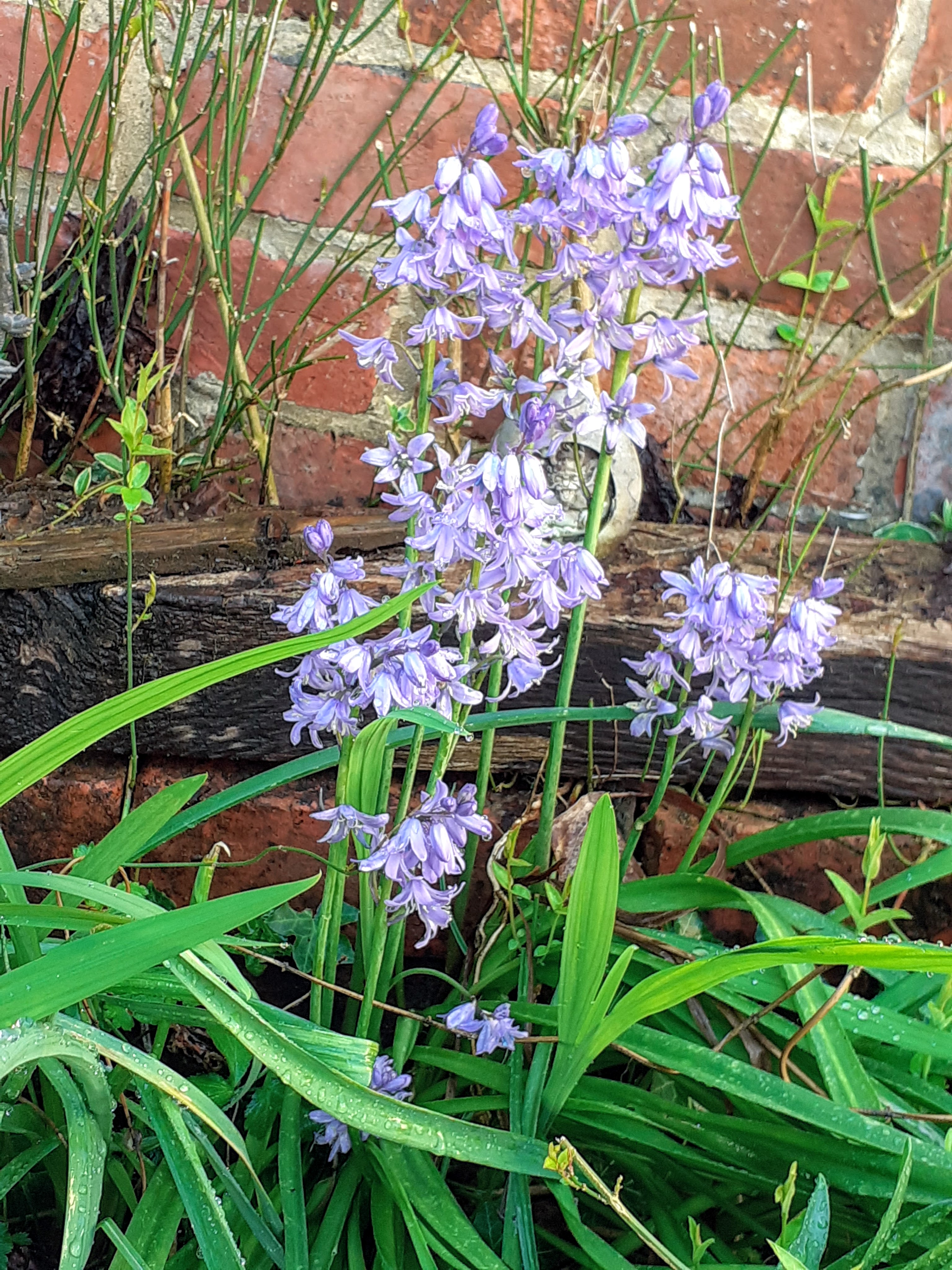
My personal connection with the tree itself is limited. It concerns this time of year and the association with bluebells. Indeed the bluebell is my main focus, with the beech as complementary. If they are separated, I follow the bluebell, and the picture below is a recent one, of the Spanish variety, from our garden. For me, it represents a favourite moment in the year, to be appreciated while it lasts. It reminds me simultaneously of the poignancy of impermanence (including my own) and the beauty of the eternal present (within which I am held).

(1) This mandala is based on my personal experience of trees in the neighbourhood as well as traditional lore. Moving around the summer quarter from Beltane, 1 May, the positions and dates of the four trees are: Hawthorn, south-east, 1-23 May; Beech & Bluebell, south-south-east, 24 May – 15 June; Oak, south, 16 June – 8 July; Gorse, south-south-west, 9 – 31 July. The autumn quarter then starts with Apple at Lughnasadh/Lammas. For a complete list of the sixteen trees, see https://contemplativeinquiry.blog/2020/autumn-equinox-2020-hazel-salmon-awen/

(2) John Matthews & Will Worthington The Green Man Oracle London: Connections, 2003.

REMEMBERING THE GLASTONBURY THORN

In my wheel of the year tree mandala (1), hawthorn presides from 1-23 May. It celebrates Beltane and the rising strength of the sun. Looking forward to that time, I think particularly of a specific tree, the Glastonbury thorn at Wearyall Hill, to represent that period. But the tree is gone, and is now unlikely to return, though ever-living in my heart and imagination..

It was a variety of common hawthorn (crataegus monogyna biflora) that flowered twice a year – first around Christmas and then in spring. I took the photograph in a misty Imbolc moment in 2007, between flowerings. It is the only one I will ever have, and for that reason I treasure it. The much revered tree was vandalised in 2010. New shoots appearing from March 2011 mysteriously disappeared. A new sapling, grafted from a descendent or the original tree, was planted in 2012 and consecrated – only to be snapped in half and irreparably damaged 16 days later. In May 2019, after some years of hesitation, the tree was entirely removed by the landowner in a final acceptance that the tree was lost. Sacred thorn trees, said to be descended from the same original, can still be found in the ruins of Glastonbury Abbey and at the Church of St. John.

I particularly liked the Wearyall Hill tree, because it was physically removed from the bustle of Glastonbury as a twenty-first century spiritual centre. The hill just seemed quietly natural – pagan, if you wanted to think of it that way, or Christian, if you wanted to link it to the story of Joseph of Arimathea’s staff, and how it came to life and flowered when planted in a new land. I was shocked by the violence against the tree and against other people’s love for it.

An ancestor of thee thorn (the individual plants do not last forever) had been cut down before, probably in 1647 by a Parliamentary soldier in England’s civil war. For the thorn was strongly linked to royal patronage, the miracle of a Christmas flowering, and a link between sacred land and sacred kingship. The kind of Royalism represented by this constellation of ideas and images was strong in Somerset at that time, but so was religious Puritanism, allied to a wish for constitutional change. The war was bitterly fought within the county. The legend of the thorn, cultivated by one group of people, made it vulnerable to another group of people identified with different loyalties.

The modern destruction of the thorn also seems not to have been casual, or it wouldn’t have been repeated so systematically. But I am not sure of the motivation. I find myself understanding a seventeenth century act of violence better than the modern one. Was this venerated tree the victim of a current human culture war? Are there potential lessons for Avalonians? Whatever the case, I am still in mourning.

(1) This mandala is based on my personal experience of trees in the neighbourhood as well as traditional lore. Moving around the summer quarter from Beltane, 1 May, the positions and dates of the four trees are: Hawthorn, south-east, 1-23 May; Beech & Bluebell, south-south-east, 24 May – 15 June; Oak, south, 16 June – 8 July; Gorse, south-south-west, 9 – 31 July. The autumn quarter then starts with Apple at Lughnasadh/Lammas. For a complete list of the sixteen trees, see https://contemplativeinquiry.blog/2020/autumn-equinox-2020-hazel-salmon-awen/

TREE MANDALA: BLACKTHORN

In my wheel of the year tree mandala (1), blackthorn (ogham, straif) covers 8-30 April, the final twenty-three days before Beltane. It has a beautiful white flower and elegant sharp thorns. I have seen descriptions of the latter as ‘vicious’, but they only hurt us if we invade the blackthorn’s space. The plant is not a triffid. It doesn’t come after us. So I don’t follow the line of tradition that links blackthorn to harsh fate. Blackthorn doesn’t ask to be turned into guardian hedges or crowns of thorn. That is down to our fellow humans.

The picture above comes from my magic year of 2007, happily well documented, when I was much engaged with trees and Druid study. I felt a pull towards blackthorn, more than towards the generality of hawthorn during that period. (I will write about the Glastonbury Thorn, the exception, at Beltane, my last tree mandala with a ‘memory lane’ theme).

I am drawn particularly to the strand of tradition that links blackthorn to powerfully creative magic – for it was long used in the making of wizards’ staffs. The text of The Green Man Oracle (2) suggests that “we have forgotten the magic that lies within us”. Blackthorn in particular has the ability to “foster waking dreams”. The Oracle adds that, “to access this personal magic, we must step away from busy, surface consciousness, and sink deeply into the ever flowing stream of our magical dreams. The ideas, scenes and presences that throng the deepest levels of our understanding require intense listening” Such magic, the Oracle continues, brings a light into the darkest places. For me that would mean just enough light to illuminate them, and not so much as to dazzle them into negation. How otherwise can the denizens of the dark be offered a welcome home if they want it, and in any event a better understanding?

(1) This mandala is based on my personal experience of trees in the neighbourhood as well as traditional lore. Moving around the spring quarter from 1 February, the positions and dates of the four trees are: Birch, north-east, 1-22 February; Ash & Ivy, east-north-east, 23 February – 16 March; Willow, east, 17 March – 7 April; Blackthorn, east-south-east, 8 – 30 April. The summer quarter then starts with Hawthorn at Beltane. For a complete list of the sixteen trees, see https://contemplativeinquiry.blog/2020/autumn-equinox-2020-hazel-salmon-awen/

(2) John Matthews & Will Worthington The Green Man Oracle London: Connections, 2003.

TREE MANDALA: WILLOW

I walk past these willows and they awaken my joy in natural beauty. Their full splendour may yet be to come, but they are already abundant with new life and growth. I am lifted by the promise that’s in them.

In my mandala of the year (1), willow presides over period from 17 March to 7 April. Working with trees in my Druid training, I developed a close contact with a willow near to where I then lived in Bristol. I also made a willow wand, from a dead branch I found lying around in another part of town.

In the course of this work I developed a sense of willow that does not exactly match our inherited lore. My records tell me that my main personal impressions concerning willow were of “resilience and generativity” and of “vibrancy in early spring”. Those impressions still stand. I don’t link myself so much to associations with the dark side of the moon (and moon goddess) or the many uses of wicker.

I do make connections between willow and the energy of water, and I can know of willow as a portal to gently magical experiences. Below, I offer a digitised picture of my Bristol tree, taken on 21 March 2007, and an account of time spent with it that afternoon. I enjoy the chance to share this fourteen year old memory, and bring a small piece of my personal Druid history into the present. Intentional reminiscence can be a deeply satisfying here-and-now experience.

“This afternoon I went out to see the trees – beautiful sunshine. The willow I’ve connected with looked very willowy – buds, leaves, catkins. It seemed solid, vibrant, pulsing. Leaning against the trunk from shoulder to hip, I sensed a resonance connected to the contact. Tuning in, I began to make a sound. The note that developed was light and optimistic, but strong enough fully to reach me in the belly. It had a potency that surprised me. I felt carefree, I could take in the cool equinoctial breeze with the warm equinoctial sun and enjoy a moment of holy idleness after a time of rushing around and work.”

I avoid talking about this experience in the language of relationship with the tree, though part of me would like to. I do not know what it is like to be a willow tree, but I am sure it is like something. I know of no way to check in with the tree that allows it to contradict my own precious intimations of communion, should it want to. I suspect that it barely noticed me. Yet the experience felt healing, and I have never forgotten it.

(1) This mandala is based on my personal experience of trees in the neighbourhood as well as traditional lore. Moving around the spring quarter from 1 February, the positions and dates of the four trees are: Birch, north-east, 1-22 February; Ash & Ivy, east-north-east, 23 February – 16 March; Willow, east, 17 March – 7 April; Blackthorn, east-south-east, 8 – 30 April. The summer quarter then starts with Hawthorn at Beltane. For a complete list of the sixteen trees, see https://contemplativeinquiry.blog/2020/autumn-equinox-2020-hazel-salmon-awen/

Earth Eclectic

music that celebrates Earth and speaks to the heart

Sarah Fuhro Star-Flower Alchemy

Follow the Moon's Cycle

Muddy Feet

Meeting nature on nature's terms

Rosher.Net

A little bit of Mark Rosher in South Gloucestershire, England

Becoming Part of the Land

A monastic polytheist's and animist’s journal

selkiewife

Selkie Writing…

Charlotte Rodgers

Images and words set against a backdrop of outsider art.

Prof Jem Bendell

living with metacrisis and collapse

Towint

The pagan path. The Old Ways In New Times

The Druids Garden

Spiritual journeys in tending the living earth, permaculture, and nature-inspired arts

The Blog of Baphomet

a magickal dialogue between nature and culture

This Simple Life

The gentle art of living with less

Musings of a Scottish Hearth Druid and Heathen

Thoughts about living, loving and worshiping as an autistic Hearth Druid and Heathen. One woman's journey.

Wheel of the Year Blog

An place to read and share stories about the celtic seasonal festivals

Walking the Druid Path

Just another WordPress.com site

anima monday

Exploring our connection to the wider world

Grounded Space Focusing

Become more grounded and spacious with yourself and others, through your own body’s wisdom

The Earthbound Report

Good lives on our one planet

Hopeless Vendetta

News for the residents of Hopeless, Maine