Contemplative Inquiry

This blog is about contemplative inquiry

Tag: Sacred activism

BEING NOBODY

“I’m nobody.

So are you.

What ecstasy!

Join me.” (1)

According to Andrew Harvey (1), the translator of this brief poem by Kabir, “Kabir is far more than a poet; he is a universal initiatory field, as expansive as Rumi and as embodied, radical and ferocious as Jesus”. I certainly experience a creative shock in Kabir’s celebration of being ‘nobody’ in a world where being ‘somebody’ is such a highly valued social accomplishment. But what if the accomplishment distracts from something else, something of greater value? Kabir invites us to share the ‘ecstasy’ of being nobody. In another of his verses, which were performed as songs, Kabir links this ecstasy with love:

“You can’t grow love in gardens

Or sell it in markets.

Whether you’re a king or peasant

If you want it

Give your head and take it”.

In my experience, Kabir’s work opens a door to forms of contemplation and creativity in which my personality and personal biography are not the primary focus. Especially in darkening times, bearing witness to the way of the heart, and drawing strength from it, is a form of sacred activism. The liturgy of modern Druidry speaks of a love of justice and a love of all existences, embedded in a living relationship with Spirit. This for me is a commitment to live from.

(1) Kabir Turn Me To Gold: 108 Poems of Kabir Unity Village, MO: Unity Books, 2018 Translations by Andrew Harvey. Photographs by Brett Hurd.

(2) See also https://contemplativeinquiry.blog/2021/01/30/turn-me-to-gold/

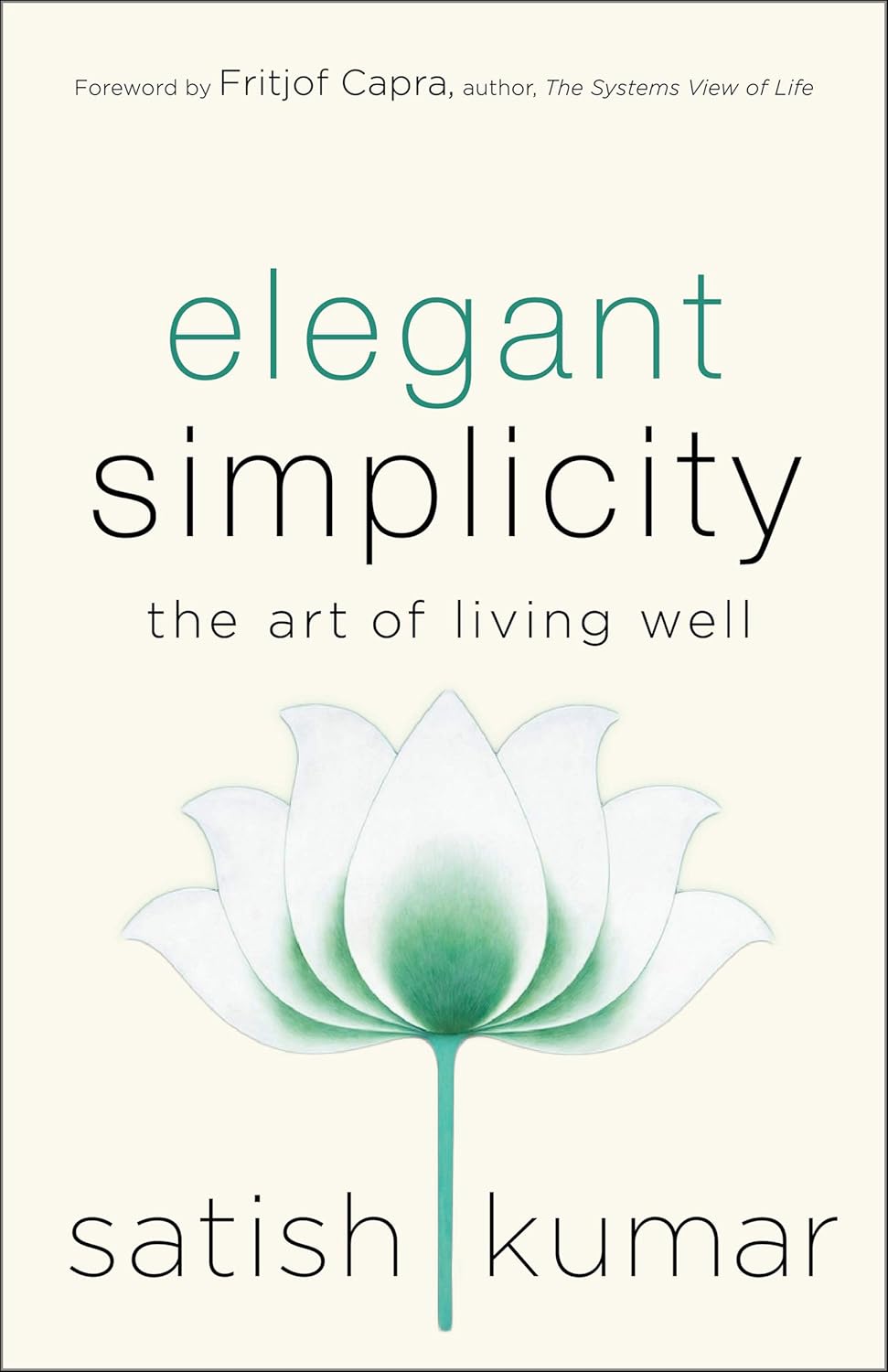
BOOK REVIEW: ELEGANT SIMPLICITY

Highly recommended. Satish Kumar (born in 1936) published Elegant Simplicity: the Art of Living Well in 2019 (1). It begins with a foreword by Fritjof Capra and a preface by the author Let’s be Simple which quotes the 1848 Shaker song ‘Tis the gift to be simple, ‘Tis the gift to be free. The book summarises the author’s personal story as well as discussing his values. I have written posts based on some of his other work before (2). I especially recommend this book to anyone interested in knowing more about Satish Kumar’s practice (grounded in Jain spirituality and Gandhi’s non-violent activism) and his influence on deep ecology, creative arts and education.

Elegant Simplicity has a summarising quality, looking back on decades devoted to sacred activism in different forms. It is divided into fourteen chapters: Each is preceded by a brief and relevant quotation from another thinker. The chapter then becomes a meditation on the quote:

1 My Story: Beginnings – ‘True happiness lies in contentment’ Mahatma Gandhi.

2 Simplicity of Walking – ‘All truly great thoughts are conceived by walking’ Friedrich Nietzsche.

3 Life is a Pilgrimage – ‘Faith is not the clinging to a shrine but an endless pilgrimage of the heart’ Abraham Joshua Heschel.

4 Elegant Simplicity – ‘Any fool can make things complicated, it requires a genius to make them simple’ E. F. Schumacher.

5 A Society of Artists – ‘This world is but a canvas to our imagination’ Henry David Thoreau.

6 Yoga of Action – ‘Life is a process not a product’ Brian Goodwin.

7 Learning is Living – ‘Education is not preparation for life; education is life itself’ Thomas Dewey.

8 Right Relationships – ‘We are all related – relationships based on obligation lack dignity’ Wayne Dwyer.

9 Love Unlimited – ‘There is no charm equal to tenderness of the heart’ Jane Austin.

10 Power of Forgiveness – ‘It’s one of the greatest gifts you can give yourself, to forgive. Forgive everybody.’ Maya Angelou.

11 Dance of Opposites – ‘Life and death are one as the river and the sea are one’ Kahlil Gibran.

12 Deep Seeing – ‘To see clearly is poetry, prophecy, and religion, all in one’ John Ruskin.

13 Union of Science and Spirituality – ‘Science is not only compatible with spirituality; it is a profound source of spirituality’ Carl Sagan.

14 Soil, Soul and Society – ‘We live in an interconnected world and in an interconnected time so we need holistic solutions to our interconnected problems‘ Naomi Klein.

Fellow activist and author Vandana Shiva describes Elegant Simplicity as “the distillation” of Satish Kumar’s ideas and actions. “It shows the intimate connections between the inner and the outer world, soil, soul and society, beauty joy and non-violence. It indicates that the solutions to the big problems of our time – climate change, hate, violence, hopelessness and despair – lie in thinking and living with elegant simplicity, reducing our ecological footprint while enlarging our hearts and minds”.

For me, Satish Kumar is an inspiration rather than a direct model. Even in the conditions of the early 1960’s I would not have walked, or aspired to walk, from New Delhi to Washington DC without carrying any money. Yet Satish Kumar and his companion E. P. Menon succeeded and made a huge public impact at the time. Their peace pilgrimage gave oxygen to the campaign for nuclear disarmament. No state gave up its arms, but treaties limiting the numbers and testing of nuclear arms became normalised for some decades. Satish Kumar’s initiatives in deep ecology and education, especially the ‘small school’ and Schumacher College, have changed lives. Directly and indirectly, his influence has awakened many people from the dystopian trance of our dominant cultures. Satish Kumar is a widely revered elder: a peaceful warrior for a more liveable, generous and creative world.

(1) Satish Kumar Elegant Simplicity: The Art of Living Well New Society Publishers (https://www.newsociety.com): Gabriola Island, BC, Canada: 2019

(2) See previous posts:

NEWS OF A DEATH

TWO VIEWS OF THE DIVINE

OUTDOOR WALKING MEDITATION

NOTE: “Satish Kumar (born 9 August 1936)[1] is an Indian British activist and speaker. He has been a Jain monk, nuclear disarmament advocate and pacifist.[3]Now living in England, Kumar is founder and Director of Programmes of the Schumacher College international center for ecological studies, and is Editor Emeritus of Resurgence & Ecologist magazine. His most notable accomplishment is the completion, together with a companion, E. P. Menon, of a peace walk of over 8,000 miles in June 1962 for two and a half years, from New Delhi to MoscowParisLondon, and Washington, D.C., the capitals of the world’s earliest nuclear-armed countries.[4][5] He insists that reverence for nature should be at the heart of every political and social debate.” (Wikipedia)

BOOK REVIEW: THE BURNING HOUSE

A highly recommended illustration of spirituality in support of political action. In The Burning House: A Buddhist Response to the Climate and Ecological Emergency (1), author Shantigarbha affirms that ‘the ecological crisis is nothing if not a spiritual crisis, a crisis of meaning and direction for our civilisation’. Most Druids would say the same, and see value in his approach.

Shantigarbha (Seed or Womb of Peace) (2) is a teacher of Buddhism and Nonviolent Communication (NVC). He has also trained members of Extinction Rebellion (XR) in nonviolence and de-escalation skills. He believes that we cannot wait to change our lives before we change the world, or to change the world before we change our lives: we have to do the best we can with both, together, now. He sees the climate crisis as primarily one of ’empathy, connection and community’ and says that ‘when we use our energy to cultivate our own vitality, we naturally use the abundance we discover in the service of life’.

The book title The Burning House references a traditional Buddhist story about a father trying to get his children out of a burning house. There is no time to pick them up individually, so he simply commands them to leave. But they are busy playing with their toys and ignore him. He has to find a skilful means of getting them out. In his anguish (but also inspiration) he tells them that there are even more wonderful and exciting toys outside. In the parable the burning house stands for a life of samsara and unawareness. Outside there is the opportunity for awareness and the tools to develop it.

The book looks first at the climate crisis and ways it can be understood. There follow chapters on how Buddhist ethics support environmental ethics, and how compassionate action based on wisdom can enable the transformation we need. There are chapters on aspects of emotional intelligence. How to transform anger is the first – rather than acting out our anger or repressing it, we can identify and mobilise ‘the life in it’. Hatred, by contrast, is characterised as always toxic and self-harming. There are chapters on ecological grief and its potentially heavy weight – and also on gratitude for what we do still have. There is a beautiful quote from Francis Weller: ‘How much sorrow can I hold? That’s how much gratitude I can give. If I carry only grief, I’ll bend toward cynicism and despair. If I have only gratitude, I’ll become saccharine and won’t develop much compassion for other people’s suffering. Grief keeps the heart fluid and soft, which helps make compassion possible’ (3).

Later chapters focus more specifically on nonviolent social change, on being the change, and on the role of nonviolent disruption in the pursuit of climate justice. Practical examples draw on UK experience in 2019, mostly in London and Bristol. Whilst illuminating, they are limited in place and time. The last chapter, Final thoughts: the beauty and terror, summarises what we can do both individually and collectively. It sees some grounds for hope – if we treat the climate and ecological emergency as an emergency. Shantigarbha draws on Sraddha, ‘the Buddhist equivalent of hope’, better translated as confidence or trust. It is not faith or hope in the ordinary sense. ‘Sraddha represents a higher or broader perspective, our connection with vision. It signifies an emotional response to our ideals. In terms of the burning house it represents the father’s cry of inspiration’. We are invited to have the courage and confidence to do what we can, and let the effects ripple out. It is what we can do, and all we can do.

The Burning House offers valuable perspectives both on Buddhist political engagement and on climate action. Each chapter contains a link to a guided meditation, offered as a resource to readers.

(1) Shantigarbha The Burning House: A Buddhist Response to the Climate and Ecological Emergency Cambridge: Windhorse Publications, 2021 (https://www.windhorsepublications.com)

(2) See: https://www.SeedofPeace.org

(3) See: https://www.thesunmagazine.org/issues/478/the-geography-of-sorrow)

NAVIGATING TURBULENT TIMES

Ten suggestions for navigating turbulent times: I am interested in the following list by Carolyn Baker and Andrew Harvey (1). They are not from my tradition, but I find their thoughts relevant and challenging. They prompt me to wonder what my list would be. Their book, which I will review in a later post, was published in the USA in 2020, a little before the November elections.

“1. Stay Safe: wear masks when you are outside, continue social distancing as much as possible, and listen carefully to the scientists who are telling us we are in the middle of a second wave of the pandemic. Shun all large gatherings and rallies and find other ways to protest which can be just as effective.

“2. Take special care of your health and keep your body vibrant with exercise and good nutrition. The psychological and emotional demands of unfolding crises will be far more effectively sustained with a healthy body.

“3. Whatever your spiritual practice, plunge more deeply than ever into it. It is essential to pursue realization of your true Self with more faith and intensity in these exploding times than ever before.

“4. Fill your life with inspiration and beauty. Inspiration will keep your heart buoyant and alive, and beauty will remind you of the magnificence of life and fill you with the energy to want to safeguard it.

“5. If you can, spend 20 minutes in nature per day, experiencing your oneness with it and drinking in through every pore its steadiness and radiance. Allow yourself to become intimate with the Earth.

“6. Stay aware of how the pandemic and environmental crises are evolving. There is no security in denial or ignorance. Learn, however, to pace yourself because the ferocious information you will be taking in can become overwhelming.

“7. Take time to grieve. No one will escape heartbreak in a time such as this, and not attending to the suffering of the heart that inevitably rises in the face of so much destruction will lead to severe depression or a kind of inner deadness that makes it impossible to respond creatively. Get support from others who are also grieving alone, and there is no need to be alone in a crisis that is now global.

“8. Renew old friendships and relish and deepen the ones you have you have because everything now depends on the sanity and joy that only deep friendship and relationship can provide, Take special care and lavish special love on your animal companions, and they will reward you with their tender and miraculous love.

“9. Despite being mostly in lockdown, make an effort to practice Sacred Activism by giving wisely to those in need. Foodbanks need support as do healthcare workers and the homeless who are afraid of going to shelters because they are Petri dishes for the virus. If you are able to assist those in prison by standing up for their rights, or by encouraging them in any way, do so. Take seriously your right to vote, for everything depends throughout the world on turning back the tide of dark money-financed authoritarianism.

“10. Use this book as a way of training your inner eyes to see and celebrate the signs of the Birth of a new humanity that are rising everywhere amidst the obviously apocalyptic death. Note the heroism of extraordinary/ordinary people globally who are turning up to serve the sick and dying. Note the heroism of protestors after the horrific death of George Floyd. Read great evolutionary philosophers and mystics like Sri Aurobindo, Teilhard de Chardin, Bede Griffiths, Satprem, Teresa of Avila, Hildegard of Bingen, and Julian of Norwich, and those who speak of the global dark night, giving birth potentially to an embodied divine humanity.”

(1) Carolyn Baker & Andrew Harvey Radical Regeneration: Birthing the New Human in the Age of Extinction Bloomington, IN: iUniverse, 2020

XR STORIES

This re-blog, from The Earthbound Report, presents three stories from the recent Extinction Rebellion (XR) action in London. Written from an insider perspective, they illustrate the movement culture that XR seeks to model.

Three little XR stories you won’t read in the papers — The Earthbound Report

WELL-BEING: CONTEMPLATING ACTION

“In The Spirit Level Richard Wilkinson and Kate Pickett put inequality at the centre of public debate by showing conclusively that less equal societies fare worse than more equal ones across everything from education to life expectancy. The Inner Level explains how inequality affects us individually, how it alters how we think, feel and behave. It sets out the overwhelming evidence that material inequities have powerful psychological effects: when the gap between rich and poor increases, so does the tendency to define and value ourselves and others in terms of superiority and inferiority. A deep well of data and analysis is drawn upon to empirically show, for example, that low social status is associated with elevated levels of stress hormones, and how rates of anxiety and depression are intimately related to the inequality which make that status paramount.” (1)

What links contemplation and action? My answer is creative and powerful ideas. In a recent post (2), I cited Brendan Myers (3) proposition that a flourishing life is ethically desirable and good (a powerful, creative idea), and that it depends on us supporting each other’s well-being and that of the biosphere and the Earth itself (another powerful creative idea). The Spirit Level and The Inner Level concern ‘developed’ countries in the 21st century and to an extent the last two decades of the 20th. They paint a depressing picture, especially for the U.K. and the U.S.A, and for me it shows the need to champion a social ecology that supports health and well-being.

For some years I worked at the interface between public health (i.e. population-based health, largely concerned with prevention work and the creation of more supportive environments) and mental health. So, I am interested in the recent publication of The Inner Level (4) and may write further about it. Thinking about ‘health’ in the bigger picture (with service provision as only one aspect) is a positive way into social justice work, where powerful ideas can (in principle) be realised through ethical passion and political will informed by scientific evidence. It is a notion of how to do public policy that needs to be kept alive.

I know this doesn’t happen much, now, in a culture like ours with high levels of bullying, confusion, distraction and misinformation. We seem to be living with an orchestrated dumbing down of political discourse in the service of oligarchic interests. So, my first action – not always recognised as action – is personal resistance to any onset of cynicism, numbness and despair within myself. My second action – also not always recognised as action – is to work at maintaining an adequate level of knowledge and understanding of what is happening in the world, using the lens of ‘powerful ideas’ to make sense of the information I digest. This includes having an historical perspective – both backwards and forwards – on current events. My third action is to place myself within networks that share my concerns and are responding to them in diverse ways – hopefully modelling cultures of: compassion (including ruthless compassion); openness and creativity; curiosity about the world; and criticality (deconstructive where necessary and appreciative where possible) in the realm of ideas and action. Further developments will come from there, and I will write about them within this blog.

Over time my contemplative life has moved towards a blend of energy work and meditative connection to source, with the practice forms kept simple. It is also the clear, awake space out of which I act in the world.

(1) https://www.equalitytrust.uk/

(2) https://contemplativeinquiry.wordpress.com/2018/07/02/ethics-and-civilization/

(3) Brendan Myers Reclaiming Civilization: A Case for Optimism for the Future of Humanity Winchester, UK & Washington, USA: Moon Books, 2017

(4) Richard Wilkinson and Kate Pickett The Inner Level: How More Equal Societies Reduce Stress, Restore Sanity and Improve Everyone’s Well-being

Earth Eclectic

music that celebrates Earth and speaks to the heart

Sarah Fuhro Star-Flower Alchemy

Follow the Moon's Cycle

Muddy Feet

Meeting nature on nature's terms

Rosher.Net

A little bit of Mark Rosher in South Gloucestershire, England

Becoming Part of the Land

A monastic polytheist's and animist’s journal

selkiewife

Selkie Writing…

Charlotte Rodgers

Images and words set against a backdrop of outsider art.

Prof Jem Bendell

living with metacrisis and collapse

Towint

The pagan path. The Old Ways In New Times

The Druids Garden

Spiritual journeys in tending the living earth, permaculture, and nature-inspired arts

The Blog of Baphomet

a magickal dialogue between nature and culture

This Simple Life

The gentle art of living with less

Musings of a Scottish Hearth Druid and Heathen

Thoughts about living, loving and worshiping as an autistic Hearth Druid and Heathen. One woman's journey.

Wheel of the Year Blog

An place to read and share stories about the celtic seasonal festivals

Walking the Druid Path

Just another WordPress.com site

anima monday

Exploring our connection to the wider world

Grounded Space Focusing

Become more grounded and spacious with yourself and others, through your own body’s wisdom

The Earthbound Report

Good lives on our one planet

Hopeless Vendetta

News for the residents of Hopeless, Maine