Contemplative Inquiry

This blog is about contemplative inquiry

Tag: Rosary

WORKING WITH BEADS

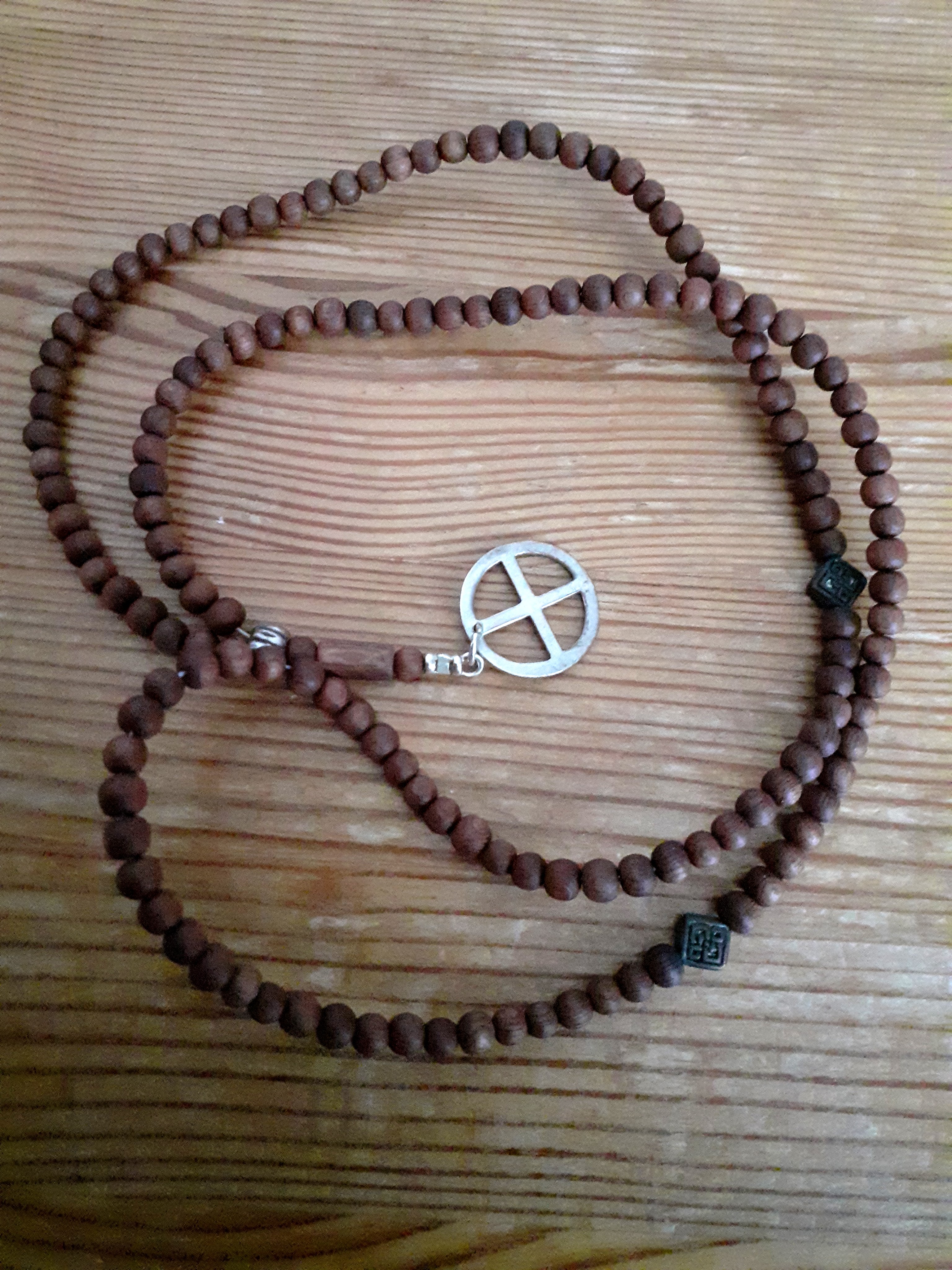
Recently I wrote about the balanced cross (1), linking it to the paidirean (pahj-urinn) prayer beads of the Ceile De (Culdees), a modern monastic order based in Scotland. This post is about the beads and my work with them. Beads like this were part of the original Ceile De tradition and are known to have been used in the days of Columcille (St. Columba).

There are 150 beads, each about 5 mm wide.  They are made of unstained rosewood and were left immersed in rose damask oil for a month.  As well as scenting the beads, the oil gives the beads a pinkish colour. A cross hangs from the beads – at heart level when worn as a necklace.

Each Paidirean is ceremonially strung in Scotland by a Ceile De Order member.  The process takes two hours and involves prayer, meditation and continuous chanting during the stringing.  Then a blessing is spoken over the completed Paidirean which is anointed with water and with oil from a local holy well, used for at least 1500 years. The Paidirean is an object of power as well as beauty. 

I am not a member of the Ceile De, and when I acquired the Paidirean they knew that I would work with the beads in my own way. I bring together meditation and prayer. I work with the Soham mantra, with Satish Kumar’s understanding (2) that it means ‘you are, therefore I AM’. Whilst I am mindful to my breath, to the mantra and to the movements of the beads, mindfulness is a means and not the purpose of the practice.

The purpose is to make an offering to Spirit – an offering from one lamp to the light, one wave to the ocean. After some hesitation and experiment, I have adopted the word Spirit, rather than Goddess or God, to address the Divine. It is more universal and inclusive as, for me, befits a panentheist view. In making my offering, I am aware that Soham also works laterally, including relations between all beings within the web of life, just as the Druid prayer speaks of  ‘the love of all existences’. Ultimately, we are recognising the divinity in each other.

Spirit is not beyond us in some other realm. It is here, now, and everywhere.  When I work with the beads, I am making both an offering and an affirmation.

(1) https://contemplativeinquiry.blog/2025/01/04/the-balanced-cross

(2) Satish Kumar You Are therefore I AM: A Declaration of Dependence Totnes: Green Books, 2002

SLOW HEALING BREATH: CHANTING HELPS TOO

“When Buddhist monks chant their most popular mantra Om Mani Padme Hum, each spoken phrase lasts six seconds, with six seconds to inhale before the chant starts again. The traditional chant of Om, the “sacred sound of the universe” in Jainism and other traditions, takes six seconds to sing, with a pause of about six seconds to inhale. The sa ta ma na chant, one of the best-known techniques in Kundalini Yoga, also takes six seconds to vocalize, followed by six seconds to inhale. Then there are the ancient Hindu hand and tongue poses called mudras. A technique called khechari, intended to help boost physical and spiritual health and overcome disease, involves placing the tongue above to soft palate so that it’s pointed towards the nasal cavity. The deep, slow breaths taken during this khechari each take six seconds.

“Japanese, African, Hawaiian, Native American, Buddhist, Taoist, Christian – these cultures and religions all had somehow developed the same prayer techniques, using the same breathing patterns. And they all likely benefitted from the same calming effect.

“In 2001, researchers at the University of Pavia in Italy gathered two dozen subjects, covered them with sensors to measure blood flow, heart rate and nervous system feedback and then had them all recite a Buddhist mantra as well as the original Latin version of the rosary, the Catholic prayer cycle of the Ave Maria, which is repeated half by a priest and half by the congregation. They were stunned to find that the average number of breaths for each cycle was ‘almost exactly’ identical, just a bit quicker than the pace of the Hindu, Taoist, and Native American prayers: 5.5 breaths a minute”. [I find the same when chanting the awen – aah-ooo-wen – in Druidry: JN]

“But what was even more stunning was what breathing like this did to the subjects. Whenever they followed this slow breathing pattern, blood flow to the brain increased and the systems in the body entered into a state of coherence, when the functions of heart, circulation and nervous system are coordinated to peak efficiency. The moment the subjects returned to spontaneous breathing or talking, their hearts would beat a little more erratically, and the integration of these systems would slowly fall apart. A few more slow and relaxed breaths, and it would return again.

“A decade after the Pavia tests, two renowned professors and doctors in New York, Patricia Gerbarg and Richard Brown, used the same breathing pattern on patients with anxiety and depression, minus the praying. Some of these patients had trouble breathing, so Gerbarg and Brown recommended that they start with an easier rhythm of three-second inhales with at least the same length exhale. As the patients got more comfortable, they breathed in and breathed out longer.

“It turned out that the most efficient breathing rhythm occurred when both the length of respirations and total breaths per minute were locked into a spooky symmetry: 5.5-second inhales followed by 5.5 second exhales, which works out almost exactly to 5.5 breaths a minute. This was the same as the pattern as the rosary. The results were profound, even when practised for just five to ten minutes a day”.

Extract from James Nestor Breath: The New Science of a Lost Art Riverhead Books: USA & Penguin Life, UK: 2020 (Kindle edition)

Earth Eclectic

music that celebrates Earth and speaks to the heart

Sarah Fuhro Star-Flower Alchemy

Follow the Moon's Cycle

Muddy Feet

Meeting nature on nature's terms

Rosher.Net

A little bit of Mark Rosher in South Gloucestershire, England

Becoming Part of the Land

A monastic polytheist's and animist’s journal

selkiewife

Selkie Writing…

Charlotte Rodgers

Images and words set against a backdrop of outsider art.

Prof Jem Bendell

living with metacrisis and collapse

Towint

The pagan path. The Old Ways In New Times

The Druids Garden

Spiritual journeys in tending the living earth, permaculture, and nature-inspired arts

The Blog of Baphomet

a magickal dialogue between nature and culture

This Simple Life

The gentle art of living with less

Musings of a Scottish Hearth Druid and Heathen

Thoughts about living, loving and worshiping as an autistic Hearth Druid and Heathen. One woman's journey.

Wheel of the Year Blog

An place to read and share stories about the celtic seasonal festivals

Walking the Druid Path

Just another WordPress.com site

anima monday

Exploring our connection to the wider world

Grounded Space Focusing

Become more grounded and spacious with yourself and others, through your own body’s wisdom

The Earthbound Report

Good lives on our one planet

Hopeless Vendetta

News for the residents of Hopeless, Maine