Contemplative Inquiry

This blog is about contemplative inquiry

Tag: Roman Catholicism

BOOK REVIEW: SMALL THINGS LIKE THESE
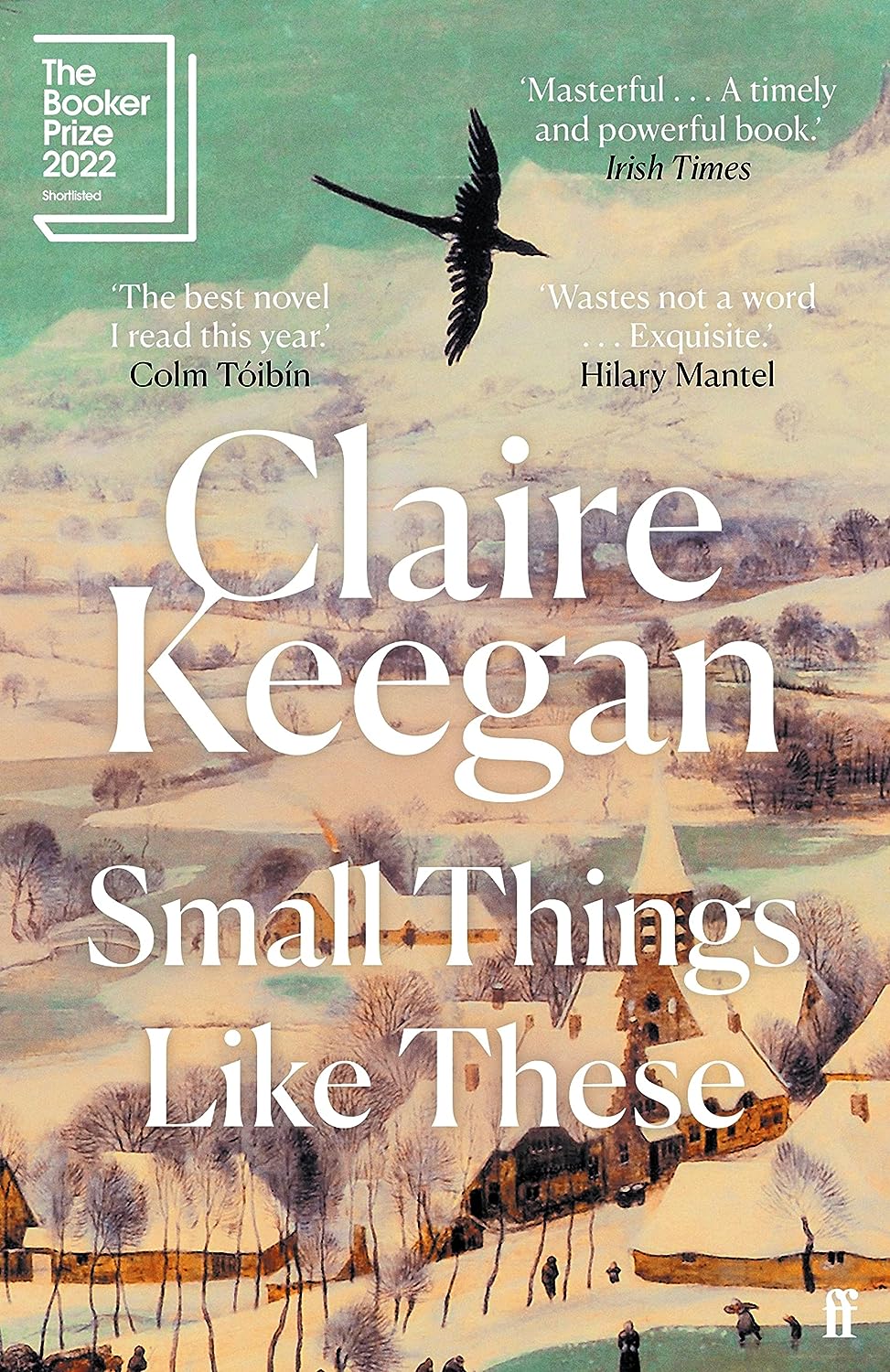
Beautifully written, and highly recommended. Claire Keegan’s Small Things Like These (1) is a novella set in the small Irish town of New Ross in the cold December of 1985, “a December of crows”. New Ross is in many ways a strong community, but business is bad. There are closures, poverty and emigration. The central, point-of-view character is Bill Furlong, a coal and timber merchant, adequately prosperous and very busy at this time of year. Born on 1 April 1946, he is a pillar of his community, a regular if tepid church goer, married with five daughters. The older of these are at St. Margaret’s, “the only good school for girls in town”.

But Bill is also something of an outsider. His father is unknown. ‘Furlong’ is his mother’s family name. She herself becomes pregnant at the age of 16, whilst working as a maid for the Protestant widow Mrs. Wilson, comfortable on a military pension and a decent sized farm. Mrs. Wilson chooses to keep her on and takes an interest in the boy. This interest continues after his mother’s sudden death when he is 12. Technical School leads to an opportunity at the coal yard where he works his way up and subsequently becomes the owner. When he gets engaged to Eileen, Mrs. Wilson gives him some thousands of pounds to establish himself. He enjoys being a family man and a good provider. The Christmas season, with its time at home, rich food and present giving is a welcome opportunity to celebrate.

Bill is naturally generous, refuses to judge people harshly and is prone to spontaneous acts of kindness, the “small things like these” of the title. The main action of the novella begins when he personally delivers a Christmas coal and wood order to the local convent, a powerful-looking place on the hill, where the nuns run both a “training”, or possibly “reforming”, school for girls” and a popular laundry business. There is some lack of clarity over the detail. They might be involved in arranging adoptions as well. Although a little set apart, it is one of the major institutions of the town.

Arriving in the dark at the covent coal house door Bill finds the bolt stiff with frost and has to force it open. There he finds a young girl, Sarah, who has clearly been locked in there for some time. She asks him to take her away or at least ask the whereabouts of her 14 month old baby who has been taken from her. The Mother Superior becomes involved and embarks on an unconvincing performance of compassion involving tea and cake for both Bill and the girl, and a story about Sarah’s incarceration as the result of a game with other girls.

Bill, going home, realizes that he forgot to ask about the baby. He recollects the numerous locks in the convent buildings and broken glass on the tops of walls. He is unhappy and misses his way home, fetching up in a remote spot he doesn’t recognize. In one of the novella’s occasional fairytale moments, he asks an old man with a billhook: “will you mind telling me where this road will take me?” The old man replies: “this road will take you wherever you want to go, son”.

On his return he tells Eileen and, separately, two friends his story. They are keen to talk him out of any public comment or further action. The convent is powerful. Other church institutions would rally round it. It is also his largest customer with the capacity to influence others. Bill has worked very hard to get where he is. Why risk financial disaster? But he is strongly affected by his encounter with Sarah. He finds himself becoming reluctant even to attend mass, let alone take the sacrament. He thinks of what Mrs. Wilson did for him, particularly since he is now fairly sure that his father was not one of her own relatives.

Late on Christmas Eve he goes back to the convent on foot, unbolts the coalhouse door, finds Sarah, and begins the walk through town to his home, “the excitement in his heart matched by the fear of what he could not yet see but knew he would encounter”. On this journey, he also recognizes a “fresh, new, unrecognisable joy in his heart … some part of him was going wild, he knew … never once in his whole and unremarkable life had he known a happiness akin to this”. The narrative ends when he reaches the door of his family home. On the other side of that door lies the beginning of another story, and another day.

(1) Claire Keegan Small Things Like These London: Faber & Faber, 2021

The author has dedicated this story to the women and children who suffered time in Ireland’s mother and baby homes and Magdalen laundries. In a note on the text she adds: “Ireland’s last Magdalen laundry was not closed down until 1996. It is not known how many girls and women were concealed, incarcerated and forced to labour in these institutions. Ten thousand is the modest figure; thirty thousand is probably more accurate. Most of the records from the Magdalene laundries were destroyed, lost or made inaccessible. Rarely was any of these girls’ or women’s work recognised or acknowledged in any way. Many girls and women lost their babies. Some lost their lives. Some or most lost the lives they could have had. … These institutions were run and financed by the Catholic Church in concert with the Irish State. No apology was issued by the Irish government until Taoiseach Enda Kelly did so in 2013”.
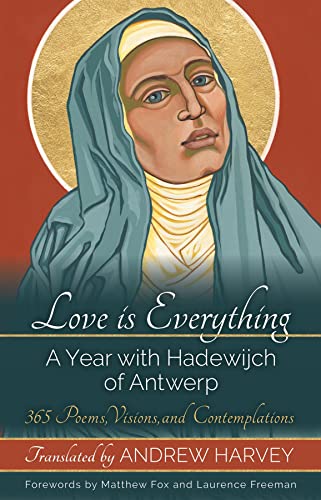
HADEWIJCH THE BEGUINE

How could I believe this

If I had not found it true?

The soul that wanders in free nakedness

Births all that is and will be,

Participates in ecstasy

In engendering the Son

In creation and re-creation

Of all the worlds.

In sublimest mystery

All words drown.

From: Andrew Harvey (translator) Love is Everything: A Year with Hadewijch of Antwerp: 365 Poems Singapore: Medio Media, 2002 (Forewords by Matthew Fox and Laurence Freeman)

Hadewijch of Antwerp lived in the 13th. century. She was a Beguine, part of a women’s lay order who took no religious vows beyond promising not to marry “as long as they lived as Beguines”. They could leave at any time. For a period, they flourished in the Low Countries, France, and the Rhineland. The only definitely known Beguine community (Beguinage) in England was in Norwich in the 15th. century, well after the time of Hadewijch or indeed the English anchoress Julian. Beguines stressed voluntary poverty (though they could keep their own property), care for the sick, and a life of devotion. They worked in the world, for example in the woollen and silk industries, and in laundries. Leading figures such as Hadewijch also wrote for the wider community and effectively developed their own theology.

Andrew Harvey salutes Hadewijch as “one of the most incandescent and inspired of all Christian mystics” and sees her now as pointing the way to an “evolutionary transformation into embodied divinity” that “our devastating global dark night is both urgently demanding and making possible”. Literate in Latin and French as well as the middle Dutch in which she wrote, Hadewijch was well acquainted with with the literature of Christian mysticism and also the works of the troubadour tradition with its own philosophy of love. She is known to have written 31 letters, 14 visions, 45 poems and stanzas, and 16 poems in couplets, initially circulated in the Flemish lowlands and in the Rhineland.

Hadewijch was influential on the historically better known mystics of the 14th. century – particularly Jan Ruusbroec, who acknowledged her influence in his own work, and probably also Meister Eckhart. But she herself was forgotten by the end of the 15th. century and not rediscovered until the middle of the 19th. It is only in recent decades that she has once more received widespread attention.

The church and society of Hadewijch’s day were at best ambivalent about the Beguines and their relative independence. Hadewijch was able to flourish for a time, but “the intensity of her witness to Christ consciousness aroused bitter opposition from both church clerics and from within her own community”. She may have spent time in prison and possibly lived her last years serving and sleeping as an unpaid helper in a leprosarium.

By the early 14th. century, attitudes had become even harder. The French Beguine Marguerite de Porete was burned at the stake in Paris in 1310, as a ‘relapsed heretic’. In her widely popular book The Mirror of Simple Souls, she had written that “a soul, annihilated in the love of the creator could, and should, grant to nature all that it desires”. Her view was that such a soul could desire nothing but good, and was incapable of sin. But her words were interpreted as an invitation to ignore the moral law, and to suggest that one had no need for the Church and its sacraments or its code of ethics.

In 1311-12, the Council of Vienne attacked the Beguines for their alleged tendency to “dispute and preach about the highest Trinity and the divine essence and introduce opinions contrary to the Catholic faith concerning the articles of faith and the sacraments of the Church”. Although the Beguines continued to function, they became more cautious, more mainstream for their time and more likely to be aligned to other Orders. There were no more influential writers that I am aware of. Their wings had been clipped. They were no longer a threat.

I am drawn to Hadewijch’s writing for its eloquence in evoking profound contemplative experiences. Her spiritual boldness and unswerving commitment earn my deepest respect. She reveals the power in contemplative culture. Though not on the same path as Hadewijch, I am sensitive also to the heartbreaking gender, theological and institutional issues raised by her life and work.

My personal take-away is that innovative spiritual movements, however contemplative and mystical, are also part of the social world. They need to develop supportive communities, however precarious and marginal. They are effectively co-creating new culture, and it needs to be nurtured and protected. They also need to avoid turning entirely inwards and degenerating into cults. The Beguines seem to have got this balance about right, despite the highly repressive conditions of their time. This is a source of inspiration in itself.

Earth Eclectic

music that celebrates Earth and speaks to the heart

Sarah Fuhro Star-Flower Alchemy

Follow the Moon's Cycle

Muddy Feet

Meeting nature on nature's terms

Rosher.Net

A little bit of Mark Rosher in South Gloucestershire, England

Becoming Part of the Land

A monastic polytheist's and animist’s journal

selkiewife

Selkie Writing…

Charlotte Rodgers

Images and words set against a backdrop of outsider art.

Prof Jem Bendell

living with metacrisis and collapse

Towint

The pagan path. The Old Ways In New Times

The Druids Garden

Spiritual journeys in tending the living earth, permaculture, and nature-inspired arts

The Blog of Baphomet

a magickal dialogue between nature and culture

This Simple Life

The gentle art of living with less

Musings of a Scottish Hearth Druid and Heathen

Thoughts about living, loving and worshiping as an autistic Hearth Druid and Heathen. One woman's journey.

Wheel of the Year Blog

An place to read and share stories about the celtic seasonal festivals

Walking the Druid Path

Just another WordPress.com site

anima monday

Exploring our connection to the wider world

Grounded Space Focusing

Become more grounded and spacious with yourself and others, through your own body’s wisdom

The Earthbound Report

Good lives on our one planet

Hopeless Vendetta

News for the residents of Hopeless, Maine