Contemplative Inquiry

This blog is about contemplative inquiry

Tag: Public health

HEALTH PROBLEMS

We’ve lost the chance to sugar the pill.

This is a very bad result.

This situation won’t stay still.

This is a very bad result.

The problem came from an animalcule.

This is a very bad result.

Small and unseen – yet we look like fools

This is a very bad result.

Much more lethal than Covid 19

This is a very bad result.

The most toxic critter ever seen

This is a very bad result.

Coincidence it must surely be

This is a very bad result

That it came from my brother’s laboratory.

This is a very bad result.

Synchronicity? Cause and effect?

This is a very bad result.

Whatever the case we’re completely wrecked.

This is a very bad result.

One per cent will survive this thing.

This is a very bad result.

I hope it’s the one that I am in.

This is a very bad result.

I wrote this piece some months ago, still digesting the experience of the Covid 19 pandemic, the public health response to it, and the continuing presence of the virus in our world. I had also been reflecting on formal political messaging – government as public relations and media theatre, the intense pre-occupation with opinion polls and beauty contest elections – together with halting and inconsistent approaches to real-world problem-solving.

Writing of this kind is part of my Druid path and not a separate activity. My practice might have a contemplative foundation, but contemplation isn’t everything. The inheritance of Bardistry, and engagement with the wider world also matter. Currently, I feel a pull towards working for the healthy use of language, and challenging its corrupt and unhealthy deployments. T. S. Eliot once talked about poets being tasked to ‘purify the dialect of the tribe’. That’s not quite my language, but I can appreciate what he is pointing to.

I have recently been given another nudge, by Naomi Klein’s book Doppelganger: A Trip into the Mirror World (1) where she talks about the rise of ‘conspiracy influencers’ in a world where governments and corporations have deservedly lost our trust. “Conspiracy influencers perform what I have to think of as a doppelganger of investigative journalism, including many of its stylistic conventions, while hopping over its accuracy guardrails”. She goes on to say that “the end result of being surrounded by this kind of discourse is … a state of continuous disbelief” that replaces real threats with distorted versions of themselves. Hence the belief that “the problem with Covid was not a highly infectious disease being fought half-heartedly by for-profit drug companies and hollowed-out states, but an app that wanted to turn you into a slave”.

Klein also helps me to see a connection between the defence of language and contemplative spirituality. She speaks of calm as form of shock resistance. “When people and societies enter into a state of shock, they lose their identities and footing”. In the midst of such break down, the effect of conspiracy culture is to maintain panic and confusion. She suggests that some conspiracy culture influences are simply part of the panic and confusion. Others, more knowingly, manipulate it for ulterior ends. If shock induces a loss of identity, calm returns us to ourselves. “I write to tame the chaos in my surroundings, in my own mind, and – I hope – in the minds of my readers as well. The information is almost always distressing, and, for many, shocking, but in my view the goal should never be to put readers into a state of shock. It should be to pull them out of it”. Of her chosen work overall she says: “the role of the researcher-analyst is plain: to try and create some sense, some ordering of events, maps of power”. Clarity, calm and purpose support each other.

(1) Naomi Klein Doppelganger: A Trip into the Mirror World London: Penguin Random House, 2023
A TAKE ON ‘GENEROSITY’

“Generosity begins in welcome: a hospitality that offers whatever the host has that would meet the need of a guest. The welcome of opening the doors of one’s home signifies the opening of the self to others, including guests who may disrupt and demand. To guests who suffer, the host’s welcome is an initial promise of consolation. If the cosmic creation of life is the founding act of generosity, the human gift of consolation has at least one analogous quality: no reciprocity is required, for indeed none may be possible.

“When the giving of consolation is taken to be the paradigm of generosity, our imagination of what might be a generous relationship moves beyond material gifts and the economy of exchange that material gifts instigate. Generosity transcends any expectation of what the gift may bring back in reciprocity. Generosity implies the host’s trust in the renewable capacity to give; the generous person feels no need to measure what is given against what is received. Generosity does not plan for the giver’s own future. It responds to the guest’s need.

“Yet because what is offered can never meet the guest’s need completely, the welcome that generosity offers contains a plea for forgiveness. The biblical story of Job’s three friends, who arrive to console him and stay to accuse him, reminds us that consolation will always go wrong to some degree, and generosity always falls short.

“Generosity accepts our ultimate human failure to be generous. What counts is continuing to reopen the door of hospitality, welcoming the guest who needs consolation.” (1)

(1) Arthur W. Frank The Renewal of Generosity: Illness, Medicine, and How to Live Chicago & London: University of Chicago Press, 2004 (In the context of the book, Frank advocates a generosity of spirit both to the givers and receivers of care, in systems that tend to be technocratic and subject to resource constraints.)

HEALTHY SPACES

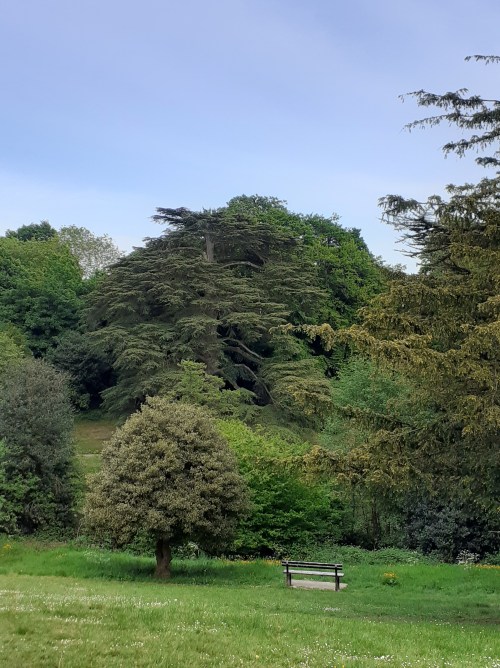
Everyone benefits from healthy spaces. Such spaces may be physical, social or spiritual. They can be all three at the same time. I am glad that here in England park benches, given adequate physical distancing between people, are no longer out of bounds.

Where I live, the early weeks of the late-arriving Covid-19 lockdown seemed to create a fragile nemeton, a collective healthy space in which to take stock amidst empty roads, reduced noise, fresher air and a more reflective existence, all set in a beautiful spring. The circumstances meant that this could not apply to everyone, as those of us enjoying these conditions well knew. But there seemed to be a moment where this sense of an altered space was sufficiently present for a critical mass of people. It was a sacred space, a good space for the blossoming of generosity and compassion. Clapping for health and other key workers has been its brief weekly ritual. An atmosphere of community solidarity in the face of crisis and suffering was tentatively enabled.

The purity of the nemeton period did not last long. Aspects of it have been eroding for a while. But I notice that my personal Druid practice has been subtly influenced it, in a good way, at a time when I have also been considering my own vulnerability and mortality and that of loved ones. I seem to have made a hard-to-describe gain in depth and resiliency.

Although my ‘wheel of the year’ focus for the year from 21 December 2019 is proving very different from my original expectations, I have received an unlooked-for gift. I sense that I am not alone in this, and my hope is that positive influences from the lockdown experience will seed inspirational developments, personal and collective, over time. The human and social costs of the virus continue to be very high due both to the illness and its political mismanagement. Let them at least be honoured through commitments to fostering healthier and more creative ways of being in the future.


SPRING ABUNDANCE AND PUBLIC HEALTH

April growth, when it gets going, is abundant and exuberant. When the days are clear and warm and anticipate summer, I feel a surge of celebration. We are, at last, moving in the direction of Beltane and the merry month.

Since I last wrote, I have recovered my pleasure in outdoor walking. My body’s wish to be outdoors and moving, enjoying the gifts of the season, is stronger than any doubt or anxiety. My pleasure in taking pictures, for the last six months integral to my walks, is part of this. I am glad that my essential phone incorporates a conceivably non-essential camera.

I took the picture above specifically because it shows the lovingly cultivated flower bed in my local public park. This flower bed, and the park itself, exist to be seen and enjoyed, without any entrance charge, by anyone who wants to be there. They are examples of a highly pro-social resource. As we move towards an uncertain future, I hope that we continue to value such spaces, and take collective care to preserve them.

This morning, looking at the news, I see my view supported affirmed by current research. “Meredith Williams, a postdoctoral fellow at the London School of Economics’s school of geography and environment, said access to green space was vital to public health. ‘Even before the pandemic, there was an increasing focus on research on the physical and mental benefits of green space. Having access to nature gives us a sense of calmness and tranquillity … that helps with reducing the stress that comes especially from urban living'” (1). The context is rumours of enhanced lockdown in London’s parks, where the residents of poorer boroughs have less access both to private gardens and public parks, putting more pressure on the public spaces that do exist.

Yesterday I found Stratford Park in Stroud almost deserted, its carefully tended flower beds unobserved and unenjoyed. For me, publishing this picture honours the work of its gardeners. Their creativity deserves to be recorded and shared, both for what it is, and what he stands for, as the wheel of 2020 continues to turn.

(1) Guardian 11 April 2020 Coronavirus park closures hit BAME and poor Londoners most

WELL-BEING: CONTEMPLATING ACTION

“In The Spirit Level Richard Wilkinson and Kate Pickett put inequality at the centre of public debate by showing conclusively that less equal societies fare worse than more equal ones across everything from education to life expectancy. The Inner Level explains how inequality affects us individually, how it alters how we think, feel and behave. It sets out the overwhelming evidence that material inequities have powerful psychological effects: when the gap between rich and poor increases, so does the tendency to define and value ourselves and others in terms of superiority and inferiority. A deep well of data and analysis is drawn upon to empirically show, for example, that low social status is associated with elevated levels of stress hormones, and how rates of anxiety and depression are intimately related to the inequality which make that status paramount.” (1)

What links contemplation and action? My answer is creative and powerful ideas. In a recent post (2), I cited Brendan Myers (3) proposition that a flourishing life is ethically desirable and good (a powerful, creative idea), and that it depends on us supporting each other’s well-being and that of the biosphere and the Earth itself (another powerful creative idea). The Spirit Level and The Inner Level concern ‘developed’ countries in the 21st century and to an extent the last two decades of the 20th. They paint a depressing picture, especially for the U.K. and the U.S.A, and for me it shows the need to champion a social ecology that supports health and well-being.

For some years I worked at the interface between public health (i.e. population-based health, largely concerned with prevention work and the creation of more supportive environments) and mental health. So, I am interested in the recent publication of The Inner Level (4) and may write further about it. Thinking about ‘health’ in the bigger picture (with service provision as only one aspect) is a positive way into social justice work, where powerful ideas can (in principle) be realised through ethical passion and political will informed by scientific evidence. It is a notion of how to do public policy that needs to be kept alive.

I know this doesn’t happen much, now, in a culture like ours with high levels of bullying, confusion, distraction and misinformation. We seem to be living with an orchestrated dumbing down of political discourse in the service of oligarchic interests. So, my first action – not always recognised as action – is personal resistance to any onset of cynicism, numbness and despair within myself. My second action – also not always recognised as action – is to work at maintaining an adequate level of knowledge and understanding of what is happening in the world, using the lens of ‘powerful ideas’ to make sense of the information I digest. This includes having an historical perspective – both backwards and forwards – on current events. My third action is to place myself within networks that share my concerns and are responding to them in diverse ways – hopefully modelling cultures of: compassion (including ruthless compassion); openness and creativity; curiosity about the world; and criticality (deconstructive where necessary and appreciative where possible) in the realm of ideas and action. Further developments will come from there, and I will write about them within this blog.

Over time my contemplative life has moved towards a blend of energy work and meditative connection to source, with the practice forms kept simple. It is also the clear, awake space out of which I act in the world.

(1) https://www.equalitytrust.uk/

(2) https://contemplativeinquiry.wordpress.com/2018/07/02/ethics-and-civilization/

(3) Brendan Myers Reclaiming Civilization: A Case for Optimism for the Future of Humanity Winchester, UK & Washington, USA: Moon Books, 2017

(4) Richard Wilkinson and Kate Pickett The Inner Level: How More Equal Societies Reduce Stress, Restore Sanity and Improve Everyone’s Well-being

Earth Eclectic

music that celebrates Earth and speaks to the heart

Sarah Fuhro Star-Flower Alchemy

Follow the Moon's Cycle

Muddy Feet

Meeting nature on nature's terms

Rosher.Net

A little bit of Mark Rosher in South Gloucestershire, England

Becoming Part of the Land

A monastic polytheist's and animist’s journal

selkiewife

Selkie Writing…

Charlotte Rodgers

Images and words set against a backdrop of outsider art.

Prof Jem Bendell

living with metacrisis and collapse

Towint

The pagan path. The Old Ways In New Times

The Druids Garden

Spiritual journeys in tending the living earth, permaculture, and nature-inspired arts

The Blog of Baphomet

a magickal dialogue between nature and culture

This Simple Life

The gentle art of living with less

Musings of a Scottish Hearth Druid and Heathen

Thoughts about living, loving and worshiping as an autistic Hearth Druid and Heathen. One woman's journey.

Wheel of the Year Blog

An place to read and share stories about the celtic seasonal festivals

Walking the Druid Path

Just another WordPress.com site

anima monday

Exploring our connection to the wider world

Grounded Space Focusing

Become more grounded and spacious with yourself and others, through your own body’s wisdom

The Earthbound Report

Good lives on our one planet

Hopeless Vendetta

News for the residents of Hopeless, Maine