Contemplative Inquiry

This blog is about contemplative inquiry

Tag: Presence

A MOMENT OF GENTLE RAIN

Saturday morning, 8 July. Gloucester, England. I am warm. I am indoors. I am contentedly lethargic. My gaze turns to a balcony door.

I contemplate Elaine’s balcony garden. The flowers are less dramatic than during the solstice period. Their colours are softer. I see more green. I see raindrops on the other side of the door. They are evidence of a gentle rain falling on this tiny garden.

“I am the movement of the breath and stillness in the breath”, I say in my Druid contemplative liturgy. “Living presence in a field of living presence: here, now and home”. This can be true at any time, but some conditions are more helpful than others. Here and now, I become alive to the balcony garden, fully present. Knowing Elaine as creator of this garden extends my sense of connection. A simple nourishing moment.

Hours later, with a flash and a crash, the heavens opened and my world changed, heralding a new kind of experience.

Raindrops on glass,

Flowers in their pots.

Calm before the storm.

‘SOLITUDE: SEEKING WISDOM IN EXTREMES’: SHAPING THE STORY

This post is a continuation of the last (1). During his experimental year of radical wilderness solitude in Patagonia, Robert Kull maintained a journal. The complete journal was 900 pages long, and he had not only to review it but also to write an edited version. Both the original writing and the editing involved a careful process of selection. Even the original entries told only “one among many possible tales”. Kull says: “I have, though, both in the original journal entries and in the editing process, tried to tell my truth as I lived it”. He is very conscious of the way in which “the magic of words”, and cultural expectations about narratives, including the motif of the ‘hero’s journey’, can come between the experience and the record. These considerations influence what he brings back from his year, and what we can learn from it. I feel moved by, and respectful of, the way he works through these concerns.

“In the journal, a saga of physical adventure and spiritual transformation runs parallel to and weaves through the drifting account of daily life – the autobiographical quest of the hero. This is a recognized, even expected, storytelling mode for someone spending a year alone in the wilderness, and I could have enhanced the heroic saga during editing. But instead I’ve allowed that tidy narrative to remain interrupted over and over by the unruly wildness of the ‘hero’s’ soul.

“In the messier story, the hero’s cultural ideals of personal success, social progress, and free will are questioned in view of the cyclic storms of depression, rage, fear, and doubt about his place in society and a felt lack of spiritual development. Despite differences in theology, moral orientation and self-discipline, the man in that pedestrian tale may have more in common with St. Augustine and his surrender of personal agency to Divine Will than with the stereotypical self-oriented striving of modern culture’s secular hero.

“My goal in the wilderness was not to conquer either the external world or my own inner nature, but to give up the illusion of ownership and control and to experience myself as part of the ebb and flow of something greater than the individual ego. But the goal of attaining enlightenment was elusive – except when it was not. Through a shift in consciousness, my quest came to an end as I realized there was nowhere to go and nothing to get. The notion of a holy grail out there – or even within – was illusory, and what I was seeking I always already had: I was not a special hero, but simply a speck of life like all other specks – unless I was not. Personal agency always reasserted itself, and these two aspects of my being struggled and then tentatively began to dance together.

“Stories of spiritual seekers or solitaries in the wilderness are often portrayals of heroic adventure. It’s difficult not to slip into this mode, but I’ve tried. We already have enough of such writing, and in its most blatant form it’s little better than checkout-counter publications flaunting the amazing lives of superhuman ‘stars’. When I read such stories and compare them to my own actual life, I feel diminished. ‘That’s not how my life is. What’s wrong with me?’ I’m also pulled out of my own life and into vicariously living the imaginary life of another. What I offer instead is a more human account so perhaps we can wander the spaces and silences of wilderness solitude together.” (1)

(1) https://contemplativeinquiry.blog/2023/05/23/radical-wilderness-solitude-an-experiment/

(2) Robert Kull Solitude: Seeking Wisdom in Extremes – A Year Alone in the Patagonian Wilderness Novato, CA: New World Library, 2008

RADICAL WILDERNESS SOLITUDE: AN EXPERIMENT

‘Perhaps the most useful aspect of my year alone in the wilderness was to come to accept that my inner world has its own inherent weather patterns, as does the external world. The recognition that I’m not in control and that grey days do not mean I’ve done something wrong, That all the ups and downs, lights and darks, are part of who I am; who we are’ (1).

This post is a second story from Stephen Batchelor’s The Art of Solitude (1,2) – this time not about him. On 5 February 2001, Robert Kull, then aged 54, spent a year alone on a remote island off the southern coast of Patagonia. The nearest humans were at Puerto Natales, sixty miles away across impassible mountains and fjords. No boats ever passed by. Kull wanted to explore extended solitude as a self-challenging inquiry. He had already experienced three months of solitude in northern BC, Canada, which he found strange, powerful and ‘potentially frightening’ especially ‘without other people to help me maintain my identity’. This had led to a breakdown, as the ‘facade of autonomous self-sufficiency started to crumble’, and then to a breakthrough – an ecstatic experience of mystical union with nature that lasted several weeks.

Wishing for a truly radical solitude off the Patagonian coast, Kull even questioned his own journal writing on the grounds that ‘daily writing feels like breaking solitude’, since ‘as soon as the solitary begins to speak, even if by writing to an imagined reader, he (or she) is no longer truly alone’. For when he writes, or thinks about writing, ‘I’m not really here in solitude, but in an imaginary future where someone else is reading my descriptions’. But he also finds that when he considers not writing, ‘I’m hit with a wave of isolation and loneliness’. Self-compassionately, and out of loyalty to his project, he continues with his journal.

In the early weeks Kull is busy with the construction and maintenance of his cabin (built of material brought with him on a Chilean Navy ship). He is also equipped with a wind generator, solar panels, a wood-burning stove, and a small boat with outboard motors. He has concerns about fresh water, firewood, blackflies and shoulder pains. Once set up, he records his observations of condors, eagles, ducks, dolphins, seals and limpets. He fishes, he reads, and he writes about the books he is reading. He settles into a routine of meditation, philosophical introspection, writing poems, and taking photographs.

Batchelor does not mention that Kull’s sojourn was tied in to a PhD. project for The University of British Columbia at Royal Roads, Vancouver Island. Kull’s research question was: What are the physical, emotional, psychological and spiritual effects of deep wilderness solitude? (3) Kull summarises his methodology: “I develop an innovative methodology of vigilant mindfulness combined with radically honest journal keeping and narrative writing to examine and document my own lived experience in solitude. I extend interdisciplinarity and integrate spiritual practice with academic study, and I share my work with the non-academic community”. This seems to me an important piece of context, which makes the project clearly pre-meditated and planned with a community of peers and an accountability to them. It holds the individual quest within a collective endeavour and, in my view, adds to its meaning.

Unsurprisingly, Kull shows dedication, deep thought and meticulous planning in organising his experiment. He shows courage, honesty and rigour in carrying it out. He finds, and reports, that he does not repeat an earlier ‘enlightenment’ experience. Complex subjective experience is simply too tricky in that respect. It is to Kull’s credit that he can accept a new and different outcome. One lesson I draw from his experiment is that solitude cannot be absolute. It is always relative, always negotiated, and will involve different costs and outcomes depending on who is being solitary and what their arrangements are. Kull’s was a well-resourced collective project, though it may not always have felt like it alone on the island.

I will return to Robert Kull’s wilderness solitude project when I have read his own book. I am grateful to him for putting himself on the line in this remarkable experiment. His willingness to share his personal experience in the setting of an academic project, and to explore the issues that it raises, is a gift to us all.

(1) Stephen Batchelor The Art of Solitude: A Meditation on Being Alone with Others in This World New Haven, CT & London, England: Yale University Press, 2020

(2) See also: https://contemplativeinquiry.blog/2023/05/05/

(3) https://bobkull.org/ Robert Kull’s book for the public, Solitude, Seeking Wisdom in Extremes – A Year Alone in the Patagonia Wilderness, is referenced on this site, with a link to Amazon. See also: https://contemplativeinquiry.blog/2023/05/26/

* Often transliterated as Chuang Tzu

CONTEMPLATION AS SERVICE

“They also serve who only stand and waite” (1) wrote the naturally activist poet John Milton. He was coming to terms with his loss of sight and significant worldly defeat. For him, waiting means waiting upon God, as a servant, rather than waiting for an appointment, waiting for salvation, or stuck in the wounded forever-waiting enacted in Samuel Beckett’s play Waiting for Godot. For Milton, waiting, being available, is a form of engagement and of service.

Contemplative living can be understood as service, even without Milton’s theology or master-servant relationship with the Divine. For contemplative life is more than ‘just being’. It asks us to stay present in the activities of daily life and and in our interactions with others. When present, ideally, we bring spacious stillness into the world. With consciousness comes quality. Every task is sacred. Every event is full of meaning. When we are alive to the experience we are having, we feel our oneness with the whole and the Source. Then we can “affect the world much more deeply than is visible on the surface” of our lives (2).

(1) John Milton When I Consider How My Light Is Spent In Delphi Complete Works of John Milton Delphi Classics, 2012 (e-book)

(2) Eckhart Tolle A New Earth: Create Your Better Life Today London: Penguin Books, 2016 (First Edition 2005). My second paragraph above draws on this source whilst somewhat modifying the message.

EMERSON: ‘IMMORTAL BEAUTY’

“Crossing a bare common, in snow puddles, at twilight, under a clouded sky, without having in my thoughts any occurrence of special good fortune, I have enjoyed a perfect exhilaration. I am glad to the brink of fear. In the woods too, a man casts off his years, as the snake his slough, and at what period soever of life, is always a child. In the woods, is perpetual youth.

“Within these plantations of God, a decorum and sanctity reign, a perennial festival is dressed, and the guest sees not how he should tire of them in a thousand years. In the woods, we return to reason and faith. There I feel that nothing can befall me in life, – no disgrace, no calamity, (leaving me my eyes), which nature cannot repair.

“Standing on the bare ground, – my head bathed by the blithe air, and uplifted into infinite space, – all mean egotism vanishes. I become a transparent eye-ball; I am nothing; I see all; the currents of the Universal Being circulate through me; I am a part or particle of God. The name of the nearest friend sounds then foreign and accidental: to be brothers, to be acquaintances, – master or servant, is then a trifle and a disturbance. I am the lover of an uncontained and immortal beauty.” (1)

In the first paragraph above, I hear my own experience, described in a mid 19th century American voice. I share the sense that the exhilaration comes partly from the land, woods and sky themselves and partly from the continuing life of the child within us.

In the second paragraph, I feel at home with with the overall sentiment, whilst having to work a little with Emerson’s terminology. At the beginning I am not sure what he means by ‘God’. I do understand that ‘plantations of God’ restores innocence, as well as wildness, to the term ‘plantation’. (Emerson was a notable abolitionist.) I also note that the woods are a domain where reason and faith are brought together, in a time and culture where they seemed to be in conflict. Nature isn’t just a word for material reality. Nature is a source of protection and healing that goes beyond the mundane.

The third paragraph makes Emerson’s transcendentalism clear, and with it the true power of contemplation. ‘Standing on the bare ground … uplifted into infinite space – all mean egotism vanishes. I become a transparent eyeball. I am nothing: I see all”. God and Nature become Universal Being, from which ‘I’ am not separate. To be simply present in this space, with no agenda and nothing in mind, is to be “the lover … of an uncontained and immortal beauty”. The nature of our experience is a living nature we perceive, are part of, and relate to – not a reified externality. An open, enlivened receptivity to this reality can allow a deeper awareness (for Emerson, that of the Divine in us) to declare its presence.

(1) Ralph Waldo Emerson Nature Boston, Mass: Thurston, Torry and Company, 1849

NOTE: According to Wikipedia, Ralph Waldo Emerson (1803-82) “was an American essayist, lecturer, philosopher, abolitionist and poet who led the transcendentalist movement of the mid-19th century” who gradually moved away from the religious and social beliefs of his contemporaries, formulating and expressing the philosophy of transcendentalism in his 1836 essay Nature”. He wrote most of his important essays as lectures first and then revised them for print. “Emerson’s ‘nature’ was more philosophical than naturalistic. … Emerson is one of several figures who took a more pantheist or pandeist approach by rejecting the view of God as separate from the world”.

ALERT REST IN THE LIGHT OF EARLY SPRING

Crocuses are appearing, harbingers of spring. In the middle of the day, I feel the power of the sun. In my own life, I am getting used to a smaller and lighter living space. The work of moving is almost done. I shed calculation and care, making room for curiosity and glee.

Some of this is visual. I track changes in daylight from misty early morning to strong sunlight and vivid blue sky at noon. Subtle shifts moment to moment lead to big changes over the hours.

A personal mood of renewal fits the change of season, now that we are clearly in a rising year. The difference is that I am allowing myself to experience a tiredness that I had not fully acknowledged when our moving process was at its height. I am also aware that there are still things to be done. I am not fully in a get-up-and-go frame of being. What I need most, right now, is an alert kind of rest.

I have a sense of coming to a place, and settling, and embracing the experience I am offered here. I’ve been working to refine my personal understanding of Eckhart Tolle’s use of ‘Presence’. For me, it seems to combine an immersion in the flow of experience and a communion with it. Not only bare awareness but also relationship. Being alive in a living cosmos. Opening up to gratitude and love.

This is a key aspect of my contemplative inquiry within the modern Druid tradition, though the experience pointed to is universal. Uncovering what is hidden in plain sight by polishing the lenses of perception. An alert kind of rest.

THE VIEW FROM HOME

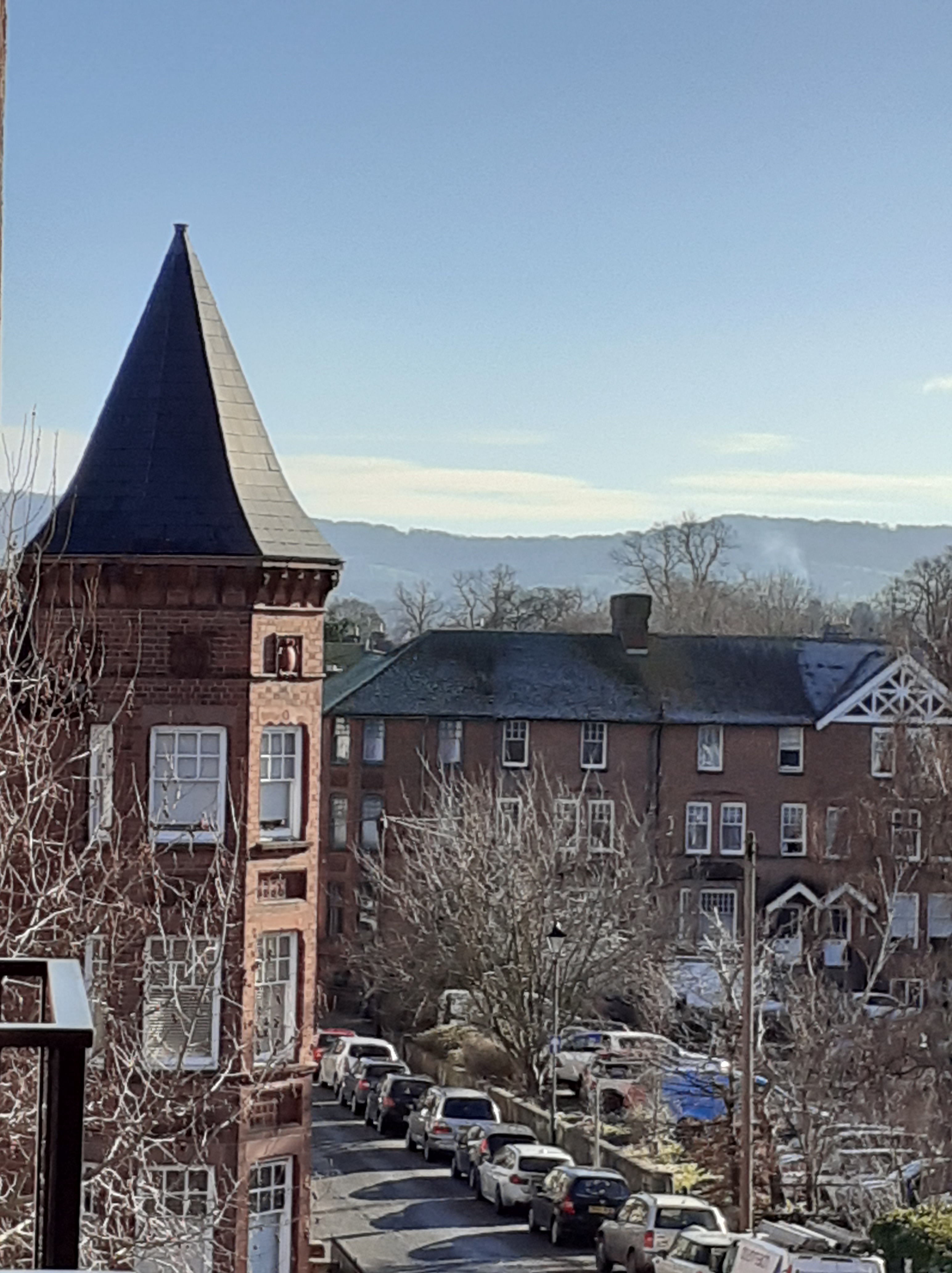
This, now, is our view from home. It helped to sell a compact apartment to us. It is a place of light and sunshine for much of the time, and allows us to see beyond the perimeters of our small historic city. Looking out, I see an expanse of energised space, providing room for the fecundity of nature. A wonderful gift for an old Druid.

Tilting my gaze a little downwards, I have more sense of our neighbourhood and the inevitable presence of cars. There was once an elegant square here, now somewhat sacrificed for a modest amount of parking space. But I do like the sense of an outlook on everyday life. I don’t want to be cut off from it. I’m glad that it’s there.

Elaine and I have not fully moved in as yet. This is a transitional moment. There’s still much work to be done. But there seems to be a shift in gravity now, and the promise of a benign base. As I se it, human flourishing enables the spiritual path too. It supports our capacity to be present in and to the web of life. At times in the journey, deprivation may need to be faced. But it is not a virtue, and in this moment I am glad of a space where the heart can easily open. Feeling gratitude, I wonder how this adventure will unfold.

MIDWINTER CONTEMPLATION 2022

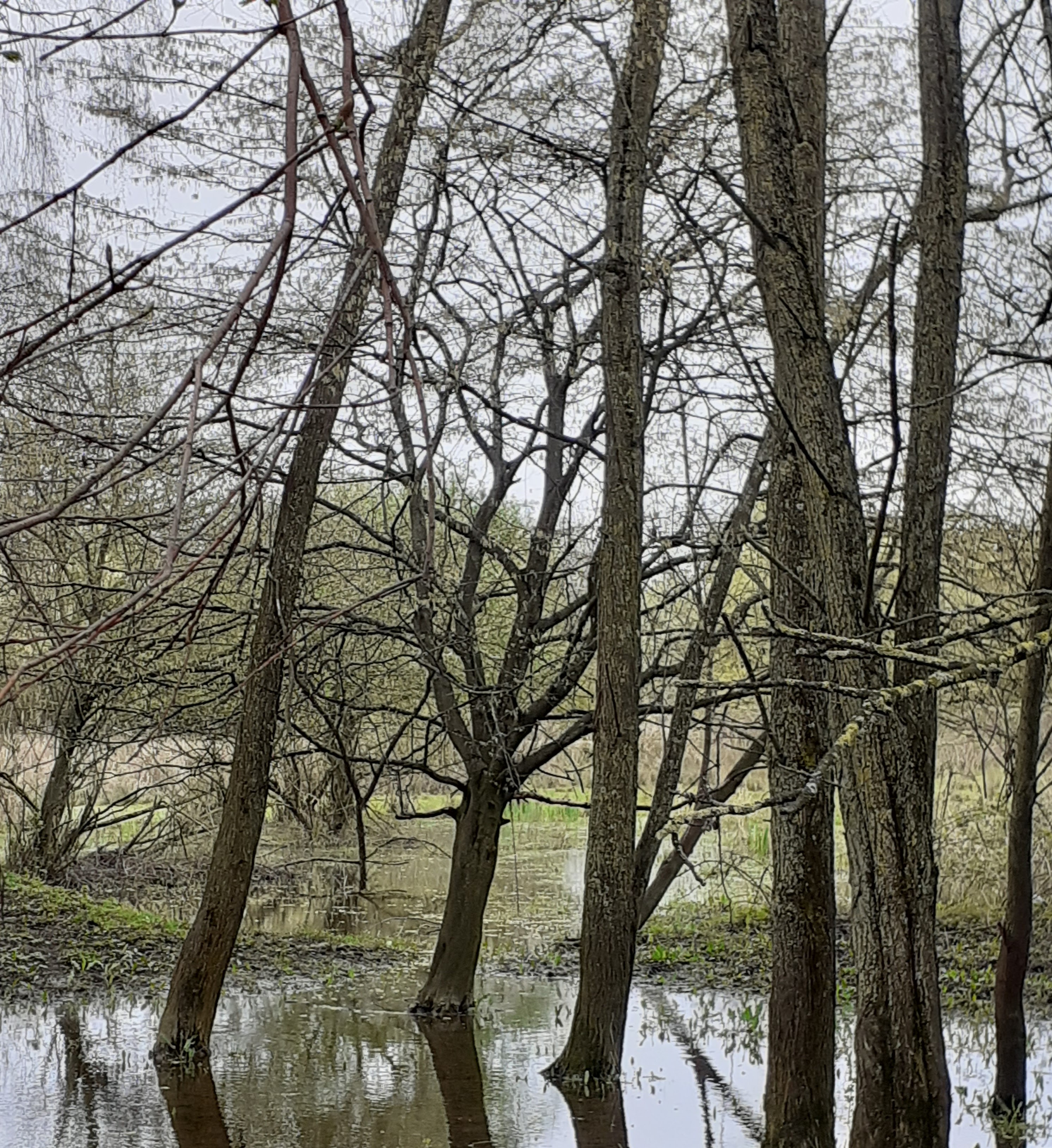
The picture above, taken in the mid-afternoon of the recent Winter Solstice, shows a local water meadow after heavy rain. My eyes are drawn downwards, to the reflections in the water and beyond. But height is there too, with trees and an early sunset sky. All with a sense of stillness. I felt in touch with the unknown within and beyond me, and open to the world.

Earlier in the day I had already been profoundly moved by the live-streamed funeral of John Heron, an elder for me in the field of humanistic and transpersonal psychology, and also in what he called ‘participatory spirituality’. This describes a ‘spiritual animation’ that occurs ‘between people, between people and place and other kinds of beings in place’. He saw this as a spiritual inquiry process, largely outside the traditions.

Over the last several days, I have been contemplating words, not by John himself but by Carl Rogers, the originator of person-centred counselling, about this kind of openness and its power. He wrote them in continuous prose, but I have re-arranged the spacing to help with my contemplative process. I find that they help me to better understand both my failures and my successes. They are a kind of direction for me. Although they are about being with people, they have become linked also with this landscape, because of the openness I felt there, in this liminal space.

“I find that

when I am closest to my intuitive self

when I am somehow in touch with the unknown in me

then whatever I do seems full of healing.

Then simply my presence is releasing and helpful to the other.

When I can be relaxed and close

to the transcendental core of me

it seems that my inner spirit has

reached out

and touched

the inner spirit

of the other.

Our relationship transcends itself

and becomes a part of something larger.”

THE ALBION SAILS ON COURSE (NOVEMBER 2016)

“The Albion sails on course. Black script on white wall. The spill-zone around Corbridge Crescent, the painted devil heads and hybrid monsters, the bare-breasted pin-ups from naughtier times mouthing Situationist slogans, are captured and made fit for purpose by film crews and television set-dressers, lighting technicians and catering caravans, responding to dissent as exploitable edge.

“LOADED WITH/ MEMORIES/ I WAS NOT AFRAID/TO SET OFF/ AN ADVENTURE/ ANY MORE.

“14 November 2016: the words I copied into my notebook yesterday are painted over with white undercoat, so that professionals can create rebellion suitable for television. For example, a Worholist head of Che Guevara – CHE GAY – inflated to cover an entire wall, with fake yelps about eating the rich to replace the groundwork of RIP and the Secret Society of Super Villains and Artists. NO PIGS ….

“The outlaw in his shack on the ledge by the canal sleeps through the entire fuss. He learnt his lesson after the first Immigration Enforcement raid. Now his shelter looks like the detritus of a lumberyard. ….

“A young boy cycles uncertainly to school, in the wake of his mother, wearing a silver skull mask. Welcome to the comic world, Hackney. At the base of the image swamp we find the sinister clown: child-catcher, grinning molester. The public joke, the big-haired politician who dissolves into the Joker of DC Comics.

“Extinguish fire with petrol. One of the latest Andrews Road defacements is a poster: SILENT BILL MUSE WANTED. Silence against the noise of imagery? The meditation of a hooded man sitting all day on a bench? Or another who dreams the fading city through all the hours in an Arsenal-branded sleeping bag? ‘Be silent in that solitude,’ said Edgar Allan Poe. ‘Let them come. The restless spirits of the dead are in death around thee’.” (1)

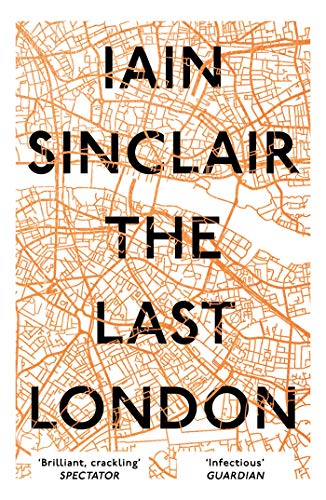
Iain Sinclair has a reputation as a leading figure in the practice of psychogeography, though he has now somewhat distanced himself from the word itself. He is quoted as saying (2) that “I buy into a union of writing and walking” and identifying with “the kind of writers who very definitely have, within their writing, this rhythm of journeys and walks and pilgrimages and quests”.

Sinclair’s work often celebrates London’s neglected and overlooked spaces, and draws on a visionary tradition of London writers from William Blake to Arthur Machen as well as the French situationists who developed psychogeography as a concept. His early reputation rests on the prose poem Lud Heat (1975) which was also influenced by Alfred Watkins and the earth mysteries school that followed in his wake. This work describes lines of force between Hawksmoor’s London churches to reveal the hidden relationship between the city’s financial, political and religious institutions. Peter Ackroyd drew on these themes for his later Hawksmoor (1985).

Last London (2017) is grittier and more concerned with a November 2016 witnessing of social breakdown in Hackney, a London borough that is being simultaneously gentrified. In the UK, it is also the year of the Brexit referendum (the Albion sails on course?) and in the US the month, November, of Donald Trump’s election as president (“at the base of the image swamp we find the sinister clown”).

Why am I drawn to this work? I lived in London for 17 years, from the late 1970s to the mid 1990s: there’s an element of nostalgia, and also of grief. Beyond that, my contemplative inquiry has led me in recent years to a practice of walking and writing. Are there lessons for me in Sinclair’s tradition?

My contemplative inquiry is not just about resting in the eternal moment – it also concerns life in place, time and culture. I’ve always liked walking meditation, mobile and open-eyed. Ideally, the still point and the moving line are both present, together as one. Often I stumble around between them, but that’s part of the journey: learning to be present in a field of living presence. I have a lot to learn.

(1) Iain Sinclair The Last London: True Fictions from an Unreal City London: OneWorld Publications, 2017

(2) Merlin Coverley Psychogeography Harpenden: Oldcastle Books Ltd, 2018 (first edition 2006) In his last chapter, Psychogeography Today, the author devotes a section to Iain Sinclair and the Re-branding of Psychogeography.

LIFE-FORCE: A TAOIST UNDERSTANDING

“Three subtle energy currents:

Twin helixes around a jade pillar.

This glowing presence

Is the force of life itself.

“Deep in meditation, it is possible to become aware of the life-force itself. You can see it if you learn to look within. To describe it as electricity, or power, or light, or consciousness is all somewhat correct. But such descriptions are inadequate. You have to see it for yourself. You have to feel it for itself. You have to know it for yourself.

“To be in its presence is to be in something primeval, basic, mysterious, shamanistic and profound. To be in its presences makes all references mute and all senses slack, leaving only deep awe. One is drawn to it in utter fascination. It is the mighty flame to our mothlike consciousness.

“This column of energy that coils around itself holds all the stages of our growth. It is our soul; it is the force that animates us and gives us awareness. If you want to engage your life completely, it is essential for you to come to terms with this inner power. Once you harmonize with it you can blend with the dynamics of being human.”

Deng Ming-Tao 365 Tao: Daily Meditations New York, NY: HarperOne, 1992

Earth Eclectic

music that celebrates Earth and speaks to the heart

Sarah Fuhro Star-Flower Alchemy

Follow the Moon's Cycle

Muddy Feet

Meeting nature on nature's terms

Rosher.Net

A little bit of Mark Rosher in South Gloucestershire, England

Becoming Part of the Land

A monastic polytheist's and animist’s journal

selkiewife

Selkie Writing…

Charlotte Rodgers

Images and words set against a backdrop of outsider art.

Prof Jem Bendell

living with metacrisis and collapse

Towint

The pagan path. The Old Ways In New Times

The Druids Garden

Spiritual journeys in tending the living earth, permaculture, and nature-inspired arts

The Blog of Baphomet

a magickal dialogue between nature and culture

This Simple Life

The gentle art of living with less

Musings of a Scottish Hearth Druid and Heathen

Thoughts about living, loving and worshiping as an autistic Hearth Druid and Heathen. One woman's journey.

Wheel of the Year Blog

An place to read and share stories about the celtic seasonal festivals

Walking the Druid Path

Just another WordPress.com site

anima monday

Exploring our connection to the wider world

Grounded Space Focusing

Become more grounded and spacious with yourself and others, through your own body’s wisdom

The Earthbound Report

Good lives on our one planet

Hopeless Vendetta

News for the residents of Hopeless, Maine