Contemplative Inquiry

This blog is about contemplative inquiry

Tag: prayer

EARLY SPRING: AFFIRMING LIFE

I am connecting with spring and its urgent affirmation of life – its green shine and fecundity. It is the sunrise season, the season of early growth. For me, where I live, the immediate pre-equinox period often generates a strong feeling of dynamism and emergent potential. I am in sync with the awakening earth.

Elaine’s return from hospital and the enhanced clinical support she is receiving are helping me to live this season more fully. In our joint lives we are both feeling more agency in shaping a new phase in our life together.

In this moment I feel refreshed and optimistic within my Druid contemplative path. I have adjusted my formal practice so that I have two practice sessions in the day, both of them roughly twenty minutes long. The first, at the beginning of the day and standing, is affirmative and dynamic. It includes body and energy work and a theme of healing and rejuvenation. The second, at the end of the day and sitting, is contemplative. It includes breathwork, a mantra meditation using beads, and prayer. In the modern Druid manner it includes a commitment to the collectively imperilled qualities of love, peace and justice. This shift is having a renewing and reinvigorating effect on me, as befits the season: another way of gratefully affirming the gift of a human life.

THE WAY OF THE HEART

Sufism is often referred to as the Way of the Heart. Hazrat Inayat Khan was a Sufi teacher and musician from Gujarat, India, who took his teaching to the West in the early 20th century. His combination of spiritual teaching, philosophy and music was normal in this culture and tradition. In his own life and work, Hazrat Inayat Khan created a Universal Sufi movement independent of its Islamic origins, though always inspired by them. Practitioners from his movement created the Dances for Universal Peace.

The image above is the Ace of Cups from Ayeda Husain’s The Sufi Tarot (1). Ayeda Hussain is a teacher in the Ineyatiyya, a global organisation dedicated to Universal Sufism as taught by Hazrat Inayat Khan. She sees Sufism and Tarot as two systems of healing and transformation that can be valuably brought together. She treats Tarot as a vehicle for spiritual teaching, going so far as to include contemplations and affirmations for each card.

Referring to her Ace of Cups, she says: ‘In Sufi poetry, the cup is the heart that must be emptied before the beloved can pour the Divine nectar into it. Just as a cup that is filled cannot be poured into, neither can a heart filled with limiting impressions. The work of the mystic then, is to clear impressions that clutter and cloud the heart, so that it may be able to receive. As the heart opens, we become aware of new offers and opportunities in both love and spiritual growth’.

I came to The Sufi Tarot by an indirect route. When I began working with my Ceile De (2) beads, I didn’t at first expect to use them for mantra meditation and I looked at a collection of fuinn (sacred chants) as an option for working with the beads. Fuinn tend to be brief and I thought that a single fonn might work for me. They are in Scottish Gaelic and frequently use heart language, as in:

Gun tigeadh, solas nan solas

(Goon tee-guch, sol-us nan sol-us)

Air mo chridhe

(Air mo chree)

This translates into English as Come light of lights, to my heart.

I found this fonn beautiful though somehow not right for my purpose. But the phrase air mo chridhe would not leave me. As soon as I heard it, in the old language, it needed no translation, and I felt I had known it forever.

What I did in my own practice, having decided on the Soham mantra for the beads, was to create a version of the modern Druid peace prayer as a love prayer.

Deep within my innermost being, may I find love.

Silently in the stillness of this space, may I nurture love.

Heartfully, in the wider web of life, my I live in love.

Now using this prayer, I felt the desire for friendly guidance in this work of the heart. I felt prompted to search for ‘Sufi Tarot’, and was surprised when came up immediately. When I received the pack, I was quickly reassured that I had had been given what I asked for. I look forward to this new thread within my contemplative inquiry.

(1) Ayeda Husain The Sufi Tarot Carlsbad, CA; New York, NY; London; Sydney; New Delhi: Hay House, 2022. Art team Nazish Abbas, Hassaan Aftab, Momina Khan

(2) https://contemplativeinquiry.blog/2025/01/14

WORKING WITH BEADS

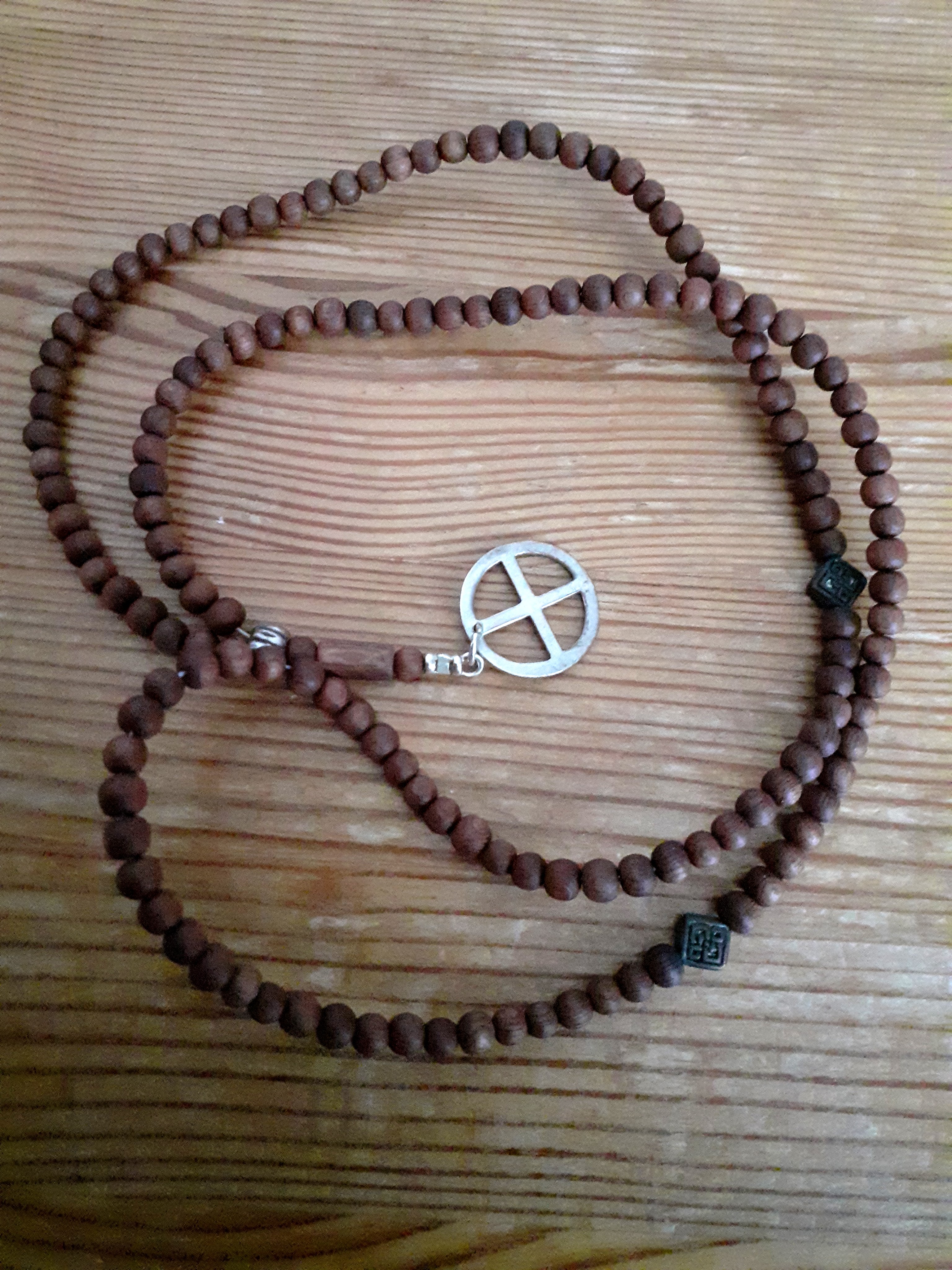
Recently I wrote about the balanced cross (1), linking it to the paidirean (pahj-urinn) prayer beads of the Ceile De (Culdees), a modern monastic order based in Scotland. This post is about the beads and my work with them. Beads like this were part of the original Ceile De tradition and are known to have been used in the days of Columcille (St. Columba).

There are 150 beads, each about 5 mm wide.  They are made of unstained rosewood and were left immersed in rose damask oil for a month.  As well as scenting the beads, the oil gives the beads a pinkish colour. A cross hangs from the beads – at heart level when worn as a necklace.

Each Paidirean is ceremonially strung in Scotland by a Ceile De Order member.  The process takes two hours and involves prayer, meditation and continuous chanting during the stringing.  Then a blessing is spoken over the completed Paidirean which is anointed with water and with oil from a local holy well, used for at least 1500 years. The Paidirean is an object of power as well as beauty. 

I am not a member of the Ceile De, and when I acquired the Paidirean they knew that I would work with the beads in my own way. I bring together meditation and prayer. I work with the Soham mantra, with Satish Kumar’s understanding (2) that it means ‘you are, therefore I AM’. Whilst I am mindful to my breath, to the mantra and to the movements of the beads, mindfulness is a means and not the purpose of the practice.

The purpose is to make an offering to Spirit – an offering from one lamp to the light, one wave to the ocean. After some hesitation and experiment, I have adopted the word Spirit, rather than Goddess or God, to address the Divine. It is more universal and inclusive as, for me, befits a panentheist view. In making my offering, I am aware that Soham also works laterally, including relations between all beings within the web of life, just as the Druid prayer speaks of  ‘the love of all existences’. Ultimately, we are recognising the divinity in each other.

Spirit is not beyond us in some other realm. It is here, now, and everywhere.  When I work with the beads, I am making both an offering and an affirmation.

(1) https://contemplativeinquiry.blog/2025/01/04/the-balanced-cross

(2) Satish Kumar You Are therefore I AM: A Declaration of Dependence Totnes: Green Books, 2002

PHILIP CARR-GOMM: PEACEMAKING

I was moved and inspired by Philip Carr-Gomm’s recent Peacemaking podcast on his Tea with a Druid. In the first five minutes he checks in with his live viewers, as is his custom, and finds a theme of anxiety and distress about world events. He speaks of the need for ‘islands of sanity’ – enclosures of calm and peace. He introduces the hope that the people gathered together by the podcast itself can become one. A guided meditation later in the podcast does the job. The gathering becomes an enclosure of calm and peace in real time. It still worked for me well after the event. Such is the magic of Druidry.

Before the meditation, Philip explains the role of Druids, ancient and modern, as peacemakers. The ancient Druids were exempted from military service and had a pan-Celtic authority. A Roman author depicts Druids as walking between warring tribes, urging calm and asking the fighters to put down their weapons: they were “shaming Mars before the Muses”. The God of war and destruction had to bow down before the Goddesses of creativity and inspiration. The Druids of that time were also lawmakers and judges. In Ireland, St. Patrick valued their Brehon Laws so highly that they were written down and continued in force. Peacemaking, peacekeeping and jurisprudence worked together.

In modern Druidry, Philip emphasises the attention given to peace in ritual, where the intention is to begin and end in peace both inward and outward. Our Druid prayer asks for justice, because where there is justice in the world there is also peace. Justice isn’t about killing. It’s about peace: right action, right speech, right thought, right behaviour. We trust the power of prayer and of consciousness directed by love. Sitting in meditation or prayer influences the people involved, and creates a field of consciousness and energy which acts as a patch of calm and peace in bad psychic weather.

I recommend readers to watch the video and, if you are willing, enter into its meditative space. I also include The Modron Prayer (Modron being the Ancient Mother) in this post, as a way of ending it:

“Deep within the still centre of our being,

May we find peace.

Silently, within the quiet of the Grove,

May we share peace.

Powerfully, within the greater circle of humankind,

May we radiate peace.

May peace prevail on Earth.

May it be so. May it be so. May it be so.”

SKY

“Isaac spent all his time reading in a dark house, refusing to go out into the sunshine. His next-door neighbor was a hidden spiritual master, who periodically dropped by to say to Isaac, ‘don’t spend your whole life hunched over your desk in this dark room. Get out and look at the sky!’ Isaac would nod and keep on reading. Then one day his house caught fire. Grabbing what possessions he could, he ran outside. There, he saw the master, pointing upwards. ‘Look,’ said the master, ‘Sky!’ In this story, there are three elements that represent the process of awakening: the fire, the master, and the sky. Kali is all of them.” (1)

(1) Sally Kempton Awakening to Kali: The Goddess of Radical Transformation Boulder, Colorado: Sounds True, 2014

Sally Kempton belongs to the tradition of Kashmir Shaivism, and has described her path as a contemplative and devotional Tantra. For this tradition, a subtle vibratory energy is the substratum of everything we know, and the expression of a divine feminine power called Shakti. This power has five faces – the power to be conscious, the power to feel ecstasy, the power of will or desire, the power to know, and the power to act.

All of these powers come together in the act of cosmic creation, when divine intelligence spins a universe out of itself in Shakti’s dance. Her powers are constantly at play in ourselves and the world, nudging us towards an evolution of consciousness, with which we must align when we seek conscious transformation. Shakti, the formless source of everything, takes multiple forms. Indeed the whole complex Indian pantheon, gods and goddesses alike, are forms of Shakti.

Sally Kempton says that anthropologists have identified two basic versions of Kali, specifically, in popular Indian religion. There is a forest and village Kali represented as scary and half-demonic, and the urban and more modern Kali Ma – “a benign and loving source of every kind of boon and blessing”. Here, her wildness is largely symbolic. Kempton’s Kali seems to be a challenging, ruthlessly compassionate teacher and guide.

In a recent post I wrote: “it is as if I am resourced by a timeless, unboundaried dimension from which I am not separate”. (2) It is my current experiential understanding of the spiritual approach knowns as ‘non-dualism’. Kashmiri Shaivites, Including Sally Kempton, are non-dualists. They are entirely at ease with deity devotion as part of the path.

I am wondering now if, and how, a greater element of deity oriented and devotional practice might add to my own path. Just over three years ago I let go of a ‘Way of Sophia’ thread, with some pain, because it no longer felt authentic. All that’s left is my address to the Goddess (Primal Cosmic Mother, Lady Wisdom) in the Druid’s prayer. Something is missing, I think, and I feel close to another shift. Frankly, I feel nudged.

(2) https://contemplativeinquiry.blog/2022/12/31/a-direction-for-2023/

BLUE SKY, CLIMATE CRISIS AND DRUID PRAYER

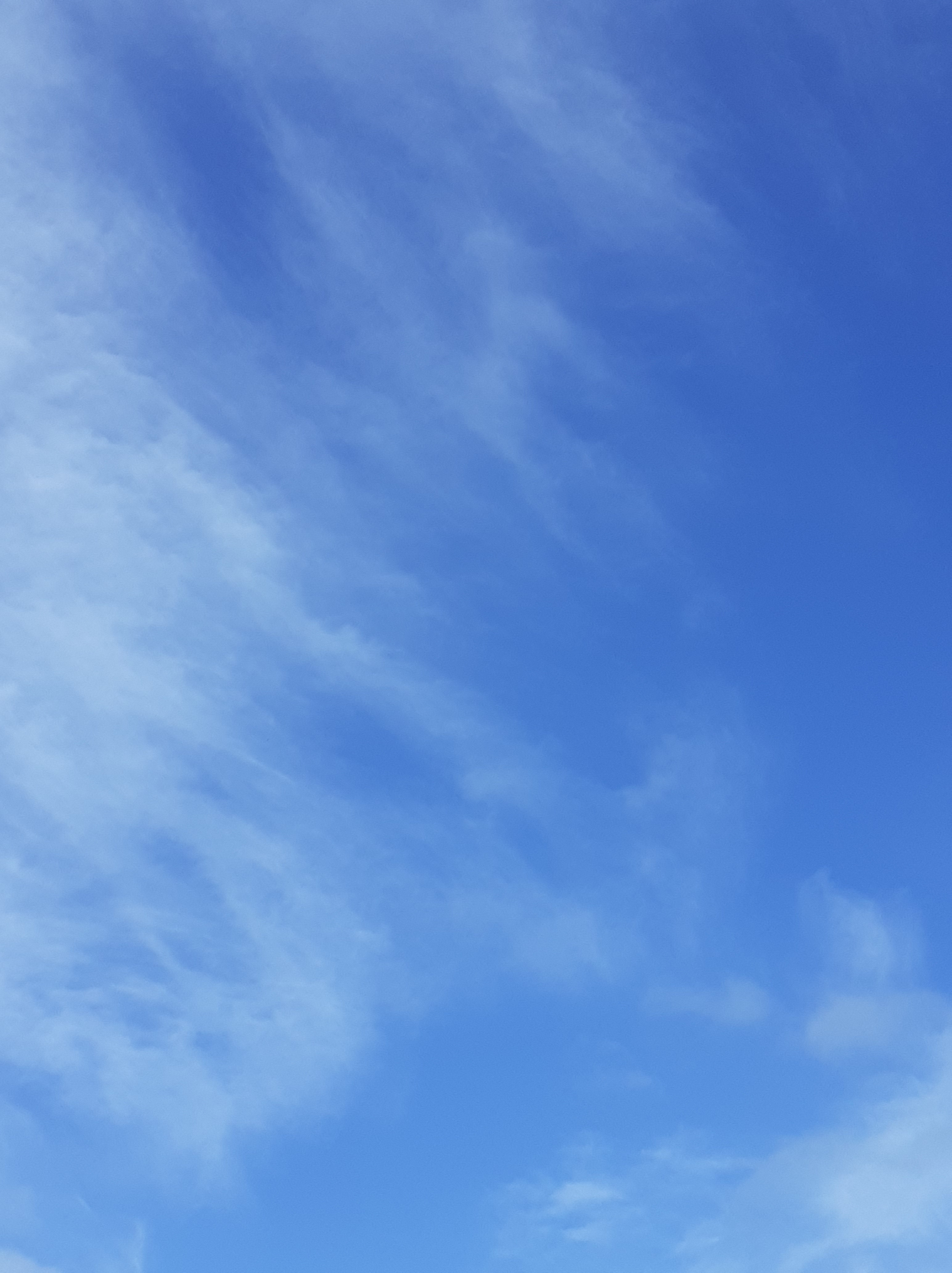
I love the sky in most weathers. I especially love it when it is azure blue and feels like a high domed roof, well able to contain the movement of wispy, shapeshifting clouds. The sky is part of nature, just like the earth. It is not a detached, alienated realm, beyond the influence of what some traditions might call our little life.

Sometimes I wish it was beyond our influence, as the news about the climate crisis goes on getting worse. The moment of joy is infused with a heartache that has every right to be there. It reminds me of our interconnectedness, and the Druid prayer for knowledge and love of justice, and, through that, the love of all existences (1).

I will stay open to my simple joy at inhabiting a living world of beauty and abundance, even if sadness keeps it company. The healing pleasure of sky-gazing is a part a long, common inheritance, not to be repressed, numbed or lost. I will continue to invite it in and let it nourish me.

(1) One modest practical way to enact the love of justice and of all existences, beyond lifestyle adjustments, is to support https://www.stopecocide.earth/ – now gaining momentum.

SLOW HEALING BREATH: CHANTING HELPS TOO

“When Buddhist monks chant their most popular mantra Om Mani Padme Hum, each spoken phrase lasts six seconds, with six seconds to inhale before the chant starts again. The traditional chant of Om, the “sacred sound of the universe” in Jainism and other traditions, takes six seconds to sing, with a pause of about six seconds to inhale. The sa ta ma na chant, one of the best-known techniques in Kundalini Yoga, also takes six seconds to vocalize, followed by six seconds to inhale. Then there are the ancient Hindu hand and tongue poses called mudras. A technique called khechari, intended to help boost physical and spiritual health and overcome disease, involves placing the tongue above to soft palate so that it’s pointed towards the nasal cavity. The deep, slow breaths taken during this khechari each take six seconds.

“Japanese, African, Hawaiian, Native American, Buddhist, Taoist, Christian – these cultures and religions all had somehow developed the same prayer techniques, using the same breathing patterns. And they all likely benefitted from the same calming effect.

“In 2001, researchers at the University of Pavia in Italy gathered two dozen subjects, covered them with sensors to measure blood flow, heart rate and nervous system feedback and then had them all recite a Buddhist mantra as well as the original Latin version of the rosary, the Catholic prayer cycle of the Ave Maria, which is repeated half by a priest and half by the congregation. They were stunned to find that the average number of breaths for each cycle was ‘almost exactly’ identical, just a bit quicker than the pace of the Hindu, Taoist, and Native American prayers: 5.5 breaths a minute”. [I find the same when chanting the awen – aah-ooo-wen – in Druidry: JN]

“But what was even more stunning was what breathing like this did to the subjects. Whenever they followed this slow breathing pattern, blood flow to the brain increased and the systems in the body entered into a state of coherence, when the functions of heart, circulation and nervous system are coordinated to peak efficiency. The moment the subjects returned to spontaneous breathing or talking, their hearts would beat a little more erratically, and the integration of these systems would slowly fall apart. A few more slow and relaxed breaths, and it would return again.

“A decade after the Pavia tests, two renowned professors and doctors in New York, Patricia Gerbarg and Richard Brown, used the same breathing pattern on patients with anxiety and depression, minus the praying. Some of these patients had trouble breathing, so Gerbarg and Brown recommended that they start with an easier rhythm of three-second inhales with at least the same length exhale. As the patients got more comfortable, they breathed in and breathed out longer.

“It turned out that the most efficient breathing rhythm occurred when both the length of respirations and total breaths per minute were locked into a spooky symmetry: 5.5-second inhales followed by 5.5 second exhales, which works out almost exactly to 5.5 breaths a minute. This was the same as the pattern as the rosary. The results were profound, even when practised for just five to ten minutes a day”.

Extract from James Nestor Breath: The New Science of a Lost Art Riverhead Books: USA & Penguin Life, UK: 2020 (Kindle edition)

WHO IS THE GODDESS I PRAY TO?

The Goddess I pray to has neither name nor form. Concerning Her, I have a felt sense of primal cosmic motherhood. I avoid imagery, whilst assuming that She could take any form in the apparent world and does in fact take every form.

She does not have to be female, in the world’s understanding – though for me ‘She’, ‘Goddess’ and ‘Cosmic Mother’ are the best terms for affirming a connection. Praying to Her spontaneously, I, James, fragile and mortal human, find an I-Thou connection to the living heart of being. In the formal setting of the Druid prayer, where I may be feeling naturally integrated, asking the Goddess for protection increases my sense of sacred openness and enlivens me energetically. Sometimes, I feel the grace of an ageless power at my back as I say the prayer.

I think of a Greek wisdom tradition, evolving over time from a veneration of the Moon (1,2), in which She is Zoe, the life beyond time, and I, as one of her children, am Bios, the life which is born, dies and is born again. Ultimately, I find is no separation between us. Indeed, the smallest blade of grass is imbued with the power and presence of the Goddess, the source of all. But there are times when I strongly and appropriately sense my individual littleness. Then especially I look for an I-Thou relationship with a perceived higher power. In this relationship, prayer is valid.

Bringing prayer into my practice moves my inquiry forward in two ways. The first works by integrating Sophian themes from earlier inquiry into my practice of Druidry (3,4). The second is a tilt towards a faith position of sorts, which I have stood back from hitherto. Greg Goode may be right to say that (5) “everything is paradoxical. We can’t even say that it’s consciousness or that anything exists”. But I have pitched my tent, all the same: I am working in the faith that the term ‘consciousness’, like ‘living heart of being’ or ‘source of all’, points to a cosmic foundation from which I, as human, am not separate.

I have arrived at a form of panentheism, a Oneness that allows for a zone of distinction between the human and the divine. This view provides a clearer context for my At-Homeness in the flowing moment, the experience where I lean most into union. At other times, praying to the Goddess may help to soften me up. In the softened state, I more readily re-connect with source and all. I am enabled to be a more effective agent, and capacity for the world. All of these experiences and understandings are now included in my Druid view and practice.

(1) Anne Baring Anne and Jules Cashford The Myth of the Goddess: Evolution of an Image London: Penguin, Arkana Books, 1993

(2) https://contemplativeinquiry.blog/2020/04/16/lunar-wisdom/

(3)https://contemplativeinquiry.blog/2019/11/05/sophian-way/

(4) https://contemplativeinquiry.blog/2019/12/30/world-tree-and-sophia/

(5) https://contemplativeinquiry.blog/2020/01/19/scepticism-openness-and-flow/

RIPPLE EFFECTS: WHERE PRAYER CAN BE VALID

The story of Elaine’s illness is her story. She is the central character and, in describing her experience, she has used the language of rebirth. Her words sound congruent and meaningful to me. I have a place in her story, and she in mine. We are together a lot of the time. Her dramatic hospitalisation and return have had significant ripple effects on me – not as a stone thrown into a pond rippling out in circles, but as distinctive currents moving in one body of water.

From an inquiry perspective, I find myself in a new place concerning prayer. Something in me broke open when Elaine was in hospital, after her own life-and-death crisis was past, but when she was still very ill, and it was still possible for something to go wrong. We couldn’t see each other of course but were texting. I wept and prayed when alone, having completely forgotten that I ‘don’t believe’ in petitionary prayer.

This is something that happens for many people in crisis, and I could have gone back to my previous setting, especially after Elaine came home, out of danger. But I haven’t – because I know that, regardless of any effect that my prayers may have had on Elaine’s wellbeing, they made me somehow more present, with a more porous and open sense being. Prayer seems to push me in the direction of compassionate capacity and availability, at the very least making me more conscious of my existing limitations and willing to move beyond them.

I have reflected on my practice, and the understandings behind it, and I have made changes. I wrote about my previous position in the post My Druid Prayer – https://contemplativeinquiry.blog/2020/08/27/ . I still respect it. I stand by my references to ‘Oneness’ as universal interbeing. The version of the prayer I offered was liked both by Humanist and Naturalist Druids and by those influenced by the example of non-theistic forms of Non-Duality, such as Buddhism and Taoism. I am glad to have written this revision, and I will continue to use it on some occasions. But in my daily evening practice, when I say the Druid Prayer, I have returned to tradition, beginning ‘Grant O Goddess your protection’ rather than ‘In the recognition of Oneness I find protection’. For my changed relationship to prayer also opens up a changed relationship with the divine, which I am exploring now and will write about soon. I am working towards a more integrated Druidry, inclusive of a devotional space where prayer can be valid.

NON-DUALITY AND YOGA NIDRA

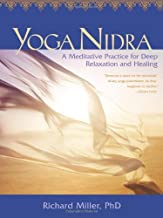
This post is built around Dr. Richard Miller’s approach to Yoga Nidra (1) and my response to it. The resource I am working with – a book and a CD – was published in 2005. My concern in writing is with how a “meditative practice for deep relaxation and healing” can also be what one reviewer (2) described as the “perfect tool” for the author’s non-dual teachings. For the recommended practices “require only presence, and as such represent both the path and the goal of non-dual practice.”

The word non-dual is a translation of the Sanskrit advaita, literally ‘not two’. I remember a podcast in which Peter Russell (3), a long-term practitioner and writer in this field, cautioned against a tendency to equate ‘not two’ with ‘one’. He then told an ancient Indian story about the making of clay pots. A potter takes a lump of clay and makes two pots. One clay; two pots. In the Indian tradition, this is a ‘consciousness first’ understanding, and modern versions draw on terms like presence, awareness, ground of being, or true nature to point to our ultimate identity as this consciousness. ‘God’ is also used in this way. The understanding is that we are never separate from this identity, though we may feel separate from it, or forget it, or ‘not believe’ in it. After all, most of our attention is on our individual life in the world with all its pulls, stresses and demands.

Early in his book, Richard Miller describes his first experience of Yoga Nidra:

“Our instructor led us through Shavasana, the traditional yogic pose for inducing deep relaxation while lying completely still on the floor. The instructor expertly guided us into being conscious of sensations throughout our body, as well as to opposing experiences, such as warmth-coolness, agitation-calmness, fear-equanimity, sorrow-joy, and separation-oneness. I was invited to rotate may attention through the sensations elicited by pairs of opposites until I was able to embody these opposing experiences with neither attachment or aversion to what I was experiencing.

“I drove home that evening feeling totally relaxed and expansively present. For the first time in years, I felt free of all conflict, radiantly joyful, and attuned wit the entire universe. I experienced life as being perfect just as it was and felt myself to be a spacious nonlocalized presence. Instead of my usual experience of being in the world, I was having a nonmental experience of the world being within me, similar to experiences I had known as a child”.

Miller’s motivation to continue was “a longing in me to consciously awaken into and fully abide as this sense of presence”. As well as becoming a yoga teacher and psychotherapist he has worked with Direct Path teachings as a student of Jean Klein. He describes the very term Yoga Nidra as a paradox, a play on the words ‘sleep’ and ‘awake’ as it means ‘the sleep of the Yogi’. The implication is that the normal person is asleep to their true nature through all states of consciousness – waking, dreaming and deep sleep – while the Yogi is one who is awake and knows his or her true nature across all states, including sleep. The practice therefore involves both deep relaxation and deep inquiry.

A full practice on Miller’s CD begins with two commitments – one to a form of mindfulness at the edge of sleep where, for the reasons pointed to above, it is OK to ‘fall asleep’ since there is a trust that the process will continue to run at other levels. The second is described as a ‘heartfelt prayer’, articulated as though it has already been fulfilled – for in the absolute, there is only now: Miller gives the example ‘my friend is whole, healed and healthy’. Then the meditation moves through seven stages, the first six of which address specific forms of awareness: body and sensation; breath and energy; feelings and emotions; thoughts, beliefs and images; desire, pleasure and joy; and witness/ego-I. The final stage (sahaj) is our natural state, ‘the awareness of changeless Being’. Each stage provides an opportunity to identify conventionally positive and conventionally negative experiences, and to hold both in a wider embrace. The sixth stage inquires into the very nature of the ‘I’ that believes itself to be a separate witness, enabling the simple being of the final stage. The whole practice lasts about 35 minutes.

I’ve been looking for an evening practice to complement my morning one. After only a week, it has the right feel, the right format and the right length for me at this point in my life. Over the last three or four years non-duality has become my common sense. During this period I have worked a good deal with the ‘Seeing’ experiments of Douglas Harding’s Headless Way (4) and also with substantial resources from Direct Path teachers Greg Goode (5) and Rupert Spira (6). A non-dual view, as a working assumption, is now both cognitively and experientially well installed.

I don’t have a deep interest in non-dualist metaphysics for its own sake. I am deeply committed to this world and my human life. What I find is that a non-dual model of reality adds to my experience of human life in the world, and cannot be separated from it. I find myself leaning in to this nourishing and illuminating possibility, and committed to commit to living by it. Roger Miller’s Yoga Nidra has met me where I am. I am very grateful for this gentle, life-affirming, and subtle practice, which helps to maintain me on this path.

(1) Richard Miller Yoga Nidra: A Meditative Practice for Deep Relaxation and Holding Boulder, CO: Sounds True, 2005

(2) Stephen Cope, author of Yoga and the Quest for the True Self and The Wisdom Of Yoga

(3) https://www.peterrussell.com/

(4) http://www.headless.org/

(5) Greg Goode The Direct Path: A User Guide Non-Duality Press, 2012 (UK edition)

(6) Rupert Spira Transparent Body: Luminous World: the Tantric Yoga of Sensation and Perception Oxford: Sahaja Publications, 2016

Earth Eclectic

music that celebrates Earth and speaks to the heart

Sarah Fuhro Star-Flower Alchemy

Follow the Moon's Cycle

Muddy Feet

Meeting nature on nature's terms

Rosher.Net

A little bit of Mark Rosher in South Gloucestershire, England

Becoming Part of the Land

A monastic polytheist's and animist’s journal

selkiewife

Selkie Writing…

Charlotte Rodgers

Images and words set against a backdrop of outsider art.

Prof Jem Bendell

living with metacrisis and collapse

Towint

The pagan path. The Old Ways In New Times

The Druids Garden

Spiritual journeys in tending the living earth, permaculture, and nature-inspired arts

The Blog of Baphomet

a magickal dialogue between nature and culture

This Simple Life

The gentle art of living with less

Musings of a Scottish Hearth Druid and Heathen

Thoughts about living, loving and worshiping as an autistic Hearth Druid and Heathen. One woman's journey.

Wheel of the Year Blog

An place to read and share stories about the celtic seasonal festivals

Walking the Druid Path

Just another WordPress.com site

anima monday

Exploring our connection to the wider world

Grounded Space Focusing

Become more grounded and spacious with yourself and others, through your own body’s wisdom

The Earthbound Report

Good lives on our one planet

Hopeless Vendetta

News for the residents of Hopeless, Maine