Contemplative Inquiry

This blog is about contemplative inquiry

Tag: Poetry

SELF COMPASSION AND DECISION MAKING

“Friend, please,
Do not try to decide now.
Do not shut any possibility out of your heart.
Honour this place of not-knowing.
Bow before this bubbling mess of creativity.

“Slow down. Breathe.
Sink into wonderment.
Befriend the very place where you stand.
Any decision will make itself, in time.
Any choice will happen when your defences are down.
Answers will appear only when they are ready.
When the questions have been fully honoured, and loved.


“Do not label this place ‘indecision’.
It is more alive than that.
It is a place where possibilities grow.
It is a place where uncertainty is sacred.


“There is courage in staying close.
There is strength in not knowing.


“Friend, please know,
There is simply no choice now.


“Except to breathe, and breathe again,
And trust this Intelligence beyond mind.”
 

 Jeff Foster. See: www.lifewithoutacentre.com/

WANDERER

The Wanderer is the Fool of the Wildwood Tarot (1). To become the Wanderer is to let go of formless potential and take on identity and aspiration. Entering the Wildwood world, I find myself at midwinter. As I gradually get my bearings, I lean towards the first signs of a strengthening sun, and the distant promise of spring.

In my first use of the cards, I chose an eight-card spread. Four of the cards belong to Vessels, the water suit (2). They include both ace and king. Where I live, this fits with two or three months of rain and flood, well beyond what used to be normal. The placement of these cards suggests reasons to be hopeful, at a price. Another card, indicated as a helpful resource, is the Pole Star, the name given to Major Trump 17 in this pack.

These results have triggered memories of two Anglo-Saxon poems, often anthologised together: The Wanderer and The Seafarer. Both are voices from a Christianised culture in the old northern world. The first part of The Seafarer, possibly a separate composition from the second, “has variously been regarded as literal or allegorical, and related to such figures as the pilgrim.” (3). The extract below emphasises endurance in the face of adverse conditions. I like the seafarer for being an ordinary man of his time, and not an idealised hero. He does what he needs to, and won’t give up. He can find beauty and communion with bird life, in a harsh and lonely setting. But he also owns feelings of distress, sorrow and complaint. He belongs to history rather than myth.

“I sing my own true story, tell my travels,

How I have often suffered times of hardship

In days of toil, and have experienced

Bitter anxiety. My troubled home

On many a ship has been the heaving waves,

Where grim night-watch has often been my lot

At the ship’s prow as it beat past the cliffs.

Oppressed by cold my feet were bound by frost

In icy bonds, while worries simmered hot

About my heart, and hunger from within

Tore the sea-weary spirit. He knows not,

Who lives most easily on land, how I

Have spent my winter on the ice-cold sea,

Wretched and anxious, in the paths of exile,

Lacking dear friends, hung round by icicles,

While hail flew past in showers. There heard I nothing,

But the resounding sea, the ice-cold waves.

Sometimes I made the song of the wild swan

My pleasure, or the gannet’s call, the cries

Of curlews for the missing mirth of men,

The singing gull, instead of mead in hall.

Storms beat the cliffs, and icy-winged

The tern replied, the horn-beaked eagle shrieked.

No patron had I there who might have soothed

My desolate spirit. He can little know

Who, proud and flushed with wine, has spent his time

With all the joys of life among the cities,

Safe from such fearful venturings, how I

Have often suffered weary on the seas.

(1) Mark Ryan & John Matthews The Wildwood Tarot Wherein Wisdom Resides London: Connections, 2011. Illustrations by Will Worthington

(2) See also https://contemplativeinquiry.wordpress.com/2019/12/30/

(3) Extract from The Seafarer in A Choice of Anglo-Saxon Verse London: Faber & Faber, 1970 (Selected with an introduction and a parallel verse translation by Richard Hamer)

JOHN COWPER POWYS: PORIUS AND TALIESIN

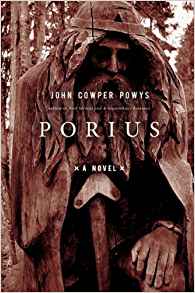
Porius (1) is John Cowper Powys’ last novel. It took him seven years to write, and he completed it in 1949, when he was 77. It is set in the year 499 CE, in North Wales. Porius is a Romano-British prince. Arthur, a suspect foreigner to most local people, reigns as Emperor. Rome is ruled by Goths, but links are maintained with Constantinople. The Saxons are an existential threat. People have to find a way of dealing with the situation in which they find themselves. But the book is at least as much about the inner lives of the characters as it is about the action they take.

Powys thought of Porius as his masterpiece. His publishers did not agree and insisted that he cut it by a third, which he did over two agonising years. Fortunately, a complete edition is available now thanks to modern editors Judith Bond and Morine Krissdottir. In her foreword Krissdottir says, “I am always reminded when I read the novel of these lines: ‘we are always in error, lost in the wood, standing in chaos, the original mess, creating a brand-new world’. Powys was as gloriously lost by the time he had written Porius as the reader sometimes is … but he was still the superb craftsman, who knew that it was the story itself that had the power to shape the forest within and without, that had the power to create a brand-new world”.

Instead of writing a review, I want to focus on one character, Taliesin, and what Powys has to say through him about the creative life. Powys has a number of point of view characters, with a variety of stances. He seems to give them equal air-time, making Porius a genuinely multi-vocal novel. Taliesin is portrayed as a young, mercurial bard, popular thanks to outstanding skill in cooking as well as poetry. (The cover illustration above is of Merlin – old, saturnine, more central to the book as a whole). Powys builds Taliesin’s bardic character, and the idiosyncratic working of his awen, with care.

“Taliesin had indeed worked out for himself, quite apart from his power of expressing it in such assonances and alliterations as had never been heard before, a really startling philosophy of his own. This philosophy depended on a particular and special use of sensation; and its secret had the power of rendering all matter sacred and pleasure giving to the individual soul. And it had the power … of fusing the immense past with the immeasurable future and of doing this, moreover, not by means of an ‘eternity’ beyond experience and imagination, but by means of a quivering vibrating, yet infinitely quiescent moment of real Time.”

Taliesin can rely on an easy fluency with language. More important is his capacity for open creative reverie, based on a deep sensitivity to the perceptions of the moment. He is described as sitting on a four-legged stool in the deepening of a late October evening. As he sits, he feels the full warmth of a fire and is able to see “the glittering path of moonlight on wind-ruffled water”. He can see a hawk’s nest, and the “ancestral sword of Cynan ap Clydno, thrust to the depth of half its blade, in the buried stump of a vanished oak tree”. The sword is reminiscent of a cross. Taliesin muses that “any sort of thing happening near a cross, not to speak of a sword, always seems in some way to be watched – if not heard and guarded against”. J.C. Powys comments, “considering the sword and the cross, the moonlit space between that figure on the four-legged stool and Clydno’s rusty weapon may well have vibrated with dangerous antipathy as the words ‘The Mothers’ and ‘Nothingness’ and ‘Annwfn’ floated away towards the lake. Rather than writing, Taliesin speaks into the darkness. Writing may come later. The piece that follows is lengthy, and eventually settles into a contemplation of “the thing none can utter, the thing inexpressible” yet “known from before the beginning”. Here is the final section:

“I know it from pond slime and

frog spawn and grub spit,

From bracken’s green coral,

white lichen, yellow mosses,

Newts sinking with their arms

out to reedy pools’ bottoms,

Swords rusting in their oak

stumps, wrapped in the long rains,

Eggs rotting in their lost nests,

enjoying the wild mists, I know it from all these, and to

men proclaim it:

The ending forever of the Guilt

sense and God sense,

The ending forever of the Sin

sense and Shame sense,

The ending forever of the Love

sense and Loss sense,

The beginning forever of the Peace paradisic,

The ‘I feel’ without question,

The ‘I am’ without purpose,

The ‘it is’ that leads nowehre,

the life with no climex,

The ‘Enough’ that leads forward

to no consummation

The answer to all things, that

yet answers nothing,

The centre of all things, yet all

on the surface,

The secret of Nature, yet Nature goes blabbing it

With all of her voices from

earth, air, fire, water!

Whence comes it? Whither

goes it? It is nameless; it is

shameless;

It is Time free at last from its Ghostly Accuser,

Time haunted no more by a

Phantom Eternal;

It is godless; but its gods are as

sea sand in number;

It’s the square with four sides

that encloses all circles;

Four horizons hath this Tetrad

that swallows all Triads;

It includes every creature that

Nature can summon.

It excludes from Annwfyn nor

man, beast nor woman!”

The mid twentieth century was a time of considerable interest in the Matter of Britain and Arthurian themes. But generally, then, we find a polished and rather conservative Christian perspective, applicable even to Taliesin. The Inkling Charles Williams wrote two collections of linked verse about him – Taliessin Through Logres and The Region of the Summer Stars (2). The latter collection includes these lines from the poem Taliessin in the Rose Garden:

“I was Druid-born and Byzantium trained.

Beyond Wye, by the Cauldorn of Ceridwen, I saw

the golden cycle flash in the forest, and heard

the pagans mutter a myth; thence by the ocean

dreaming the matter of Logres I came where the heirarchs

patter the sacred names on the golden floor

under the throne of Empire.”

John Cowper Powys, too, was a man of his time. But insofar as his Porius relies on legendary history, he borrows more from archaic Welsh tradition than the better known pan European literature that developed out of it. He himself is much more nature friendly and Pagan in sensibility. I see him as following a broadly emancipatory direction in modern spiritual culture, and we are his heirs.

(1) John Cowper Powys Porius: a Romance of the Dark Ages Overlook Duckworth, 2007. Edited by Judith Bond and Morine Krissdottir, with a foreword by Morine Krissdottir. The first abbreviated edition was published in 1951.

(2) Charles Williams Taliessin Through Logres & The Region of the Summer Stars Berkeley, CA: The Apocryphile Press, 2016. Edited with an introduction by Sorina Higgins. (Taliesin Through Logres first published in 1938; The Region of the Summer Stars in 1944)

BOOK REVIEW: Y DAROGAN ANNWN

The image above is the cover for Lorna Smithers’ new collection of poems, Y Darogan Annwn, and it illustrates the themes of the collection. Lorna Smithers explains: “Daronwy, the Brythonic World Tree, is falling. Beneath its boughs appears Y Darogan Annwn, a child-prophet, who prophecies the end of the Age of Man. She must find the source of the poison, outwit the scientists of Gwydion, and release the destructive fury of the spirits of Annwn. Her ultimate decision will be whether to become one with her prophecy.”

Prophecy, like poetry, is a gift of awen, the inspirational energy of Brythonic culture. To be awenydd, open and dedicated to this gift, is to accept its demands. Y Darogan is a child of the gods and a daughter of dragons. She is a shape-shifter who can move through multiple identities, the most poignant of which is that of a little girl. She will never grow up. Her individual life will last for less than a year.

The collection contains 50 poems in all. Two are introductory and the others are arranged in seven sections providing a narrative structure: Lock and Key; The Forest of Daronwy; The Fisher King; The Golden Ring; Doomsday; The End of Days; and The Hereafter. Together they present a wasteland story for our times, drawing on British Celtic and Arthurian themes whilst subverting the patriarchal assumptions of the old texts. The individual poems are each relatively short, and likely to have most impact on people who have some familiarity with the Mabinogion and the Brythonic mythos in which it is embedded. However the wasteland confronted is that of our own times: its military industrial complexes based on a perverted science, and the current slide into climate catastrophe.

For her self-introduction in the first verse, the infant Y Darogan uses pithy lines of power, reminiscent of The Book of Taliesin*, though with updated cultural references.

I have been a fallen star

and a tear in a river of tears

flowing through Annwn.

I have been hydrogen,

oxygen, carbon, nitrogen,

helium burning in the sun.

****

I have been dark matter

I have not been found by

the scientists of Gwydion.

By contrast, Doronwy, the Brythonic World Tree, is introduced in a prose poem, one of the longer individual pieces in the book. Together, these introductory pieces provide a point of departure for the story that builds over the seven main sections. Y Darogan’s mission of cleansing is itself a path of destruction, and “no Champion’s Light stands out on her forehead, just the darkness of the black hole”. Only at the very end is there a regenerative (rather than ‘redemptive’) note. The material demands verbal resilience in the face of multiple and unavoidable stresses, and even at its bleakest, there is power and magic in Lorna Smithers’ writing.

Oh Breath of the Wind

don’t leave me leave me please!”

She does not know how long

she has been wandering Pennant Gofid,

the Valley of Grief through ghosts and mist,

only that she found the treasure, became

the answer, and it’s harder to bear

than the weight of the crow.

The howling of wolves loudens.

The sky blackens with ghost-wings.”

Overall, I believe that Y Dorogan Annwn is a significant contribution to the re-visioning of the world’s great stories as we confront unprecedented challenges on our collective journey. I am grateful for the opportunity to read and review it.

Lorna Smithers’ blogs at https://lornasmithers.wordpress.com/ using the title At Peneverdant. Her About section describes her calling as an awenydd and devotee of Gwyn ap Nudd, God of the Brythonic underworld Annwn, of the dead, and of the Wild Hunt. The Y Darogan Annwn collection is now for sale as a PDF, see link:

https://lornasmithers.wordpress.com/2019/10/12/y-darogan-annwn/

  • The Book of Taliesin in The Four Ancient Books of Wales Forgotten Books, 2007 (Originally published in 1868, when the original material was translated and edited by William F. Skene)

POEM: MATSUO BASHO

In imagination,

An old woman and I

Sat together in tears

Admiring the moon.

Matsuo Basho The Narrow Road to the Deep North and Other Travel Sketches London: Penguin Books, 1966. (Translated from the Japanese with an introduction by Noboyuki Yuasa.) The strongly Zen influenced Basho lived from 1644 – 1694 and is considered one of the greatest figures in Japanese literature.

POEM: WALKING

Poem by seventeenth century Anglican mystic Thomas Traherne, whose life will be celebrated tomorrow, 10 October.

To walk abroad, is not with Eys

But Thoughts, the Fields to see and prize;

Els may the silent Feet,

Like Logs of Wood,

Mov up and down and see no Good,

Nor Joy nor Glory meet.

Ev’n Carts and Wheels their place do change,

But cannot see, tho very strange

The Glory that is by;

Dead Puppets may

Move in the bright and glorious Day,

Yet not behold the Sky.

And are not Men than they more blind,

Who having Eys yet never find

The Bliss in which they mov;

Like statues dead

They up and down are carried,

Yet neither see nor lov.

To walk is by a Thought to go;

To mov in Spirit to and fro;

To mind the Good we see;

To taste the Sweet;

Observing all the things we meet

How choice and rich they be.

To note the Beauty of the Day,

And golden Fields of Corn survey;

Admire the pretty Flow’rs

With their sweet Smell;

To prais their Maker, and to tell

The Marks of His Great Pow’rs.

To fly abroad like active Bees,

Among the Hedges and the Trees,

To cull the Dew that lies

On evry Blade,

From evry Blossom; till we lade

Our Minds, as they their Thighs.

Observ those rich and glorious things,

The Rivers, Meadows, Woods and Springs,

The fructifying Sun;

To note from far

The Rising of each Twinkling Star

For us his Race to run.

A little Child these well perceivs,

Who, tumbling among Grass and Leaves,

May Rich as Kings be thought.

But there’s a Sight

Which perfect Manhood may delight,

To which we shall be brought.

While in those pleasant Paths we talk

‘Tis that tow’rds which at last we walk;

But we may by degrees

Wisely proceed

Pleasures of Lov and Prais to heed,

From viewing Herbs and trees.

Denise Inge (ed.) Happiness and Holiness: Thomas Traherne and His Writings Norwich: Canterbury Press, 2008 (Canterbury Studies in Spiritual Theology)

POEM: RAPT FORM

FIRE upon Night the way flashing

Cove within Earth the seed receiving

South into North of us –

Eagle upon mountain and the light ascending

The Bowl of the daily dark descending

Stars beyond the shore of us

The Centre stays and the pattern fixes

The Centre moves and the diagram mixes

For many and more of us.

The Eye shines as the cast is shining

The Bowl gathers darkness as the shade is spreading

The Pentagram weaves its tent overheading

The stars and the Polestar turning and twining

Until the rotating of day.

O day and night O night of time

[the weft upon the warp of rhyme}

I backward step to the abyss

Where Form ends and Nothing is –

Where Nothing ends and All-Thing is.

Ross Nichols Prophet Priest and King: The Poetry of Ross Nichols Lewes: The Oak Tree Press, 2001 (Edited and introduced by Jay Ramsay)

“Ross Nichols, who was a contemporary of Eliot, and rated highly by many including Edwin Muir, was Chief of the Order of Bards, Ovates and Druids (OBOD) until his sudden and unexpected death in 1975. An accomplished prose writer, essayist, editor and water colourist who exhibited at the Royal Academy, we can now see him as one of the ‘Apocalypse poets’ of the 1940’s As Chief of the Order from 1964, his contribution was substantial, re-introducing into modern Druid practice the Winter Solstice Festival and the four Celtic Fire Festivals, which he led at London and in Glastonbury.”(Book blurb)

For information about OBOD see http://www.druidry.org/

THE TAO OF URSULA K LE GUIN

“The Tao Te Ching is partly in prose, partly in verse; but as we define poetry now, not by rhyme and meter but as a patterned intensity of language, the whole thing is poetry. I wanted to catch that poetry, its terse, strange beauty. Most translations have caught meanings in their net, but prosily, letting the beauty slip through. And in poetry, beauty is no ornament; it is the meaning. It is the truth. We have that on good authority.

“Scholarly translations of the Tao Te Ching as a manual for rulers use a vocabulary that emphasises the uniqueness of the Taoist ‘sage’, his masculinity, his authority. This language is perpetuated, and degraded, in most modern versions. I wanted a Book of the Way accessible to a present-day, unwise, unpowerful, and perhaps unmale reader, not seeking esoteric secrets, but listening for a voice that speaks to the soul. I would like that reader to see why people have loved the book for twenty-five hundred years.

“It is the most lovable of all the great religious texts, funny, keen, kind, modest, indestructibly outrageous, and inexhaustibly refreshing. Of all the deep springs, this is the purest water. To me, it is also the deepest spring.”

Ursula K. Le Guin, introducing her own English version of the Tao Te Ching*

*Lao Tzu Tao Te Ching: A Book about the Power and the Way Boston & London: Shambhala, 1998 (A new English version by Ursula K. Le Guin, with the collaboration of J.P. Seaton, Professor of Chinese, University of North Carolina, Chapel Hill)

WILLIAM BLAKE: ETERNITY

He who binds himself to a joy

Doth the winged life destroy;

But he who kisses the joy as it flies

Lives in eternity’s sunrise.

William Blake Complete Writings Oxford University Press, 1972 (edited by Geoffrey Keynes)

WHEN I WAS A CREEK

When I was

a tree,

I sang and danced

with the wind

and offered

food and refuge

to all who came.

When I was

a cloud,

I floated freely,

bringing

shade and rain

wherever they

were needed.

When I was

a creek,

I flowed effortlessly

around stones

and nourished life

everywhere

I went.

When I was

a seed,

I held

the story

of what

I would become

inside me

until the sun

and rain

let me know

it was time

to share it.

When I was

a flower,

I opened up

to reveal

my beauty

and invited the bees

to share

the sweetness.

Now I am

human

and can do so many things,

yet I am

full of questions

about who I am

and why I’m here.

Kai Siedenburg Poems of Earth and Spirit: 70 Poems and 40 Practices to Deepen your Connection with Nature Our Nature Connection, 2017

CONTEMPLATION

I like this poem for its economy and simplicity, and for its gentle, shape-shifting animism – for the ease with which it moves between identities in nature. For me, there is power and beauty in this, all the better for a relative lack of ornament.

As a human, I do feel a bit set up. Whereas the rest of nature is awarded an innocence and generosity not always evident in the apparent world, we humans are implicitly stigmatised for our questions, and thereby separated from the rest of nature. In our mainstream culture (both religious and secular) we place ourselves above the rest of nature, so the polar opposite perspective does have a corrective value. But it leaves me unsatisfied.

My sense is that the writer is placing herself alongside me, the reader, and the other humans. She is not awarding herself a free pass on the grounds of her vividly present and enacted imaginative empathy. So I would say to her what I say to myself. As I read it, there’s a strong invitation to self-compassion in the last verse.

Our finite minds are as natural as anything on earth.. Our questions about who we are, why we’re here and what to do are part of us. For me, the only way through them is become more skilled in the process of inquiry and to learn to live by its fruits. I value this poem partly through what it evokes directly, and partly because it stimulates useful inquiry.


Earth Eclectic

music that celebrates Earth and speaks to the heart

Sarah Fuhro Star-Flower Alchemy

Follow the Moon's Cycle

Muddy Feet

Meeting nature on nature's terms

Rosher.Net

A little bit of Mark Rosher in South Gloucestershire, England

Becoming Part of the Land

A monastic polytheist's and animist’s journal

selkiewife

Selkie Writing…

Charlotte Rodgers

Images and words set against a backdrop of outsider art.

Prof Jem Bendell

living with metacrisis and collapse

Towint

The pagan path. The Old Ways In New Times

The Druids Garden

Spiritual journeys in tending the living earth, permaculture, and nature-inspired arts

The Blog of Baphomet

a magickal dialogue between nature and culture

This Simple Life

The gentle art of living with less

Musings of a Scottish Hearth Druid and Heathen

Thoughts about living, loving and worshiping as an autistic Hearth Druid and Heathen. One woman's journey.

Wheel of the Year Blog

An place to read and share stories about the celtic seasonal festivals

Walking the Druid Path

Just another WordPress.com site

anima monday

Exploring our connection to the wider world

Grounded Space Focusing

Become more grounded and spacious with yourself and others, through your own body’s wisdom

The Earthbound Report

Good lives on our one planet

Hopeless Vendetta

News for the residents of Hopeless, Maine