Contemplative Inquiry

This blog is about contemplative inquiry

Tag: Poetry

POEM: SAILING TO BYZANTIUM

I’ve had a request for the full text of W. B. Yeats’ poem Sailing to Byzantium and so this post is devoted to it.

1

That is no country for old men. The young

In one another’s arms, birds in the trees

-Those dying generations – at their song,

The salmon falls, the mackerel crowded seas,

Fish, flesh or fowl, commend all summer long

Whatever is begotten, born, and dies.

Caught in that sensual music all neglect

Monuments of unageing intellect.

II

An aged man is but a paltry thing,

A tattered coat upon a stick, unless

Soul clap its hands and sing, and louder sing

For every tatter in its mortal dress,

Nor is there any singing school but studying

Monuments of its own magnificence;

And therefore I have sailed the seas and come

To the holy city of Byzantium.

III

O sages standing in God’s holy fire

As in the gold mosaic of a wall,

Come from the holy fire, perne in a gyre*,

And be the singing masters of my soul.

Consume my heart away; sick with desire

And fastened to a dying animal

It knows not what it is; and gather me

Into the artifice of eternity.

IV

Once out of nature I shall never take

My bodily form from any natural thing,

But such a form as Grecian goldsmiths make

Of hammered gold and gold enamelling

To keep a drowsy Emperor awake;

Or set upon a golden bough to sing

To lords and ladies of Byzantium

Of what is past, or passing, or to come.

  • “Perne in a gyre” – ‘pern’ is another name for spool, and ‘to pern’ or ‘perne’ is to move with a circular, spinning motion; a gyre is Yeats’ symbol for circular movements in history – In A Vision Yeats said that “each age unwinds the threads another age had wound”.

Yeats, W. B. Poems of W. B. Yeats London: MacMillan & Co, 1964 (Selected with an introduction and notes by A. Norman Jeffares)

SAILING TO BYZANTIUM

This post is inspired by The Byzantine Tarot, a collaboration between two notable talents – John Matthews as writer and Cilla Conway as artist. It’s an excellent piece of work, but this post is not a review. It’s about two of the major trumps and their effect on me.

I impulse-bought the pack about a month ago. I didn’t get it for divination. I wanted it for the iconography of the major trumps, though in fact all the cards are carefully chosen and beautifully rendered. Part of the integrity of this tarot is that the images are drawn from the culture they reference – a culture itself very busy with sacred images, though at times its ruling circles reacted against them. Cilla Conway’s work is a wonderful evocation of this culture and its imagery, an imagery consciously crafted in the service of Christian Orthodoxy*.  It’s an interesting subject for a tarot pack, since the tarot form itself introduces an element of gnostic subversion into the work.

In the Byzantine Tarot, Sophia appears as the Papesse/High Priestess. She mediates “between the higher and lower realms of creation, watching over the Holy Fool on his journey and guiding those who seek her blessings to find their own path through the world”. In the apparent world, Byzantine Orthodoxy had no vacancy for a Papesse/High Priestess, and was not in business to encourage people to find their own way unless it was also the Churches’ way. The Fool of this tarot is a Holy Fool and draws on the history of the Desert Fathers, though the specific image is from Moscow, for the Slav world inherited the Orthodox tradition and the role of the Holy Fool. There is a happy reframing of these formidable world-renouncing ascetics in the text. A naked, haloed man steps outside his cell raising his hands towards the dove of the Holy Spirit and “prepares to step off into the air above the sea, asking without words to be allowed to access the joy and wonder of the world”. He is said to represent ‘crazy wisdom’, also known to Sufi and Buddhist tradition.

I feel engaged with these images, but not close to the Orthodox Church. Fortunately good images transcend doctrine. They have a larger suggestive power. I see a Goddess, depicted in one card as an angelic intercessor and in the other as a dove. I see a devotee who is a completely opened up. I’m learning how development works in spirals. A few years ago I was taken up with the image of Sophia and this modified my experience of Druidry. It was initially her influence that got me to explore meditative disciplines and see through the eye of contemplation more systematically. When my exploration took me further East, my specific sense of Sophia began to diminish.

Two tarot images have brought her back into my life. Now that she’s in my life, I have to move on from the specific images, for all their potent catalyst role. In relation to my life and practice, the Sophia depicted is too hierophantic and static. I like the Holy Fool icon, but the ‘Crazy Wisdom’ references in the text open up unwelcome possibilities of dogmatic intuitionism and licensed abuse-by-Guru that we find in Crazy Wisdom Masters from many traditions.

If I want to orient myself to the ‘Holy Fool’ archetype, there are lines within W. B. Yeats’ poem Sailing to Byzantium, which act as a better guide. He starts with the complaint “That is no country for old men” – Ireland, but more essentially the world of “whatever is begotten, born and dies, caught in … sensual music”. Then he says:

“An aged man is but a paltry thing,

A tattered coat upon a stick, unless

Soul clap its hands and sing, and louder sing

For every tatter in its mortal dress.”

On my reading the world of begetting, birthing and dying – with all its sensual music – is absolutely fine and to be celebrated. It’s the being “caught” in it that’s the problem. For there is another dimension. The seven directions operate vertically as well as horizontally, with eternity at the centre, within, around and throughout.  Sophia reminds me of this, and it changes everything.

* Early in the 4th century C.E. the Roman Emperor Constantine began the Christianisation of the Empire and moved the capital eastwards from Rome to the old Greek city of Byzantium which he rebuilt and modestly renamed Constantinople. Two hundred years later when Orthodox Christianity was dominant and enforceable, a new Cathedral of Hagia Sophia (Holy Wisdom) became the greatest building of the city. It still is in some ways, having survived two conversions since the fall of the city in 1453, first into a mosque and later into a museum in today’s Istanbul.

Matthews, John & Conway, Cilla The Byzantine Tarot: Wisdom from an Ancient Empire London: Connections Book Publications, 2015

Yeats, W. B. Poems of W. B. Yeats London: MacMillan & Co, 1964 (Selected with an introduction and notes by A. Norman Jeffares)

POEM: ARTHUR

Behind storm-fretted bastions gray and bare

Flame-crested warriors of Cunedda’s line

Feast in a gold ring, – their targes shine

Along the wall and clang to gusts of air;

And in the shadow, torches blown aflare

Reveal a chief, half human, half divine,

With brooding head, starred by the Dragon Sign,

Hung motionless in some undreamed despair.

But when he starts, three torques of twisted gold

Writhe on his breast, for voices all men fear

Wail forth the battle-doom dead kings have borne;

And as the mead-hall fills with sudden cold,

Above the wind-tossed sea his heart can hear

The strange gods calling through their mystic horn.

Arthur is one of Six Celtic Sonnets written by Thomas Samuel Jones and included in From the Isles of Dream: Visionary Stories and Poems of the Celtic Renaissance, selected by John Matthews and with a foreword by Robin Williamson (Floris Books, 1993).

Thomas Samuel Jones (1882-1932) came from Welsh and Irish stock and was born in Oneida County, New York State, near the Adirondack Mountains. Each of the six sonnets reflects a facet of Celtic tradition. They were originally published in 1930 as part of the collection Aknahton and Other Sonnets. For those of us who resonate with Druid and Celtic spirituality, they are part of our modern cultural ancestry.

POEM: MAY UPON ICTIS

Far out at sea beneath rich Tyrian sails

The merchants watch a ghostly mountain spread

Terrific dawn-wings fired with cloudy red,

And cease their barter over purple bales;

Wild headland flames to headland; in the dales

Hushed warriors wait, for now torqued chief may tread

That dim white forest where the vanished dead

Gather like birds before the spume-drenched birds.

Around the mount barbaric trumpets cry;

Then Ictis thunders through her altar-stone

Long-cloven by a god’s mysterious rune;

And pinnacle between the earth and sky

Her savage prophet stands, majestic, lone,

Helmed with the sun and girdled with the moon.

May upon Ictis is one of Six Celtic Sonnets written by Thomas Samuel Jones and included in From the Isles of Dream: Visionary Stories and Poems of the Celtic Renaissance, selected by John Matthews and with a foreword by Robin Williamson (Floris Books, 1993). Ictis, or Iktin, is or was an island described as a tin trading centre in the Bibliotheca Historica of the Sicilian-Greek historian Diodoris Siculus, writing in the first century BC. While Ictis is widely accepted to have been an island somewhere off the southern coast of what is now England, scholars continue to debate its precise location. Candidates include St Michael’s Mount and Looe Island off the coast of Cornwall, the Mount Batten peninsula in Devon, and the Isle of Wight further to the east.

Thomas Samuel Jones (1882-1932) came from Welsh and Irish stock and was born in Oneida County, New York State, near the Adirondack Mountains. Each of the six sonnets reflects a facet of Celtic tradition. They were originally published in 1930 as part of the collection Aknahton and Other Sonnets. For those of us who resonate with Druid and Celtic spirituality, they are part of our modern cultural ancestry.

POEM: A DRUID TOWN

A sunless maze of tangled lanes enfold

The magic dwellings of the forest race,

Whose hidden shapes are flames that leave no trace

At mid-moon when the Druid’s dream is told;

The shadows of enchanted orchards hold

Red thatch of wings and woad-stained doors that face

The wandering stars, and guard the sacred place

Where faery women thread their warps with gold

The dragon knight shall lose his strength of hand

Nor ever raise his long leaf-shapen shield,

If he but follow where the white deer roam;

And never will the mariner reach land

When harps ring seaward as the dawn fires yield

The golden caer upon the ninth wave’s foam.

A Druid Town is one of Six Celtic Sonnets written by Thomas Samuel Jones and included in From the Isles of Dream: Visionary Stories and Poems of the Celtic Renaissance, selected by John Matthews and with a foreword by Robin Williamson (Floris Books, 1993).

Thomas Samuel Jones (1882-1932) came from Welsh and Irish stock and was born in Oneida County, New York State, near the Adirondack Mountains. Each of the six sonnets reflects a facet of Celtic tradition. They were originally published in 1930 as part of the collection Aknahton and Other Sonnets. For those of us who resonate with Druid and Celtic spirituality, they are part of our modern cultural ancestry.

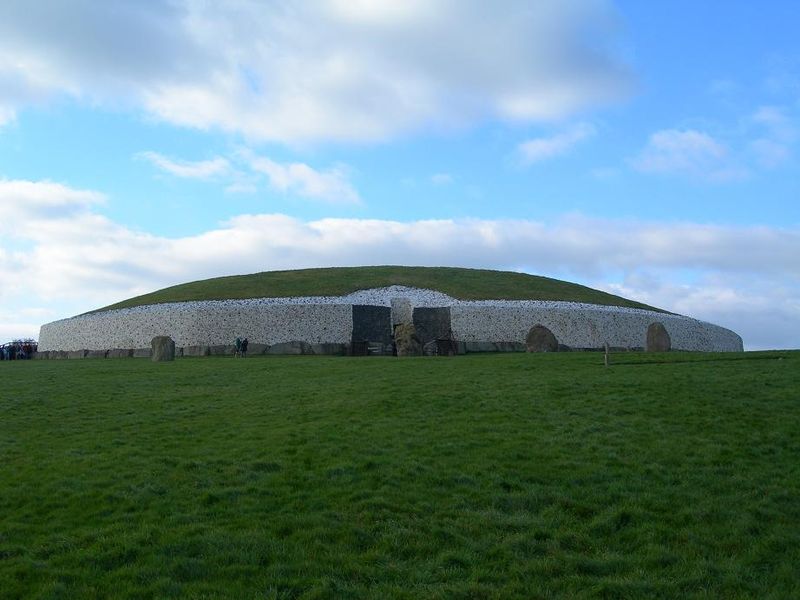
POEM: NEW GRANGE

800px-Newgrange

Picture cc by 2.5 pl – originally uploaded by Shira-commonswiki

The golden hill where long-forgotten kings

Keep lonely watch upon their feasting-floor

Is silent now, – the Dagda’s harp no more

Makes sun and moon move to its murmurous strings;

And never in the leafy star-led Springs

Will Caer and Angus haunt the river shore,

For deep beneath an ogham-carven door

Dust dulls the dew-white wonder of their wings.

Yet one may linger loving the lost dream –

The magic of the heart that cannot die;

Although the Rood destroy the quicken-rods;

To him through earth and air and hollow stream

Wild music whines, as two swans wheeling cry

Above the cromlech of the vanished gods.

New Grange is one of Six Celtic Sonnets written by Thomas Samuel Jones and included in From the Isles of Dream: Visionary Stories and Poems of the Celtic Renaissance, selected by John Matthews and with a foreword by Robin Williamson (Floris Books, 1993).

Thomas Samuel Jones (1882-1932) came from Welsh and Irish stock and was born in Oneida County, New York State, near the Adirondack Mountains. Each of the six sonnets reflects a facet of Celtic tradition. They were originally published in 1930 as part of the collection Aknahton and Other Sonnets. For those of us who resonate with Druid and Celtic spirituality, they are part of our modern cultural ancestry.

HAIKU BY BUSON

A Summer Haiku by the 18th century Japanese poet Buson from the collection Zen Haiku, selected and translated by Jonathan Clements. London: Frances Lincoln, 2000

Across the summer stream

With such joy

My sandals in my hand

POEM: TALIESIN

An unfamiliar (at least to me) image of Taliesin. One of ‘Six Celtic Sonnets’ by Thomas Samuel Jones, first published in 1930. Taken from the ‘Isles of Dream’, an anthology of work from the ‘Celtic Renaissance ‘.

On lonely shores where dreams are drifted sand

He follows to the end a star’s bright course,

A ghostly hunter without hound or horse,

The warrior-bard, last of the Druid band;

But still his wizard harp rings in his hand

Beside the Stream of Sorrow’s hidden source,

Still from a breaking heart his wild songs force

Their way into the god’s mysterious land.

Dauntless he sings, and sees the drear woods turn

To golden orchards by the river bed

Where healing waters of the rainbow run;

And past the valley near great peaks that burn

With beaconing fire the hero-bard is led

Up toward the Dragon City of the Sun.

Taliesin is one of Six Celtic Sonnets written by Thomas Samuel Jones and included in From the Isles of Dream: Visionary Stories and Poems of the Celtic Renaissance, selected by John Matthews and with a foreword by Robin Williamson (Floris Books, 1993).

Thomas Samuel Jones (1882-1932) came from Welsh and Irish stock and was born in Oneida County, New York State, near the Adirondack Mountains. Each of the six sonnets reflects a facet of Celtic tradition. They were originally published in 1930 as part of the collection Aknahton and Other Sonnets. For those of us who resonate with Druid and Celtic spirituality, they are part of our modern cultural ancestry.

POEM: CAER SIDI

Poetry from the ‘Celtic Renaissance’ – one of ‘Six Celtic Sonnets’  written by Thomas Samuel Jones and first published in 1930. Taken from ‘The Isles of Dream’, an anthology by John Matthews.


Alone, unarmed, the Dragon King must go

To seek the Cauldron by a magic shore,

For gleaming harness wrought of wizard ore

Is powerless against an unknown foe;

The lonely Caer, walled with the flaming Bow,

Lifts dark enchanted horns where wild seas roar,

And in the moon’s white path a mystic door

Moves to strange music only Merlins know.

Within, vast shapes and awful shadows start,

While deathless gods who hold the way-worn stairs,

Do ghostly battle with a hero’s soul;

But at his eagle cry their thronged shields part,

And from the cloven fire the Chieftain bears

High in his mighty grasp the star-rimmed Bowl.

Caer Sidi is one of Six Celtic Sonnets written by Thomas Samuel Jones and included in From the Isles of Dream: Visionary Stories and Poems of the Celtic Renaissance, selected by John Matthews and with a foreword by Robin Williamson (Floris Books, 1993).

Thomas Samuel Jones (1882-1932) came from Welsh and Irish stock and was born in Oneida County, New York State, near the Adirondack Mountains. Each of the six sonnets reflects a facet of Celtic tradition. They were originally published in 1930 as part of the collection Aknahton and Other Sonnets. For those of us who resonate with Druid and Celtic spirituality, they are part of our modern cultural ancestry.

ETHICS AND THE ENDLESS KNOT

Exploring ethics through contemplative trance and active imagination

In Clear and Present Thinking (1) a book about logic, Brendan Myers includes a Chapter on Moral Reasoning. In this chapter he talks about Virtue Theory as one “where the weight of moral concern is on the character and identity of the person who acts and chooses, as well as the habits he or she develops and discharges through her actions and their consequences”.

Some days after reading this, I found myself in my inner sacred space, a heart space, the garden of the Goddess. I was not doing any formal practice. I was just there. When the garden first emerged, it was specifically as Sophia’s garden. And so it was this time.

There was a banner hanging from a tree branch, hawthorn I think. It was red, with a gold pentangle inscribed on it. I recognised it as the heraldic emblem from Gawain’s shield in Sir Gawain and the Green Knight (2). In this 14th century English poem the pentangle is introduced as a token of fidelity first devised by King Solomon. It is unbroken anywhere, and known in England as the ‘endless knot’. The poem involves an interrogation of ‘virtue’ as understood both in King Arthur’s Camelot and in the older world of the Green Knight far to the north. Gawain will have to navigate both physical perils and moral ambiguities.

Why did I find this device, as a spontaneously emerging image, in Sophia’s Garden? Firstly, I had been thinking about virtue ethics as described by Brendan Myers. Secondly, the pentangle in this form has been a significant image for me ever since I encountered the poem in my late teens. I’ve revisited it from time to time ever since, and this includes the reading of John Matthews’ Sir Gawain: Knight of the Goddess (3) which makes the link with Sophia. “In the Gnostic system, Sophia, the divine emanation of the Godhead, would not permit anyone to enter her Realm of Light, unless they were in complete balance, and bore the sign of the pentangle upon them”.

The offered meaning, as I see it, is that when addressing virtue ethics, I can’t rely on reason alone. Virtue ethics is up close and personal, more than an abstract principle or set of rules. I need to mobilise more of myself. In Sophia’s Garden I’m in a deepened form of awareness, and can contemplate the imagery using heart and intuition as well as rationality. They all work together.

Allowing the vision, I entered a light trance, with the image firmly in mind. I lay down with pen and paper near. I fell asleep for a short period – not part of the plan, but cleansing and useful. On waking I had words: Love/Wisdom. Sophia is Goddess of Love/Wisdom. The love is the greater quality, and it is an Eros fuelled love, for Sophia is the emanation of the Divine who ‘fell’ and then recovered (4). There must an opening up and movement towards someone or something, however slight and tentative, for it to be ‘love’. Whereas I owe justice and a pre-supposition of basic good will towards sentient beings, love is in my experience beyond command and does not result from a conscious act of will – though I can certainly work at expanding my potential to be a conduit. Wisdom is connected to this love, acting as a detector of distortions – empty or ungrounded sentiment, unaware compulsion, possessive attachment, ‘spiritual’ love as world rejecting flight, or driven and reckless forms of generosity lacking in self-care.

But love modifies wisdom too. Wisdom here is too energised to be altogether prudential. Counting the cost may make sense, but it’s not the only criterion. Wisdom uses the head yet is lodged in the heart. At the same time, wisdom also knows that ‘Love’ and ‘Wisdom’ as words can begin to solidify into things, always a problem with ‘nouning’. They can become wooden idealisations devoid of context and process, accessories to self-image, identity performance and external reputation. They can become alienated and commodified. They can even turn and be turned against us. So wisdom guards herself and love by guarding against too much reference to ‘Wisdom’ and ‘Love’.

At this stage I’m thinking again of the pentangle and wanting to use it to bring the virtues into relationship with each other rather than separating them out. I’m feeling happy about using this traditional framework so long as I can be playful with it. For I understand this to be the Sophian Way – with solemnity seen as having a stupefying effect, anaesthetising awareness. So in this ethics of the endless knot, I place love at the apex of the pentangle as I look at the banner, I move down to the base on my right, igniting the love/wisdom link.

Then, moving diagonally up left from the base I come to justice, for love and wisdom need justice in the world for the sake of their own flourishing: injustice inhibits the free flow of love and wisdom. I’ve already named justice, and fairness, as something I owe to all on a personal level, based on a presupposition of basic good will. I’m also clear about the need to work for justice in the wider world. On this, my vision is of a justice is careful of its methods, or it risks licensing revenge, both in power and opposition. Care about language and imagery are themselves a work for justice. Injustice wants to constrain and police these great resources. It seeks to close down their emancipatory magic. Working for justice is rational activity in service to love and wisdom. Sophia has always cried out against injustice, false justice and no justice. She has an ambivalent relationship with the law.

The classical virtue following on from justice, as I move in a straight line from left to right, is courage. What kind of courage am I looking at? For me it’s not about ‘warriorship’, with its theatricality and somewhat militaristic associations, however reframed for current values and conditions. (Perhaps that’s why my pentangle is inscribed on a banner rather than a shield.) Rather, it combines resilience with witnessing. Early Taoism captures the resilience aspect: “true goodness is like water … it goes right down to the low loathsome places, and so finds the way” and “the hard sword fails, the stiff tree’s felled. The hard and great go under. The soft and weak stay up” (5). I understand witnessing in a ‘truth to power’ sense and link it to my notion of care about emancipatory, life and world-expanding language and imagery and the need to guard them. This witnessing courage, to be honourable, may involve the willing loss of recognised honour and standing in a world that is formally virtuous. So it depends on a strong inner authority and a willingness to go against tribal custom. This is the courage I would tie in with love, wisdom and justice.

Moving down diagonally from courage, we come to the base of the golden pentangle on the left hand side, where I place temperance. In the course of its long history, ‘temperance’ has tended to shift from ideas of moderation to ideas of abstinence, as culture and religion have changed. Here and now, I have a resonance of ‘treading lightly on the earth’, in two senses. One is about limiting demands on material resources for the health and flourishing of the earth and its inhabitants. The other is about an ultimate non-attachment to material goods, contents of consciousness and the self-image they create. For me, there is a balance here which is why the word temperance comes in. I can love my possessions, my ideas and visions, my loved ones, my neighbours and my sense of who I am. But I am not fundamentally identified, not wholly immersed, in them. For these forms of love, if they are to flourish, demand some space around them, and there is a sense in which I am alone even within these nourishing interconnections. In another sense I am not. For I can go back to the simplicity of aware being and loving, timelessly arising from the fertile latency of the void. In this way I complete the endless knot.

This vision and reflection are only a beginning. I intend to continue engaging with this ethical approach, integrating it into my contemplative inquiry.

References

  1. Brendan Myers, Charlotte Elsby, Kimberly Baltzer-Jaray & Nola Semczyszyn Clear and Present Thinking: a Handbook in Logic and Rationality, Version 1.1 (21st May 2013) Available via brendanmyers.net or Amazon/Kindle
  2. Licensed under the Creative Commons Attribution-NoDerivs 3.0 Unported License – see creativecommons.org/licenses/by-nd/3.0/
  3. Sir Gawain and the Green Knight edited with an introduction, prose translation and notes by W. R. J. Barron. (Revised edition) Manchester, England: Manchester University Press, 1998
  4. John Matthews Sir Gawain Knight of the Goddess (Revised edition) Rochester, Vermont: Inner Traditions, 1998
  5. Pistis Sophia: a Gnostic Gospel translated into English with an introduction and annotated bibliography by G. R. S. Mead. Blauvelt, New York: Spiritual Science Library, 1984 (New Foreword for American Edition by Richard K. Russell
  6. Lao Tzu Tao Te Ching: a Book about the Way and the Power of the Way Shambhala: Boston & London, 1998 (A new English version by Ursula K. LeGuin)
Earth Eclectic

music that celebrates Earth and speaks to the heart

Sarah Fuhro Star-Flower Alchemy

Follow the Moon's Cycle

Muddy Feet

Meeting nature on nature's terms

Rosher.Net

A little bit of Mark Rosher in South Gloucestershire, England

Becoming Part of the Land

A monastic polytheist's and animist’s journal

selkiewife

Selkie Writing…

Charlotte Rodgers

Images and words set against a backdrop of outsider art.

Prof Jem Bendell

living with metacrisis and collapse

Towint

The pagan path. The Old Ways In New Times

The Druids Garden

Spiritual journeys in tending the living earth, permaculture, and nature-inspired arts

The Blog of Baphomet

a magickal dialogue between nature and culture

This Simple Life

The gentle art of living with less

Musings of a Scottish Hearth Druid and Heathen

Thoughts about living, loving and worshiping as an autistic Hearth Druid and Heathen. One woman's journey.

Wheel of the Year Blog

An place to read and share stories about the celtic seasonal festivals

Walking the Druid Path

Just another WordPress.com site

anima monday

Exploring our connection to the wider world

Grounded Space Focusing

Become more grounded and spacious with yourself and others, through your own body’s wisdom

The Earthbound Report

Good lives on our one planet

Hopeless Vendetta

News for the residents of Hopeless, Maine