Contemplative Inquiry

This blog is about contemplative inquiry

Tag: Pilgrimage

BOOK REVIEW: ELEGANT SIMPLICITY
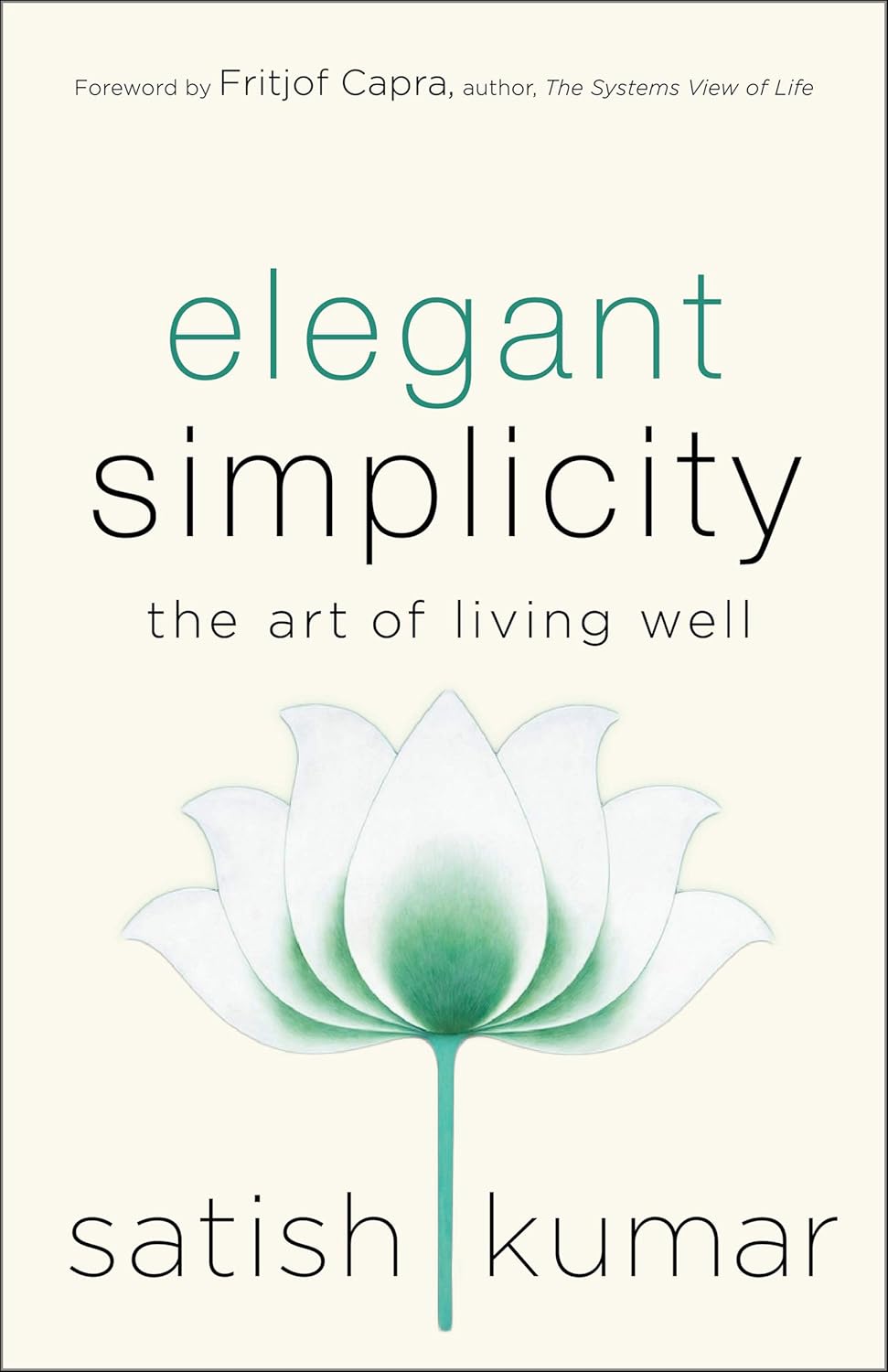
Highly recommended. Satish Kumar (born in 1936) published Elegant Simplicity: the Art of Living Well in 2019 (1). It begins with a foreword by Fritjof Capra and a preface by the author Let’s be Simple which quotes the 1848 Shaker song ‘Tis the gift to be simple, ‘Tis the gift to be free. The book summarises the author’s personal story as well as discussing his values. I have written posts based on some of his other work before (2). I especially recommend this book to anyone interested in knowing more about Satish Kumar’s practice (grounded in Jain spirituality and Gandhi’s non-violent activism) and his influence on deep ecology, creative arts and education.

Elegant Simplicity has a summarising quality, looking back on decades devoted to sacred activism in different forms. It is divided into fourteen chapters: Each is preceded by a brief and relevant quotation from another thinker. The chapter then becomes a meditation on the quote:

1 My Story: Beginnings – ‘True happiness lies in contentment’ Mahatma Gandhi.

2 Simplicity of Walking – ‘All truly great thoughts are conceived by walking’ Friedrich Nietzsche.

3 Life is a Pilgrimage – ‘Faith is not the clinging to a shrine but an endless pilgrimage of the heart’ Abraham Joshua Heschel.

4 Elegant Simplicity – ‘Any fool can make things complicated, it requires a genius to make them simple’ E. F. Schumacher.

5 A Society of Artists – ‘This world is but a canvas to our imagination’ Henry David Thoreau.

6 Yoga of Action – ‘Life is a process not a product’ Brian Goodwin.

7 Learning is Living – ‘Education is not preparation for life; education is life itself’ Thomas Dewey.

8 Right Relationships – ‘We are all related – relationships based on obligation lack dignity’ Wayne Dwyer.

9 Love Unlimited – ‘There is no charm equal to tenderness of the heart’ Jane Austin.

10 Power of Forgiveness – ‘It’s one of the greatest gifts you can give yourself, to forgive. Forgive everybody.’ Maya Angelou.

11 Dance of Opposites – ‘Life and death are one as the river and the sea are one’ Kahlil Gibran.

12 Deep Seeing – ‘To see clearly is poetry, prophecy, and religion, all in one’ John Ruskin.

13 Union of Science and Spirituality – ‘Science is not only compatible with spirituality; it is a profound source of spirituality’ Carl Sagan.

14 Soil, Soul and Society – ‘We live in an interconnected world and in an interconnected time so we need holistic solutions to our interconnected problems‘ Naomi Klein.

Fellow activist and author Vandana Shiva describes Elegant Simplicity as “the distillation” of Satish Kumar’s ideas and actions. “It shows the intimate connections between the inner and the outer world, soil, soul and society, beauty joy and non-violence. It indicates that the solutions to the big problems of our time – climate change, hate, violence, hopelessness and despair – lie in thinking and living with elegant simplicity, reducing our ecological footprint while enlarging our hearts and minds”.

For me, Satish Kumar is an inspiration rather than a direct model. Even in the conditions of the early 1960’s I would not have walked, or aspired to walk, from New Delhi to Washington DC without carrying any money. Yet Satish Kumar and his companion E. P. Menon succeeded and made a huge public impact at the time. Their peace pilgrimage gave oxygen to the campaign for nuclear disarmament. No state gave up its arms, but treaties limiting the numbers and testing of nuclear arms became normalised for some decades. Satish Kumar’s initiatives in deep ecology and education, especially the ‘small school’ and Schumacher College, have changed lives. Directly and indirectly, his influence has awakened many people from the dystopian trance of our dominant cultures. Satish Kumar is a widely revered elder: a peaceful warrior for a more liveable, generous and creative world.

(1) Satish Kumar Elegant Simplicity: The Art of Living Well New Society Publishers (https://www.newsociety.com): Gabriola Island, BC, Canada: 2019

(2) See previous posts:

NEWS OF A DEATH

TWO VIEWS OF THE DIVINE

OUTDOOR WALKING MEDITATION

NOTE: “Satish Kumar (born 9 August 1936)[1] is an Indian British activist and speaker. He has been a Jain monk, nuclear disarmament advocate and pacifist.[3]Now living in England, Kumar is founder and Director of Programmes of the Schumacher College international center for ecological studies, and is Editor Emeritus of Resurgence & Ecologist magazine. His most notable accomplishment is the completion, together with a companion, E. P. Menon, of a peace walk of over 8,000 miles in June 1962 for two and a half years, from New Delhi to MoscowParisLondon, and Washington, D.C., the capitals of the world’s earliest nuclear-armed countries.[4][5] He insists that reverence for nature should be at the heart of every political and social debate.” (Wikipedia)

TWO VIEWS OF THE DIVINE

In 1986, at the age of 50, Satish Kumar (1) went on an extended pilgrimage of British sacred sites. When staying overnight as a guest of the Bishop of Lincoln, he initiated a dialogue on divinity. In this discussion, divinity is described as God, and masculine language is used throughout. (In other contexts Satish Kumar has been happy to use Goddess references and language.) My own practice is largely non-theistic, yet I am Pagan enough to have been jolted by this limitation. Diverse images, stories and beliefs about the divine continue to inform my heart, mind and imagination. The two views articulated here (both eco-friendly in their way) point to very different experiences and understandings of the divine, and of the world: dualist and non-dualist in formal terms.

“‘It is with great pleasure that I welcome you, Satish, to Lincoln and my house, the Bishop said. ‘Going on a pilgrimage is an ancient tradition, but walking for four months around Britain to its sacred places is not so common.’

“‘I am honoured to be your guest,’ I said. ‘I have been inspired and renewed by being within many churches and cathedrals, but increasingly I am finding all places sacred and the presence of the divine everywhere.”

“‘The Bishop heard my comment with thoughtful silence, and then said, ‘For us, God is above and beyond his creation. We aspire to reach God, but God and the world are not the same.’

“‘In the Hindu tradition the world is understood to be the dance of the God Shiva, and the yet the dance and the dancer cannot be separated. The world is not like a painting, a finished object which when complete is seen as separate from the painter. The universe is a living dance and God in in the heart of all beings and things. We do not separate God and the world.’

“The Bishop pondered and in a gentle voice said, ‘I believe that the world is God’s creation and therefore it is sacred. Human beings must act as responsible guardians and caring stewards. We must love the land and look after the earth in its glorious diversity. We have no right to plunder, pollute, exploit, destroy, kill or in anyway disrespect God’s creation. Like in a family, God is the Father and we are his children, and all members of the family should live in harmony with each other. God’s family includes the animals and the natural world. If we are sensitive and caring, we can live with nature rather than against it. The advance of science and technology requires that human beings live with greater sensitivity than ever before, since we are now equipped with extremely powerful and destructive tools. This destructive impulse is not part of God. God is good and good only.’

“‘For me, Divinity is neither good nor bad,’ I said. ‘It is like pure water and pure air. The human soul is also pure. Good and bad is a matter of perception. For example, from nature’s point of view creeping buttercups and nettles are fine wherever they are; they will grow where the soil is ripe for them. From the human perspective, however, a gardener struggles to remove the buttercups and nettles; he regards them as weeds, and complains when they overtake flowers. The rose and the thorn are part of the same plant – we cannot have one without the other. The analytical mind attempts to separate the good and evil, the decorative and ugly, the useful and non-useful, the weed and the flower. I have seen during my journey people pulling out foxgloves in one area and carefully planting them in another. If we are to live in harmony with God’s family, we need to love the wilderness, the weeds and the wet.'”

From: Satish Kumar No Destination: Autobiography of a Pilgrim Cambridge: Green Books, 2014 (extended 4th edition – first edition 1992)

(1) “Satish Kumar (born 9 August 1936)[1] is an Indian British activist and speaker. He has been a Jain monk, nuclear disarmament advocate and pacifist.[3]Now living in England, Kumar is founder and Director of Programmes of the Schumacher College international center for ecological studies, and is Editor Emeritus of Resurgence & Ecologist magazine. His most notable accomplishment is the completion, together with a companion, E. P. Menon, of a peace walk of over 8,000 miles in June 1962 for two and a half years, from New Delhi to MoscowParisLondon, and Washington, D.C., the capitals of the world’s earliest nuclear-armed countries.[4][5] He insists that reverence for nature should be at the heart of every political and social debate.” (Wikipedia)

UNSOUGHT JOURNEY

Ego sets me up, in both a narcissistic and rational way, to be the hero of my own journey. But it’s at least equally valuable to have a support role in someone else’s. On Monday 8 April my wife Elaine flew to Gran Canaria with her sister Glynis for a restful and undemanding holiday. It worked brilliantly for nearly three days. On Thursday 11 April Elaine had a fall resulting in a fractured femur. Instead of a restful and undemanding holiday, they were in a health disaster overseas.

Elaine was duly admitted to hospital. Other health complications – a characteristic of we older people – meant it took 9 days for Elaine to have a successful operation: not ideal given the problem being addressed. Glynis was the support person and champion at this stage. But soon it became evident that Elaine would not be well enough for repatriation for some time. An original plan for me to be the person who organised things at home was ditched, and I flew to Gran Canaria on 28 April allowing Glynis to go home.

In a way it wasn’t hard. But I was knocked around by Elaine’s predicament, which might have been fatal, and by the culture shock of being in a new place where, but for the kindness of strangers, I had the verbal and communication skills of, at best, a chimpanzee. I also had to be, or at least appear to be, competent in managing (influencing?) the hospital and insurance companies’ relationship both with Elaine and each other. A completely unfamiliar situation for me, and not one that I would want to be in again.

We managed somehow. Elaine and I know and love each other. We supported each other in our respective roles. I liked my hotel though its amenities were largely wasted on me. Its great virtue was in being 15 minutes easy walking distance from the hospital. I spent several hours a day with Elaine, but also had several on my own. I needed to be away from stimulation for a good deal of time. I did enjoy the warmth, and especially at sundown, the sky over Gran Canaria’s south coast.

The repatriation, when it came, felt almost sudden. We flew back, together with a wonderful paramedic and minder sent over for the purpose, on Friday 10 May. Elaine, whose left leg is not weight bearing at all, was trolleyed and chaired both on an off a commercial flight where she got her own row of three seats. The cabin crew were great.

The repatriation process ended with an ambulance journey to the Gloucester Royal hospital, where our paramedic had organised Elaine’s admission in advance and Elaine was wheeled straight onto the orthopaedic ward where she now is. This is also in walking distance from our home. At the moment she is largely being monitored and tested. A new phase will begin when the physiotherapists show up on Monday. I hope soon to get some sense of how soon Elaine will come home, and what resources we will need for our lives going forward. It’s my 75th birthday on 25 May, and my best present would be to have Elaine home by then.

This post has been a simple story, without much obviously contemplative, reflective or overtly ‘spiritual’ content. But I don’t in my own life and practice make much distinction between the spiritual and mundane, and I do know that this has been a life-changing event. A pilgrimage, of sorts.

UNDERWORLD DREAM

In the last segment of a complex dream, I am somehow bonded with a young woman. We are both at the end of our teens. We are not related and there’s no erotic buzz, or, if so, only a faint one. We are joined, rather, in a quest to visit the surface of the earth. No-one we know or know of has ever been there, but there are stories of such journeys in the past.

Our quest has been widely talked about in the busy, crowded underground community of which we are part. Opinions about its wisdom vary. There are longstanding fears of the uncanny Uplands. But this journey to the surface, and to a specific building traditionally understood to be or have been there, matters to many people. For us and our supporters, there’s a sense of pilgrimage about this enterprise. We understand it as a sacred mission. It might lead to consequential encounters – new and healing connections – contradicting our ingrained aversion to the open surface world. Or of course, in a variety of ways, it might not.

Our ascent will be either in an remarkably plush-looking lift or by climbing a long spiral staircase that looks shabby and undermaintained. Arrived at the bottom of the lift, we hesitate. An ancient AI, presenting as a humanoid robot, manages this lift. They sing its praises but we don’t trust them. Our instincts say that the staircase is the right way to go. My companion and I both suspect that whilst lift and staircase are adjacent at their underground departure point, they may be more distant at the top. They may lead to different destinations. The choice between them matters, and intuition is our only guide.

My companion moves decisively to the bottom of the stairs and begins to run up them. I follow, also running. We continue to bound up the stairs, regardless of possible weaknesses in their structure. I experience a flash of gratitude for the renewed youth that allows me to do this. Then I wake up.

WANDERER

The Wanderer is the Fool of the Wildwood Tarot (1). To become the Wanderer is to let go of formless potential and take on identity and aspiration. Entering the Wildwood world, I find myself at midwinter. As I gradually get my bearings, I lean towards the first signs of a strengthening sun, and the distant promise of spring.

In my first use of the cards, I chose an eight-card spread. Four of the cards belong to Vessels, the water suit (2). They include both ace and king. Where I live, this fits with two or three months of rain and flood, well beyond what used to be normal. The placement of these cards suggests reasons to be hopeful, at a price. Another card, indicated as a helpful resource, is the Pole Star, the name given to Major Trump 17 in this pack.

These results have triggered memories of two Anglo-Saxon poems, often anthologised together: The Wanderer and The Seafarer. Both are voices from a Christianised culture in the old northern world. The first part of The Seafarer, possibly a separate composition from the second, “has variously been regarded as literal or allegorical, and related to such figures as the pilgrim.” (3). The extract below emphasises endurance in the face of adverse conditions. I like the seafarer for being an ordinary man of his time, and not an idealised hero. He does what he needs to, and won’t give up. He can find beauty and communion with bird life, in a harsh and lonely setting. But he also owns feelings of distress, sorrow and complaint. He belongs to history rather than myth.

“I sing my own true story, tell my travels,

How I have often suffered times of hardship

In days of toil, and have experienced

Bitter anxiety. My troubled home

On many a ship has been the heaving waves,

Where grim night-watch has often been my lot

At the ship’s prow as it beat past the cliffs.

Oppressed by cold my feet were bound by frost

In icy bonds, while worries simmered hot

About my heart, and hunger from within

Tore the sea-weary spirit. He knows not,

Who lives most easily on land, how I

Have spent my winter on the ice-cold sea,

Wretched and anxious, in the paths of exile,

Lacking dear friends, hung round by icicles,

While hail flew past in showers. There heard I nothing,

But the resounding sea, the ice-cold waves.

Sometimes I made the song of the wild swan

My pleasure, or the gannet’s call, the cries

Of curlews for the missing mirth of men,

The singing gull, instead of mead in hall.

Storms beat the cliffs, and icy-winged

The tern replied, the horn-beaked eagle shrieked.

No patron had I there who might have soothed

My desolate spirit. He can little know

Who, proud and flushed with wine, has spent his time

With all the joys of life among the cities,

Safe from such fearful venturings, how I

Have often suffered weary on the seas.

(1) Mark Ryan & John Matthews The Wildwood Tarot Wherein Wisdom Resides London: Connections, 2011. Illustrations by Will Worthington

(2) See also https://contemplativeinquiry.wordpress.com/2019/12/30/

(3) Extract from The Seafarer in A Choice of Anglo-Saxon Verse London: Faber & Faber, 1970 (Selected with an introduction and a parallel verse translation by Richard Hamer)

Earth Eclectic

music that celebrates Earth and speaks to the heart

Sarah Fuhro Star-Flower Alchemy

Follow the Moon's Cycle

Muddy Feet

Meeting nature on nature's terms

Rosher.Net

A little bit of Mark Rosher in South Gloucestershire, England

Becoming Part of the Land

A monastic polytheist's and animist’s journal

selkiewife

Selkie Writing…

Charlotte Rodgers

Images and words set against a backdrop of outsider art.

Prof Jem Bendell

living with metacrisis and collapse

Towint

The pagan path. The Old Ways In New Times

The Druids Garden

Spiritual journeys in tending the living earth, permaculture, and nature-inspired arts

The Blog of Baphomet

a magickal dialogue between nature and culture

This Simple Life

The gentle art of living with less

Musings of a Scottish Hearth Druid and Heathen

Thoughts about living, loving and worshiping as an autistic Hearth Druid and Heathen. One woman's journey.

Wheel of the Year Blog

An place to read and share stories about the celtic seasonal festivals

Walking the Druid Path

Just another WordPress.com site

anima monday

Exploring our connection to the wider world

Grounded Space Focusing

Become more grounded and spacious with yourself and others, through your own body’s wisdom

The Earthbound Report

Good lives on our one planet

Hopeless Vendetta

News for the residents of Hopeless, Maine