
Contemplative Inquiry

This blog is about contemplative inquiry

Tag: Perception

DOORS OF PERCEPTION: SUN, SKY, SHADOW, SNOW

This post is about Hillfield Gardens (1,2) and the taste of psychic rejuvenation. Just being there, actively opening to the elemental energies of place and time, I felt confident, happy and strong.

The early morning of 20 November was misty and dark in a slushy, miserable kind of way; closed in and confining rather than magical and mysterious. Elaine and I catastrophised together in gloomy harmony about skies made unfriendly by perpetual drizzle and pavements made treacherous by hidden ice. The term stir crazy came up for me. We have begun to expect fresh air and activity outside the home. This time we planned to be in separate spaces. They are good in themselves and healthy for us as a partnership. So the tension of anticipated disappointment was in the air, for a long moment in a dull morning.

Then everything changed, with clear blue sky and sun. After an early lunch, I could wheel Elaine to her creative arts event and then fully stretch my legs in a walk to Hillfield Gardens. When I got there I slowed down again and shifted from a doing mode to a being mode. I became porous to the world – at once disappearing into it and expanding to embrace it. The snow on the ground looked beautiful to me and a crinkly fallen leaf both modified the picture and enhanced the look. William Blake once famously wrote: “if the doors of perception were cleansed, everything would appear as it is, infinite” This brief eternal time (being in two worlds at once) – with the snow on the ground, and the fallen leaf – was like that, or at least something which pointed towards it. I feel tremendous gratitude for the experience. In its afterglow, I found myself feeling confident, happy and strong.

At a reduced level of intensity, I continued my walk. Below, My attention was drawn by a seat, and the snow around it, in a secluded corner of the gardens. Sun shone freely on the buildings, and the bushes, but reached only a small area on the seat.
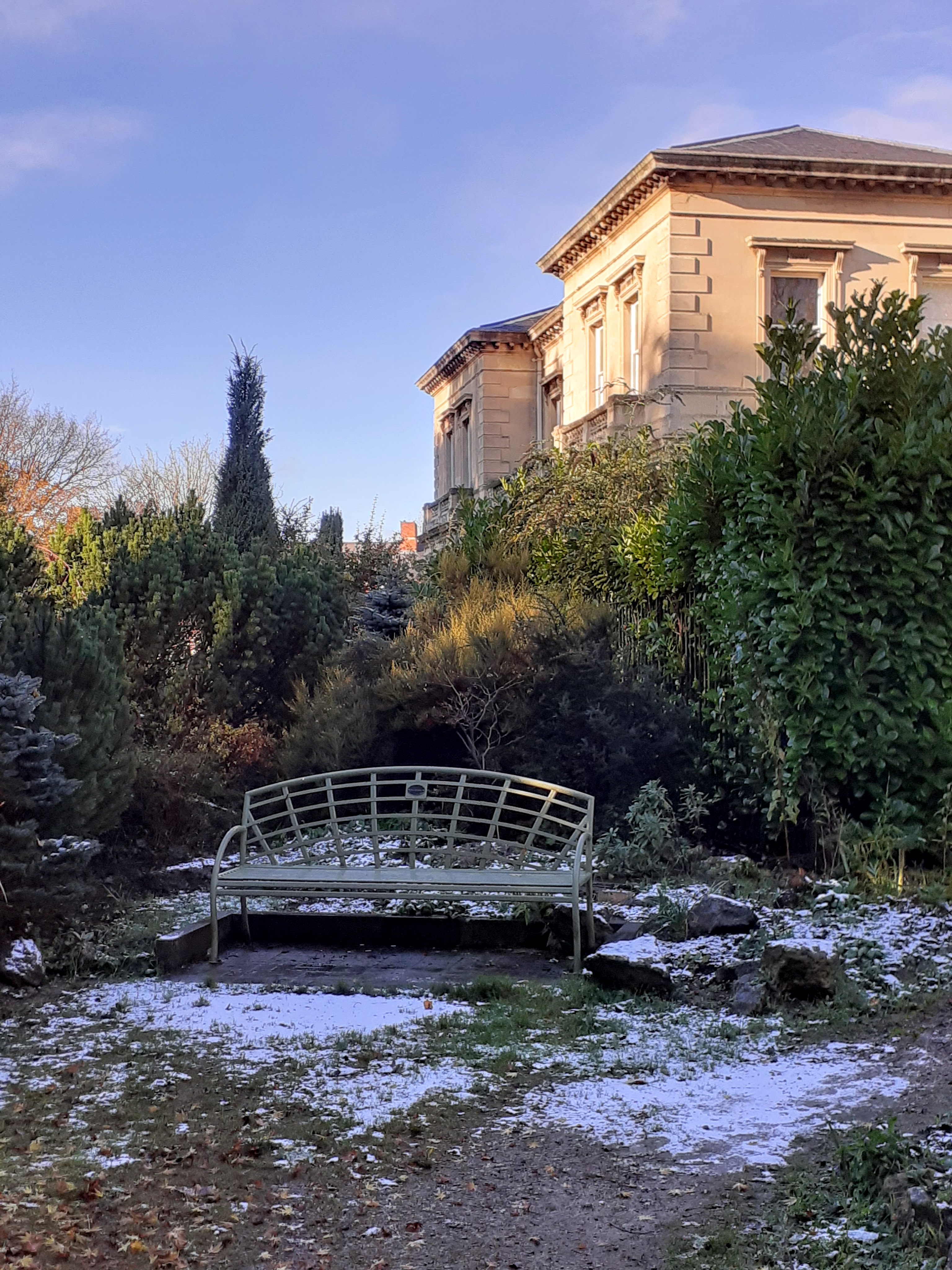
In the most wooded and unmanicured section of the gardens, I found snow still present on a section of cleared space and pathway. Elsewhere there was no trace of it, even in this relatively shadowed space.

On the buildings below – blue sky, sun and shadow. In the picture below snow is just discernible on a rooftop and in a garden. During the period of my walk (1-1.30 pm) the gardens visibly changed. The snow was retreating and shadows continued to shift.

It wasn’t a long walk – twenty minutes each way for the sake of my legs and thirty in the garden. It was enough. I took away the psychic rejuvenation I named at the beginning of this post. The experience was both mystical and ordinary, a place where the ‘spiritual’ and ‘mundane’ are one – and big part of how I live my Druidry.

(1) SEE: https://contemplativeinquiry.blog/2024/04/11/images-from-a-town-garden/

(2) NOTE: At the beginning of April 2024 I discovered Hillfield Gardens – a little outside the centre of Gloucester, yet still in easy walking distance (or an easy bus ride) from where I live. Originally the gardens of a large house, Hillfield Gardens are about 1.6 hectares in extent. They are managed by a Friends Group on behalf of Gloucestershire County Council. For me the gardens are a tranquil space, different in feeling-tone from other local parks.

‘CONCRETE SCIENCE’ IN NEOLITHIC CULTURES

Extract from The Dawn of Everything: A New History of Humanity by David Graeber and David Wengrow (1), exploring the notion of ‘concrete science’. The idea comes from the anthropologist Claude Levi-Strauss, who is quoted as saying that “there are two distinct modes of scientific thought … two strategic levels at which nature is accessible to scientific enquiry: one roughly adapted to that of perception and imagination: the other at a remove from it”. ‘Concrete science’ is the first. The specific focus, in this part of the book, is on the development of Early Neolithic societies in lowland parts of the Fertile Crescent, especially along the valleys of the Jordan and Euphrates rivers.

Graeber and Wengrow write: “It’s important to recall that most of humanity’s greatest scientific discoveries – the invention of farming, pottery, weaving, metallurgy, systems of maritime navigation, monumental architecture, the classification and indeed domestication of plants and animals. and so on” come out of ‘concrete science’. But what does such a science actually look like, in the archaeological record? “The answer lies precisely in its ‘concreteness’. Invention in one domain finds echoes and analogies across a whole range of others, which might otherwise seem completely unrelated”.

“We can see this clearly in early Neolithic cereal cultivation. Recall that flood-retreat farming required people to establish durable settlements in mud-based environments, like swamps and lake margins. Doing so meant becoming intimate with the properties of soils and clays, carefully observing their fertility under different conditions, but also experimenting with them as tectonic materials, or even as vehicles of abstract thought. As well as supporting new forms of cultivation, soil and clay – mixed with wheat and chaff – became basic materials of construction: essential in building the first permanent houses; used to make ovens, furniture and insulation – almost everything, in fact, except pottery, a later invention in this part of the world.

“But clay was also used, in the same times and places, to (literally) model relationships of utterly different kinds, between men and women, people and animals. People started using its plastic qualities to figure out mental problems, making small geometric tokens that many see as direct precursors to later systems of mathematical notation. Archaeologists find these tiny numerical devices in direct association with figurines of herd animals and full-bodied women: the kind of miniatures that stimulate so much speculation about Neolithic spirituality, and which find later echoes in myths about the demiurgic, life-giving properties of clay. As we’ll soon see, earth and clay even come to redefine relationships between the living and the dead.

“Seen this way, the ‘origins of farming’ start to look less like and economic transition and more like a media revolution, which was also a social revolution, encompassing everything from horticulture to architecture, mathematics to thermodynamics, and from religion to the remodelling of gender roles. And while we can’t know who exactly was doing what in this brave new world, it’s abundantly clear that women’s work and knowledge were central to its creation; that the whole process was a fairly leisurely, even playful one, not forced by any environmental catastrophe or demographic tipping point and unmarked by major violent conflict. What’s more, it was all carried out in ways that made radical inequality an extremely unlikely outcome”.

(1) David Graeber and David Wengrow The Dawn of Everything: A New History of Humanity Penguin Books, 2022 (First published in Great Britain by Allen Lane in 2021)

NOTE ABOUT THE AUTHORS David Graeber was a professor of anthropology at the London School of Economics. He is the author of Debt: The First 5,000 Years. As an activist, he also helped to make Occupy Wall Street (2011) an era-defining moment. He died on 2 September 2020. David Wengrow is a professor of comparative archaeology at University College London. He conducts fieldwork in Africa and the Middle East and is the author of What Makes Civilisation? Following David Graeber’s death shortly after the text of The Dawn of Everything was completed, David Wengrow has overseen its publication.

Earth Eclectic

music that celebrates Earth and speaks to the heart

Sarah Fuhro Star-Flower Alchemy

Follow the Moon's Cycle

Muddy Feet

Meeting nature on nature's terms

Rosher.Net

A little bit of Mark Rosher in South Gloucestershire, England

Becoming Part of the Land

A monastic polytheist's and animist’s journal

selkiewife

Selkie Writing…

Charlotte Rodgers

Images and words set against a backdrop of outsider art.

Prof Jem Bendell

living with metacrisis and collapse

Towint

The pagan path. The Old Ways In New Times

The Druids Garden

Spiritual journeys in tending the living earth, permaculture, and nature-inspired arts

The Blog of Baphomet

a magickal dialogue between nature and culture

This Simple Life

The gentle art of living with less

Musings of a Scottish Hearth Druid and Heathen

Thoughts about living, loving and worshiping as an autistic Hearth Druid and Heathen. One woman's journey.

Wheel of the Year Blog

An place to read and share stories about the celtic seasonal festivals

Walking the Druid Path

Just another WordPress.com site

anima monday

Exploring our connection to the wider world

Grounded Space Focusing

Become more grounded and spacious with yourself and others, through your own body’s wisdom

The Earthbound Report

Good lives on our one planet

Hopeless Vendetta

News for the residents of Hopeless, Maine