Contemplative Inquiry

This blog is about contemplative inquiry

Tag: Panpsychism

ANIMISM FOR OUR TIMES

This post looks at Animism as the guiding principal of my Druidry. The term itself comes from nineteenth century anthropology, and is somewhat problematic. Scholars from European and North American backgrounds , formed by a mix of Christian and secular ideas, were studying, and labelling, the traditional practices of other people. The people themselves were mostly in the process of becoming colonial subjects and living in cultures under stress. So ‘Animism’ started out as a top-down classification, which gave Animists a lowly position in the hierarchy of cultural and spiritual life. A stigma persists to this day.

Despite this dubious history, the word ‘Animism’ is now being turned around by people from the global north itself, spiritually hungry in our now palpably faltering 21st century world. Some years ago, research by Graham Harvey distinguished two positive uses of the term Animism among modern western Pagans. “Some Pagans identified Animism as a part of their religious practice or experience which involved encounters with tree-spirits, river-spirits or ancestor-spirits. This Animism was metaphysical. … Other Pagans seemed to use ‘Animism’ as a short-hand reference to their efforts to re-imagine and re-direct human participation in the larger-than-human, multi-species community. This Animism was relational, embodied, eco-activist and often ‘naturalist’ rather than metaphysical” (1).

My Animism draws primarily on the second of the two accounts above. But it is deepened by a Buddhist influence, especially that of the Vietnamese Zen Master Thich Nhat Hanh: “There is no absolute dividing line between living matter and inert matter. If we took the so-called inanimate elements out of you and me, we would not be able to live. We are made of non-human elements. This is what is taught in the Diamond Sutra, an ancient Buddhist text that could be considered the world’s first treatise on deep ecology. We cannot draw a hard distinction between human beings and other living beings, or between living beings and inert matter. There is vitality in everything. The entire cosmos is radiant with vitality. If we see the Earth as a block of matter lying outside of us, then we have not yet truly seen the Earth. The Earth is also alive” (2).

Thich Nhat Hanh follows an old tradition. In thirteenth century Japan, Zen Master Eihei Dogen had taught that enlightenment is just ‘intimacy with all things’. Elsewhere in his own text, Thich Nhat Hanh says: “Just as a wave doesn’t need to go looking for water, we don’t need to go looking for the ultimate. The wave is the water. You already are what you want to become. You are made of the sun, moon and stars. You have everything inside you”. Thich Nhat Hanh explains that a flower is made only of non-flower elements. We can say that the flower is empty of separate self-existence. But that doesn’t mean that the flower is not there. “When you perceive reality in this way, you will not discriminate against the garbage in favour of the rose” (2).

This Buddhist wisdom doesn’t seem to me to come directly out of the four noble truths or eightfold path. The Buddhists of south-east and east Asia were at ease with the traditional Animism of their cultures, and the views expressed above appear to me to be at least partly a cultural gift from the Animists. Japan, for example, was intensely influenced by Buddhism without any thought of displacing Shinto, and the traditions readily interwove.

It was otherwise in the west. Already, In the first century CE, the Roman philosopher Plutarch wrote of the death of Great Pan, after the time of Jesus but before the rise of Christianity. James Hillman comments: “With Pan dead, so was Echo; we could no longer capture consciousness through reflecting within our instincts. … The person of Pan the mediator, like an ether who invisibly enveloped all natural beings with personal meaning, with brightness, had vanished. Stones became only stones – trees, trees; things, places, animals no longer this god or that, but became ‘symbols’, or were said to ‘belong’ to one god or another. When Pan is alive, then nature is too – the owl’s hoot is Athena and the mollusc on the shore is Aphrodite … Whatever was eaten, smelled, walked upon or watched, all were sensuous presences of archetypal significance”.” (3).

James Hillman, after service as Director of Studies as the Jung Institute in Zurich, went on to develop his own form of archetypal psychology. He was a strong proponent of Panpsychism, a world view very similar to forms of Animism being articulated today. Panpsychism literally means the ensoulment of everything (from the Greek), though the sound ‘Pan’ also associates us with the god. At the same time this view broadly fits with the understanding of Zen Buddhist Thich Nhat Hanh, described above.

‘Animism’ is for me a word, not a thing, or a another religious banner to raise. It points to a wide range of experiences, understandings, and articulations. Pinned down to a single, dictionary definition, it would lose its power and energy. Yet Animism has become the word that best describes my way of being a modern Druid, both as view and as practice. I find it grounding and regenerative to have decisively adopted this word.

(1) Graham Harvey (ed.) The Handbook of Contemporary Animism London & New York: Routledge, 2014 (First published by Acumen in 2013)

(2) Thich Nhat Hanh The Art of Living London: Rider, 2017 (Rider is part of Penguin Random House)

(3) James Hillman The Essential James Hillman: A Blue fire London: Routledge, 1989 (Introduces and edited by Thomas Moore in collaboration with the author)

See also my recent post at https://contemplativeinquiry.blog/2023/07/02/animist-endarkenment which references Emma Restall Orr’s The Wakeful World: Animism, Mind and the Self in Nature

ANIMIST ENDARKENMENT

I have been re-visiting Emma Restall Orr’s ground-breaking work on animism, where she reframes this term for our times and emphasises its value to modern Druids. Much of her book explores the formal philosophy and metaphysics of animism and panpsychism. In this, more lyrical passage, she questions ‘permanent enlightenment’ and advocates freedom from “knowledge-based certainty” and dependency on knowing.

“To the animist, a state of permanent enlightenment is not considered natural. His senses inform him that, firstly, light is sustained by a balance of light and darkness, and, secondly, it is lived for the most part in neither darkness or light, but in varying degrees of twilight and shadow, of half knowing, believing, assuming and concluding.

“The aspiration for fluency and lucidity, another light-derived word, is firmly established in our culture though. Literally and figuratively, in darkness we are denied the safety of certainty. As the dusk comes and the light slips away like an outgoing tide, edges begin to dissolve. In darkness, our senses more easily blur, leaving us potentially deceived. If we are dependent upon knowing, this can leave us confused and fearful. The not-knowing is judged as ignorance; darkness is declared bad, and to be avoided as dangerous. As the deep wellspring of wickedness, any who embrace the darkness must be equally spurned.

“If, however, our aim is not a knowledge-based certainty, what the darkness provides is delicious and necessary release. In the dark, the separation created by edges is no longer relevant to our perception and reality, allowing entirely new parameters of freedom. … We need moments within which we can dissolve all we are and all we know, that we might find the nourishment for new inspiration and realisation”.

(1) Emma Restall Orr The Wakeful World: Animism, Mind and the Self in Nature Winchester, UK & Washington, USA: Moon Books, 2012

BIOCENTRISM

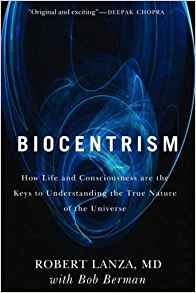
Biocentrism (1) and the follow-up Beyond Biocentrism (2) are science-referenced explorations of cosmos and consciousness. Unusually, they present a ‘consciousness first’ view. In the first book authors Robert Lanza and Bob Berman work through the evidence and identify seven principles of biocentrism.

“If one removes space and time as actual entities rather than subjective, relative and observer-created phenomena, it pulls the rug from the notion that an external world exists within its own independent skeleton. Where is this external objective existence if it has neither time nor space? we can, at this point formulate seven principles:

“First Principle of Biocentrism: What we perceive as reality is a process that involves our consciousness. An ‘external’ reality if it existed, would – by definition – have to exist in space. But this is meaningless, because space and time are not absolute realities but rather tools of the human and animal mind.

“Second Principle of Biocentrism: Our external and internal perceptions are inextricably intertwined. They are different sides of the same coin and cannot be divorced from one another.

“Third Principle of Biocentrism: The behaviour of subatomic particles – indeed all particles and objects – is inextricably linked to the presence of an observer. Without the presence of a conscious observer, they at best exist in an undetermined state of probability waves.

“Fourth Principle of Biocentrism: without consciousness, ‘matter’ dwells in an undetermined state of probability. Any universe that could have preceded consciousness only existed in a probability state.

“Fifth Principle of Biocentrism: the structure of the universe is explainable only through biocentrism. The universe is fine-tuned for life, which makes perfect sense as life creates the universe, not the other way around. The ‘universe’ is simply the complete spatio-temporal logic of the self.

“Sixth Principle of Biocentrism: Time does not have a real existence outside of animal-sense perception. It is the process by which we perceive changes in the universe.

“Seventh Principle of Biocentrism: Space, like time, is not an object or a thing. Space is another form of our animal understanding and does not have an independent reality. We carry space and time around with us like turtles with shells. Thus, there is no absolute self-existing matrix in which physical events occur independent of life.”

Beyond Biocentrism summarises and extends Biocentrism. It does not repeat the principles, but elegantly summarises the perspective of biocentrism and takes the argument into new territory. An appendix to the book lists its major topics as: the exploration of time; the unreality of death; the nonreality of space; the nature of consciousness; science proofs of biocentrism; asking about awareness in machines (probably no) and plants (certainly yes).

When I contemplate biocentric thinking, I feel engaged and intrigued – without taking a stance on its truth claims. I can see how the universe of the space/time continuum, and within it the earth that I love, may be but a bubble of local, provisional reality. In the light of this narrative, simply experiencing life, being part of it, feels vividly magical. The effect is to ground me even more in my earth spirituality, gratefully celebrating the experienced here and now.

(1) Robert Lanza, MD, with Bob Berman Biocentrism: How Life and Consciousness are the Keys to Understanding the True Nature of the Universe Dallas, TX: Benbella Books, 2009

(2) Robert Lanza, MD, with Bob Berman Beyond Biocentrism: Rethinking Time, Space, Consciousness, and the Illusion of Death Dallas, TX: Benbella Books, 2016

PANPSYCHISM: A NOTE

Non-dualist author Peter Russell is happy to use the Western terms ‘panpsychism’ and ‘panexperientialism’ when discussing what he calls the “mystery of consciousness”. These terms are both modifications of ‘pantheism’ and the ideas have a kinship with those of modern animism. From a Druid perspective, I find it valuable to see this kind of connection being made with the non-dualist systems of Indian origin – whether Tantric, Vedantic, Buddhist or Jain. Challenging our modern mainstream culture’s assumptions about consciousness, Russell says:

“The underlying assumption of the current meta-paradigm is that matter is insentient. The alternative is that the faculty of consciousness is a fundamental quality of nature. Consciousness does not arise because of some particular arrangement of nerve cells or processes going on between them, or from any other physical features. It is always present.

“If the faculty of consciousness is always present, then the relationship between consciousness and nervous systems needs to be rethought. Rather than creating consciousness, nervous systems may be amplifiers of consciousness, increasing the richness and quality of experience. In the analogy of a film projector, a nervous system is like having a lens in the projector. Without the lens there is still a light on the screen, but the image is much less sharp.

“In philosophical circles the idea that consciousness is in everything is called panpsychism, from the Greek pan, meaning all, and psyche, meaning soul or mind. Unfortunately, the words soul and mind suggest that simple life forms may possess qualities of consciousness found in human beings. To avoid this misunderstanding, some contemporary philosophers use the term panexperientialism – everything has experience.

“Whatever name this position is given, its basic tenet is that the capacity for inner experience could not evolve or emerge out of entirely insentient, non-experiencing matter. Experience can only come from that which already has experience. Therefore, the faculty of consciousness must be present all the way down the evolutionary tree.

“We know that plants are sensitive to many aspects of their environment – length of daylight, temperature, humidity, atmospheric chemistry. Even some single-celled organisms are sensitive to physical vibration, light and heat. Who is to say that the do not have a corresponding glimmer of awareness?

“According to this view, there is nowhere we can draw a line between conscious and nonconscious entities; there is a trace of experience, however slight, in viruses, molecules, atoms and even elementary particles.”

Peter Russell From Science to God: a Physicist’s Journey into the Mystery of Consciousness Novato, CA: New World Library, 2002

NATURE ALIVE

“A cry went through late antiquity: ‘Great Pan is dead!’. Plutarch reported it in his On the failure of the oracles, yet the saying has itself become oracular, meaning many things to many people in many ages. One thing was announced: nature had become deprived of its creative voice. It was no longer an independent voice of generativity. What had had soul, lost it: or lost was the psychic connection with nature.

“With Pan dead, so to was Echo; we could no longer capture consciousness through reflecting within our instincts. They had lost their light and fell easily into asceticism, following sheepishly without instinctual rebellion their new shepherd, Christ, with his new means of management. Nature no longer spoke to us – or we could no longer hear. The person of Pan the mediator, like an ether who invisibly enveloped all natural things with personal meaning, with brightness, had vanished. Stones became only stones – trees, trees; things, places and animals no longer were this god or that, but became ‘symbols’, or were said to ‘belong’ to one god or another.

“When Pan is alive then nature is too and it is filled with gods, so that the owl’s hoot is Athena and the mollusc on the shore is Aphrodite. These bits of nature are not merely attributes or belongings. They are gods in their biological forms. And where better to find the gods than in the things, places and animals that they inhabit, and how better to participate in them through their concrete, natural presentations. Whatever was eaten, smelled, walked upon or watched, all were sensuous presences of archetypal significance.” (1)

The above is an extract from a piece by James Hillman, one time director of studies at the Jung Institute in Zurich. Hillman later went on to develop his own variant form of archetypal psychology. Here he is a strong proponent of panpsychism, a world view very similar to the forms of animism being articulated today. Panpsychism literally means the ensoulment of everything (from the Greek), though the word ‘pan’ also cues in a reference to the Roman god of that name. I find his approach both passionate and liberating as a stance to take towards ‘nature alive’.

(1) Hillman, James (1989) The essential James Hillman: a blue fire London: Routledge (Introduced and edited by Thomas Moore in collaboration with the author)

Earth Eclectic

music that celebrates Earth and speaks to the heart

Sarah Fuhro Star-Flower Alchemy

Follow the Moon's Cycle

Muddy Feet

Meeting nature on nature's terms

Rosher.Net

A little bit of Mark Rosher in South Gloucestershire, England

Becoming Part of the Land

A monastic polytheist's and animist’s journal

selkiewife

Selkie Writing…

Charlotte Rodgers

Images and words set against a backdrop of outsider art.

Prof Jem Bendell

living with metacrisis and collapse

Towint

The pagan path. The Old Ways In New Times

The Druids Garden

Spiritual journeys in tending the living earth, permaculture, and nature-inspired arts

The Blog of Baphomet

a magickal dialogue between nature and culture

This Simple Life

The gentle art of living with less

Musings of a Scottish Hearth Druid and Heathen

Thoughts about living, loving and worshiping as an autistic Hearth Druid and Heathen. One woman's journey.

Wheel of the Year Blog

An place to read and share stories about the celtic seasonal festivals

Walking the Druid Path

Just another WordPress.com site

anima monday

Exploring our connection to the wider world

Grounded Space Focusing

Become more grounded and spacious with yourself and others, through your own body’s wisdom

The Earthbound Report

Good lives on our one planet

Hopeless Vendetta

News for the residents of Hopeless, Maine