Contemplative Inquiry

This blog is about contemplative inquiry

Tag: Panentheism

‘BEING’

‘Being’ can be thought of in a number of ways. One is to say that it simply is what it is. I am. The flowers are.  No need for complications. I sympathise with this approach.

Yet when nudged to look at a 2021 post of my own (1), I found the following words based on the work of Eckhart Tolle (2). “Human is form. Being is formless. Human and Being are not separate but interwoven.” A part of my work in contemplative inquiry is to find a balance between human and Being.

For me, ‘Being’ is a way to talk about the divine, whilst keeping a distance from theistic language and its traditional associations. Some people use ‘ground of being’ in this sense. Experientially, silence, stillness, emptiness – the space between thoughts, feeling and things – open me up to Being. Feelings of joy and lovingkindness are likely to enter in. I find that deepening into Being enriches the human dimension itself – with all of its relationships, roles and activities in 3D time bound reality. In older language, it brings heaven to earth.

I like this use of language for its plainness and simplicity. Ultimately its assumptions are a matter of faith within a larger framework of unknowing. It simply describes where I stand within my continuing inquiry. I have also enjoyed being reminded of this use of words by my past self. It’s a personal benefit of having this record.

(1) https://contemplativeinquiry.blog/2021/03/03/spring-clarity/

(2) Eckhart Tolle Oneness with All Life: Awaken to a Life of Purpose and Presence Penguin Random House UK, 2018 (1st. ed. 2008)

AN UNDERSTANDING OF ‘GNOSIS’

My last post was about working with ancient texts. Here I look at the term ‘gnosis’ in the Gospel of Thomas. I am indebted to the commentary of translator Jean-Yves Leloup. Here he reflects on logion 5, whose text I include  in a note below.

“Gnosis is not a system, not another ideology through which we are to interpret and understand the world. On the contrary, it means opening our eyes to what we are already looking at, right in front of us, not searching somewhere else.

”  … Things are not hidden in themselves; they are open – the veils hiding them are in the habits of our own vision, so crude, so overloaded with memories and assumptions about reality, distorting what is before us …

“Gnosis is a long-term work of recognition, of purity of attention so as really to see what is in front of us. The consequence of this attention is that we become what we see and what we love … If we look at chaos, we will reflect chaos. If we look at light, we will reflect light.” (1)

I am glad that this commentary provides more than scholarly exegesis. Leloup says in his introduction that he wants to offer “a meditation that arises from the tilled earth of our silence. It is my belief that it is from this ground, rather than from mental agitation, that these words can bear their fruit of light “. In this way Leloup dreams the myth onwards for our time, and passes the baton to his readers. Both a blessing, and a responsibility.

(1) Commentary on Logion 5, The Gospel of Thomas: The Gnostic Wisdom of Jesus Rochester, VT: Inner Traditions, 2005

(Text translated from the Coptic with commentary by Jean-Yves Leloup; foreword by Jacob Needleman. English translation by John Rowe  Original French edition published 1986).

The translated logion reads:

“Yeshua said:

Recognize what is in front of you, and what is hidden from you will be revealed.

There is nothing hidden that will not be revealed.”

NOTE: See also

CHILD OF THE NOW

NUMINOUS IMAGES: SKY TO EARTH

Recent days have been rich in numinous images. Images that for me mark the divinity within our material reality. Above, the recent full moon: clear light at the centre and a blood moon halo suggesting a link with the earth, later to manifest in an eclipse. The sky  is deep violet leaning into indigo. The shaded trees absorb the energy of the sky as well as of the earth. The whole image feels moving and inspiring – an image for contemplation which doesn’t need esoteric analysis. Its simple presence is enough.

The same is true for the images that follow. Immediately below is a day time sky image. The day was frequently stormy, with high winds and hard rain.  Dark clouds testify to moments of lightning, loud thunder and tumultuous rain. But the image itself records a period of respite. In a gap between the clouds, blue sky can be seen and the light pours strongly in.

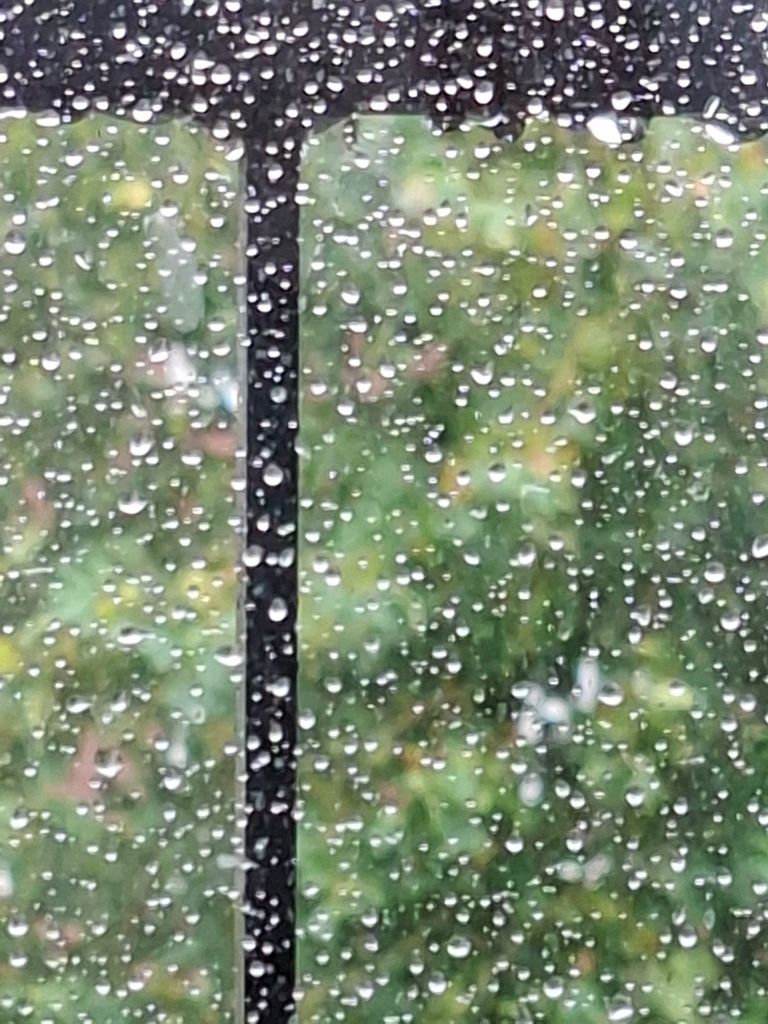
Rain on a window pane is central to the next image. The rain drops are the primary subject. What’s on the other side (a balcony garden) isn’t entirely clear in the picture and doesn’t need to be. I experience a great sense of cleansing and refreshment here – the water of life as it falls from the sky, each drop itself an ocean. I look out from my interior space, two stories above the ground floor, and connect with this bounty.

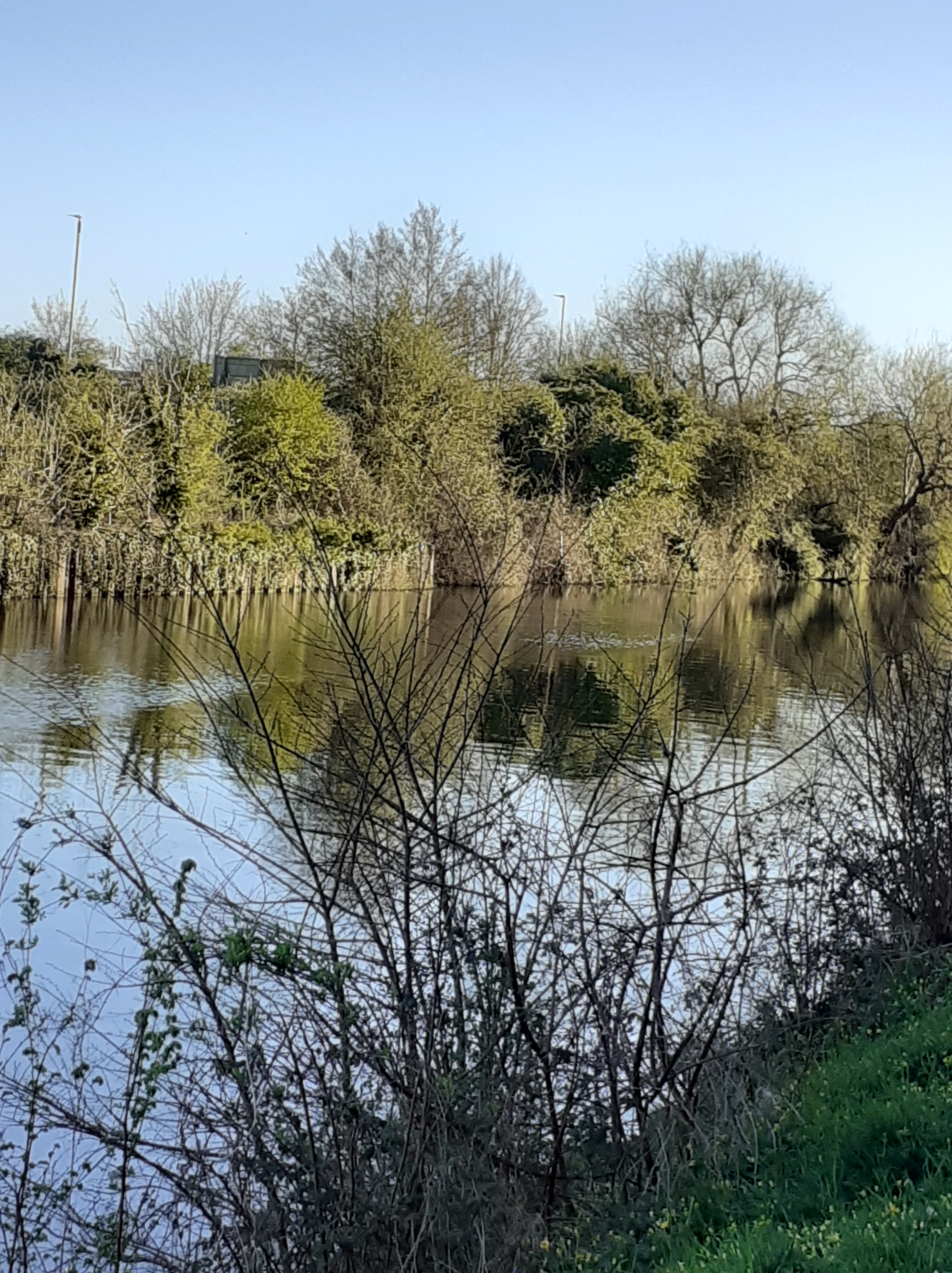
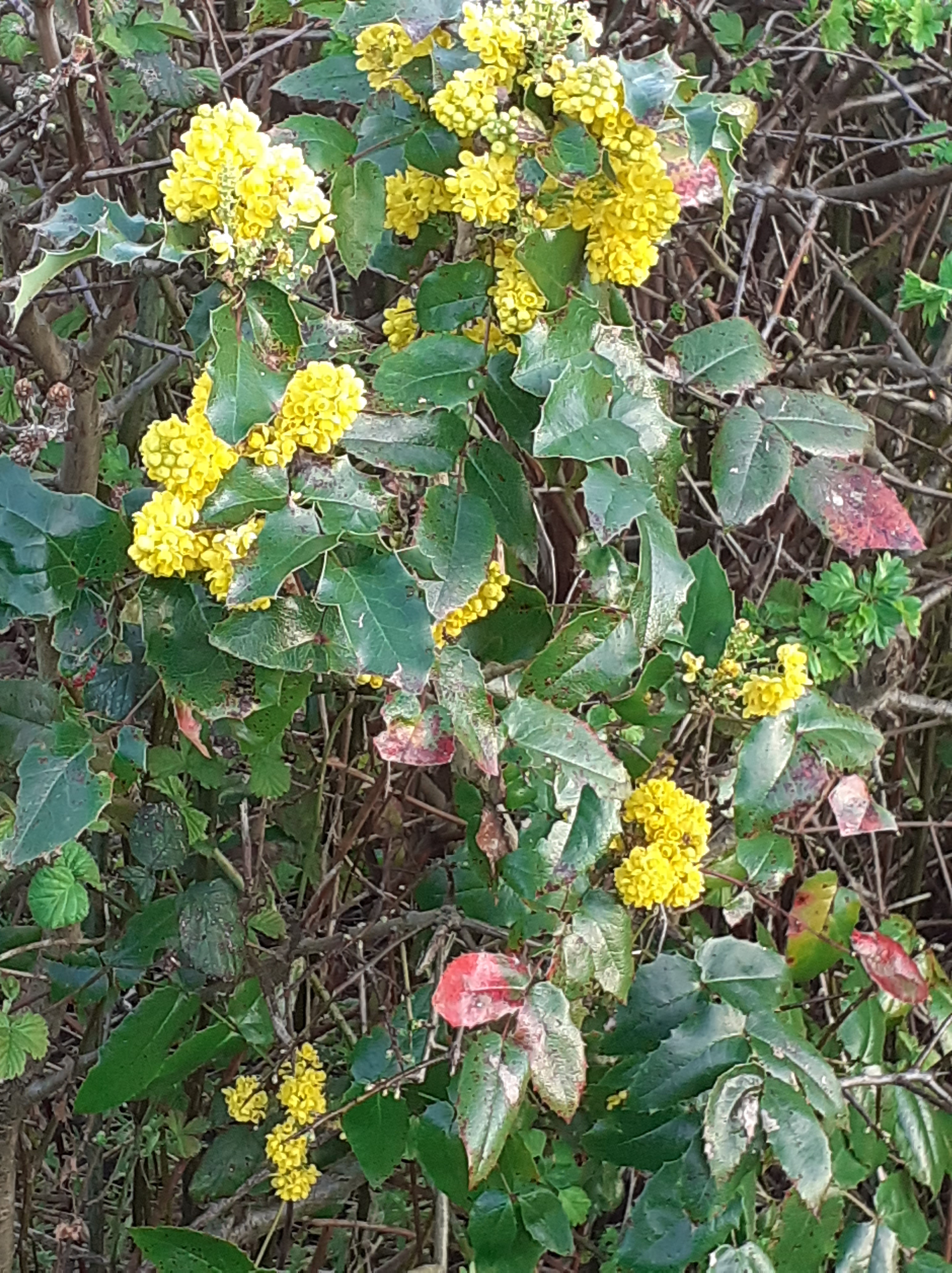
The two remaining images come from  a recent walk on Alney Island – outdoors and on normally marshy ground. The first is a woodland space with its fresh entangled green. The ground still looks drier than it sometimes does, yet I  sense health and recovery here. In the second image, I see a re-greened path with benignly rioting verges. Seeing what I see, I follow the green path.

HARVESTING INSIGHT

Noticing a single corn stalk under our neighbouring birch trees, I wonder whether the seed simply blew in or was planted by an unknown hand. If the latter, what was their intention? I realise that I will never know.

I do know how much I enjoy its presence in this space at this time. I experience it as a miracle inviting gratitude and it has marked the seasonal moment for me, this first harvest of a now declining year.

With increasing clarity I understand that I do not work well with personified and individualised images of the divine. Something seems subtly off, as if I am failing to sound my own authentic note in the Great Song of the world.

I believe that we are given different gifts in our encounters with the Cosmos, leading to legitimately different understandings. When I lean in to the notion of divine personality – even when using the term ‘Spirit’ in that sense – I am not fully living my own truth. I subtly disempower myself and weaken my connection.

For in my universe, when I rest in my own clarity, there is no separation between nature (including culture) and spirit. In the awkward activity of identification and labelling, I answer to terms like animist, panentheist and nondualist.

These words are approximations, with the power to be distracting and slightly depressing. I can find words that point to my experience well enough. But the explanatory words, the more formal and generalised terms, feel clumsy. There’s a necessary level of unknowing that these isms don’t recognise.

When consciously living in spirit, I am neither alone, as a single human person, nor am I with another being. I am simply in a different dimension of embodied awareness, supported and empowered by the bubbling source from which I spring. For me, Nature is more than the ‘nature’ of dualist spiritualities and of the scientific humanism that grew out of them.

As I harvest the learning, or relearning, of this lesson, I renew my commitment to practice and path, once again revising the beginning and end of the modern Druid’s prayer (1). I move from from ‘Grant, Spirit your protection, and in protection, strength … ‘ to ‘In spirit I find protection, and in protection, strength …’. I end with ‘and in the love of all existences, the love of this radiant Cosmos’ rather than ‘the love of God/Goddess/Spirit and all goodness’. These small changes formalise and anchor my understanding.  For me, they are an important affirmation, illuminating my path.

(1) Traditionally, this prayer runs:

Grant O God/Goddess/Spirit, your protection,

And in protection, strength,

And in strength, understanding,

And in understanding, knowledge,

And in knowledge, the knowledge of justice

And in the knowledge of justice, the love of it

And in the love of it, the love of all existences

And in the love of all existences, the love of God/Goddess/Spirit and all goodness”.

NB Providing the options of God/Goddess/Spirit is I think an OBOD (Order of Bards, Ovates and Druids) innovation. The original version, from the late 18th century, simply said ‘God’. Some modern Druids say ‘God and Goddess’.

HERTHA AS EARTH MOTHER AND COSMIC GODDESS

Hertha (Nerthus, Erth) was a Germanic Goddess of the Earth, associated with fertility, domestic animals and nature. She was believed to live in an island grove, whilst also touring the land in a cow drawn chariot to bring peace and joy to those who celebrated her. Our ancient information is derived from the Roman author Tacitus, in his Germania (1). Current accounts also link her to themes of rebirth, kinship, health, longevity and tradition. It is said that she can descend through the smoke of any fire to bring gifts. See: https://journeyingtothegoddess.wordpress.com/2012/12/25/goddess-hertha/

Algernon Charles Swinburne’s Victorian poetry is mentioned in two of Ronald Hutton’s Divinity lectures at Gresham College (2,3). In particular he describes the poem Hertha (3) as an important example of Pagan currents in Victorian British culture. Although widely seen then and (for some people) since as transgressive, Swinburne’s voice is confident and strong – as I hope these extracts show:

“I am that which began:

Out of me the years roll;

Out of me God and man;

I am equal and whole;

God changes, and man, and the form of them bodily;

I am the soul.

“Before ever land was,

Before ever the sea,

Or soft hair of the grass,

Or fair limbs of the tree,

Or the flesh-coloured fruit of my branches, I was, and thy soul was in me.

“First life on my sources

First drifted and swam;

Out of me are the forces

That save it or damn;

Out of me man and woman, and wild beast and bird; before God was, I am.”

As I read these verses, Swinburne’s Hertha is cosmic as well as local, universal as well as tribal. Swinburne clearly values Hertha’s specific name and lineage and he identifies Hertha with the World Tree in some verses. But he does not simply revive the old North European traditions. His Paganism models a new culture for a new time.

Although another 150 years have passed since Swinburne wrote this poem, I find it directly relatable. For me, it contains one of the most powerful affirmations of Panentheist Paganism I have heard: “I am the mouth that is kissed and the breath in the kiss, the search, and the sought, and the seeker, the soul and the body that is”. What better time than Beltane to celebrate Hertha and the 19th century seeding of Modern Paganism.

(1) Tacitus Agricola and Germania London: Penguin, 2009 (rev ed)

(2) The Modern Goddess and Where did Modern Paganism start? https://www.gresham.ac.uk/watch-now/

(3) Algernon Charles Swinburne Complete Poetical Works Delphi Classics, 2013 (Kindle edition)

CONTEMPLATIVE DIARY?

Recently I have wondered whether to change the name of this blog from Contemplative Inquiry to Contemplative Diary. I won’t, because the inquiry focus has been very strong over the years. It is ancestral to the diary approach and a deep influence upon it. Some of the older inquiry posts continue to be read. The most popular is A Parable About a Parable first published in July 2018 – https://contemplativeinquiry.blog/2018/07/31/.

But most of my current posts are not like that. They tend to be more informal, more embedded in daily life, more obviously situated in time, place and everyday personal experience. My most recent post, Spring Forward https://contemplativeinquiry.blog/2025/03/31/ – is a case in point.

This shift in emphasis developed in the years of the Covid pandemic and is characterised by living the Wheel of the Year day-by-day (rather than festival by festival) in a specific location. I use my own photographs much more than in the early days of the blog. For me, these changes fit with a name like Contemplative Diary.

Yet the diary approach is itself a fruit of inquiry. It has emerged as I become relatively less concerned with fundamental questions. They are now settled for me as far as they can be in this life. My current work comes out of an individual life practice grounded in modern Druidry, with a firm ethical basis and a light touch in formal ritual and meditation. All of these are illuminated by the sense of a divine presence from which the world, including me, is not separate.

Contemplation and inquiry are still at the heart of my work, in simpler and more relaxed forms than was right for the early years. The diary approach marks an emerging phase of my contemplative inquiry, rather than a break with it. Where it will take me going forward, I cannot yet say.

THE MYTH OF THE JOURNEY AND THE MYTH OF THE NOW

I use the word ‘myth’ in a positive sense. Myth is a gift of imagination. It is a way of seeing beyond the limiting horizons of everyday life and culture. We can intuit a fuller, more spacious and generous reality, a reality with multiple dimensions. The specific myth of the journey, or quest, has had a powerful role in human history at both the personal and collective levels.

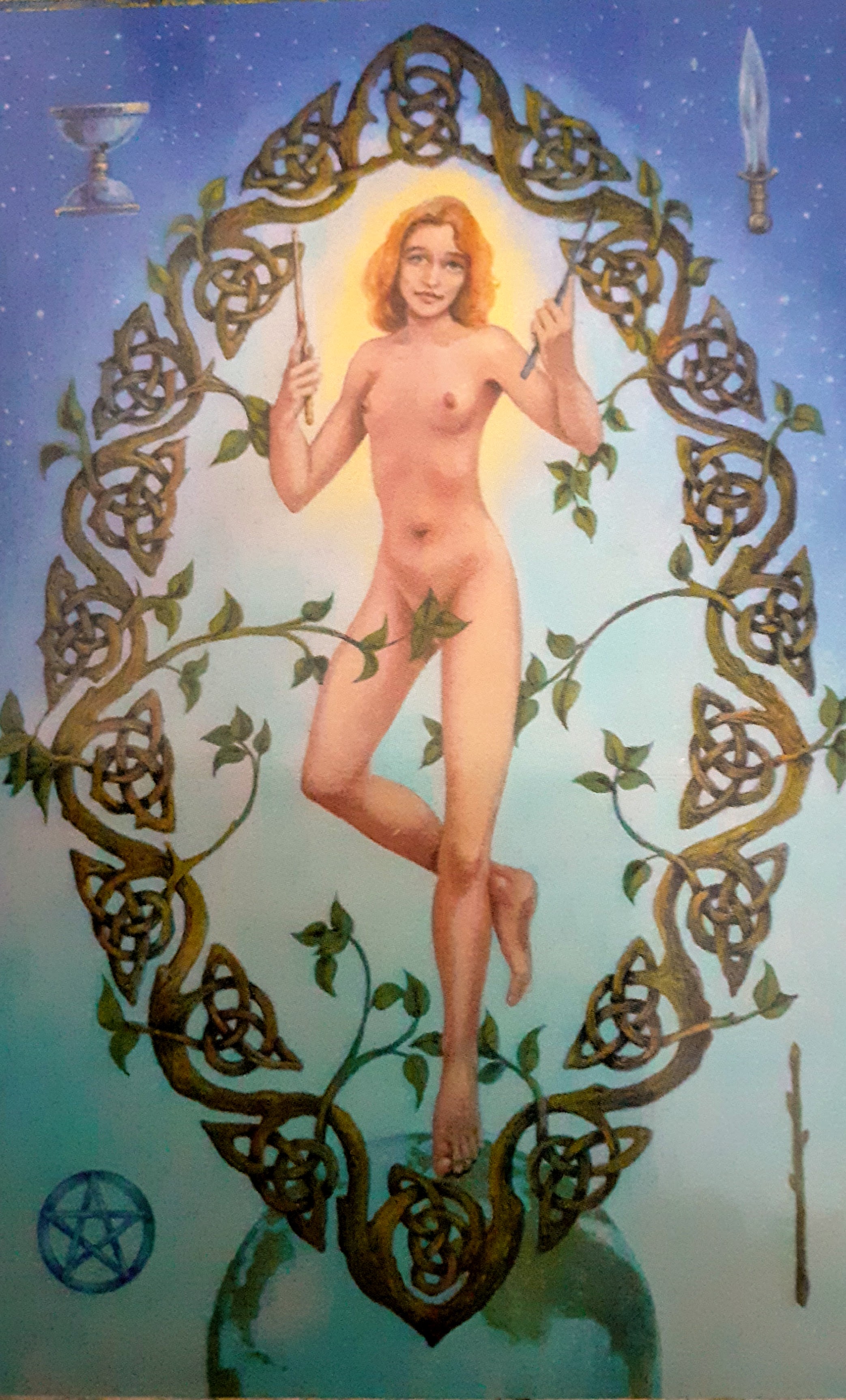
The picture above is the Fool, or innocent, as depicted the The Druidcraft Tarot (1). Trusting their inner knowing, the Fool steps over a cliff. It is a spring dawn, and a new beginning. The major Arcana are a map of the journey, which in essence, here, is seen as a refinement of the soul to the point where union with the divine is a lived experience. This experience is available here, in the world, and so the card indicating the completion of the journey (see picture below) is here called The World.

The mythology of the deck draws on the Welsh Celtic story of Taliesin and Ceridwen as well as the pan-European Arthurian grail quest, and broader Western Mysteries understandings derived from the Hermetic Order of the Golden Dawn. But any individual journey is its own new beginning and its fruits depend of making the journey in real time, and not clinging too tightly to traditional understandings.

In my own spiritual life, I have drawn both on the myth of the journey and another, apparently contradictory myth – that of the eternal moment, the transfigured here-and-now. Again, I find no disparagement in the word myth. This says that non-separation from the divine is a given. There is nowhere to go and nothing to do. Ultimately, there is no ontological difference in being awake to this reality than in being asleep to it. Yet lived experience is transformed by being awake to this reality and living from the awareness.

From a human perspective, coming to this awareness and then living it are, experientially, a journey in themselves. Another way of looking at it would be to say that I am the Fool and the Universe (my preferred term for the final card) at the same time, every day. In this way, I reconcile the myth of the journey with the myth of the now, and draw strength from both.

(1) Philip & Stephanie Carr-Gomm The Druidcraft Tarot: Using the Magic and Wicca and Druidry to Guide Your Life London, UK: Connections, 2004 (Illustrations by Will Worthington)

WORKING WITH BEADS

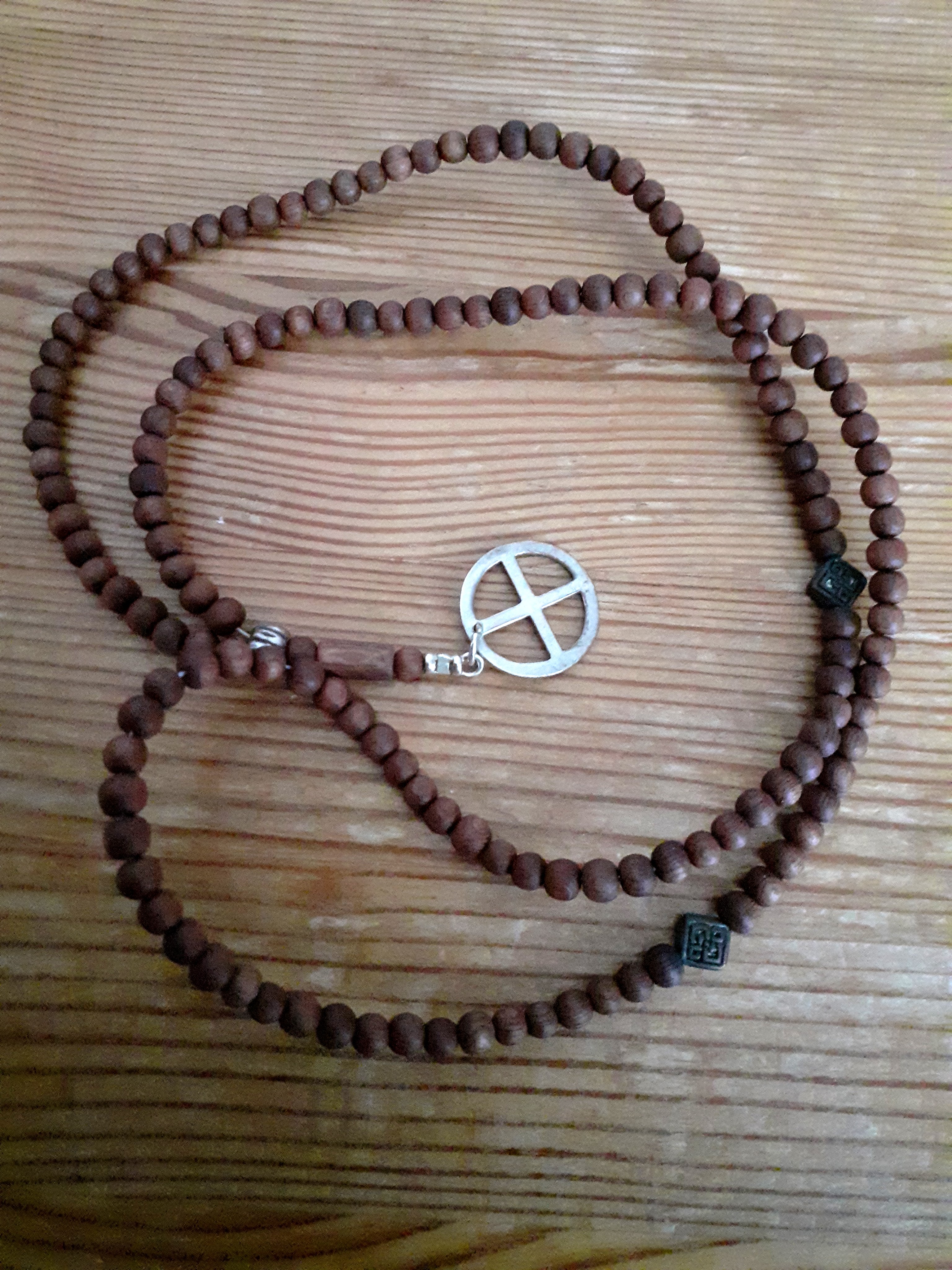
Recently I wrote about the balanced cross (1), linking it to the paidirean (pahj-urinn) prayer beads of the Ceile De (Culdees), a modern monastic order based in Scotland. This post is about the beads and my work with them. Beads like this were part of the original Ceile De tradition and are known to have been used in the days of Columcille (St. Columba).

There are 150 beads, each about 5 mm wide.  They are made of unstained rosewood and were left immersed in rose damask oil for a month.  As well as scenting the beads, the oil gives the beads a pinkish colour. A cross hangs from the beads – at heart level when worn as a necklace.

Each Paidirean is ceremonially strung in Scotland by a Ceile De Order member.  The process takes two hours and involves prayer, meditation and continuous chanting during the stringing.  Then a blessing is spoken over the completed Paidirean which is anointed with water and with oil from a local holy well, used for at least 1500 years. The Paidirean is an object of power as well as beauty. 

I am not a member of the Ceile De, and when I acquired the Paidirean they knew that I would work with the beads in my own way. I bring together meditation and prayer. I work with the Soham mantra, with Satish Kumar’s understanding (2) that it means ‘you are, therefore I AM’. Whilst I am mindful to my breath, to the mantra and to the movements of the beads, mindfulness is a means and not the purpose of the practice.

The purpose is to make an offering to Spirit – an offering from one lamp to the light, one wave to the ocean. After some hesitation and experiment, I have adopted the word Spirit, rather than Goddess or God, to address the Divine. It is more universal and inclusive as, for me, befits a panentheist view. In making my offering, I am aware that Soham also works laterally, including relations between all beings within the web of life, just as the Druid prayer speaks of  ‘the love of all existences’. Ultimately, we are recognising the divinity in each other.

Spirit is not beyond us in some other realm. It is here, now, and everywhere.  When I work with the beads, I am making both an offering and an affirmation.

(1) https://contemplativeinquiry.blog/2025/01/04/the-balanced-cross

(2) Satish Kumar You Are therefore I AM: A Declaration of Dependence Totnes: Green Books, 2002

FAITH

In my Druid circle, I associate the northern quarter with faith. The quality and context of faith are not defined. They could simply mean faith in the practice and path. My contemplative inquiry overall has tended towards a stance of ‘sacred agnosticism’ (1), in which faith is not emphasised. This has served me in many ways. I have avoided mixing up the idea of ‘faith’ with affiliation to authoritarian movements, mandated beliefs, or the surrender of self-responsibility and personal discernment. I have been alert to the metaphysical group think and consensus collusion that can show up in any spiritual movement (other kinds of movement too). I have done my best to gather and evaluate information skilfully, when developing principles about how to live ethically and gracefully in an increasingly scary world.

And yet … this is not the whole story, or I would feel spiritually malnourished. In recent months I have experienced a strong felt sense of the divine. When I describe myself as ‘living presence in a field of living presence in a more than human world’ – an animist identification – the identification now seems more than animist, though the animism is still there. I pray more congruently to the Goddess as Ancient Mother and talk, less anthropomorphically, about the ‘bubbling source from which I spring’. The Divine is beyond name, form or description – and some people prefer a specialist, capitalised use of rather abstract terms like Consciousness, Awareness, Void, Ground of Being. But the ones from my own practice are the ones that work for me. They come from the intuitive heart and the imagination. To me they offer a deeper knowing, though I am personally cautious about the use of the word gnosis. For me, it can reduce the sense of mystery,  banishing the creative role of faith itself.

I have become a provisional panentheist, experiencing intimations of a divine which is everywhere and no-where, and from which we are not separate. This partly reprises work I did in the earlier days of my inquiry using the framework of non-duality. Now I find panentheism a better term than non-duality for affirming both the divine and the world. The earth spirituality in the Druid tradition is in no way compromised by a panentheist perspective. If anything it is enhanced.

(1) See https://contemplativeinquiry.blog/2024/02/16/sacred-agnos

EMERSON: ‘IMMORTAL BEAUTY’

“Crossing a bare common, in snow puddles, at twilight, under a clouded sky, without having in my thoughts any occurrence of special good fortune, I have enjoyed a perfect exhilaration. I am glad to the brink of fear. In the woods too, a man casts off his years, as the snake his slough, and at what period soever of life, is always a child. In the woods, is perpetual youth.

“Within these plantations of God, a decorum and sanctity reign, a perennial festival is dressed, and the guest sees not how he should tire of them in a thousand years. In the woods, we return to reason and faith. There I feel that nothing can befall me in life, – no disgrace, no calamity, (leaving me my eyes), which nature cannot repair.

“Standing on the bare ground, – my head bathed by the blithe air, and uplifted into infinite space, – all mean egotism vanishes. I become a transparent eye-ball; I am nothing; I see all; the currents of the Universal Being circulate through me; I am a part or particle of God. The name of the nearest friend sounds then foreign and accidental: to be brothers, to be acquaintances, – master or servant, is then a trifle and a disturbance. I am the lover of an uncontained and immortal beauty.” (1)

In the first paragraph above, I hear my own experience, described in a mid 19th century American voice. I share the sense that the exhilaration comes partly from the land, woods and sky themselves and partly from the continuing life of the child within us.

In the second paragraph, I feel at home with with the overall sentiment, whilst having to work a little with Emerson’s terminology. At the beginning I am not sure what he means by ‘God’. I do understand that ‘plantations of God’ restores innocence, as well as wildness, to the term ‘plantation’. (Emerson was a notable abolitionist.) I also note that the woods are a domain where reason and faith are brought together, in a time and culture where they seemed to be in conflict. Nature isn’t just a word for material reality. Nature is a source of protection and healing that goes beyond the mundane.

The third paragraph makes Emerson’s transcendentalism clear, and with it the true power of contemplation. ‘Standing on the bare ground … uplifted into infinite space – all mean egotism vanishes. I become a transparent eyeball. I am nothing: I see all”. God and Nature become Universal Being, from which ‘I’ am not separate. To be simply present in this space, with no agenda and nothing in mind, is to be “the lover … of an uncontained and immortal beauty”. The nature of our experience is a living nature we perceive, are part of, and relate to – not a reified externality. An open, enlivened receptivity to this reality can allow a deeper awareness (for Emerson, that of the Divine in us) to declare its presence.

(1) Ralph Waldo Emerson Nature Boston, Mass: Thurston, Torry and Company, 1849

NOTE: According to Wikipedia, Ralph Waldo Emerson (1803-82) “was an American essayist, lecturer, philosopher, abolitionist and poet who led the transcendentalist movement of the mid-19th century” who gradually moved away from the religious and social beliefs of his contemporaries, formulating and expressing the philosophy of transcendentalism in his 1836 essay Nature”. He wrote most of his important essays as lectures first and then revised them for print. “Emerson’s ‘nature’ was more philosophical than naturalistic. … Emerson is one of several figures who took a more pantheist or pandeist approach by rejecting the view of God as separate from the world”.

Earth Eclectic

music that celebrates Earth and speaks to the heart

Sarah Fuhro Star-Flower Alchemy

Follow the Moon's Cycle

Muddy Feet

Meeting nature on nature's terms

Rosher.Net

A little bit of Mark Rosher in South Gloucestershire, England

Becoming Part of the Land

A monastic polytheist's and animist’s journal

selkiewife

Selkie Writing…

Charlotte Rodgers

Images and words set against a backdrop of outsider art.

Prof Jem Bendell

living with metacrisis and collapse

Towint

The pagan path. The Old Ways In New Times

The Druids Garden

Spiritual journeys in tending the living earth, permaculture, and nature-inspired arts

The Blog of Baphomet

a magickal dialogue between nature and culture

This Simple Life

The gentle art of living with less

Musings of a Scottish Hearth Druid and Heathen

Thoughts about living, loving and worshiping as an autistic Hearth Druid and Heathen. One woman's journey.

Wheel of the Year Blog

An place to read and share stories about the celtic seasonal festivals

Walking the Druid Path

Just another WordPress.com site

anima monday

Exploring our connection to the wider world

Grounded Space Focusing

Become more grounded and spacious with yourself and others, through your own body’s wisdom

The Earthbound Report

Good lives on our one planet

Hopeless Vendetta

News for the residents of Hopeless, Maine