Contemplative Inquiry

This blog is about contemplative inquiry

Tag: Paganism

BOOK REVIEW: STAFF OF LAUREL, STAFF OF ASH

“If our place is imperilled, so are our myths. If we heal the one, we heal the other … So said priestesses who long ago spoke in the voice of doves. So said the prophetic oaks they tended, who murmured to their suppliants through wind blown leaves.”(1)

Staff of Laurel, Staff of Ash: Sacred Landscapes in Ancient Nature Myth is an inspirational collection of interwoven contemplations on landscape and myth; on enchantment, disenchantment and re-enchantment. I strongly recommend it to anyone with an interest in these themes.

Author Dianna Rhyan says of her own approach to writing: “assembled, these pages refused to assemble, and so altogether, they form a series of sketches, fallen like samaras*, whose order is ultimately undetermined. The priestess of Apollo wrote her prophecies on leaves. When strong winds came, they scattered all over her cave. Did she mind? Amidst the leaves, voices of winds and voices of trees, lost and found, thread their way.” This review shares something of the book’s flavour, rather than attempting a linear account of what is covers.

Rhyan draws strength from wild and marginal spaces, especially the Cuyahoga River in north eastern Ohio. She describes her close relationship with the land but is all too aware of a sadness in its silence. The genocidal displacement of the people who once lived there has erased their stories about this land and their relationship with it. As a mythologist, she looks further afield for inspiration, especially ancient Mesopotamia (now Iraq) and the early Greek speaking world. Even four thousand years ago, in the early Sumerian world, people had doubts about ‘civilisation’. We find the contrasting influences of the laurel, which blooms, and the ash, “a battle-earned artifact”.

In the Epic of Gilgamesh (2) the hero destroys a forest and its guardian at an early stage of his “futile immortality quest” and then goes out of his way to offend the Mother Goddess Inanna. In The Descent of Inanna, she herself must experience death, losing her identity and powers as she descends through seven gates to the Underworld controlled by her sister Ereshkigal. Asking, at each gate, ‘Gatekeeper, why is this done?’, she receives the reply ‘Silence, Inanna. Do not open your mouth against custom. The rules of the Great Below are flawless. You may not question what is perfect.’ Rhyan’s reading of this ritualised and repeated reply finds a new order in which free nature, and the Goddess perceived as its embodiment, need to be rigorously controlled. She comments on the way in which perfection “deadens” and rules “disarm”. For three days Inanna hangs dead, a carcass on a hook. But the upper world needs Inanna in order to reproduce itself and flourish. The Wisdom God Enki sends emissaries to Ershkigal to secure Inanna’s release. She does not stay dead.

Rhyan also draws on Greek sources from different periods. One of them, from Sophocles’ last play, Oedipus at Colonus, is about the final days of Oedipus, after he has blinded himself and been been exiled from his erstwhile kingdom of Thebes. These misfortunes follow the discovery that he has (unwittingly) killed his father, married his mother and thereby, as a source of pollution, caused a plague in the city. He is told: “seek no more to master anything”.

Oedipus is now a pauper, wandering in a wasteland. Letting go of his civic and social identities and surrendering to this fate, he survives. He is reborn as a child of nature on the goddess haunted mountain Cithaeron. For his awakened inner vision has guided him to the place where he was once, as an infant, left out to die. The compassionate nymphs who nursed him then are perhaps looking out for him once more. He has journeyed from palace to periphery, freed from all power and self-determination. At that point, he is given a new role, as guardian of the sacred grove at Colonus. It is a place beloved by immortals, a place of lush growth, where the nightingale sings, and with “cool waters” that never fail. Here, as this new version of himself, he will live out his days.

Late on in her book, Dianna Rhyan says: “if we look over our shoulder, not only what we threw away as detritus is following us. What we had despaired we had lost forever, long ago in the depths of ancient ages, is following us too. We require myth, intensely alive myth, to see it. It is very good at not being seen.” I see her as making a great contribution to making ‘intensely alive myth’ visible once more.

(1) Dianna Rhyan Staff of Laurel, Staff of Ash: Sacred Landscapes in Ancient Nature Myth Winchester, UK & Washington, USA: Moon Books, 2023

(2) https://contemplativeinquiry.blog/2023/05/30/

*Samaras: here, the winged maple seeds found in the author’s local woodlands.

HOW PAGAN WAS MEDIEVAL BRITAIN?

How Pagan Was Medieval Britain? is the sixth and final lecture in Professor Ronald Hutton’s Gresham College series on early Pagan history in Britain (1). The simple answer, according to Hutton, is: not as much as was widely believed in the twentieth century, by scholars and the lay public alike. Some thought that full medieval Christianity was an upper class faith, with commoners, especially in the countryside, being ‘cheerful semi-Pagans’, Christian by day and following the old ways by night. Others thought that the two religions ran in parallel, with the latter being necessarily clandestine whilst some of its iconography was visible. Green Man and Sheela na Gig images, often present in the churches themselves, seemed to indicate the survival of a Pagan sensibility at the very least – canny concessions by the Church to the people. Witch persecutions were seen as evidence of an active, surviving woman centred nature religion. Indeed, such ideas influenced cultural and religious developments in the twentieth century itself – specifically, the rise of neo-Paganism; more broadly, the Feminist and Green movements that were dynamically emerging at the time.

However, turning to the medieval period itself, Hutton, does not find evidence of actually existing Pagan religion in the available sources. Witch trials have been carefully examined in recent years, and the victims don’t fit the profile. In Anglo-Saxon times, the legal codes and church councils stopped bothering to forbid Christian converts their old ways by 800 CE. The prohibitions reappeared in the tenth century, in relation to Viking settlers, but ceased again by 1030 CE. In the later middle ages there was serious concern over Christian heretics (Lollards) and some concern over ale-house cynics expressing anti-religious views. In medieval society people tended be nosy about other people’s business and there was social pressure to conform. There are court cases that draw on this kind of informal surveillance, but none concerned with Pagan religious practice. Hutton traces Sheela Na Gig images to the Church in France, saying that they had an anti-erotic intent. Likewise, Green Man, Wild Man and Jack in the Green figures have specific historical origins not concerned with any Pagan deity. Hutton quite reasonably offers no comment on their widely perceived role as archetypal images, because these are outside the remit of the empirical historian. His focus is on self-defined and organised Pagan religion during a specific period in Britain.

But it is true, according to Hutton, that the medieval church offered religious continuity in other ways. The veneration of saints, who were very diverse and numerous, allowed polytheist habits of mind to continue, especially in the realm of petitionary prayer. Individual saints might be local, or specialists in specific forms of help. For many people they seemed more approachable than the persons of the trinity. However in Britain there seem to have been no saints who had themselves once been gods*. Likewise Christians had holy wells, but they were different from the old Pagan ones, rather than the same ones repurposed. The temple of Sulis Minerva at Bath, for example, was left alone. Few temples or ancient religious sites became churches, even though Pope Gregory had recommended this approach when he sent his mission to Kent in 597 CE.

Church attendance was not compulsory in the middle ages. It is estimated that only around 50% of parishioners attended regularly, though they did turn up in much larger numbers for the major festivals. During these, ‘secular revelry’ was allowed, even encouraged, and the festivals raised a lot money for Parish churches, enabling them at times to abolish Parish rates. This widely beneficial outcome was seen as ‘cheating the Devil’. Even on normal days, the Church offered spectacle – with the mass, libations and incense. Local priests came from the people, didn’t have to be literate, and didn’t have to preach. That was done by specialist friars with notable performance skills, often very popular. Additionally, many people belonged to guilds linked to their churches, usually focused around a saint. There were lay religious guilds for both women and men, which had a variety of purposes, officered by their own lay members. Craft guilds performed plays at festival times. This form of Christian culture lasted in Britain until the middle of the sixteenth century, when the old church fragmented into a plurality of new ones over hard-fought time. Different kinds of Christian culture, generally even less Pagan friendly, emerged.

(1) https://www.gresham.ac.uk/watch-now/medieval-pagan/

* An exception would be the Gaelic speaking areas in Scotland and Brighid

BOOK REVIEW: THE TORCH OF BRIGHID

Highly recommended for anyone interested in Brighid, Celtic spirituality and the evolving culture of modern Paganism. In The Torch of Brighid, Erin Aurelia eloquently describes her flame tending path as a devotee of the Goddess Brighid. For her, this is a path of celebration, contemplation, creativity and deep personal change. Her book shares the fruits of a remarkable journey.

The author makes clear that she is not reconstructing a past Pagan practice. No such practice is known. She references a Christian history dating from 480 CE, where nuns maintained a sacred flame at Kildare in Ireland. This was documented as still in place in the later 12th century CE by Gerald of Wales in his History and Topography of Ireland. It was repressed by the English King Henry VIII – who also ruled Ireland – as part of his violent religious revolution of the 1530s and 40s. On 1 February 1993, flame tending was revived both by Catholic Brigantine sisters in Kildare by the neo-Pagan Daughters of the Flame in Vancouver, BC. Both groups were influenced by Gerald of Wales’ description.

Erin Aurelia has been a flame tender for 20 years. She began in the Daughters of the Flame and then founded her own Order, the Nigheanan Brigde Flametending Order, going on to lead it for eight years. The original model involved moving through cycles of twenty days, in which nineteen flame tenders take a day each to tend the flame, leaving the Goddess to take care of the twentieth. Erin found that she wanted an intensified practice and a closer fellowship with other Brighid devotees. During those years, she writes: “Brighid inspired me to develop guided meditations to use during vigils, seasonal feasts, and lunar phases”. Later came “the template for a whole new way to practice flame tending: the way that the flame tending cycle matches with the twenty letters of the traditional Irish tree ogham alphabet, in which each alphabet letter is denoted by a tree and infused with esoteric meaning”. She describes herself as “enthralled and excited” by this discovery, which lead on to daily communing with Brighid and a fuller development of her work.

She found the process transformative, and learned that “growth is not only made through obtaining wisdom, but by implementing it. And Brighid showed me that I can effectively implement it by embodying her own skills as Shaper, Healer, Seer, and Transformer. Through embodying her skills, I became empowered”. In the narrative of her own journey, Erin shows her willingness to innovate, take initiatives, lead when called to do so, and also step back from leadership. Her relationship with ancient culture is to be inspired by it without being bound by it. I see her as modelling the best of modern Pagan practice in these respects.

Erin provides extensive information on her flame tending vigils, and how to set them up. She shares prayers, meditations and path workings. She includes her unique approach to ogham work, and also her own way of working energetically with the traditional ‘three cauldrons’ (of warming, vocation and knowledge). She shares her ways of working through the four Irish fire festivals from Imbolc (1 Feb.) to Bealtaine (1 May} to Lughnasadh (1 Aug.) to Samhain (1 Nov.). She has an Imbolc advent practice centred around the four Sundays prior to Imbolc – because it starts the year in this tradition and is specifically dedicated to Brighid. Her book is a powerful addition to the growing literature about Brighid as a much loved Goddess.

ANIMATE, INANIMATE AND INTENSELY ANIMATE

The wood thrush has a complex throat that allows it to sing two notes at the same time and harmonize with its own voice.

“Ancient poets in Sumer composed in more than one dialect, and the dialects were gendered. … For example, in Inanna’s Descent when a god or the (male) narrator speaks they use one dialect; when a goddess speaks, her words are in another mode. Noticing the difference between their tongues was a breakthrough that led to the decipherment of broken clay tablets that had long laid separated in museums across the world. I wonder how the artists performed the voices when poetry was sung.

“The score of musical Sumerian speech expands still further. ‘Wood’ had its own symbol in Sumerian, distinguishing it from the other raw materials or swaying trees. Signs expressed the difference between what is animate, inanimate, and intensely animate, in other words, divine.

“Intensively alive clay tablets on museum shelves burrow between Mesopotamian stone seals and terra cotta plaques, bearing nature symbols everywhere. We find compassion, delight, and danger in them: sea-Nammu, storm-Enlil, date palm-Inanna. Bird men on trial before bull-helmeted gods. Feather-skirted goddesses brandishing clusters of heavy fruit. Out of their shoulders leap lightning, grain, sunrays, and fishy streams.

“Humbaba* radiates melam, the vigor of being intensely alive, and Inanna radiates date palm blossoms, arrows, or bolts of energy from her shoulders. The symbol for divinity looked like a star. It radiated the vigor of uniquely dynamic forms of life.

“Look deep into life forms and see shimmering, pulsating cell membranes, the ceremonial fringed dancing-capes of being. Long before we saw a cell shimmer under a microscope, we saw life shimmer in myth”.

Dianna Rhyan Staff of Laurel, Staff of Ash: Sacred Landscapes in Ancient Nature Myth Winchester, UK & Washington, USA: Moon Books, 2023 (I plan to write a review of this book when I have had more time to digest it: see https://contemplativeinquiry.blog/2023/06/14/

*Humbaba is a ‘monstrous, though anthropomorphic, guardian of the Cedar Forest in Lebanon, equipped with superhuman powers in the form of 7 ‘auras’ (or ‘terrors’). In the Epic of Gilgamesh He is defeated (in some versions through trickery) by Gilgamesh and his companion Enkidu, who go on to cut down the forest. The domain of the ‘intensely animate’ is thereby shrunken as heroic ‘civilisation’ marches arrogantly on. Gilgamesh will learn lessons later in the epic.

See: The Epic of Gilgamesh: The Babylonian Epic Poem and Other Texts in Akkadian and Sumerian translated by Andrew George Penguin Random House UK, 2020 (2nd ed. First ed. 1999)

WHEEL OF THE DAY

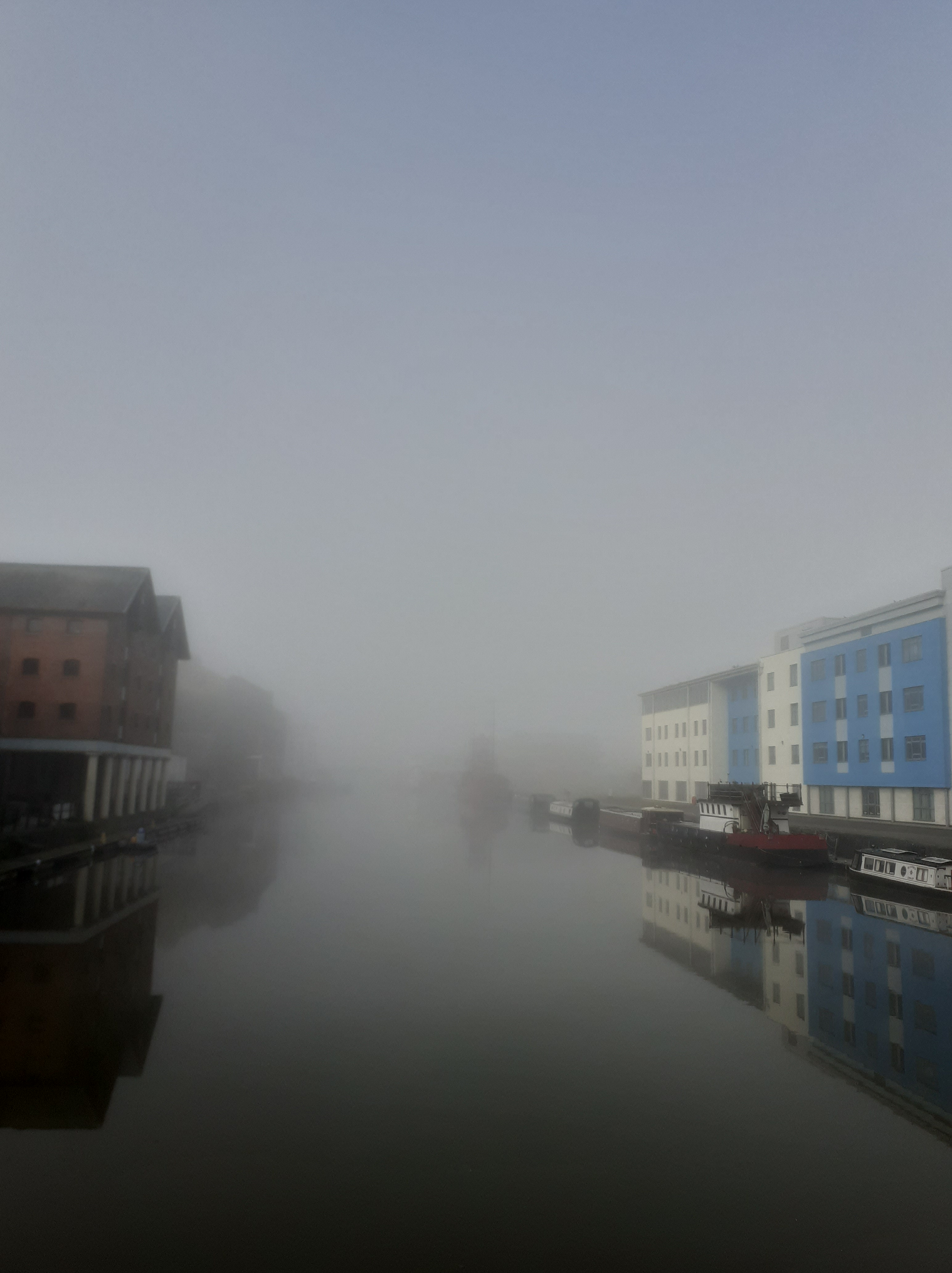
Two pictures taken 12 hours apart in neighbouring locations. 7.30 am above and 7.30 pm below. The wheel of the day following its course in the light time of the year. Dawn is well past regardless of mist, and sunset yet to come even if shadows are lengthening.

Delighting in these experiences. No further narrative.

CELEBRATING THE MONTH OF MAY

The Irish name for May is Bealtaine. Linguistically at least, the May Day festival sets the scene for a calendar month. As I experience the wheel of the year in my own life, this feels right. May, the merry month, has always been special to me. Born towards the end of the month in 1949, I continue to feel newer and fresher in May, with a heightened sense of life. Changes happening around me, in the rest of nature, feed that sense. I’m part of something bigger.

The demarcation of time might be a product of human counting and naming, but it doesn’t feel arbitrary to me. Counting and naming have a powerful magic of their own. On 14 May 2023 I went on a morning walk, reaching a small wooded area at about 7.45 am. It was a time of dispersing mists and strengthening light. A time of warming up. I enjoyed it from the start, but there came a moment when my experience of the walk changed radically.

I see the wood. I stand at its edge. Hawthorn invites me in, decked in the green and white of the May season. I understand this as a moment for slowing down and shifting into a softer, more intuitive connection with the realm I am entering. I am moving into a kind of sacrament – a communion with nature in a unique time and place. I feel a joyful kind of reverence here, free of solemnity and unction. As I continue slowly on the path, sunlight, striking a slender tree trunk, illuminates my way.

Then comes a tanglewood immersion. Variations in wood. Variations in green. Variations in light – especially light. This place could be dark and dank. At times, no doubt, it appropriately is. But it is May now, and wonderfully backlit. There’s a yellowing of green that points to new light and growth rather than their decay. I have a strong sense of participating in a living world. My own vitality is boosted.

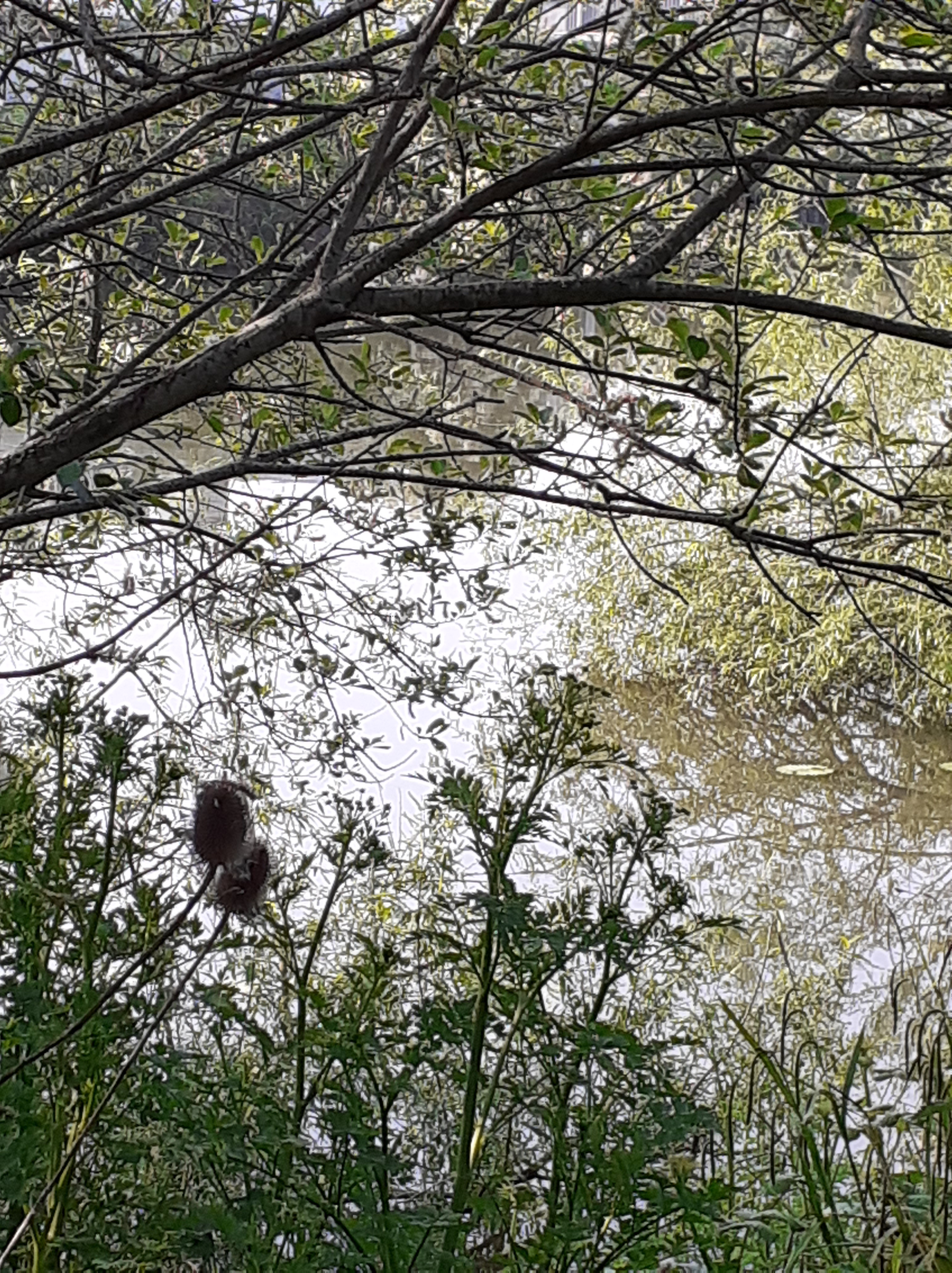
I am now drawn towards water. Again, some foliage is shaded. Other foliage is vividly lit up. On the water, the mist is still clearing. It is still fairly early in the day. It is at times like this that I feel most Druidic, very at home and blessed in this quiet connectedness.

A little later, I crouch at the water margin’s edge. Whereas the previous scene had a spacious serenity, this has intimations of activity, a small but crowded world of its own, with thriving plants and and a thriving sub aquatic realm beside them. Even in this small space, life is complex and abundant. The same holds, on a somewhat expanded scale, to this vulnerable scrap of woodland as a whole. I emerge from my sacrament refreshed and renewed, with the imprint of Bealtaine 2023 upon me.

FINDING LOST GODS IN WALES

Professor Ronald Hutton’s fifth lecture in the Gresham College series on early Pagan history in Britain (1) is called Finding Lost Gods in Wales. Hutton’s main focus is on medieval Welsh literature. The language used is a 5th/6th century CE mutation of the Brythonic speech once used throughout Britain, further developed for literary purposes by court bards in the 6/7th century. Hutton describes it as “made for poetry” because of the concentration of meaning in the words. He gives as an example in a literal English translation:

‘Colour light waves spread boiling billows

‘Flood-tide river mouth on sea where nothing waits.’

He contrasts this with an English translation for English ears, demanding more words whilst sacrificing impact and immediacy.

‘Bright as the light that falls on the waves, where the boiling billows spread

That flashes a moment from the meeting of river flood and sea.’

This language was the public voice of a consciously dispossessed people, creating a new sense of Welsh Celtic nationhood in the 9th and 10th centuries, when the English, Scottish Gaels and Vikings had reduced their territory to less that 10% of Britain. It led to a flowering of Bardic culture throughout the medieval period.

Taliesin was celebrated as Wales’ greatest Bard. There is no certainty that he existed, though poems surviving from the 6th century have been attributed to him. There are no recorded statements of his pre-eminence before the 10th century. Later poets inspired by him continued to write in his name for a further 300 years. His link with Awen as the source of inspiration reveals the mystical roots of the whole Bardic tradition. But for instances or echoes of specifically Pagan motifs we are largely reliant on a small group of texts from the 11th -13th centuries: The Black Book of Carmarthen, The White Book of Rhydderch, the Red Book of Hergest, the Book of Taliesin and the Mabinogion, a collection of prose stories. (The full prose Hanes Taliesin is from a much later date.)

In contrast to Irish medieval literature, we do not find Goddesses, Gods or explicitly Pagan characters in these Welsh texts, even in the four branches of the Mabinogi, though these do seem to be set in Pagan times. Several characters have superhuman abilities, without being presented as Gods. However, we do have Annwn, an otherworldly realm of human-like beings who interact with ordinary humans. We also find shape-shifting abilities – people change into animal forms and back again; humans change their appearance; objects change their form.

There is certainly magic and magical poetry, as in the Preiddeu Annwn (The Lute of the Otherworld). This poem, though hostile to monks and their pretensions to scholarship, is overtly Christian. According to Hutton, poems of this kind delight in being difficult, allusive and packed with metaphor, references and wordplay. No one now can say with any certainty what they were originally intended to mean. But this, suggests Hutton, is a gift and invitation to the poets, story tellers and artists of later generations including our own.

On the specific question of deity, Hutton discusses Rhiannon, Cerridwen, Gwyn ap Nudd, and Arianrhod. None is described in this literature as divine and, according to Hutton, we do not find them in that role in Celtic antiquity.

Rhiannon is superhuman and comes from an enchanted world to find a husband of her own choosing. She stays the course despite horrible experiences. She has been thought of as a horse goddess, but this is not suggested in the Mabinogion and there is no indication of a horse Goddess in the archaeology of Iron Age Britain or in Romano-British inscriptions. She has also been seen as a Goddess of Sovereignty, but she does not confer sovereignty on either of her husbands, and there is no record of any sovereignty Goddess in Europe outside Ireland.

Cerridwen begins as a mother skilled in sorcery trying to empower her son but actually empowering a lowly servant boy instead. By the 13th century she has, through her association with Awen, become the muse of the Bards, giver of power and the laws of poetry. In 1809 the scholar Edward Davies made her the great Goddess of ancient Britain and many people have Iolo seen her in that light ever since.

In 11th and 12th century texts Gwyn ap Nudd was one of King Arthur’s warriors, imbued with a degree of magic power. By the 14th century, poets are making him a mighty power of darkness, enchantment and deception. In the 1880’s the scholar Sir John Rhys made him the Celtic God of the dead and leader of the Wild Hunt. This is largely how he is seen today.

In the fourth branch of the Mabinogi, Arianrhod is a powerful, beautiful and selfish enchantress with the capacity to make unbreakable curses. By the 13th and 14th centuries her magical powers are much increased. She can cast a rainbow about a court, and the Corona Borealis is called the Fortress or Arianrhod. In the 20th century she began to be seen as a Star Goddess.

Professor Hutton’s lecture includes a discussion of the Welsh Bardic revival at the end of the eighteenth century, inspired largely by Iolo Morgannwg, here presented as a mixed blessing given his willingness to forge ‘ancient’ documents to advance his cause. Hutton ends with a section on the legend placing Glastonbury as the site of King Arthur’s final refuge and eventual burial, and also the place in which the Holy Grail was buried. Both of these were concocted by the later medieval monks of Glastonbury Abbey as a potential source of patronage and a pilgrimage income. At the same time, post holes linked to a neolithic structure have recently been found near Chalice Well – which may well be a numinous site of great antiquity. Artefacts have also been recently found in the area, including the Abbey itself, from the early post-Roman period in which Arthur’s career has been set. We weave our stories from a mixture of fact, fiction, speculation and deep intuition. Being conscious of this circumstance may make them all the richer.

(1) https://www.youtube.com/watch?v=NTmIEE91D-k

See also: https://contemplativeinquiry.blog/2021/03/26/ for my review of Cerridwen Celtic Goddess of Inspiration by Kristoffer Hughes as an in-depth account of the Goddess and her evolution. He also discusses the Welsh Bardic tradition and the later work of Iolo Morgannwg

VIKING PAGAN GODS IN BRITAIN

Professor Ronald Hutton’s fourth lecture in the Gresham College series on early Pagan history in Britain (1) is about the Vikings and their spiritual legacy. An overview of the old Norse world shows a people who, expanding beyond their Scandinavian homelands, were notable both as aggressive sea raiders and as traders, farmers and town builders. Travelling to new lands, and often settling in them, they grew familiar with cultures from Britain and Ireland in the west to Russia and the Byzantine Empire in the east. Their name was known in the Islamic world and as far as China. Slaving was a major part of their trade.

The raiding came first – a ‘Viking’ is a raider. They first became known in Britain and Ireland as looters of monasteries, where non-warrior monks lived close to the sea in places noted for their treasure. Monks who were not killed often became slaves. Hutton notes that early Scandinavian literature is largely realistic (relatively sparse in supernatural themes) and shows a tolerance of psychotic violence. A small boy gets bested by larger peers in a ball game and, enraged, drives an axe into another boy’s head. The community wonders what to do with him and steers away from serious punishment. For ‘he has ‘the makings of a real Viking’. Saga heroes are not very religious. Asked by a Christian ruler what he believes in, one replies: ‘I believe in me’. This seems to be the self-reliant ethic of the rootless, adventuring Viking.

Our written knowledge of Viking Pagan gods largely comes from Icelandic sources dating from 150-400 years after Christian conversion. It includes poetry, sagas and scholarly work. According to Hutton, the Pagan poems are no longer fully understood. It is thought that depictions of Paganism in this work are drawn partly from contemporary Baltic and Slav Paganism, better known by the writers than their own past. It is possible that Odin’s sacrifice of self to self, over nine days, on the windy tree is a response to Christianity: Odin is tougher than Christ.

In prose work, goddesses are few and far between. There are more goddess names in the older poems, but we do not know their stories. The gods on record are those still known in modern popular culture: Odin (the leader, god of travel, wisdom, knowledge, war, poetry); Thor (god of sky, weather, farming); Frey (god of fertility, crops, animals); Freya (goddess of love, war, magic); Baldur (handsome, beloved of all); Tyr (heroic god of war); Loki (devious and cunning – with a question around the word ‘evil’?). However, there is some doubt on whether either the warriors’ paradise Valhalla, or the end-of-the-world story of Ragnarok are derived from early Pagan tradition.

The Pagan Viking Gods came to Britain, with serious settlements beginning in the 860s, and they are remembered in place names. Odin, for example, is very well remembered in Orkney. But their worship did not last long, at least officially. The last Pagan ruler was removed in 954. The settlers had always lived among a larger co-existing Christian population. However, King Canute had to pass a law in the early 11th century forbidding the veneration of trees, stones and pools, the use of charms and the worship of sun and moon. Hutton suggests that here we see glimpses of a family and nature oriented religion without priests and temples and so unlikely to leave monuments. There is no archaeological evidence for Viking temples or shrines in Britain, though 34 swords have been found in English rivers in a way that suggests they were placed there as offerings. There are carvings that seem to show Pagan themes on crosses and a slab in the church at Sockburn, County Durham, shows the war god Tyr with Fenris, the wolf who bit his hand off.

Most of the archaeological research focuses on burial sites and grave goods. High status burials in particular included graves goods – on the whole, men had weapons, women had jewellery and both might have horses and dogs. These suggest a belief in another life in which people will want their possessions, but there does not seem to be a consistent narrative about what this afterlife would be. In some cases it is possible that, where more than one person is involved, someone may have been killed in order to accompany the deceased. Norse-settled Scotland and its islands (Both northern and western) are rich in burial sites, as is the Isle of Mann (still constitutionally a Norse lordship under the British crown run by its Parliament the Tynwald). In one ship burial there, an earlier Christian burial site was desecrated to make room for the newcomers. English Viking burial sites include the Henley Woods burials and the large site by the River Trent near Repton in Derbyshire. This is the site of the military camp set up the ‘sons of Ragnar’.

All in all, there is enough to suggest that Viking Paganism once flourished it Britain. But we do not quite catch the subjective life of its adherents. Perhaps people wore their religion lightly; perhaps it was deeply interwoven with material life and not seen as a major specific preoccupation. Soon enough, it was superseded, often for largely political reasons, by Christianity. Enigmatic pointers from literature and archaeology, enduring place names, and the land, the sea, the sky themselves (to borrow the Celtic elements) are what remain.

(1) https://gresham.ac.uk/watch-now/viking-gods/

ANGLO-SAXON PAGAN GODS

This post is based on Ronald Hutton’s third lecture in the Gresham College series on early Pagan history in Britain (1). Hutton notes that the Anglo-Saxons arrived at a later date than the Romans, but with a religion that is less well-known. Why? He explains that it came as a foreign importation that did not mix well with existing traditions, whether Christian or Pagan. Moreover the Pagan Anglo-Saxons left no written records about their own practices, and their conversion to Christianity came too soon for a substantial body of archaeological evidence to accumulate.

Nonetheless the early Anglo-Saxons have had a lasting influence on English culture. They occupied a land that had experienced a major system collapse. A place which had once had towns, stone buildings, country houses, factories, substantial military installations and a money-using, trading economy, now made do with subsistence farming and wooden buildings, ruled over by rival petty kings. On the whole, the Saxons didn’t bring this about. It’s what they found, and they were troubled by the ruins of past power and prosperity as an example of what fate (wyrd) could do. They wondered, too, what had happened to the people (giants?) who had built the now ruined structures that they saw around them. Anglo-Saxon poetry (for example The Wanderer) reflects on this poignancy.

To get glimpses of Anglo-Saxon religion, Hutton says, we look to Roman accounts of their continental ancestors in Germany, narratives from later English Christians, and still later Icelandic sources describing a world view that is seen as cognate with the early English one. Their most important god was Woden, evidenced in place names and the family trees of early English kings. He is described as the King of the Gods, and patron of rulers, voyagers, and skills. He is a wisdom figure who can also be a cunning deceiver and an enchanter. In this he resembles the Norse Odin, the German Wotan – and also, in certain respects, the Roman Mercury. But this doesn’t mean a one-to-one correspondence: Woden, unlike Odin, is shown with the full use of both eyes. Other significant gods were Thunor (with similarities to Thor, Donner, Taranis and Jupiter), Tiu the war god (compared to Mars) and Frigg – goddess of love, fertility and abundance (like Freya, and Venus).

Other gods are named, though we know little about them – Seaxnet, Ing, Geat, Hreda (a goddess of the earth) and Eostre (concerned with dawn and spring). The names of more local and tribal deities are lost. There were sacred places – on hills (Hearg = modern English Harrow) and on level ground, especially near roads (Weoh). There were specific places linked to deities near burial mounds. The only known candidate for a Pagan Anglo-Saxon temple is Yeavering in Northumberland, but even that might be a royal hall. Little is known about the priesthood. There was no equivalent knowledge-bearing class like the Celtic Druids. Kingship was a semi-sacred role and kings could be blamed for disasters. Shadowy non-human figures (elves) co-existed with humans in the world and were seen as harmful. They lacked the glamour found in Irish and Welsh stories about such denizens of the wild places – forests and hollow hills.

We have a wealth of information from grave goods. There is a fairly even split between burial and cremation. Ashes from cremations tended to be kept in urns. These were decorated, primarily with serpent imagery. The swastika was also popular, as a fire image. In the case of inhumations, people were buried facing east, accompanied by grave goods that would be useful for an afterlife. These included crystal and glass beads, combs and razors, belts and knives (as eating utensils). There is relatively little gender distinction in the choice of goods, except that weapons were associated with men. (Even here Hutton notes the revision now being brought about by DNA examination of bones in Scandinavia, and confirming the presence of high status women warriors: could the same be true of the Pagan English?) From the sixth century, the Pagan Anglo-Saxons used burial mounds. Towards the end of the Pagan period, high status burial could be rich and elaborate – the most famous example being at Sutton Hoo in East Anglia, first excavated in 1939. This can be seen as a response to growing prosperity and the rise of Christian competition.

597 CE marks the first mission from Rome to the southern English. (Northumbrians were first introduced to the new religion by Celtic monks based in Iona.) In 665 CE the last English kingdom was formally converted. Penda the powerful Pagan Mercian king fought the Christian kingdoms, but for loot, power and glory, not for his religion. He did not stand in the way of his son’s conversion. There were no wars of religion or clearly identified martyrs on either side. Christianity offered many political, diplomatic and commercial advantages to the ruling class. The Christians were highly organised, determined and had a unified creed to rally around. These characteristics seem largely absent on the Pagan side. Official Paganism was over in the Anglo-Saxon world until it faced the Viking invasions that began in the 790s. Even then, the now Christian Anglo-Saxons did everything they could to resist them, partly as a matter of faith.

(1) https://gresham.ac.uk/watch-now/anglo-saxon-gods/

BRIGID AT IMBOLC

“Every day and every night

That I say the genealogy of Bride,

I shall not be killed, I shall not be harried,

I shall not be put in a cell, I shall not be wounded …

No fire, no sun, no moon shall burn me,

No lake, no water, no sea shall drown me.” (1)

Brigid has a long history, stretching back in Gaelic traditions to at least the pagan Celtic iron age. The words above come from the Western Highlands of Scotland, in this form probably dating to the traumatising early modern period. Caitlin Matthews suggests that, even though the the words are addressed to ‘St. Bride’ rather than the Goddess of poets, they still have the talismanic power to preserve life.

More recently, Brigid has been successfully revived as a Pagan Goddess, where, according to an affirming Imbolc self-dedication story by Morgan Daimler (2) she has lost none of her capacity to protect her devotees.

“When I decided that it was essential for me a self-dedication to the pagan path, just like all my books talked about, I chose Imbolc to do it on. At that point the holiday to me was on the 2nd, the same day as America celebrated Groundhog Day, and was about cleansing and blessing of the self, so it seemed ideal for a self-dedication. I got everything together and when the night of the ritual arrived I was excited to take such a life changing step. At 13, coming from a non-religious background, doing something like this was momentous and I felt like I was ready to commit myself to the spirituality I had been studying.

“I went out alone into the bitter cold, without a winter coat on, and tried to do the ritual the way I had learned how to, but it was hard to focus. February in Connecticut is frigid and the darkness on that particular night was total, without any moon to light my way. It was Brigid’s holiday, so I automatically started calling on her, asking for her help, for the strength to do what I planned to do. At the same time it was almost a reflex to call on a Goddess I associated with warmth a light under those circumstances. It was important to me to make a declaration of my religious path, the books I’d read at that point had emphasized the need to be outdoors, and I was too stubborn to let the cold weather stop me. So I prayed to Brigid.

“It’s funny the way, as children, we simply take experiences in our stride, without considering them at all out of the ordinary. I don’t remember ever feeling Brigid’s presence or having a sense of the numinous, but I prayed and then I was warm. The cold simply ceased to be something I noticed, as if everything around me had become an indoor room temperature. I took the usual half hour or so kneeling on the cold ground to do my ritual, dedicating myself to the Irish Gods and to pagan spirituality. And then I got up, collected my supplies and went back inside, feeling euphoric.

“At the time it never even registered that what I did was dangerous or that I was risking frostbite and hypothermia. And I never stopped and thought that it should seem at all remarkable to pray to Brigid for warmth and then be warm. It all seemed entirely natural and normal.

“We speak, and the Gods really do listen. Sometimes they even answer.” (2)

(1) Alexander Carmichael Carmina Gadelica Edinburgh: Scottish Academic Press, 1972 (Cited in Caitlin Matthews The Element of the Celtic Tradition Shaftesbury: Element Books, 1989)

(2) Morgan Daimler Pagan Portals – Brigid: Meeting the Celtic Goddess of Poetry, Forge, and Healing Well Winchester UK & Washington USA: Moon Books, 2016. Daimler identifies as a reconstructionist polytheist pagan working in the Irish tradition.

Earth Eclectic

music that celebrates Earth and speaks to the heart

Sarah Fuhro Star-Flower Alchemy

Follow the Moon's Cycle

Muddy Feet

Meeting nature on nature's terms

Rosher.Net

A little bit of Mark Rosher in South Gloucestershire, England

Becoming Part of the Land

A monastic polytheist's and animist’s journal

selkiewife

Selkie Writing…

Charlotte Rodgers

Images and words set against a backdrop of outsider art.

Prof Jem Bendell

living with metacrisis and collapse

Towint

The pagan path. The Old Ways In New Times

The Druids Garden

Spiritual journeys in tending the living earth, permaculture, and nature-inspired arts

The Blog of Baphomet

a magickal dialogue between nature and culture

This Simple Life

The gentle art of living with less

Musings of a Scottish Hearth Druid and Heathen

Thoughts about living, loving and worshiping as an autistic Hearth Druid and Heathen. One woman's journey.

Wheel of the Year Blog

An place to read and share stories about the celtic seasonal festivals

Walking the Druid Path

Just another WordPress.com site

anima monday

Exploring our connection to the wider world

Grounded Space Focusing

Become more grounded and spacious with yourself and others, through your own body’s wisdom

The Earthbound Report

Good lives on our one planet

Hopeless Vendetta

News for the residents of Hopeless, Maine