Contemplative Inquiry

This blog is about contemplative inquiry

Tag: Order of Bards Ovates and Druids

FIRE ON WATER

8pm, 25 July. Alchemy on the canal. The evening sun, low and potent in the sky, strikes the flowing water. At points the union of the two creates a molten liquid light, clearly defined in the still image above.

By contrast, the short video below reveals light and water together in movement. Flow, and patterns in the flow, draw my attention. They show me an energised harmony, becoming more than the sum of their parts.

I notice also that when I play the video without sound, I find it contemplative and reflective. When I play it with sound, the birds immerse me in living nature. I value both experiences.

I usually feel a transition into late summer about now, a little before Lammas/Lughnasadh. The days here are still long, though now clearly not as long as they have been. It’s a warm time, often the warmest of the year. Blackberries have appeared on their bushes, a foretaste of autumnal fruit bearing.

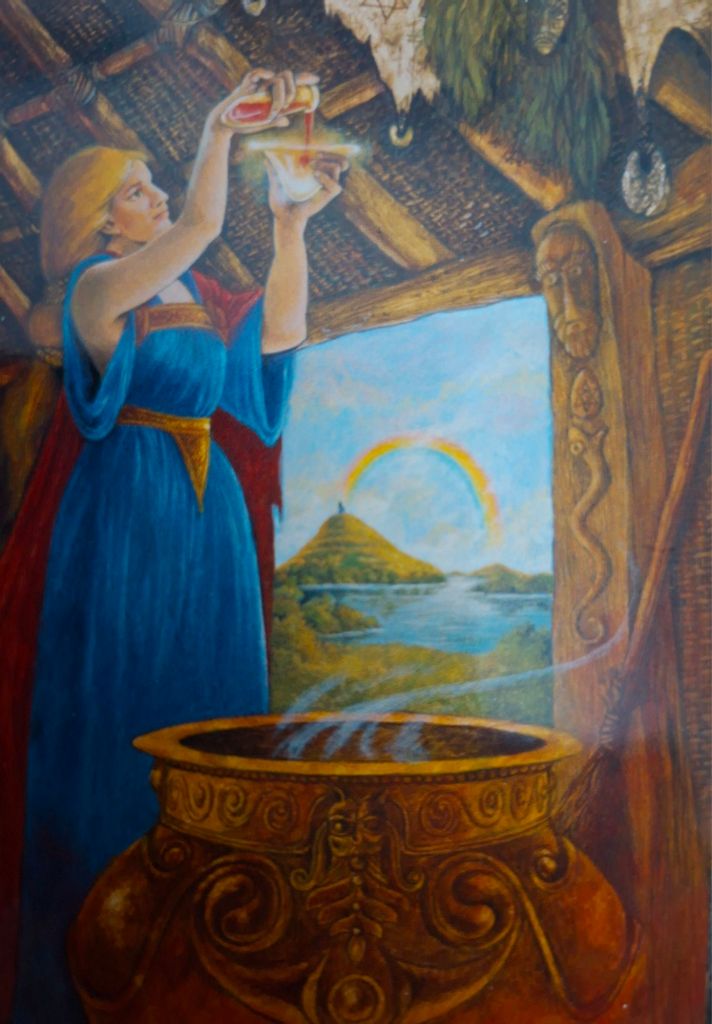
I am reminded, too, of the Fferyllt, the Druid alchemist in OBOD tradition. She is a woman of power and a devotee of Brigid. In the Druidcraft Tarot (1) she is represented by Trump XIV, standing for fluency between worlds, creativity, harmony, peace, alchemy and magic. My canal side encounter with fire on water nudged my imagination towards this figure, who somehow completed it.

(1) Philip and Stephanie Carr-Gomm The DruidCraft Tarot: Use the Magic of Wicca and Druidry to Guide Your Life London: Connections, 2004. Illustrated by Will Worthington.
MODERN DRUIDS (RONALD HUTTON) 2 MODERN DRUID MOVEMENTS

Modern Druids is the most recent public lecture (2 April 2025) presented by Professor Ronald Hutton in his tenure as Professor of Divinity at Gresham College, London. I provide a link below (1). This is the second of two posts about the lecture, focusing on Modern Druid movements in Britain from 1781. The first, concerning Hutton’s take on early modern perceptions of ancient Druidry, is published at https://contemplativeinquiry.blog/2025/04/08/ . It distinguishes four understandings, named by Hutton as Nationalist, Green, Demonic and Confessional.

Turning to modern Druid movements, Hutton also distinguishes four different kinds, emerging from the later eighteenth century up to the present:

  1. Masonic Druids The Ancient Order of Druids was launched in London in 1781, as a closed society with initiation rites, secret memberships, signs and passwords, loosely modelled on Masonry. Its purpose was to give working men opportunities for participation in the performing arts. By 1820 it had become a huge success, moving beyond London to the Midlands and North of England. Some members wanted more focus on the insurance side of friendly society life, and in 1833 the United Ancient Order of Druids was formed, splitting off from the AOD. The UAOD lasted until the late twentieth century. The original AOD still exists.
  2. Theosophical Druids emerged in the period from 1910 as an esoteric spiritual group. It followed the ideals of the Theosophical Society and worked towards the recovery of ancient mystical wisdom from all religions and philosophies. Founded by George Watson MacGregor Reid, and originally called the Order of the Universal Bond, the new group mixed Egyptian, Greek, Zoroastrian, Muslim, Jewish and Buddhist ideas with Irish and Welsh literature and using Druid names, roles and status. In 1912 a group of members went to Stonehenge to celebrate the Winter Solstice. Increasingly identified as The Ancient Druid Order they continued their association with Stonehenge for over 70 years. Always unpopular with the archaeologists of that period, the ADO sometimes had the support of the government and site administrators and sometimes not. In 1985 the festival that had grown up on the site was banned under Margaret Thatcher.
  3. New Age Druids is the name Hutton gives to the Order of Bards Ovates and Druids (OBOD). The first iteration of OBOD was a split-off from the ADO in 1964 led by Ross Nichols, who took the new group to Glastonbury for their public ceremonies. On his death in 1975, the Order went into hibernation until 1988, when Philip Carr-Gomm, who had been a youthful apprentice of Ross Nichols, re-awakened it. By 1988 the human potential movement, and a new Celtic revival strand in western alternative spiritualty, were both gathering in strength. True to its Theosophical roots, OBOD declared itself to be a spirituality rather than a religion and opened itself up to people of all religions and none. The bulk of the membership identified as either Pagan, Christian or Buddhist. OBOD declared an aim of “uniting humans with the natural world and their own true selves”, to “heal the disorientation implicit for many in an urbanised and atomised social existence” and “to give peace”. Hutton goes on to mention The British Druid Order (BDO) and The Druid Network (TDN) but doesn’t say much about them. Although they hived off from OBOD, dual or multiple membership is common.
  4. Counter Cultural Druids When the Stonehenge Festival was banned in 1985, many people felt they had lost a clergy and a temple as well as a festival. Some wanted to fight for a religion they saw as under attack. (Hutton does not specifially mention the ‘Battle of the Beanfield’.) The single most prominent leader who arose was Arthur Pendragon, ex-soldier, ex-biker gang leader, and mystic. He was prominently associated with the Glastonbury Order of Druids (GOD), the Secular Order of Druids (SOD) and the Loyal Arthurian Warband (LAW). These groups campaigned for civil liberties and preservation of the countryside. They held demonstrations against laws that limited the former, and organised protest camps on the routes of controversial road and building schemes. Arthur was frequently prosecuted and invariably acquitted by juries. Hutton identifies Arthur as part of a long tradition of working class protest, in which the use of costume and theatre is used to make disempowered people visible. Arthur himself had a more mystical view of his mission. Once, while looking for a sign, he noticed an attractive ceremonial sword in a local shop. Asked where it had come from, he was told that it had been Excalibur in the movie of that name.

Modern Druidry in Britain continues to mutate and develop, but Hutton ends his analysis at this point. I recommend readers to visit the link below and draw their own conclusions.

(1) https://www.gresham.ac.uk/watch-now/modern-druids/

APRIL AND ‘DRUID MINDFULNESS’

Where I live, April 2023 brings qualities and freshness and new growth. My heart meets the moment as I walk in the bracing breeze. Sunny and overcast periods succeed each other. Moving through this enlivening space, I naturally welcome the energy of change it embodies.

But it’s not quite that simple. There’s an underlying turbulence too, which can easily challenge my balance. Slogans like ‘I am the sky. Everything else is weather’ aren’t enough. I, as natural man, have to ground and embody them. They have be be aligned with my felt sense.

I wasn’t sure how to talk about this when I discovered that someone else had done it for me. Philip Carr-Gomm, who until recently led OBOD (Order of Bards, Ovates and Druids), offers a regular podcast: Tea with a Druid. No 249 is about ‘finding calm in chaos’. It is up on YouTube as: https://www.youtube.com/watch?v=Ew4pD3OJen8

Philip suggests that the best way to deal with chaos, turbulence, or the everyday stress of modern life, is to turn to the stillness inside. Then it becomes possible to stay in the moment whilst expecting nothing. It takes work to get there – to identify ways of finding stability and calm even when all around is unstable and unpredictable.

Philip understands modern Druidry as a tradition of ‘mindfulness in natural settings’, whether real or visualised. The stillness found in those settings isn’t a dead stillness but a living one – leaves rustle, waves crash. The refreshment is somewhat different from that of a more abstract meditation where we sit with thoughts and feelings, finding the space beyond. In the podcast, Philip takes us through a meditation of the kind he describes. I thoroughly recommend it to anyone, whether or not involved in Druidry.

Returning to my recent walk, and the record of it, I see branches, buds and sky. I remember the movement in the sky, and a slight quivering of the wood. Records have their limitations. The stillness wasn’t one of complete stasis, as it may appear below. My current response is complicated by the human gift of memory, which is not the original experience. I am also absorbing someone else’s input. I am in a completely different here and now. But I am held within an enlivened tranquility, not at all that of the ‘tranquiliser’, and this is certainly a wonderful resource. Gratitude to the culture that has enabled it.

Earth Eclectic

music that celebrates Earth and speaks to the heart

Sarah Fuhro Star-Flower Alchemy

Follow the Moon's Cycle

Muddy Feet

Meeting nature on nature's terms

Rosher.Net

A little bit of Mark Rosher in South Gloucestershire, England

Becoming Part of the Land

A monastic polytheist's and animist’s journal

selkiewife

Selkie Writing…

Charlotte Rodgers

Images and words set against a backdrop of outsider art.

Prof Jem Bendell

living with metacrisis and collapse

Towint

The pagan path. The Old Ways In New Times

The Druids Garden

Spiritual journeys in tending the living earth, permaculture, and nature-inspired arts

The Blog of Baphomet

a magickal dialogue between nature and culture

This Simple Life

The gentle art of living with less

Musings of a Scottish Hearth Druid and Heathen

Thoughts about living, loving and worshiping as an autistic Hearth Druid and Heathen. One woman's journey.

Wheel of the Year Blog

An place to read and share stories about the celtic seasonal festivals

Walking the Druid Path

Just another WordPress.com site

anima monday

Exploring our connection to the wider world

Grounded Space Focusing

Become more grounded and spacious with yourself and others, through your own body’s wisdom

The Earthbound Report

Good lives on our one planet

Hopeless Vendetta

News for the residents of Hopeless, Maine