Contemplative Inquiry

This blog is about contemplative inquiry

Tag: Ogham alphabet

ROWAN’S LATE SUMMER SIGN

Where I live, late summer is often the warmest time of year, and the driest. This is likely to be the case in 2025, already a warm dry year. But in the sun’s apparent annual journey, it is also a time of waning. Sunrise is an hour later than at the solstice, and sunset is forty-five minutes earlier. This change will accelerate from now on.

I do not see waning as negative. There is power and beauty in this ‘waning’. In the rowan (aka mountain ash) picture above, the berries are moving from tentative orange to bright scarlet, an effect of the seasonal changes in the light. Rowan is an ogham tree, linking a group of indigenous Irish and British trees to an ancient Irish alphabet. Its Gaelic name luis means bright or flame.

Looking at the year as a whole, some of the berries will still be holding on beyond midwinter, by which time the tree, which can live for up to 200 years, will be making its annual comeback. At that time, as described in William Anderson’s justly venerated in Green Man poem (1):

The hungry birds harry the last berries of rowan

But white is her bark in the darkness of rain

‘I rise with the sap’, says the Green Man

‘I rise with the sap’ says he. (1)

The resilience of the tree runs throughout its year and lifetime. In  late summer specifially, this resilience is manifested in berries at their brightest, against the backdrop of a still blue evening sky.

Traditionally Rowan has strong associations with protection, spiritual  protection not least. According to The Green Man Tree Oracle (2), ‘it can also offer insight into danger through the invocation of higher wisdom’. Ancient Druid shamans were said to breathe in the smoke from rowan fires to initiate a trance state that allowed them to predict coming danger.

The Druids also planted rowan, as well as oak and ash, in their sacred groves. But Celtic Druids were not the only people to place a high value on the rowan tree. Our modern word rowan is probably descended from the Norse runas – narrowly translated as ‘charm’ but in fact bringing the wider runic and Norse traditions with it.

When I encountered the rowan I was strongly moved by it. It stood out from everything else.   I had previously decided not to take pictures on my walk, but felt compelled to change my mind. I didn’t need ancient lore to feel more alert and heartened. It’s just that the framing it provides added cultural depth.  The encounter with rowan put a spring in my step and was a highlight of my evening.

(1) William Anderson Green Man: archetype of our oneness with the Earth Harper Collins: London & San Francisco, 1990

(2) John Matthews & Will Worthington The Green Man Tree Oracle: ancient wisdom from the greenwood  London: Connections, 2003

LATE WINTER: REGENERATION

In the picture above, birch catkins are gaining strength. It is a bleak and cold early afternoon. The tree trunks sit in quiet latency. But new life is stirring all the same.

In the wheel of the year, winter is the season both of dying and regeneration. Late winter my be the coldest time of year, but the turn has been made and the days are already lengthening. Imbolc, which once marked the first lambing season of the year for our ancestors, is on its way.

Four years ago (1) I wrote a post in which I described the place of Birch (Beith) in the Irish Ogham alphabet, and its link with new beginnings and the need for careful preparation in any new endeavour. In Northern runic tradition Birch (Beorc, Berkana) is identified with the young Goddess, sexuality and birth, as well as beauty and creativity in general. At the time of writing I was working with a mandala of 16 trees in which Birch was my tree from 1-22 February. It continues to be an important tree in my life.

Now, my emphasis is different. I started by reflecting on a group of birch trees planted just outside our building. I can see them now  out of a balcony widow. There are five in this space, somewhat sheltered between two buildings. They are the nearest thing to a grove in this urban setting. They are still young and have only recently reached the second floor level where we live. They seem vulnerable, shallow-rooted. When we have high winds, I expect them to blow down. They bend a long way. But they haven’t broken or fallen yet.

They are our neighbours. Elaine and I walk among them often. They are a good place for her when she re-learns walking after her accident and its complications. She first noticed the catkins and pointed them out to me weeks ago, when they were tiny. The picture above, which I took today, shows how much they have managed to grow in these apparently unpromising winter weeks.

(1) https://contemplativeinquiry.blog/2021/02/01/birch-new-beginning/

WHAT’S MY NAME?

It is September. I am thinking about my Druid name Muin (blackberry). The plant is flourishing as it always does when given half a chance. But the fruits are less plentiful now and fairly small: thin pickings for the wayside walker. In the human world, we have largely moved on to the making of jam and wine from our existing harvest.

Today, I am thinking about my psychic and imaginal connection to Muin, and why I am standing by this name. For me, a Druid name is neither an alter ego nor a simple add-on to my other names. It is the name that calls me into my Druid identity and practice. In this context, I ask myself: as Muin, who am I? what do I stand for? who might I become? As I asked these questions in an imaginatively opened state, these lines came up. In a way, I believe, Muin is talking to James, whilst being an aspect of him (me) and anyone else who wants to listen.

Muin is my name.

I am blackberry:

bramble, fruit and wine.

I have deep roots

unseen by the outward eye.

I run riot underground.

I am an ogham letter,

Linked to ancient knowledge,

And bearer of underworld wisdom.

I am a guardian,

My barriers and boundaries

Snare the unwary.

Protecting great treasures

They sharply test

The unprepared.

Lucifer fell on me,

Hurled from high heaven.

Rough landing indeed.

But the heaven-referenced war

Of this light-bearer outcast

Is not my concern.

I am fruit of the fair folk,

Crushed for your drink,

As an offering to you:

A gateway to Seership

If you dare accept me

At the right time.

I am blackberry:

bramble, fruit and wine.

Muin is my name.

BOOK REVIEW: THE TORCH OF BRIGHID

Highly recommended for anyone interested in Brighid, Celtic spirituality and the evolving culture of modern Paganism. In The Torch of Brighid, Erin Aurelia eloquently describes her flame tending path as a devotee of the Goddess Brighid. For her, this is a path of celebration, contemplation, creativity and deep personal change. Her book shares the fruits of a remarkable journey.

The author makes clear that she is not reconstructing a past Pagan practice. No such practice is known. She references a Christian history dating from 480 CE, where nuns maintained a sacred flame at Kildare in Ireland. This was documented as still in place in the later 12th century CE by Gerald of Wales in his History and Topography of Ireland. It was repressed by the English King Henry VIII – who also ruled Ireland – as part of his violent religious revolution of the 1530s and 40s. On 1 February 1993, flame tending was revived both by Catholic Brigantine sisters in Kildare by the neo-Pagan Daughters of the Flame in Vancouver, BC. Both groups were influenced by Gerald of Wales’ description.

Erin Aurelia has been a flame tender for 20 years. She began in the Daughters of the Flame and then founded her own Order, the Nigheanan Brigde Flametending Order, going on to lead it for eight years. The original model involved moving through cycles of twenty days, in which nineteen flame tenders take a day each to tend the flame, leaving the Goddess to take care of the twentieth. Erin found that she wanted an intensified practice and a closer fellowship with other Brighid devotees. During those years, she writes: “Brighid inspired me to develop guided meditations to use during vigils, seasonal feasts, and lunar phases”. Later came “the template for a whole new way to practice flame tending: the way that the flame tending cycle matches with the twenty letters of the traditional Irish tree ogham alphabet, in which each alphabet letter is denoted by a tree and infused with esoteric meaning”. She describes herself as “enthralled and excited” by this discovery, which lead on to daily communing with Brighid and a fuller development of her work.

She found the process transformative, and learned that “growth is not only made through obtaining wisdom, but by implementing it. And Brighid showed me that I can effectively implement it by embodying her own skills as Shaper, Healer, Seer, and Transformer. Through embodying her skills, I became empowered”. In the narrative of her own journey, Erin shows her willingness to innovate, take initiatives, lead when called to do so, and also step back from leadership. Her relationship with ancient culture is to be inspired by it without being bound by it. I see her as modelling the best of modern Pagan practice in these respects.

Erin provides extensive information on her flame tending vigils, and how to set them up. She shares prayers, meditations and path workings. She includes her unique approach to ogham work, and also her own way of working energetically with the traditional ‘three cauldrons’ (of warming, vocation and knowledge). She shares her ways of working through the four Irish fire festivals from Imbolc (1 Feb.) to Bealtaine (1 May} to Lughnasadh (1 Aug.) to Samhain (1 Nov.). She has an Imbolc advent practice centred around the four Sundays prior to Imbolc – because it starts the year in this tradition and is specifically dedicated to Brighid. Her book is a powerful addition to the growing literature about Brighid as a much loved Goddess.

TREE MANDALA: BEECH AND BLUEBELL

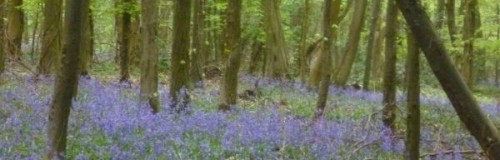
In my wheel of the year tree mandala (1), beech and bluebell together cover the period from 24 May-15 June – taking over from hawthorn and handing on to oak. In this instance, I am drawn by the powerful visual effects of bluebells carpeting woodland in which beech is the dominant tree.

The picture above is an old one. The last year in which Elaine and I went into this space (2018 or 2019) the wood felt weird. Part of it – not quite the area in the picture – was a scene of desolation. A lot of the trees had been taken down, with a kind of ragged insensitivity. It felt like a bad moment in Lord of the Rings. I don’t know the story behind this. Perhaps there was disease, or some other genuine need for a thinning out of trees. It was certainly systematic, with notices about the work being done – the result of management, and not of vandalism, in the conventional usage of our language.

The beech is an elegant tree, and I experience it as having a soft energy. It has been traditionally feminised, and thought of as ‘Queen of the Woods’, sharing the place of honour with the kingly oak according to The Green Man Tree Oracle (2). The same source says that “slivers of beech wood and leaves were once carried as talismans to bring good luck and increase creative energy”. Local British traditions associate the beech (ogham name phagos) with serpents “probably because of its long serpentine root systems”, they add – and I wonder too about the archaic link between the Goddess and serpent power in many cultures.

.

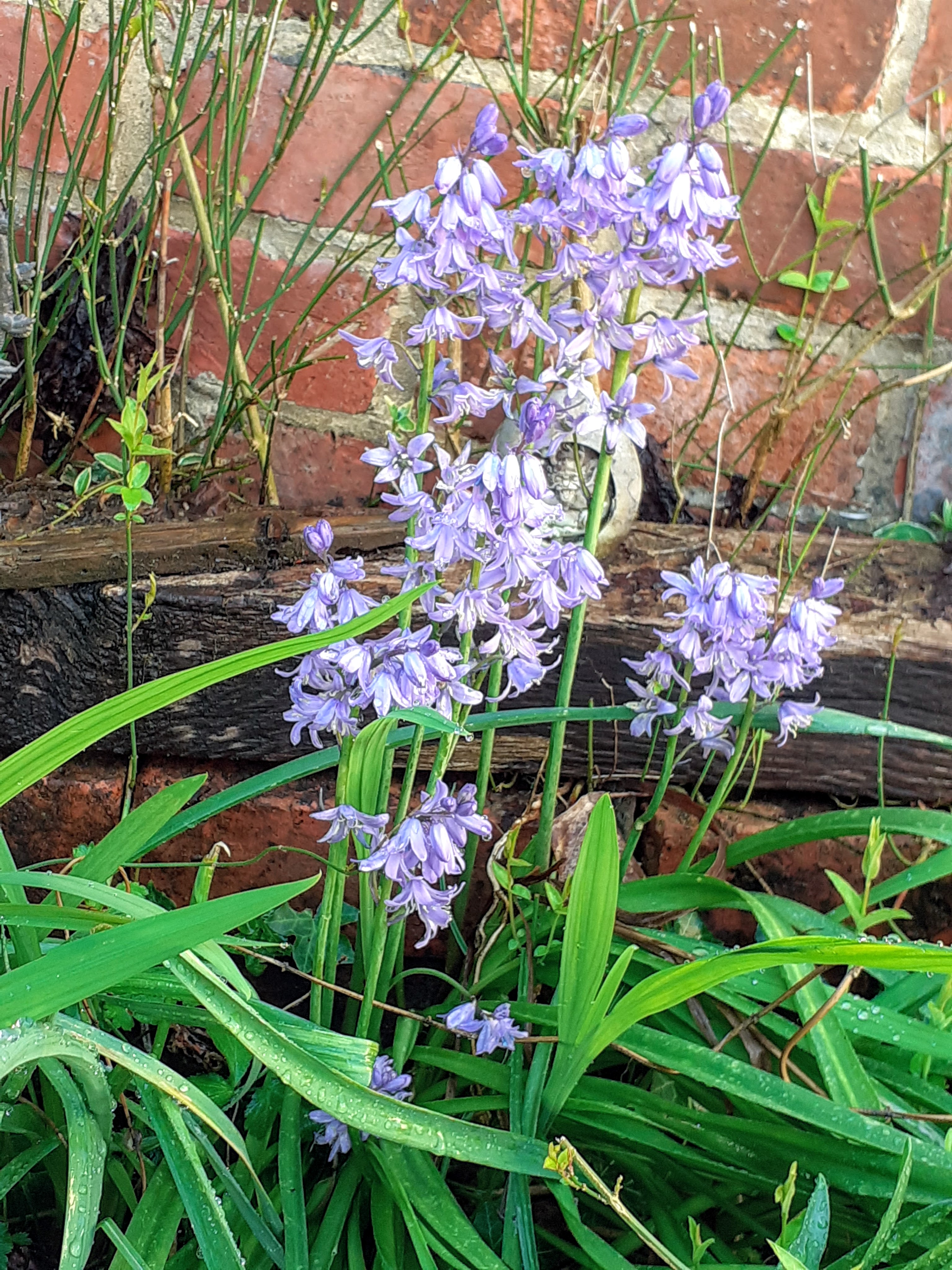
My personal connection with the tree itself is limited. It concerns this time of year and the association with bluebells. Indeed the bluebell is my main focus, with the beech as complementary. If they are separated, I follow the bluebell, and the picture below is a recent one, of the Spanish variety, from our garden. For me, it represents a favourite moment in the year, to be appreciated while it lasts. It reminds me simultaneously of the poignancy of impermanence (including my own) and the beauty of the eternal present (within which I am held).

(1) This mandala is based on my personal experience of trees in the neighbourhood as well as traditional lore. Moving around the summer quarter from Beltane, 1 May, the positions and dates of the four trees are: Hawthorn, south-east, 1-23 May; Beech & Bluebell, south-south-east, 24 May – 15 June; Oak, south, 16 June – 8 July; Gorse, south-south-west, 9 – 31 July. The autumn quarter then starts with Apple at Lughnasadh/Lammas. For a complete list of the sixteen trees, see https://contemplativeinquiry.blog/2020/autumn-equinox-2020-hazel-salmon-awen/

(2) John Matthews & Will Worthington The Green Man Oracle London: Connections, 2003.

TREE MANDALA: BLACKTHORN

In my wheel of the year tree mandala (1), blackthorn (ogham, straif) covers 8-30 April, the final twenty-three days before Beltane. It has a beautiful white flower and elegant sharp thorns. I have seen descriptions of the latter as ‘vicious’, but they only hurt us if we invade the blackthorn’s space. The plant is not a triffid. It doesn’t come after us. So I don’t follow the line of tradition that links blackthorn to harsh fate. Blackthorn doesn’t ask to be turned into guardian hedges or crowns of thorn. That is down to our fellow humans.

The picture above comes from my magic year of 2007, happily well documented, when I was much engaged with trees and Druid study. I felt a pull towards blackthorn, more than towards the generality of hawthorn during that period. (I will write about the Glastonbury Thorn, the exception, at Beltane, my last tree mandala with a ‘memory lane’ theme).

I am drawn particularly to the strand of tradition that links blackthorn to powerfully creative magic – for it was long used in the making of wizards’ staffs. The text of The Green Man Oracle (2) suggests that “we have forgotten the magic that lies within us”. Blackthorn in particular has the ability to “foster waking dreams”. The Oracle adds that, “to access this personal magic, we must step away from busy, surface consciousness, and sink deeply into the ever flowing stream of our magical dreams. The ideas, scenes and presences that throng the deepest levels of our understanding require intense listening” Such magic, the Oracle continues, brings a light into the darkest places. For me that would mean just enough light to illuminate them, and not so much as to dazzle them into negation. How otherwise can the denizens of the dark be offered a welcome home if they want it, and in any event a better understanding?

(1) This mandala is based on my personal experience of trees in the neighbourhood as well as traditional lore. Moving around the spring quarter from 1 February, the positions and dates of the four trees are: Birch, north-east, 1-22 February; Ash & Ivy, east-north-east, 23 February – 16 March; Willow, east, 17 March – 7 April; Blackthorn, east-south-east, 8 – 30 April. The summer quarter then starts with Hawthorn at Beltane. For a complete list of the sixteen trees, see https://contemplativeinquiry.blog/2020/autumn-equinox-2020-hazel-salmon-awen/

(2) John Matthews & Will Worthington The Green Man Oracle London: Connections, 2003.

TREE MANDALA: ASH AND IVY

Within my mandala of the year (1) Ash and Ivy together are part of a playful period extending to midsummer. The picture above holds memories of the year 2007, when the original photograph was taken in a wood near Bristol. It has recently been digitised and stylised by Elaine Knight, a frequent companion in my adventures with trees during that year.

I was enthusiastically connecting with them at the time, spurred on by an OBOD course (see http://www.druidry.org). My main focus was on being present in the presence of the living trees and connecting with them. I had a secondary concern with information about them. This includes traditional lore now often linked to the ogham alphabet. In that alphabet, ivy is gort and ash is nuin.

In my personal mandala of the year, ash and ivy preside from 23 February to 16 March. Ivy, as ever, is luxurious and abundant. Ash, at this time, is mostly tall and sleepy. I have a strong memory of finding them together as I walked up a tangled, sloping path. I felt an immediate connection with them, which I recorded at the time, though I hardly needed to. The occasion has stayed vividly in my mind ever since. Indeed the wish to celebrate that memory prompted me to include them in my tree mandala when it developed a year or so later.

In ogham lore, ash is connected with themes of rootedness and endurance (2). An ash can bear weight and absorb shocks. It has been the second most popular tree, after hawthorn, for planting at holy wells. It has also been a popular choice for maypoles. In the northern, Viking, tradition, it is Yggdrasil, world tree and wisdom steed of Odin. It links underworld, earth and heaven. It links macrocosm to microcosm, and the inner and outer worlds.

Ivy embodies the strength that can come from seeking support, whilst also being associated with poetry and intoxication. Its spiralling, labyrinthine dance turns both inwards and outwards. Ivy is a tenacious plant, skilled in binding and attachment. It is said also to connect us with our own inner resources, giving us “the ability to see through the eyes of the soul beyond the material world” (3).

I am fascinated by the way in which we can read the characteristics of our own hearts and imaginations into the life of trees whilst also connecting with their independent existence and what it can teach us about, for example, interdependence, a slower rhythm of life or the simple miracle of being. When among trees, I am taken up with the life of the tree on its own terms, more than with either botanical knowledge or inherited mythologies pointing to a larger life. It is when I am away from them that I turn fruitfully to their role in the collective imagination. There are different kinds of attention in play here, and I find that it helps to be aware of the difference without doing too far in disentanglement.

(1) This mandala is based on my personal experience of trees in the neighbourhood as well as traditional lore. Moving around the spring quarter from 1 February, the positions and dates of the four trees are: Birch, north-east, 1-22 February; Ash & Ivy, east-north-east, 23 February – 16 March; Willow, east, 17 March – 7 April; Blackthorn, east-south-east, 8 – 30 April. The summer quarter then starts with Hawthorn at Beltane. For a complete list of the sixteen trees, see https://contemplativeinquiry.blog/2020/autumn-equinox-2020-hazel-salmon-awen/

(2) The image is from: John Matthews & Will Worthington The Green Man Oracle London: Connections, 2003.

(3) Liz and Colin Murray The Celtic Tree Oracle: A System of Divination London: Eddison-Sadd, 1988 (Illustrated by Vanessa Card)


BIRCH: NEW BEGINNINGS

Within my mandala of the year (1) Birch – Beith in the Irish ogham alphabet (2) – is the first tree for the spring quarter beginning at Imbolc. The overall theme of this quarter, in my world, is one of early growth. Birch presides from 1-22 February and will become one of the first trees to flower in spring, from March onwards. It is also one of the first trees to colonise new ground.

In ogham lore Birch is understood to support new beginnings and to encourage careful preparation, a skilful laying of the ground on which we will build. “In making your spiritual journey with this tree as your guide, remember to concentrate your mind on the uplifting slender whiteness of the tree, a whiteness that stands out clearly from the tangled undergrowth and confusion of shrubs and thorny bushes that cover the floor and, hence, may inhibit an easy journey” (3). The Green Man’s wisdom (1) is that a good beginning leads to a good conclusion.

In runic tradition (4), where Birch (Beorc, Berkana) is also linked to new beginnings, there is specific reference to the young Goddess, sexuality and birth, as well as beauty and creativity more generally. Birch may signal a laying aside of old patterns, whether merely redundant or positively toxic, and a willingness to welcome new, more energising and nourishing ways of being.

For me, this is a welcome shift from the necessary defensiveness and protectiveness of alder. This year, it comes just at the moment where such a shift is possible – as my wife Elaine continues her recovery from major illness and we begin to dream and think our way forward, into a new cycle of life. The wheel turns, and there is a promise of positive change in the air.

(1) The image is from: John Matthews & Will Worthington The Green Man Oracle London: Connections, 2003.

(2) This mandala is based on my personal experience of trees in the neighbourhood as well as traditional lore. Moving around the spring quarter from 1 February, the positions and dates of the four trees are: Birch, north-east, 1-22 February; Ash & Ivy, east-north-east, 23 February – 16 March; Willow, east, 17 March – 7 April; Blackthorn, east-south-east, 8 – 30 April. The summer quarter then starts with Hawthorn at Beltane. For a complete list of the sixteen trees, see https://contemplativeinquiry.blog/2020/autumn-equinox-2020-hazel-salmon-awen/

(3) Liz and Colin Murray The Celtic Tree Oracle: A System of Divination London: Eddison-Sadd, 1988 (Illustrated by Vanessa Card)

(4) Sweyn Plowright The Rune Primer: a Down to Earth Guide to the Runes Rune-Net, 2006

MR. BRAMBLE

In my mandala of the year (1), I have sixteen trees. In the quarter from Lughnasadh (or Lammas) to Samhain, these are apples, blackberry, hazel and rowan. Blackberry presides over the days from 24 August to 15 September.

My choices have as much to do with personal memories as with natural processes, traditional lore, or the ogham alphabet in which Blackberry is Muin. In England we have an August Bank Holiday in which the weekend is extended to include the last Monday of the month. This year it will be August 31st. I have early memories of blackberry picking walks during this holiday, with family groups doted around a wooded hillside, and an air of informal ritual. Although balmy days might follow, this was the final act of summer.

The plant, of course, is with us throughout the year. The Druid Plant Oracle (2) names it as Bramble. “If you have ever tried digging up Bramble roots, you will know how tenacious they are – they travel long and deep, and some root systems can cover a wide area and be of great age”. Blackberry was said to be the bush into which Lucifer fell when he was thrown out of Heaven. Bramble provided a challenge for the prince in Sleeping Beauty.

Bramble also provided much needed sustenance for the famished wayfarers in The Voyage of Maeldun. In Joanne Harris’ Blackberry Wine (3) a small rural community in the south of France is saved from unwanted gentrifying ‘development’ through the prickly stubbornness of key individuals. These, quietly supported by most of their community, defend their own vision of how to live in the face of personal, commercial and threatened legal pressures. Neglected flora, overlooked forms of intoxication and a little magic all contribute to the holding of a much loved space. Mr Bramble is a good friend to have.

(1) See the ‘house’ section of: https://contemplativeinquiry.blog/2020/08/12/meditation-wisdoms-house/

(2) Philip and Stephanie Carr-Gomm The Druid Plant Oracle: Working with the Flora of the Druid Tradition London: Connections, 2007 (Illustrated by Will Worthington)

(3) Joanne Harris Blackberry Wine London: Black Swan, 2000

(4) The image at the top is from John Matthews & Will Worthington The Green Man Oracle: Ancient Wisdom from the Greenwood London: Connections, 2003

Earth Eclectic

music that celebrates Earth and speaks to the heart

Sarah Fuhro Star-Flower Alchemy

Follow the Moon's Cycle

Muddy Feet

Meeting nature on nature's terms

Rosher.Net

A little bit of Mark Rosher in South Gloucestershire, England

Becoming Part of the Land

A monastic polytheist's and animist’s journal

selkiewife

Selkie Writing…

Charlotte Rodgers

Images and words set against a backdrop of outsider art.

Prof Jem Bendell

living with metacrisis and collapse

Towint

The pagan path. The Old Ways In New Times

The Druids Garden

Spiritual journeys in tending the living earth, permaculture, and nature-inspired arts

The Blog of Baphomet

a magickal dialogue between nature and culture

This Simple Life

The gentle art of living with less

Musings of a Scottish Hearth Druid and Heathen

Thoughts about living, loving and worshiping as an autistic Hearth Druid and Heathen. One woman's journey.

Wheel of the Year Blog

An place to read and share stories about the celtic seasonal festivals

Walking the Druid Path

Just another WordPress.com site

anima monday

Exploring our connection to the wider world

Grounded Space Focusing

Become more grounded and spacious with yourself and others, through your own body’s wisdom

The Earthbound Report

Good lives on our one planet

Hopeless Vendetta

News for the residents of Hopeless, Maine