There is rain on the window pane, and bleakness beyond: the closing in of early winter, with more closing in to come. It is not yet the festive season.
But the geraniums are heralds of change. Leaves may turn brown. Petals may be shed. But the insistent continuity of these flowers is a bright blessing in a grey moment, a vivid affirmation of the life force itself.
Contemplating these geraniums marks for me a distinctive point in the wheel of time, and the timeless Now that holds it.
For the first time since I fractured my shoulder in a heavy fall, I have walked beside the Gloucester canal. The period between 2pm and 4.30 on 28 October was particularly auspicious. Cool but clear. Blue sky and sunshine.
On this occasion, as I tentatively walked the paths, I found myself in a living world dominated by yellow and green. A fall was happening, but was not very advanced. I noticed my confidence in walking becoming more consistent and reliable. I felt good. I was at ease in the woodland world.
The walk was part of my coming to terms with an advancing age, in which the possibility of a damaging fall is priced in. I felt a little nostalgic for a distant past. At a time when I was impatiently looking forward to my fourth birthday I fell down a flight of stairs and simply got up again. I was pleased to have a story to tell my parents, but couldn’t understand their alarm when I told it. 1953 is indeed another country.
However most of my attention, on this walk, was on the walk itself. Pragmatically, it needed to be, and I was also increasingly held by the spirit of place and time on this benign late October day. I had a strong sense of here, now and home.
I had a goal of reaching a newly refurbished bridge for pedestrians and cyclists only. This would give me time to turn around and get home before sunset (roughly 4.45 now that the clocks have changed). A slowish two and a half hours is as much as I can manage as yet. From a recovery perspective, I feel on track.
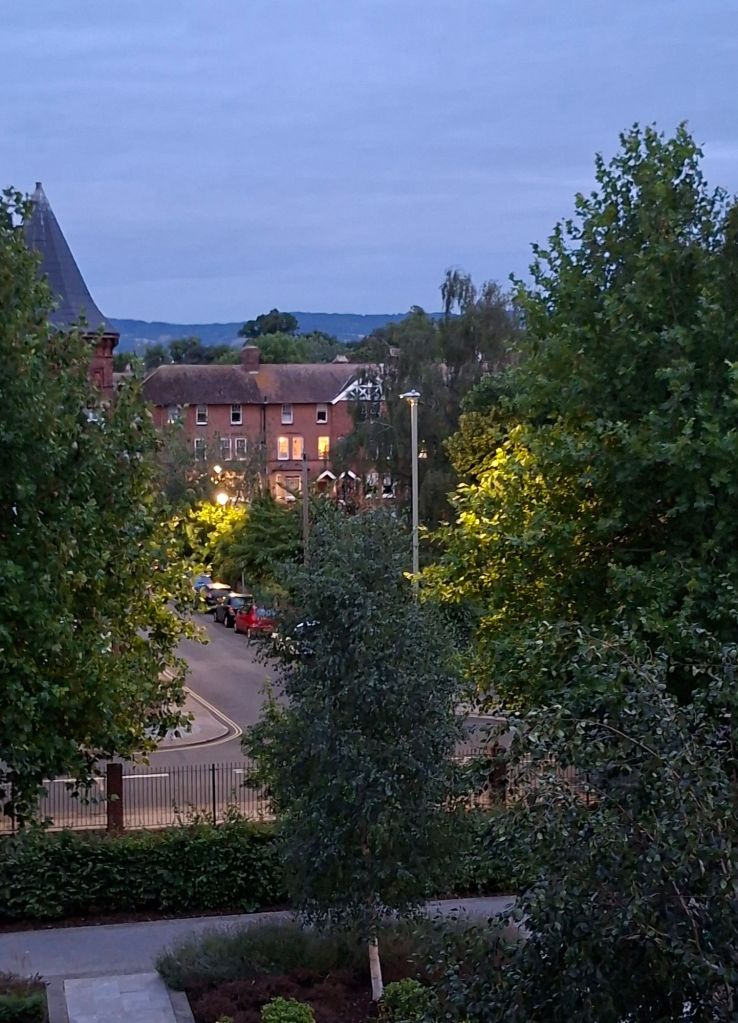
I see change in a familiar scene. Looking out from our apartment I contemplate a gentle twilight. It is modified by artificial light. During the recent heatwave I somehow had little consciousness of this moment in the day. But now, with lower temperatures and rain, my world is a tiny bit different. I discover myself in a twilit scene, and a twilight frame of mind, a little after sunset.
Although this sunset is only ten minutes earlier than the sunsets of the Solstice period, I feel, deep within me, the turning of the Wheel. It’s as if I am leaning in to the spirit of late summer, and the first of the harvest festivals that define the waning year. We are not there yet, though Lammas is but a fortnight away. I am simply becoming aware of a coming seasonal shift.
I am also aware of wanting to savour the sense of a change without wanting to hurry it on. Above, an image of trees, houses, hills and sky anchors me into a specific place and time. It’s a ‘now’ experience rather than an anticipation. Below, an image of birch leaves back-lit by electric light holds me in an appreciation of the pattern they make. I am held by the power of a simple pleasure.
I use the word ‘myth’ in a positive sense. Myth is a gift of imagination. It is a way of seeing beyond the limiting horizons of everyday life and culture. We can intuit a fuller, more spacious and generous reality, a reality with multiple dimensions. The specific myth of the journey, or quest, has had a powerful role in human history at both the personal and collective levels.
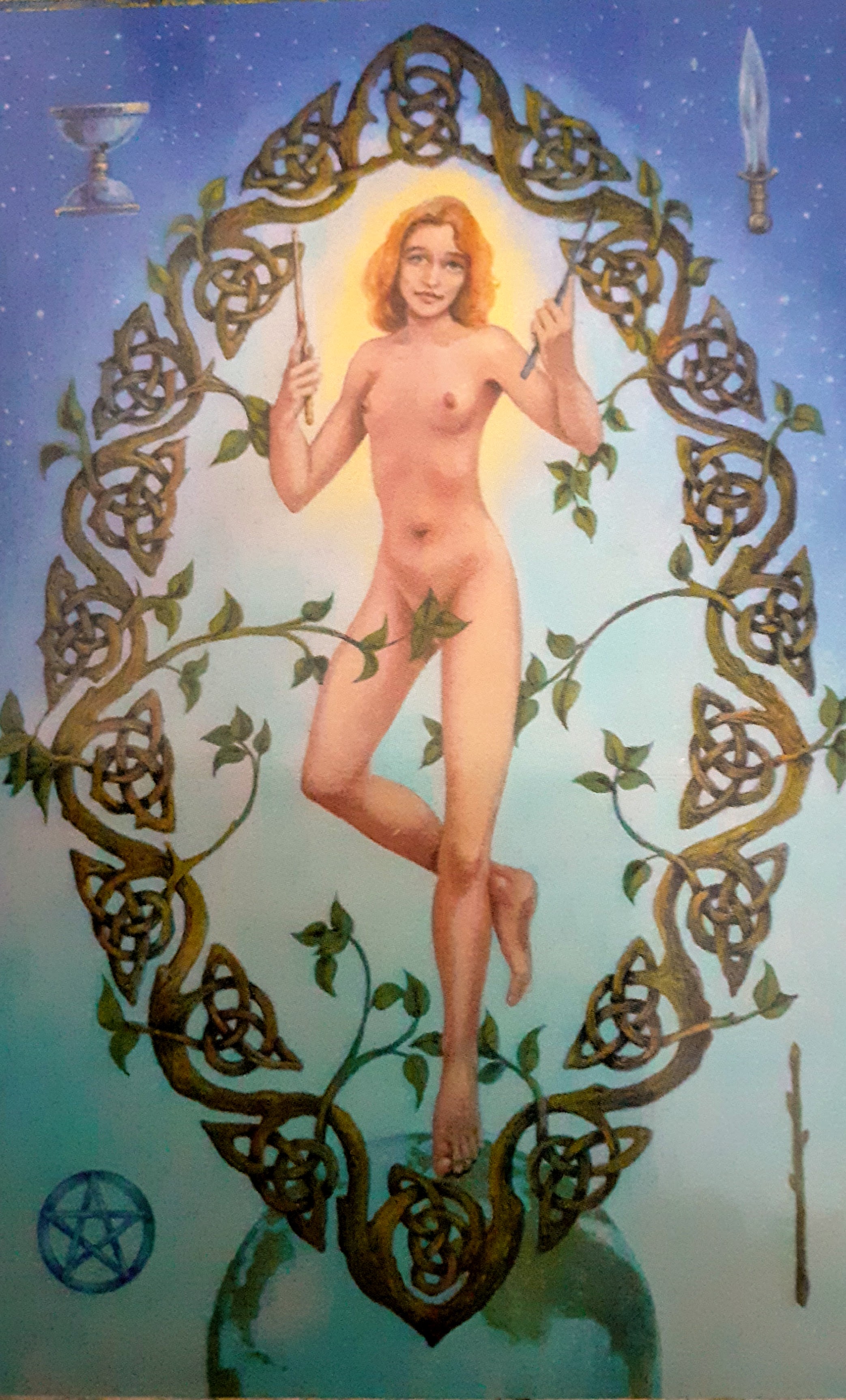
The picture above is the Fool, or innocent, as depicted the The Druidcraft Tarot (1). Trusting their inner knowing, the Fool steps over a cliff. It is a spring dawn, and a new beginning. The major Arcana are a map of the journey, which in essence, here, is seen as a refinement of the soul to the point where union with the divine is a lived experience. This experience is available here, in the world, and so the card indicating the completion of the journey (see picture below) is here called The World.
The mythology of the deck draws on the Welsh Celtic story of Taliesin and Ceridwen as well as the pan-European Arthurian grail quest, and broader Western Mysteries understandings derived from the Hermetic Order of the Golden Dawn. But any individual journey is its own new beginning and its fruits depend of making the journey in real time, and not clinging too tightly to traditional understandings.
In my own spiritual life, I have drawn both on the myth of the journey and another, apparently contradictory myth – that of the eternal moment, the transfigured here-and-now. Again, I find no disparagement in the word myth. This says that non-separation from the divine is a given. There is nowhere to go and nothing to do. Ultimately, there is no ontological difference in being awake to this reality than in being asleep to it. Yet lived experience is transformed by being awake to this reality and living from the awareness.
From a human perspective, coming to this awareness and then living it are, experientially, a journey in themselves. Another way of looking at it would be to say that I am the Fool and the Universe (my preferred term for the final card) at the same time, every day. In this way, I reconcile the myth of the journey with the myth of the now, and draw strength from both.
(1) Philip & Stephanie Carr-Gomm The Druidcraft Tarot: Using the Magic and Wicca and Druidry to Guide Your Life London, UK: Connections, 2004 (Illustrations by Will Worthington)
“Just as a wave doesn’t need to go looking for water, we don’t need to go looking for the ultimate. The wave is the water. You already are what you want to become. You are made of the sun, moon and stars. You have everything inside you.”
If I had authored the words above, they would be a clear statement of my stance as a modern Druid. In fact they were written by the Vietnamese Zen monk and peace activist Thich Nhat Hanh, who has spent the latter part of his life making Buddhism accessible to westerners. For me, this shows the wider resonance of his core understanding. Indeed he continues by using the language of a third tradition – the best known to most westerners – to develop his theme.
“In Christianity there is the phrase, ‘resting in God’. When we let go of all seeking and striving, it is as if we are resting in God. We establish ourselves firmly in the present moment; we dwell in the moment. We rest in our cosmic body. Dwelling in the ultimate doesn’t require faith or belief. A wave doesn’t need to believe it is water. The wave is already water in the very here and now.
“To me, God is not outside us or outside reality. God is inside. God is not an external entity for us to seek, for us to believe in or not to believe in. God, nirvana, the ultimate, is inherent in every one of us. The Kingdom of God is available in every moment. The question is whether we are available to it. With mindfulness, concentration and insight, touching nirvana, touching our cosmic body or the Kingdom of God, becomes possible with every breath and every step.”
Thich Nhat Hanh The Art of Living London: Penguin Random House UK, 2017
“Whenever there is beauty, kindness, the recognition of the goodness of simple things in your life, look for the background to that experience within yourself. But don’t look for it as if you were looking for something. You cannot pin it down and say, ‘Now I have it, or grasp it mentally and define it in some way. It is like the cloudless sky. It has no form. It is space; it is stillness, the sweetness of Being and infinitely more than these words, which are only pointers. When you are able to sense it directly within yourself, it deepens. So when you appreciate something simple – a sound, a sight, a touch – when you see beauty, when you feel living kindness toward another, sense the inner spaciousness that is the source and background to that experience.”
Eckhart Tolle Oneness with All Life: Awaken to a Life of Purpose and Presence Penguin Random House UK, 2018 (First ed. published 2008)






 Contemplative Inquiry