Contemplative Inquiry

This blog is about contemplative inquiry

Tag: non-duality

WORLD TREE: A HOLOTROPIC VISION

“The unified field of cosmic energy that I had experienced before now became a massive tree of radiant energy suspended in space. Larger than the largest galaxy, it was composed entirely of light. The core of the tree was lost to the brilliant display but limbs and leaves were visible around its edges. I experienced myself as one of the leaves, the lives of my family and close friends were clustered around me on a small branch. All of our distinguishing characteristics, what made us the individuals we were, appeared from this perspective to be quite minor, almost arbitrary variations of this fundamental energy.

“I was taken around the tree and shown how to move from one person’s experience to another and it was ridiculously easy. Different lives around the globe were simply different experiences the tree was having. … At this point, I was the tree. Not that I was having the full range of its experience, but I knew myself to be this single, encompassing Consciousness. I knew that its identity was my true identity. … To experience my true Identity filled me with a profound sense of numinous encounter”.

The above experience is reported by one of Stanislav Grof’s research subjects in his inquiry into “non-ordinary states of consciousness”. As a young psychiatrist in Soviet era Czechoslovakia Grof pioneered the therapeutic use of LSD. The authorities welcomed ‘progressive’ chemical treatments as an alternative to the bourgeois introspection of psychoanalysis. Seeking greater freedom, and given an opportunity to work in the USA, Grof became a Professor in the John Hopkins University School of Medicine. He continued his clinical and research work until it was banned in 1967 due to a moral panic about psychotropic drugs. His response was to invent holotropic breathing, a ‘natural’ and legal method of giving people access to the same states. Grof became a founder of the Transpersonal Association, which affirmed the place of spirituality in the therapeutic domain. Grof also developed a close association with the Esalen Institute in Big Sur, California, and became a leading figure in the counter-culture of the day.

Grof disliked the limitations he perceived in conventional scientific culture, in particular the view that “our boundaries were defined by the surface of the skin, and consciousness was seen as nothing more than the product of that thinking organ known as the brain”. He thought that scientific culture had developed in an ethnocentric way and was irrationally closed to information gained in non-ordinary states. For him, there was a limiting conflation of ‘objective reality’ and ‘consensus reality’. Anything referenced beyond this was open to dismissal “as the product of an overly active imagination or a mental disorder”, and thus delegitimised in conventional scientific discourse. Grof became interested in archetypal images like the world or cosmic tree because he found them coming up frequently in sessions, as phenomena inviting “numinous encounter”.

For me, reports of this kind add strength to the image of the world tree, though my personal experience of it is different. Some images, like that of the the world (or cosmic) tree, or tree of life, appear in many different cultures and historical periods. They are widely thought of as universal. But the specific ways in which they appear, and the meanings ascribed to them, vary with place, time and culture.

Stanislav Grof The Holotropic Mind: the Three Levels of Human Consciousness and How They Shape Our Lives San Francisco, CA: HarperSanFrancisco, 1993 (Written with Hal Zena Bennett)
EMPTINESS AND INTERBEING

At this point in my inquiry I want to refine my understanding of ’emptiness’. The Buddhist teacher Thich Nhat Hanh is a great help here, in his final commentary on the Prajnaparamita Heart Sutra .

Thich Nhat Hanh discusses Buddha’s teaching that everything is “a manifestation of causes and conditions” and that nothing is permanent or unchanging. This applies to the whole cosmos, and not just to the apparent world. “Whether you call it atman (the soul) or Brahman (ultimate divinity), whether you call it the individual self or the universal self, you cannot find anything there”. Buddha’s teaching was aimed at undermining both of these notions. Nothing has any ‘self-nature’ (we might use the term ‘essence’).

Thich Nhat Hanh pursues this right into the territory of emptiness. “There are still many people who are drawn into thinking that emptiness is the ground of being, the ontological ground of everything. But emptiness, when understood rightly, is the absence of any ontological ground. … We must not be caught by the notion of emptiness as an eternal thing. It cannot be any kind of absolute or ultimate reality. This is why it can be empty. Our notion of emptiness should be removed. It is empty.”

He goes on to say: “the insight of interbeing is that nothing can exist by itself alone, that each thing exists only in relation to everything else … looking from the perspective of space we call emptiness ‘interbeing’; looking from the perspective of time we call it ‘impermanence’ … to be empty is to be alive, to breathe in and breathe out. Emptiness is impermanence; it is change … we should celebrate. … When you have a kernel of corn and entrust it to the soil, you hope it will be a tall corn plant. If there is no impermanence, the kernel of corn will remain a kernel of corn forever and you will never have an ear of corn to eat. Impermanence is crucial to the life of everything”.

This is one side of an age old controversy within spiritualities of Indian origin. In this blog, I have given friendly attention to the other side as well – particularly Direct Path teachers like Rupert Spira and Greg Goode and the Indian influenced Douglas Harding. In the end I don’t make an absolute judgement about it. My Sophian ‘At-Homeness in the flowing moment’ is compatible with both views. But I’m now finding greater energy and aliveness in the framework here presented by Thich Nhat Hanh.

Increasingly, when I do Direct Path exercises I experience a breaking down of assumptions about experience itself, and a tremendous opening out … but no container called ‘Awareness’ to fill a God sized hole. It’s similar for me with the Harding exercises. My experience is broadly the same, but my felt sense has shifted, and my narrative with it. I’m moving away from big picture truth claims about this, because I have become sceptical that exercises like this provide any grounds for them, one way or the other. Rather, I lean in to an evolving personal understanding, always provisional, of my contemplative experiences.

As a shorthand, I can talk about the tension between a ‘Oneness’ framing and an ‘interbeing’ framing of what people call non-duality. The difference can seem subtle – and it may be best to use ambiguous, open-ended words like ‘Tao’ and preserve a sense of mystery. But at this turning of the year, ‘interbeing’ is my preferred term. It fits better with the eco-spirituality which I take from my Druid journey, and affirms the relational basis of my Sophian Way.

(1) Thich Nhat Hanh The Other Shore: a New Translation of the Heart Sutra with Commentaries Berkeley, CA: Parallax Press, 2017

See also: https://contemplativeinquiry.wordpress.com/2017/10/21/the-uses-of-emptiness/ an earlier post that I’ve been able to draw on here.

WINTER MORNING LIGHT

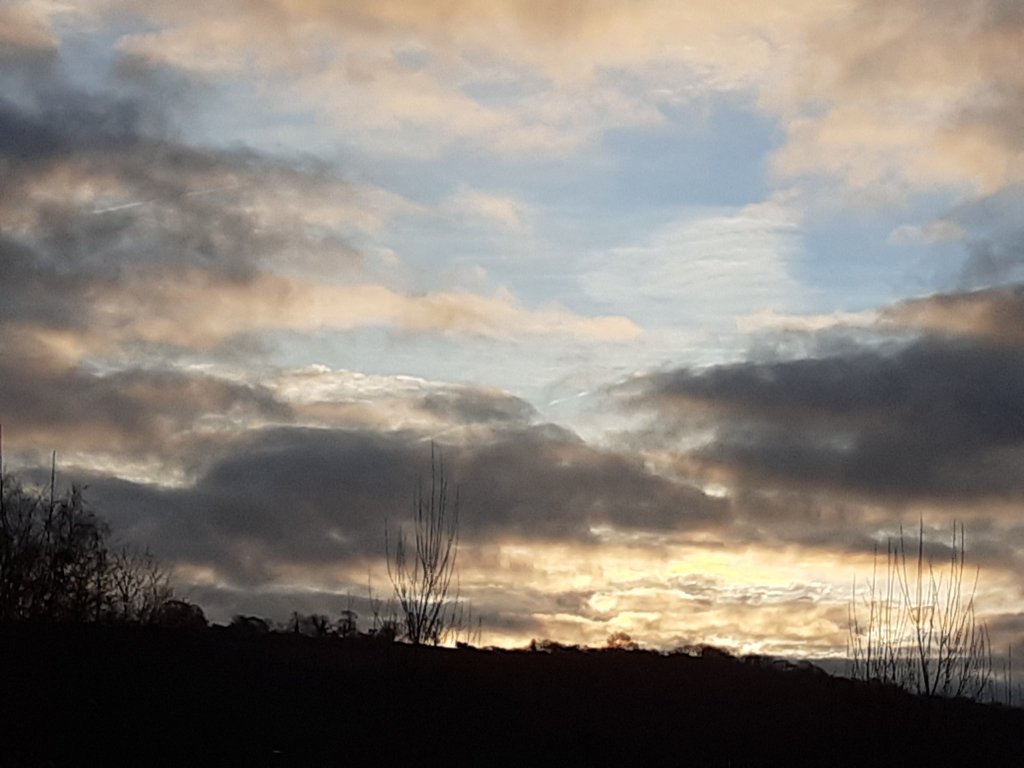
This is 7 December where I live, a little after 8 am, itself a little after the moment of dawn. The sunrise is still early in its process, fifteen days before the turn of the year. I took the pictures on one of my regular canal walks, this time between Stroud and Brimscombe in Gloucestershire, England.

This year I am paying close attention to the dance of place and time. It is part of my re-grounding after my adventures in non-duality, yet retaining the learning they brought. I surrender to the experience of winter sunlight. I breathe it in, and it fills the world, enacting a primal awareness. At the same time I acknowledge the particularity of time and place, of movement and change in nature. I also know that my observation of this winter light, at this time and in this place, is unique. It will never happen again in quite this way. It makes me glad to be alive and here for it. This gift is all the greater, and all the more to be treasured, for that very vulnerability, personal and collective, of which I am also conscious.

INTEGRATION

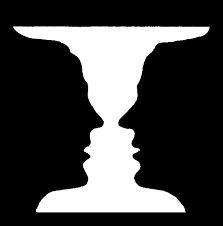
This is my grail image. I can see a chalice against a formless yet shape-creating background, or I can see two beings, with an enabling space between them. Two worlds; one image. Flicking rapidly between them, there comes a point where I can see them both, in the same place, at the same time.

I see the whole as an image of integration. Myth making just a little, I can point to a primal void, from which I am in no way separate, a cosmic mother, from whom I am distinct yet also in no way separate, and the birth of multiple individual forms of which I am one. With individuality comes otherness – and a world of connection/separation, community/exile, love/hate, joy/fear, generosity/contraction, conflict/co-operation, solidarity/predation. By integration I don’t here mean making the bad stuff go away, though efforts in that direction are immensely important. I am pointing, rather, to a capacity to hold all experience in presence and awareness: the deep experiential acceptance that all of the above, right up to void and creation, are happening here and happening now. They are the reality within which I awaken.

The Christian grail quest, which concerns the healing of the soul and its opening into spirit, partly evolved from older stories about the healing of the land, and maintains a wasteland motif. In Mahayana Buddhism enlightenment makes no sense if any sentient being is left behind. The modern Western Mystery tradition provides ways of bringing these stories together, with more of a tilt at this point in our history towards the collective dimension. I have written before that “for me the grail represents the presence and energy of Sophia”*, and has power for me on my Sophian Way. On this way, the ‘inner’ and ‘outer’ work go hand in hand: these are in any case conventional and limiting terms.

I understand the future as demanding cultures of resilience. Because of that I am glad that I have retained a foothold in Druidry and Paganism, because I see them as cultures of possibility in this regard. My Sophian Way has been a personal one, arising unexpectedly within my Druid education, and given some scope for recognition because of the way my Druid education worked. It fits better into the OBOD community, with its Universalist opening and invitation to learn from all traditions, than into any Christian, Gnostic or New Age community that I know of.

Yesterday I made a symbolic re-connection with OBOD (for I had never really left) by taking out a subscription to its magazine Touchstone after a lapse. Here at least I can name the Sophian Way unequivocally as a Goddess devotion without going through flips and twists about what ‘divine feminine’ might mean. At the same time, the name Sophia does reference insights and influences from other traditions, including secular philosophy, as befits a Goddess of Wisdom. For me, this is another kind of integration, whose fruits will manifest over time.

THE FLOW OF INQUIRY

There’s a saying that we never see the same stream twice. It’s true, from a certain perspective. The water is always different. In this recent picture there’s more of it than is usual. The flow is faster and more energised. But in another sense, it is clearly the same stream. There’s a pattern and a placing that make it the same. Not forever. But enough to give it an identity of its own. Enough for us to recognise it, and to be in relationship with it over time.

I think of my inquiry in the same way. It is clearly a process of inquiring, not a thing. It has changed a lot over the years. But I notice, looking back, that it does also have characteristic points of reference and recurring themes. It has its own kind of flow. I see for example that whilst taking up practices of self-inquiry linked to non-dualist movements, I have not embraced the movements. I have gone to them for insight, not belonging. Instead, I have naturalised the insight and reframed it in my own terms – such as stilling into presence, or finding home in the flowing moment. The central focus on Sophia, and the naming of a Sophian Way, has helped here. In my world, contemplative inquiry is a core Sophian practice.

I have also kept a least half a foot in the cultural matrix of modern Druidry, Paganism, animism and eco-spirituality. These movements are closer to my heart and imagination, and feel more like my cultural home. For me, emptiness only has meaning as a home to fullness and and an exuberant multiplicity of forms. The Sophia card (Major Arcana II) in the Byzantine Tarot has a vision of Sophia as present in all of creation and the natural world, and also “watching over the steps of the Holy Fool on his journey and guiding those who seek her blessing to find their own path through the world”*. I am not at all sure about the word ‘holy’, but I see Sophia in the stream, and sense the guidance there.

*John Matthews and Cilla Conway The Byzantine Tarot: Wisdom of an Ancient Empire London: Connections, 2015

NON-DUALITY AND YOGA NIDRA

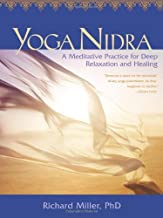
This post is built around Dr. Richard Miller’s approach to Yoga Nidra (1) and my response to it. The resource I am working with – a book and a CD – was published in 2005. My concern in writing is with how a “meditative practice for deep relaxation and healing” can also be what one reviewer (2) described as the “perfect tool” for the author’s non-dual teachings. For the recommended practices “require only presence, and as such represent both the path and the goal of non-dual practice.”

The word non-dual is a translation of the Sanskrit advaita, literally ‘not two’. I remember a podcast in which Peter Russell (3), a long-term practitioner and writer in this field, cautioned against a tendency to equate ‘not two’ with ‘one’. He then told an ancient Indian story about the making of clay pots. A potter takes a lump of clay and makes two pots. One clay; two pots. In the Indian tradition, this is a ‘consciousness first’ understanding, and modern versions draw on terms like presence, awareness, ground of being, or true nature to point to our ultimate identity as this consciousness. ‘God’ is also used in this way. The understanding is that we are never separate from this identity, though we may feel separate from it, or forget it, or ‘not believe’ in it. After all, most of our attention is on our individual life in the world with all its pulls, stresses and demands.

Early in his book, Richard Miller describes his first experience of Yoga Nidra:

“Our instructor led us through Shavasana, the traditional yogic pose for inducing deep relaxation while lying completely still on the floor. The instructor expertly guided us into being conscious of sensations throughout our body, as well as to opposing experiences, such as warmth-coolness, agitation-calmness, fear-equanimity, sorrow-joy, and separation-oneness. I was invited to rotate may attention through the sensations elicited by pairs of opposites until I was able to embody these opposing experiences with neither attachment or aversion to what I was experiencing.

“I drove home that evening feeling totally relaxed and expansively present. For the first time in years, I felt free of all conflict, radiantly joyful, and attuned wit the entire universe. I experienced life as being perfect just as it was and felt myself to be a spacious nonlocalized presence. Instead of my usual experience of being in the world, I was having a nonmental experience of the world being within me, similar to experiences I had known as a child”.

Miller’s motivation to continue was “a longing in me to consciously awaken into and fully abide as this sense of presence”. As well as becoming a yoga teacher and psychotherapist he has worked with Direct Path teachings as a student of Jean Klein. He describes the very term Yoga Nidra as a paradox, a play on the words ‘sleep’ and ‘awake’ as it means ‘the sleep of the Yogi’. The implication is that the normal person is asleep to their true nature through all states of consciousness – waking, dreaming and deep sleep – while the Yogi is one who is awake and knows his or her true nature across all states, including sleep. The practice therefore involves both deep relaxation and deep inquiry.

A full practice on Miller’s CD begins with two commitments – one to a form of mindfulness at the edge of sleep where, for the reasons pointed to above, it is OK to ‘fall asleep’ since there is a trust that the process will continue to run at other levels. The second is described as a ‘heartfelt prayer’, articulated as though it has already been fulfilled – for in the absolute, there is only now: Miller gives the example ‘my friend is whole, healed and healthy’. Then the meditation moves through seven stages, the first six of which address specific forms of awareness: body and sensation; breath and energy; feelings and emotions; thoughts, beliefs and images; desire, pleasure and joy; and witness/ego-I. The final stage (sahaj) is our natural state, ‘the awareness of changeless Being’. Each stage provides an opportunity to identify conventionally positive and conventionally negative experiences, and to hold both in a wider embrace. The sixth stage inquires into the very nature of the ‘I’ that believes itself to be a separate witness, enabling the simple being of the final stage. The whole practice lasts about 35 minutes.

I’ve been looking for an evening practice to complement my morning one. After only a week, it has the right feel, the right format and the right length for me at this point in my life. Over the last three or four years non-duality has become my common sense. During this period I have worked a good deal with the ‘Seeing’ experiments of Douglas Harding’s Headless Way (4) and also with substantial resources from Direct Path teachers Greg Goode (5) and Rupert Spira (6). A non-dual view, as a working assumption, is now both cognitively and experientially well installed.

I don’t have a deep interest in non-dualist metaphysics for its own sake. I am deeply committed to this world and my human life. What I find is that a non-dual model of reality adds to my experience of human life in the world, and cannot be separated from it. I find myself leaning in to this nourishing and illuminating possibility, and committed to commit to living by it. Roger Miller’s Yoga Nidra has met me where I am. I am very grateful for this gentle, life-affirming, and subtle practice, which helps to maintain me on this path.

(1) Richard Miller Yoga Nidra: A Meditative Practice for Deep Relaxation and Holding Boulder, CO: Sounds True, 2005

(2) Stephen Cope, author of Yoga and the Quest for the True Self and The Wisdom Of Yoga

(3) https://www.peterrussell.com/

(4) http://www.headless.org/

(5) Greg Goode The Direct Path: A User Guide Non-Duality Press, 2012 (UK edition)

(6) Rupert Spira Transparent Body: Luminous World: the Tantric Yoga of Sensation and Perception Oxford: Sahaja Publications, 2016

MAP AND TERRITORY

The Empress Wu Zetian ruled the Chinese empire alone from 690-705, the only woman ever to do so. It was the time of the Tang dynasty, when China was open to central Asian and Indian cultural influence. Wu herself had a strong Buddhist commitment.

She was curious about the world view of an esoteric Buddhist school, the Hwa Yen. In this view, all the universes were seen as a single living organism, characterised by mutually interdependent and interpenetrating processes of becoming and unbecoming. The Empress asked for a simple and practical demonstration of this complex vision.

The Hwa Yen sage Fa-tsang was given a palace room in which he placed eight large mirrors, each at one of the eight points of the compass. He placed a ninth mirror on the ceiling and a tenth on the floor. Then he suspended a candle from the ceiling in the centre of the room. The Empress was delighted at the effects thus created. ‘How beautiful! How marvellous!’ she cried. Fa-tsang explained how the reflection of the flame in each of the ten mirrors demonstrated the relationship of the One and the many, and also how each mirror also reflected the reflections of the flame in all the other mirrors, until myriad flames filled them all. The reflections were mutually identical. In one sense they were interchangeable; in another sense they existed individually. Then Fa-tsang covered one of the reflections to show the significant consequences this had for the whole. He described the relationship between the reflections as ‘One in All; All in One; One in One; All in All ‘.

Hwa Yen Buddhists also spoke of ‘The Great Compassionate Heart’. They understood it as a quality of awareness that sees all phenomena including ourselves as arising out of Emptiness, remaining part of the Emptiness whilst assuming a temporal form, and finally falling back into Emptiness and being reabsorbed. “It is a quality of awareness that quite naturally expresses itself in acts of deepest, yet quite unsentimental reverence and compassion for all that is, the just and the unjust, humans, animals, plants and stones”.*

Fa-tsang was careful to provide a ‘the-map-is-not-the-territory’ caveat. “Of course, I must point out, Your Majesty, that this is only a rough approximation and static parable of the real state of affairs in the universe – for the universe is limitless and in it an all is in perpetual, multidimensional motion”. Yet he had still taken care to provide his Empress with a beautiful, memorable and instructive map. Such maps, and the sense of ‘Great Compassionate Heart’ which they foster are of great value. They can nourish the seeker and illuminate the way, for rulers and non-rulers alike.

*Richard Miller Yoga Nidra: a Meditative Practice for Deep Relaxation and Healing Boulder, CO: Sounds True, 2005 (A more extended version of the story is included in this book.)

CELEBRATING THE MYSTERY

Yesterday my wife Elaine and I went to visit Gloucester Cathedral, where a beautifully crafted model of the moon has been hung in the body of the church. There were many visitors, most of them clearly drawn to this display and enlivened by it. For everyone there was something special about a scientifically accurate depiction of the moon in a medieval Christian building that continues to be an active space for worship. For some, the presence of the moon would also have suggested Pagan and archetypal references to provide a balancing influence in a splendidly patriarchal setting. It also allowed for a sense of only slightly subdued informality and fun, which I don’t generally associate with Church of England cathedrals. People felt free to enjoy themselves, and I give great credit to the organisers for their achievement.

The concept paid tribute to our age-old human search for meaning, and a sense of place within the cosmos. I was reminded of some reading I’d done only a couple of days before, and I’ve checked out the reference. For me, the image above and the words below show the same attractive spirit, one I find an inspiration for my contemplative inquiry.

“Both science and spirituality reflect our human urge to know – that perennial itch to make sense of the world and who we are. This quest is an essential part of being human. We probe reality as best we can with our tools of understanding – structures, models, theories, myths, beliefs, teachings – but those tools of understanding also define the limits of our knowledge. … There is no ultimate truth. No teacher, no scientist will give us all the answers. Let us simply bow to the intelligence of our hearts, drop into not knowing, keep our minds open, cherish the questions, and let the answers arise and evolve, all the while celebrating this mystery called life.”*

*Zia and Maurizio Benazzo On the Mystery of Being: Contemporary Insights on the Convergence of Science and Spirituality Oakland, CA: Reveal Press, 2019. (Reveal Press is an imprint of New Harbinger Press)

FEELINGS AND CONTEMPLATION

“In meditation, when a wave of feeling comes to visit – a grief, a fear, an unexpected anger or melancholy – can you stay present with that wave, breathe into it, let go of trying to ‘let go’ of it, and simply let it be, let it live, let it express itself right now within you? Can you notice the impulse in you to resist it, to refuse it, distract yourself from it and move away from your experience? Don’t judge or shame yourself for that impulse either, for wanting to have a different experience that you’re having – it’s an old habit, this urge to disconnect, this impulse to flee, this addiction to ‘elsewhere’.

” But see, today, if you can stay very close to ‘what is’, see if you can actually connect with the visiting feeling, gently lean in to your experience as it happens. Instead of shutting down, moving away, denying the energy in the body, can you gently open up to it? Can you flush it with curious attention? Let it move in you? Stay present throughout its life cycle, as it is born, expresses what it has to express, and falls back into Presence, its oceanic home?” (1)

The extract above is from a piece by Jeff Foster called When We Push Feelings Away. I support his approach, though I don’t now make firm distinctions between an activity called ‘meditation’ and the spontaneous flow of attention. I can stay present with the wave of feeling, and breathe into it, whether I’m ‘in meditation’ as a defined practice or not.  Meditation, once exotic and formal, has become naturalised. My contemplative life is pared down and minimalist, holding a strong sense of the sacred in daily life, including the work of self-healing. Jeff Foster continues:

“… One day, deep in meditation, perhaps, we remember, all feelings are sacred and have a right to exist in us, even the messiest and most inconvenient and painful ones. And we remember to turn towards our feelings instead of turning away. To soften into them. To make room for them instead of numbing them or ignoring them. …. So much creativity is released, so much relief is felt, when we break this age-old pattern of self-abandonment and repression, go beyond our careful conditioning, and try something totally new: staying close to feelings, as they emerge in the freshness of the living moment, waving to us, calling to us, seeking their true home in our heart of hearts.”

Jeff Foster calls this piece Pushing Feelings Away. I like his concern with holding and acceptance within what he calls Presence. I call my overall path a Sophian Way, and not The Sophian Way, because it is a solitary path that morphs and shifts.  Jeff Foster works with personal feelings from a transpersonal, non-dual  perspective that I find very Sophian, characterised  by wisdom, contemplation and compassion. My own path brings together this approach with the Eco-spirituality – or ‘Nature Mysticism’ – catalysed by my experience of modern Druidry.

(1) Jeff Foster The Joy of True Meditation: words of encouragement for tired minds and wild hearts Salisbury: New Sarum Press, 2019

POEM: RAPT FORM

FIRE upon Night the way flashing

Cove within Earth the seed receiving

South into North of us –

Eagle upon mountain and the light ascending

The Bowl of the daily dark descending

Stars beyond the shore of us

The Centre stays and the pattern fixes

The Centre moves and the diagram mixes

For many and more of us.

The Eye shines as the cast is shining

The Bowl gathers darkness as the shade is spreading

The Pentagram weaves its tent overheading

The stars and the Polestar turning and twining

Until the rotating of day.

O day and night O night of time

[the weft upon the warp of rhyme}

I backward step to the abyss

Where Form ends and Nothing is –

Where Nothing ends and All-Thing is.

Ross Nichols Prophet Priest and King: The Poetry of Ross Nichols Lewes: The Oak Tree Press, 2001 (Edited and introduced by Jay Ramsay)

“Ross Nichols, who was a contemporary of Eliot, and rated highly by many including Edwin Muir, was Chief of the Order of Bards, Ovates and Druids (OBOD) until his sudden and unexpected death in 1975. An accomplished prose writer, essayist, editor and water colourist who exhibited at the Royal Academy, we can now see him as one of the ‘Apocalypse poets’ of the 1940’s As Chief of the Order from 1964, his contribution was substantial, re-introducing into modern Druid practice the Winter Solstice Festival and the four Celtic Fire Festivals, which he led at London and in Glastonbury.”(Book blurb)

For information about OBOD see http://www.druidry.org/

Earth Eclectic

music that celebrates Earth and speaks to the heart

Sarah Fuhro Star-Flower Alchemy

Follow the Moon's Cycle

Muddy Feet

Meeting nature on nature's terms

Rosher.Net

A little bit of Mark Rosher in South Gloucestershire, England

Becoming Part of the Land

A monastic polytheist's and animist’s journal

selkiewife

Selkie Writing…

Charlotte Rodgers

Images and words set against a backdrop of outsider art.

Prof Jem Bendell

living with metacrisis and collapse

Towint

The pagan path. The Old Ways In New Times

The Druids Garden

Spiritual journeys in tending the living earth, permaculture, and nature-inspired arts

The Blog of Baphomet

a magickal dialogue between nature and culture

This Simple Life

The gentle art of living with less

Musings of a Scottish Hearth Druid and Heathen

Thoughts about living, loving and worshiping as an autistic Hearth Druid and Heathen. One woman's journey.

Wheel of the Year Blog

An place to read and share stories about the celtic seasonal festivals

Walking the Druid Path

Just another WordPress.com site

anima monday

Exploring our connection to the wider world

Grounded Space Focusing

Become more grounded and spacious with yourself and others, through your own body’s wisdom

The Earthbound Report

Good lives on our one planet

Hopeless Vendetta

News for the residents of Hopeless, Maine