Contemplative Inquiry

This blog is about contemplative inquiry

Tag: non-duality

‘BEING’

‘Being’ can be thought of in a number of ways. One is to say that it simply is what it is. I am. The flowers are.  No need for complications. I sympathise with this approach.

Yet when nudged to look at a 2021 post of my own (1), I found the following words based on the work of Eckhart Tolle (2). “Human is form. Being is formless. Human and Being are not separate but interwoven.” A part of my work in contemplative inquiry is to find a balance between human and Being.

For me, ‘Being’ is a way to talk about the divine, whilst keeping a distance from theistic language and its traditional associations. Some people use ‘ground of being’ in this sense. Experientially, silence, stillness, emptiness – the space between thoughts, feeling and things – open me up to Being. Feelings of joy and lovingkindness are likely to enter in. I find that deepening into Being enriches the human dimension itself – with all of its relationships, roles and activities in 3D time bound reality. In older language, it brings heaven to earth.

I like this use of language for its plainness and simplicity. Ultimately its assumptions are a matter of faith within a larger framework of unknowing. It simply describes where I stand within my continuing inquiry. I have also enjoyed being reminded of this use of words by my past self. It’s a personal benefit of having this record.

(1) https://contemplativeinquiry.blog/2021/03/03/spring-clarity/

(2) Eckhart Tolle Oneness with All Life: Awaken to a Life of Purpose and Presence Penguin Random House UK, 2018 (1st. ed. 2008)

AN UNDERSTANDING OF ‘GNOSIS’

My last post was about working with ancient texts. Here I look at the term ‘gnosis’ in the Gospel of Thomas. I am indebted to the commentary of translator Jean-Yves Leloup. Here he reflects on logion 5, whose text I include  in a note below.

“Gnosis is not a system, not another ideology through which we are to interpret and understand the world. On the contrary, it means opening our eyes to what we are already looking at, right in front of us, not searching somewhere else.

”  … Things are not hidden in themselves; they are open – the veils hiding them are in the habits of our own vision, so crude, so overloaded with memories and assumptions about reality, distorting what is before us …

“Gnosis is a long-term work of recognition, of purity of attention so as really to see what is in front of us. The consequence of this attention is that we become what we see and what we love … If we look at chaos, we will reflect chaos. If we look at light, we will reflect light.” (1)

I am glad that this commentary provides more than scholarly exegesis. Leloup says in his introduction that he wants to offer “a meditation that arises from the tilled earth of our silence. It is my belief that it is from this ground, rather than from mental agitation, that these words can bear their fruit of light “. In this way Leloup dreams the myth onwards for our time, and passes the baton to his readers. Both a blessing, and a responsibility.

(1) Commentary on Logion 5, The Gospel of Thomas: The Gnostic Wisdom of Jesus Rochester, VT: Inner Traditions, 2005

(Text translated from the Coptic with commentary by Jean-Yves Leloup; foreword by Jacob Needleman. English translation by John Rowe  Original French edition published 1986).

The translated logion reads:

“Yeshua said:

Recognize what is in front of you, and what is hidden from you will be revealed.

There is nothing hidden that will not be revealed.”

NOTE: See also

CHILD OF THE NOW

HARVESTING INSIGHT

Noticing a single corn stalk under our neighbouring birch trees, I wonder whether the seed simply blew in or was planted by an unknown hand. If the latter, what was their intention? I realise that I will never know.

I do know how much I enjoy its presence in this space at this time. I experience it as a miracle inviting gratitude and it has marked the seasonal moment for me, this first harvest of a now declining year.

With increasing clarity I understand that I do not work well with personified and individualised images of the divine. Something seems subtly off, as if I am failing to sound my own authentic note in the Great Song of the world.

I believe that we are given different gifts in our encounters with the Cosmos, leading to legitimately different understandings. When I lean in to the notion of divine personality – even when using the term ‘Spirit’ in that sense – I am not fully living my own truth. I subtly disempower myself and weaken my connection.

For in my universe, when I rest in my own clarity, there is no separation between nature (including culture) and spirit. In the awkward activity of identification and labelling, I answer to terms like animist, panentheist and nondualist.

These words are approximations, with the power to be distracting and slightly depressing. I can find words that point to my experience well enough. But the explanatory words, the more formal and generalised terms, feel clumsy. There’s a necessary level of unknowing that these isms don’t recognise.

When consciously living in spirit, I am neither alone, as a single human person, nor am I with another being. I am simply in a different dimension of embodied awareness, supported and empowered by the bubbling source from which I spring. For me, Nature is more than the ‘nature’ of dualist spiritualities and of the scientific humanism that grew out of them.

As I harvest the learning, or relearning, of this lesson, I renew my commitment to practice and path, once again revising the beginning and end of the modern Druid’s prayer (1). I move from from ‘Grant, Spirit your protection, and in protection, strength … ‘ to ‘In spirit I find protection, and in protection, strength …’. I end with ‘and in the love of all existences, the love of this radiant Cosmos’ rather than ‘the love of God/Goddess/Spirit and all goodness’. These small changes formalise and anchor my understanding.  For me, they are an important affirmation, illuminating my path.

(1) Traditionally, this prayer runs:

Grant O God/Goddess/Spirit, your protection,

And in protection, strength,

And in strength, understanding,

And in understanding, knowledge,

And in knowledge, the knowledge of justice

And in the knowledge of justice, the love of it

And in the love of it, the love of all existences

And in the love of all existences, the love of God/Goddess/Spirit and all goodness”.

NB Providing the options of God/Goddess/Spirit is I think an OBOD (Order of Bards, Ovates and Druids) innovation. The original version, from the late 18th century, simply said ‘God’. Some modern Druids say ‘God and Goddess’.

HERTHA AS EARTH MOTHER AND COSMIC GODDESS

Hertha (Nerthus, Erth) was a Germanic Goddess of the Earth, associated with fertility, domestic animals and nature. She was believed to live in an island grove, whilst also touring the land in a cow drawn chariot to bring peace and joy to those who celebrated her. Our ancient information is derived from the Roman author Tacitus, in his Germania (1). Current accounts also link her to themes of rebirth, kinship, health, longevity and tradition. It is said that she can descend through the smoke of any fire to bring gifts. See: https://journeyingtothegoddess.wordpress.com/2012/12/25/goddess-hertha/

Algernon Charles Swinburne’s Victorian poetry is mentioned in two of Ronald Hutton’s Divinity lectures at Gresham College (2,3). In particular he describes the poem Hertha (3) as an important example of Pagan currents in Victorian British culture. Although widely seen then and (for some people) since as transgressive, Swinburne’s voice is confident and strong – as I hope these extracts show:

“I am that which began:

Out of me the years roll;

Out of me God and man;

I am equal and whole;

God changes, and man, and the form of them bodily;

I am the soul.

“Before ever land was,

Before ever the sea,

Or soft hair of the grass,

Or fair limbs of the tree,

Or the flesh-coloured fruit of my branches, I was, and thy soul was in me.

“First life on my sources

First drifted and swam;

Out of me are the forces

That save it or damn;

Out of me man and woman, and wild beast and bird; before God was, I am.”

As I read these verses, Swinburne’s Hertha is cosmic as well as local, universal as well as tribal. Swinburne clearly values Hertha’s specific name and lineage and he identifies Hertha with the World Tree in some verses. But he does not simply revive the old North European traditions. His Paganism models a new culture for a new time.

Although another 150 years have passed since Swinburne wrote this poem, I find it directly relatable. For me, it contains one of the most powerful affirmations of Panentheist Paganism I have heard: “I am the mouth that is kissed and the breath in the kiss, the search, and the sought, and the seeker, the soul and the body that is”. What better time than Beltane to celebrate Hertha and the 19th century seeding of Modern Paganism.

(1) Tacitus Agricola and Germania London: Penguin, 2009 (rev ed)

(2) The Modern Goddess and Where did Modern Paganism start? https://www.gresham.ac.uk/watch-now/

(3) Algernon Charles Swinburne Complete Poetical Works Delphi Classics, 2013 (Kindle edition)

THE MYTH OF THE JOURNEY AND THE MYTH OF THE NOW

I use the word ‘myth’ in a positive sense. Myth is a gift of imagination. It is a way of seeing beyond the limiting horizons of everyday life and culture. We can intuit a fuller, more spacious and generous reality, a reality with multiple dimensions. The specific myth of the journey, or quest, has had a powerful role in human history at both the personal and collective levels.

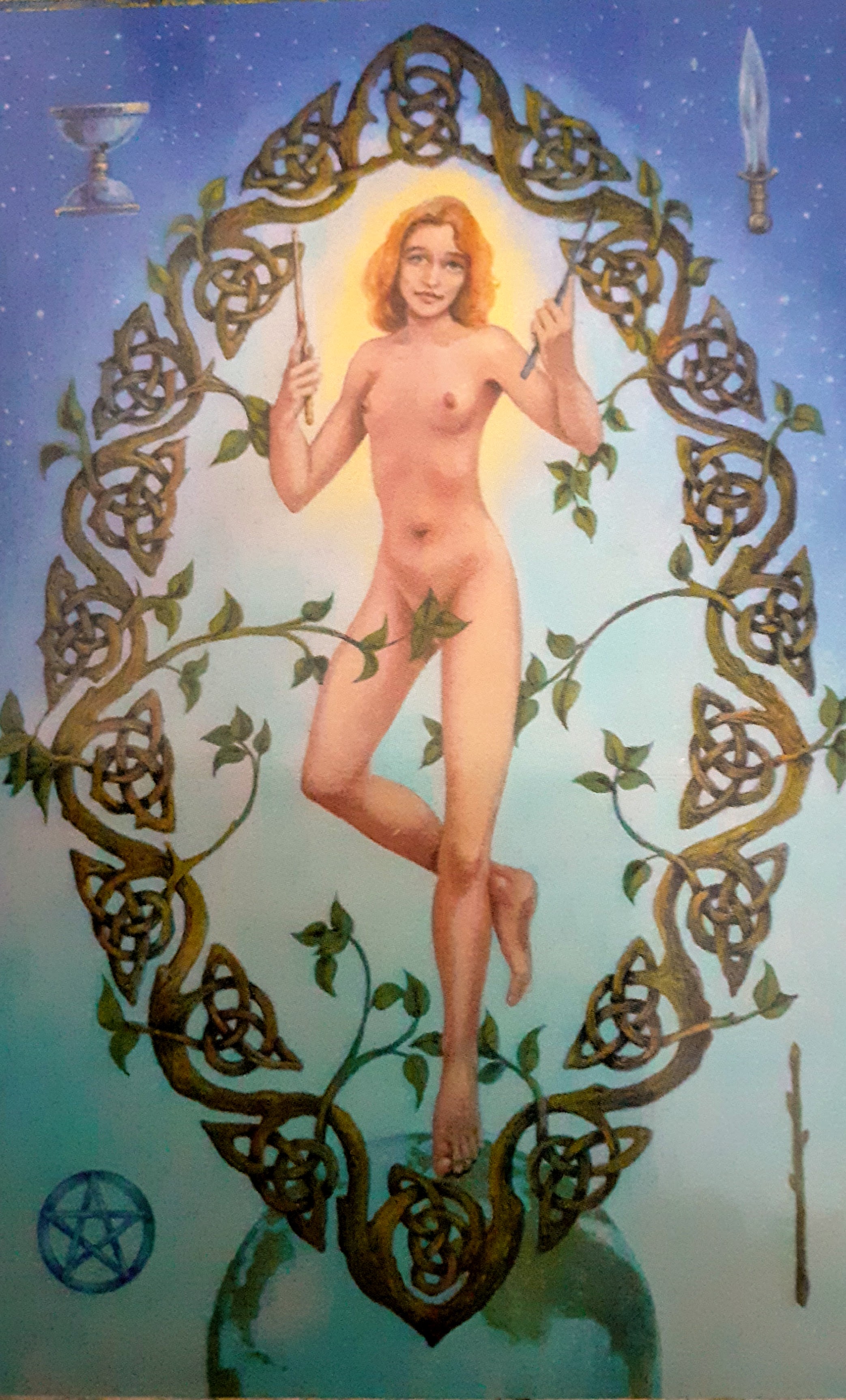
The picture above is the Fool, or innocent, as depicted the The Druidcraft Tarot (1). Trusting their inner knowing, the Fool steps over a cliff. It is a spring dawn, and a new beginning. The major Arcana are a map of the journey, which in essence, here, is seen as a refinement of the soul to the point where union with the divine is a lived experience. This experience is available here, in the world, and so the card indicating the completion of the journey (see picture below) is here called The World.

The mythology of the deck draws on the Welsh Celtic story of Taliesin and Ceridwen as well as the pan-European Arthurian grail quest, and broader Western Mysteries understandings derived from the Hermetic Order of the Golden Dawn. But any individual journey is its own new beginning and its fruits depend of making the journey in real time, and not clinging too tightly to traditional understandings.

In my own spiritual life, I have drawn both on the myth of the journey and another, apparently contradictory myth – that of the eternal moment, the transfigured here-and-now. Again, I find no disparagement in the word myth. This says that non-separation from the divine is a given. There is nowhere to go and nothing to do. Ultimately, there is no ontological difference in being awake to this reality than in being asleep to it. Yet lived experience is transformed by being awake to this reality and living from the awareness.

From a human perspective, coming to this awareness and then living it are, experientially, a journey in themselves. Another way of looking at it would be to say that I am the Fool and the Universe (my preferred term for the final card) at the same time, every day. In this way, I reconcile the myth of the journey with the myth of the now, and draw strength from both.

(1) Philip & Stephanie Carr-Gomm The Druidcraft Tarot: Using the Magic and Wicca and Druidry to Guide Your Life London, UK: Connections, 2004 (Illustrations by Will Worthington)

FAITH

In my Druid circle, I associate the northern quarter with faith. The quality and context of faith are not defined. They could simply mean faith in the practice and path. My contemplative inquiry overall has tended towards a stance of ‘sacred agnosticism’ (1), in which faith is not emphasised. This has served me in many ways. I have avoided mixing up the idea of ‘faith’ with affiliation to authoritarian movements, mandated beliefs, or the surrender of self-responsibility and personal discernment. I have been alert to the metaphysical group think and consensus collusion that can show up in any spiritual movement (other kinds of movement too). I have done my best to gather and evaluate information skilfully, when developing principles about how to live ethically and gracefully in an increasingly scary world.

And yet … this is not the whole story, or I would feel spiritually malnourished. In recent months I have experienced a strong felt sense of the divine. When I describe myself as ‘living presence in a field of living presence in a more than human world’ – an animist identification – the identification now seems more than animist, though the animism is still there. I pray more congruently to the Goddess as Ancient Mother and talk, less anthropomorphically, about the ‘bubbling source from which I spring’. The Divine is beyond name, form or description – and some people prefer a specialist, capitalised use of rather abstract terms like Consciousness, Awareness, Void, Ground of Being. But the ones from my own practice are the ones that work for me. They come from the intuitive heart and the imagination. To me they offer a deeper knowing, though I am personally cautious about the use of the word gnosis. For me, it can reduce the sense of mystery,  banishing the creative role of faith itself.

I have become a provisional panentheist, experiencing intimations of a divine which is everywhere and no-where, and from which we are not separate. This partly reprises work I did in the earlier days of my inquiry using the framework of non-duality. Now I find panentheism a better term than non-duality for affirming both the divine and the world. The earth spirituality in the Druid tradition is in no way compromised by a panentheist perspective. If anything it is enhanced.

(1) See https://contemplativeinquiry.blog/2024/02/16/sacred-agnos

TWO VIEWS OF THE DIVINE

In 1986, at the age of 50, Satish Kumar (1) went on an extended pilgrimage of British sacred sites. When staying overnight as a guest of the Bishop of Lincoln, he initiated a dialogue on divinity. In this discussion, divinity is described as God, and masculine language is used throughout. (In other contexts Satish Kumar has been happy to use Goddess references and language.) My own practice is largely non-theistic, yet I am Pagan enough to have been jolted by this limitation. Diverse images, stories and beliefs about the divine continue to inform my heart, mind and imagination. The two views articulated here (both eco-friendly in their way) point to very different experiences and understandings of the divine, and of the world: dualist and non-dualist in formal terms.

“‘It is with great pleasure that I welcome you, Satish, to Lincoln and my house, the Bishop said. ‘Going on a pilgrimage is an ancient tradition, but walking for four months around Britain to its sacred places is not so common.’

“‘I am honoured to be your guest,’ I said. ‘I have been inspired and renewed by being within many churches and cathedrals, but increasingly I am finding all places sacred and the presence of the divine everywhere.”

“‘The Bishop heard my comment with thoughtful silence, and then said, ‘For us, God is above and beyond his creation. We aspire to reach God, but God and the world are not the same.’

“‘In the Hindu tradition the world is understood to be the dance of the God Shiva, and the yet the dance and the dancer cannot be separated. The world is not like a painting, a finished object which when complete is seen as separate from the painter. The universe is a living dance and God in in the heart of all beings and things. We do not separate God and the world.’

“The Bishop pondered and in a gentle voice said, ‘I believe that the world is God’s creation and therefore it is sacred. Human beings must act as responsible guardians and caring stewards. We must love the land and look after the earth in its glorious diversity. We have no right to plunder, pollute, exploit, destroy, kill or in anyway disrespect God’s creation. Like in a family, God is the Father and we are his children, and all members of the family should live in harmony with each other. God’s family includes the animals and the natural world. If we are sensitive and caring, we can live with nature rather than against it. The advance of science and technology requires that human beings live with greater sensitivity than ever before, since we are now equipped with extremely powerful and destructive tools. This destructive impulse is not part of God. God is good and good only.’

“‘For me, Divinity is neither good nor bad,’ I said. ‘It is like pure water and pure air. The human soul is also pure. Good and bad is a matter of perception. For example, from nature’s point of view creeping buttercups and nettles are fine wherever they are; they will grow where the soil is ripe for them. From the human perspective, however, a gardener struggles to remove the buttercups and nettles; he regards them as weeds, and complains when they overtake flowers. The rose and the thorn are part of the same plant – we cannot have one without the other. The analytical mind attempts to separate the good and evil, the decorative and ugly, the useful and non-useful, the weed and the flower. I have seen during my journey people pulling out foxgloves in one area and carefully planting them in another. If we are to live in harmony with God’s family, we need to love the wilderness, the weeds and the wet.'”

From: Satish Kumar No Destination: Autobiography of a Pilgrim Cambridge: Green Books, 2014 (extended 4th edition – first edition 1992)

(1) “Satish Kumar (born 9 August 1936)[1] is an Indian British activist and speaker. He has been a Jain monk, nuclear disarmament advocate and pacifist.[3]Now living in England, Kumar is founder and Director of Programmes of the Schumacher College international center for ecological studies, and is Editor Emeritus of Resurgence & Ecologist magazine. His most notable accomplishment is the completion, together with a companion, E. P. Menon, of a peace walk of over 8,000 miles in June 1962 for two and a half years, from New Delhi to MoscowParisLondon, and Washington, D.C., the capitals of the world’s earliest nuclear-armed countries.[4][5] He insists that reverence for nature should be at the heart of every political and social debate.” (Wikipedia)

‘MAGIC/DELIGHT’

“When we see a magic trick – or anything else that catches us off guard in a magical way – in the moment of surprise our mind stops, and there is a flash of delight. We are in a state of mute wonder.

“The same bliss of wonder, delight, and amazement is the focus of this meditation. We use our response to propel ourselves into a state beyond the mind, a state where we see the magical nature of life.

Our delight in what we are seeing, coupled with an amazed mind, become a doorway into an intuitive flash in which we remember that life itself is like a magic show, a dream – and not at all what our worries little self was thinking it to be!

“This meditation encourages us to attend to all the moments of surprise and delight that occur throughout our day.

“The following contemplation can help prepare us to take full advantage of these moments.

Practice thinking of delight

“Bring to mind a memory of a time when you experienced surprise and delight;

“Focus on your reaction – feel fully your surprise and the wonderful sensation of your delight;

“In this thought-free moment, let the great bliss remind you of the true nature of reality;

“Remain alert for these moments as they occur throughout the day.” (1)

(1) Meditation 43 from: Lee Lyon The 112 Meditations from the Book of Divine Wisdom: the Meditations from the Vijnana Bhairava Tantra with Commentary and Practice Santa Fe, NM: Foundation for Integrative Meditation, 2019. See http://www.integrativemeditation.org

Lee Lyon’s introduction describes the Vijnana Bhairava Tantra as “a compendium of meditations from the 8th century Shaivite tradition in Kashmir. Acknowledged as one of the supreme jewels of the Tantric tradition of northern India, this much loved text had remained largely obscure until its rediscovery last century. … One of the great hallmarks of this tradition is its … enthusiastic engagement with all aspects of our life experience, even the ‘unspiritual’, as wonderful, natural gateways into our true nature”.

The basic teaching is to move through the surface appearance of our lives into “the pure energy behind form”. It is through engaging “the deeper energy in any experience, pleasurable or difficult, ecstatic or terrifying, that we move through the appearance of separation into the ever present Oneness.”

SKY

“Isaac spent all his time reading in a dark house, refusing to go out into the sunshine. His next-door neighbor was a hidden spiritual master, who periodically dropped by to say to Isaac, ‘don’t spend your whole life hunched over your desk in this dark room. Get out and look at the sky!’ Isaac would nod and keep on reading. Then one day his house caught fire. Grabbing what possessions he could, he ran outside. There, he saw the master, pointing upwards. ‘Look,’ said the master, ‘Sky!’ In this story, there are three elements that represent the process of awakening: the fire, the master, and the sky. Kali is all of them.” (1)

(1) Sally Kempton Awakening to Kali: The Goddess of Radical Transformation Boulder, Colorado: Sounds True, 2014

Sally Kempton belongs to the tradition of Kashmir Shaivism, and has described her path as a contemplative and devotional Tantra. For this tradition, a subtle vibratory energy is the substratum of everything we know, and the expression of a divine feminine power called Shakti. This power has five faces – the power to be conscious, the power to feel ecstasy, the power of will or desire, the power to know, and the power to act.

All of these powers come together in the act of cosmic creation, when divine intelligence spins a universe out of itself in Shakti’s dance. Her powers are constantly at play in ourselves and the world, nudging us towards an evolution of consciousness, with which we must align when we seek conscious transformation. Shakti, the formless source of everything, takes multiple forms. Indeed the whole complex Indian pantheon, gods and goddesses alike, are forms of Shakti.

Sally Kempton says that anthropologists have identified two basic versions of Kali, specifically, in popular Indian religion. There is a forest and village Kali represented as scary and half-demonic, and the urban and more modern Kali Ma – “a benign and loving source of every kind of boon and blessing”. Here, her wildness is largely symbolic. Kempton’s Kali seems to be a challenging, ruthlessly compassionate teacher and guide.

In a recent post I wrote: “it is as if I am resourced by a timeless, unboundaried dimension from which I am not separate”. (2) It is my current experiential understanding of the spiritual approach knowns as ‘non-dualism’. Kashmiri Shaivites, Including Sally Kempton, are non-dualists. They are entirely at ease with deity devotion as part of the path.

I am wondering now if, and how, a greater element of deity oriented and devotional practice might add to my own path. Just over three years ago I let go of a ‘Way of Sophia’ thread, with some pain, because it no longer felt authentic. All that’s left is my address to the Goddess (Primal Cosmic Mother, Lady Wisdom) in the Druid’s prayer. Something is missing, I think, and I feel close to another shift. Frankly, I feel nudged.

(2) https://contemplativeinquiry.blog/2022/12/31/a-direction-for-2023/

A CONTEMPLATIVE PERSPECTIVE ON WISDOM

For me, wisdom can take many forms. Below, Eckhardt Tolle emphasises contemplative process over cognitive product. I don’t treat this as an exclusive definition of the word wisdom. But I have certainly been nourished by taking Tolle’s understanding to heart and learning how to let the process unfold.

“Wisdom is not a product of thought. The deep knowing that is wisdom arises through the simple act of giving someone or something your full attention. Attention is primordial intelligence, consciousness itself. It dissolves the barriers created by conceptual thought, and with this comes the recognition that nothing exists in and by itself. It joins the perceiver and the perceived in a unifying field of awareness. It is the healer of separation.” (1)

(1) Eckhardt Tolle Stillness Speaks Vancouver, Canada: Namaste Publishing, 2003

Earth Eclectic

music that celebrates Earth and speaks to the heart

Sarah Fuhro Star-Flower Alchemy

Follow the Moon's Cycle

Muddy Feet

Meeting nature on nature's terms

Rosher.Net

A little bit of Mark Rosher in South Gloucestershire, England

Becoming Part of the Land

A monastic polytheist's and animist’s journal

selkiewife

Selkie Writing…

Charlotte Rodgers

Images and words set against a backdrop of outsider art.

Prof Jem Bendell

living with metacrisis and collapse

Towint

The pagan path. The Old Ways In New Times

The Druids Garden

Spiritual journeys in tending the living earth, permaculture, and nature-inspired arts

The Blog of Baphomet

a magickal dialogue between nature and culture

This Simple Life

The gentle art of living with less

Musings of a Scottish Hearth Druid and Heathen

Thoughts about living, loving and worshiping as an autistic Hearth Druid and Heathen. One woman's journey.

Wheel of the Year Blog

An place to read and share stories about the celtic seasonal festivals

Walking the Druid Path

Just another WordPress.com site

anima monday

Exploring our connection to the wider world

Grounded Space Focusing

Become more grounded and spacious with yourself and others, through your own body’s wisdom

The Earthbound Report

Good lives on our one planet

Hopeless Vendetta

News for the residents of Hopeless, Maine