Contemplative Inquiry

This blog is about contemplative inquiry

Tag: Nature

LIVING PRESENCE

In my part of the world, we have begun the greening of the year. But I can’t go out to meet it, or if so, only a little. I can’t go out, so I have to go in. In the greening of my contemplative life, a sense of ‘living presence’ has been the key.

My bespoke liturgy speaks to me and at times asks for change. A section of my morning practice, an affirmation of ‘at-homeness in the present moment’, wants to expand into a ‘celebration of living presence’. At-homeness stood for a place of safety and regeneration. ‘Living presence’ includes that and points to more. In the celebration, I affirm myself as ‘living presence in a field of living presence: here, now and home’. I’ve added a period of walking meditation (20 minutes or so), mindful to breath and footfall and also including liv-ing pres-ence as a mantra over two full breaths.

The Phrase ‘living presence’ came up spontaneously but realising that I didn’t actually make it up, I checked up on where I first came across it. It comes from the Sufi teacher Kabir Edmund Helminski (1). “Presence signifies the quality of consciously being here … the way in which we occupy space. Presence shapes our self-image and emotional tone. Presence determines the degree of our alertness, openness and warmth. Presence decides whether we leak and scatter our energy or embody and direct it”.

For Helminski, presence is also our link to the divine. since in the bigger picture it is “the presence of Absolute Being reflected through the human being. We can learn to activate this presence at will. Once activated, we can find this presence both within and without. Because we find it extending beyond the boundaries of what we thought was ourselves, we are freed from separation, from duality. We can then speak of being in this presence”.

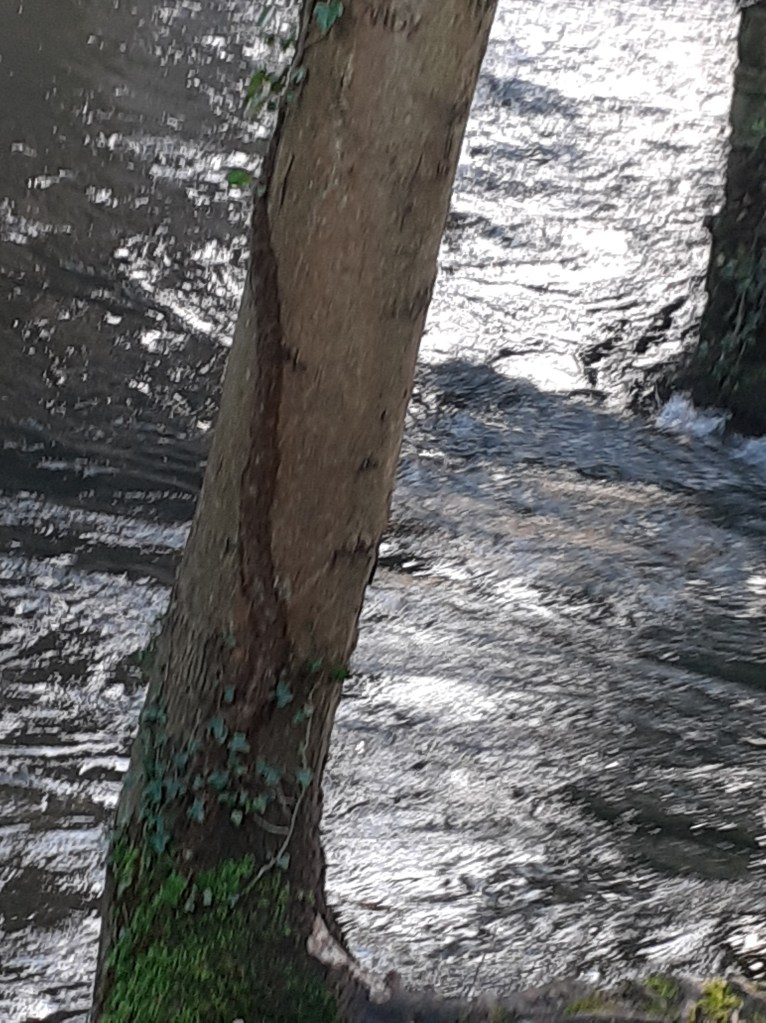
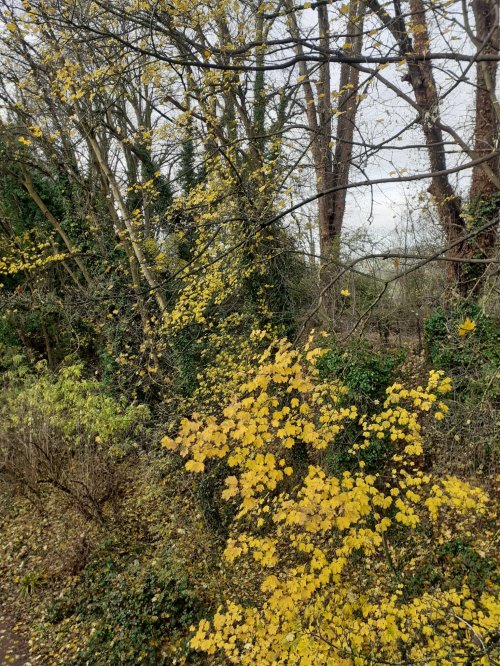
My picture of leaves in light against a darker background is, for me, an image of living presence. It wasn’t intended to look like this, but I’m glad that it does. It said ‘living presence’ to me as soon as I saw it. Each leaf grows out of the tree and is extended by the light of the sun. All are enabled and nourished by ‘interbeing’, the Buddhist teacher Thich Nhat Hanh’s (2) reframe of ‘dependent origination’. But the elements of darkness and shade, whilst delineating the tree trunk, also suggest the mystery of a primordial nature, no-thing in itself yet making everything possible. The picture seems to be saying that the potential for greening is everywhere, outside and within.

(1) Kabir Edmund Helminski Living Presence: A Sufi Way to Mindfulness & the Essential Self New York, NY: Jeremy P. Tarcher/Putnam, 1992

(2) Thich Nhat Hanh The Other Shore: A New translation of the Heart Sutra with Commentaries Berkeley, CA: Palm Leaves Press, 2017

REBLOG: FIRST LEAVES — DRUID LIFE

Reblog of a recent Druid Life post, about the turning of the Wheel in the Stroud district of the English Cotswolds, and the way it is being influenced by the climate crisis. “It feels too early. I’d expect the fruit trees to start flowering around now, but there are leaves unfurling on a number of trees as well – most notably the elders in the more sheltered spots. I can remember springs when there were very few leaves until April and one year, May. Spring did not […]

First leaves — Druid Life

POEM: FIELD

They will not mesh, the very small and the large.

They will not converge.

On that side of the mirror, flickering fringes –

Superposition, quantum probabilities,

Shimmering light and dark; on this,

Nature has made its choice.

Time, space –

They will not bend both ways at once.

When the little ideas slip into bodies like clothes

They step through the mirror, enter

An irreducible level of noise –

Gravitational decoherence, dependent on mass.

Worlds, how sad we are to leave our dreaming behind.

So lovely we were then, so light, so playful.

But how compelling to have a body. In fact,

Irresistible.

From: Katrina Porteous Edge Hexham, Northumberland: Bloodaxe Books, 2019

Blurb note: “Edge contains three poem sequences, Field, Sun and the title sequence, which extend Porteous’s previous work on nature, place and time beyond the human scale. They take the reader from the micro quantum worlds underlying the whole Universe, to the macro workings of our local star, the potential for primitive life elsewhere in the solar system on moons such as Enceladus, and finally to the development of complex consciousness on our own planet. As scientific inquiry reveals the beauty and poetry of the Universe, Edge celebrates the almost-miraculous local circumstances which enable us to begin to understand it. All thre pieces were commissioned for performance in Life Science Centre Planetarium, Newcastle, between 2013 and 2016, with electronic music by Peter Zinovieff.”

SIGNS OF BLOSSOM

In my neighbourhood, there is a distinct mid-February period. Blossom, particularly cherry blossom, is developing. Whatever the weather I feel confidence in the coming of spring.

Humanly, I enjoy a shared experience of extended Valentine. When my partner Elaine and I decided to marry after a decade together, we chose 17 February (three days after Valentine) as our wedding date. So now a four day moment in the year celebrates ever-renewing relationship.

I imagine that most people who consciously live the wheel of the year include dates where a private significance flavours, extends, or indeed reframes a natural or tribal one. Mid February is such a time for me.

NEAR NATURE

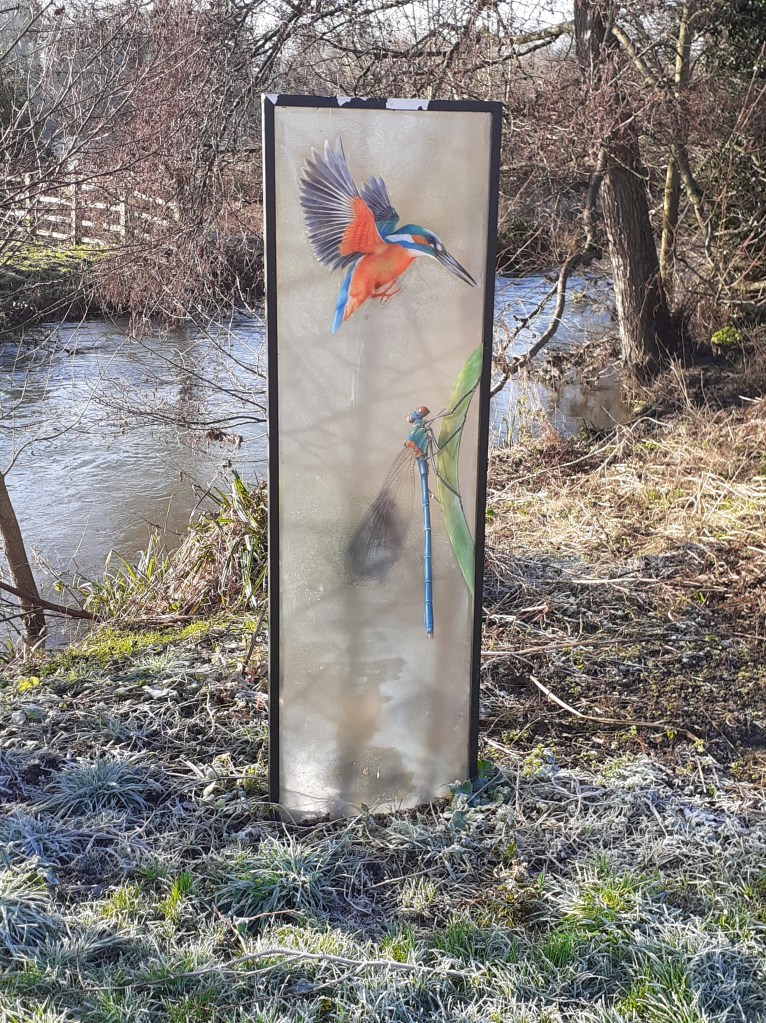
I have never been much of a wilderness person. In times past I have foolishly used this to feel like a lesser Druid. ‘Near nature’ is my habitat. It is a world of parks, streams, canals, accessible hills, woodlands and former rail tracks. Human artefacts of varying vintages are very much part of the scene. These places keep on giving. Over the last couple of days a touch of frost coupled with brighter light has changed the feeling tone of a generally wet and clouded winter. Pictures celebrate this bounty.

NATURAL AND RITUAL PATTERNING

At the winter solstice, I began a year of enhanced attention to the wheel of the year. I have re-introduced the circle as container for my morning practice. The directions and elements are conventional for my location and tradition. The references are all naturalistic – with ‘heaven’ as the dome of the sky.

The journey around my circle begins and ends at the midwinter moment, in the north, domain of the powers of earth. The patterning is minimalist, though it still took awhile to get a language that feels just right. Now it grows in power and resonance with familiarity and repetition. For me, ritual patterning scarcely competes with complexity and flow of natural patterning, as I look at the pictures above and below. Compared with these, it is something of an abstraction. Yet I value it all the same. This simple patterning embodies my commitment. It will walk with me through the year.

I stand, north, facing south, ring my bells and say: I arise today through the strength of heaven, light of sun, radiance of moon, splendour of fire, speed of lightning, swiftness of wind, depth of sea, stability of earth and firmness of rock.

North, facing outwards: I greet the powers of the north, element of earth, season of winter, time of dying and regeneration. Hail and welcome!

East, facing outwards: I greet the powers of the east, element of air, season of spring, time of early growth. Hail and welcome!

South, facing outwards: I greet the powers of the south, element of fire, season of summer, time of ripening. Hail and welcome!

West, facing outwards: I greet the powers of the west, element of water, season of autumn, time of bearing fruit. Hail and welcome!

Spiralling in to centre: I greet the power at the centre, the one world tree, giver of life and teacher of wisdom. Hail and welcome! Back north, I begin a full round of the circle, sunwise, and say I cast this circle in the sacred grove of Wisdom. May there be peace throughout the world!

My closing is a reversal of the opening, with an uncasting of the circle, a repetition of the opening words and a final ringing of the bells. In the address to the directions, the words ‘thank and ‘farewell’ replace ‘greet’ and ‘welcome’. I have noticed that the other parts of my morning practice are subtly enriched by this new container.

WINTER MORNING LIGHT

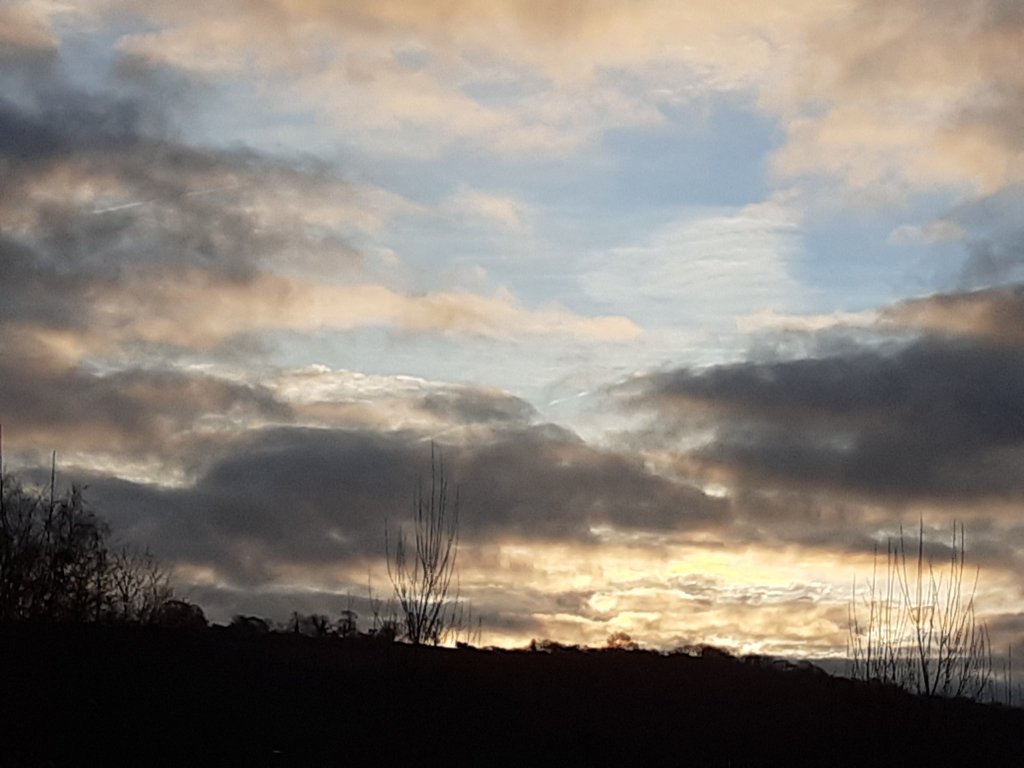
This is 7 December where I live, a little after 8 am, itself a little after the moment of dawn. The sunrise is still early in its process, fifteen days before the turn of the year. I took the pictures on one of my regular canal walks, this time between Stroud and Brimscombe in Gloucestershire, England.

This year I am paying close attention to the dance of place and time. It is part of my re-grounding after my adventures in non-duality, yet retaining the learning they brought. I surrender to the experience of winter sunlight. I breathe it in, and it fills the world, enacting a primal awareness. At the same time I acknowledge the particularity of time and place, of movement and change in nature. I also know that my observation of this winter light, at this time and in this place, is unique. It will never happen again in quite this way. It makes me glad to be alive and here for it. This gift is all the greater, and all the more to be treasured, for that very vulnerability, personal and collective, of which I am also conscious.

EYE OF SPIRIT

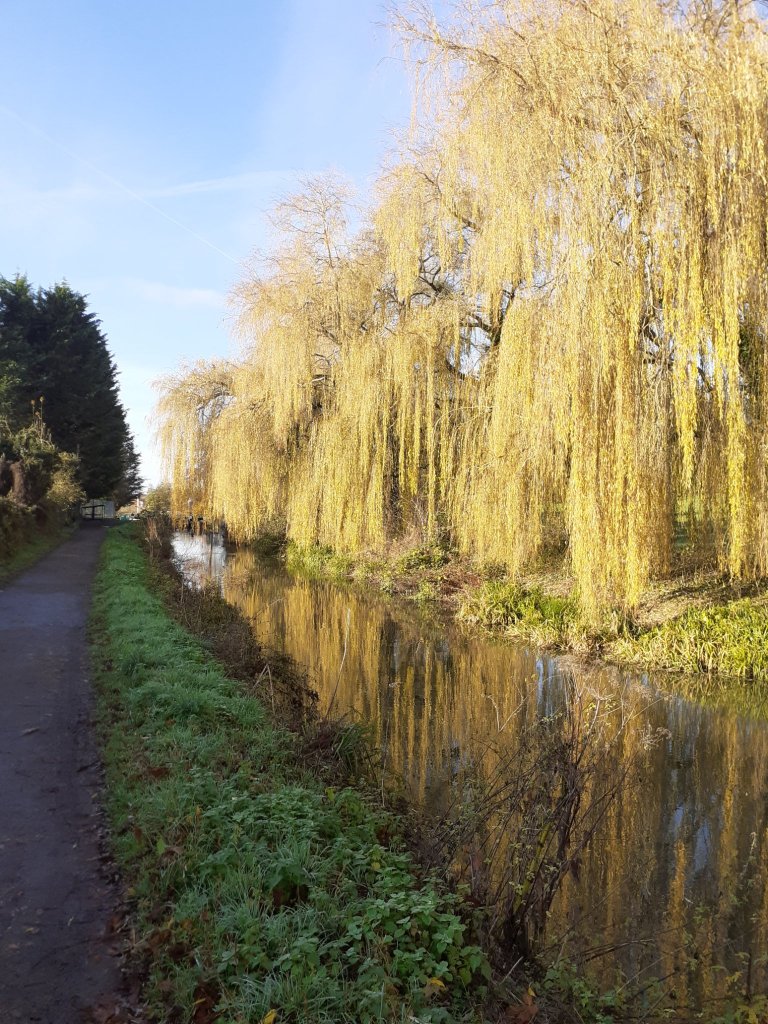
I walk my Sophian Way, seeking imagery for the end of November. The willows provide it. I see a dying back of the year, where the withdrawn and conserved life has a beauty of its own.

Stilling into presence, and holding the trees in loving attention, I act as the eye of spirit. I am aware equally of the uniqueness and otherness of the trees, and of my inter-being with them. I feel love, gratitude and wonder. I also feel a poignancy, and a sense of vulnerability – for them, and me, and everyone else.

I am glad to be taking pictures again after a gap of many years. There are dangers of displacing my attention into the process of photography, or of contracting into a collector’s obsession with ‘capturing’ images. My solution is to be artless and spontaneous in pressing the button – and to leave my phone in my pocket for most of the time. Once at home, I do find myself delighting in the record.

BOOK REVIEW: GREENING THE PARANORMAL

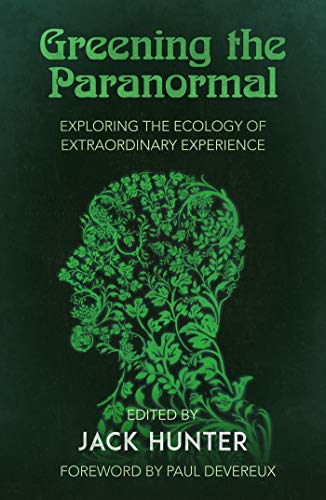
I recommend this book to anyone concerned with deep ecology, animism, or the kinds of phenomena we describe as ‘paranormal’. It opens with two substantial framing pieces, a foreword by Paul Devereux and an introductory chapter by editor Jack Hunter. These are followed by 16 chapters from a diverse range of contributors, mostly seeking to combine direct witness with a workable form of academic analysis. To an extent this book is a story of how to face this difficult challenge. Very early, in his foreword, Paul Devereux shows how the challenge can come from the ‘phenomena’ themselves.

“We were trying to geographically map generations of old accounts of fairy paths we had uncovered in the verbatim records of University College Dublin. Suddenly, standing in the grass, there was a figure, between two and three feet tall. It was anthropomorphic and fully three dimensional (as we could clearly determine while we were drifting slowly past. It had sprung its appearance out of nowhere, and it caught my wife’s and my own transfixed attentions simultaneously.

The figure was comprised of a jumble of very dark green tones, as if composed of a tight dense tangle of foliage rather like the stand of woodland a hundred yards or so beyond the sward of grass. It didn’t seem to quite have a face, just a head with deep set eyes appearing out of the green tangle. It presented a distinctly forbidding appearance. As we crawled past in our car, the figure started to turn its head in our direction, but then vanish.

“Charla called out, ‘Oh, shit!’ We looked at each other, both of us wide-eyed and thoroughly disconcerted. ‘You saw that!’ I asked rhetorically. The whole episode had lasted for only about half a minute or so, but it was unequivocally an actual. if transient, objective observation.”

The running inquiry question throughout the book is, what do we make of experiences like this, if we are determined to honour rather than dismiss them? Devereux senses four major themes in the suggested ‘greening of the paranormal’ in our time. The first is animism, the ‘Big Step for our culture to take’: the sense that the elements of the non-human world are animate in some way – rocks, rivers, soil, as well as plants and living organisms. This involves a deep relationship with the land beyond utility and subsistence. The second theme is the vision quest, a wilderness journey which is more about paying attention and being open to what unfolds, rather than posing questions. The third concerns the ‘liminal’ places that seem to support our breaking through into other-world realms or altered mind states. The fourth is inter-species communion with the animal and plant kingdoms. In the language used by Jack Hunter, we find ourselves dealing with a “profoundly mindful, sentient and agentic world” and the potential re-opening of lost forms of communication and connection.

Many of the contributors believe that we are unlikely to get through the climate crisis if we continue to ignore dimensions of experience from which our cultural filters have exiled us. Some of them live or work in countries that have been colonised by Europeans, but where pockets of traditional indigenous wisdom remain. They recognise that in some cases there are invitations to share in this. There are also concerns about appropriation and the dynamics of the researcher/subject relationship. There is a questioning of the word ‘shamanism’ as currently used – and arguably over-extended and suspect.

This book does not read like a novel. Although I have read it all, there were two or three chapters which didn’t speak to me. Others were riveting. I see it as an excellent book to own and keep for reference. The foreword and first chapter each stand alone and I recommend reading both of them. The other chapters can be cherry picked according to taste or need. Overall there’s a strong invitation to wake up to the aspects of world, life and experience that are being pointed to. The book suggests that they are needed for our personal, social and global healing.


IMAGINING MYSTERY

‘Imagining mystery’ is the title given by Ursula K. Le Guin for Chapter 25 in A Book About the Way and the Power of the Way, her English rendition of the Tao Te Ching.

“There is something

that contains everything

Before heaven and earth

it is.

Oh, it is still, unbodied,

all on its own, unchanging.

“all-pervading,

ever moving.

So it can act as the mother

of all things.

Not knowing its real name,

we only call it the Way.

“If it must be named,

Let its name be Great.

Greatness means going on,

going on means going far,

and going far means turning back.

“So they say, ‘the Way is great,

heaven is great, earth is great;

four greatnesses in the world,

and humanity is one of them’.

“People follow earth,

earth follows heaven,

heaven follows the Way,

the Way follows what is.”

Ursula Le Guin comments: “I’d like to call the ‘something’ of the first line a lump – an unshaped, undifferentiated lump, chaos, before the Word, before Form, before Change. Inside it is time, space, everything; in the womb of the Way. The last words of the chapter, tzu jan, I render as ‘what is’. I was tempted to say, ‘The Way follows itself’, because the Way is the way things are; but that would reduce the significance of the words. They remind us to see the way not as a sovreignty or a dominion, all creative, all yang. The Way itself is a follower. Though it is before everything, it follows what is.”

She also owns to a piece of creative editing. “in all the texts, the fourth verse reads: So they say, ‘the Way is great/heaven is great;/earth is great;/and the king is great./Four greatnesses in the world/and the king is one of them’.” Yet in the next verse, which is the same series in reverse order, instead of ‘the king’, it is ‘the people’ or ‘humanity’. I think a Confucian copyist slipped the king in. The king garbles the sense of the poem and goes against the spirit of the book. I dethroned him.”

I share Ursula Le Guin’s lens, and editorial calls like this are the reason I am drawn to her version more than any other. The text as a whole speaks to our experience of moving between non-duality, dualities, and the multiplicity of the 10,000 the things. For me, the work Ursula Le Guin has done, in reframing traditional understandings of A Book About the Way and the Power of the Way, makes her a teacher in her own right.

She calls the first chapter of her version Taoing, emphasising process and flow, and the need to stay open to uncertainties and ambiguities. The text both acknowledges that words over-define experience (thus limiting and distorting it) and understands the need to use them (otherwise why write it?) When taoing, we hold such points of tension. For they are the key to imagining mystery.

“The way you can go

isn’t the real way,

The name you can say

isn’t the real name.

Heaven and earth

begin in the unnamed:

name’s the mother

of the ten thousand things.

So the unwanting soul

sees what’s hidden,

and the ever-wanting soul

sees only what it wants.

Two things, one origin,

but different in name,

whose identity is mystery,

Mystery of all mysteries!

The door to the hidden.”

Lao Tzu Tao Te Ching: A Book About the Way and the Power of the Way Boston & London: Shambhala A new English version by Rrsula K. Le Guin, with the collaboration of J. P. Seaton, Professor of Chinese, University of North Carolina, Chapel Hill.

Earth Eclectic

music that celebrates Earth and speaks to the heart

Sarah Fuhro Star-Flower Alchemy

Follow the Moon's Cycle

Muddy Feet

Meeting nature on nature's terms

Rosher.Net

A little bit of Mark Rosher in South Gloucestershire, England

Becoming Part of the Land

A monastic polytheist's and animist’s journal

selkiewife

Selkie Writing…

Charlotte Rodgers

Images and words set against a backdrop of outsider art.

Prof Jem Bendell

living with metacrisis and collapse

Towint

The pagan path. The Old Ways In New Times

The Druids Garden

Spiritual journeys in tending the living earth, permaculture, and nature-inspired arts

The Blog of Baphomet

a magickal dialogue between nature and culture

This Simple Life

The gentle art of living with less

Musings of a Scottish Hearth Druid and Heathen

Thoughts about living, loving and worshiping as an autistic Hearth Druid and Heathen. One woman's journey.

Wheel of the Year Blog

An place to read and share stories about the celtic seasonal festivals

Walking the Druid Path

Just another WordPress.com site

anima monday

Exploring our connection to the wider world

Grounded Space Focusing

Become more grounded and spacious with yourself and others, through your own body’s wisdom

The Earthbound Report

Good lives on our one planet

Hopeless Vendetta

News for the residents of Hopeless, Maine