Contemplative Inquiry

This blog is about contemplative inquiry

Tag: Nature

SPIDER

I’ve been busy with spiders over the last few weeks, noticing their variety both indoors and out. There’s one outside my window as I write. Some of this attention has involved removing spiders from the house. As I become more sensitized to their sentience, I’ve grown somewhat ambivalent about this. Yet from a wider household perspective, it does need to be done. The extract below is from David Abram’s Spell of the Sensuous and looks at the life of a spider.

“Consider a spider weaving its web, for instance, and the assumption still held by many scientists that the behavior of such a diminutive creature is thoroughly ‘programmed in its genes.’ Certainly, the spider has received a rich genetic inheritance from its parent and predecessors. Whatever ‘instructions’, however, are enfolded within the living genome, they can hardly predict the specifics of the microterrain within which the spider may find itself in any given moment. They could hardly have determined in advance the exact distances between the cave wall and the branch that the spider is now employing as an anchorage point for her current web, or the exact strength of the monsoon rains that make web-spinning a bit more difficult on this evening.

“The genome could not have explicitly commanded the order of every flexion and extension of her various limbs as she weaves this web into its place. However complex are the inherited ‘programs’, patterns or predispositions, they must still be adapted to the immediate situation in which the spider finds itself. However determinate its genetic inheritance, it must still, as it were, be woven into the present, an activity that necessarily involves both a receptivity to the specific shapes and textures of that present and a spontaneous creativity by which every animate organism necessarily orients itself to the world (and orients the world around itself), that we speak of by the term ‘perception’”.

David Abram The Spell of the Sensuous: Perception and Language in a More-Than-Human World New York: Vintage Books, 1997 & 2017

This book has been an inspiration to many people over the last 20 years, including both naturalist and animist Pagans. The extract comes from a section entitled The Mindful Life of the Body.
POEM: THIS WORLD OF DEW


This world of dew

is only the world of dew –

and yet … oh and yet.

Kobayashi Issa (1763-1828), translated from the Japanese by Robert Hess. From The poetry of impermanence, mindfulness and joy edited by John Brem. (Wisdom, kindle edition, undated.)


STEPHEN BATCHELOR: THE EVERYDAY SUBLIME

Stephen Batchelor explores his view that “the mystical does not transcend the world but saturates it”. For me, this discussion has a resonance beyond the ranks of ‘secular Buddhism’. The passage below is from his book After Buddhism: rethinking the Dharma in a secular age (1). I am attracted to his view of ‘the everyday sublime’ and for me at least, its relevance extends well beyond Batchelor’s specific context.

“Meditation originates and culminates in the everyday sublime … [It] is about what is happening to this organism as it touches the environment in this moment. I do not reject the experience of the mystical. I reject the view that the mystical is concealed behind what is merely apparent, that it is anything other than what is occurring in time and space right now. The mystical does not transcend the world but saturates it. ‘The mystical is not how the world is,’ noted Ludwig Wittgenstein in 1921, ‘but that it is.’

“As understood by Edmund Burke and the Romantic poets, the sublime exceeds our capacity for representation. The world is excessive: every blade of grass, every ray of sun, every falling leaf is excessive. None of these things can be adequately captured in concepts, images, or words. They overreach us, spilling beyond the boundaries of thought. Their sublimity brings the thinking, calculating mind to a stop, leaving one speechless, overwhelmed with either wonder or terror. Yet for we human animals who delight and revel in our place, who crave security, certainty and consolation, the sublime is banished and forgotten. As a result, life is rendered opaque and flat. Each day is reduced to the repetition of familiar actions and events, which are blandly comforting but devoid of an intensity we both yearn for and fear.

“To experience the everyday sublime requires that we dismantle the perceptual conditioning that insists on seeing ourselves and the world as essentially comfortable, permanent, solid, and ‘mine’. It means to embrace suffering and conflict rather than to shy away from them, to cultivate the embodied attention that contemplates the tragic, changing, empty and impersonal dimensions of life, rather than succumbing to fantasies of self-glorification or self-loathing. This takes time. It is a life-long practice.

“The ordinary sublime is our ordinary life experienced from the perspective of the fourfold task [NB Batchelor’s reframe of the Buddhist four noble truths JN].  …

  • An open-hearted embrace of the totality of one’s existential situation
  • A letting go of the habitual restrictive patterns of thought and behavior triggered by that situation
  • A conscious valorization of those moments in which such reactive patterns have stilled
  • A commitment to a way of life that emerges from such stillness and responds empathetically, ethically and creatively to the situation in hand.

“Understood in this way, meditation is not about gaining proficiency in technical procedures claimed to guarantee attainments that correspond to the dogmas of a particular religious orthodoxy. Nor is its goal to achieve a privileged, transcendent insight into the ultimate nature of reality, mind, or God. In the light of the fourfold task, meditation is the ongoing cultivation of a sensibility, a way of attending to every aspect of experience within a framework of ethical values and goals.

…..

“As a sensibility, meditation enables us to cultivate an understanding of moment-to-moment experience much as we develop an appreciation of art or poetry or nature. Grounded in the body and the senses, we value an open-mindedness to what is unfamiliar, probe our sensorium with relentless curiosity, listen attentively to what others have to say, are willing to suspend habitual attitudes and opinions, and questions what is going on instead of simply taking things for granted. The disengagement of meditation is not an aloof regard (or disregard) but a perspective that engenders another kind of response to what is happening. And it begins with the breath, our primordial relationship to the fabric of the world in which we are embedded.”

  • Stephen Batchelor After Buddhism: rethinking the dharma for a secular age New Haven & London: Yale University Press, 2015

ONCE AND FUTURE WIZARD

I first encountered Merlin when I was nine years old, through T. H. White’s The Sword in the Stone. It includes a wonderful account of shape-shifting and indeed of education (as imaginative, experiential, self-reliant). As time went on I didn’t exactly get Arthur, the Wart’s, education. But I got enough to feed both memory and hope as enhancements of here-and-now experience rather than distractions from it. I didn’t forget, or if so, not completely. Thanks to Elen Sentier for reminding me in her recent book, which I plan to review soon.

“The thunder-clouds which usually go with hot weather were there, high columns of cumulus with glaring edges, but there was not going to be any thunder. It was too hot even for that. ‘If only’, thought the Wart, ‘I did not have to go into a stuffy classroom, but could take off my clothes and swim in the moat’.

“They crossed the courtyard, having almost to take deep breaths before they darted across it, as if they were going quickly through an oven. The shade of the gatehouse was cool, but the barbican, with its close walls, was hottest of all. In one last dash across the desert they had reached the drawbridge – could Merlyn have guessed what he was thinking? – and were staring down into the moat.

“It was the season of water-lilies. If Sir Ector had not kept one section free of them for the boys’ bathing, all the water would have been covered. As it was, about twenty yards on each side of the bridge were cut each year, and one could dive in from the bridge itself. The moat was deep. It was used as a stew, so that the inhabitants of the castle could have fish on Fridays, and for this reason the architects had been careful not to let the drains and sewers run into it. It was stocked with fish every year.

“’I wish I was a fish’, said the Wart

“’What sort of fish?’

It was almost too hot to think about this, but the Wart stared down into the cool amber depths where a school of small perch were aimlessly hanging about.

“’I think I should like to be a perch,’ he said. ‘They are braver than the silly roach, and not quite so slaughterous as the pike are.”

“Merlyn took off his hat, raised his staff of lignum vitae politely in the air, and said slowly, ‘snylrem stnemilpmoc ot enutpen dna lliw eh yldnik tpecca siht yob sa a hsif?’

“Immediately there was a loud blowing of sea-shells, conches and so forth, and a stout, jolly-looking gentleman appeared seated on a well-blown-up cloud above the battlements. He had an anchor tattooed on his stomach and a handsome mermaid with Mabel written under her on his chest. He ejected a quid of tobacco, nodded affably to Merlyn and pointed his trident at the Wart. The Wart found that he had tumbled off the drawbridge, landing with a smack on his side in the water. He found that the moat and the bridge had grown a hundred times bigger. He knew that he was turning into a fish.

“’Oh, Merlyn,’ he cried, ‘please come too.’

“’For this once,’ said a large and solemn tench beside his ear, ‘I will come but in future you will have to go by yourself. Education is experience, and the essence of experience is self-reliance.’”

(1) T. H. White The sword in the stone Volume 1 of The once and future King London: Collins, 1958

(2) Elen Sentier Merlin once & future wizard Winchester UK & Washington USA: Moon Books, 2016 (Pagan Portals series)


BOOK REVIEW: THE CRANE BAG

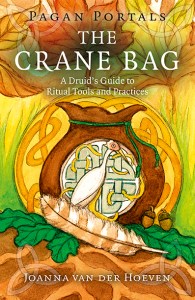
The Craane BagThe Crane Bag, Joanna van der Hoeven’s forthcoming book*, offers an introduction to the ritual tools and practices found in the Druid tradition. It achieves this briefly, simply and with a light touch – as books in the Pagan Portals series are designed to do. Yet it much more than a tick box guide. It provides context and meaning, showing the modern evolution of the Druid tradition itself.

The author makes it clear that she wants readers “to develop their own path in their own time in their own fashion”. Re-enchantment is both path and goal. With proper use, the crane bag “can further the Druid in working with the tides of nature, finding his or her own place in the environment, living in balance, harmony and peace”. The movement overall is “toward reintegration with the natural world”.

At its simplest, the crane bag is the container for Druid ritual tools and as such enables the practices. Bag and tools provide the practitioner with “something tangible to express the spiritual”, acting as a portable “map of the soul”. Behind the crane bag lies an ancient Irish story beginning with the contention between two sisters and the transformation of one of them, Aoife, into a crane. The story is beautifully told and its relevance clearly explained in the first chapter of the book.

In ritual, a period of time and an area of space are set apart and dedicated. This is not to create a lasting duality of sacred and mundane, but a step on the way to experiencing everything as sacred. “Ritual helps us to step back from the busyness, into another way of being. It is a change of consciousness, where we can shift our perception away from a singular view to a more plural view, realising that we are part of an ecosystem”. There is a clear preference for working outdoors, where awareness can shift more readily, though this is not insisted on.

A Druid’s tools will vary with the Druid. The book identifies the following: a silver branch; a staff; cups/bowls/cauldrons; drums; a sickle or knife; robes; altars; fire/candles; incense. People may make or buy them. Ethical sourcing of tools and materials is discussed in some detail, in line with the values of The Crane Bag overall.

What goes into a ritual is explored under the headings of call for peace; preparing the nemeton; honouring spirits of place, three worlds, four directions, ancestors, deities; ritual action; prayers and magic; offerings; eisteddfod; sacrifice; feast; closing. There’s encouragement to practitioners to craft what is right for them from within this set of suggestions and beyond it. The author adds, “I have been in circles with Christian Druids and Buddhist monks, as well as other religions from all over the world”. What matters in ritual is being present and performing the ritual with mindfulness, so that “any words that you speak, any gesture or movement you make will flow more easily, be more graceful and filled with meaning”.

There’s a final chapter on ‘altered states’. I don’t use the term myself, because it makes an ‘altered’ vs ‘normal’ distinction that doesn’t really work for me in my own life. But I recognise it as a term that is widely and usefully employed. Here, it facilitates valuable discussions of meditation, drumming, chanting and song, sensory deprivation, sacred landscape and sitting out. Three kinds of meditation are distinguished: calming the mind and re-tuning the body, journeying and problem solving. Guidance is offered on each kind. Different suggestions are also explored within the other topics. For sensory deprivation, there are two. One is the Celtic version of the sweat lodge, called teach an alais. The other is total immersion in darkness for a considerable period before being brought out into the light. The author refers to early medieval accounts of this, where it was done in aid of Bardic inspiration and prophesy: imbhas forosna.

I found The Crane Bag a very useful contribution to its topic and highly recommend it.


Joanna van der Hoeven The Crane Bag: a Druid’s guide to ritual tools and practices Winchester UK & Washington USA: Moon Books, 2017

*According to the publisher, the book is due for release on 28 July, and can be pre-ordered through Amazon US & UK, Indiebound and Hive.

ANOTHER SHORE?


My sacred space at home has undergone a complete makeover. I am effectively in a different place. It happened this way. On 7 May, I ordered a statue of Guanyin, partly as a birthday present to myself and partly with reference to ‘the true thought of the heart’. Perhaps the true thought of the heart is the real gift. In a blog post I wrote on that day (1), I described Guanyin as sitting on a crescent moon, playful and androgynous. I said: “it is the note that I am looking for”.

When the statue arrived from China, it was much bigger than I expected. It was over two metres high and quite broad, because Guanyin is sitting on a crescent moon, which takes up space. Caught up in the elegance of the design, I had completely misread the dimensions. No room in my room for the true thought of the heart?

Making room involved a complete clearing and cleaning of the place, and a considerable re-arranging of furniture. During an afternoon, I reshaped the space entirely with Guanyin as the predominant focus. Other imagery is still there. The Western Way is still well represented. A Green Man represents our oneness with the Earth, and our apparent separation from it and need for healing stories. A somewhat Marian (both of them) Sophia is there, imaging sacred fertility, sacramental relationship and the challenge to awaken. So are other familiar objects – a dragon sitting on an egg, an abstract and geometrical mandala picture, a tiny wooden Buddha, (not new) contained and serene. (A hopefully only slightly larger and more expansive laughing one is on his way.) Around the walls I find a C17th map of Somerset, my native county; pictures of Glastonbury Tor and the Eildon Hills; a small painting of a crane; and a painting I commissioned in the early 1990s of the Pictish Dancing Sea Horses from the Aberlemno Stone in Angus.

Yet the defining presence is now Guanyin. It happened as if by itself. The rest of the room is familiar and understood. She by contrast is numinous, dynamic and unknown, as well as large. The relationship is not yet established. Close-up, she is indeed playful and androgynous, but she is much more than that. As Guanyin, s/he hears the cries of the world. In her male aspect, s/he is Avolokitesvara, who shared the wisdom gained from deep practice in The Prajnaparamita Heart Sutra. S/he opens the way to the whole tradition of Mahayana Buddhism and its Vajrayana or Tantric variants. Thich Nhat Hanh reminds us of the seeming riddle of this path. “The Prajnaparamita Sutra says, ‘The Bodhisattva helps row living beings to the other shore but in fact no living beings are being helped to the other shore’ (2). Inevitably, it seems, I am drawn by this proposition. Necessarily, it seems, I am gathering Buddhist resources and accessing Buddhist networks, now attracted to the path as well as the Bodhisattva. I did not anticipate this.

This transcends contemplative inquiry, whilst emphatically including it. The Guanyin Oracle (3) tells me that I am under a God’s protection, and gives me a verse called After the Rain.

“After a long rain, we joyously watch the heavens clear.

The sun and moon grow slowly brighter.

The gloomy days are over, so be happy and joyous.

You will bound through the Dragon Door in one leap.

I am reminded of Penny Billington’s use of the term ‘egrigore’ in Contemplative Druidry (4). In Chapter 4 Druid Identity and Values, she says that spiritual movements have an egrigore, “an inner reality made up not only of the ideas of the members, but also the invisible influences from the other realms that resonate with that ‘flavour’ of spiritual thought; and as Druids we are dedicated to making connections not only in the natural world but on the other planes as well, other states of consciousness.” I certainly find that images and their associations can have a tremendous power if I am open to them, and for me, now, the Guanyin image is one of those. It is focusing my energy and attention, and making a Buddhist inspired matrix of references, aspirations, values, traditions and practices vividly present to me. This kind of process works much faster than ordinary thinking. Assembling a new Chinese statue out of three separate parts, cleansing and reordering a room, took me into a new space, and here I still am.

  • https://contemplativeinquiry.wordpress.com/2017/05/07/sophia-and-guanyin/
  • Thich Nhat Hanh The miracle of mindfulness: a manual on meditation London: Rider, 1991
  • Stephen Karcher The Kuan Yin Oracle: the voice of the Goddess of compassion London: Piatkus, 2009
  • James Nichol Contemplative Druidry: people practice and potential Amazon/KDP, 2014 (Foreword by Philip Carr-Gomm)

REBLOG: SCIENCE IN SERVICE TO MOTHER EARTH

Science is, after all, an endeavor of humans and our machines. What would it mean to put this endeavor at the service of Mother Earth? Presumably, our efforts must always be guided by human discernment, in all its fallibility. Who decides what best serves this vision of the Greater Good?

via [A Pedagogy of Gaia] Science in Service to Mother Earth, by Bart Everson — Humanistic Paganism

EPICURUS AND THE BUTTER

“Epicurus had a garden just near Athens. He was also one of the rarest of men, just like Chuang Tzu. He didn’t believe in God, he didn’t believe in anything, because belief is nonsense. Only foolish people believe. A man of understanding has faith, not belief. Faith is different. Faith means trusting life, trusting it so absolutely that one is ready to go with it, anywhere.

“He had a small garden, and he lived there with his disciples. People thought that he was an atheist, immoral. He did not believe in God, he did not believe in the scriptures, he did not believe in any temple. He was an atheist. But he lived in such a great way. His life was superb, magnificent, even though he had nothing, even though they were very poor. The king heard about them and wanted to see how they lived, and how they could be happy without belief. If you could not be happy even with a belief in God, how could these people be happy without God?

“So he came one evening to visit Epicurus’ garden. He was really surprised, amazed – it was a miracle. They had nothing, almost nothing, but they lived like emperors. Like gods they lived. Their whole life was a celebration.

“When they went to the stream to take their bath, it was not simply a bath; it was a dance with the river. They sang and they danced and they swam and they jumped and they dived. Their eating was a celebration, a feast, and they had nothing, just bread and salt, not even butter. But they were so thankful that just to be was enough; nothing more was needed.

“The emperor was very much impressed, and he asked Epicurus: ‘next time I come, I would like some gifts for you. What would you like?’

“Epicurus said, ‘Give us time to think. We never thought that anybody would give us gifts, and we have so many gifts from nature. But if you insist, then bring us a little butter, nothing else. Just that will do.’”

  • Osho When the shoe fits: commentaries on the stories of the Taoist mystic Chuang Tzu London: Watkins Publishing, 2004


POEM: THE GREAT MOTHER

“If we think with the Earth spirit, our souls become populous with beauty, for we turn the cup of our being to a spring which is always gushing.” A.E.

The Great Mother sustained me at that time

Of the bare earth and the cold rime

With the purity of her clear air,

The acceptance of the seasons year by year,

The serenity of patience in her face

That soothed the heart and slowed my pace.

Wher’er I walked, by hill or field or shore,

In summer time she never gave me more.


Her calm, her majesty and powers

Strengthened me and taught me in those hours.

Under the open sky, or through the shadowed wood

New truths were given and were understood.

Vast and deep her wisdom. With her lore

Our souls are fed, perhaps as ne’er before.

In winter quiet, where frozen is the rill

Herself she gives, our emptiness to fill.

Clare Cameron Memories of Eden London: The Mitre Press, 1976

downloadClare Cameron (1896 – 1983) was an English poet and mystic, whose life spanned much of the twentieth century. In 1930 her Green Fields of England, centred on footpath travels in the English countryside, was compared to the work of Richard Jefferies and Edward Thomas in the previous generation. At this period, she was involved with the Hermetic Order of the Golden Dawn. For two years the noted occultist Israel Regardie worked for her husband Thomas Burke and wrote the first of his books on the Kabbalah at their home. Later, Clare became associated with the London Buddhist Society under the leadership of Christmas Humphries and formed a friendship with the young Alan Watts, who she succeeded as editor of the journal Buddhism in England (later The Middle Way) when he left for the U.S. in 1938. Gradually Clare moved in a more Christian direction, and for over 20 years she edited The Science of Thought Review, based on the ideas of the mystical teacher Henry Hamblin.

clare-cameron0001Throughout all these changes Clare drew on her experience of nature as sacred within a spirituality that emphasized the sanctity of existence and the silent background of being. Politically she championed women’s empowerment, non-violence in both aims and methods, the view that interdependence applies to countries as well as people, and the growing attention to environmental causes. She also supported the early development of interfaith dialogue.

POEM: THE BOATMAN’S FLUTE

Today there is no wind on the Yangtze;

the water is calm and green

with no waves or ripples.

All around the boat

light floats in the air

over a thousand acres of smooth, lustrous jade.

One of the boatmen wants to break the silence.

High on wine, he picks up his flute

and plays into the mist.

The clear music rises to the sky –

an ape in the mountains

screaming at the moon;

a creek rushing through a gully.

Someone accompanies on the sheepskin drum,

his head held steady as a peak,

his fingers beating like rain drops.

A fish breaks the crystal surface of the water

And leaps ten feet into the air.

From Yang Wan-li Heaven my Blanket: Earth my Pillow: Poems from Sung Dynasty China New York & Tokyo: Weatherhill, 1975 (Translated and introduced by Jonathan Chaves)

Yang Wan-li (1127-1206) was a scholar-bureaucrat and poet of Sung Dynasty China, a period of history during which some of the most treasured masterpieces of Chinese art and literature were created. Yet this culture was vulnerable. Northern China was occupied by Jurchen nomads, and the Southern Sung’s base in Hangchow is described in Chaves’ introduction as “a refuge of elegant solitude  from which they gazed longingly toward the north … in this quiet setting they were able to enjoy the beauties of bird, rock and stream”. The Boatman’s Flute chooses a natural setting, a scene on a great river, to capture a musical moment.

Yang Wan-li’s work is also presented at: https://contemplativeinquiry.wordpress.com/2015/05/14/reflection-on-chinese-poetry/


Earth Eclectic

music that celebrates Earth and speaks to the heart

Sarah Fuhro Star-Flower Alchemy

Follow the Moon's Cycle

Muddy Feet

Meeting nature on nature's terms

Rosher.Net

A little bit of Mark Rosher in South Gloucestershire, England

Becoming Part of the Land

A monastic polytheist's and animist’s journal

selkiewife

Selkie Writing…

Charlotte Rodgers

Images and words set against a backdrop of outsider art.

Prof Jem Bendell

living with metacrisis and collapse

Towint

The pagan path. The Old Ways In New Times

The Druids Garden

Spiritual journeys in tending the living earth, permaculture, and nature-inspired arts

The Blog of Baphomet

a magickal dialogue between nature and culture

This Simple Life

The gentle art of living with less

Musings of a Scottish Hearth Druid and Heathen

Thoughts about living, loving and worshiping as an autistic Hearth Druid and Heathen. One woman's journey.

Wheel of the Year Blog

An place to read and share stories about the celtic seasonal festivals

Walking the Druid Path

Just another WordPress.com site

anima monday

Exploring our connection to the wider world

Grounded Space Focusing

Become more grounded and spacious with yourself and others, through your own body’s wisdom

The Earthbound Report

Good lives on our one planet

Hopeless Vendetta

News for the residents of Hopeless, Maine