Twelve years ago (1) I wrote about the paidirean (pahj-urinn) prayer beads of the Ceile De or Culdee movement (2). In its current iteration this is a modern monastic order based in Scotland with a lay following in other parts of the world. It looks back to the early Celtic church once influential in Ireland, Scotland and north-east England. The post referenced above (1) describes my relationship with the beads at the time.
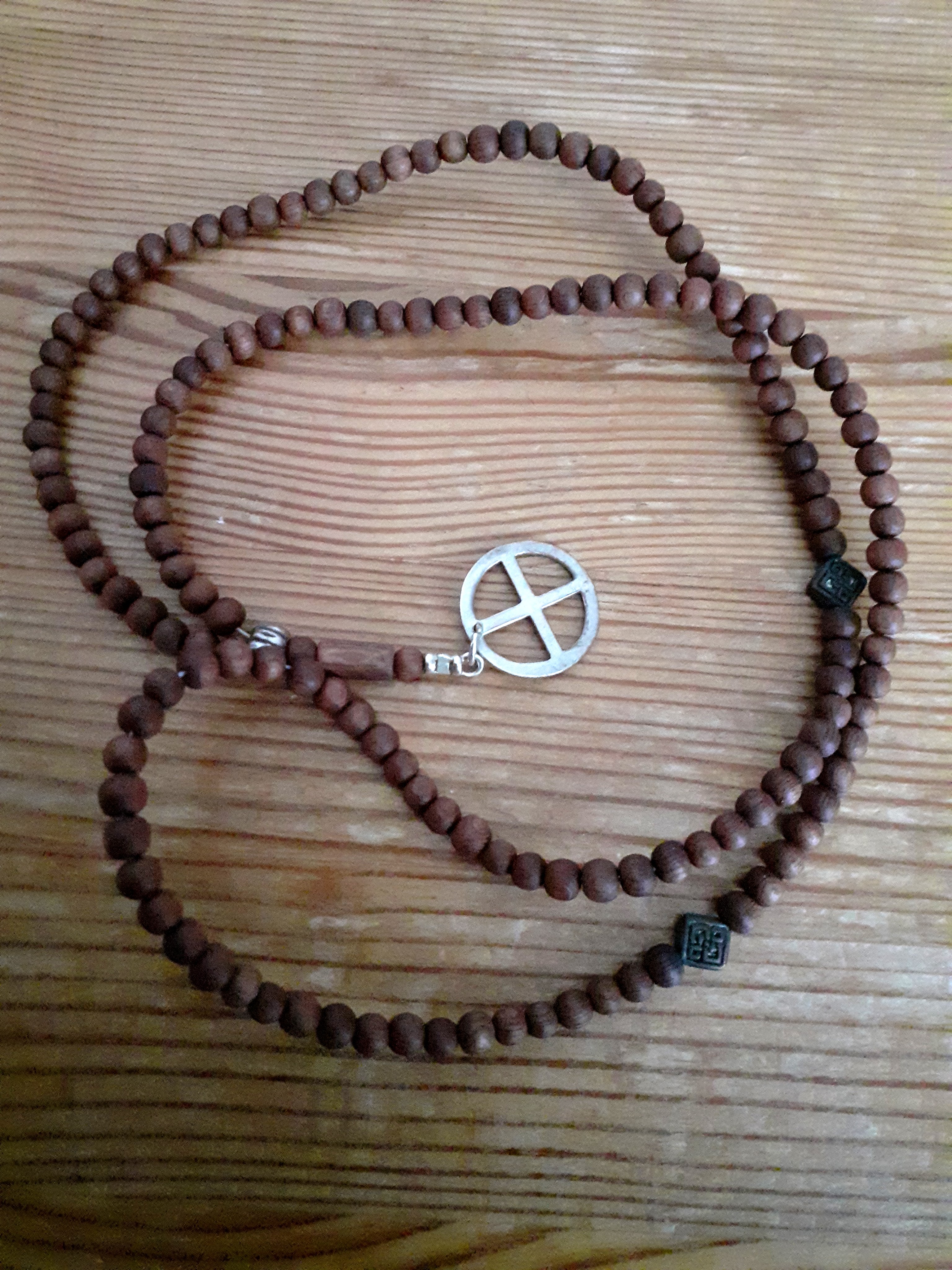
Now, coming back to this beautiful artifact, I am principally focused on the cross – an equal armed and circled silver cross that hangs from the beads – at heart level when worn as a necklace. This form of cross is an ancient symbol, sacred to many people in many cultures, often understood as a sun wheel, and not specific to Celtic Christianity. It is sometimes called the balanced, or peaceful, cross.
For me, this cross is a more fundamental image than the awen symbol, which I can also wear as a pendant, appropriately sitting at the level of my throat. The silver cross maps a whole imaginal world: four directions or winds – east, south, west, north; four powers – light, life, love, law; four elements- air, fire, water, earth; four guardians – hawk, stag, salmon, bear; four qualities – vision, purpose, wisdom, faith; four times of day – sunrise, midday, sunset, midnight; four seasons – spring and early growth, summer and ripening, autumn and bearing fruit, winter, dying and regeneration. Having a liturgy to this effect, casting a circle and calling for peace as a regular practice, marinate me in a certain way of spiritual life. Wearing this cross confirms and declares it.
In my light energy work, the disc becomes a radiant sphere that holds me. For there is a vertical dimension. Horizontally I hold my hands out palms raised and the energy flows out from heart through outstretched arms and to my hands. Vertically it flows in both directions from my heart to my feet and the earth and also to my brow and above my head. But the source of this radiance is the energy behind the heart and the still emptiness behind the energy. This flow is an open system. Energy also comes back. My energy sphere is porous to the world. I like the illustration on the bag below because it shows an empty circle at the centre. This does not feature on the pendant itself, but to me empathises the divine power at the centre from which I am not separate. It is good to reconnect with an carrier of healing and insight which I appeared to have left behind. I am grateful that it was still here for me when I was ready to reconnect.
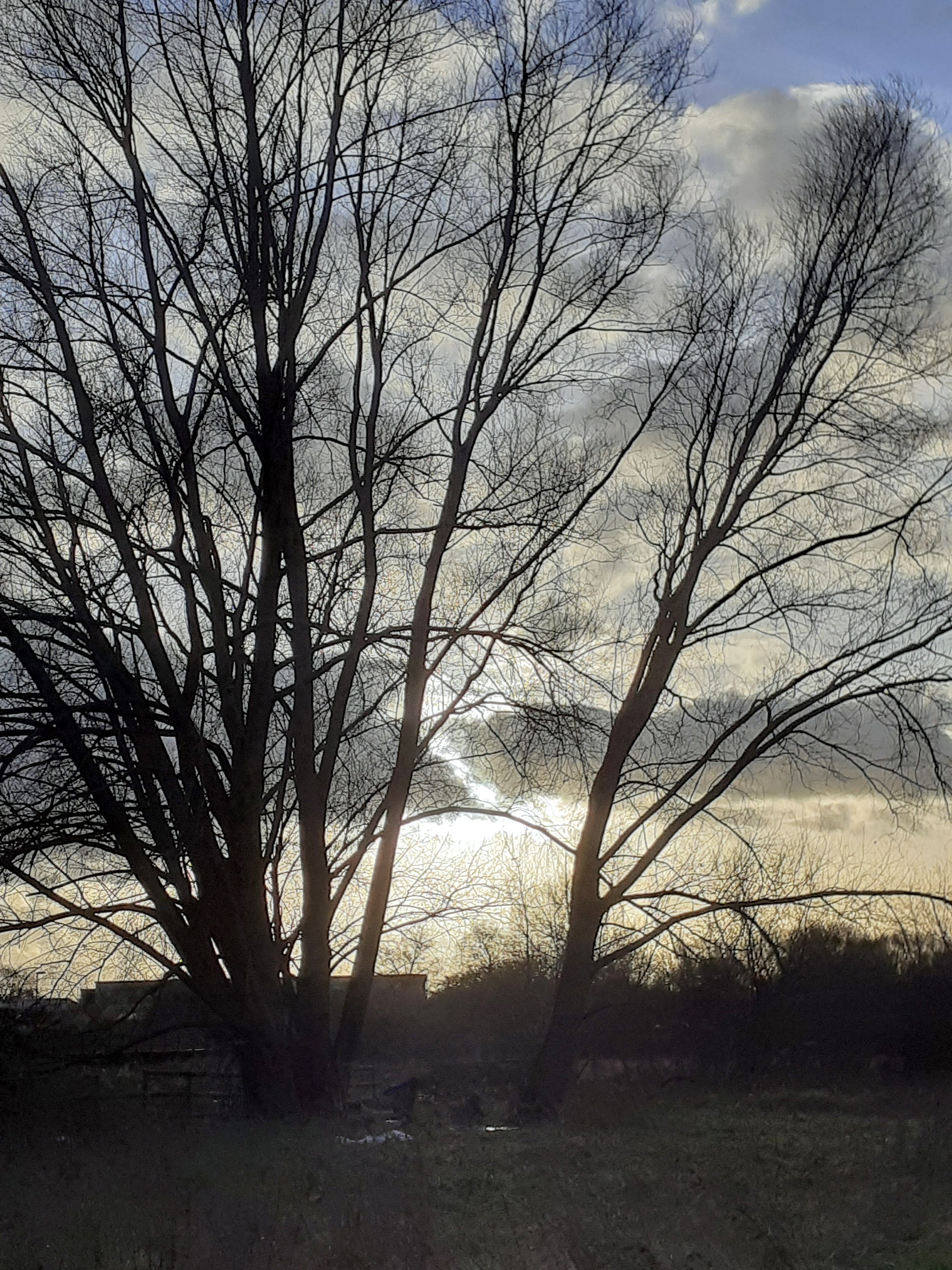
Seasonal Blessings to all readers, and my best wishes for 2024! I took these photos between 2.20 and 2.50 pm on 21 December, the last day before the Solstice, and a little more than an hour before sunset in Southern England.
The location is Alney Island, Gloucester, which I had not been to for some time. I encountered a sun that was low in the sky, clearly sinking, but still having an obvious influence on the landscape. Above, you can see a powerful luminescence behind the starkness of the trees. Immediately below, you can see light effects on the river and the trees themselves.
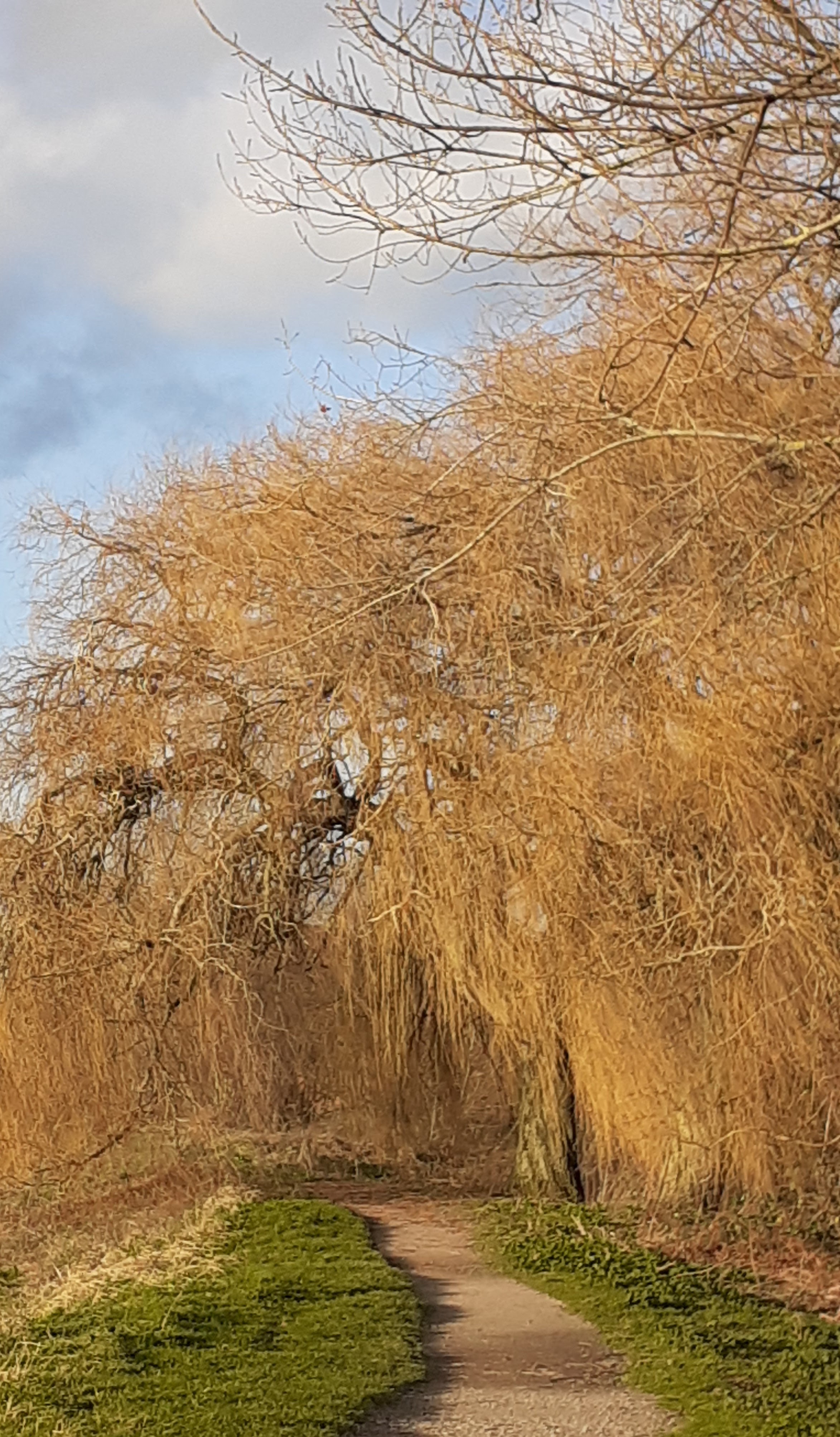
In the picture below, the midwinter sunshine is clearer and stronger. I love the way in which the willows show their vitality and abundance even when they have lost their leaves. The path is relatively dry, yet surrounded by green grass. There is a play of light and shade. There is blue as well as cloud in the sky.
On the ground, in the afternoon, and now in the evening as I write, I am thinking of light and dark, and of waxing and waning, as natural phenomena. I am not thinking in moral or metaphysical terms. These are different considerations, with a tendency moreover towards abstraction and absolutism. In my experience, nature tends to be nuanced. Different things are going on at the same time. Certainly where I live, there is always some balance of light and dark. The balance shifts, but both are always in play.
We treat tomorrow’s sunrise as the beginning of a turn. Here, in 2023, the afternoon before the change seems like a friendly one for an annual nadir of the light. This is also a bit how I am thinking about myself. Towards the end of November, when I last wrote a post of this type, I was celebrating a recovery from illness, and the opportunity of a good day. A good day was about what it was. Many people have pointed out in the last year or so that Covid-19 seems to have a long tail. I have been physically restricted beyond what I think of as normal.
I’m aware of a 75th birthday coming up next year, at which time our government will no longer consider my death as premature. Yet I am in good heart and feeling resilient. Without being presumptuous, I’m leaning in to longevity. I’m checking my capabilities and energy levels, anticipating some adjustments, and noticing the many rays of light which present themselves in my world.
Highly recommended. Unseen Beings: How We Forgot the World Is More Than Human (1) is about the many beings we humans have actively ‘unseen’ and the consequences of our human-centric lens. Author Erik Jampa Andersson describes his book as a diagnostic exploration of the roots of the climate crisis, itself an extreme consequence of a much wider malaise. Whereas the common view of ‘saving the planet’ tends to be one of ‘guarding the storehouse’, a better focus would be on ‘supporting the welfare of living beings’.
Andersson has a background in Tibetan Buddhism and Tibetan medicine. In the manner of Buddhism’s Four Noble Truths, and of his medical training, he divides his book into four parts: Diagnosis, Causes and Conditions, Prognosis, Treatment.
Diagnosis concerns “our ecological disease”. Andersson reminds us of what the climate crisis is, how far it has been allowed to go, and the “fanciful stories” with which we have soothed our fears: “full of human exceptionalism, divine protection, techno-fixes and post-apocalyptic salvation”. For Andersson, the foundational root cause is “the sundering of human and non-human beings, and our perceptual separation from ‘Nature’. He refers to “the poison of anthropocentricity”. He reviews the evidence for plant and fungal sentience and awareness as well as that of the animal kingdom. He concludes that Nature is not a place, but “a tightly knit community of interconnected beings, some seen, many unseen, all engaged in their own affairs and with their own experience of reality”. He describes this relational approach to the living world as “what most scholars now call ‘animism’ … neither a religion nor a system of belief, but a paradigm of more-than-human relationship”. He sees this stance toward the world as “our natural state”.
Causes and Conditions A mini-ice age some 13,000 years ago interrupted an early agricultural period in some places and prompted a series of innovations. The domestication of the horse was especially significant. Andersson sees a move away from our ‘natural state’ beginning at this time. But it is not fully evident to us until the age of written philosophy and scripture. The Greek philosophers Plato and Aristotle declare a hierarchy of sentience from plants up to animals and then humans at the top, uniquely endowed with a rational soul. In the Hebrew book of Genesis, God gives dominion over the Earth and its animals to man for his use. In the Western Christianity of the 13th century CE, Thomas Aquinas says that Christians have no duty of charity to non-humans because they are resources, not persons. In the 17th century CE, early in the West European led colonial era, Descartes holds public vivisections of dogs and other animals declaring that they are soulless automata and that their apparent distress is meaningless. In the mid 19th century CE, Darwin restores other beings as our ancestors and cousins, but but without much sense of kinship or empathy.
Prognosis Here Andersson introduces two concepts from Tibetan medicine: ‘provocation’ and ‘spirit illness’. The provocation of other sentient beings is a health risk. He discusses the origins of the recent Covid-19 pandemic in these terms, as human become ever more invasive of our remaining wild spaces. In cases of deforestation, pollution, and any disruption of air, water, soil and trees, there is a price to pay for the wounding of other spirits, whether seen by the eye, seen through a microscope and normally unseen but recognised by tradition. (‘Supernatural’ is an unhelpful word here – everyone is part of nature). In Tibetan tradition, the cultivation of a clear mind is highly prized and works within human psychology, but not for disruptive events like these. There is a need to make amends. Rituals are held in sensitive and damaged places. The damage caused in these circumstances and the resultant chronic collective disease can only be addressed by learning how to care for eachother, non-human beings and the planet itself.
Treatment Using the Buddhist 8-fold path as a structure, Andersson recommends ‘cultivating care’ over a system of rules and regulations aimed at a ‘sustainability’ which tries to restore the old status quo. We cultivate care of the Earth, one another and non-human beings. Hence: 1 right view is a return to our ‘natural state’, as described under Diagnosis; 2 right intention describes commitment to a path of rewilding and regeneration; 3 right speech is the use of “life-affirming language” (e.g. using ‘they’ as an alternative to ‘it’ for non-human beings); 4 right action is causing as little harm as possible to other beings; 5 right livelihood means adopting principles of authentic sustainability and non-exploitation; 6 right diligence is based on “the durability of the heart-felt ethic; 7 right mindfulness means “paying attention to nature’s vitality”; 8 right concentration involves imaging a new future with “authentic myth-making”.
Concerning 8 above, Andersson has been profoundly moved by the work of J. R. R. Tolkien from his later childhood onwards. As a result, he developed a high valuation of authentic myth-making and enchantment. In this realm, the non-human is essential. Tolkien had his own life-changing moment of enchantment when, as a student, he first read the Old English words: Eala earendel engla beorhtast, ofer middangeard monnum sended. (Hail Earendel brightest of angels, above the middle-earth sent unto men). Of this evocation of Venus arising as the morning star, in the old language, Tolkien later wrote: “there was something very remote and strange and beautiful about these words, if I could grasp it, far beyond ancient English”. For Andersson, authentic myth and authentic science work together in support of a redemptive animist vision. By contrast, the form of discourse to worry about is ‘fallacy’ – a complete dissociation from the truth. Andersson again quotes Tolkien: “if men were ever in a state in which they did not want to know or could not perceive truth (facts and evidence) then Fantasy would languish until they were cured. If they ever get into that state (it would not seem at all impossible) Fantasy will perish and become morbid delusion”. For Andersson, this too has become a symptom of our current ecological disease, making the need for honest and healthy communication all the more urgent.
For me, Andersson has made a valuable addition to a growing literature about the current crisis, whose most alarming symptom is climate breakdown. He goes to the root of the problem, offering a clear and coherent view about how to stand in the face of it. It is a well-researched, well-crafted and compassionate contribution to the genre.
(1) Erik Jampa Andersson Unseen Beings: How We Forgot the World is More Than Human Carlsbad, CA & New York City; London; Sydney; New Delhi: Hay House, 2023
I attach a links to conversations between the author and Andrew Harvey below. It adds considerably to what I can present in a review:
From the modern animist perspective of his Unseen Beings: How We Forgot the World Is More Than Human, Erik Jampa Andersson looks at what we owe to our canine friends.
“In our own evolution as a species, non-humans have often played crucial roles. Plants and animals weren’t always just our food and possessions – they were are mentors, companions, even our ancestors.
“There’s one non-human, in particular, whose profound impact on our human story warrants far more recognition … They were descended from the beasts of legend – formidable hunters who commanded vast swathes of land with ferocious might. In many of our myths and legends, they were immortalized as guardians of the underworld and crucial intermediaries between the human and non-human domains. Before we had ever tamed a horse, milked a cow, or sown a field of grain, we had befriended a dog.
“… It’s believed that humans and wolves were gradually drawn together during the perilously harsh conditions of the Last Glacial Maximum [20,000+ years ago: JN]. As our paths began to cross more and more frequently in our pursuit of mutual prey, what likely started as a timid sharing of spoils led to an unusual sense of kinship between the two predators. Wolves were drawn into the warmth of human encampments, and ultimately made themselves quite at home at the foot of our beds. They offered us vital protection, companionship, and a natural ‘security alarm’ in a wild and dangerous world, while we provided them with warmth, food, and evidently also emotional satisfaction.
“Studies of canine intelligence have repeatedly attested to dogs’ advanced capacity for memory, social cognition, inferential learning, and even comprehension (and possible use) of human language. But beyond their clear intelligence, what deserves significantly more attention is the very real impact dogs have had on our own evolutionary trajectory.
“Unlike predators who prefer to prey on weaker animals, wolves thrived as persistence hunters, successfully felling giant mammals by stalking them to exhaustion in well-organized packs. As territorial animals, they also went to the great trouble of staking out their own tribal domains, maintaining a distinctly pastoral lifestyle in complex social groups.
“Such practices were wholly foreign to early humans and other simians, but by the time our ancestors found their footing in the Eurasian wilderness, they had become rather formidable and territorial pack hunters themselves. Researchers suggest that these novel human behaviours were at least partially influenced by our burgeoning relationship with canines, who introduced us to their world, taught us their hunting tricks, and afforded us peace of mind by protecting our settlements against less amiable foes.
“The domestication of dogs was one of the key forces that led to the development of fully modern humans, impacting our relationship with one another and the world at large for many millennia to come”.
(1) Erik Jampa Andersson Unseen Beings: How We Forgot the World is More Than Human Carlsbad, CA & New York City; London; Sydney; New Delhi: Hay House, 2023
Where I live, April 2023 brings qualities and freshness and new growth. My heart meets the moment as I walk in the bracing breeze. Sunny and overcast periods succeed each other. Moving through this enlivening space, I naturally welcome the energy of change it embodies.
But it’s not quite that simple. There’s an underlying turbulence too, which can easily challenge my balance. Slogans like ‘I am the sky. Everything else is weather’ aren’t enough. I, as natural man, have to ground and embody them. They have be be aligned with my felt sense.
I wasn’t sure how to talk about this when I discovered that someone else had done it for me. Philip Carr-Gomm, who until recently led OBOD (Order of Bards, Ovates and Druids), offers a regular podcast: Tea with a Druid. No 249 is about ‘finding calm in chaos’. It is up on YouTube as: https://www.youtube.com/watch?v=Ew4pD3OJen8
Philip suggests that the best way to deal with chaos, turbulence, or the everyday stress of modern life, is to turn to the stillness inside. Then it becomes possible to stay in the moment whilst expecting nothing. It takes work to get there – to identify ways of finding stability and calm even when all around is unstable and unpredictable.
Philip understands modern Druidry as a tradition of ‘mindfulness in natural settings’, whether real or visualised. The stillness found in those settings isn’t a dead stillness but a living one – leaves rustle, waves crash. The refreshment is somewhat different from that of a more abstract meditation where we sit with thoughts and feelings, finding the space beyond. In the podcast, Philip takes us through a meditation of the kind he describes. I thoroughly recommend it to anyone, whether or not involved in Druidry.
Returning to my recent walk, and the record of it, I see branches, buds and sky. I remember the movement in the sky, and a slight quivering of the wood. Records have their limitations. The stillness wasn’t one of complete stasis, as it may appear below. My current response is complicated by the human gift of memory, which is not the original experience. I am also absorbing someone else’s input. I am in a completely different here and now. But I am held within an enlivened tranquility, not at all that of the ‘tranquiliser’, and this is certainly a wonderful resource. Gratitude to the culture that has enabled it.
The place is called Lower Parting, though it is actually a joining. The parting is 3km (just under two miles) up river. There, the River Severn divides into two channels, east and west, to flow around Alney Island. When taking the picture above, I was standing near the point where the channels meet again. It was around 9 a.m. on 22 June. I had not been there before.
Although every time and place is ultimately sacred, some times and places are easier for me to honour. In my experience this is partly a property of the times and places, partly down to culture and tradition, and partly to do with my own inner and outer availability.
On this occasion, I was within a midsummer period which for me lasts from a day or so before the solstice until around 25 June. I like to acknowledge the stasis (standstill) element within the solstice experience. It is not just about a point of time. Like its midwinter opposite and twin, my midsummer allows an extended pause before the wheel of the year turns. My walk on 22 June was an intentional celebration of the midsummer stasis, something between an outdoor walking meditation and a miniature festival pilgrimage. It was built around my first encounter with an intuited special place, now that I am fit enough once more to walk the required distance.
I can easily understand why people in many parts of the world have seen water, especially flowing water, as sacred. I am on a quiet part of a quiet island in the middle of Gloucester city. The wetland here is blissfully unfit for development, and now a nature reserve. I was able to stand here and look out at the joining of the waters, under a blue sky, and surrender to a benign spirit of place. I didn’t have to attend to my attention. In this extended, flowing, moment, nature was doing that for me. I found, here, a generous horizon, and a living peace that invites participation. I am glad and grateful to have discovered this place on this day.
In my tradition, at every seasonal festival, we are asked to think not only of the time we are celebrating, but also of its opposite. Walking back from Lower Parting, I see features in the landscape that help me. My pictures below do not evoke winter, but they do show light and shade within a single image. On planet Earth, the time of my summer is the time of someone else’s winter. These are both ways in which opposites complement each other in an interconnected world.
The first days of November were kind to me, with bright sunshine and temperatures good for walking. I have felt fitter and healthier than for awhile, and completed a 7 mile walk on 1 November without much sense of wear and tear. I felt alive in an everyday kind of way and appreciative of the spaces I moved through. My main focus was movement itself, and I took photographs only of places beyond my current ‘normal’ range. Nothing mystical: just the simple pleasure of being in place.
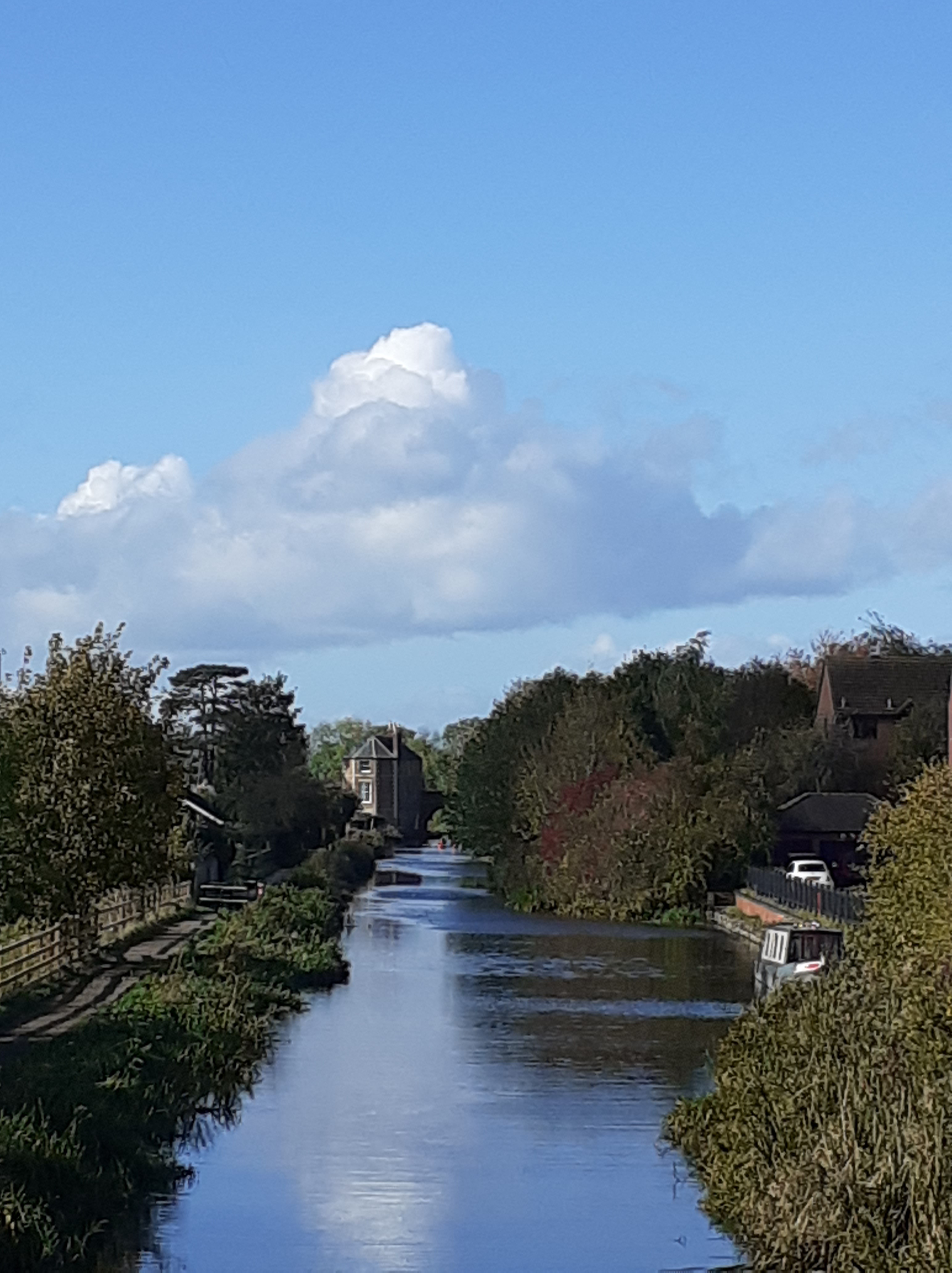
1 November gave me autumn at its best rather than any sign of winter. The canal had, in places, a kind of dappled intimacy, aided both by unmanicured foliage and architecture on a human scale. The quality of light was heart-lifting too, always significant for me.
There were also other spaces, more open, allowing an overview of the canal landscape. The picture below gives an indication of how much blue sky there was, on the day. It was a delight to be able to see so far, and so clearly. I realise how much my resilience, at times wobbly, is supported by simple experiences like this.
After the equinox comes a deepening of autumn. Light, colour, texture – my sense of the world is different. Images of this moment in the year shape my sense of time as well as of place. I savour the turning of the wheel. All time is transitional, yet every time has its own uniqueness.
Contemplating images like this is for me a way of sustaining what modern Druids sometimes call a re-enchantment with and of the world. Simple attention to the living world is a renewing experience, and protects the heart from what can seem like the half-life of a Wasteland culture. Opening to a living cosmos, I plead guilty, with pride, to the charge of Romanticism.
It is after 9 a.m. on Sunday 26 September, Locally I enjoy orange as a colour of ripening, rich and shiny with life, as the season of bearing fruit moves on.
There are trees whose leaves have already turned, but will stay on their branches for awhile, giving these woods a more mixed, autumnal appearance.
But there is still a preponderance of green, some of it surprisingly fresh. Here it provides a canopy of green light and shade.
The season is also asserting a downward pull, towards the earth and dissolution – a process, however, still in its early stages. The broken fence seems almost to be sharing this, beginning a return to the land.
Then there is the undergrowth, with its mix of living and dead wood, living and dead leaves, and the soil that holds them. The evergreen leaves are defiantly vivid. Taking pictures, I celebrate the time of year.
Highly recommended. Sacred Actions* is an excellent resource for developing sacred relationship with the earth in dedicated spiritual practice and acts of daily life. Pennsylvania-based author Dana O’Driscoll is steeped in Druidry and the U.S. homesteading movement. She is Grand Archdruid of the Ancient Order of Druids in America (AODA), and an OBOD Druid. She is a Mount Haemus scholar, lecturing on Channeling the Awen Within in 2018. In a recent blog post in Druid’s Garden (https://druidgarden.wordpress.com) she describes Sacred Actions as presenting “a hybridization of nature spirituality, sustainability and permaculture practice”.
The book is built around the wheel of the year and its eight festivals. O’Driscoll begins with the Winter Solstice, where her theme is the ethics of care applied at both the private and public levels. New life practices are supported by specific exercises and rituals. She continues the same approach with the other festivals: Imbolc – “wisdom through oak knowledge and re-skilling”; Spring Equinox – “spring cleaning and disposing of the disposable mindset”; Beltane – “sacred action in our homes”; Summer Solstice – “food and nourishment”; Lughnasadh – “landscapes, gardens and lawn liberation”; Fall Equinox = “earth ambassadorship, community and broader work in the world”; Samhain – “sustainable ritual tools, items and objects”.
To prospective readers I suggest an initial reading, followed by more intensive engagement with the individual chapters, season by season. Use this text to identify what inspires and moves you and has the power to bring a richer sense of ‘sacred actions’ into your own life. Sacred Actions is a powerful source of ecological and ethical inspiration, and a fine addition to Druid literature.
* Dana O’Driscoll Sacred Actions: Living the Wheel of the Year through Earth-Centered Sustainable Practices Altglen, PA: Red Feather, 2021
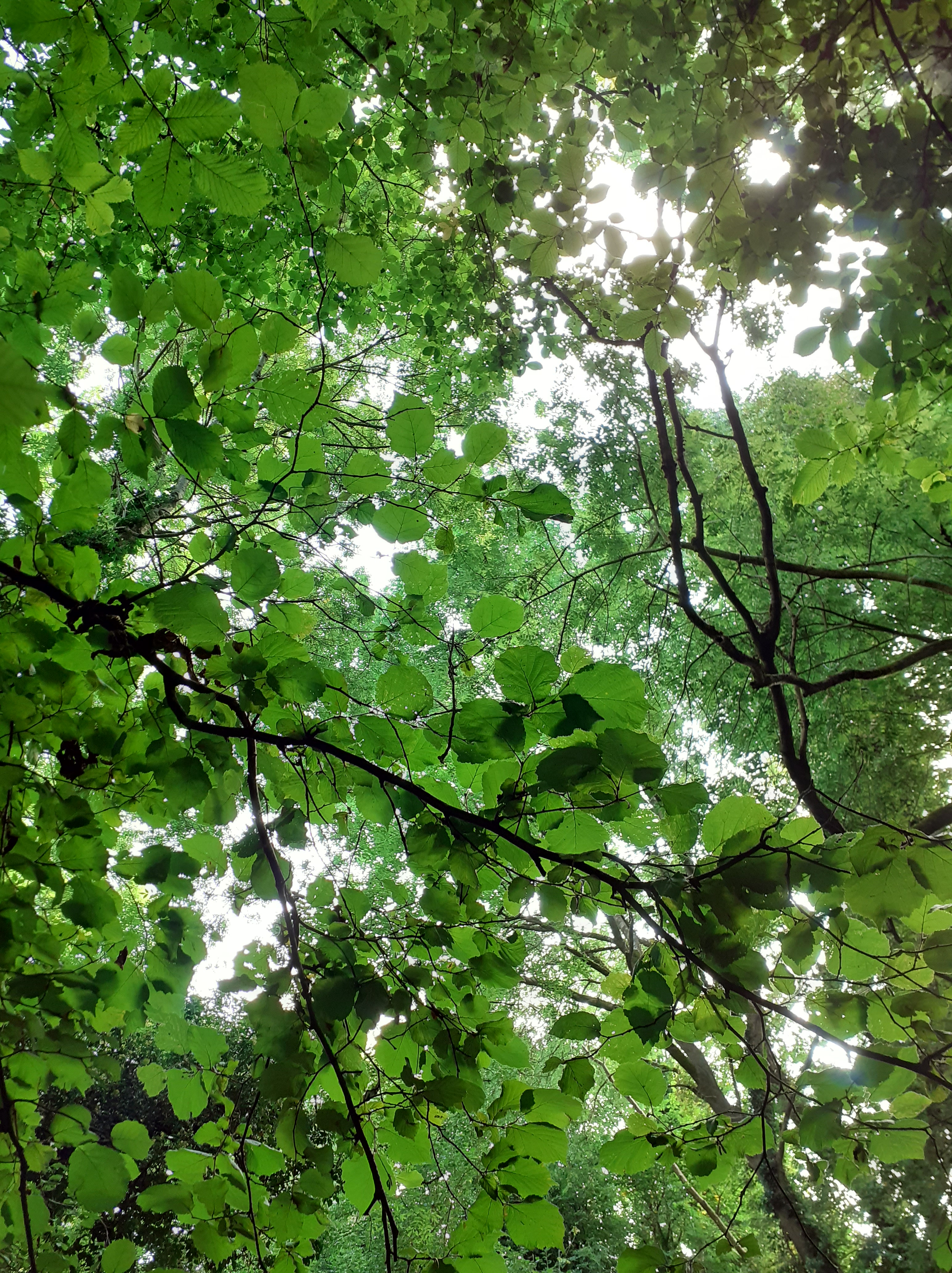
In my wheel of the year tree mandala (1), beech and bluebell together cover the period from 24 May-15 June – taking over from hawthorn and handing on to oak. In this instance, I am drawn by the powerful visual effects of bluebells carpeting woodland in which beech is the dominant tree.
The picture above is an old one. The last year in which Elaine and I went into this space (2018 or 2019) the wood felt weird. Part of it – not quite the area in the picture – was a scene of desolation. A lot of the trees had been taken down, with a kind of ragged insensitivity. It felt like a bad moment in Lord of the Rings. I don’t know the story behind this. Perhaps there was disease, or some other genuine need for a thinning out of trees. It was certainly systematic, with notices about the work being done – the result of management, and not of vandalism, in the conventional usage of our language.
The beech is an elegant tree, and I experience it as having a soft energy. It has been traditionally feminised, and thought of as ‘Queen of the Woods’, sharing the place of honour with the kingly oak according to The Green Man Tree Oracle (2). The same source says that “slivers of beech wood and leaves were once carried as talismans to bring good luck and increase creative energy”. Local British traditions associate the beech (ogham name phagos) with serpents “probably because of its long serpentine root systems”, they add – and I wonder too about the archaic link between the Goddess and serpent power in many cultures.
.
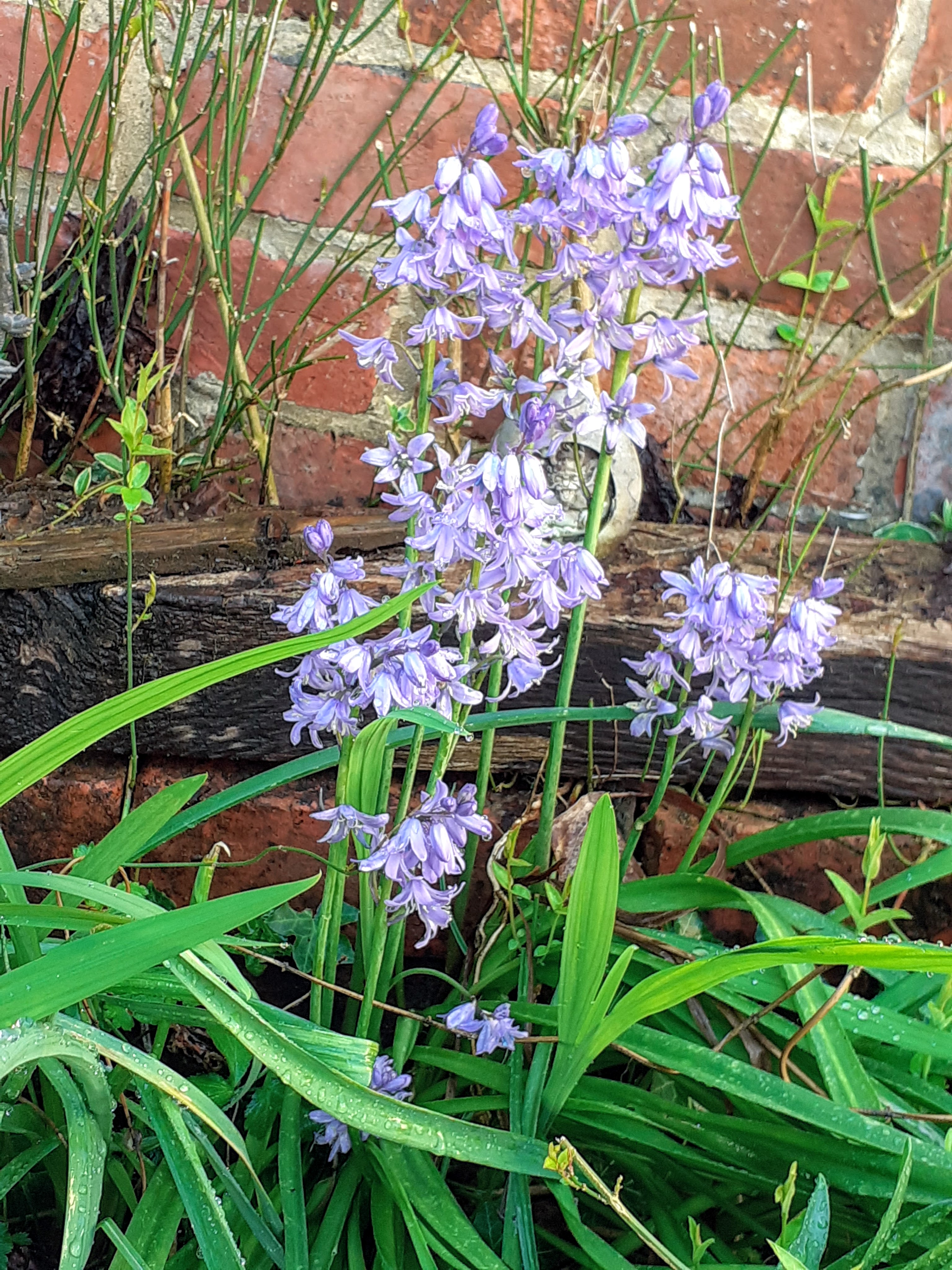
My personal connection with the tree itself is limited. It concerns this time of year and the association with bluebells. Indeed the bluebell is my main focus, with the beech as complementary. If they are separated, I follow the bluebell, and the picture below is a recent one, of the Spanish variety, from our garden. For me, it represents a favourite moment in the year, to be appreciated while it lasts. It reminds me simultaneously of the poignancy of impermanence (including my own) and the beauty of the eternal present (within which I am held).
(1) This mandala is based on my personal experience of trees in the neighbourhood as well as traditional lore. Moving around the summer quarter from Beltane, 1 May, the positions and dates of the four trees are: Hawthorn, south-east, 1-23 May; Beech & Bluebell, south-south-east, 24 May – 15 June; Oak, south, 16 June – 8 July; Gorse, south-south-west, 9 – 31 July. The autumn quarter then starts with Apple at Lughnasadh/Lammas. For a complete list of the sixteen trees, see https://contemplativeinquiry.blog/2020/autumn-equinox-2020-hazel-salmon-awen/
(2) John Matthews & Will Worthington The Green Man Oracle London: Connections, 2003.









 Contemplative Inquiry