It is September. I am thinking about my Druid name Muin (blackberry). The plant is flourishing as it always does when given half a chance. But the fruits are less plentiful now and fairly small: thin pickings for the wayside walker. In the human world, we have largely moved on to the making of jam and wine from our existing harvest.
Today, I am thinking about my psychic and imaginal connection to Muin, and why I am standing by this name. For me, a Druid name is neither an alter ego nor a simple add-on to my other names. It is the name that calls me into my Druid identity and practice. In this context, I ask myself: as Muin, who am I? what do I stand for? who might I become? As I asked these questions in an imaginatively opened state, these lines came up. In a way, I believe, Muin is talking to James, whilst being an aspect of him (me) and anyone else who wants to listen.
I first registered Contemplative Inquiry on 28 August 2012 and WordPress have sent me 12th anniversary greetings. That’s a long-term project by my historic standards. True, the first two years were tentative and I took an 8 month break in 2018/9. But my contemplative inquiry, both as blog and as practice, now feels like a settled part of my life. I continue to ground it in a form of modern Druidry with, Janus-like, both pagan and universalist faces.
Through my inquiry, I came over the years to understand myself as, at heart, ‘living presence in a field of living presence in a more than human world’. This may sound like something of a formula, but it is at least my own formula, providing a compressed account of my experience and understanding, It is not connected to any particular belief system, and arose through a simple recognition of what seems to be given to us, in joy and sorrow alike.
When I open and deepen to living presence, a gestalt of self-and-world, not just self, reveals itself in a sometimes transfiguring way. It is not complicated to practice or experience. In consequence I have found myself nudged, however haltingly, towards a spirit of openness, an acceptance that nothing stays the same, an ethic of interdependence and a life of abundant simplicity.
I no longer think of the inquiry as a path or journey. It is more like a deepening, or maturation, in place. Looking back at early blog posts I find seeds of my current view right at the beginning of my inquiry. As early as 2 September 2012 I wrote about Satish Kumar’s experience (1,2) of outdoor walking meditation. It made a strong impression on me. The difference today is that I have internalised it and given it my own unique flavour. This year I celebrate a clearer understanding and a more confident voice. I am grateful both to influences like Satish Kumar and to the version of me who launched this inquiry twelve years ago..
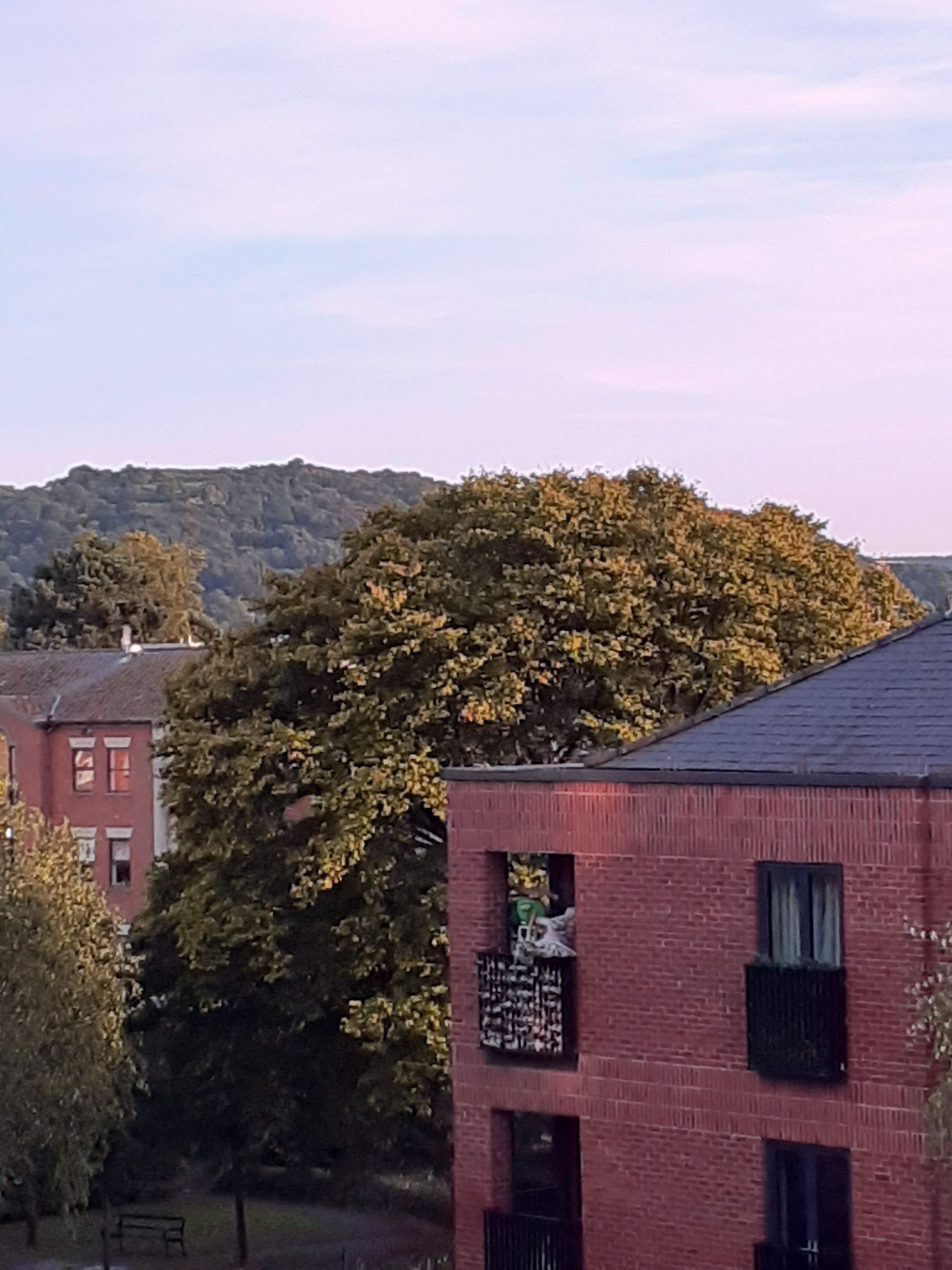
After a grey and stormy day came a grey and calm sunset. Facing west, I looked up at the sky. I began to contemplate the clouds and the muted influence of the sun.
As this skyscape became my world, the solid earth became a distant rumour. Physical reality became porous, indefinite, and insubstantial. Dissolving into this space, I briefly became part of it, no longer an external observer. This experience was fleeting in time-bound reality but imprinted itself on my memory.
Then a seagull seemed to emerge out of nowhere, a dynamic edge of creative light shimmering about its newly-minted form. For me this moment was both grey and luminous, filled with subtle light.
The bird embodied a tremendous joy in flying, with an elegance not seen on the roof tops or the ground. It flew fast and I didn’t see it for long. After its disappearance I noticed how easy it was to enjoy a grey sunset that I might otherwise call gloomy.
Every year is unique and I wondered, then, whether the summer of 2024 was breaking up early in my neighbourhood. As I write, on a rainy morning two days later, this remains an open question.
The wheel continues to turn, and I find myself turning to the west, leaning into autumn, embracing this season for what it uniquely is. It is much more than a precursor to winter. Autumn has tended to be my favourite season and the one I find the most conducive to contemplative and visionary states.
In recent days, I have felt, as much as seen, the retreat of daylight in the evenings. It comes earlier and seems more decisive as the year advances. Mostly, indoors, it has led to a soft and gradual increase of dimness and shadow. I often find this pleasurable and delay resorting to artificial light.
But on Friday 16 August I was caught unawares. I had not been paying attention and it felt as if Night had truly fallen for the first time in my waning year, suddenly and assertively. It wasn’t even fully dark, yet I sensed that Night now ruled.
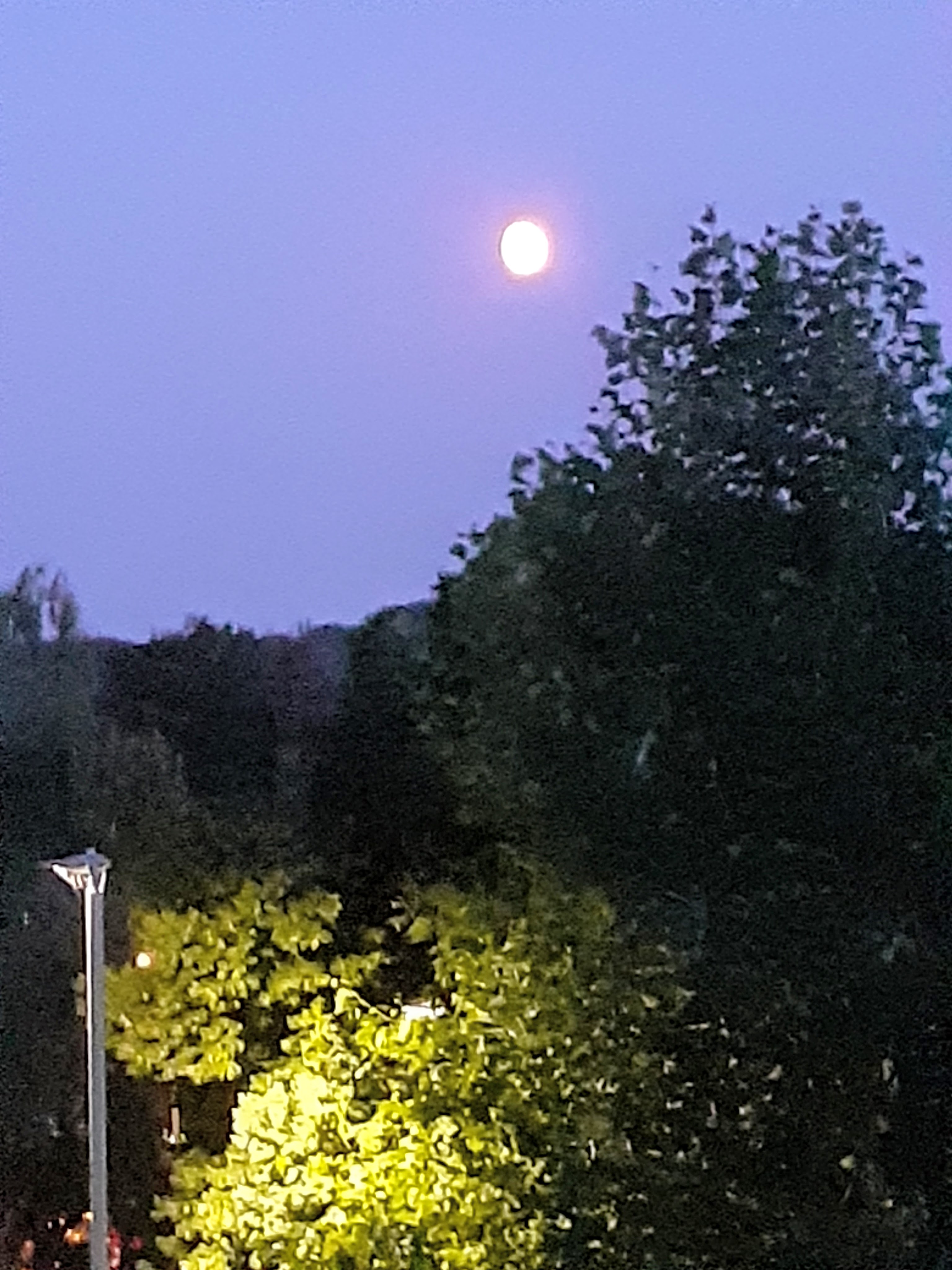
I felt that I was mobilising for a different life. A nocturnal life. To an extent, a lunar life. Standing on an east-facing balcony, I found deep twilight presided over a by a waxing gibbous moon – a super moon, close to the earth, only three days before full.
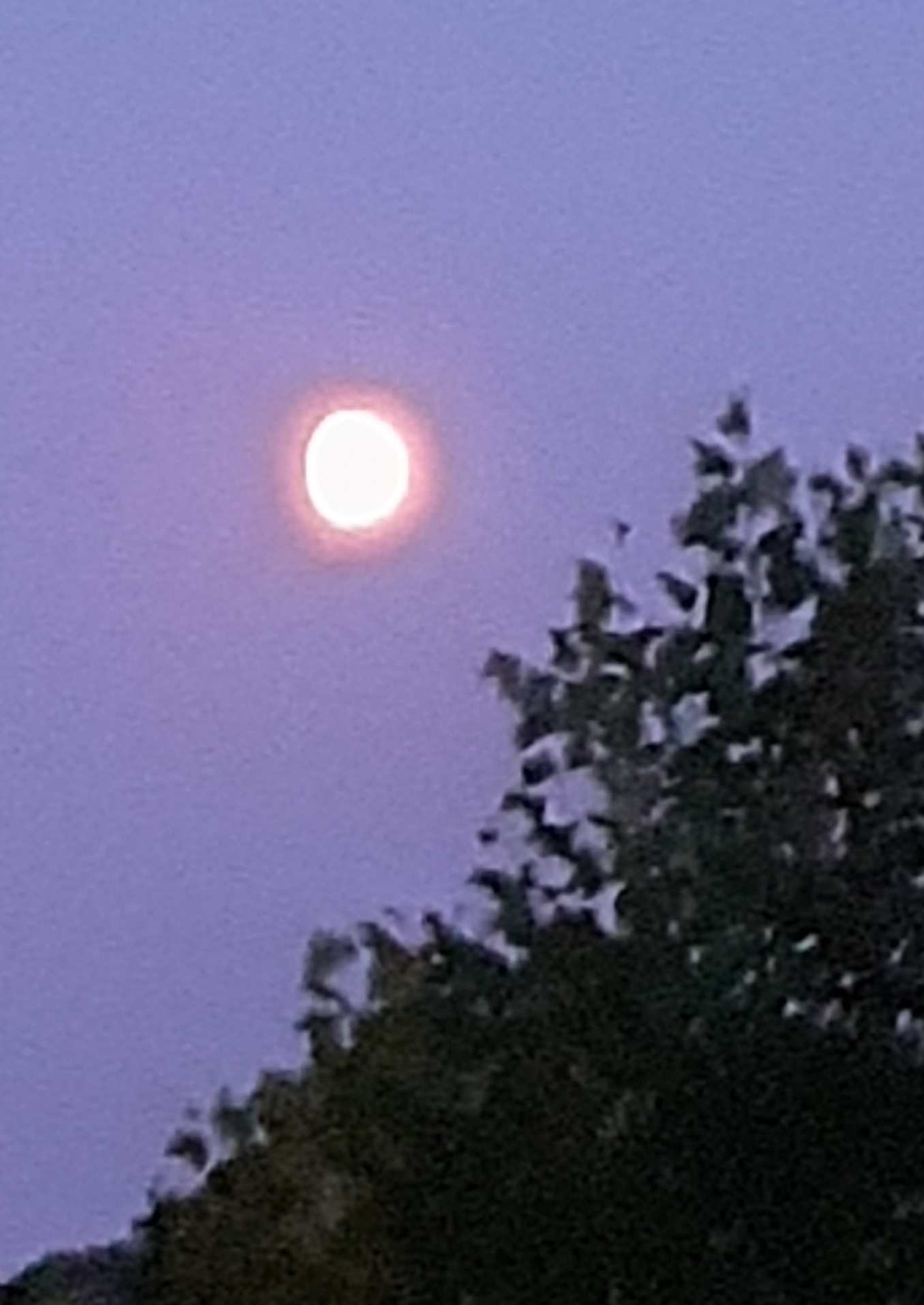
In the picture above, a street lamp seems to compete in brightness. But as I stood in my balcony it was the moon that drew my eye. Its influence was so much greater. The moon persuaded me to take the picture. Indeed I took a second picture (below) of the moon as the only light source. I needed the “radiance of moon” (1) to stand out clearly, in full contrast to the “light of sun”.
Night isn’t just about darkness. It’s about the world that emerges when the sunlight withdraws. Just over a month before the autumn equinox, I have tasted the ‘dark’ half of the year.
(1) From the St. Patrick’s Prayer/Cry of the Deer: “I arise today through the strength of heaven, light of sun, radiance of moon, splendour of fire, speed of lightning, swiftness of wind, depth of sea, stability of earth and firmness of rock”. I begin and end my regular morning practice with these words.
My contemplative inquiry requires a “vulnerability of openness” as part of its process (1). For it is based on personal experience rather than theoretical knowledge. If I want to build an ecology of awareness, language and conceptual thinking are not enough. I need to be attentive to the whole of my living experience, including my body’s wisdom, my feelings, my contemplative states and my imagination. I am a living presence in a field of living presences, in a more than human world. My inquiry is really about how best to be awake and flourishing in this field.
Vulnerability of openness is of course not the whole story. It is the yin aspect of an inquiry process that also has its yang. In a recent post (2) I wrote: “My walking time is still restricted. Perhaps because of this, familiar outdoor spaces have become exotic and magical to my eyes. My limiting circumstances are paradoxically making me more focused and attentive, enhancing my felt quality of life. I am readier to find joy in simple, passing experiences.”
This suggests that ‘magical’ experiences, even when apparently unwilled, are enhanced by focus and attention. Agency and will are part of the process too. Language and concepts allow me to bear witness to my unfolding experiences. But for me, without the vulnerability of openness at its root, the entire process is greatly diminished.
(1) Peter Reason (ed) Participation in Human Inquiry London: Sage, 1994
NB Participative inquiry involves groups working together in a collective research process.. But for Reason, the term ‘participation’ refers more fundamentally to human participation in the world: he uses it to challenge the widely assumed primacy of language and conceptual thinking in human experience.
“Half-way between the certainty of science on one hand, and the supernatural on the other, is mystery …. Mystery is central to enchanted experience because enchantment is not a rational process of recognition, categorization, knowledge, facts or rationalizations. It is, instead, a pure experience of sensing and being.” (1)
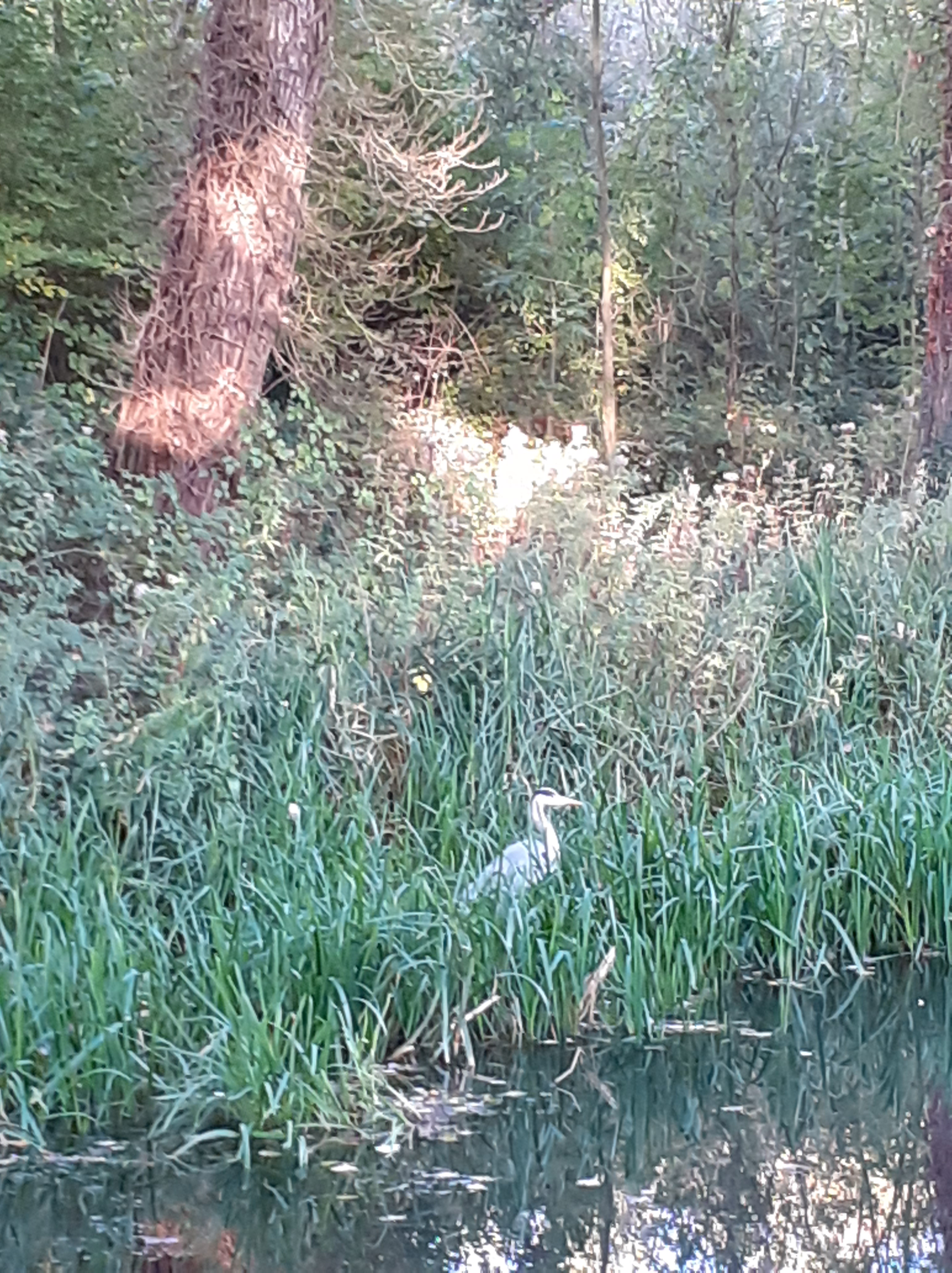
I saw the heron on 11 October 2020, in the first year of the pandemic and just a little after dawn. I had been walking for about forty minutes, beginning in near darkness and experiencing the gradual coming of the light. I described this walk at the time as an “enchanted meander” at a liminal point in that day (2).
My encounter with the heron was unexpected and I responded with “delighted surprise”. Four years later, reflecting on the memory, I note that I was able to experience delighted surprise from within stillness. In that moment I was a still human sharing space with a still heron on a still early morning. So the heron stayed in place, not needing to fly away. Beyond that there was no communing, but this was somehow blessing enough. Stillness of this kind, in contact with our more than human world, allows space for an enhanced bandwidth of experience. It is, perhaps, an opening to what Arran Stibbe calls “mystery”.
On that morning, my enhanced experience was partly displaced into the taking of a picture and also the wider purpose of my walk. That’s fine, a good enough choice. But I wonder what would have happened if I, like the heron, had stayed in place.
(1) Arran Stibbe Econarrative: Ethics, Ecology and the Search for New Narratives to Live By London: Bloomsbury Academic, 2024
My walking time is still restricted. Perhaps because of this, familiar outdoor spaces have become exotic and magical to my eyes. My limiting circumstances are paradoxically making me more focused and attentive, enhancing my felt quality of life. I am readier to find joy in simple, passing experiences.
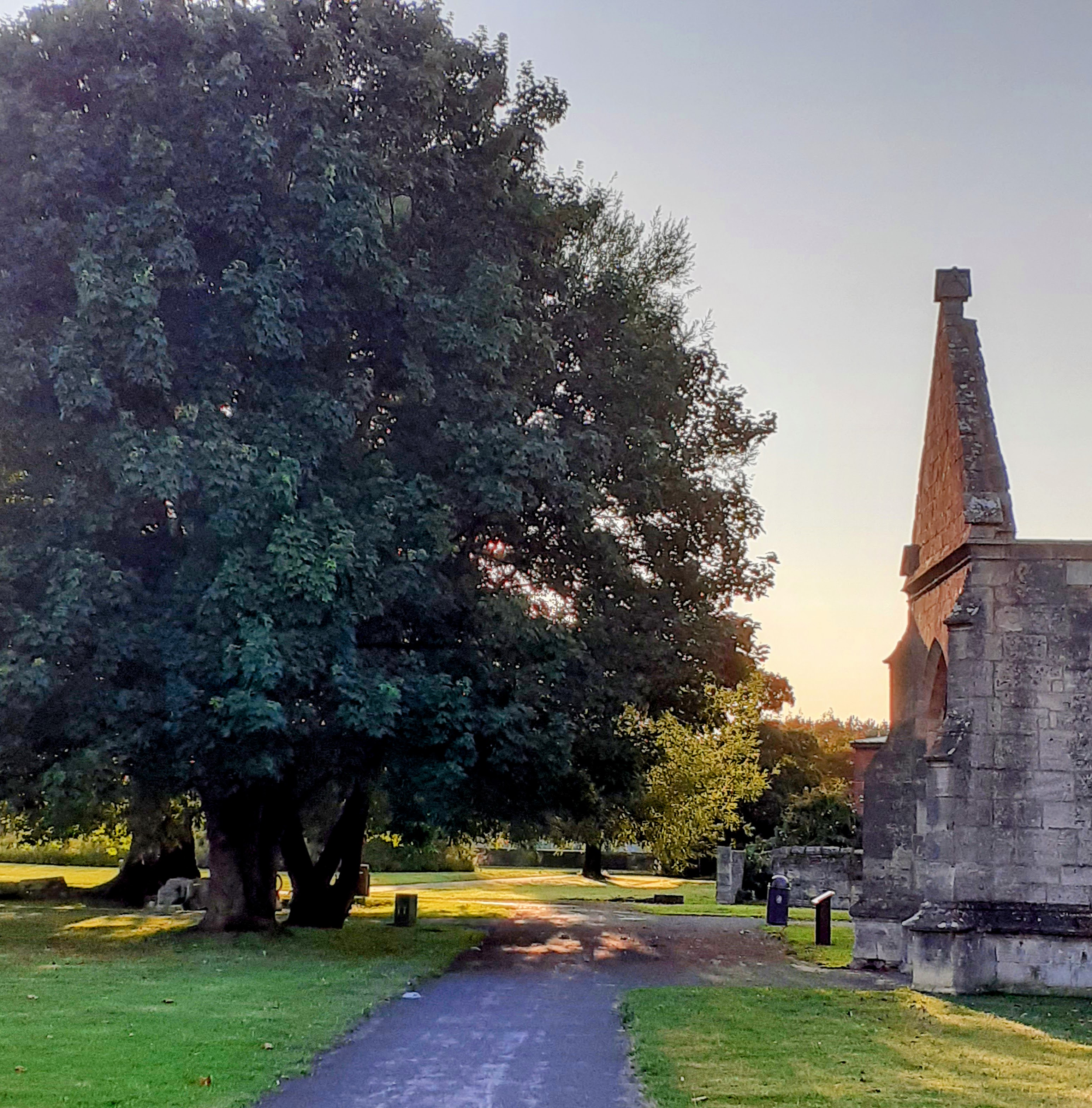
On my contemplative walks, the shapes and colours of trees move me deeply. Grasses and sky have a similar impact. I am very aware of these July days. I am very aware of summer. I am very aware of my place in the world as the year turns in my immediate neighbourhood.
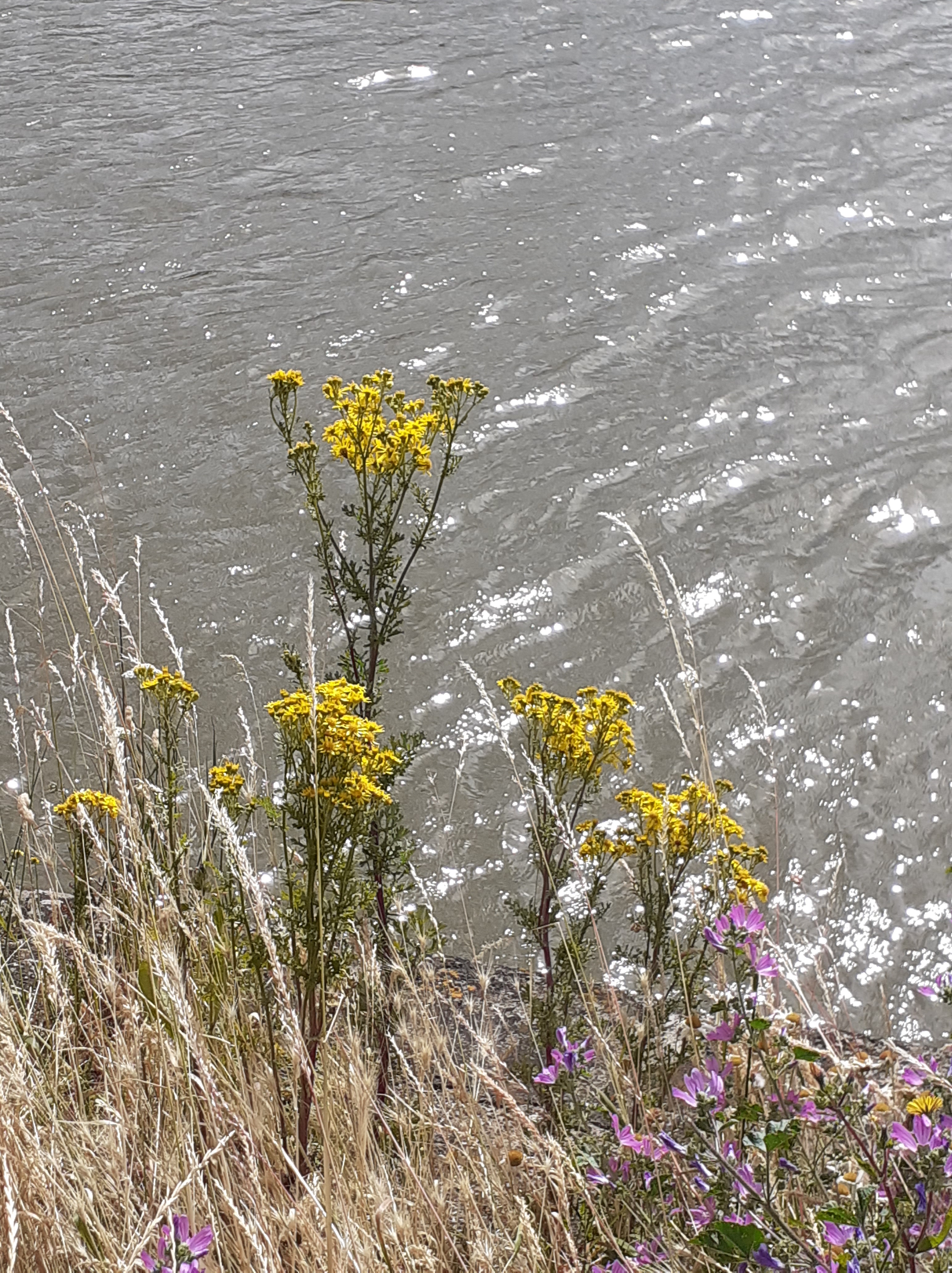
A little further away, I stand on a canal bridge (below) and look back towards the city, which seems distant and small. Water and sky give me space and perspective. I let the elements of water and air nourish me at a time when I am largely grounded.
Close up at the water margin, I find light shining on the water. There is energy and movement here. The power of the sun is present in both a shifting luminosity on the water and the flowering resilience on the bank.
I shift into a meditation on the four classical elements – earth, water, air and fire – and how they work together to make the fifth (life, spirit) possible. Consciously engaged with the four, I can stand as the fifth, resourcing my individual life within a world of impermanence and interbeing.
In the original edition of The Dreampower Tarot (1) The Sleeper is an androgyne figure in a field of corn and poppies. Their face is turned towards the flowers. Their right arm is outstretched, with palm and fingers turning a little towards the ground. Their forefinger hints that we should look to the earth and underworld for healing and inspiration. The whole image evokes deep evening slumber.
In this midsummer period, I’m in a regime of going to bed early, before the light has gone. It reminds me of delicious childhood moments and I feel comforted. During this period I have tended to dream of abstract images and unfathomable events, with background sounds so soft that I can barely hear them.
In these dreams, I have no language and can make no real sense of anything. I’m OK about this, because I’m aware of being aware and safe in awareness without the slightest ability to formulate a sentence like this one. The recognition is primal and wordless. At times, I experience a push towards understanding of a sort, but it is not (yet?) agitated or dominant in consciousness. I seem, in this dreaming (as perhaps once in pre-natal life), to be in realm of divinely simple potential.
When I wake up in the early morning. at this time of year, I find light again, and a different feeling of wonder. Using my resources of language and culture, I am able to make cognitive sense of my world once more. The gift of the dream is that my everyday experience feels, for a while, strange and new. It makes room for the luminosity and magic that I can easily forget in my ‘waking’ hours. The morning light outside my window confirms their presence here. They nourish me, and I am porous to the world.
(1) R. J. Stewart The Dreampower Tarot: The Three Realms of Transformation in the Underworld London: The Aquarian Press, 1993 Illustrated by Stewart Littlejohn










 Contemplative Inquiry