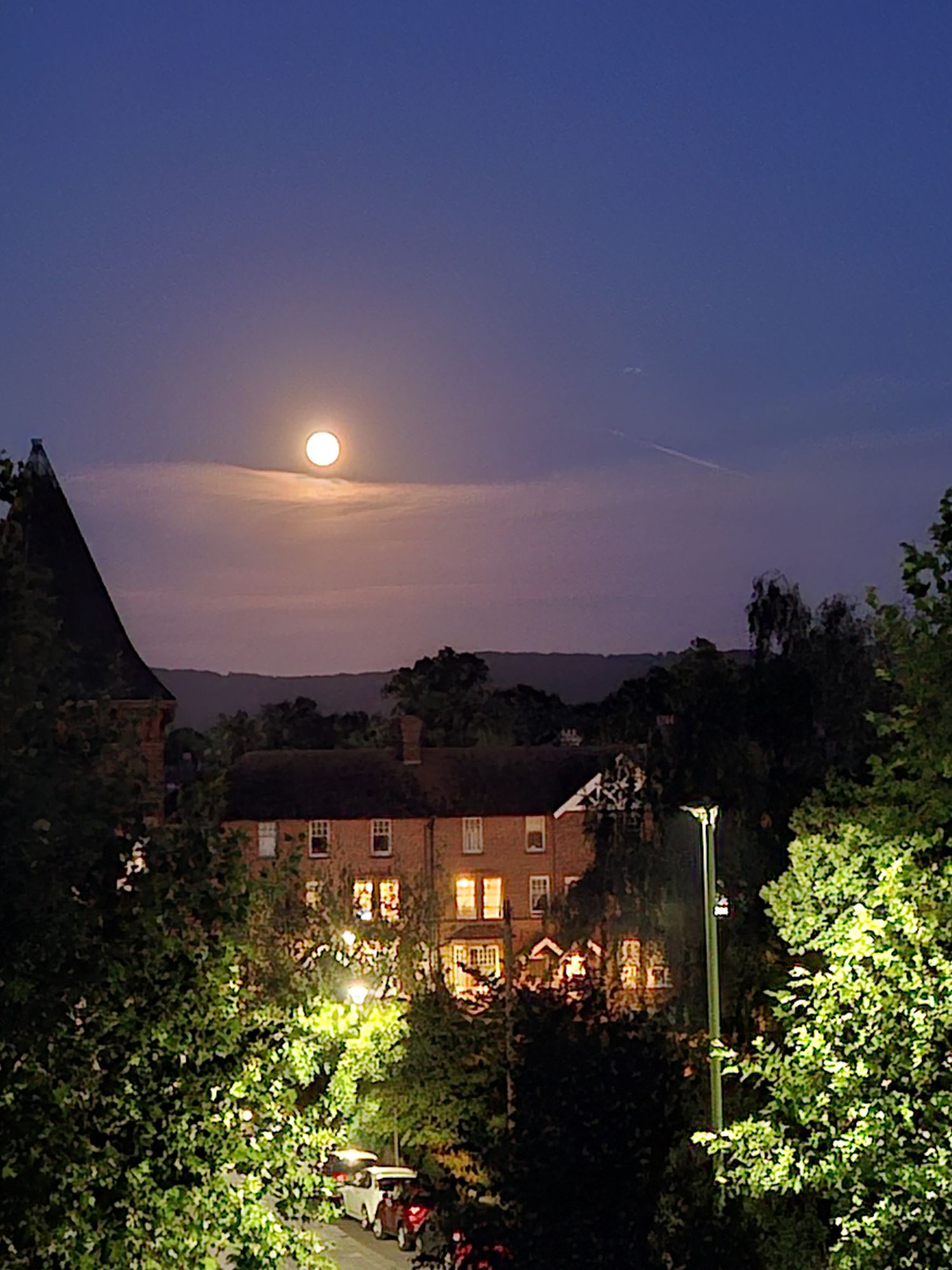
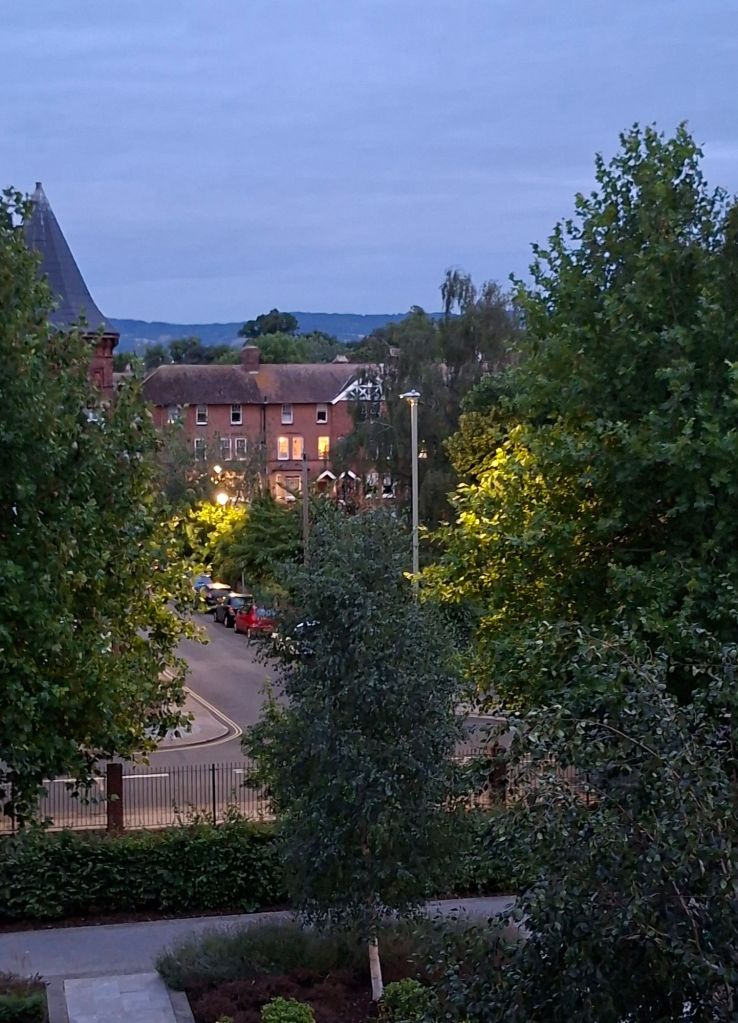
I see change in a familiar scene. Looking out from our apartment I contemplate a gentle twilight. It is modified by artificial light. During the recent heatwave I somehow had little consciousness of this moment in the day. But now, with lower temperatures and rain, my world is a tiny bit different. I discover myself in a twilit scene, and a twilight frame of mind, a little after sunset.
Although this sunset is only ten minutes earlier than the sunsets of the Solstice period, I feel, deep within me, the turning of the Wheel. It’s as if I am leaning in to the spirit of late summer, and the first of the harvest festivals that define the waning year. We are not there yet, though Lammas is but a fortnight away. I am simply becoming aware of a coming seasonal shift.
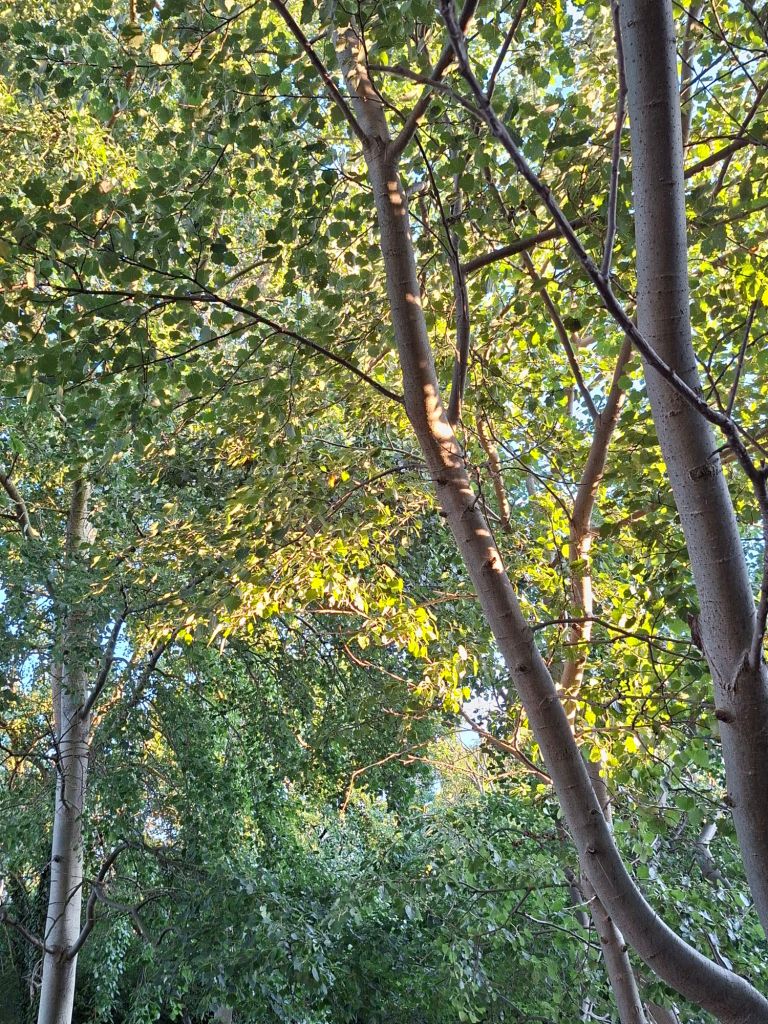
I am also aware of wanting to savour the sense of a change without wanting to hurry it on. Above, an image of trees, houses, hills and sky anchors me into a specific place and time. It’s a ‘now’ experience rather than an anticipation. Below, an image of birch leaves back-lit by electric light holds me in an appreciation of the pattern they make. I am held by the power of a simple pleasure.
An Interview with Frank McEowen (1) is the latest offering in Philip Carr-Gomm’s This Magical Life podcast. The overall aim of This Magical Life is to explore the intersection of Druidry, Psychology and Wisdom. Philip is a clinical psychologist and led OBOD (the Order of Bards, Ovates and Druids) for some 30 years. Frank is the author of, among other works, The Mist-Filled Path: Celtic Wisdom for Exiles, Wanderers and Seekers.
This wide-ranging interview covers three main topics: Celtic bards, Chinese hermit poets and politics in America today. All of these are tied into Frank’s journey and service. He was born in Mississippi, USA, of Irish, Scottish, Welsh and English ancestry. At an early age he experienced mystical encounters with the other world. These later prompted him to work with indigenous elders in North America, and later with teachers in Britain and Ireland, especially Ireland, opening himself also to the spirit(s) of place. He speaks of his journey as a whole as one of ‘soul retrieval’. His early books – The Mist-Filled Path, Meditations on the Irish Sprit Wheel, and The Spiral of Memory and Belonging, come out of this experience.
For reasons explained in the interview, Frank then made a decision to ‘disappear inward’, becoming a hermit and poet. As well as working in Celtic spirituality, Frank was also a student of Zen. He had a natural attraction to Chinese and Japanese wayfaring hermit poetry and modelled the life style as well as the art, adjusted to a different time and culture. This period led to three books of poetry published under the name of Frank LaRue Owen: The School of Soft Attention,The Temple of Warm Harmony and Stirrup of the Sun and Moon.
Like Philip, part of Frank’s service is in the field of psychological healing and personal development, principally as a student of Arnold Mindell. Mindell coined the term ‘Dream Body’ – a psycho-spiritual approach that is also Earth reverencing. It is within this framework that they talk about American politics today. First they identify distressed energies within the national psyche which the current President has uncorked and used in a darkly charismatic and disinhibited way. The discussion takes off from there, looking at issues of grief, loss (of democracy) and possible hope. Connecting this predicament to the bard/poet vocation, Frank quotes Ukrainian poet Ilya Kaminski: “the project of Empire is to dull the senses. The project of the poet is to wake up the senses”. Projects of Empire are not unique to the USA. There is something to reflect on for us all.
I recommend this podcast as a rich and varied conversation, covering a lot of ground in its 36 minutes.
(1) The YouTube post spells Frank’s surname as McEowen and the covers of his early books use MacEowen. I don’t know if he has altered the spelling over time.
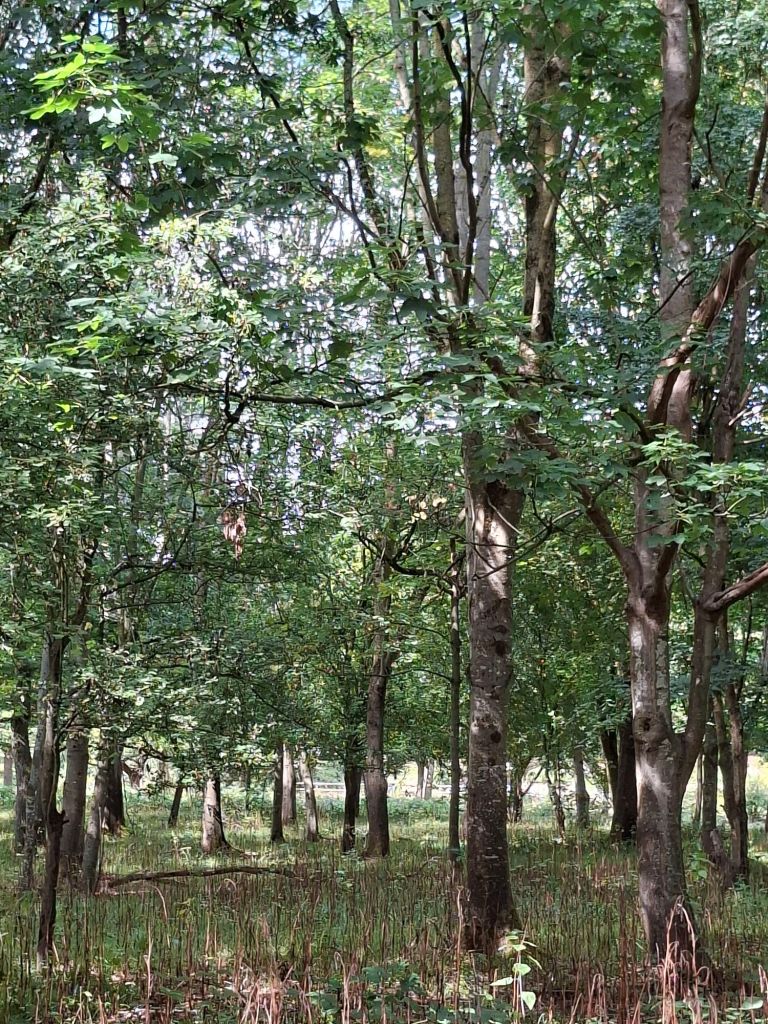
I took the picture above at 8.35 pm on 2 July, a little less than an hour before sunset. The dial still hasn’t moved much since the Solstice. The days are still long and warm. The sky this evening is blue and clear. Sunlight plays in the trees. It is good to be here, now, and alive to this moment.
The moon, below, has reached its first quarter. The Anglo-Saxons called the July moon the Hay Moon. Celts called it, variously, the Claiming Moon, Mead Moon or Herb Moon. North American traditions speak of the Buck Moon and the Thunder Moon.
For me, contemplating this moon at its first quarter, it seems like empty potential and not ready for a name. There’s a sense of mystery here. I stand with that mystery as my world moves towards a high summer sunset.
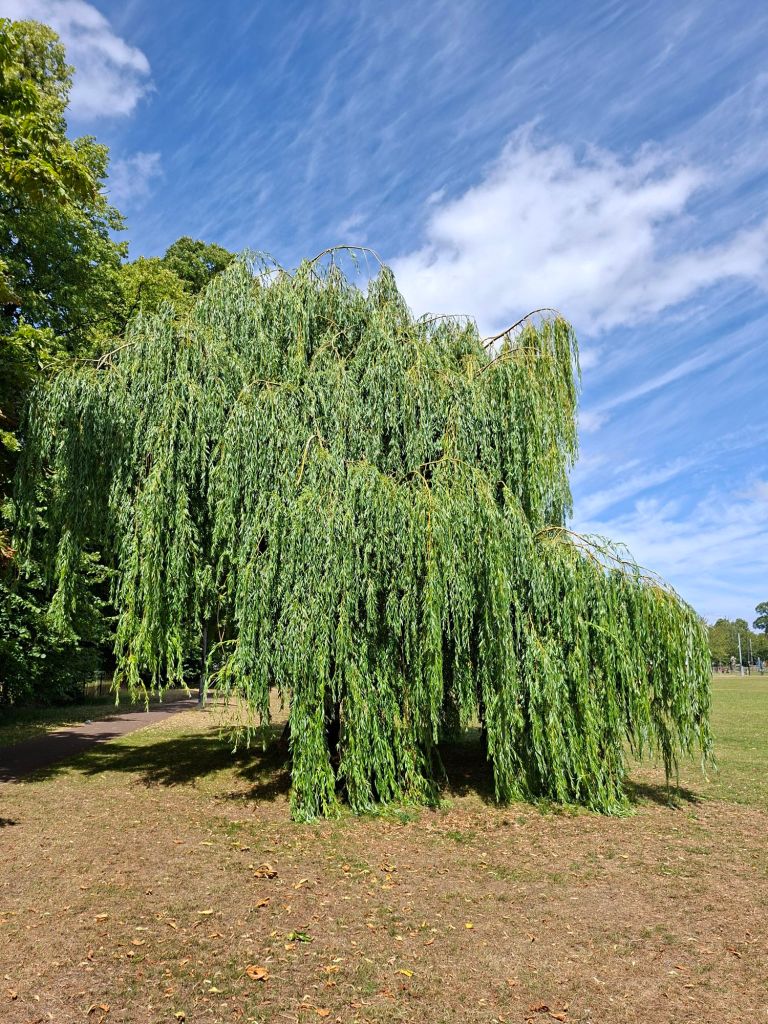
It’s a warm afternoon. The sun is strong. The park is parched. I could do with some moments of shelter. I walk towards a welcome willow tree.
I feel different under the tree’s lush canopy, as if in a benignly altered world. Its sturdy trunk upholds this precious space, embracing both light and shade. Although this space is small, I experience, here, more variety than in the expanse of park immediately surrounding it.
For awhile I cling to the cool softness of this world within the tree, feeling as well as seeing what the branches and leaves of a weeping willow can do. A taste of Nature’s magic. Then I return to the world of the park.
The garden in Gloucester Cathedral’s close is currently a magnificent riot. I was on a walk there with Elaine and we particularly noticed two powerful seeming plants that we couldn’t identify. We simply sat with them, unnamed, and bathed in their energy. It was a glorious 1 June, the first day of our official meteorological summer, and one to savour and enjoy. Only later did we do any research.
We are fairly sure that the plant above is yellow archangel and the plant below, looking like a giant thistle, is cardoon (canara cardunculus) aka prickly artichoke. Friendly feedback from readers on these identifications is welcome. If we are right both plants have long been recognised as sources of power and healing.
In our older traditions, yellow archangel was a symbol of harmony between flora and fauna. A custodian of wildlife, it fostered a bond that transcends mere survival. Herbalists still use this plant to relieve gout, sciatica and other pains of the joints and sinews. It has also been used to draw out splinters and thorns, clean and heal persistent sores, and to dissolve tumours. Yellow archangel can be used as food, in salads, soups and teas. In the wheel of our year, yellow archangel flowers fully after the bluebells die away.
Cardoon is also a plant of power. Traditionally associated with Mars, it has the virtues of strength, protection and abundance. It is has been credited with the power to ward off evil spirits. It is also connected to ideas of nourishment, the riches of nature and, latterly, sustainable gardening. The plant can grow to 2.5 metres in height. Its thick stalks are used as a vegetable. Its full flowering is in late summer and autumn, with thistle-like purple flowers.
These plants, in this garden, are a celebration of values as well as of nature and healing. I see our world through the lens of Modern Druidry and Paganism. The custodians of this space will have a Christian lens. I am happy to note that in this context they seem to be much the same. When in this space, I feel that I am in a beautiful and energising oasis in the city.
The church of St Mary de Lode, Gloucester, seems to sit among trees. The building salutes the sky without arrogantly trying to reach it. There is a bench towards the foreground of my picture. I am standing in a friendly urban space, a green space. It is one of many made possible by the Churches and Priories of the old city. This space is open to all.
In another such space, on a granite seat close to my home, I recently noticed the words “this is a slow green, stay for long enough”. I have been savouring these words ever since.
They draw me into an easy receptively, not least when the month is May and the day is warm. The riddle of ‘a slow green’ invites immersion and reverie rather than effortful attention or strategies for problem solving. ‘Stay for long enough’ is probably the wisest counsel. Let’s take the time we need gently to befriend such nurturing spaces when we are blessed to find them.
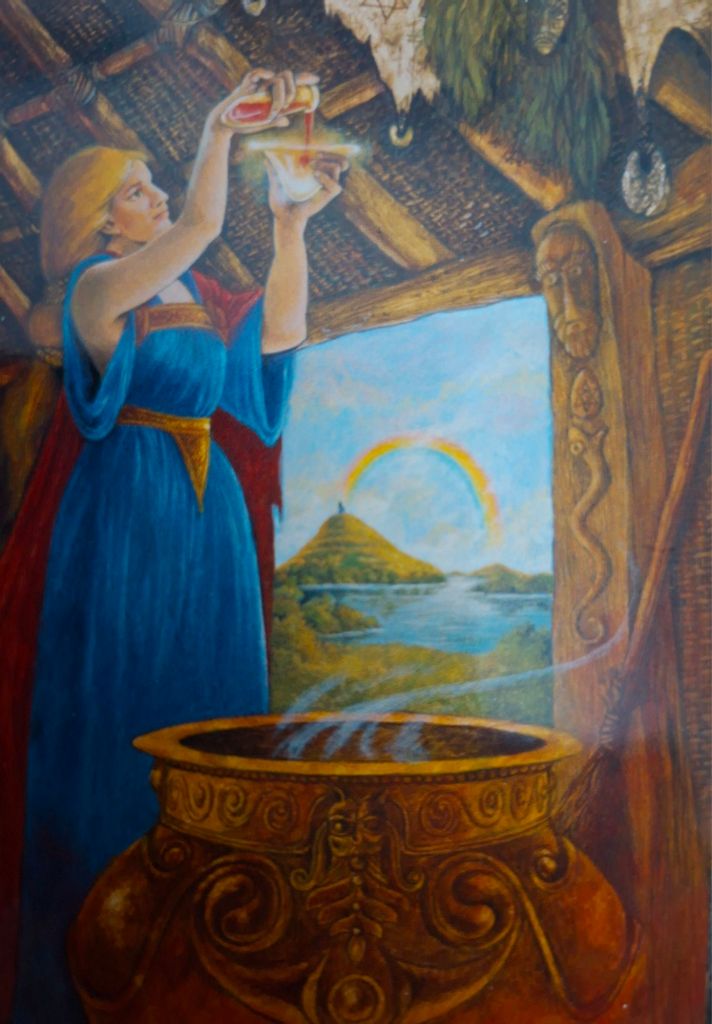
Hertha (Nerthus, Erth) was a Germanic Goddess of the Earth, associated with fertility, domestic animals and nature. She was believed to live in an island grove, whilst also touring the land in a cow drawn chariot to bring peace and joy to those who celebrated her. Our ancient information is derived from the Roman author Tacitus, in his Germania (1). Current accounts also link her to themes of rebirth, kinship, health, longevity and tradition. It is said that she can descend through the smoke of any fire to bring gifts. See: https://journeyingtothegoddess.wordpress.com/2012/12/25/goddess-hertha/
Algernon Charles Swinburne’s Victorian poetry is mentioned in two of Ronald Hutton’s Divinity lectures at Gresham College (2,3). In particular he describes the poem Hertha (3) as an important example of Pagan currents in Victorian British culture. Although widely seen then and (for some people) since as transgressive, Swinburne’s voice is confident and strong – as I hope these extracts show:
“I am that which began:
Out of me the years roll;
Out of me God and man;
I am equal and whole;
God changes, and man, and the form of them bodily;
I am the soul.
“Before ever land was,
Before ever the sea,
Or soft hair of the grass,
Or fair limbs of the tree,
Or the flesh-coloured fruit of my branches, I was, and thy soul was in me.
“First life on my sources
First drifted and swam;
Out of me are the forces
That save it or damn;
Out of me man and woman, and wild beast and bird; before God was, I am.”
As I read these verses, Swinburne’s Hertha is cosmic as well as local, universal as well as tribal. Swinburne clearly values Hertha’s specific name and lineage and he identifies Hertha with the World Tree in some verses. But he does not simply revive the old North European traditions. His Paganism models a new culture for a new time.
Although another 150 years have passed since Swinburne wrote this poem, I find it directly relatable. For me, it contains one of the most powerful affirmations of Panentheist Paganism I have heard: “I am the mouth that is kissed and the breath in the kiss, the search, and the sought, and the seeker, the soul and the body that is”. What better time than Beltane to celebrate Hertha and the 19th century seeding of Modern Paganism.
(1) Tacitus Agricola and Germania London: Penguin, 2009 (rev ed)