Contemplative Inquiry

This blog is about contemplative inquiry

Tag: Nature mysticism

ATTENTIVENESS AND WONDER

I began my contemplative journey with a sense of mysticism, which I would now reframe as “attentiveness and wonder” (1). My path has become firmly this-worldly, a stance that has varied over the six years since I launched the inquiry, at a solo Samhain Druid ritual. The group practice that developed for contemplative Druidry was naturalistic from the beginning, finding the numinous within the mundane. The Buddhist sangha with which I am linked (2) is also world oriented. It emphasizes the interconnectedness of all that the earth contains, and a way of wisdom and compassion in every day life.

My path continues to be a contemplative inquiry. It is an inquiry, because I am in an open process of bringing my truth into being, a truth which remains provisional, agnostic, limited by my human horizons. Within this inquiry, contemplative methods both train the attention and open up spaces for wonder.  Jon Kabat-Zinn, initiator of the secular mindfulness movement, calls it ‘reverence’. For him this touches us when we are “transported by some marvelous strain of music, or when struck by the artistry of a great painting … I am speaking of the mystery of the very existence of an event or object, its ‘isness’. In the case of a work of art, even the artist can’t tell how it came about” (3). At such times, it is better leave words alone and allow our senses, and our feelings, to speak for themselves.

But Kabat-Zinn warns that, since we don’t have words for “ for such numinous and luminous feelings”, we often forget how prevalent they are in our experience. We can easily become inured to them and cease noticing that we even have such feelings or are capable of having them, so caught up we can be in a certain way of knowing to the exclusion of others.” (3). This provides one of my motivations for formal spiritual work (the others having to do with wisdom and compassion).  It helps to me to shake up the mindset that stops me from noticing. To speak of the results in an Existentialist’s language of ‘attentiveness and wonder’ works well for me, better than my older use of ‘mysticism’.

(1) Maurice Merleau-Ponty Phenomenology of Perception. Paris: Editions Gallimard, 1945 (first published in English by Routledge & Kegan Paul, 1962). Merleau-Ponty wrote in his preface: “Philosophy is not the reflection of a pre-existing truth, but, like art, the act of bringing the truth into being. … It is as painstaking as the works of Balzac, Proust, Valery or Cezanne – by reason of the same kind of attentiveness and wonder, the same demand for awareness, the same will to seize the meaning of the world or history as that meaning comes into being”.

(2) https://coiuk.org/

(3)Jon Kabat-Zinn Coming to Our Senses: Healing Ourselves and the World Through Mindfulness Hyperion e-Book, 2005

CONTEMPLATIVE DRUIDRY REVISITED

I experience this season as one of endings, fruitions and threads of continuity. I’m looking back at Contemplative Druidry (1), self-published on 9 October 2014, and currently with sales of just under 1200 – mostly through Kindle.

For me, the book feels true to its moment, a time when the ‘contemplative’ meme was still relatively unfamiliar in Druidry, but where we had already had two years to explore and develop it. The book drew on the experience of a local group in Stroud, Gloucestershire, England and the thoughts of the Contemplative Druidry Facebook Group in its formative period. Much of it was about people and their feelings, thoughts, identifications and values in the process of development.

The book offered no teachings or collective community line about contemplative Druidry. But it did offer a picture of who was involved, where they stood and what they did. I identified a tentative consensus that Druid contemplative practice happened in three main ways: formal sitting meditations (both ‘pathworking’ and ‘mindful’); being in nature and walking the land; and the contemplative use of creative arts. Practice could be solo or in groups, and the book itself helped to develop templates for group sessions and day retreats.

To balance this anarchic approach to spiritual development, I was lucky enough to have a foreword by Philip Carr-Gomm, who leads the Order of Bards, Ovates and Druids (OBOD), to which I belong. Instead of the expected few words, he sent me his beautiful and inspirational essay Deep Peace of the Quiet Earth: The Nature Mysticism of Druidry. A treasure in itself, it has a deepening effect on the book as a whole.

Although the contemplative project, as a project, is finished, I am glad to know that the notion of a contemplative aspect in Druidry is no longer controversial. Within a few hours of launching the Contemplative Druidry Facebook group in 2012, I was challenged by two influential people in the Druid world. Now it has over 2,000 members and no-one turns a hair. The contemplative meme is there to stay, for its time, until it fades out again. The third anniversary of Contemplative Druidry finds me content.

(1) James Nichol Contemplative Druidry: People, Practice and Potential Amazon/KDP, 2014

AUTUMN DAY

Autumn day. Freshness after high winds and rain. Warm, but not like Summer. A soft, enlivening clarity. Simple pleasure in simple experiencing.

In this stream of awareness, it is as if I am possessed of a warm, lighthearted openness and wonder. For the world seems new and provisional, empty of explanations about anything. It is a magical day, with time stopped and infinite space for enjoyment.

I am describing my spiritual home, which I find so hard to identify within communities and movements, even the good ones. Days like this stabilize my sense of being at home and lacking nothing. They are a wonderful blessing.

POEM: THIS WORLD OF DEW


This world of dew

is only the world of dew –

and yet … oh and yet.

Kobayashi Issa (1763-1828), translated from the Japanese by Robert Hess. From The poetry of impermanence, mindfulness and joy edited by John Brem. (Wisdom, kindle edition, undated.)


NATURALISTIC ANIMISM: SEEING THE TREES FOR THE ENTS

Great contribution by John Halstead to the re-visioning of Animism.

John Halstead's avatarNaturalistic Paganism

The Tree or the Spirit of the Tree?

Those who believe in personal gods sometimes have difficulty understanding non-theistic nature worship. I have heard it said that we cannot possibly be worshipping natural phenomena, like the sun or trees; we must be worshiping a divine force “within” or “behind” the natural phenomena, something like Greek dryads or J.R.R. Tolkien’s fictional Ents, the personification of the spirits of the trees.

From a theistic perspective this makes sense. After all, Orthodox Christians do not worship their icons, and Pagan polytheists do not worship the statues that represent their gods. So some theists have difficulty understanding the non-theistic worship of physical nature. They assume that worship requires a conscious person on the other end that appreciates the worship. And if you start with that assumption, then it seems absurd to worship unconscious nature.

On the other hand, many Naturalistic Pagans are uncomfortable with…

View original post 1,581 more words

STEPHEN BATCHELOR: THE EVERYDAY SUBLIME

Stephen Batchelor explores his view that “the mystical does not transcend the world but saturates it”. For me, this discussion has a resonance beyond the ranks of ‘secular Buddhism’. The passage below is from his book After Buddhism: rethinking the Dharma in a secular age (1). I am attracted to his view of ‘the everyday sublime’ and for me at least, its relevance extends well beyond Batchelor’s specific context.

“Meditation originates and culminates in the everyday sublime … [It] is about what is happening to this organism as it touches the environment in this moment. I do not reject the experience of the mystical. I reject the view that the mystical is concealed behind what is merely apparent, that it is anything other than what is occurring in time and space right now. The mystical does not transcend the world but saturates it. ‘The mystical is not how the world is,’ noted Ludwig Wittgenstein in 1921, ‘but that it is.’

“As understood by Edmund Burke and the Romantic poets, the sublime exceeds our capacity for representation. The world is excessive: every blade of grass, every ray of sun, every falling leaf is excessive. None of these things can be adequately captured in concepts, images, or words. They overreach us, spilling beyond the boundaries of thought. Their sublimity brings the thinking, calculating mind to a stop, leaving one speechless, overwhelmed with either wonder or terror. Yet for we human animals who delight and revel in our place, who crave security, certainty and consolation, the sublime is banished and forgotten. As a result, life is rendered opaque and flat. Each day is reduced to the repetition of familiar actions and events, which are blandly comforting but devoid of an intensity we both yearn for and fear.

“To experience the everyday sublime requires that we dismantle the perceptual conditioning that insists on seeing ourselves and the world as essentially comfortable, permanent, solid, and ‘mine’. It means to embrace suffering and conflict rather than to shy away from them, to cultivate the embodied attention that contemplates the tragic, changing, empty and impersonal dimensions of life, rather than succumbing to fantasies of self-glorification or self-loathing. This takes time. It is a life-long practice.

“The ordinary sublime is our ordinary life experienced from the perspective of the fourfold task [NB Batchelor’s reframe of the Buddhist four noble truths JN].  …

  • An open-hearted embrace of the totality of one’s existential situation
  • A letting go of the habitual restrictive patterns of thought and behavior triggered by that situation
  • A conscious valorization of those moments in which such reactive patterns have stilled
  • A commitment to a way of life that emerges from such stillness and responds empathetically, ethically and creatively to the situation in hand.

“Understood in this way, meditation is not about gaining proficiency in technical procedures claimed to guarantee attainments that correspond to the dogmas of a particular religious orthodoxy. Nor is its goal to achieve a privileged, transcendent insight into the ultimate nature of reality, mind, or God. In the light of the fourfold task, meditation is the ongoing cultivation of a sensibility, a way of attending to every aspect of experience within a framework of ethical values and goals.

…..

“As a sensibility, meditation enables us to cultivate an understanding of moment-to-moment experience much as we develop an appreciation of art or poetry or nature. Grounded in the body and the senses, we value an open-mindedness to what is unfamiliar, probe our sensorium with relentless curiosity, listen attentively to what others have to say, are willing to suspend habitual attitudes and opinions, and questions what is going on instead of simply taking things for granted. The disengagement of meditation is not an aloof regard (or disregard) but a perspective that engenders another kind of response to what is happening. And it begins with the breath, our primordial relationship to the fabric of the world in which we are embedded.”

  • Stephen Batchelor After Buddhism: rethinking the dharma for a secular age New Haven & London: Yale University Press, 2015

REDEMPTION SONG

In December 2010, Swithin Fry interviewed me for Stroud FM Radio. The focus was my spiritual path, combining Druid and Buddhist aspects. A shortened version is available at the OBOD website (1). The format was a bit like Desert Island Discs, and interspersed with music. The first piece I chose was Bob Marley’s Redemption Song, and I drew attention to the lines:

“Emancipate yourselves

from mental slavery.

None but ourselves can

free ours minds.”

Astonished that nearly seven years seem to have passed, I listened to my CD of the broadcast again today. What I noticed was a lot of continuity yet some difference of emphasis. At that time, the Buddhist influence – though strongly affirmed – was a bit sketchy. It was clear to me that Buddhist contemplative methods were a means of freeing the mind and seeing reality more clearly, but I talked much more about Earth spirituality and about Bardistry. These too have power to free the mind.

I see Marley as a major Bard of his generation, with a resonance beyond Rastafarianism and the slave-descended African diaspora in the Caribbean and the Americas. What makes him a Bard for me is his ability to speak for more than himself, and to provide a voice for the voiceless. Or even not exactly voiceless, but for people needing to have their experience reflected for them in a more telling, more powerful way, articulated somehow more fully. If strong enough, the song can potentially resonate for everyone, including those outside the specific cultural experience and heritage being referenced.

This isn’t quite the conventional definition of Bardistry. But it does have the sense of a public and performance oriented art that can influence people’s view of themselves and their world in emancipatory and expansive directions. It contradicts shutting down, isolation and contraction. I could call it a Bardistry for postmodern times, when issues of social and cultural identity are complex and stressed. It’s not about pleasing Chiefs any more, and hasn’t been for quite a while.

This is a thread I haven’t much engaged with since I started to specialize in the contemplative aspects of the path. However, the issues aren’t separate: freeing ourselves from mental slavery is for me the theme that binds them. I am now more fully engaged with specifically Buddhist practices than for a long time. But listening to this broadcast again, I still identify myself as a Dharma Druid rather than Buddhist tout court.

BOOK REVIEW: THE CRANE BAG

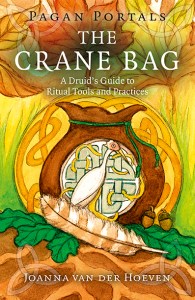
The Craane BagThe Crane Bag, Joanna van der Hoeven’s forthcoming book*, offers an introduction to the ritual tools and practices found in the Druid tradition. It achieves this briefly, simply and with a light touch – as books in the Pagan Portals series are designed to do. Yet it much more than a tick box guide. It provides context and meaning, showing the modern evolution of the Druid tradition itself.

The author makes it clear that she wants readers “to develop their own path in their own time in their own fashion”. Re-enchantment is both path and goal. With proper use, the crane bag “can further the Druid in working with the tides of nature, finding his or her own place in the environment, living in balance, harmony and peace”. The movement overall is “toward reintegration with the natural world”.

At its simplest, the crane bag is the container for Druid ritual tools and as such enables the practices. Bag and tools provide the practitioner with “something tangible to express the spiritual”, acting as a portable “map of the soul”. Behind the crane bag lies an ancient Irish story beginning with the contention between two sisters and the transformation of one of them, Aoife, into a crane. The story is beautifully told and its relevance clearly explained in the first chapter of the book.

In ritual, a period of time and an area of space are set apart and dedicated. This is not to create a lasting duality of sacred and mundane, but a step on the way to experiencing everything as sacred. “Ritual helps us to step back from the busyness, into another way of being. It is a change of consciousness, where we can shift our perception away from a singular view to a more plural view, realising that we are part of an ecosystem”. There is a clear preference for working outdoors, where awareness can shift more readily, though this is not insisted on.

A Druid’s tools will vary with the Druid. The book identifies the following: a silver branch; a staff; cups/bowls/cauldrons; drums; a sickle or knife; robes; altars; fire/candles; incense. People may make or buy them. Ethical sourcing of tools and materials is discussed in some detail, in line with the values of The Crane Bag overall.

What goes into a ritual is explored under the headings of call for peace; preparing the nemeton; honouring spirits of place, three worlds, four directions, ancestors, deities; ritual action; prayers and magic; offerings; eisteddfod; sacrifice; feast; closing. There’s encouragement to practitioners to craft what is right for them from within this set of suggestions and beyond it. The author adds, “I have been in circles with Christian Druids and Buddhist monks, as well as other religions from all over the world”. What matters in ritual is being present and performing the ritual with mindfulness, so that “any words that you speak, any gesture or movement you make will flow more easily, be more graceful and filled with meaning”.

There’s a final chapter on ‘altered states’. I don’t use the term myself, because it makes an ‘altered’ vs ‘normal’ distinction that doesn’t really work for me in my own life. But I recognise it as a term that is widely and usefully employed. Here, it facilitates valuable discussions of meditation, drumming, chanting and song, sensory deprivation, sacred landscape and sitting out. Three kinds of meditation are distinguished: calming the mind and re-tuning the body, journeying and problem solving. Guidance is offered on each kind. Different suggestions are also explored within the other topics. For sensory deprivation, there are two. One is the Celtic version of the sweat lodge, called teach an alais. The other is total immersion in darkness for a considerable period before being brought out into the light. The author refers to early medieval accounts of this, where it was done in aid of Bardic inspiration and prophesy: imbhas forosna.

I found The Crane Bag a very useful contribution to its topic and highly recommend it.


Joanna van der Hoeven The Crane Bag: a Druid’s guide to ritual tools and practices Winchester UK & Washington USA: Moon Books, 2017

*According to the publisher, the book is due for release on 28 July, and can be pre-ordered through Amazon US & UK, Indiebound and Hive.

REBLOG: SCIENCE IN SERVICE TO MOTHER EARTH

Science is, after all, an endeavor of humans and our machines. What would it mean to put this endeavor at the service of Mother Earth? Presumably, our efforts must always be guided by human discernment, in all its fallibility. Who decides what best serves this vision of the Greater Good?

via [A Pedagogy of Gaia] Science in Service to Mother Earth, by Bart Everson — Humanistic Paganism

POEM: GREEN MAN

William Anderson’s classic Green Man poem has thirteen verses of four lines each, and follows the wheel of the year from the Winter Solstice. As I write we have just reached the sixth verse, which has an off with my head theme. The honey of love is over and speaking through the oak is yet to come.

Like antlers, like veins in the brain, the birches

Mark patterns of mind on the red winter sky;

‘I am thought of all plants’, says the Green Man,

‘I am thought of all plants’, says he.

The hungry birds harry the last berries of rowan

But white is her bark in the darkness of rain;

‘I rise with the sap’, says the Green Man,

‘I rise with the sap’, says he.

The ashes are clashing their boughs like sword-dancers

Their black buds are tracing wild faces in the clouds;

‘I come with the wind’, says the Green Man.

‘I come with the wind’, says he.

The alders are rattling as though ready for battle

Guarding the grove where she waits for her lover;

‘I burn with desire’, says the Green Man,

‘I burn with desire’, says he.

In and out of the yellowing wands of the willow

The pollen-bright bees are plundering the catkins;

‘I am honey of love’, says the Green Man,

‘I am honey of love’, says he.

The hedges of quick are thick with may-blossom

As the dancers advance on their leaf-covered king;

‘It’s off with my head’, says the Green Man,

‘It’s off with my head’, says he.

Green Man becomes grown man in flames of the oak

As its crown forms his mask and its leafage his features;

‘I speak through the oak’, says the Green Man,

‘I speak through the oak’, says he.

The holly is flowering as hay fields are rolling

Their gleaming long grasses like waves of the sea;

‘I shine with the sun’, says the Green Man,

‘I shine with the sun’, says he.

The hazels are rocking the cups with their nuts

As the harvesters shout when the last leaf is cut;

‘I swim with the salmon’, says the Green Man,

‘I swim with the salmon’, says he.

The globes of the grapes are robing with bloom

Like the hazes of autumn, like the Milky Way’s stardust;

‘I am crushed for your drink’, says the Green Man,

‘I am crushed for your drink’, says he.

The aspen drops silver on leaves of earth’s salver

And the poplars shed gold on the young ivy flower heads;

‘I have paid for your pleasure’, says the Green Man,

‘I have paid for your pleasure’, says he.

The reed beds are flanking in silence the islands

Where meditates Wisdom as she waits and waits;

‘I have kept her secret’, says the Green Man,

‘I have kept her secret’, says he.

The bark of the elder makes whistles for children

To call to the deer as they rove over the snow;

‘I am born in the dark’, says the Green Man,

‘I am born in the dark’, says he.

From:  William Anderson Green Man: archetype of our oneness with the Earth Harper Collins: London & San Francisco, 1990

Earth Eclectic

music that celebrates Earth and speaks to the heart

Sarah Fuhro Star-Flower Alchemy

Follow the Moon's Cycle

Muddy Feet

Meeting nature on nature's terms

Rosher.Net

A little bit of Mark Rosher in South Gloucestershire, England

Becoming Part of the Land

A monastic polytheist's and animist’s journal

selkiewife

Selkie Writing…

Charlotte Rodgers

Images and words set against a backdrop of outsider art.

Prof Jem Bendell

living with metacrisis and collapse

Towint

The pagan path. The Old Ways In New Times

The Druids Garden

Spiritual journeys in tending the living earth, permaculture, and nature-inspired arts

The Blog of Baphomet

a magickal dialogue between nature and culture

This Simple Life

The gentle art of living with less

Musings of a Scottish Hearth Druid and Heathen

Thoughts about living, loving and worshiping as an autistic Hearth Druid and Heathen. One woman's journey.

Wheel of the Year Blog

An place to read and share stories about the celtic seasonal festivals

Walking the Druid Path

Just another WordPress.com site

anima monday

Exploring our connection to the wider world

Grounded Space Focusing

Become more grounded and spacious with yourself and others, through your own body’s wisdom

The Earthbound Report

Good lives on our one planet

Hopeless Vendetta

News for the residents of Hopeless, Maine