Contemplative Inquiry

This blog is about contemplative inquiry

Tag: Nature mysticism

TREE MANDALA: GORSE

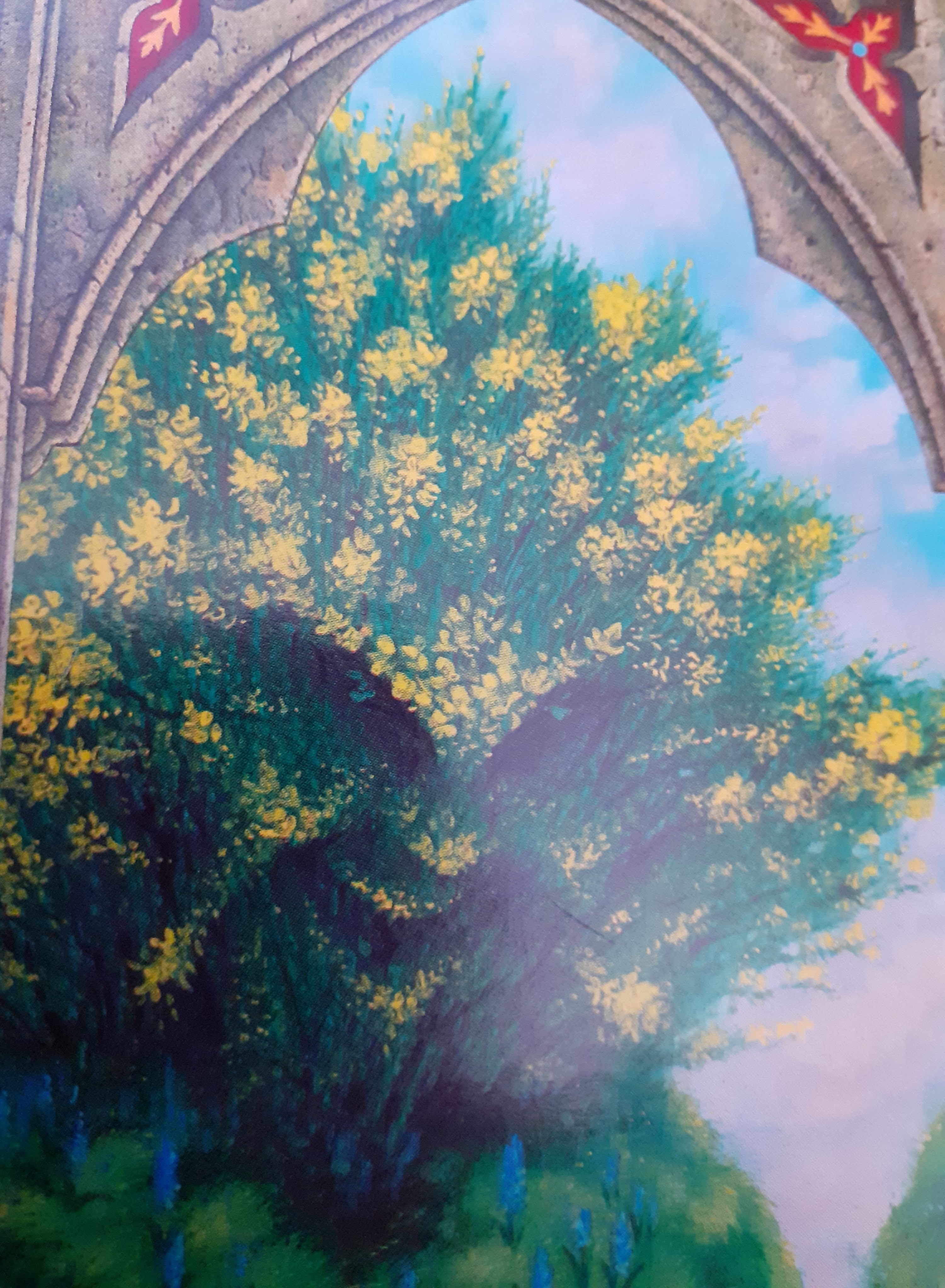
In my wheel of the year tree mandala (1), gorse covers the period from 9-31 July. It is the last tree of the summer quarter, handing over to apple at Lughnasadh/Lammas on 1 August. The illustration is from The Green Man Tree Oracle (2).

I know from my childhood that gorse can make a tame, gently sloping hill seem wild and edgy. Navigating through gorse requires an eye to self-care. Flowering gorse is not confined to summer, but for me it is anchored to summer in memory. Seen from afar, gorse was a vivid harbinger of the summer holidays with days of warmth (rising to heat) and freedom to roam. It carried a hint of adventure and disinhibition. Sometimes the promise was fulfilled. Sometimes there was a hot heavy dullness broken by only storms, and a degree of frustration. July days were unpredictable.

Gorse (ogham name Onn) was sacred to the Irish god Lugh, and thus to light, to all manner of skills, and to the fire in the head of ecstatic creativity. Lugh has a trickster aspect, and can be seen in certain lights as more a god of lightning than of the sun. He has a cousinship with the Brythonic Lleu Llaw Gyffes, the warrior magician of the fourth branch of the Mabinogi. He has also been linked to the Norse Loki, for tricksterism is an aspect of the smouldering fertile mind.

Gorse makes good fuel and so has an obvious role in fire festivals. In Brittany, 1 August was marked by the Festival of the Golden Gorse and gorse has has strong associations with the faery folk. It is a plant of power. We cannot make assumptions about how we stand with it. A wary respect might be wise.

NOTE: This post brings to an end a year in which I have featured the sixteen trees in this mandala. I began on 16 July 2020 with an out-of-sequence Rowan (3), because I had had a vivid encounter with a rowan tree in the woods. (Its time in the mandala is 9-31 October.). Then I moved on to apple (4) and blackberry (5). From the Autumn Equinox (1) the enterprise became more systematic. As a blogger, I won’t be repeating the cycle in the same way in the coming year. Once for the record feels enough.

(1) This mandala is based on my personal experience of trees in the neighbourhood as well as traditional lore. Moving around the summer quarter from Beltane, 1 May, the positions and dates of the four trees are: Hawthorn, south-east, 1-23 May; Beech & Bluebell, south-south-east, 24 May – 15 June; Oak, south, 16 June – 8 July; Gorse, south-south-west, 9 – 31 July. The autumn quarter then starts with Apple at Lughnasadh/Lammas. For a complete list of the sixteen trees, see https://contemplativeinquiry.blog/2020/autumn-equinox-2020-hazel-salmon-awen/

(2) John Matthews & Will Worthington The Green Man Tree Oracle London: Connections, 2003

(3) https://contemplativeinquiry.blog/2020/rowan/

(4) https://contemplativeinquiry.blog/2020/three-trees/

(5) https://contemplativeinquiry.blog/2020/mr-bramble/

PERCEIVING NATURE

“When you perceive nature only through the mind, through thinking, you cannot sense its aliveness, its beingness. You see the form only and you are unaware of the life within the form – the sacred mystery. Thought reduces nature to a commodity to be used in the pursuit of profit or knowledge or some other utilitarian purpose. The ancient forest becomes timber, the bird a research project, the mountain something to be mined or conquered” (1)

Since the beginning of March I have had a connection with Eckhart Tolle’s community (2). Over the next couple of months I will decide whether to make an ongoing commitment. Part of the process is to identify the points of compatibility with my Druidry so that both may support an integrated spiritual life. The view of nature is one point of compatibility, and there is a link to my sense of contemplative Druidry when Eckhart Tolle says: “When you perceive nature, let there be spaces for no-thought, no mind. When you approach nature, it will respond to you, and participate in the evolution of a human and planetary consciousness.” (1)

(1) Eckhart Tolle Stillness Speaks: Whispers of Now London: Hodder & Stoughton, 2003

(2) https://eckharttolle.com/

MIDSUMMER STASIS 2021: A CELEBRATION

A blue sky frames quiet branches. It is the midsummer standstill in my neighbourhood – a period extending over several days. I took the picture on 23 June, in the early afternoon, a time of soft warmth and sunshine, with me able to meet it. I had been prepared to miss it this year, and was delighted when the opportunity came.

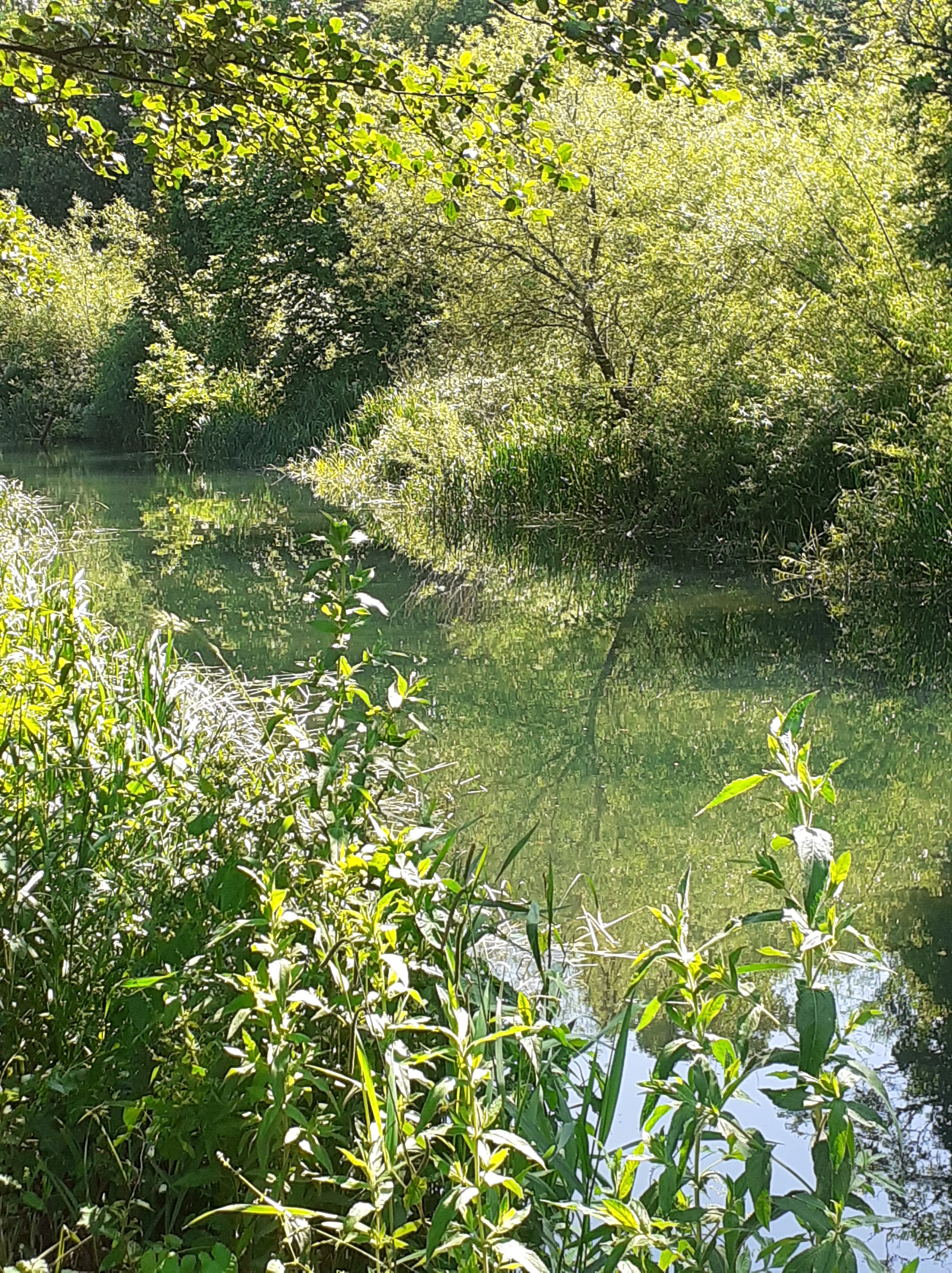
The picture below shows the play of afternoon light and shade in a semi-sheltered spot, where a footbridge crosses a stream.

The next picture makes it clear that there is substantial built environment too here – one of the things I like about this landscape – in the form of weathered railway arches visible behind the foreground green.

The nearby canal looks sleepier than the stream, as if dreaming in the lushness of the moment.

Below, water margin nettles stand out as part of the richness and fecundity of this space, calling for my attention. Clearly capable of being an irritant and seen largely as a nuisance today, the nettle was highly valued by our ancestors for food, fibre and medicine. The Druid Plant Oracle (1) describes it as “a storehouse of goodness” bearing hidden gifts. Nettle tea is widely thought of as health promoting, and modern research confirms that it is rich in antioxidants and vitamins. It is suggested that its polyphenols are helpful in managing chronic illnesses that involve inflammation. I am taking it up as a drink.

There are other, varied riches beside the path, easy to ignore, but also easy to notice and enjoy for their beauty and vitality alone.

I went for this walk without any intention of taking photographs and I travelled quite a way before I began. I felt as though the landscape was persuading me to record the day, and thus bear witness to the midsummer stasis. Yes, it happened in 2021, as it happens every year. Here is the evidence. I am glad I showed up to be part of it,

(1) Philip and Stephanie Carr-Gomm The Druid Plant Oracle: Working with the Magical Flora of the Druid Tradition London: Connections, 2007 (Illustrated by Will Worthington)

A MIDSUMMER DAY’S DREAM

This post is about a midsummer day’s dream in the the Scottish border country, a dream which included a certain kind of waking up. I have written about it before (1,2) but this is the first illustrated version. Fourteen years have passed since that day, which in many ways determined the form which my expression of Druidry would take.

I was near Melrose. The wild rose was one of many on the banks of the Tweed. In this photograph, I am on a riverside path, with my back to the river. I keenly noticed then, as I notice now, the difference between a wild rose and the more familiar cultivated ones. I love both. But I remember feeling a particular delight at the simplicity of the native flower, a sense of easy integration into habitat, and of a plant not committed to being red or white.

Looking more deeply, I have said in my earlier writing how I had a momentary experience in which, gazing at a rose, subject/object distinctions disappeared and it is as if time intersected with eternity. I have identified this with the Seeing experience more systematically explored by Douglas Harding and the community built up around his work (http://www.headless.org). This was the beginning my sense that direct experience of the world, manifesting through a form of nature mysticism, would be my way forward, eventually becoming a contemplative Druidry and the backbone of my contemplative inquiry. I experience this as a direct and simple route to stillness, presence, resting in being., and identifying with source.

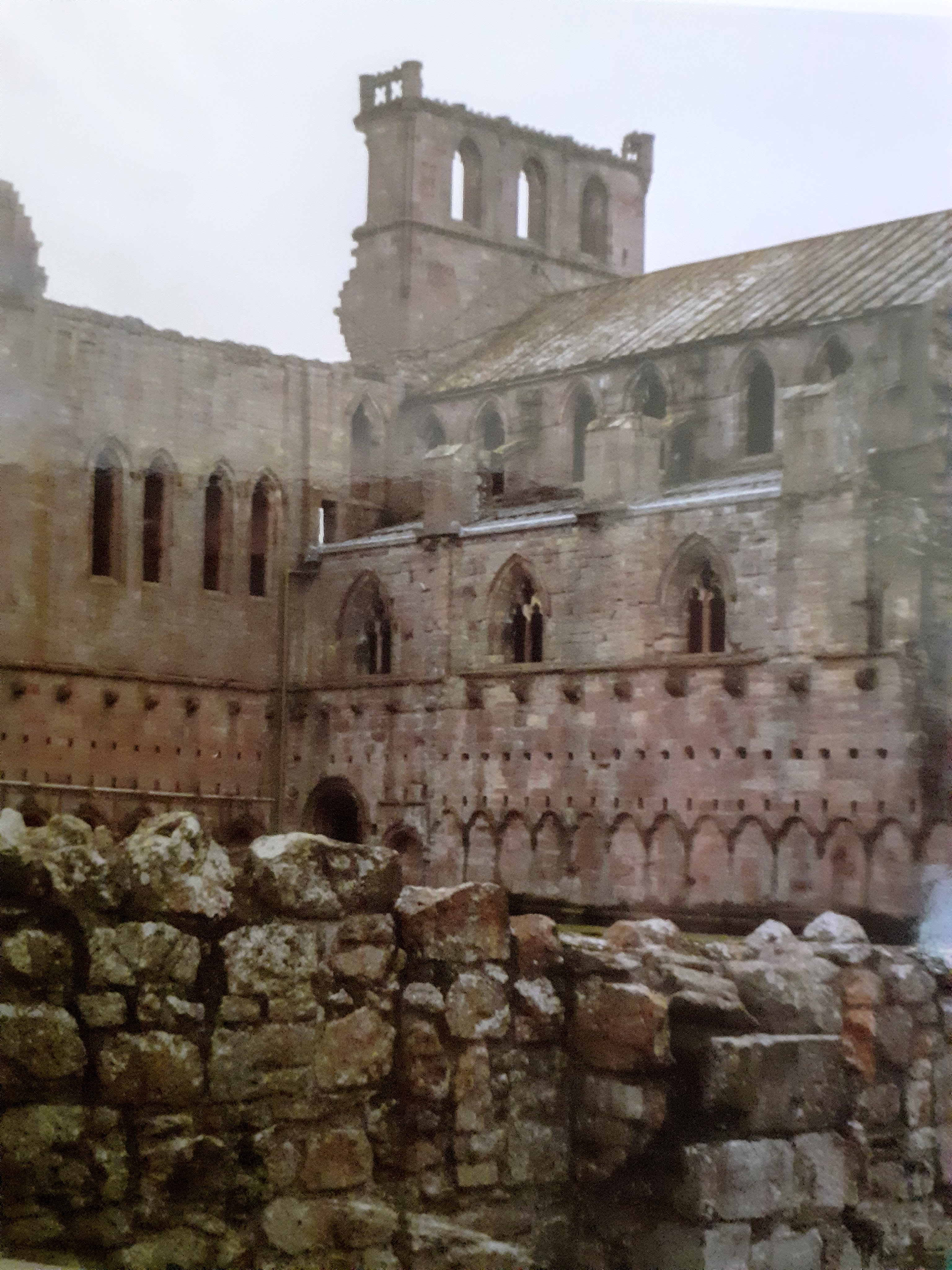
My walk amongst the wild roses had a prequel. Firstly, I had already spent time in the well-preserved ruins of Melrose Abbey. It was a building of Green Man carvings, but, sadly, neither the monks who occupied it nor the iconoclasts who abandoned it had access to the Gospel of Thomas (3) or the words:

“His disciples said to him:

‘When will the dead be at rest?’

‘When will the new world come?’

He answered them:

What you are waiting for has already come,

but you do not see it.” (3)

Here I see the abbey as a solid, material buildings, built with love and care. Even today, it belongs in its landscape, as much as the Tweed or the nearby Eildon Hills, with a semi-wild orchard of apple, pear and cherry trees. What I haven’t written before, in times when I was busy making distinctions between available paths, is that time and eternity intersect in this place too. But, on the day in question, I didn’t have that experience in the abbey grounds. I had it only among the wild roses, down by the river.

The Eildon Hills are also part of the same landscape, indeed a more primal one. But they are fairy hills and they can hide themselves. On that day, they hid from me. There was no invitation – or, rather command – from the Queen of Elfland, who had once ridden out to summon Thomas the Rhymer to her service:

“But you maun go wi’ me now Thomas

True Thomas ye maun go with me

For ye maun serve me seven years

Through weel or wae as may change to be.” (4)

At midsummer in 2007 I was looking for a spiritual home that offered both depth and simplicity. The grim half hidden hills were not appealing to me and I was closed to their magic, with an invitation or without one. I did not want to court danger by ascending into their conceivably treacherous mists. The low road by the river was the one for me.

It was a good decision, and good came of it. But I do also understand that on a different day, those hills could be seen in a different light. I do not now feel constrained to make a neat choice between a broad road, a narrow road and a bonny road. Two cycles of seven years on, well rooted in a nourishing life and practice, I find myself in a more open space, wondering what lessons this Otherworld might yet offer.

(1) James Nichol Contemplative Druidry: People, Practice and Potential Amazon/Kindle, 2014 See: https://www.amazon.co.uk/contemplative-druidry-people-practice-potential/dp/1500807206/

(2) https://contemplativeinquiry.blog/2019/07/16/seeing-contemplative-druidry/

(3) The Gospel of Thomas: the Gnostic Wisdom of Jesus (Translation from the Coptic, introduction and commentary by Jean-Yves LeLoup. English translation by Joseph Rowe. Foreword by Jacob Needleman) Rochester, VT: Inner Traditions, 2005

(4) R. J. Stewart The Underworld Initiation: A Journey Towards Psychic Transformation Wellingborough: The Aquarian Press, 1985

TREE MANDALA: OAK

“Green man becomes grown man as flames of the oak

As its crown forms his mask and its leafage his features;

‘I speak through the oak’, says the Green Man.

‘I speak through the oak says he'” (1)

In my wheel of the year tree mandala (2), oak covers the period from 16 June-8 July and thus includes Alban Hefin, the summer solstice. I am starting to bring it in. The oak has many associations – regal strength, for example – but for me the sense of the green man, the archetype of our oneness with the earth, speaking through the oak, is the most numinous. At Dodona in ancient Greece (3) an oak shrine was “guarded by priestesses who interpreted the future from the rustling of leaves on the great tree, the voice of the sacred spring that rose at its root and the behaviour of birds in its branches”. Celtic tradition describes a number of sacred oak trees, themselves roosting places for sacred birds. I like the sense that the oak does not stand alone and autonomous in these stories. For leaves to rustle, the wind is needed. Birds and springs may also participate in the ecology, of a distributed wisdom – a wisdom of interdependence, of interbeing. The oak’s great branches are matched by still greater roots, and therefore an underground network of communication and exchange that we now know sustains a mature forest (4).

The ogham name for oak, duir, means door in both Sanskrit and Gaelic (5). This can bespeak solidity and protection, for the oak can survive lightning. It was sacred to Taranis, the Celtic god of lightning and storms, to Thor in the Nordic pantheon. and to Zeus among the Greeks. But a door isn’t just defensive. It is there to be opened as well, with a sense of welcome and relationship. Dagda, father god of Ireland, was associated with the oak and never failed to give hospitality to those who asked for it.

For Druids (whose name means ‘oak wisdom’) oak was the central tree in their mysteries. There is a theme, in these mysteries, of communication between worlds, with a sensed Otherworld being less than a heart beat away. The power of the oak combines strength and sensitivity. My mandala links oak to the period in which the light has its greatest expression, and then gives way, at first very slowly, to its necessary descent into the dark. The tree bears witness as the wheel continues to turn.

(1) William Anderson Green Man: Archetype of Our Oneness with the Earth Harper Collins: London & San Francisco, 1990.

(2) This mandala is based on my personal experience of trees in the neighbourhood as well as traditional lore. Moving around the summer quarter from Beltane, 1 May, the positions and dates of the four trees are: Hawthorn, south-east, 1-23 May; Beech & Bluebell, south-south-east, 24 May – 15 June; Oak, south, 16 June – 8 July; Gorse, south-south-west, 9 – 31 July. The autumn quarter then starts with Apple at Lughnasadh/Lammas. For a complete list of the sixteen trees, see https://contemplativeinquiry.blog/2020/autumn-equinox-2020-hazel-salmon-awen/

(3) John Matthews & Will Worthington The Green Man Tree Oracle London: Connections, 2003.

(4) https://contemplativeinquiry.blog/2021/05/23/suzanne-simard-finding-the-mother-tree/

(5) Liz & Colin Murray The Celtic Tree Oracle: a System of Divination London: Eddison/Sadd Editions, 1988 (Illustrated by Vanessa Card)

LEARNING FROM OTHER TRADITIONS: KASHMIR SHAIVISM

My Druidry is an earth pathway and a nature mysticism – and it is more than that. It is concerned with recognising, and living from, a divine identity in a divine world. I practice a panentheist, non-dual, Druidry. But few of the mystical traditions known to history have fully held the two aspects together as one. Kashmir Shaivism, a form of traditional Indian Tantra, is an exception. Sally Kempton (1) explains.

“Rejecting the Vedantic view that the material world is illusory, an empty dream, the sages of Kashmir Shaivism saw all forms of the universe as manifestations of divine creative energy, of Shakti, the dynamic female principle. They worshipped Shakti in themselves, in the earth, and in every substantial and insubstantial thing, and they looked for the pulsing heart of divine bliss within all domains of experience. Astute seekers of the tradition knew innumerable pathways for uncovering the experience of the divine. They knew how to extract it from states like terror or pleasure or in the high point of a sneeze; the knew how to find the pulsation of ecstasy in empty space, in fixed attention, and in the sensations that come from swaying or twirling, or enjoying music or the taste of food.

“But the crucial insight of Shaivism is the recognition that when human consciousness lets go of its identification with the body and reflects back on itself, it is revealed as a perfect, if limited, form of the supreme ‘I’, which is God. By expanding their own I-consciousness beyond its limits, past its tendency to cling to narrow definitions of itself, yogis of the Shaivite path experienced God as themselves.

“Because they saw the world as divine, the Shaivite yogis of Kashmir had no difficulty enjoying life in all its different flavors. In this they differed from their Vedantic cousins and from the Madhyamika Buddhists who inhabited the same region of India. Shaivism was not a traditional renunciate’s path. Abhinavagupta (975-1025 CE), the preeminent genius of the tradition, was not only a philosopher and a widely revered guru but also an aesthetician, and artist and musician, and the center of a circle where sensory experience – including art, music and drama – was constantly being transmuted into yoga.

“It is this insight – that a serious practitioner of yoga does not reject their world, but instead transforms daily experience through their practice – that sets Kashmir Shaivism apart from many Indian yogic traditions, and has made this system particularly resonant for our time.”

(1) Sally Kempton Meditation for the Love of It: Enjoying Your Own Deepest Experience Boulder, CO: Sounds True, 2011

TREE MANDALA: BEECH AND BLUEBELL

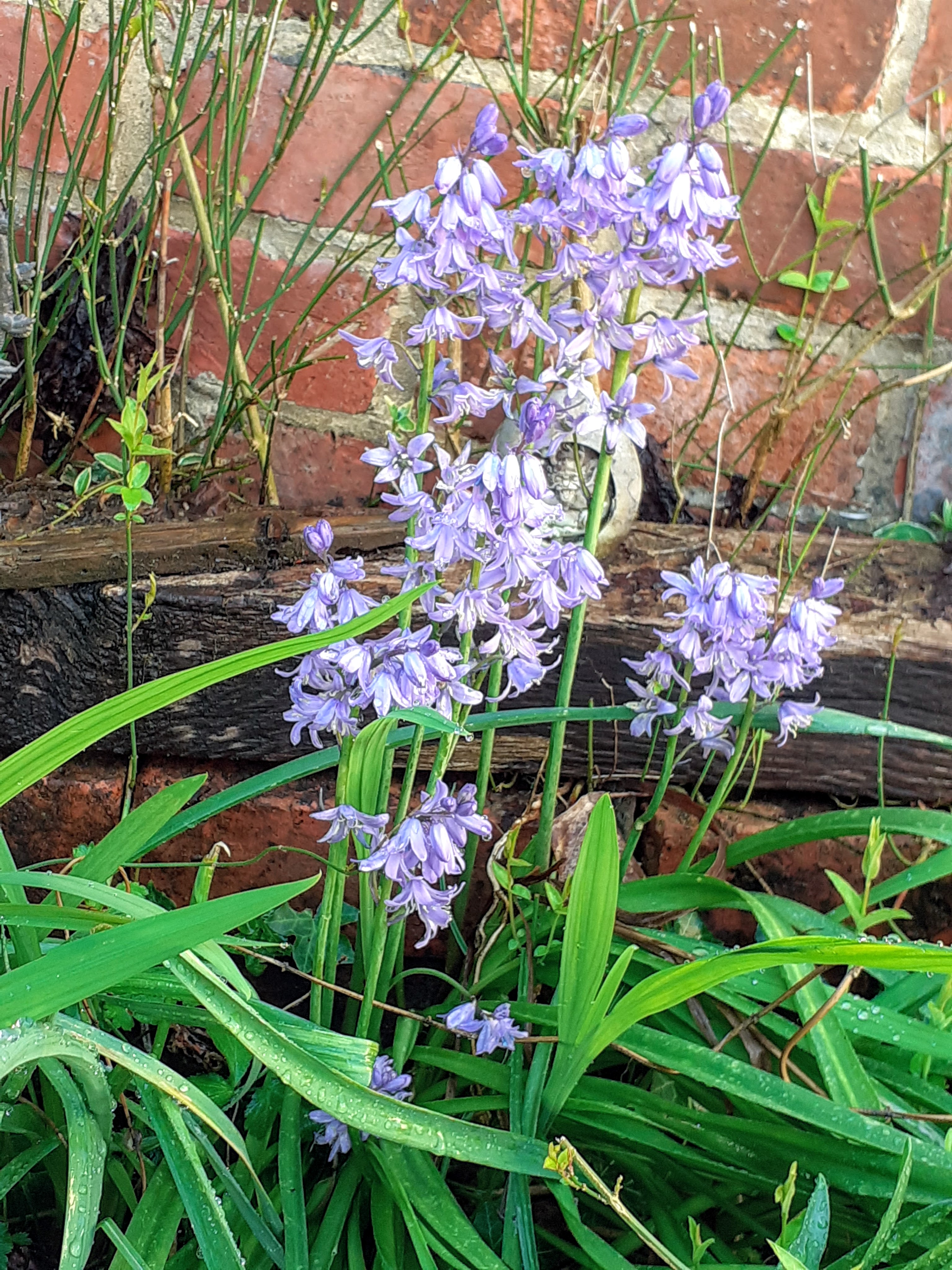
In my wheel of the year tree mandala (1), beech and bluebell together cover the period from 24 May-15 June – taking over from hawthorn and handing on to oak. In this instance, I am drawn by the powerful visual effects of bluebells carpeting woodland in which beech is the dominant tree.

The picture above is an old one. The last year in which Elaine and I went into this space (2018 or 2019) the wood felt weird. Part of it – not quite the area in the picture – was a scene of desolation. A lot of the trees had been taken down, with a kind of ragged insensitivity. It felt like a bad moment in Lord of the Rings. I don’t know the story behind this. Perhaps there was disease, or some other genuine need for a thinning out of trees. It was certainly systematic, with notices about the work being done – the result of management, and not of vandalism, in the conventional usage of our language.

The beech is an elegant tree, and I experience it as having a soft energy. It has been traditionally feminised, and thought of as ‘Queen of the Woods’, sharing the place of honour with the kingly oak according to The Green Man Tree Oracle (2). The same source says that “slivers of beech wood and leaves were once carried as talismans to bring good luck and increase creative energy”. Local British traditions associate the beech (ogham name phagos) with serpents “probably because of its long serpentine root systems”, they add – and I wonder too about the archaic link between the Goddess and serpent power in many cultures.

.

My personal connection with the tree itself is limited. It concerns this time of year and the association with bluebells. Indeed the bluebell is my main focus, with the beech as complementary. If they are separated, I follow the bluebell, and the picture below is a recent one, of the Spanish variety, from our garden. For me, it represents a favourite moment in the year, to be appreciated while it lasts. It reminds me simultaneously of the poignancy of impermanence (including my own) and the beauty of the eternal present (within which I am held).

(1) This mandala is based on my personal experience of trees in the neighbourhood as well as traditional lore. Moving around the summer quarter from Beltane, 1 May, the positions and dates of the four trees are: Hawthorn, south-east, 1-23 May; Beech & Bluebell, south-south-east, 24 May – 15 June; Oak, south, 16 June – 8 July; Gorse, south-south-west, 9 – 31 July. The autumn quarter then starts with Apple at Lughnasadh/Lammas. For a complete list of the sixteen trees, see https://contemplativeinquiry.blog/2020/autumn-equinox-2020-hazel-salmon-awen/

(2) John Matthews & Will Worthington The Green Man Oracle London: Connections, 2003.

REMEMBERING THE GLASTONBURY THORN

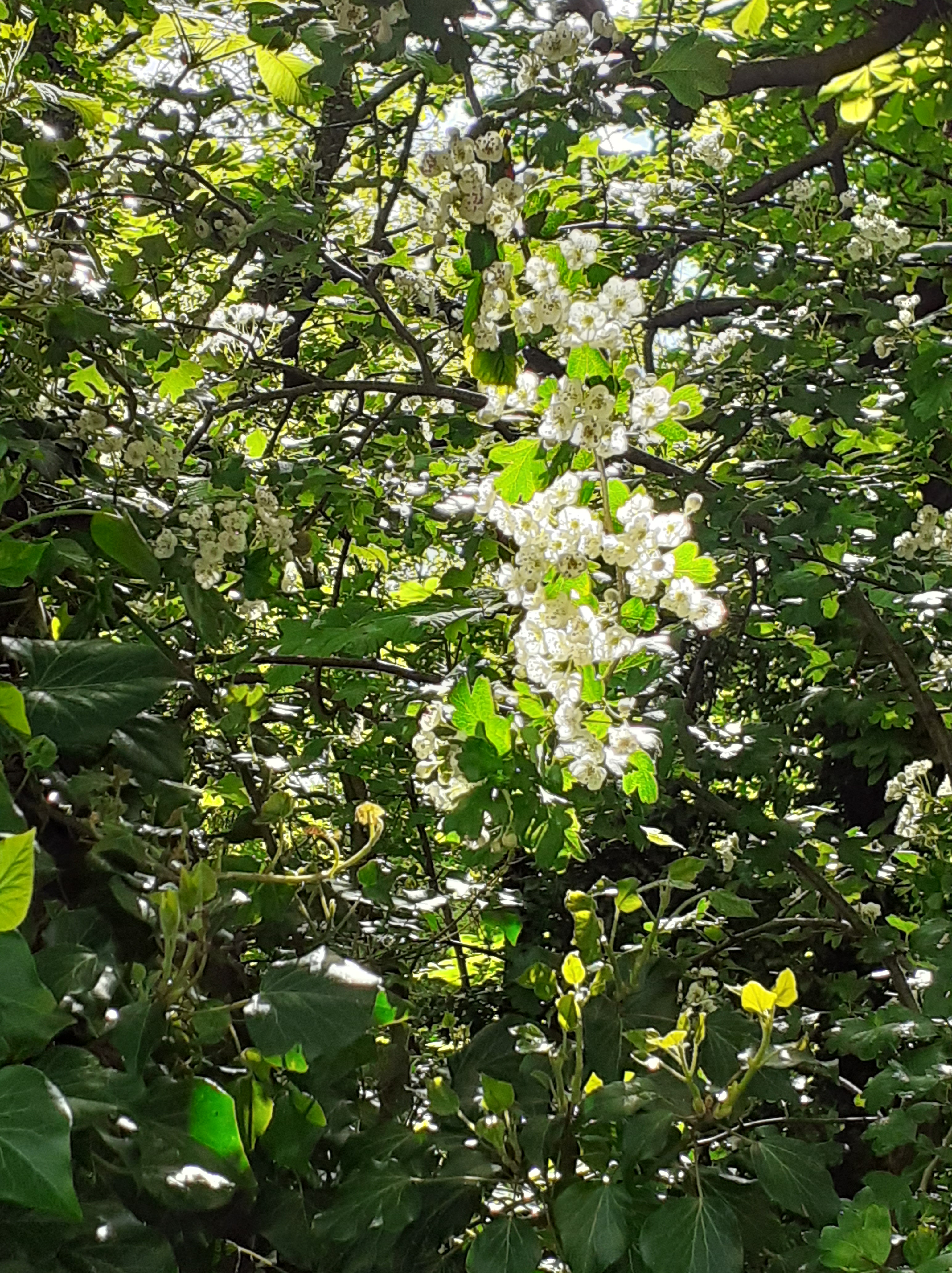
In my wheel of the year tree mandala (1), hawthorn presides from 1-23 May. It celebrates Beltane and the rising strength of the sun. Looking forward to that time, I think particularly of a specific tree, the Glastonbury thorn at Wearyall Hill, to represent that period. But the tree is gone, and is now unlikely to return, though ever-living in my heart and imagination..

It was a variety of common hawthorn (crataegus monogyna biflora) that flowered twice a year – first around Christmas and then in spring. I took the photograph in a misty Imbolc moment in 2007, between flowerings. It is the only one I will ever have, and for that reason I treasure it. The much revered tree was vandalised in 2010. New shoots appearing from March 2011 mysteriously disappeared. A new sapling, grafted from a descendent or the original tree, was planted in 2012 and consecrated – only to be snapped in half and irreparably damaged 16 days later. In May 2019, after some years of hesitation, the tree was entirely removed by the landowner in a final acceptance that the tree was lost. Sacred thorn trees, said to be descended from the same original, can still be found in the ruins of Glastonbury Abbey and at the Church of St. John.

I particularly liked the Wearyall Hill tree, because it was physically removed from the bustle of Glastonbury as a twenty-first century spiritual centre. The hill just seemed quietly natural – pagan, if you wanted to think of it that way, or Christian, if you wanted to link it to the story of Joseph of Arimathea’s staff, and how it came to life and flowered when planted in a new land. I was shocked by the violence against the tree and against other people’s love for it.

An ancestor of thee thorn (the individual plants do not last forever) had been cut down before, probably in 1647 by a Parliamentary soldier in England’s civil war. For the thorn was strongly linked to royal patronage, the miracle of a Christmas flowering, and a link between sacred land and sacred kingship. The kind of Royalism represented by this constellation of ideas and images was strong in Somerset at that time, but so was religious Puritanism, allied to a wish for constitutional change. The war was bitterly fought within the county. The legend of the thorn, cultivated by one group of people, made it vulnerable to another group of people identified with different loyalties.

The modern destruction of the thorn also seems not to have been casual, or it wouldn’t have been repeated so systematically. But I am not sure of the motivation. I find myself understanding a seventeenth century act of violence better than the modern one. Was this venerated tree the victim of a current human culture war? Are there potential lessons for Avalonians? Whatever the case, I am still in mourning.

(1) This mandala is based on my personal experience of trees in the neighbourhood as well as traditional lore. Moving around the summer quarter from Beltane, 1 May, the positions and dates of the four trees are: Hawthorn, south-east, 1-23 May; Beech & Bluebell, south-south-east, 24 May – 15 June; Oak, south, 16 June – 8 July; Gorse, south-south-west, 9 – 31 July. The autumn quarter then starts with Apple at Lughnasadh/Lammas. For a complete list of the sixteen trees, see https://contemplativeinquiry.blog/2020/autumn-equinox-2020-hazel-salmon-awen/

TREE MANDALA: BLACKTHORN

In my wheel of the year tree mandala (1), blackthorn (ogham, straif) covers 8-30 April, the final twenty-three days before Beltane. It has a beautiful white flower and elegant sharp thorns. I have seen descriptions of the latter as ‘vicious’, but they only hurt us if we invade the blackthorn’s space. The plant is not a triffid. It doesn’t come after us. So I don’t follow the line of tradition that links blackthorn to harsh fate. Blackthorn doesn’t ask to be turned into guardian hedges or crowns of thorn. That is down to our fellow humans.

The picture above comes from my magic year of 2007, happily well documented, when I was much engaged with trees and Druid study. I felt a pull towards blackthorn, more than towards the generality of hawthorn during that period. (I will write about the Glastonbury Thorn, the exception, at Beltane, my last tree mandala with a ‘memory lane’ theme).

I am drawn particularly to the strand of tradition that links blackthorn to powerfully creative magic – for it was long used in the making of wizards’ staffs. The text of The Green Man Oracle (2) suggests that “we have forgotten the magic that lies within us”. Blackthorn in particular has the ability to “foster waking dreams”. The Oracle adds that, “to access this personal magic, we must step away from busy, surface consciousness, and sink deeply into the ever flowing stream of our magical dreams. The ideas, scenes and presences that throng the deepest levels of our understanding require intense listening” Such magic, the Oracle continues, brings a light into the darkest places. For me that would mean just enough light to illuminate them, and not so much as to dazzle them into negation. How otherwise can the denizens of the dark be offered a welcome home if they want it, and in any event a better understanding?

(1) This mandala is based on my personal experience of trees in the neighbourhood as well as traditional lore. Moving around the spring quarter from 1 February, the positions and dates of the four trees are: Birch, north-east, 1-22 February; Ash & Ivy, east-north-east, 23 February – 16 March; Willow, east, 17 March – 7 April; Blackthorn, east-south-east, 8 – 30 April. The summer quarter then starts with Hawthorn at Beltane. For a complete list of the sixteen trees, see https://contemplativeinquiry.blog/2020/autumn-equinox-2020-hazel-salmon-awen/

(2) John Matthews & Will Worthington The Green Man Oracle London: Connections, 2003.

EARLY APRIL ENERGY 2021

April has been called the cruellest month. But I am experiencing a much hoped-for kindness right now. I am expansive and energised. Finally, it feels like spring in my neighbourhood. Spring as it is meant to be.

The natural world is changing, and a tentatively recovering human population is beginning to reclaim the outdoors. Now is a moment for celebrating the life force – nwyfre, viriditas, whatever we may want to call it. I find my own feelings reflected back in the vitality and vigour of the world I see around me.

The greening of the trees, and hence much of my local landscape, has started. I hope for a fuller transformation by Beltane – now less than four weeks away.

There is an abundance of colour in the woods, with the emphasis changing from the delicate blossoms we have already seen to more robust and stronger coloured flowers.

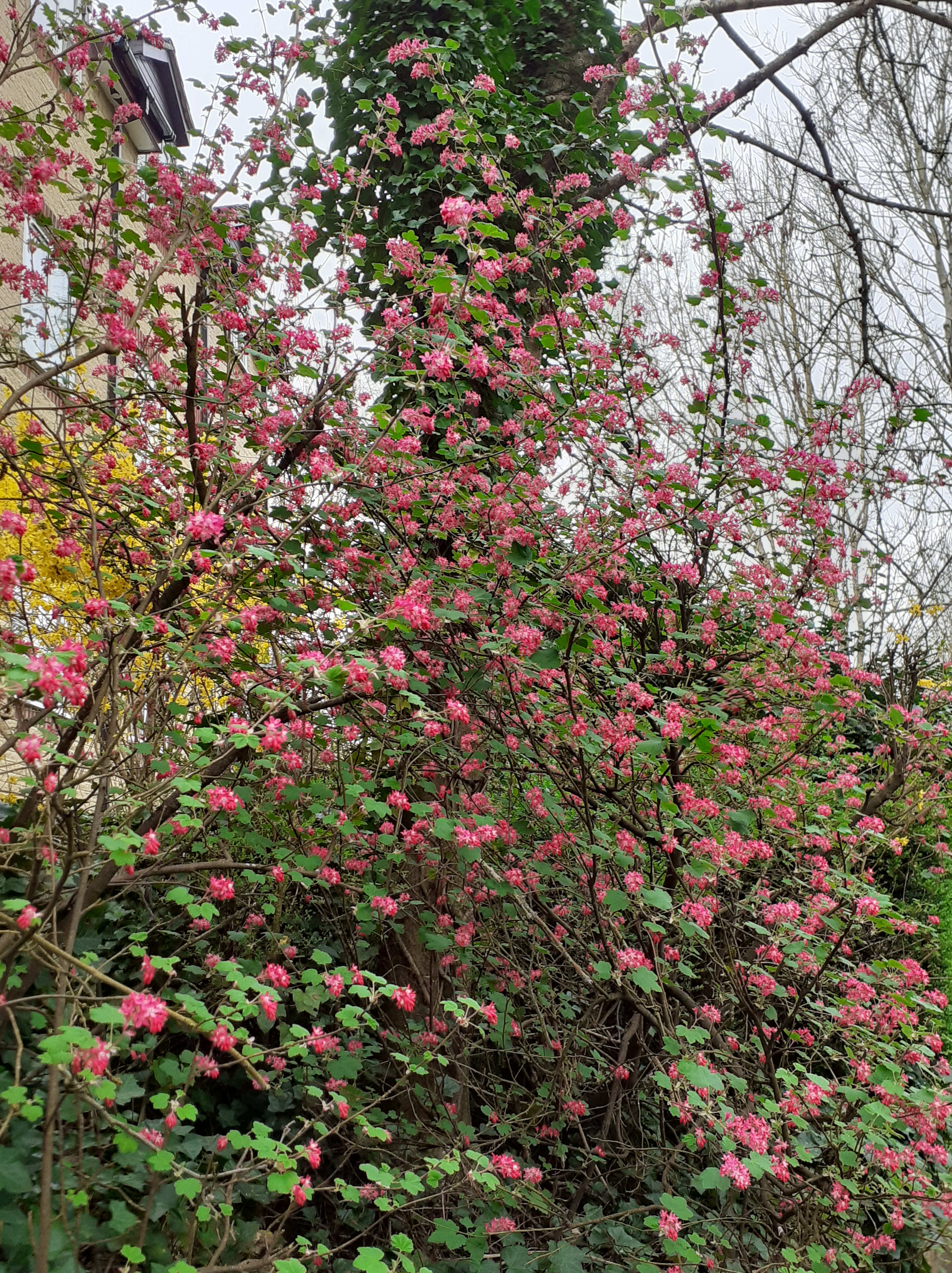
Even entering a built environment, floral energy arches across the paths.

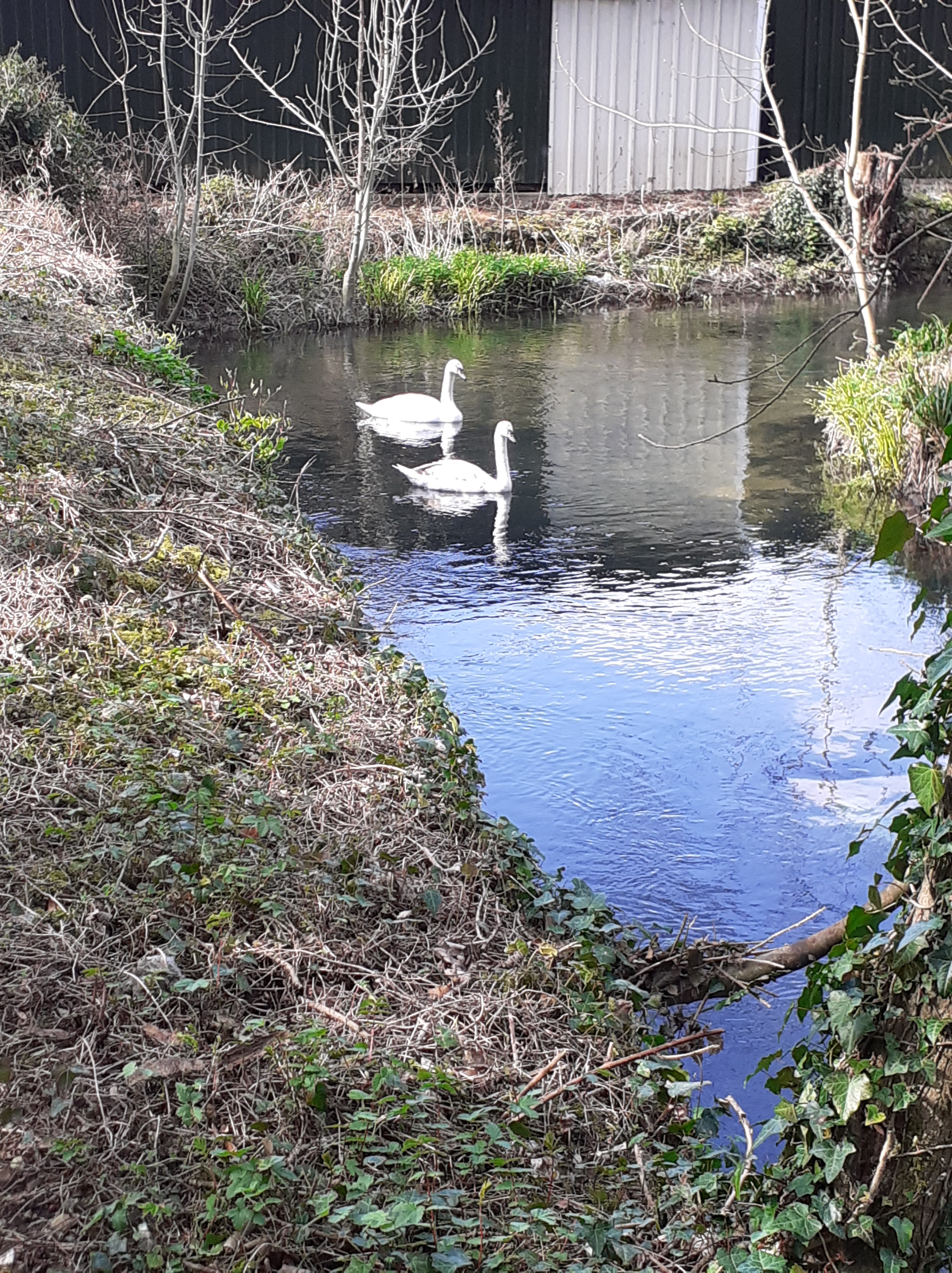
In the animal kingdom, life is stirring too. On the canal, rivers and ponds around me, swans are now pairing and nesting. I hope they have another good year.

It almost hurts to know that life – so fleeting and variable – can be so good.

Earth Eclectic

music that celebrates Earth and speaks to the heart

Sarah Fuhro Star-Flower Alchemy

Follow the Moon's Cycle

Muddy Feet

Meeting nature on nature's terms

Rosher.Net

A little bit of Mark Rosher in South Gloucestershire, England

Becoming Part of the Land

A monastic polytheist's and animist’s journal

selkiewife

Selkie Writing…

Charlotte Rodgers

Images and words set against a backdrop of outsider art.

Prof Jem Bendell

living with metacrisis and collapse

Towint

The pagan path. The Old Ways In New Times

The Druids Garden

Spiritual journeys in tending the living earth, permaculture, and nature-inspired arts

The Blog of Baphomet

a magickal dialogue between nature and culture

This Simple Life

The gentle art of living with less

Musings of a Scottish Hearth Druid and Heathen

Thoughts about living, loving and worshiping as an autistic Hearth Druid and Heathen. One woman's journey.

Wheel of the Year Blog

An place to read and share stories about the celtic seasonal festivals

Walking the Druid Path

Just another WordPress.com site

anima monday

Exploring our connection to the wider world

Grounded Space Focusing

Become more grounded and spacious with yourself and others, through your own body’s wisdom

The Earthbound Report

Good lives on our one planet

Hopeless Vendetta

News for the residents of Hopeless, Maine