Alney Island is surrounded by the River Severn at Gloucester. It is mostly a water meadow and largely free of ‘development’. I have written about it before. I took the pictures on 15 January, greatly moved by this landscape, the water margin feel, and the energy of the river, whose ‘left channel’ flowed past me close by. I’m short on words, today. So I’m letting the pictures speak for me. In a certain light, they are a kind of visual hymn.
My sense of January this year is one of bleakness qualified by promise. I spent the first week of the year grounded by back pain. So it was a pleasure, when the time came, to walk once more among trees. Their very bareness has a certain majesty. Their simple presence suggests the prospect of transformation as the year goes on.
Here, at 3.30 pm on January 9th,, I am noticing the slow lengthening of the day. It would have been twilight at this time three weeks ago. The change has an expansive note. A new lightness and colour are suggested below. They lead me further from the lassitude and brain fog of recent days. They make the world a genuinely felt privilege to be in.
Yet a taste of disenchantment does have its value. More than once, I have experienced it shortly in advance of a creative shift in energy and direction. My wife Elaine and I will soon be moving to the long=term home we have been working towards for some time. We will be setting it up, not just chasing after it, over the coming weeks. Without quite seeing the future, I do feel a returning zest and optimism.
I am writing on the last day of 2022. My very best wishes for 2023 to all readers. Many blessings for the year ahead!
The picture above was taken on 26 December (in England called Boxing Day/St. Stephen’s Day) – this year a chilly day of bright blue sky. The truncated spire* of St. Nicholas Church, Gloucester, reaches up towards the vivid sky, despite its history of damage. For me, this image of spire against sky is one of clarity, definition and spaciousness. It is a breath of fresh air.
I don’t know what 2023 will bring. I do want to bring clarity, definition and spaciousness to whatever unfolds. As my contemplative inquiry continues, I find that it subtly modifies its purpose. Discovering and re-discovering the purpose involves an element of divination, since my thinking personality is not exactly in charge.
It is as if authentic clarity and definition come out of the spaciousness itself, not out of cognitive review or ‘brain-storming’. These may be aids, but I have also to wait for signs. When I began this blog, I surprised myself by calling it ‘contemplative inquiry’ rather the ‘contemplative Druidry’. I see now that contemplative inquiry is the root description for my path.
For me, contemplation is a yin quality, an open and receptive engagement with experiences – most especially, with forms of relationship. Inquiry is a yang quality, actively deepening knowledge, refining understanding and seeking meaning. Together they support my path. Druidry is a vehicle that supports spiritual self-direction, and also challenges disastrous social norms concerning both nature and culture. Today I have revised the ABOUT section of this blog, on the eve of 2023, and my key statements are below:
“My contemplative inquiry began in 2012. It is grounded in modern Druidry, though not wholly defined by it. I acknowledge the influence of other sources, especially the wider turn towards an eco-spirituality that meets our historical moment. The inquiry process itself is my core practice, from which others radiate out.
“Over my inquiry years, I have found an underlying peace and at-homeness at the heart of experience. Here, it is as if I am resourced by a timeless, unboundaried dimension from which I am not separate. I find myself guided towards a spirit of openness, an ethic of interdependence and a life of abundant simplicity.”
*NOTE ON ST. NICHOLAS’ SPIRE: the church was first built in 1190 and added to over the centuries. A 200 ft. spire was built in the fifteenth century, but received a direct hit from cannon fire in 1643, during the English Civil War. The final repair waited until 1783, when the spire was reduced in height and capped.
It was 26 November 2022, 11 a.m. I was at the Gloucester end of the Gloucester-Sharpness canal. I found myself accepting the arrival of winter. I was observing three cygnets, now without their parents but still keeping company with each other. The underlying temperature was around 7 C (44.6 F) and good for walking, But I was feeling the pinch of a cold wind. In memory I am feeling it now. The water and sky looked grey. The trees were starting to feel skeletal, whilst still retaining some leaves. My lingering sense of autumn had finally drained away.
To accept winter’s arrival in the presence of swans felt numinous. Swans are otherworldly birds in Celtic tradition. The three together, not yet in their full adult plumage, seemed auspicious. They suggested coming opportunities for creativity, love and celebration. Winter can be a preparation for renewal, both as season and as state of mind. My acceptance goes with a faith in winter’s regenerative darkness, and the riches this can bring.
“Over the last twelve years I have walked every trail, every hillcrest, every stream-edge within a two hour walking radius of my house: everything between Lac-Des-Fees and Pink Lake, and a little beyond. …. I still encounter things I never saw before. Last year I saw a Great Horned Owl in the park for the first time. Its swift yet stately flight above my head caught my eye; a dark shadow in front of the sun, silent, and powerful in its silence.
“It rested on a tree branch not more than twenty meters away, and regarded me. I regarded him in turn. I had known for years that there are owls in the area: I’ve heard their hooting, and seen their pellets on the ground. But until that day and for ten years, I hadn’t seen one here before. Further, and I think more importantly, since I had entered the forest that day for no particular purpose but to enjoy a warm afternoon, to reaffirm my love of for the park’s landmarks and vistas, and to experience a few hours of pure human freedom, in simpler words to play, the encounter with the owl could take on a magical meaning.
“In the light of such magic, what a magnificent animal he was! How proud he seemed, as though in charge of the world, as though I required his permission to take another step. How unpretentious too: this owl had no need to pretend to be something he was not. The size of his claws, the laser-focus of his eyes meeting mine, was proof enough that he was a predator. No need to flex his weapons or brandish them. And what a delightful conversation we might have, if he were to speak. How much he could tell of the places he had seen, the adventures he had while hunting, and the pleasure of flight… Much as I would have loved to stay and hear him speak, I decided to move on after a few minutes. I did not know whether meeting his eyes might be provocative. And much as I might enjoy telling the story of how I got owl-claw scars on my face, I would certainly not enjoy getting them.
“…. Such is the magic of the forest. It can mean what you want it to mean under the aspect of play, yet at the same time it can surprise, and threaten and reveal itself, in ways no human artifact can do. It can suggest a kind of magic no human artifact can adopt: the dramatic discovery of a world not made by human hands. Thus it participates in the play, bringing its own contribution to the emergence of meaning.” (1)
(1) Brendan Myers The Circle of Life is Broken: An Eco-Spiritual Philosophy of the Climate Crisis London UK & Washington USA: Moon Books (Earth Spirit Series)
NOTE: Brendan Myers is a Canadian philosopher and author currently living in Quebec, where he teaches philosophy at Heritage College, Gatineau. He has written extensively on Pagan themes from a philosophical perspective, and his most recent book takes them further through an exploration of the climate crisis. I will review the book in my next post.
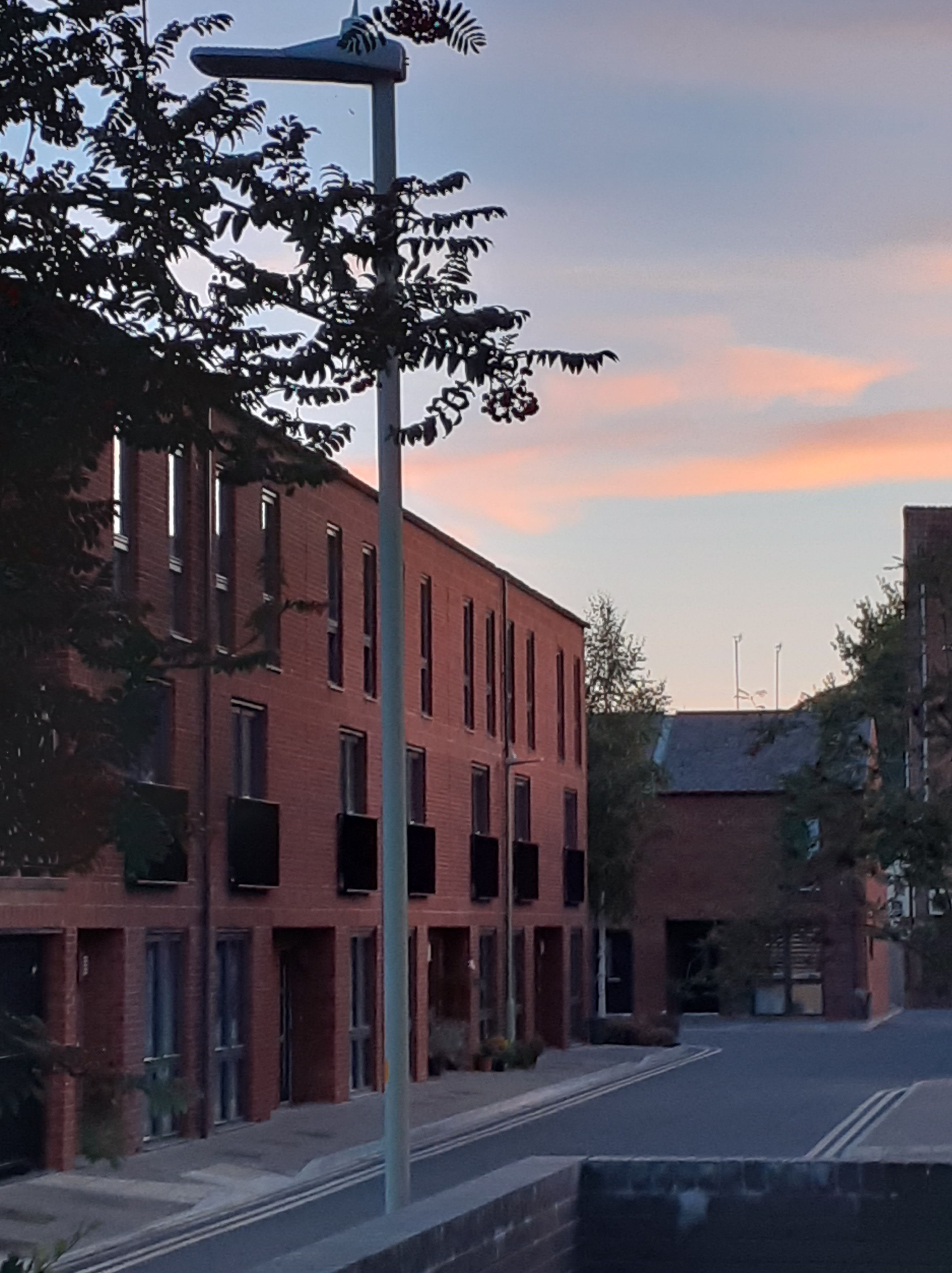
You can just see it, above the buildings, at the last breath of sunset. A sliver of light over murky cloud, the slender crescent of a new moon has appeared. I took the picture just after 6.45 pm on 28 October, still inside British Summer Time. I chose this time on this day because it was not yet dark. The sky is making room for a variety of effects, not just the stark duality of darkness and light. I stand at the cusp of the year’s endarkenment, before the festival of Samhain.
At this time of this year, I find myself tuning in to the lunar cycle as much as the solar one. To me, now, it feels subtler and more nuanced. Anne Baring and Jules Cashford describe its significance in a way I find illuminating:
“The moon was an image in the sky that was always changing yet was always the same. What endured was the cycle, whose totality could never be seen at any one moment. All that was visible was the constant interplay between light and dark, in an ever-recurring sequence. Implicitly, however, the early people must have seen every part of the cycle from the perspective of the whole.
“The individual phases could not be named, nor the relations between them expressed, without assuming the presence of the whole cycle. The whole was invisible, an enduring and unchanging circle, yet it contained the visible phases. Symbolically, it was as if the visible ‘came from’ and ‘returned to’ the invisible – like being born and dying, and being born again.” (1)
When out walking, I noticed that Christmas lights had started to appear. The ones below, at Gloucester Quays, seemed suitable for a new moon. They shifted on and off in a flowing, liquid kind of way, at slightly different times. They did not dazzle or glare or demand my whole attention. They illuminated the space without dominating it. They did not claim that their light was all that mattered.
If I tune in the another cycle, the wheel of the day, I remember how much to thank the sun for. Barely half an hour before I took the pictures above, I experienced the very different colours of the two immediately below. In the first, there is the pink of sunset cloud and some draining of blue from the sky – but, still, a sense of vivid green in the grass. An autumn evening in what is still the light of day.
The second shows a tree-lined street, with full autumn colours, fittingly sundown colours, against a misty looking autumn sky.
It seems that I am saying farewell to one season whilst welcoming another, and that my evening walk on 28 October, partially shared with my wife Elaine, somehow enabled this. There is a starkness and wildness in my last image from that walk, below, which draws me in, despite the remarkable contrast with what has gone before. Just to notice, to fully experience, and make meaning of, the cycles of moon, sun, day, year and life itself gains importance for me year by year, as the wheel turns.
(1) Anne Baring Anne and Jules Cashford The Myth of the Goddess: Evolution of an Image London: Penguin, Arkana Books, 1993
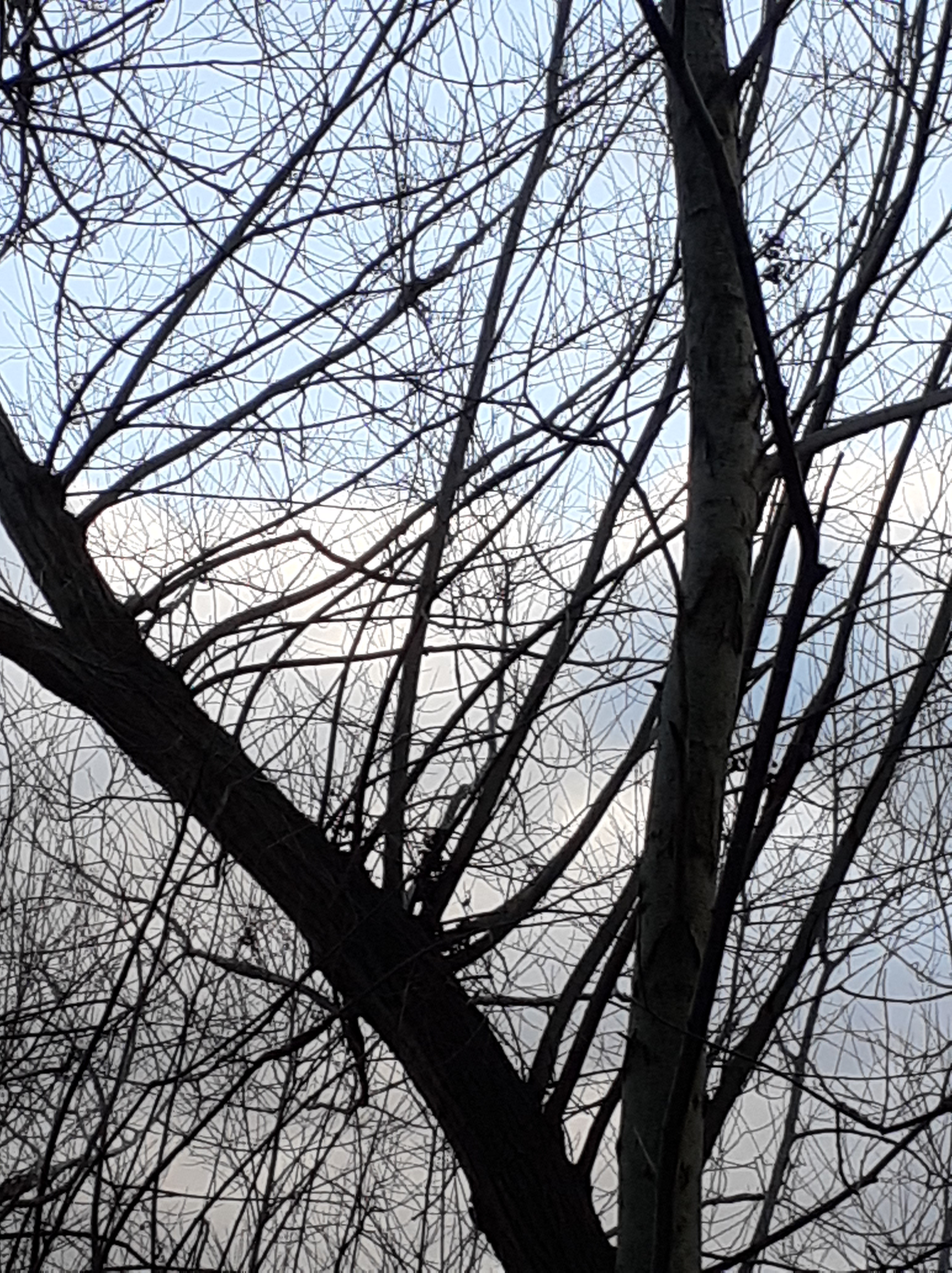
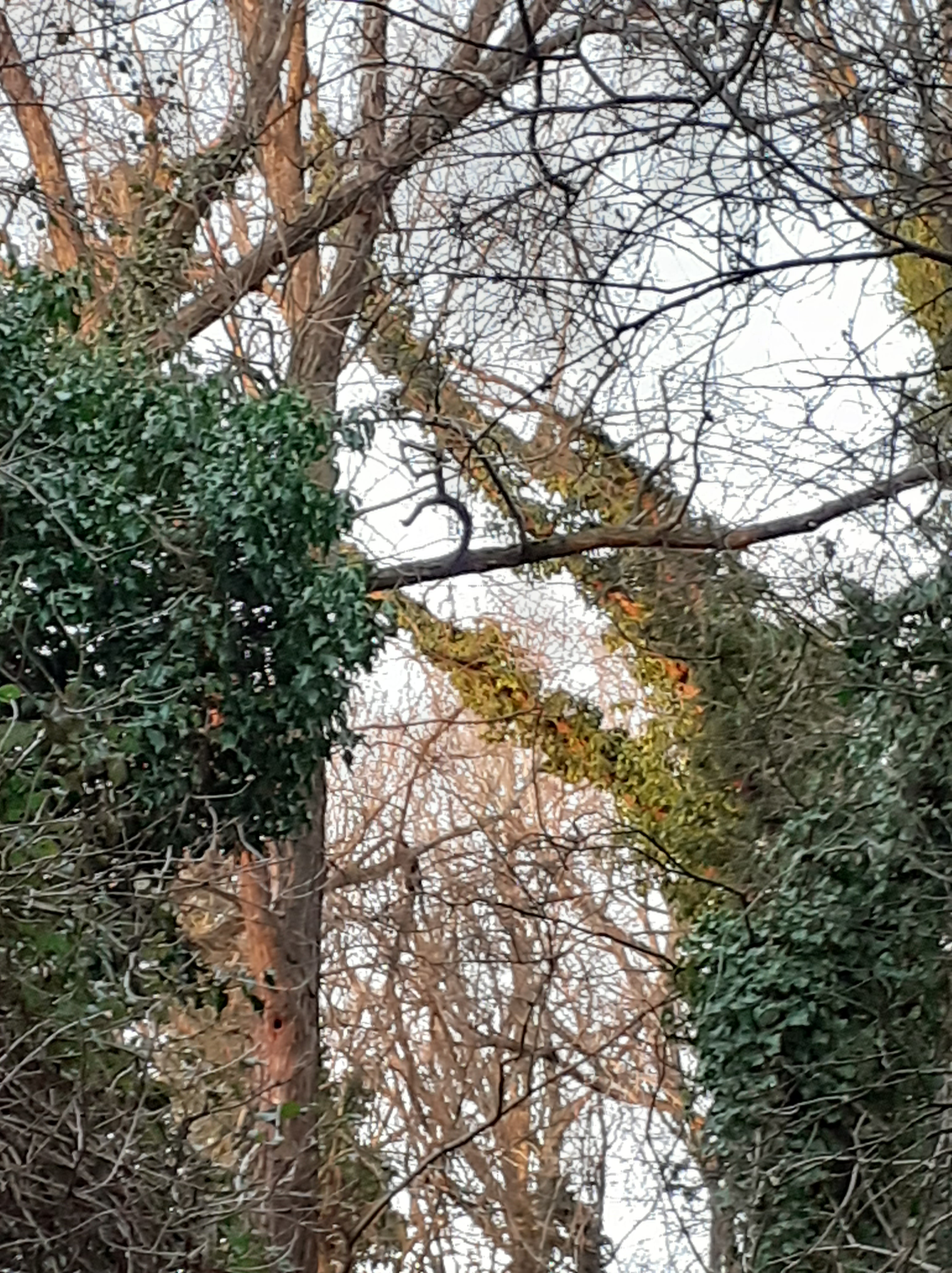
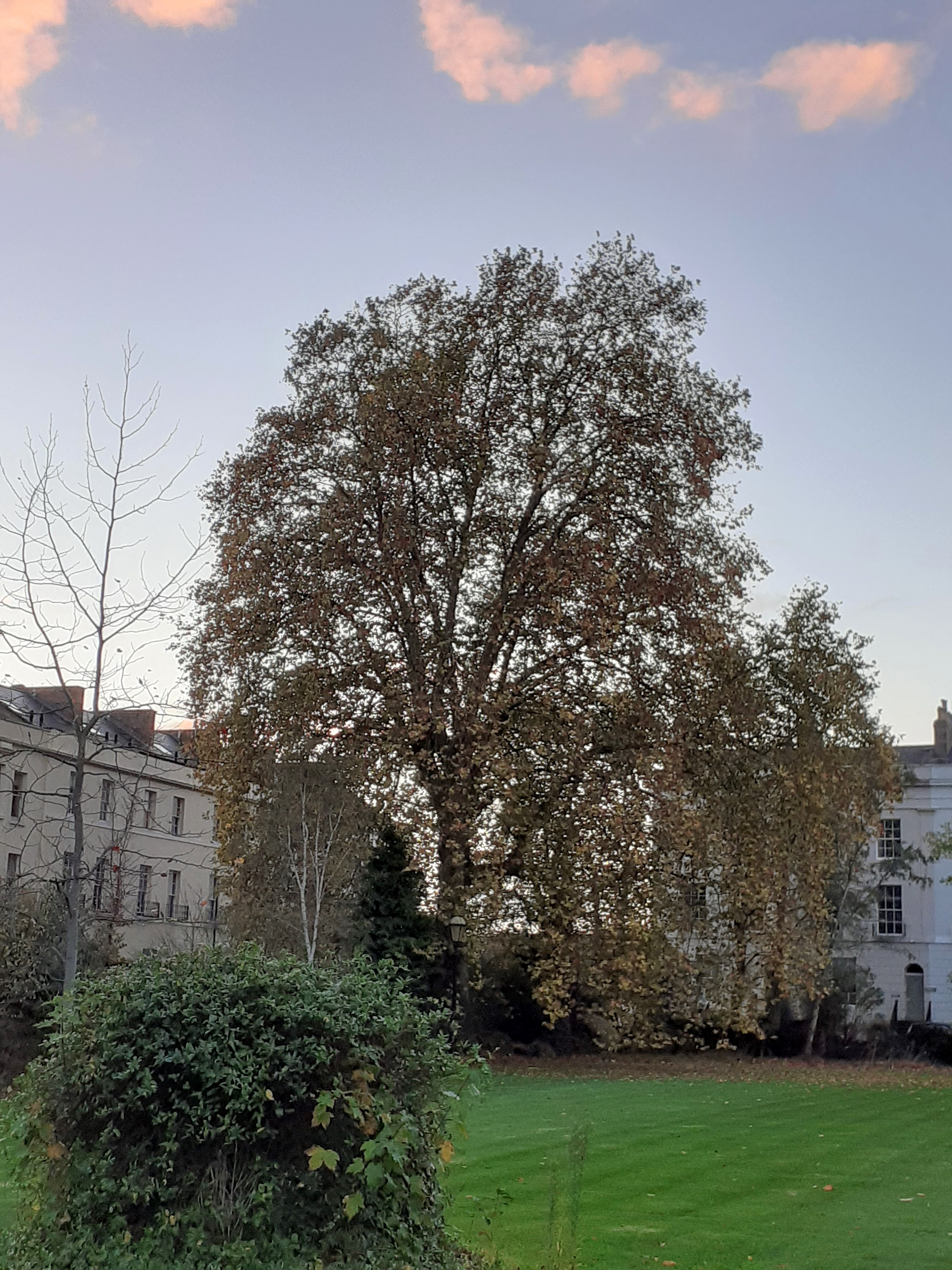
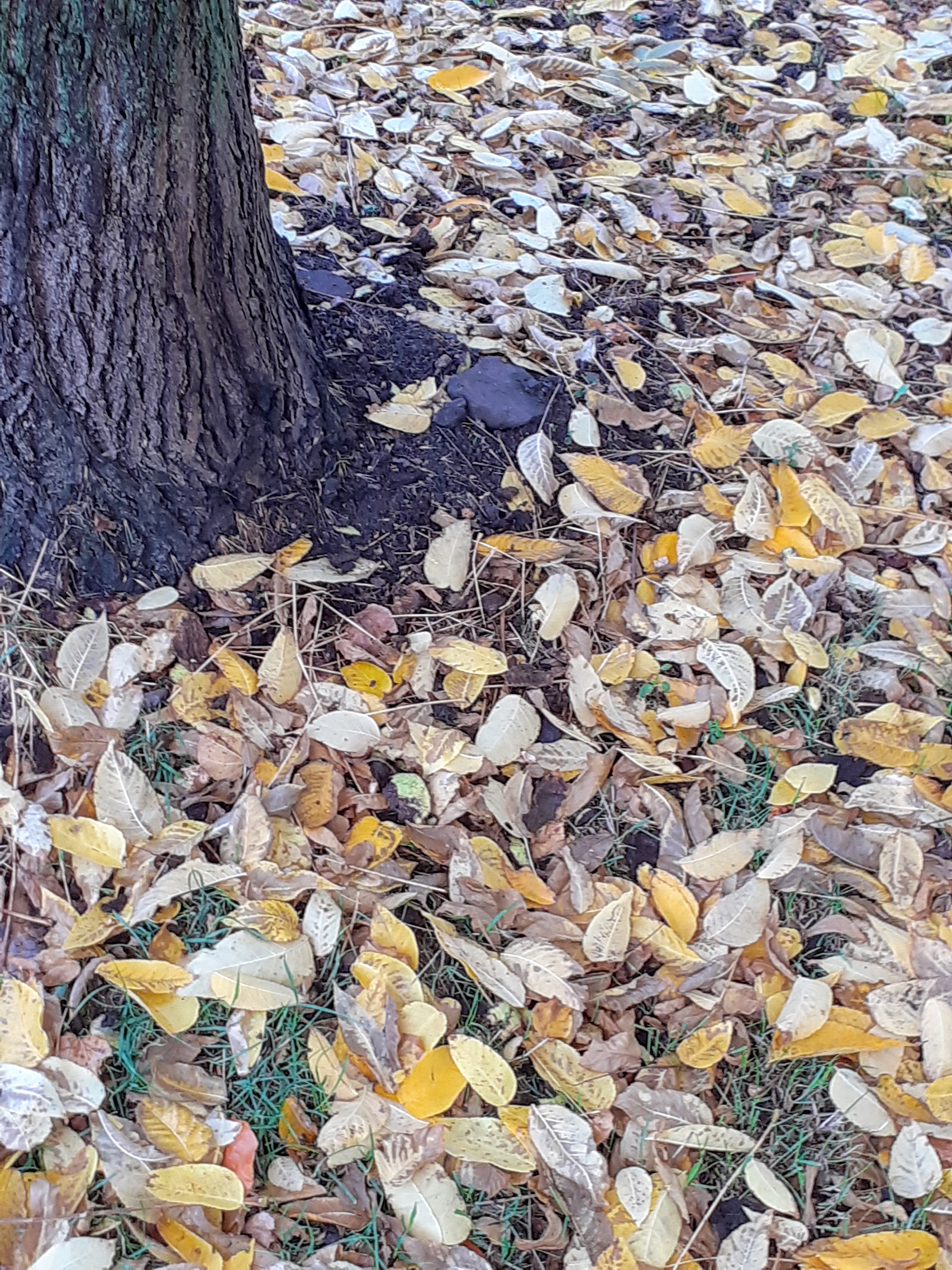
Vivid autumn colour signals a fall. Where I live, we are early in the process as yet. These leaves seem poignantly glorious to me. I respond to a beauty that I know will be short-lived. The tree is immersed in a cycle of dying and regeneration that furthers its larger life. Any sense of poignancy, glory and beauty is about me, being human.
I think of the last thirty years, and my own small deaths and regenerations over this period as I journeyed from my early forties to my early seventies. At the beginning I sensed a pull towards new priorities, which roughly fitted the Jungian notion of the second half of life as having different goals from the first. I experienced a nudge towards an inward, psycho-spiritual turn. I developed interests in experiential inquiry, Druidry/Western Mysteries, and contemplative spirituality, as part of this mid-life nudge.
This reduced my interest in career, acquisition and influence – though such interest had always been limited. In the nineties and noughties, I didn’t need a lot of money both to live well, if modestly, and accrue a reasonable retirement income. It would be much harder now. I am grateful to have experienced (relatively) favourable times, though of course the seeds of our current crises were already being sown.
Now I am ready for a new chapter, as my wife Elaine and I get ready to move to a new place of our own in Gloucester. The next move is into a smaller, more manageable space, and will involve elements of de-cluttering. I am the same tree but I will be shedding leaves and waiting for new ones to grow next year. In the moment I feel fragile, though my unknowing about the future also has an edge of wonder about the magic that may unfold. Falling is an oddly potent process at a special time of year.
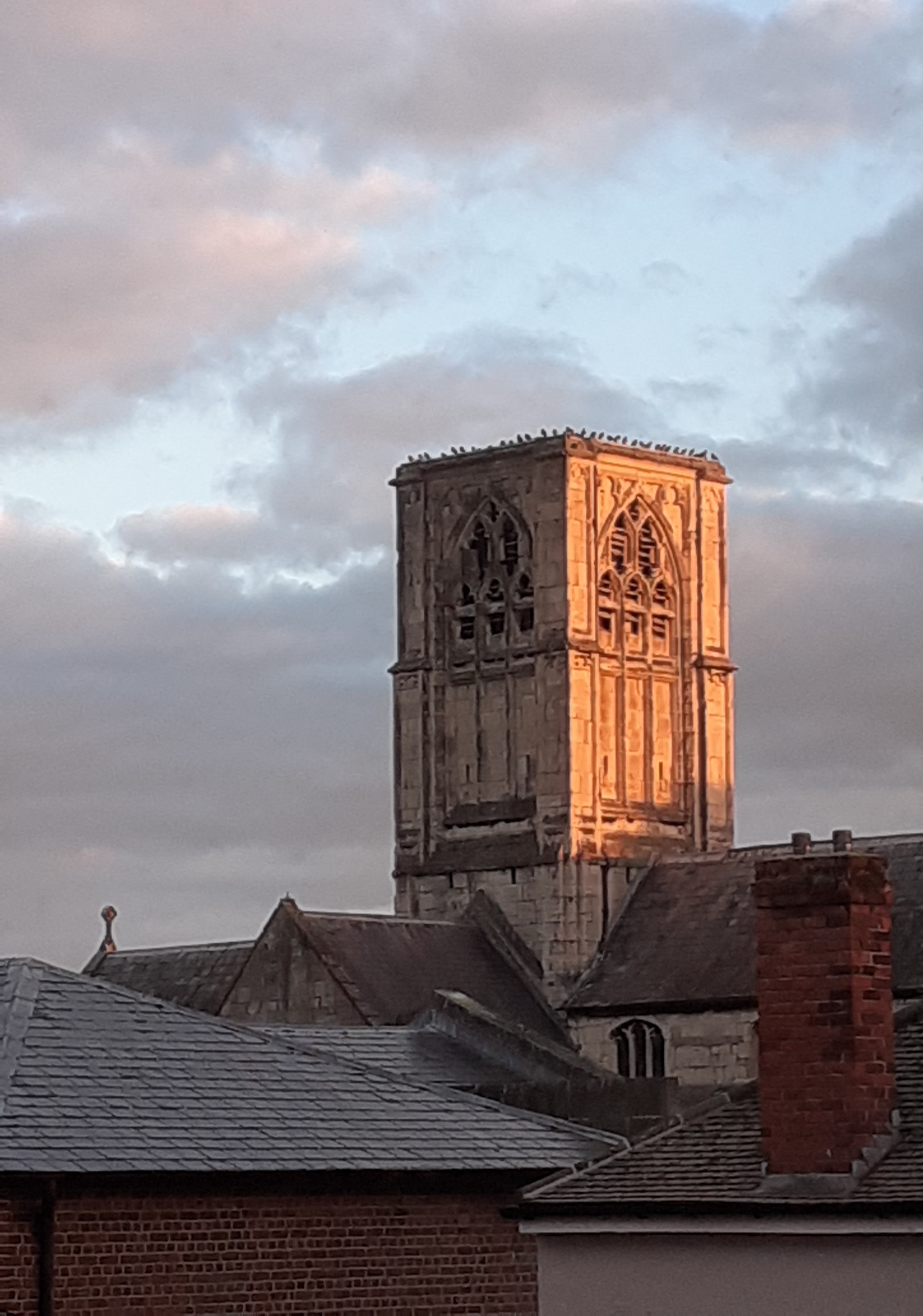
Dawn is late now, and all the more welcome when it comes. Looking out on the world after morning meditation, I see light shining on the tower of St. Mary Le Crypt. I am seeing with fresh eyes, and the knowledge that Elaine and I will be staying in Gloucester. A local house move is planned, conceivably before the turn of the year, a few minutes walk from here.
We will not be migrating north (1). Our plans fell through. We have some disappointment about this. But there’s also an element of relief that at the prospect of a less disruptive move. In many ways we are already settled. Moving house is now a major detail rather than a life-changing event. We can focus on being in place.
For me, this includes deepening my connection with the landscapes I walk in as the wheel of the year turns. Autumn is my favourite season and October can be a special month. This is my first year in Gloucester. Taking these October pictures, I can celebrate the here and now. Having them, I can enjoy the record of a new chapter in my life, with other years, with their own Octobers, to come. I don’t know what the future will bring. I do know that I find this framing nurturing and hopeful. It is part of bringing meaning to my world.
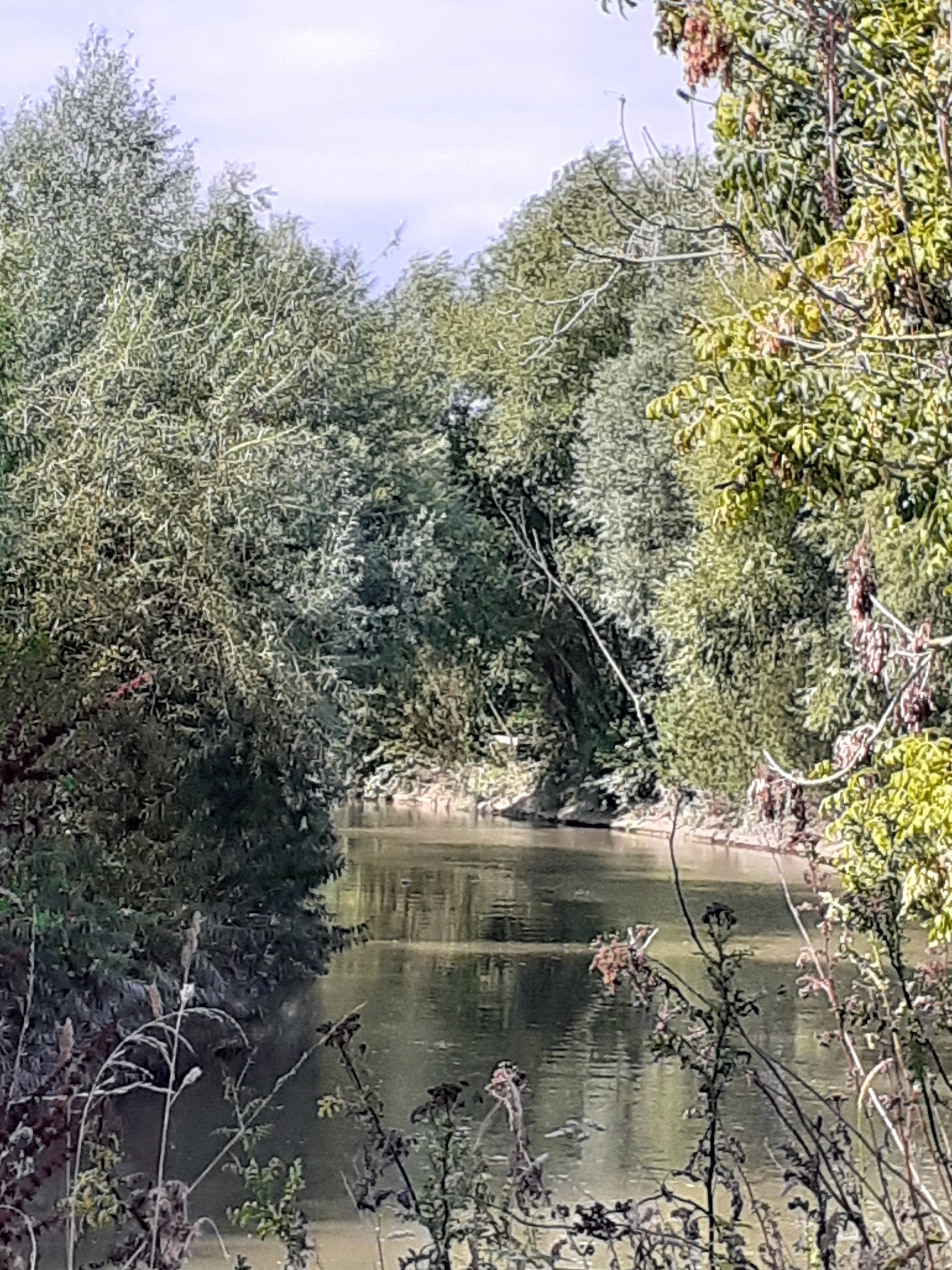
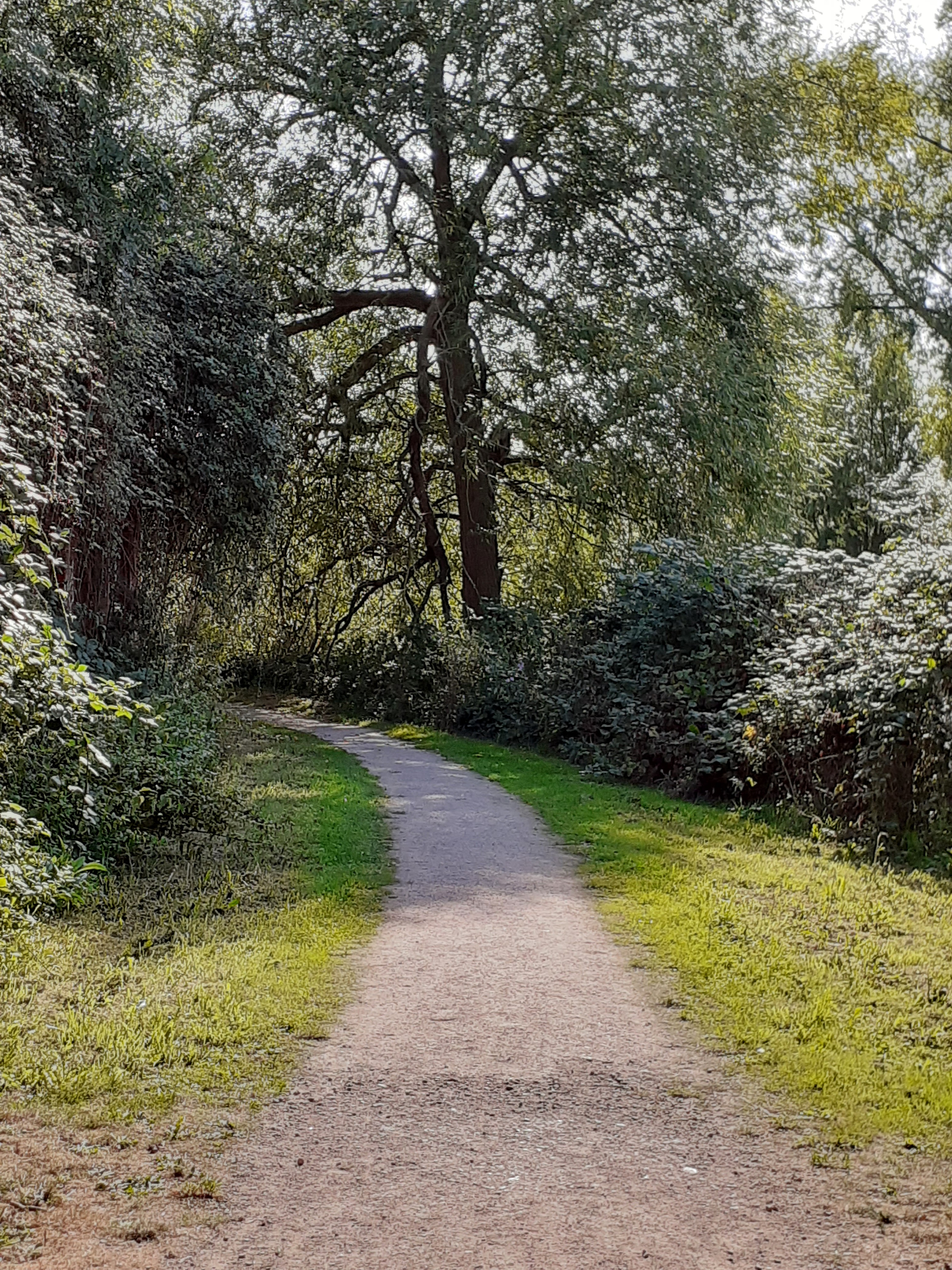
Some days seem truly blessed and easy. For me this autumn moment is one of them. I have stumbled across a previously unknown place that radiates the beauty of the season. Woods and river call to me and I respond. I like being where I am, open to the day, free of complications.
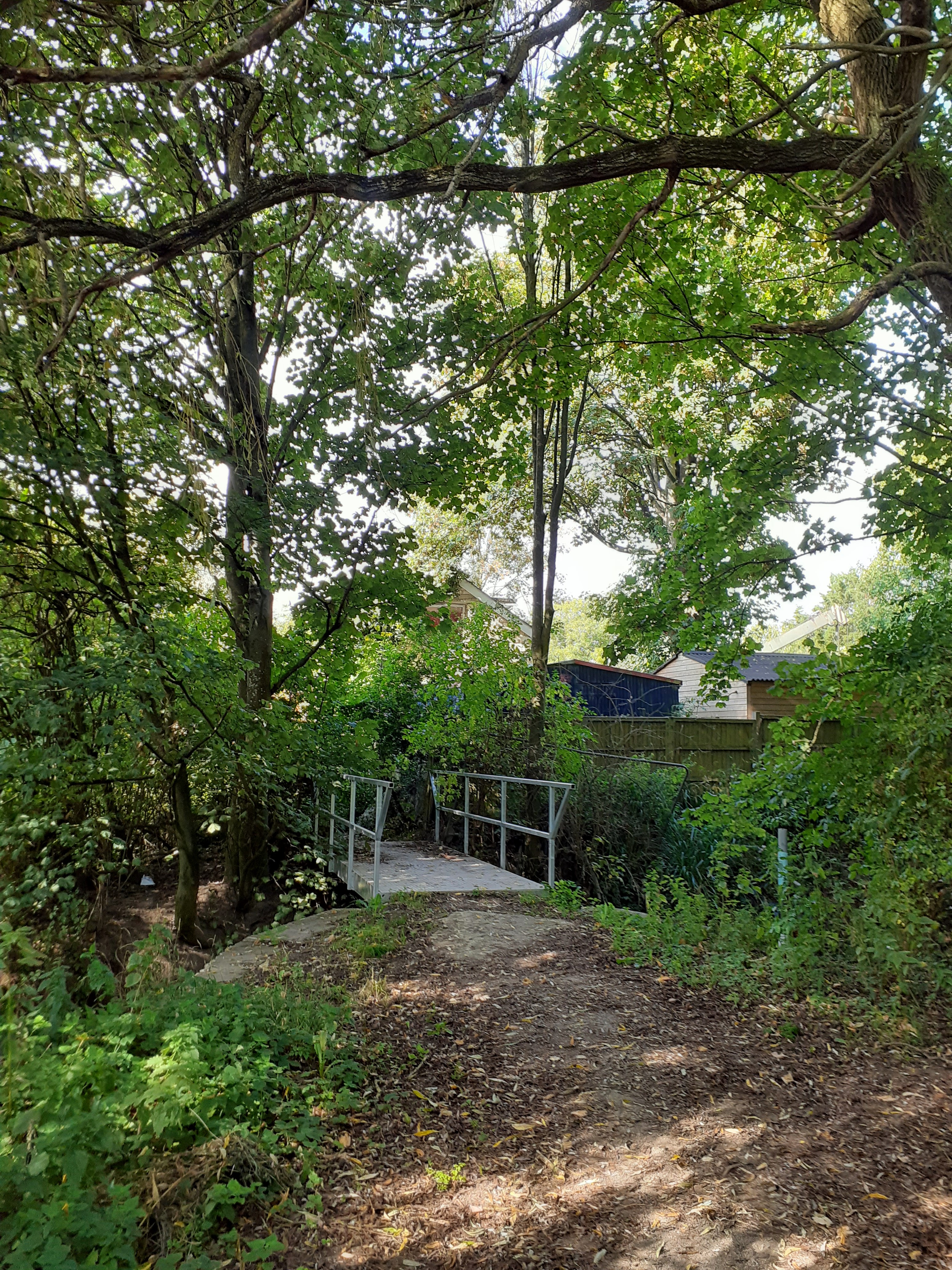
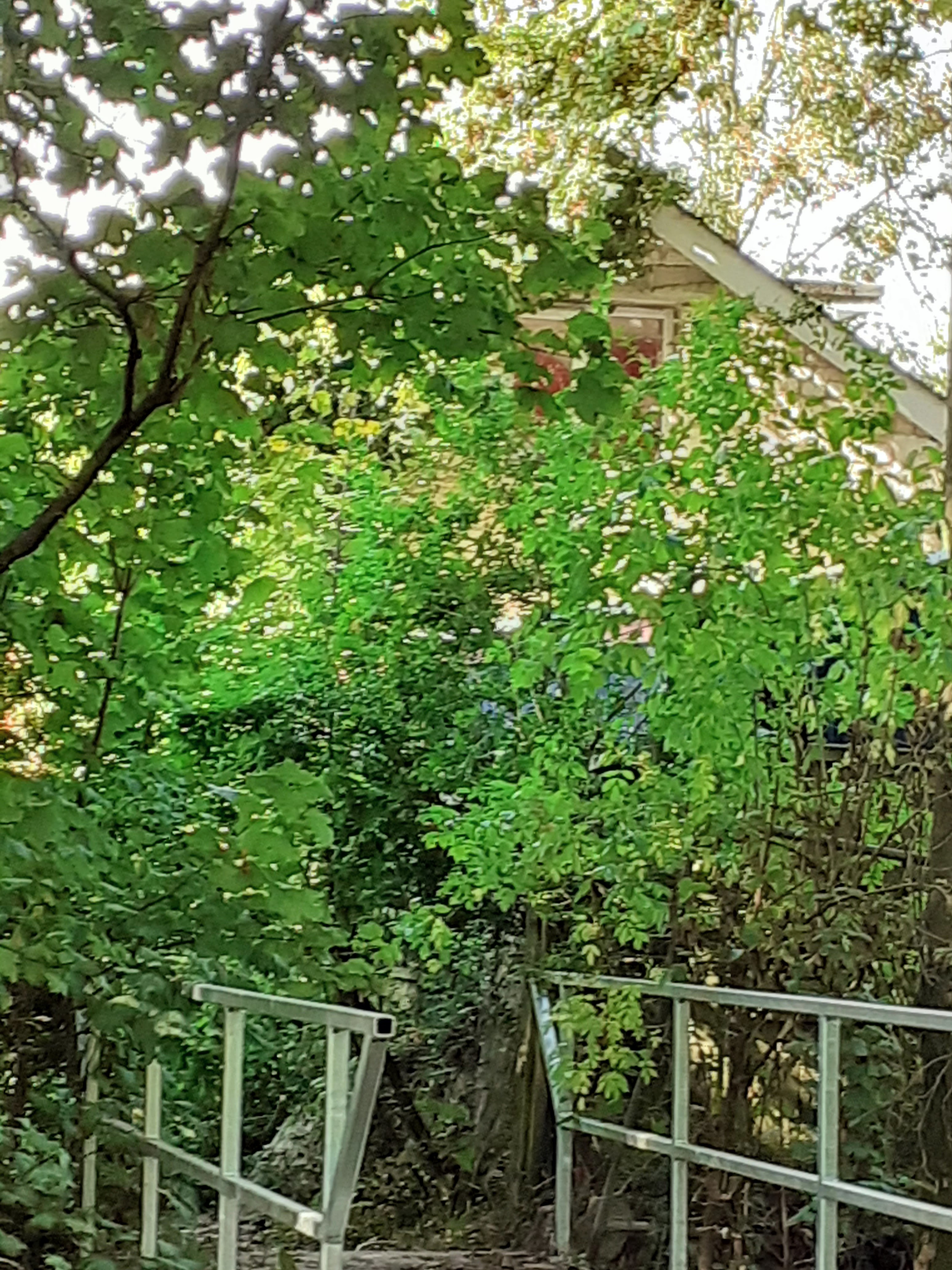
I like not knowing what’s round the next corner, whilst enjoying the new spaces I am already in. I notice how small changes of position alter the feeling-tone of place.
There’s little to say, at a time like this. There is the experience and there is the visual record. I hope the images suggest something of my simple delight in being here.
The path below seems to be telling me that there’s always somewhere else to go, but here is where I decide to stop taking pictures. A certain kind of moment is over, and best recognised as such. Nonetheless, I bask in the happiness of connecting with this new and unsuspected space.
Blessings of the season! Where I live, the sun is descending but still has a certain power. We have entered the period of the Autumn Equinox, honoured by modern Druids in the festival of Alban Elfed. Traditionally, the emphasis has been on harvest, but Dana O’Driscoll (1) suggests ‘receptivity’ as a resonant theme, “because with receptivity, rather than cultivating an expectation of what we want and expect to come, we are open to what is and what comes our way”.
She relates her approach to the changes that the world is experiencing now. “It is a counter balance to the effort-reward cultural narrative that is tied to the Fall Equinox and themes of harvest. There is one enormous problem with the effort/reward theme on a larger cultural level. It belongs to a different age. It belongs to the Holocene, an 8,000-11,000 year period of stable climate that allowed humans to develop agriculture, allowed humans to have some predictability about their surroundings, and allowed us to develop symbolic understandings like those drawn upon for the modern wheel of the year. … But we are not in the Holocene any longer, both climate-wise and culturally; we’ve moved on to the Anthropocene … characterized by human-driven planetary changes which destabilize every aspect of our lives.”
I find the call to receptivity challenging. Part of me wants the late Holocene back, in a reformed version – socioeconomically, culturally, technologically. Part of me accepts that it has gone for good but doesn’t want to acknowledge the speed and severity of the transition. Currents of anger, fear and grief cry out for recognition. These are as much part of my life-world as are the climate crisis itself, initiatives for adaptation, and the forces undermining those initiatives. I somehow have to find a receptive space for all of the above, without being overwhelmed.
The good news is that my ‘receptivity’ seems to be sourced by a deep peace at the heart of experience, a peace that grows rather than diminishes with time. In my daily practice as a modern Druid I call for peace in the east, south, west, north, deep earth & underworld [below], and starry heavens [above]. Then I say: “I stand in the peace of the centre, the bubbling source from which I spring, and heart of living presence”. These words are vibrant with life for me however often I declaim them. I experience this deep peace as a fruit of my contemplative inquiry. Perhaps there is a harvest aspect here after all.
Certainly, to stand in such peace empowers my receptivity, linking it to other qualities like reverence, delight and awe. None of this changes the world. But it allows me to contemplate it with an underlying confidence, and to face its challenges in a more resourceful way. I am very happy to mark Alban Elfed as a feast of receptivity.
(1) https://thedruidsgarden.com/ – see Fall Equinox: a Spirit Walk and its internal reference to Equinoxon Receptivity
NOTE: Pennsylvania-based Dana O’Driscoll is steeped in Druidry and the US homesteading movement. She is Grand Archdruid of the Ancient Order of Druids in America (AODA) and an OBOD Druid. She is a Mount Haemus scholar, lecturing on Channeling the Awen in 1912.










 Contemplative Inquiry