Change is coming as the days lengthen and temperatures begin to rise. I too have begun to feel spring-like – more energised and available to the world.
Stepping out, I am in harmony with the life and growth around me. I become aware, again, of the resilience and potential of the plant kingdom.
I celebrate the life force within and without, both through movement as I walk and in stillness when I pause.
I learn again that a familiar space can be ordinary and extraordinary at the same time.
I open myself to spring 2026, the new season, as the Wheel continues to turn.
I have now lived in Gloucester long enough to have a territorial sense of the city. When walking from a southerly direction, an elegant square and its garden signal my nearness to home. This signal is physical, emotional and psychic. My cognitive knowledge is secondary.
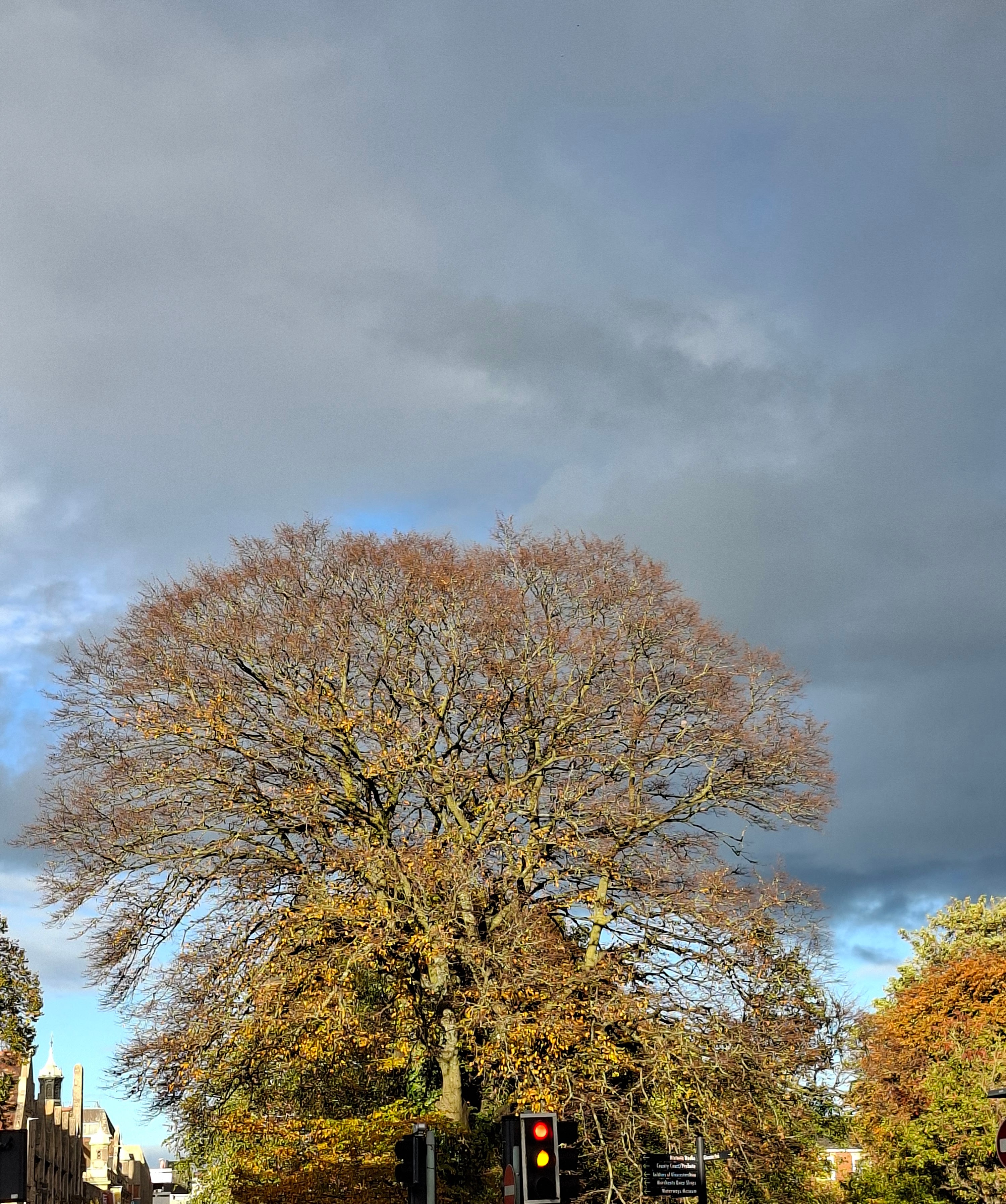
This signal is soon followed up by another, stronger one, closer to our apartment. Under looming grey clouds stands a tall, mature hornbeam. Once indoors, I will be able to look at it through our balcony windows – majestic even as it sheds its leaves.
The hornbeam is an iconic (I might almost say totemic) marker of ‘home’. Elaine and I do not individually own this tree and nor would we want to. But our city council does, with obligations towards it. That’s probably why it’s still there.
This sense of home and blessing: where does it come from? We are not migratory birds. But we used to be a bit more like them. Nomadic, but often within defined territories, however large, which we could get to know and love without the need for exclusive possession. There are people in the world who still try to live in this way but it is becoming increasingly difficult.
I speculate that part of my bodymind finds this arrangement natural, even though culture here is (mostly) very different. The feeling tone of my walking varies dramatically with different levels of newness and familiarity. In the approach to home, signalled not only by distance but also by landmarks, this is particularly strong. Perhaps this is the residue of a long lost pattern of life.
And here winter wends again, as by the way of the world it ought,
Until the Michaelmas moon has winters boding brought.” (1)
Even today, deep autumn opens the door to winter. This was even more the case in the North Staffordshire and Derbyshire regions of 14th century England, where Sir Gawain and the Green Knight was written. Even in castles, people were less sheltered from the growing cold and damp than we are. So readers and listeners of the period are reminded that the coming of winter is both natually and divinely ordained.
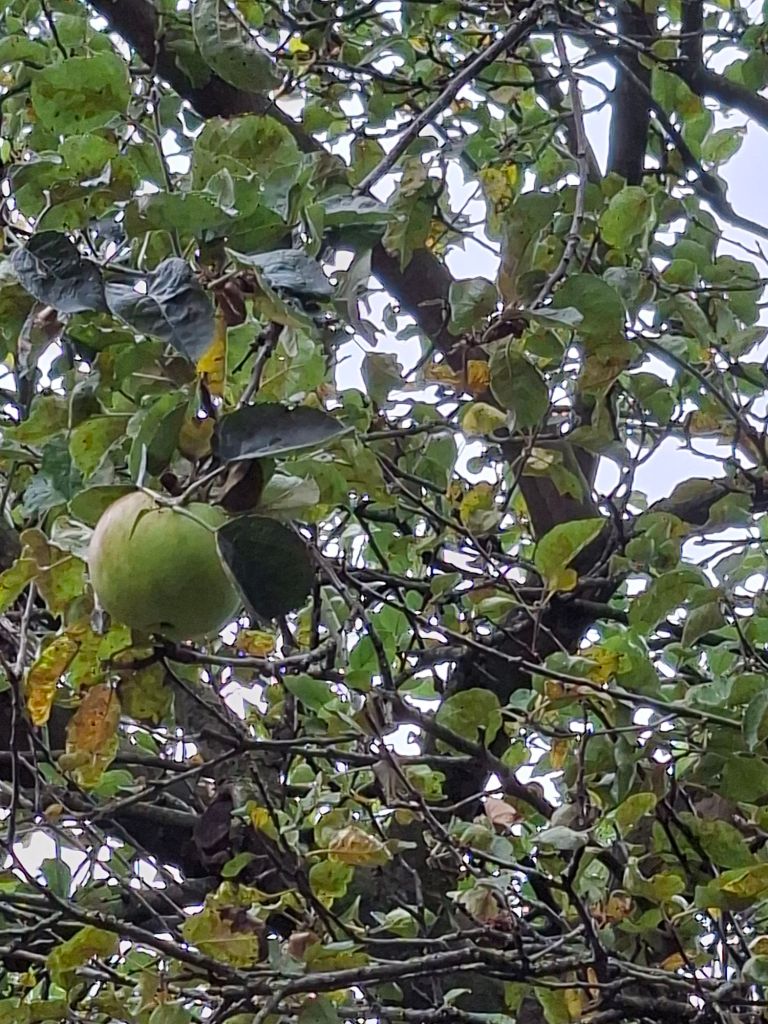
Here and now, the sight of the apple harvest in its later stages (pictured above) seems quite different than in the early ones (2) – less bright, less novel, less shiny. Rotting apples lie on the ground, now fallen outside the wall of Gloucester Cathedral’s orchard. From Nature’s exuberant perspective, this is all part of the plan. Waste is built in.
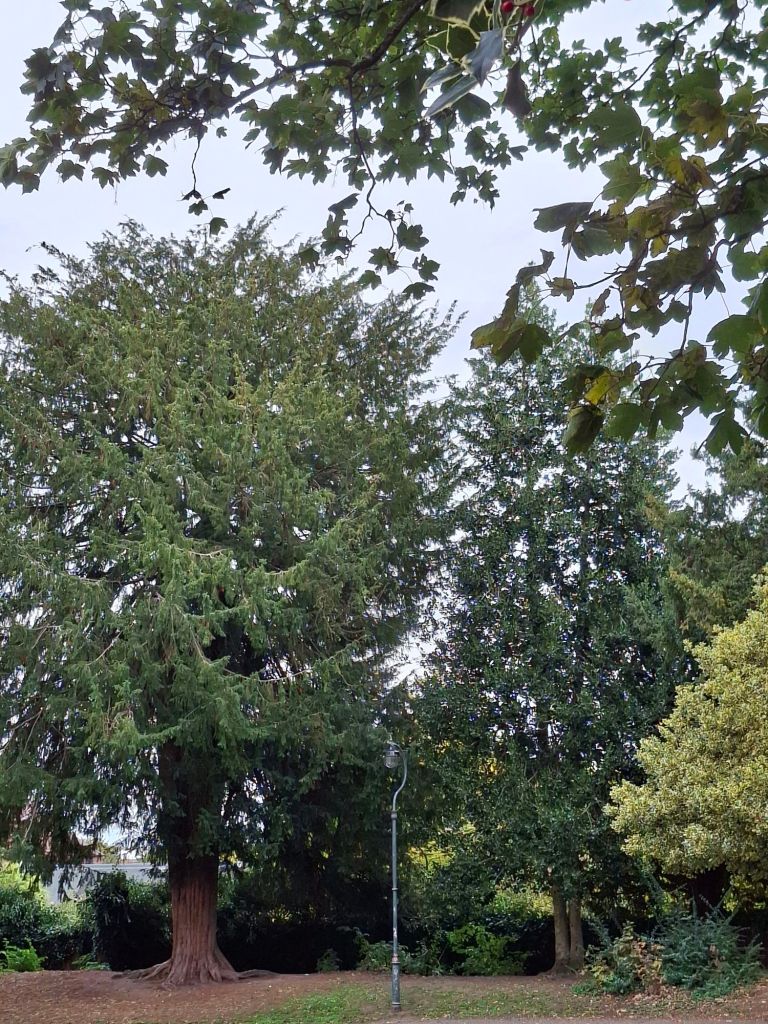
This time draws me further into the declining year. I am in the cathedral’s grounds, now looking at a yew tree and its associations with death. I’m thinking of the approach of Samhain (aka Halloween/All Hallows) at the turn of the month. Once it marked the 3rd harvest of the year – the blood harvest, where animals were slaughtered in preparation for winter. Now it is more a time to remember our ancestors, and our dead more widely.
Yet the seasonal moment, and the yew, can also be linked to wisdom and transformative change in life. I launched my contemplative inquiry at Samhain 2011. Like many people, I find that this period can be a resonant and creative time.
Below the yew, I have included a section of the cathedral itself. I have old personal associations linking medieval Gothic architecture with the feeling-tone of the declining year. I am also aware that this building is linked to the trees I picture and discuss. Gloucester Cathedral was a monastery when Sir Gawain and the Green Knight was written but many of its features were already in place.
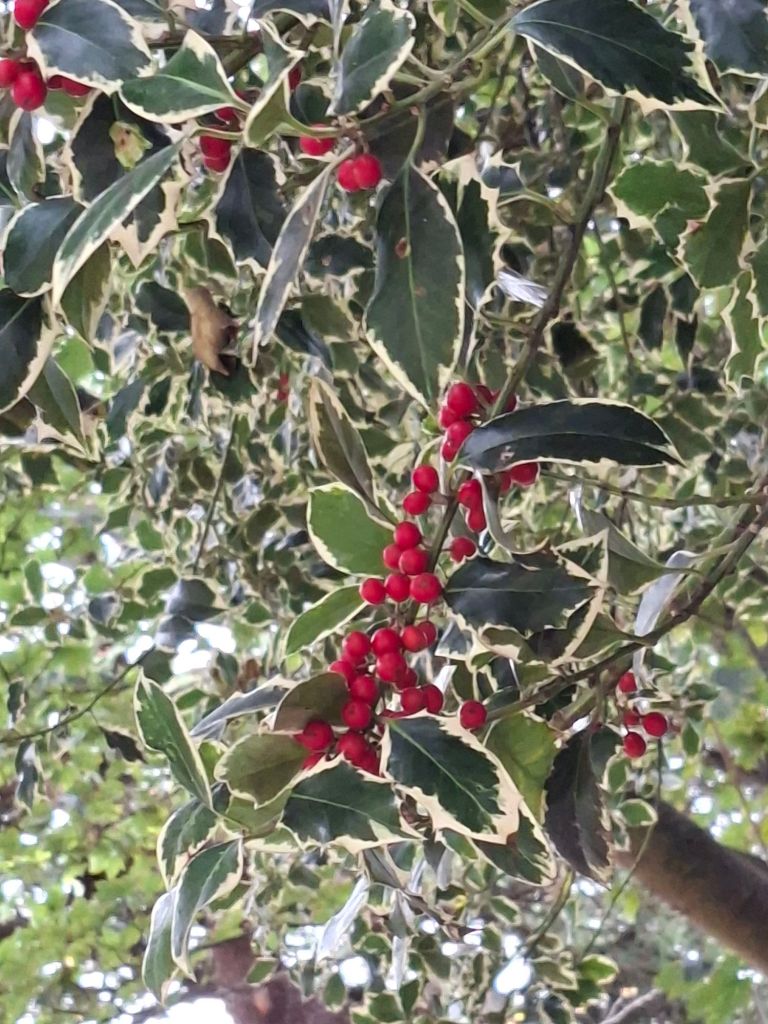
In the same space, I find both holly and ivy, with berries on the holly tree. I immediately thought of the Christmas carol The Holly and the Ivy. It is an ancient folk carol, which interweaves Christian themes and others that belong with the land. The version which is now popular was collected by Cecil Sharp in 1909 in Gloucestershire from Mary Clayton.
Many people think that the indigenous Pagan themes are the oldest, and that the central focus here is on the holly. The authors of The Green Man Tree Oracle say: “Holly’s connection with the Green Man is especially strong. In his guise as the Holly King – an ancient giant and symbol of fertility – the Green Man makes a notable appearance in the 14th century poem Gawain and d the Green Knight. Here he takes the form of a fearsome knight, who comes to King Arthur’s court to offer a midwinter challenge, carrying a club of holly and wearing a holly crown (as symbols of his true identity).” This challenge happens every year, where the Green Man/Holly King demands that we encounter him through our dealings with the natural world.
Elaine and I went to the Gloucester Cathedral Close and its surroundings on Saturday afternoon 18 October to outrun an extended period of gloom, wind and rain. We are now in it, so the lessons of the trees in deep autumn, anticipating the coming of winter, are not lost on us. The dark of the year is on its way.
(1) J.R R. Tolkien(translation of anonymous texts) Sir Gawain and the Green Knight, Pearl, Sir Orfeo New York: Ballantine Books, 1980.
Recently, Elaine and I walked to our local park after a considerable absence. We were both adequately bold and mobile at the same time. We found a park very different, at least visually, to the sad, dried-up space of late August and its premature turn.
Here, above, is lush life against a background suggestive of mist. Close up, we enjoy the patterns and colours of the leaves. They seem fresh, radiant and alive.
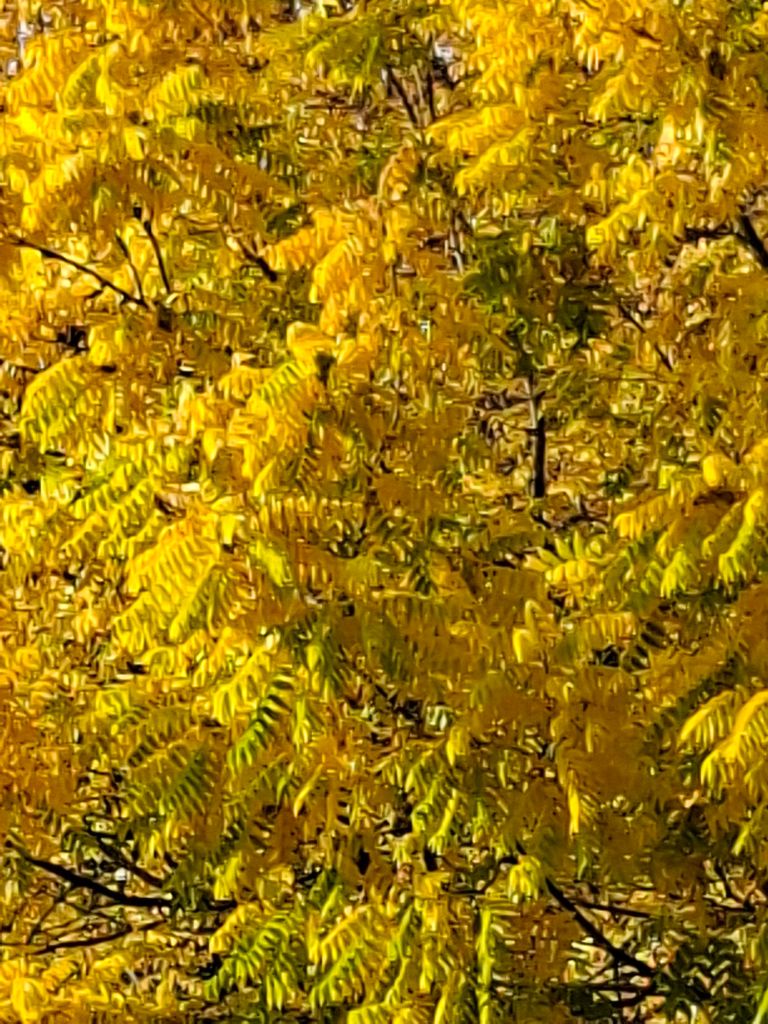
Below, the distinctive yellow of the tree of heaven, and its fern-like leaves, provide a powerful contrast that adds to our enjoyment.
Looking from a somewhat greater distance, below, I experience a sense of majesty in seeing the whole tree (right) leaning into blue sky. Its slightly closer neighbour (left) provides a subtle colour contrast with a deep green intermingled with brown leaves ready to fall.
Below, I have stepped back further from the trees. My picture is of a clump of trees in the park. They are largish trees. The person walking past them is dwarfed. But I’m still enjoying leaves. I like the reddish brown emerging from residual green. I see Nature at work in a way that is both understated and beautiful. I know also that it can be a sheltering space within a generally flat and open park.
I still have a particular affection for willow, going back 20 years when I was studying Druidry. I was in Bristol and befriended a willow on the banks of the Bristol Avon, where it moves out from the old city towards the Clifton suspension bridge and the gorge. I became a literal tree hugger. It was part of a process that indeed changed my life. Hence my affection for willow. I am glad that there are willows in the Gloucester City park.
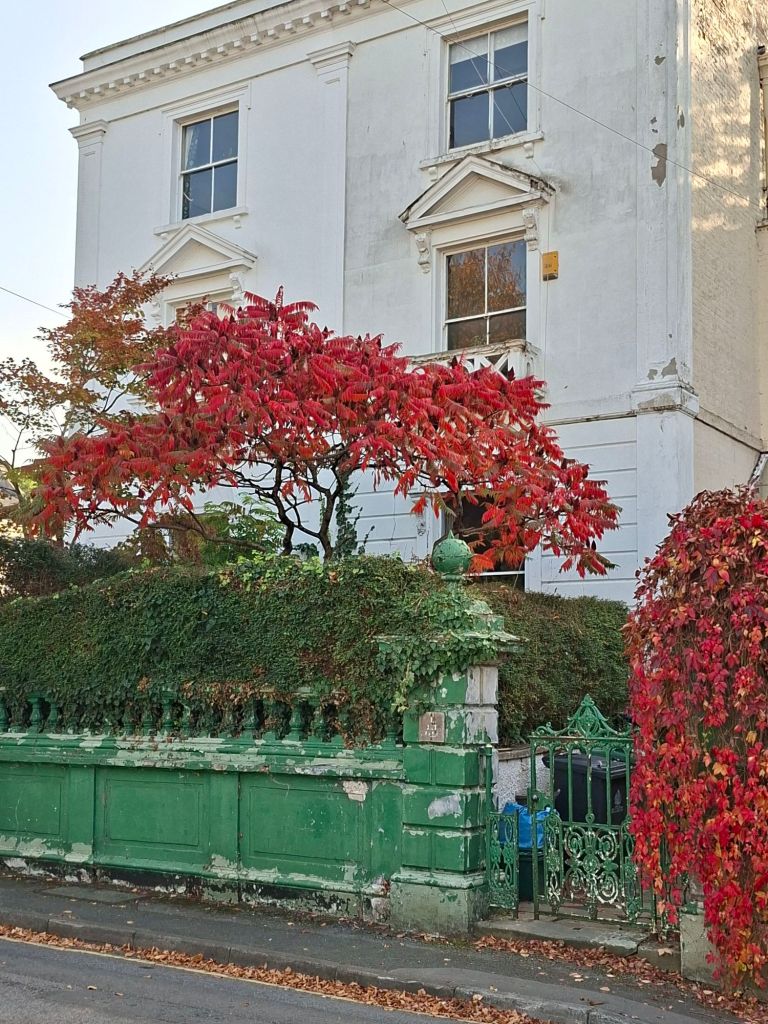
The road we took to and from the park offered leaves of autumnal red. I believe that the tree in the front garden is a stagshorn sumac. When I walk past the tree I get a little distracted by the property’s obvious need for a little tlc. Elaine however celebrates the opportunity taken by the Virginia creeper, as seen particularly in the second of the pictures below. It is great to see such abundance in this unpromising space.
For me, the great virtue of simple pleasures is their simplicity itself. Paying attention to the everyday Nature around us can be deeply nurturing and involves little risk. Yet for some, it can be a portal to re-enchantment in a largely disenchanted world.
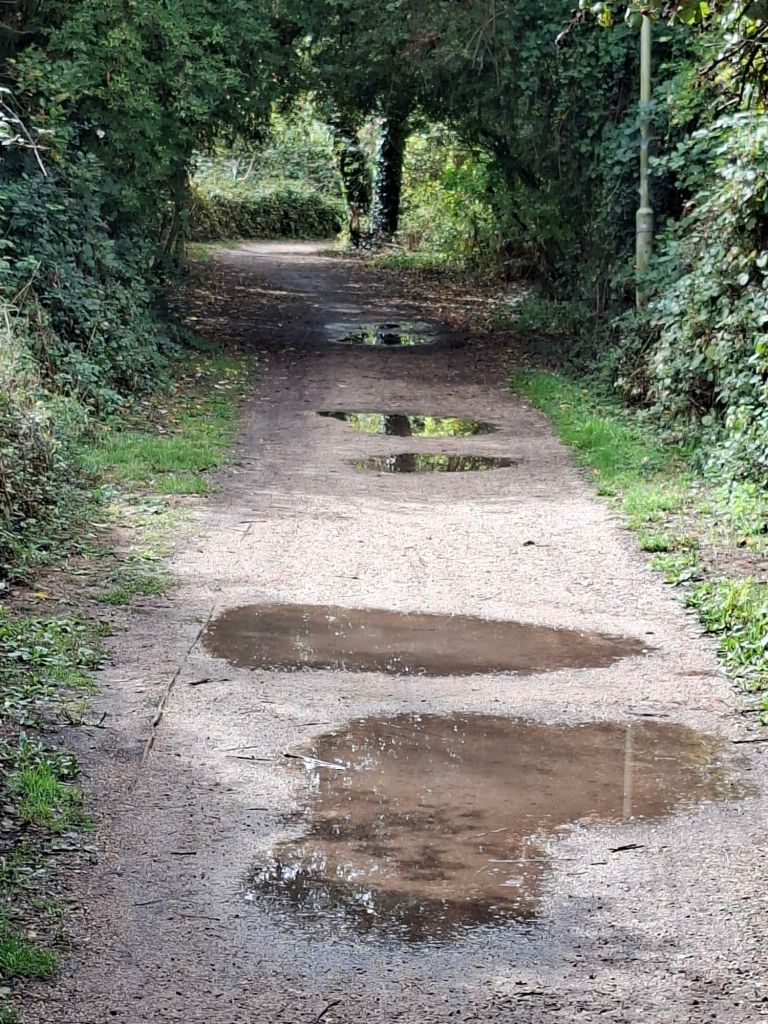
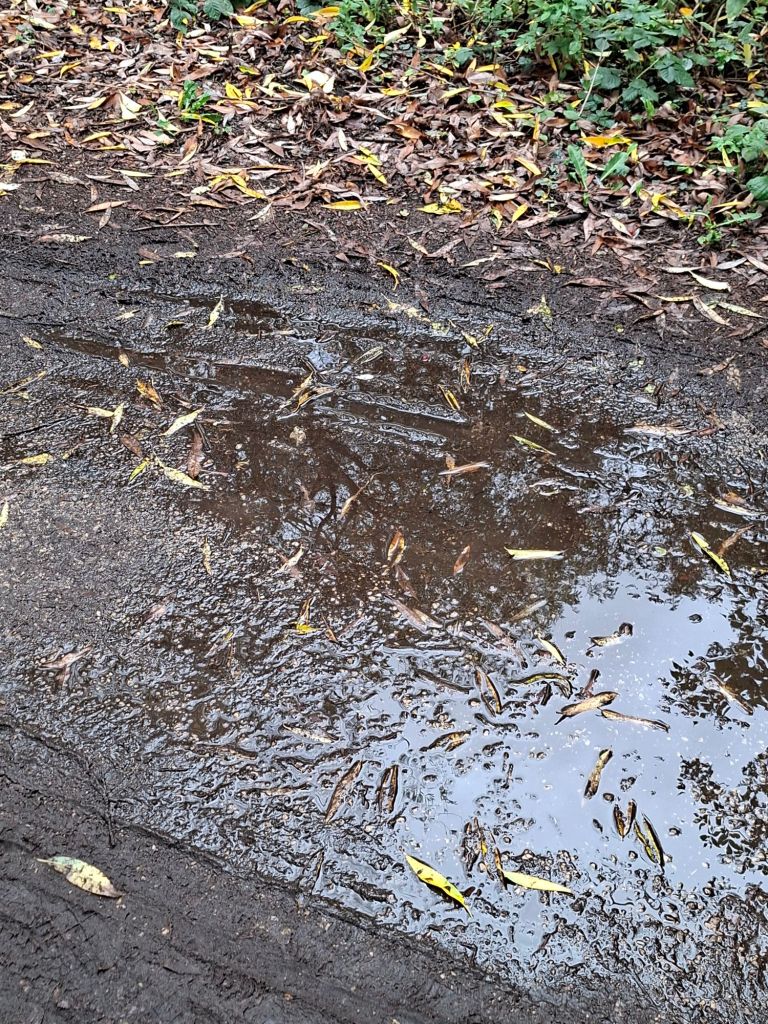
Walking on a familiar path, I found a trail of puddles in front of me. It felt exotic and refreshing. For this had been a parched and dry place for a many months. I dimly recall a past life of finding puddles a minor nuisance – almost an obstacle. Not today. They brought joy and fascination.
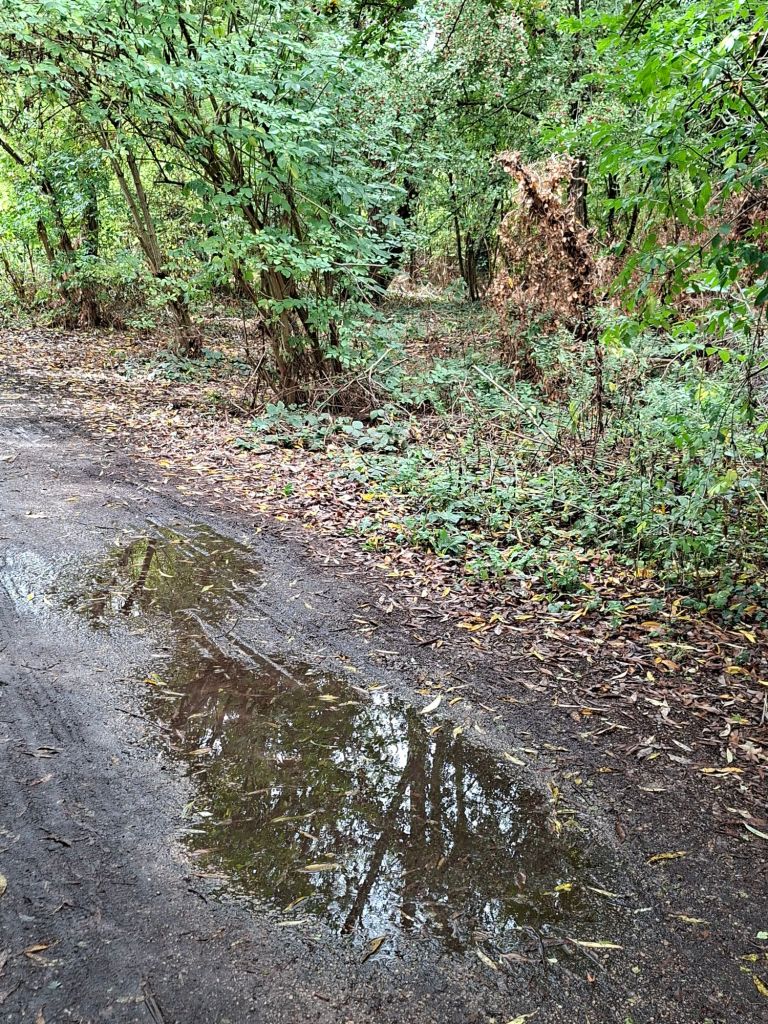
I found myself contemplating these small accumulations of fallen rain: noticing their shapes and patterns, seeing how the water creates mud so easily from dried soil, watching the slight movement fallen leaves in these tiny ponds. The circumstance of the long dry period and its ending made rainwater and its effects interesting and worthy of attention in ways that seemed new and almost strange. I opened myself up and became present to them, before moving on.
On my way home I was caught by a brief deluge. I made a brief video of rain on a puddle. I got wet too, yet it somehow completed my walk.
It is evening and for me autumnal. The sky offers the water a soft light, seemingly pink and grey. The water reflects this back, adding its own hint of mist. It is a tranquil scene.
For the first time this year, I feel a tug towards the Equinox, just under a month away. These canal waters are gentle, but they are drawn from the River Severn, site of the Severn Bore (1). Perhaps the waters are nudging something – maybe the water – in me.
A little later, facing into the declining sun (below) I see the sunset and its effects. I notice the concentrated power of the orb as it appears to reach the earth, and the way in which this energy disperses into the sky. The colour coding shifts from intense white to yellow to red-orange to an orange becoming increasingly grey. I live at latitude 52 north, and the sunset is getting earlier every day, now 8.15pm. Another autumnal feature.
Autumn is also the season of the fruit harvest. This year, many people are commenting that the fruit harvest is arriving early. Below, against the background of a clear blue daytime sky, an apple tree is fruiting. The tree is close to Gloucester Cathedral and may belong to it. Medieval Gloucester was a place of churches and priories. It was also a place of orchards, many of them cultivated by monks and friars. The picture points to natural and cultural continuity, though the fruit are early this year. I am no longer at a point tension between seasons. I am already settled in autumn.
(1) The Severn Bore is a natural tide phenomenon occurring in the River Severn in England, where a large wave surges upstream. It’s caused by the Atlantic tide pushing into the Bristol Channel and funneling it into the narrowing Severn Estuary, creating a more powerful wave that can be up to two meters high and a speed of up to 21 km/h. The Bore travels up the Severn Estuary, from Awre to Gloucester, a distance of 25 miles. It is strongest in the equinoxes (especially spring) and a popular challenge for surfers, kayakers and paddleboarders.
Noticing a single corn stalk under our neighbouring birch trees, I wonder whether the seed simply blew in or was planted by an unknown hand. If the latter, what was their intention? I realise that I will never know.
I do know how much I enjoy its presence in this space at this time. I experience it as a miracle inviting gratitude and it has marked the seasonal moment for me, this first harvest of a now declining year.
With increasing clarity I understand that I do not work well with personified and individualised images of the divine. Something seems subtly off, as if I am failing to sound my own authentic note in the Great Song of the world.
I believe that we are given different gifts in our encounters with the Cosmos, leading to legitimately different understandings. When I lean in to the notion of divine personality – even when using the term ‘Spirit’ in that sense – I am not fully living my own truth. I subtly disempower myself and weaken my connection.
For in my universe, when I rest in my own clarity, there is no separation between nature (including culture) and spirit. In the awkward activity of identification and labelling, I answer to terms like animist, panentheist and nondualist.
These words are approximations, with the power to be distracting and slightly depressing. I can find words that point to my experience well enough. But the explanatory words, the more formal and generalised terms, feel clumsy. There’s a necessary level of unknowing that these isms don’t recognise.
When consciously living in spirit, I am neither alone, as a single human person, nor am I with another being. I am simply in a different dimension of embodied awareness, supported and empowered by the bubbling source from which I spring. For me, Nature is more than the ‘nature’ of dualist spiritualities and of the scientific humanism that grew out of them.
As I harvest the learning, or relearning, of this lesson, I renew my commitment to practice and path, once again revising the beginning and end of the modern Druid’s prayer (1). I move from from ‘Grant, Spirit your protection, and in protection, strength … ‘ to ‘In spirit I find protection, and in protection, strength …’. I end with ‘and in the love of all existences, the love of this radiant Cosmos’ rather than ‘the love of God/Goddess/Spirit and all goodness’. These small changes formalise and anchor my understanding. For me, they are an important affirmation, illuminating my path.
(1) Traditionally, this prayer runs:
Grant O God/Goddess/Spirit, your protection,
And in protection, strength,
And in strength, understanding,
And in understanding, knowledge,
And in knowledge, the knowledge of justice
And in the knowledge of justice, the love of it
And in the love of it, the love of all existences
And in the love of all existences, the love of God/Goddess/Spirit and all goodness”.
NB Providing the options of God/Goddess/Spirit is I think an OBOD (Order of Bards, Ovates and Druids) innovation. The original version, from the late 18th century, simply said ‘God’. Some modern Druids say ‘God and Goddess’.
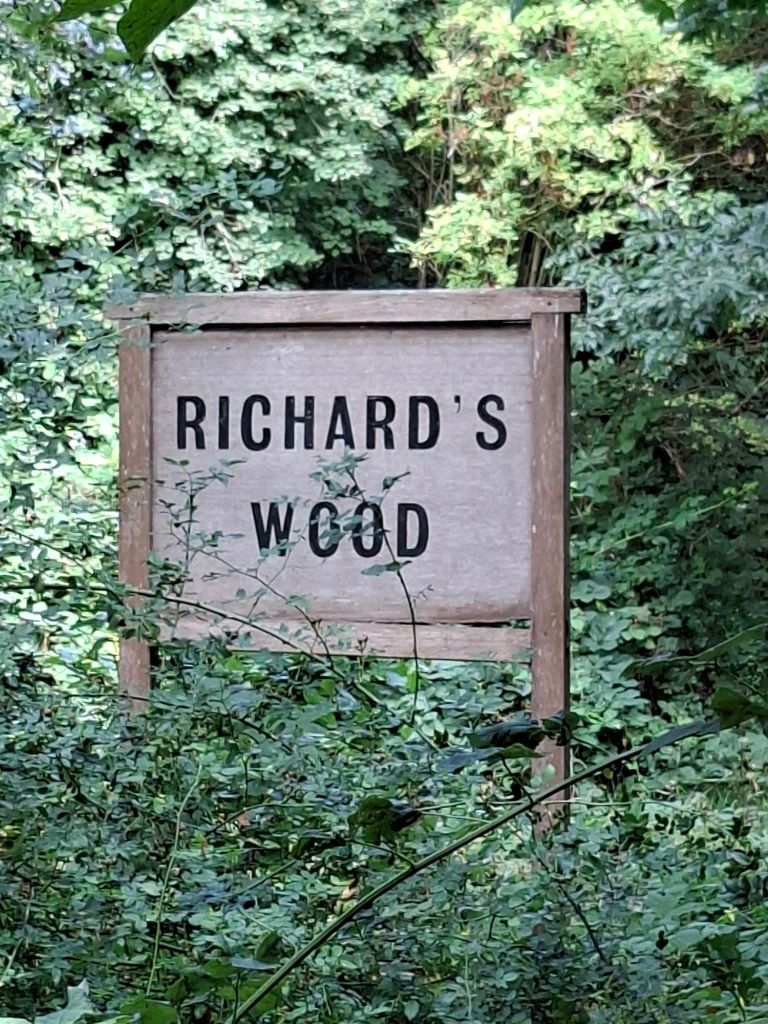
Richard’s Wood, Alney Island, was planted in 1983. It commemorates the 500th anniversary of the Charter given to the people of Gloucester by King Richard III. He was their Duke before he became King. People here have never quite seen him as the stage villain portrayed by William Shakespeare. Or, if so, as only one Royal stage villain among others.
Three years ago I wrote an Alney Island post where I ended by criticising how Richard’s Wood has been developed and managed (1). I don’t think I was wrong, but this time I felt very different, less willing to judge.
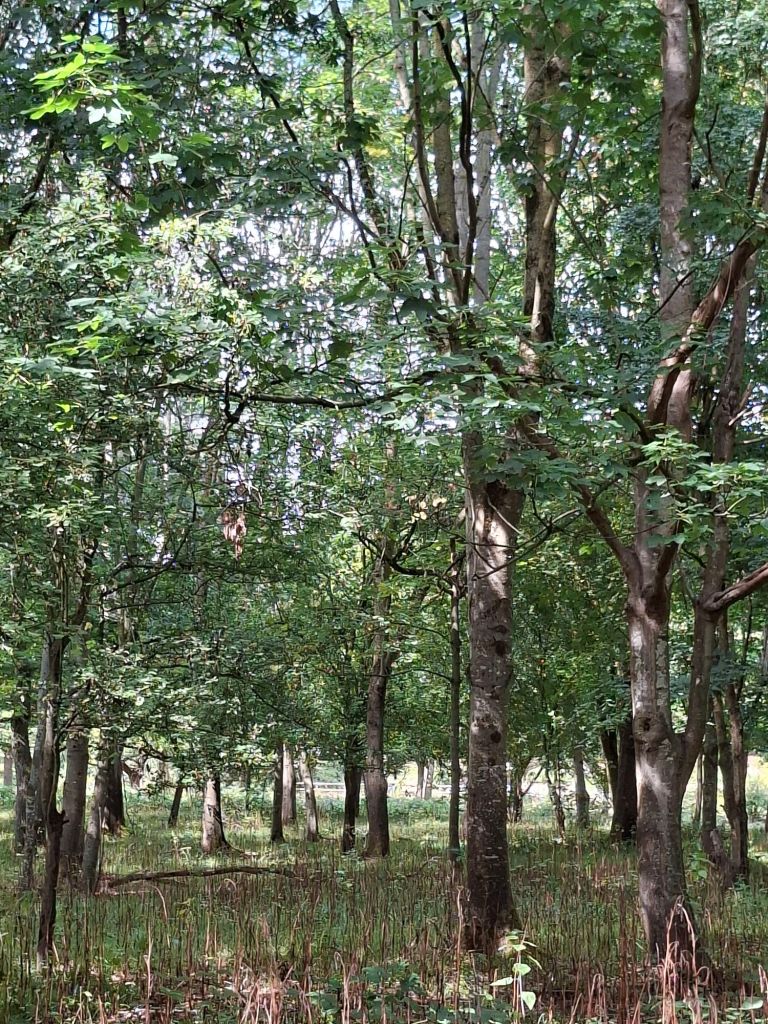
It was a hot day. I wanted to be outside. Being under cover in a wood not hard to negotiate was ideal. I strolled into enchantment. I surrendered to the trees and the way in which, together, they covered and held me.
In this state of attention, I don’t think much about botanical facts or lore. I respond to shape, texture, smell, subtle sounds, colour, light, light, shade and wonder at Nature’s variety.
I spent longer in the wood than I expected. I relished every moment I was there. I am now a friend of this space and expect to visit more often.
Above, through the trees, we can see one of the chapels belonging to the Arnos Vale Cemetery in Bristol, England. It was built as a garden cemetery extending over 45 acres in 1839, as the city’s old parish graveyards were becoming overcrowded and a health hazard. The new venture was designed to be spacious, with sunlight, fresh air, trees and shrubs.
It worked well for nearly 150 years. But in 1987 the owners announced their intention to clear a large section for ‘development’. An Association for the Preservation of Arnos Vale Cemetery swiftly sprang up. It fought successfully for a safe future for the site, gaining the support of the Bristol City Council, Bristol citizens and many people worldwide.
Now, as the Friends of Arnos vale, they continue to manage what they describe as “a hillside Victorian cemetery and conservation park, with heritage and wild life tours, plus a café”. It takes a lot of effort and activity to keep this precious space going, yet on my occasional visits I still find it tranquil and unspoilt.
For me it is a magical place, largely because the graves are being allowed to sink back into the land. There is something primal about the cross above, rough hewn, almost equal armed, and decorated with foliage. Still a cemetery, Arnos Vale has become something wilder than a garden. At this time of year, the paths become green tunnels, deftly concealing their destinations.
Yesterday I walked in Arnos Vale with a friend, and our direction of travel required a descent towards the main buildings. The steps we went down were not as overgrown as the ones below, but l found them challenging enough. The imagery and effortful activity of descent give me the feeling of a deep earth and underworld journey, and the sense of enchantment that goes with it.
Towards the bottom of the slope, my recognition of a re-enchanted space in a largely disenchanted world is further strengthened. A cross again. Evergreen ivy growing up it. Vivid summer blooms behind and in front. Tall wild grass. Trees in the background. Green abundance enhancing the gravestone rather than diminishing it. Life and death companioning each other without drama or fuss. Contemplating this natural harmony, I feel heartened and refreshed.
“I went to see the Mona Lisa in Paris, only to find that she is now permanently hidden behind a rugby scrum of people from everywhere on earth, all jostling their way to the front, only for them to immediately turn their backs on her, snap a selfie, and fight their way out again. On the day I was there, I watched the crowd from the side for more than an hour. Nobody – not one person – looked at the Mona Lisa for more than a few seconds.”
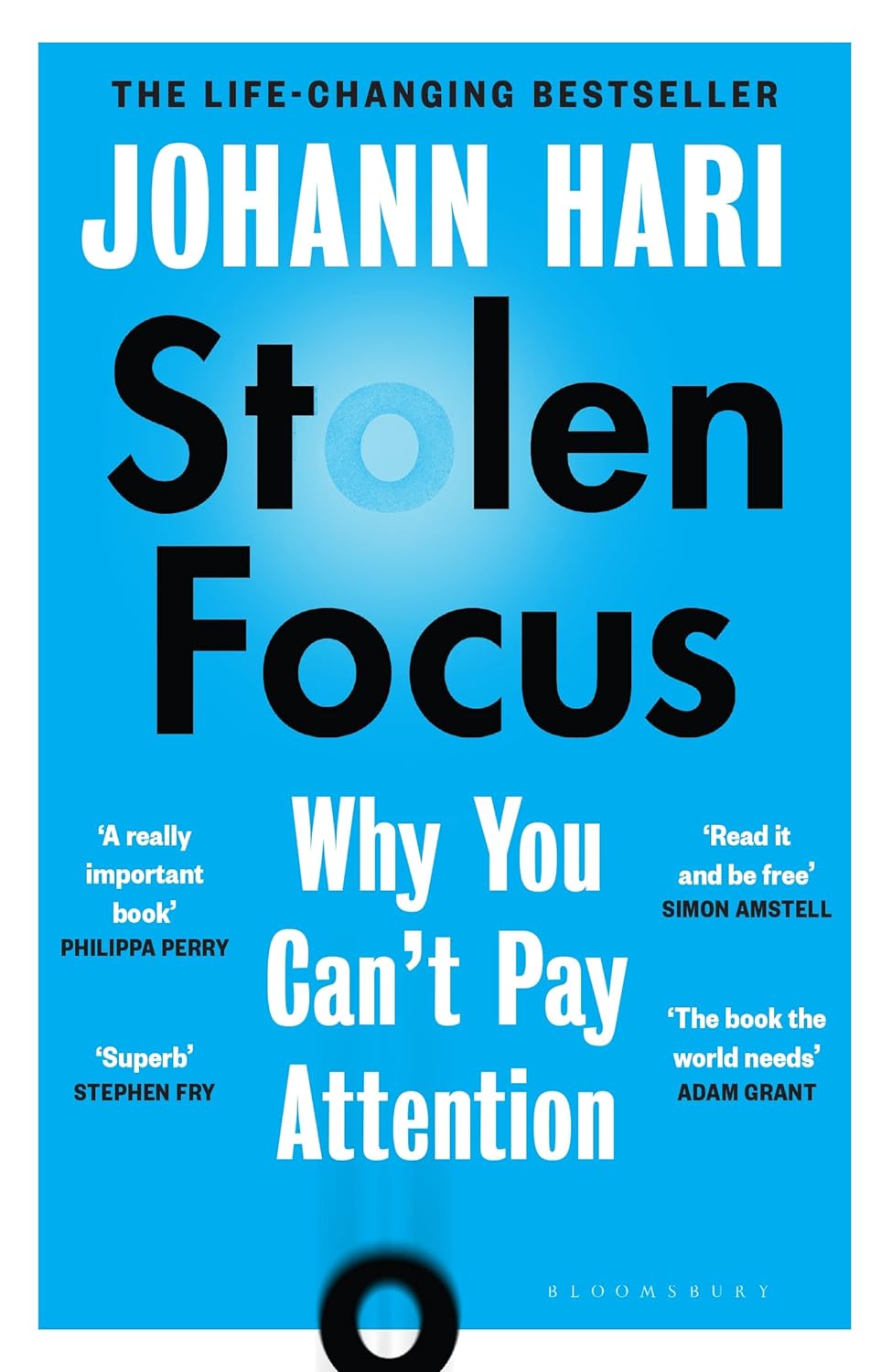
Johann Hari’s Stolen Focus: Why You Can’t Pay Attention (1) explores states of attention, how culture shapes them, and the implications of this shaping. I like Hari’s insistence that this is a collective issue and not just a matter of individual willpower. In this book, Hari identifies 12 causes of ‘stolen focus’. I plan to write a review of Stolen Focus soon. This post is about the first cause, which he describes as an increase in speed, switching and filtering.
Speed
According to Hari, modern culture overvalues speed. “People talk significantly faster now than they did in the 1950’s, and in just 20 years, people have started to walk 20% faster in cities” and “the original Blackberry advertising slogan was ‘anything worth doing is worth doing faster'”. But, argues Hari, “if you go too fast, you overload your abilities, and they degrade”. He reminds us that if we engage in deliberately slow practices, like yoga, or tai chi, or meditation … they improve our ability to pay attention by a significant amount.
Switching
Cognitive speeding has been made worse by the myth of multitasking, a term taken from 1960’s computing, when machines began to have more than one processor and could literally do two or more things at once. The human brain doesn’t have that capacity. It is naturally single-minded and isn’t going to change. So when we ‘multitask’, we are actually switching between different tasks, though we may not notice our switching.
The cost of switching is a degradation of our ability to focus, and a decline in our performance. Hewlett- Packard looked at the IQ of some of their workers in two situations. At first they tested their IQ when they were not being distracted or interrupted. Then they tested their IQ when they were receiving emails and phone calls. “The study found that ‘technological distraction’ – just getting email and calls – caused a drop in the workers’ IQ by an average of 10 points … twice the knock to your IQ that you get when you smoke cannabis”. Overall, if you spend your time switching a lot, the evidence suggests “you’ll be slower, you’ll make more mistakes, you’ll be less creative, and you’ll remember less of what you do”.
Filtering
“Think of your brain as a nightclub where, standing at the front of that club, there’s a bouncer. The bouncer’s job is to filter out most of the stimuli that are hitting you at any given moment – the traffic noise, the couple having an argument across the street, the cellphone ringing in the pocket of the person next to you – so that you can think coherently about one thing at a time.” The bouncer in our brain is the pre-frontal cortex, and it is becoming overwhelmed. There are too many stimuli and in many environments noise pollution in particular is interfering more insistently with the flow of our thoughts.
The crisis in attention that Hari outlines is a threat to our quality of life. It weakens our ability to think creatively or deeply. It tends to make us agitated as well as distracted. This is not a good place from which to build healthy relationships or solve complex problems at either the personal or the public level. I experience my contemplative inquiry as a valuable antidote to ‘stolen focus’. But it doesn’t get me everywhere, because loss of focus is a pervasive cultural problem. Beyond writing a review of the whole book, I intend to delve more deeply into the questions that Stolen Focus raises from a personal and a collective point of view.
(1) Johann Hari Stolen Focus: Why You Can’t Pay Attention London: Bloomsbury Publishing, 2022 (Kindle edition 2023)














 Contemplative Inquiry