Contemplative Inquiry

This blog is about contemplative inquiry

Tag: modern Druidry

HARVESTING INSIGHT

Noticing a single corn stalk under our neighbouring birch trees, I wonder whether the seed simply blew in or was planted by an unknown hand. If the latter, what was their intention? I realise that I will never know.

I do know how much I enjoy its presence in this space at this time. I experience it as a miracle inviting gratitude and it has marked the seasonal moment for me, this first harvest of a now declining year.

With increasing clarity I understand that I do not work well with personified and individualised images of the divine. Something seems subtly off, as if I am failing to sound my own authentic note in the Great Song of the world.

I believe that we are given different gifts in our encounters with the Cosmos, leading to legitimately different understandings. When I lean in to the notion of divine personality – even when using the term ‘Spirit’ in that sense – I am not fully living my own truth. I subtly disempower myself and weaken my connection.

For in my universe, when I rest in my own clarity, there is no separation between nature (including culture) and spirit. In the awkward activity of identification and labelling, I answer to terms like animist, panentheist and nondualist.

These words are approximations, with the power to be distracting and slightly depressing. I can find words that point to my experience well enough. But the explanatory words, the more formal and generalised terms, feel clumsy. There’s a necessary level of unknowing that these isms don’t recognise.

When consciously living in spirit, I am neither alone, as a single human person, nor am I with another being. I am simply in a different dimension of embodied awareness, supported and empowered by the bubbling source from which I spring. For me, Nature is more than the ‘nature’ of dualist spiritualities and of the scientific humanism that grew out of them.

As I harvest the learning, or relearning, of this lesson, I renew my commitment to practice and path, once again revising the beginning and end of the modern Druid’s prayer (1). I move from from ‘Grant, Spirit your protection, and in protection, strength … ‘ to ‘In spirit I find protection, and in protection, strength …’. I end with ‘and in the love of all existences, the love of this radiant Cosmos’ rather than ‘the love of God/Goddess/Spirit and all goodness’. These small changes formalise and anchor my understanding.  For me, they are an important affirmation, illuminating my path.

(1) Traditionally, this prayer runs:

Grant O God/Goddess/Spirit, your protection,

And in protection, strength,

And in strength, understanding,

And in understanding, knowledge,

And in knowledge, the knowledge of justice

And in the knowledge of justice, the love of it

And in the love of it, the love of all existences

And in the love of all existences, the love of God/Goddess/Spirit and all goodness”.

NB Providing the options of God/Goddess/Spirit is I think an OBOD (Order of Bards, Ovates and Druids) innovation. The original version, from the late 18th century, simply said ‘God’. Some modern Druids say ‘God and Goddess’.

PLANT POWER IN A CATHEDRAL CLOSE

The garden in Gloucester Cathedral’s close is currently a magnificent riot. I was on a walk there with Elaine and we particularly noticed two powerful seeming plants that we couldn’t identify.  We simply sat with them, unnamed, and bathed in their energy. It was a glorious 1 June, the first day of our official meteorological summer, and one to savour and enjoy.  Only later did we do any research.

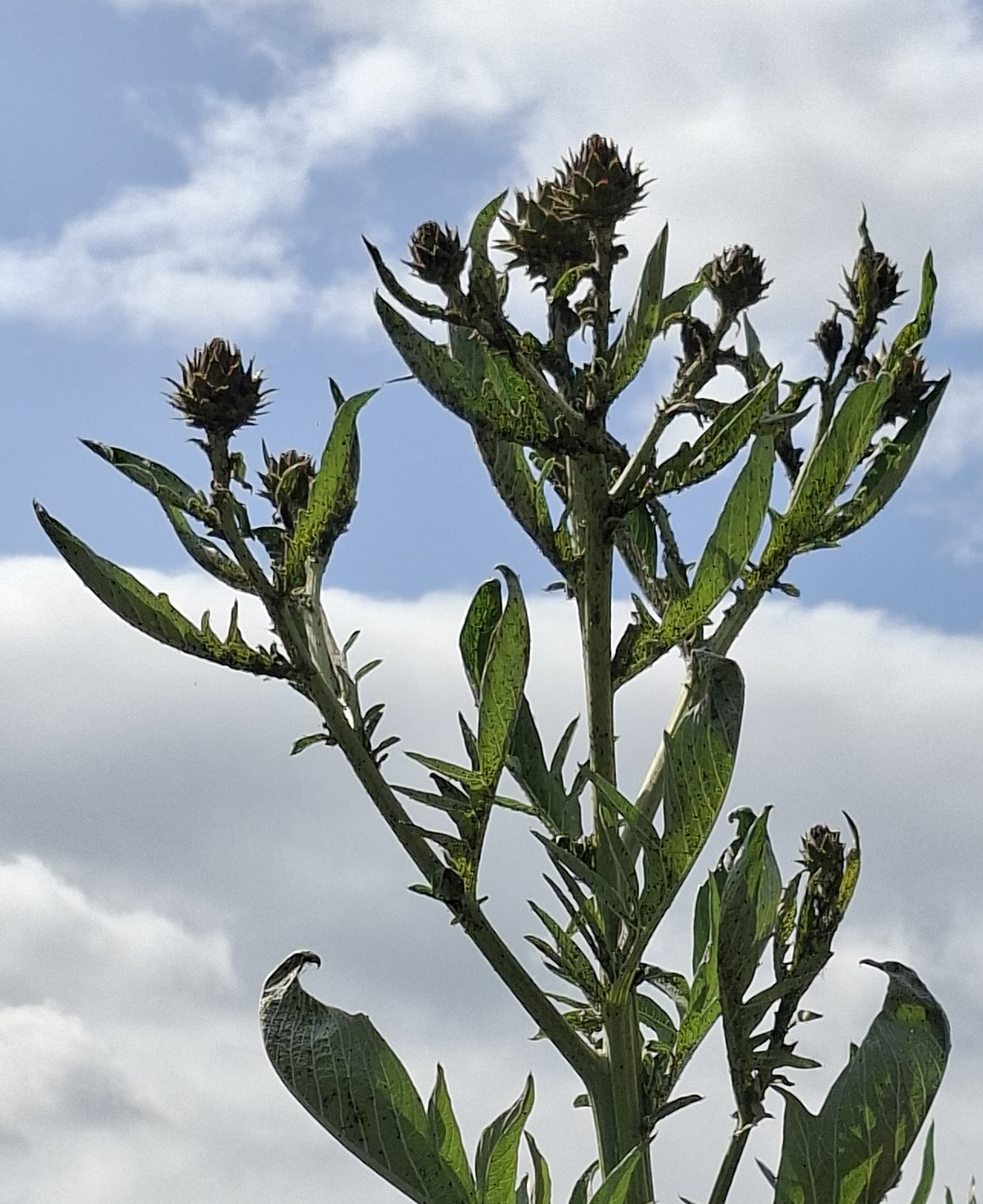
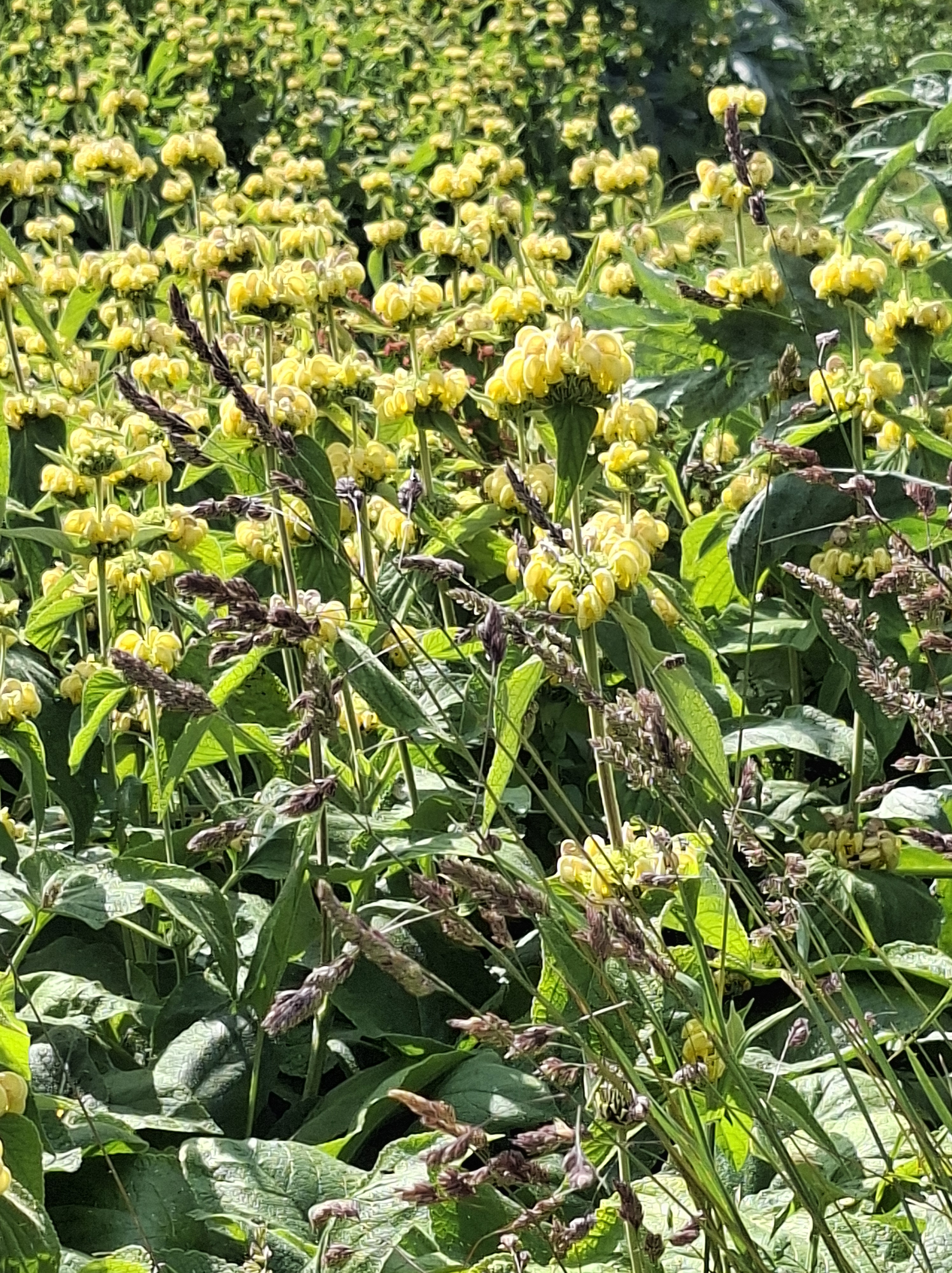
We are fairly sure that the plant above is yellow archangel and the plant below, looking like a giant thistle, is cardoon (canara cardunculus) aka prickly artichoke. Friendly feedback from readers on these identifications is welcome. If we are right both plants have long been recognised as sources of power and healing.

In our older traditions, yellow archangel was a symbol of harmony between flora and fauna. A custodian of wildlife, it fostered a bond that transcends mere survival. Herbalists still use this plant to relieve gout, sciatica and other pains of the joints and sinews. It has also been used to draw out splinters and thorns, clean and heal persistent sores, and to dissolve tumours. Yellow archangel can be used as food, in salads, soups and teas. In the wheel of our year, yellow archangel flowers  fully after the bluebells die away.

Cardoon is also a plant of power. Traditionally associated with Mars, it has the virtues of strength, protection and abundance. It is has been credited with the power to ward off evil spirits. It is also connected to ideas of nourishment, the riches of nature and, latterly, sustainable gardening. The plant can grow to 2.5 metres in height. Its thick stalks are used as a vegetable. Its full flowering is in late summer and autumn, with thistle-like purple flowers.

These plants, in this garden, are a celebration of values as well as of nature and healing. I see our world through the lens of Modern Druidry and Paganism. The custodians of this space will have a Christian lens. I am happy to note that in this context they seem to be much the same. When in this space, I feel that I am in a beautiful and energising oasis in the city.

MODERN DRUIDS (RONALD HUTTON) 2 MODERN DRUID MOVEMENTS

Modern Druids is the most recent public lecture (2 April 2025) presented by Professor Ronald Hutton in his tenure as Professor of Divinity at Gresham College, London. I provide a link below (1). This is the second of two posts about the lecture, focusing on Modern Druid movements in Britain from 1781. The first, concerning Hutton’s take on early modern perceptions of ancient Druidry, is published at https://contemplativeinquiry.blog/2025/04/08/ . It distinguishes four understandings, named by Hutton as Nationalist, Green, Demonic and Confessional.

Turning to modern Druid movements, Hutton also distinguishes four different kinds, emerging from the later eighteenth century up to the present:

  1. Masonic Druids The Ancient Order of Druids was launched in London in 1781, as a closed society with initiation rites, secret memberships, signs and passwords, loosely modelled on Masonry. Its purpose was to give working men opportunities for participation in the performing arts. By 1820 it had become a huge success, moving beyond London to the Midlands and North of England. Some members wanted more focus on the insurance side of friendly society life, and in 1833 the United Ancient Order of Druids was formed, splitting off from the AOD. The UAOD lasted until the late twentieth century. The original AOD still exists.
  2. Theosophical Druids emerged in the period from 1910 as an esoteric spiritual group. It followed the ideals of the Theosophical Society and worked towards the recovery of ancient mystical wisdom from all religions and philosophies. Founded by George Watson MacGregor Reid, and originally called the Order of the Universal Bond, the new group mixed Egyptian, Greek, Zoroastrian, Muslim, Jewish and Buddhist ideas with Irish and Welsh literature and using Druid names, roles and status. In 1912 a group of members went to Stonehenge to celebrate the Winter Solstice. Increasingly identified as The Ancient Druid Order they continued their association with Stonehenge for over 70 years. Always unpopular with the archaeologists of that period, the ADO sometimes had the support of the government and site administrators and sometimes not. In 1985 the festival that had grown up on the site was banned under Margaret Thatcher.
  3. New Age Druids is the name Hutton gives to the Order of Bards Ovates and Druids (OBOD). The first iteration of OBOD was a split-off from the ADO in 1964 led by Ross Nichols, who took the new group to Glastonbury for their public ceremonies. On his death in 1975, the Order went into hibernation until 1988, when Philip Carr-Gomm, who had been a youthful apprentice of Ross Nichols, re-awakened it. By 1988 the human potential movement, and a new Celtic revival strand in western alternative spiritualty, were both gathering in strength. True to its Theosophical roots, OBOD declared itself to be a spirituality rather than a religion and opened itself up to people of all religions and none. The bulk of the membership identified as either Pagan, Christian or Buddhist. OBOD declared an aim of “uniting humans with the natural world and their own true selves”, to “heal the disorientation implicit for many in an urbanised and atomised social existence” and “to give peace”. Hutton goes on to mention The British Druid Order (BDO) and The Druid Network (TDN) but doesn’t say much about them. Although they hived off from OBOD, dual or multiple membership is common.
  4. Counter Cultural Druids When the Stonehenge Festival was banned in 1985, many people felt they had lost a clergy and a temple as well as a festival. Some wanted to fight for a religion they saw as under attack. (Hutton does not specifially mention the ‘Battle of the Beanfield’.) The single most prominent leader who arose was Arthur Pendragon, ex-soldier, ex-biker gang leader, and mystic. He was prominently associated with the Glastonbury Order of Druids (GOD), the Secular Order of Druids (SOD) and the Loyal Arthurian Warband (LAW). These groups campaigned for civil liberties and preservation of the countryside. They held demonstrations against laws that limited the former, and organised protest camps on the routes of controversial road and building schemes. Arthur was frequently prosecuted and invariably acquitted by juries. Hutton identifies Arthur as part of a long tradition of working class protest, in which the use of costume and theatre is used to make disempowered people visible. Arthur himself had a more mystical view of his mission. Once, while looking for a sign, he noticed an attractive ceremonial sword in a local shop. Asked where it had come from, he was told that it had been Excalibur in the movie of that name.

Modern Druidry in Britain continues to mutate and develop, but Hutton ends his analysis at this point. I recommend readers to visit the link below and draw their own conclusions.

(1) https://www.gresham.ac.uk/watch-now/modern-druids/

MODERN DRUIDS (RONALD HUTTON) 1 ANCIENT INSPIRATION?

Modern Druids is Ronald Hutton’s most recent public lecture (2 April 2025) in his role of Professor of Divinity at Gresham College, London. I provide a link below (1). This is the first of two posts about the lecture, summarising Hutton’s take on early modern perceptions of ancient Druidry. The lecture goes on to describe the Modern Druid movements that have come out of an already existing inspiration. That will be the focus of my next post.  

Most of what we have believed ourselves to know about the ancient Druids is derived from comments by a limited number of Roman authors. The most prominent of these are Julius Caesar, Tacitus and Pliny. According to Hutton, recent scholarship has tended to undermine the reliability of these sources. Both Caesar and Tacitus are known to have invented material for their histories. Pliny wrote after the Druids in both Britain and Gaul (= much of modern France, parts of the Netherlands and the Rhineland) had been repressed. Nonetheless, what these authors said has strongly influenced later beliefs about Druids. Fascination with Druids, as custodians of lost ancient knowledge, has been  a feature of Northwestern European culture from the sixteenth century onwards.

Over this period, Hutton identifies eight distinct ways of imagining Druids and Druidry. The first four are visions  of the Celtic Druid past. In his analysis Hutton names them as Nationalist, Green, Demonic and Confessional. They are all projections onto the past from somewhat different groups of people, which also speak to contemporary British concerns of the seventeenth, eighteenth and nineteenth centuries. I describe these four ways below. (I will cover the remaining four ways, concerned with Modern Druid movements, in my next post.)

  1. Nationalist Druids (favourable) They are understood as patriotic, as defenders of the nation, representatives of piety and wisdom, and a link to tradition and the past. However, in a UK context, or even within the island of Britain, there are questions about what the nation is and whose traditions are being celebrated. By the end of the eighteenth century, a time when most Welsh people still spoke the Welsh language, Wales was the nation that most strongly identified with Druid heritage. A key figure in this was Iolo Morganwg, who I have written about in other posts (2,3).
  2. Green Druids (favourable) Druids are associated with woods, caves and natural spaces. They are therefore an antidote to industry, urbanisation, modernity and forms of ‘civilisation’ about which many people had strong misgivings. (My own observation is that this early modern image of ancient Druidry, in its late modern deep ecology form, is the most influential current in 21st century Druidry – JN)
  3. Demonic Druids (unfavourable) The ancient Druids were said to be a despotic heathen priesthood who practiced human sacrifice and ruled through fear, ignorance and superstition. The Romans did the Celts a service by breaking their power. This account appealed to imperialists and evangelical Christians whilst also being a gift to Gothic fiction.
  4. Confessional Druids (favourable): The story here is that, sometime between the days of Noah and Abraham, wise men, inspired by God, set forth from Palestine to Britain to teach a pure religion. These were the original Druids. British Christianity was therefore, in a sense, both native and ancient. William Stukeley (1687-1765) Druid enthusiast, Church of England priest, and the first scientific archaeologist, held this view.

I am grateful to Ronald Hutton for his analysis. By understanding the cultural soil out of which modern Druid movements, beginning as least as far back as 1781, emerged, he helps to explain why some people over the last 250 years have chosen to claim the name for ourselves. More about that in my next post (4).

(1) https://www.gresham.ac.uk/watch-now/modern-druids

(2) https://contemplativeinquiry.blog/2021/09/07

(3) https://contemplativeinquiry.blog/2020/05/11

(4) https://contemplativeinquiry.blog/2025/04/11

EARLY SPRING: AFFIRMING LIFE

I am connecting with spring and its urgent affirmation of life – its green shine and fecundity. It is the sunrise season, the season of early growth. For me, where I live, the immediate pre-equinox period often generates a strong feeling of dynamism and emergent potential. I am in sync with the awakening earth.

Elaine’s return from hospital and the enhanced clinical support she is receiving are helping me to live this season more fully. In our joint lives we are both feeling more agency in shaping a new phase in our life together.

In this moment I feel refreshed and optimistic within my Druid contemplative path. I have adjusted my formal practice so that I have two practice sessions in the day, both of them roughly twenty minutes long. The first, at the beginning of the day and standing, is affirmative and dynamic. It includes body and energy work and a theme of healing and rejuvenation. The second, at the end of the day and sitting, is contemplative. It includes breathwork, a mantra meditation using beads, and prayer. In the modern Druid manner it includes a commitment to the collectively imperilled qualities of love, peace and justice. This shift is having a renewing and reinvigorating effect on me, as befits the season: another way of gratefully affirming the gift of a human life.

BEING NOBODY

“I’m nobody.

So are you.

What ecstasy!

Join me.” (1)

According to Andrew Harvey (1), the translator of this brief poem by Kabir, “Kabir is far more than a poet; he is a universal initiatory field, as expansive as Rumi and as embodied, radical and ferocious as Jesus”. I certainly experience a creative shock in Kabir’s celebration of being ‘nobody’ in a world where being ‘somebody’ is such a highly valued social accomplishment. But what if the accomplishment distracts from something else, something of greater value? Kabir invites us to share the ‘ecstasy’ of being nobody. In another of his verses, which were performed as songs, Kabir links this ecstasy with love:

“You can’t grow love in gardens

Or sell it in markets.

Whether you’re a king or peasant

If you want it

Give your head and take it”.

In my experience, Kabir’s work opens a door to forms of contemplation and creativity in which my personality and personal biography are not the primary focus. Especially in darkening times, bearing witness to the way of the heart, and drawing strength from it, is a form of sacred activism. The liturgy of modern Druidry speaks of a love of justice and a love of all existences, embedded in a living relationship with Spirit. This for me is a commitment to live from.

(1) Kabir Turn Me To Gold: 108 Poems of Kabir Unity Village, MO: Unity Books, 2018 Translations by Andrew Harvey. Photographs by Brett Hurd.

(2) See also https://contemplativeinquiry.blog/2021/01/30/turn-me-to-gold/

THE WAY OF THE HEART

Sufism is often referred to as the Way of the Heart. Hazrat Inayat Khan was a Sufi teacher and musician from Gujarat, India, who took his teaching to the West in the early 20th century. His combination of spiritual teaching, philosophy and music was normal in this culture and tradition. In his own life and work, Hazrat Inayat Khan created a Universal Sufi movement independent of its Islamic origins, though always inspired by them. Practitioners from his movement created the Dances for Universal Peace.

The image above is the Ace of Cups from Ayeda Husain’s The Sufi Tarot (1). Ayeda Hussain is a teacher in the Ineyatiyya, a global organisation dedicated to Universal Sufism as taught by Hazrat Inayat Khan. She sees Sufism and Tarot as two systems of healing and transformation that can be valuably brought together. She treats Tarot as a vehicle for spiritual teaching, going so far as to include contemplations and affirmations for each card.

Referring to her Ace of Cups, she says: ‘In Sufi poetry, the cup is the heart that must be emptied before the beloved can pour the Divine nectar into it. Just as a cup that is filled cannot be poured into, neither can a heart filled with limiting impressions. The work of the mystic then, is to clear impressions that clutter and cloud the heart, so that it may be able to receive. As the heart opens, we become aware of new offers and opportunities in both love and spiritual growth’.

I came to The Sufi Tarot by an indirect route. When I began working with my Ceile De (2) beads, I didn’t at first expect to use them for mantra meditation and I looked at a collection of fuinn (sacred chants) as an option for working with the beads. Fuinn tend to be brief and I thought that a single fonn might work for me. They are in Scottish Gaelic and frequently use heart language, as in:

Gun tigeadh, solas nan solas

(Goon tee-guch, sol-us nan sol-us)

Air mo chridhe

(Air mo chree)

This translates into English as Come light of lights, to my heart.

I found this fonn beautiful though somehow not right for my purpose. But the phrase air mo chridhe would not leave me. As soon as I heard it, in the old language, it needed no translation, and I felt I had known it forever.

What I did in my own practice, having decided on the Soham mantra for the beads, was to create a version of the modern Druid peace prayer as a love prayer.

Deep within my innermost being, may I find love.

Silently in the stillness of this space, may I nurture love.

Heartfully, in the wider web of life, my I live in love.

Now using this prayer, I felt the desire for friendly guidance in this work of the heart. I felt prompted to search for ‘Sufi Tarot’, and was surprised when came up immediately. When I received the pack, I was quickly reassured that I had had been given what I asked for. I look forward to this new thread within my contemplative inquiry.

(1) Ayeda Husain The Sufi Tarot Carlsbad, CA; New York, NY; London; Sydney; New Delhi: Hay House, 2022. Art team Nazish Abbas, Hassaan Aftab, Momina Khan

(2) https://contemplativeinquiry.blog/2025/01/14

FAITH

In my Druid circle, I associate the northern quarter with faith. The quality and context of faith are not defined. They could simply mean faith in the practice and path. My contemplative inquiry overall has tended towards a stance of ‘sacred agnosticism’ (1), in which faith is not emphasised. This has served me in many ways. I have avoided mixing up the idea of ‘faith’ with affiliation to authoritarian movements, mandated beliefs, or the surrender of self-responsibility and personal discernment. I have been alert to the metaphysical group think and consensus collusion that can show up in any spiritual movement (other kinds of movement too). I have done my best to gather and evaluate information skilfully, when developing principles about how to live ethically and gracefully in an increasingly scary world.

And yet … this is not the whole story, or I would feel spiritually malnourished. In recent months I have experienced a strong felt sense of the divine. When I describe myself as ‘living presence in a field of living presence in a more than human world’ – an animist identification – the identification now seems more than animist, though the animism is still there. I pray more congruently to the Goddess as Ancient Mother and talk, less anthropomorphically, about the ‘bubbling source from which I spring’. The Divine is beyond name, form or description – and some people prefer a specialist, capitalised use of rather abstract terms like Consciousness, Awareness, Void, Ground of Being. But the ones from my own practice are the ones that work for me. They come from the intuitive heart and the imagination. To me they offer a deeper knowing, though I am personally cautious about the use of the word gnosis. For me, it can reduce the sense of mystery,  banishing the creative role of faith itself.

I have become a provisional panentheist, experiencing intimations of a divine which is everywhere and no-where, and from which we are not separate. This partly reprises work I did in the earlier days of my inquiry using the framework of non-duality. Now I find panentheism a better term than non-duality for affirming both the divine and the world. The earth spirituality in the Druid tradition is in no way compromised by a panentheist perspective. If anything it is enhanced.

(1) See https://contemplativeinquiry.blog/2024/02/16/sacred-agnos

DOORS OF PERCEPTION: SUN, SKY, SHADOW, SNOW

This post is about Hillfield Gardens (1,2) and the taste of psychic rejuvenation. Just being there, actively opening to the elemental energies of place and time, I felt confident, happy and strong.

The early morning of 20 November was misty and dark in a slushy, miserable kind of way; closed in and confining rather than magical and mysterious. Elaine and I catastrophised together in gloomy harmony about skies made unfriendly by perpetual drizzle and pavements made treacherous by hidden ice. The term stir crazy came up for me. We have begun to expect fresh air and activity outside the home. This time we planned to be in separate spaces. They are good in themselves and healthy for us as a partnership. So the tension of anticipated disappointment was in the air, for a long moment in a dull morning.

Then everything changed, with clear blue sky and sun. After an early lunch, I could wheel Elaine to her creative arts event and then fully stretch my legs in a walk to Hillfield Gardens. When I got there I slowed down again and shifted from a doing mode to a being mode. I became porous to the world – at once disappearing into it and expanding to embrace it. The snow on the ground looked beautiful to me and a crinkly fallen leaf both modified the picture and enhanced the look. William Blake once famously wrote: “if the doors of perception were cleansed, everything would appear as it is, infinite” This brief eternal time (being in two worlds at once) – with the snow on the ground, and the fallen leaf – was like that, or at least something which pointed towards it. I feel tremendous gratitude for the experience. In its afterglow, I found myself feeling confident, happy and strong.

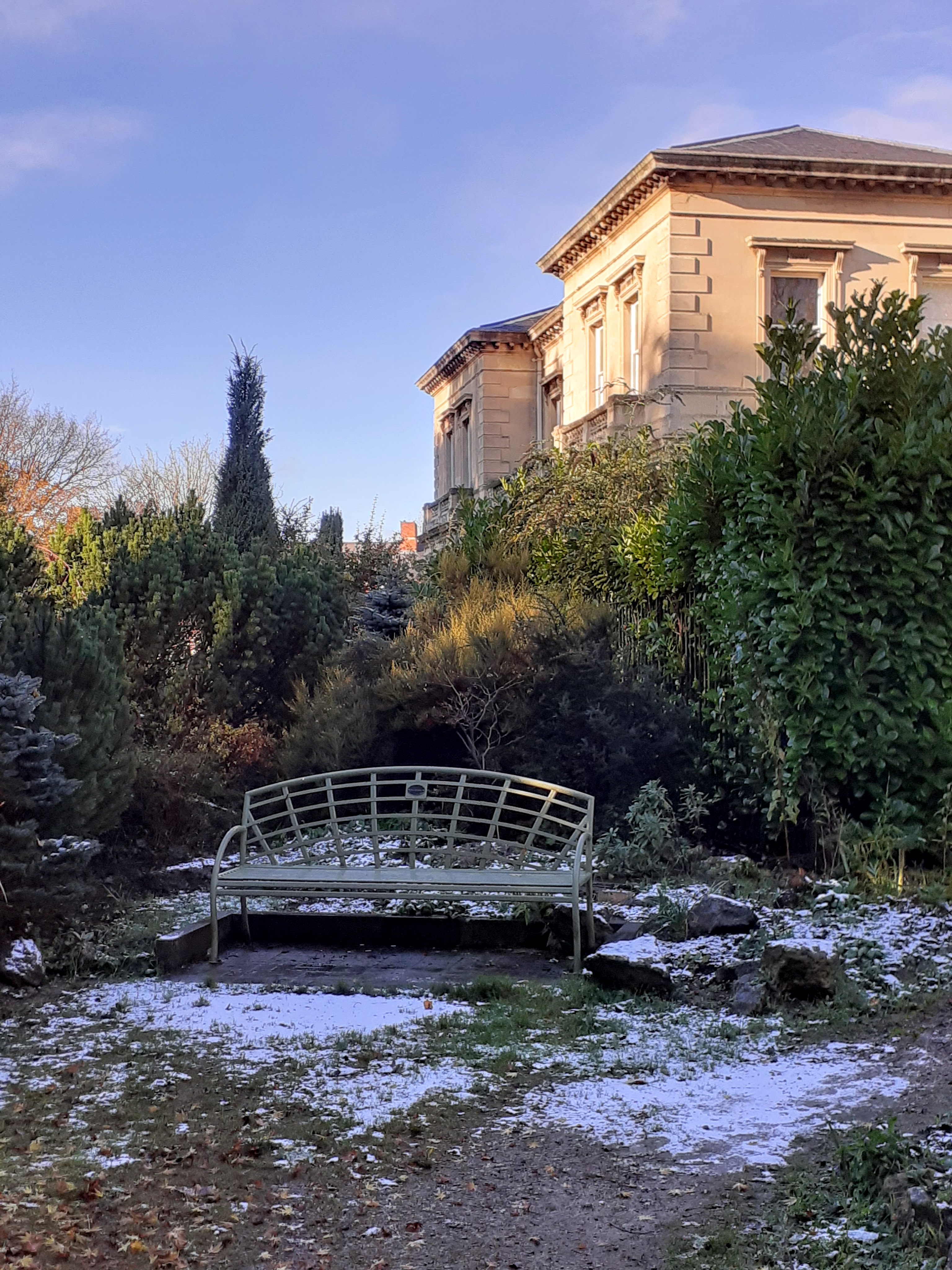
At a reduced level of intensity, I continued my walk. Below, My attention was drawn by a seat, and the snow around it, in a secluded corner of the gardens. Sun shone freely on the buildings, and the bushes, but reached only a small area on the seat.

In the most wooded and unmanicured section of the gardens, I found snow still present on a section of cleared space and pathway. Elsewhere there was no trace of it, even in this relatively shadowed space.

On the buildings below – blue sky, sun and shadow. In the picture below snow is just discernible on a rooftop and in a garden. During the period of my walk (1-1.30 pm) the gardens visibly changed. The snow was retreating and shadows continued to shift.

It wasn’t a long walk – twenty minutes each way for the sake of my legs and thirty in the garden. It was enough. I took away the psychic rejuvenation I named at the beginning of this post. The experience was both mystical and ordinary, a place where the ‘spiritual’ and ‘mundane’ are one – and big part of how I live my Druidry.

(1) SEE: https://contemplativeinquiry.blog/2024/04/11/images-from-a-town-garden/

(2) NOTE: At the beginning of April 2024 I discovered Hillfield Gardens – a little outside the centre of Gloucester, yet still in easy walking distance (or an easy bus ride) from where I live. Originally the gardens of a large house, Hillfield Gardens are about 1.6 hectares in extent. They are managed by a Friends Group on behalf of Gloucestershire County Council. For me the gardens are a tranquil space, different in feeling-tone from other local parks.

ANIMISM FOR OUR TIMES

This post looks at Animism as the guiding principal of my Druidry. The term itself comes from nineteenth century anthropology, and is somewhat problematic. Scholars from European and North American backgrounds , formed by a mix of Christian and secular ideas, were studying, and labelling, the traditional practices of other people. The people themselves were mostly in the process of becoming colonial subjects and living in cultures under stress. So ‘Animism’ started out as a top-down classification, which gave Animists a lowly position in the hierarchy of cultural and spiritual life. A stigma persists to this day.

Despite this dubious history, the word ‘Animism’ is now being turned around by people from the global north itself, spiritually hungry in our now palpably faltering 21st century world. Some years ago, research by Graham Harvey distinguished two positive uses of the term Animism among modern western Pagans. “Some Pagans identified Animism as a part of their religious practice or experience which involved encounters with tree-spirits, river-spirits or ancestor-spirits. This Animism was metaphysical. … Other Pagans seemed to use ‘Animism’ as a short-hand reference to their efforts to re-imagine and re-direct human participation in the larger-than-human, multi-species community. This Animism was relational, embodied, eco-activist and often ‘naturalist’ rather than metaphysical” (1).

My Animism draws primarily on the second of the two accounts above. But it is deepened by a Buddhist influence, especially that of the Vietnamese Zen Master Thich Nhat Hanh: “There is no absolute dividing line between living matter and inert matter. If we took the so-called inanimate elements out of you and me, we would not be able to live. We are made of non-human elements. This is what is taught in the Diamond Sutra, an ancient Buddhist text that could be considered the world’s first treatise on deep ecology. We cannot draw a hard distinction between human beings and other living beings, or between living beings and inert matter. There is vitality in everything. The entire cosmos is radiant with vitality. If we see the Earth as a block of matter lying outside of us, then we have not yet truly seen the Earth. The Earth is also alive” (2).

Thich Nhat Hanh follows an old tradition. In thirteenth century Japan, Zen Master Eihei Dogen had taught that enlightenment is just ‘intimacy with all things’. Elsewhere in his own text, Thich Nhat Hanh says: “Just as a wave doesn’t need to go looking for water, we don’t need to go looking for the ultimate. The wave is the water. You already are what you want to become. You are made of the sun, moon and stars. You have everything inside you”. Thich Nhat Hanh explains that a flower is made only of non-flower elements. We can say that the flower is empty of separate self-existence. But that doesn’t mean that the flower is not there. “When you perceive reality in this way, you will not discriminate against the garbage in favour of the rose” (2).

This Buddhist wisdom doesn’t seem to me to come directly out of the four noble truths or eightfold path. The Buddhists of south-east and east Asia were at ease with the traditional Animism of their cultures, and the views expressed above appear to me to be at least partly a cultural gift from the Animists. Japan, for example, was intensely influenced by Buddhism without any thought of displacing Shinto, and the traditions readily interwove.

It was otherwise in the west. Already, In the first century CE, the Roman philosopher Plutarch wrote of the death of Great Pan, after the time of Jesus but before the rise of Christianity. James Hillman comments: “With Pan dead, so was Echo; we could no longer capture consciousness through reflecting within our instincts. … The person of Pan the mediator, like an ether who invisibly enveloped all natural beings with personal meaning, with brightness, had vanished. Stones became only stones – trees, trees; things, places, animals no longer this god or that, but became ‘symbols’, or were said to ‘belong’ to one god or another. When Pan is alive, then nature is too – the owl’s hoot is Athena and the mollusc on the shore is Aphrodite … Whatever was eaten, smelled, walked upon or watched, all were sensuous presences of archetypal significance”.” (3).

James Hillman, after service as Director of Studies as the Jung Institute in Zurich, went on to develop his own form of archetypal psychology. He was a strong proponent of Panpsychism, a world view very similar to forms of Animism being articulated today. Panpsychism literally means the ensoulment of everything (from the Greek), though the sound ‘Pan’ also associates us with the god. At the same time this view broadly fits with the understanding of Zen Buddhist Thich Nhat Hanh, described above.

‘Animism’ is for me a word, not a thing, or a another religious banner to raise. It points to a wide range of experiences, understandings, and articulations. Pinned down to a single, dictionary definition, it would lose its power and energy. Yet Animism has become the word that best describes my way of being a modern Druid, both as view and as practice. I find it grounding and regenerative to have decisively adopted this word.

(1) Graham Harvey (ed.) The Handbook of Contemporary Animism London & New York: Routledge, 2014 (First published by Acumen in 2013)

(2) Thich Nhat Hanh The Art of Living London: Rider, 2017 (Rider is part of Penguin Random House)

(3) James Hillman The Essential James Hillman: A Blue fire London: Routledge, 1989 (Introduces and edited by Thomas Moore in collaboration with the author)

See also my recent post at https://contemplativeinquiry.blog/2023/07/02/animist-endarkenment which references Emma Restall Orr’s The Wakeful World: Animism, Mind and the Self in Nature

Earth Eclectic

music that celebrates Earth and speaks to the heart

Sarah Fuhro Star-Flower Alchemy

Follow the Moon's Cycle

Muddy Feet

Meeting nature on nature's terms

Rosher.Net

A little bit of Mark Rosher in South Gloucestershire, England

Becoming Part of the Land

A monastic polytheist's and animist’s journal

selkiewife

Selkie Writing…

Charlotte Rodgers

Images and words set against a backdrop of outsider art.

Prof Jem Bendell

living with metacrisis and collapse

Towint

The pagan path. The Old Ways In New Times

The Druids Garden

Spiritual journeys in tending the living earth, permaculture, and nature-inspired arts

The Blog of Baphomet

a magickal dialogue between nature and culture

This Simple Life

The gentle art of living with less

Musings of a Scottish Hearth Druid and Heathen

Thoughts about living, loving and worshiping as an autistic Hearth Druid and Heathen. One woman's journey.

Wheel of the Year Blog

An place to read and share stories about the celtic seasonal festivals

Walking the Druid Path

Just another WordPress.com site

anima monday

Exploring our connection to the wider world

Grounded Space Focusing

Become more grounded and spacious with yourself and others, through your own body’s wisdom

The Earthbound Report

Good lives on our one planet

Hopeless Vendetta

News for the residents of Hopeless, Maine