
WILD WRITING
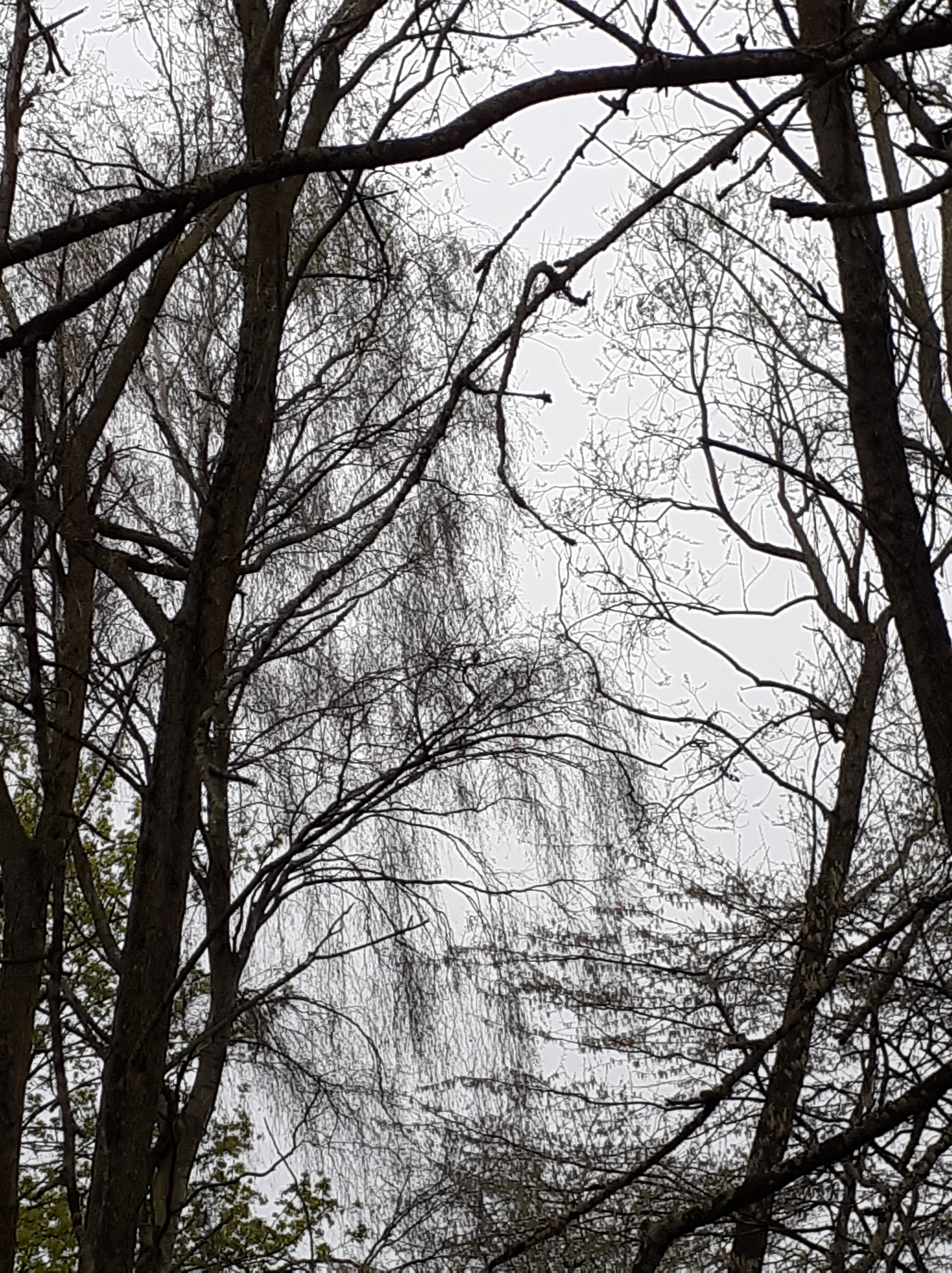
I look at the picture with fresh eyes. It is already a record of the past, and it is much too still. Yet I feel drawn towards this image. I enjoy the tree shapes in their starkness. I sense resilience in the plant life pictured here. I am writing now with sunlight intermittently on my shoulder, and the sounds of wind and rain beyond my strong glass doors.
I am also reflecting on writing as a practice. Natalie Goldberg (1,2) writes books about this and her description of ‘writing practice’ seems to me to have two entirely compatible meanings. The first is that it trains people for the writing of poems, stories and novels. The second points to a form of life practice flowing from the view that “writing is the crack through which you can crawl into a bigger world, into your wild mind” (1).
In Wild Mind: Living the Writer’s Life Natalie Goldberg compares writing practice with journaling. “Journal writing has a fascination with the self, with emotion and situation. It stops there. Writing practice lets everything else run through us; in writing practice, we don’t attach to any of it. We are aware that the underbelly of writing is non-writing. Journal writing seems to be about thought, about rumination and self-analysis. … We want to get below discursive thought to the place where mind – not your mind or my mind but mind itself – is original, fresh. It’s not you thinking. Thoughts just arise impersonally from the bottom of our minds. That is the nature of mind – it creates thoughts. It creates them without controlling them or thinking them … Writing practice knows this, knows how we are not our thoughts, but lets the thoughts, visions, emotions run through us and puts them on the page.” (1)
In her earlier book, Writing Down the Bones: Freeing the Writer Within, Natalie Goldberg quotes Jack Kerouac as saying that a writer should be ‘submissive to everything, open, listening’. She also recommends that “we stay in the trenches with attention to detail”, avoiding escape into abstraction. She points to poetry in particular, “because it brings us back to where we are. It asks us to settle inside ourselves and be awake”. She reproduces the famous William Carlos Williams poem:
“So much depends
upon
a red wheel
barrow
glazed with rain
water
beside the white
chickens.”
I remember this poem from my childhood. I liked it a lot, but couldn’t find anything to say about it in the class room when it was expected that I would. I was embarrassed then. I wouldn’t be now.
Natalie Goldberg also practices Zen Buddhism, with Katagiri Roshi until his death and more recently as an ordained member of the Order of Interbeing founded by Thich Nhat Hanh. She acknowledges the role of Zen in developing her insights into the creative process. I find her approach, including her practical exercises, very helpful.
(1) Natalie Goldberg Wild Mind: Living the Writer’s Life New York, NY: Open Road Integrated Media, 2011 (first published 1990)
(2) Natalie Goldberg Writing Down the Bones: Freeing the Writer Within Boulder, CO: Shambhala, 2016 (30th anniversary edition)

 Contemplative Inquiry