Contemplative Inquiry

This blog is about contemplative inquiry

Tag: meditation

BOOK REVIEW: THE CRANE BAG
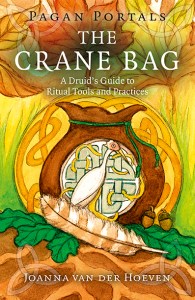
The Craane BagThe Crane Bag, Joanna van der Hoeven’s forthcoming book*, offers an introduction to the ritual tools and practices found in the Druid tradition. It achieves this briefly, simply and with a light touch – as books in the Pagan Portals series are designed to do. Yet it much more than a tick box guide. It provides context and meaning, showing the modern evolution of the Druid tradition itself.

The author makes it clear that she wants readers “to develop their own path in their own time in their own fashion”. Re-enchantment is both path and goal. With proper use, the crane bag “can further the Druid in working with the tides of nature, finding his or her own place in the environment, living in balance, harmony and peace”. The movement overall is “toward reintegration with the natural world”.

At its simplest, the crane bag is the container for Druid ritual tools and as such enables the practices. Bag and tools provide the practitioner with “something tangible to express the spiritual”, acting as a portable “map of the soul”. Behind the crane bag lies an ancient Irish story beginning with the contention between two sisters and the transformation of one of them, Aoife, into a crane. The story is beautifully told and its relevance clearly explained in the first chapter of the book.

In ritual, a period of time and an area of space are set apart and dedicated. This is not to create a lasting duality of sacred and mundane, but a step on the way to experiencing everything as sacred. “Ritual helps us to step back from the busyness, into another way of being. It is a change of consciousness, where we can shift our perception away from a singular view to a more plural view, realising that we are part of an ecosystem”. There is a clear preference for working outdoors, where awareness can shift more readily, though this is not insisted on.

A Druid’s tools will vary with the Druid. The book identifies the following: a silver branch; a staff; cups/bowls/cauldrons; drums; a sickle or knife; robes; altars; fire/candles; incense. People may make or buy them. Ethical sourcing of tools and materials is discussed in some detail, in line with the values of The Crane Bag overall.

What goes into a ritual is explored under the headings of call for peace; preparing the nemeton; honouring spirits of place, three worlds, four directions, ancestors, deities; ritual action; prayers and magic; offerings; eisteddfod; sacrifice; feast; closing. There’s encouragement to practitioners to craft what is right for them from within this set of suggestions and beyond it. The author adds, “I have been in circles with Christian Druids and Buddhist monks, as well as other religions from all over the world”. What matters in ritual is being present and performing the ritual with mindfulness, so that “any words that you speak, any gesture or movement you make will flow more easily, be more graceful and filled with meaning”.

There’s a final chapter on ‘altered states’. I don’t use the term myself, because it makes an ‘altered’ vs ‘normal’ distinction that doesn’t really work for me in my own life. But I recognise it as a term that is widely and usefully employed. Here, it facilitates valuable discussions of meditation, drumming, chanting and song, sensory deprivation, sacred landscape and sitting out. Three kinds of meditation are distinguished: calming the mind and re-tuning the body, journeying and problem solving. Guidance is offered on each kind. Different suggestions are also explored within the other topics. For sensory deprivation, there are two. One is the Celtic version of the sweat lodge, called teach an alais. The other is total immersion in darkness for a considerable period before being brought out into the light. The author refers to early medieval accounts of this, where it was done in aid of Bardic inspiration and prophesy: imbhas forosna.

I found The Crane Bag a very useful contribution to its topic and highly recommend it.


Joanna van der Hoeven The Crane Bag: a Druid’s guide to ritual tools and practices Winchester UK & Washington USA: Moon Books, 2017

*According to the publisher, the book is due for release on 28 July, and can be pre-ordered through Amazon US & UK, Indiebound and Hive.

HEADLESS ZEN?

“Let go of emptiness and come back to the brambly forest. Riding backwards on the ox, drunken and singing, who could dislike the misty rain pattering on your bamboo raincoat and hat.” Chan Master Hongzhi.

Recently I came across Susan Blackmore’s Zen and the Art of Consciousness (1). Blackmore, though not a Buddhist, works experientially within the Chan tradition (Chan being a Taoist influenced form of Chinese Buddhism, and the precursor of Japanese Zen). It’s how she does her first-person, subjective lifeworld inquiry into consciousness, which she also studies as a cognitive scientist. The book shows her working through ten questions, starting with: ‘Am I conscious now’?

Question 3 is ‘Who is asking the question? Here she brings in Douglas Harding of the Headless Way* and uses some of his experiments. I worked with these last year. I didn’t maintain an ongoing connection with the Headless family for long, mostly because of Harding’s tilt towards self-identification with/as the One cosmic consciousness, as the means dis-identification from ‘self’ at the human level. I’ve discovered that I can’t align myself with it. I don’t want to be God. Yet the ‘headless’ experience and its value have stayed with me. After completing my first Headless Way* pointing experiment, I reported: “pointing out – ‘curtains, folds, blueness, a crack showing light. Right arm. Flesh, tattoos, patterning. Pointing in: nothing: a relief, really, and a joy.” As that work continued, the joy only grew when the exterior view rushed in to fill the space. I say ‘view’ rather than ‘world’ because the world I perceive is a co-creation of the (presumed) outside world and my own (presumed) senses. A bat would have a completely different experience. Still, there was a sense of ‘everything’ filling my nothing at the centre.

Blackmore’s version is this. She describes meditating and looking towards a flower bed. “I paid open attention to everything I could see and hear, and in the space at the top of my shoulders I found no head, only forget-me-nots. I looked for the self who was looking at the forget-me-nots, and simply became them. It was very simple; very obvious”. Blackmore’s subsequent understanding – “what I see is what I am’ – does not as I read it make ‘I am God’ cosmic consciousness claims. Indeed, she is influenced by the philosopher Dan Dennett, who thinks of ‘consciousness’ itself as not just a reification (turning a process into a substance) but an altogether redundant idea. He’s the opposite kind of monist to Douglas Harding.

Some people like to have a line to follow. I like openness, and the possibility of multiple perspectives. I like the gleeful return to the commonsense world indicated by the 12th century Master Hongzhi above. It’s in Blackmore’s book, as part of feedback from her own Chan teacher at a time when she was in relentless pursuit of the problem of consciousness, and may have needed some rebalancing and lightening up in her role as sentient being. I also like the Interbeing approach mapped out in Thich Nhat Hanh’s commentary on the Heart Sutra (2) and more recent works such as his Love Letter to the Earth (3), with ‘We are the Earth’ as its first section and ‘Healing Steps’ as the second.

I will give the last word to a member of the Headless Way community. This is in the form of a poem by Colin Oliver called the Oneness of Things (4), which for me captures the ‘headless’ experience seamlessly, and – as only poets can – finds room for all of the above:

The sun low over the beach:

shining wires of dune grass,

stones and the shadows of stones.

On the shoreline, the rush of foam

mirrored in the wet sand.

In the oneness of things

I am nowhere in sight.


* www.headless.org/

(1) Susan Blackmore Zen and the Art of Consciousness, Oneworld Publications, 2014 (ebook edition)

(2) Thich Nhat Hanh The Heart of Understanding: Commentaries on the Prajnaparamita Heart Sutra Berkeley, CA: Parallax Press, 1988

(3) Thich Nhat Hanh Love Letter to the Earth, Berkeley, CA: Parallex Press, 2013

(4) Colin Oliver Nothing but this Moment: selected poems London: Shollond Trust, 2013

TEMPLE OF SOPHIA

My ‘Temple of Sophia’ recollects the active imagination work I did when practising Druidry and the Way of Sophia as a fusion path. The Temple keeps the work alive for me, though its presentation lacks the dynamism of the original set of practices when I was working them. The Temple structure owes something to the ‘art of memory’ of the ancient Greeks This was a system of impressing ‘places’ and ‘images’ on the mind, which continued into the dawn of modernity. Late practitioners included Giordano Bruno and the English alchemist Robert Fludd (1).

Here is how the visualisation goes.

“[I am] …on the water of a lake, in a rowing boat … mooring on the western shore … walking eastwards on a path between carved stones … on the left hand a Pictish ‘dancing seahorse’ … on the right hand, a Levantine image (a pomegranate tree, serpent coiled around the base, dove at the top) … moving up to the western door of the Temple of Sophia, a domed stone building, half hidden in extensive tree cover … basically round but with arms extended in each of the 4 cardinal directions to create an equal armed cruciform shape.

“I enter the temple through a porch at the western end, over which are written two lines from Primary Chief Bard, in the Book of Taliesin (2): I stood at the cross with Mary Magdalene; I received the Awen from Ceridwen’s cauldron. I find myself facing the eastern wing. Its most striking feature is a rose window at the back. It also has an altar whose white cloth is embroidered with a golden gnostic cross, and strewn with white and red rose petals. At the centre stands a chalice, white candles on either side. Looking around me I see steps spiraling downwards to a crypt, left (northern extension) and steps spiraling upwards to an upper room, right (southern extension).

“The main body of the temple is lit by chandeliers hanging from the ceiling as well as natural light from the windows. On the floor is a large mosaic given definition by the golden outline of a circle, crossed at the cardinal points by golden lines which merge at the centre within a fully golden circle, which includes 3 white seed pearls in a triangular cluster at the centre.

“Just outside the outer circle, around the wheel of the year, are depictions of 16 trees: yew, north-west; elder, north-north-west; holly, north; alder, north-north-east; birch, north-east; ash & ivy, east-north-east; willow, east; blackthorn, east-south-east; hawthorn, south-east; beech & bluebell, south-south-east; oak, south; gorse, south-south-west; apple, south-west; blackberry & vine, west-south-west; hazel, west; rowan, west-north-west. Each representation of a tree on the mosaic offers a portal for further communication with the tree. If I visualize myself standing on the image, then I may enter another imaginal landscape for a fuller experience – whether through sensing or communicating with the tree in question, or indeed becoming it.

“Moving in to the delineated quarters of the main circle, I find: north, a seated white hart in a yellow square; east, an eagle with wings outstretched, in a blue circle; south, a mottled brownish adder in a red triangle; west, a silver salmon over a silver crescent moon. These positions, too, are potential portals into an Innerworld landscape. If I visualize myself standing on an image, it has the power to take me to another imaginal landscape, and to forms of engagement – whether simply connecting, communicating or indeed journeying there. At the golden centre of the circle, the cluster of three white pearls recollects the three drops of inspiration distilled from Ceridwen’s cauldron and the visionary power of Awen. There are also other trinities – the triple goddess; the orthodox Christian trinity; or the divine mother, father and child; or the singularity of Tao becoming the two, three and 10,000 things. This is more a place for simple contemplation.

“Spiraling again out of the circle, and exiting north, I descend into the crypt. Here I find an empty sarcophagus dimly lit by candles. Two or three steps below the sarcophagus is a small, warm pool, lit by night lights – a ‘birthing pool’, perchance a re-birthing pool. There is an image of a coiled serpent at the bottom of the pool and a red ankh painted at the centre of the ceiling. I can spend time lying within the sarcophagus, contemplating change, death and dissolution. I can also move on to the birthing pool, and taste the experience there.

“Leaving the crypt and moving across the temple, I climb the steps to the upper room, which has a meditation chair at its centre, with a chalice, or grail, on a small table in front of it. There is a white dove painted on the ceiling; otherwise the room is plain. If I centre myself and drink from the chalice, saying, my heart is home to Sophia, I may find myself in a Garden. It has a fountain at the centre, surrounded by four flower beds of alternating red and white roses. There are fruit trees, apple, pear and plum, trained around the walls. Sometimes, full bright sunlight shines on the scene and strikes the dazzling water of the fountain, warming an illuminating each drop as it falls. At other times, I am in moonlit or starlit night, and I hear as much as see the fountain. Either way, I open myself to the experience of the Garden. Sophia herself as psychopomp may or may not appear. Indeed, there is no ultimate distinction between Sophia, the Garden and me.

“On coming back from the vision of the garden, I sit and rest for a while. Eventually I leave the upper room, and, descending into the main body of the temple. I walk to the south point of the circle and from there move, spiralling, into the centre. I face the altar at the east, bowing and giving thanks before I leave the temple.”

(1) Frances A. Yates The Art of Memory London: Pimlico, 1966

(2) John Matthews Taliesin: Shamanism and the Bardic Mysteries in Britain and Ireland London: The Aquarian Press, 1991

CONTEMPLATIVE DRUIDRY

Yesterday we closed down the Druid contemplative group in Stroud,, Gloucestershire, England launched in 2012. It’s not easy to judge the life-cycle of a group. In this case, people (including me) were beginning to move on in their various directions. We made an intentional ending at the right time. I celebrate that group, it’s members and its life, and take many riches with me.

Nimue Brown's avatarDruid Life

I first joined Contemplative Druidry as a facebook group, but by happy chance I moved to Stroud, which was the location for physical meetings, so about four years ago, I started going to those as well. It brought me into contact with many likeminded people locally. The monthly opportunity to sit in contemplation with others was a tremendously valuable experience. The habit of looking at where I am in my life and being witnessed in a held space has been good for me too.

Yesterday was the final session. It struck me how rare a privilege it is to close something with care and attention. How often the last time we do something, we only know in hindsight. Consciously and deliberately bringing something to an end, honouring its history, and letting it go is a beautiful thing to get to do, and very much in keeping with my experience of…

View original post 291 more words

FULLNESS

Yesterday I spent 90 minutes watching trees, their branches now bare, against a steadily darkening sky. I forgot myself in the scene, feeling filled with it. The core experience was fullness.

I suppose that this is what I mean by the ‘sacrament of the present moment’ – though this experience was of the flowing present, extended over time, noticing and enjoying change in nature. On later reflection, I was less reminded of mystics and meditators than of poets, particularly John Keats and his ‘negative capability’. He contrasted this with another type of response, which he called “the Wordsworthian or egotistical sublime”. Negative capability is “everything and nothing – it has no character – it enjoys light and shade; it lives in gusto, be it foul or fair, high or low, rich or poor, mean or elevated – It has as much delight in conceiving an Iago as an Imogen. What shocks the virtuous philosopher delights the chameleon poet”. (1)

‘Everything and nothing’ can be experienced as empty or full. I’m increasingly finding fullness. This has the effect of holding me in nature and time, in my unique human life soon enough to be over. This is where I want to be, with the important qualification that ‘fullness’ gives me a additional sense of being resourced by a larger well-spring of life than I might otherwise recognise. Experienced fullness doesn’t come simply from trees and sky. It comes also from the receptive openness I access when my senses are attuned. I find myself feeling a stillness underneath and within all movement; hearing a silence underneath and within all sound; seeing a soft luminescence underneath and within all colour and form, and in darkness too. These are the keys to fullness – a fullness where everything stills and slows down yet doesn’t stop.

Largely this is what I now mean (for myself) by a ‘contemplative’ state. Its development reflects a magpie approach to learning and my felt sense of what is right for me. I discovered the stillness through Buddhist breath meditation (movement of the breath as the belly rises and falls; yet stillness within). But I am not a Buddhist. I learned the silence through listening to the Oran Mor (Song of the World), though I don’t currently work within Gaelic traditions. I discovered (what should I call it?) primordial luminescence within the Headless Way (2). But I’m not continuing with the Headless path, because the headless trope itself now feels tedious and I don’t entirely share the Harding world view. Fullness has a link to Sophian Gnosticism, of all these traditions the closest to my heart, under the Greek name Pleroma. But my ‘fullness’ has come out of direct experience and I’m being careful to keep it that way. I like the resonance of the English word fullness, and it helps to maintain a degree of separation from the ancient view. Yet even whilst maintaining my inner authority, I am grateful for these inputs from the world’s spiritual heritage. I remain indebted whilst crafting my own path.

I’m not Keats and, for me, negative capacity for fullness tends to come as an alloy. It is generally interspersed with a certain amount of egotistical sublime, in my case as an upgraded stream of consciousness or monkey mind narrative. In my universe, that’s fine too, and all part of the fullness. I would like more skill in switching between the two modes at will, and I believe this to be achievable. At another level, it doesn’t really matter.

(1) Keats selected poems and letters Oxford: Heinemann Educational Publishers, 1995 (Selected by Robert Gittings; edited by Sandra Anstey)

(2) http://www.headless.org

POST INQUIRY: SACRAMENT OF THE PRESENT MOMENT

I don’t have to share a person’s cosmology and beliefs to learn from them. Right now, I am thinking of Martin Pegler’s book (1) on the modern Christian mystic Martin Israel. It was recommended to me by my Druid friend Rosa Davis and I realised that it helps me to articulate something important even though I do not share its faith framework.

Pegler and Israel both use the term ‘sacrament of the present moment’. This isn’t just about being awake and attentive. Talking about ‘contemplative prayer’, Pegler says: “Reality need not be attained since it is an already accomplished fact, but it still needs to be recognised and then made our own if it is to mean anything. With an open mind and heart, it is best to forget everything we have learned and begin again just where we are … we wait patiently in the stillness of attentive trust for Truth to reveal itself”.

Pegler is a former follower of Ramana Maharsi who came back to the Anglican Church, so he is speaking of a Divine Truth. But his approach does not require this understanding to make sense. “Making a solemn pledge to honour everything in our experience is enough to allow the waters of Life to flow unencumbered … To know the true self … requires a radical acceptance of ourselves as we really are, of our whole personality in fact. As the outer layers are recognised and put in proper perspective, so the core or centre of the psyche is revealed. How radiant and warm it is but how few of us know it! We are deterred from this knowledge by the surrounding layers of cold and darkness. Many people strive for this central place of warmth, of which they are intuitively aware and may even have touched momentarily during meditation or during some great aesthetic experience. But few will attain comfort until they have made the surrounding darkness their own possession also.”

I find these reflections helpful. Treating present moment awareness as a sacrament, rather than an attainment or skill is helpful. Allowing the ‘moment’ to be reflective – to have depth and interiority – is helpful. Recognizing ‘light’ and ‘dark’ alike is helpful: nothing gets airbrushed out.  The sacrament of the present moment is a full recognition of who I am and the context in which I find myself.

This radical acceptance paradoxically opens space for change. I find limited value in approaches that say, ‘don’t be like that. Be like this instead’. But the sacrament of the present moment is different. I think I’ve been celebrating it for a long time without naming it. Each experience is what it is, and remains sacramental in despair and joy alike. Cumulatively I have been finding it naturally easier to access a felt sense of inner freedom and peace. I recognize this heart space, or heart-wisdom space, as my true home. This place, or state, is also the centre from which I operate best in the wider world. It is my reason for maintaining a personal contemplative practice.

(1) Philip Pegler Meeting evil with mercy: an Anglican priest’s bold answer to atrocity Winchester & Washington: Christian Alternative, 2016 (Reflections on the Ministry of Martin Israel)

BOOK REVIEW: ZEN FOR DRUIDS

jhp574843867221aIn this user-friendly book, Joanna van der Hoeven further develops ideas already present in her earlier ones, especially Zen Druidry. On my reading, this book will work best for Druids committed to a modern eco-spirituality. I imagine readers already re-enchanted by their experience of the natural world, who want a harmonious relationship with that world, and to honour, protect and preserve it. Zen for Druids confirms this stance and adds something else: the interwoven ethical and attentional training of the Buddhist tradition.

The author draws specifically on Thich Nhat Hanh, the Vietnamese Zen Master who founded the Community of Interbeing and is a leading model and exponent of ‘engaged Buddhism’. This cultivates personal, social and ecological levels of awareness. It recognizes the radical interdependence of all beings and a need to make ethical/political choices in line with this interdependence. Such Buddhism is not in any way world denying, in the way that Buddhist tradition has at times been in the past. I see Thich Nhat Hanh as a perfect source of influence for this book, and several of his own works are cited in the bibliography.

Zen for Druids is divided into five parts. The first is a clear exposition of Buddhist basics, helped by that tradition’s own style of clear exposition and list making. It includes chapters on the three treasures, the four noble truths, the five basic precepts for lay Buddhists, the eightfold path and the sixteen Bodhisattva precepts. By age-old Buddhist design, there is a certain amount of repetition in these lists, with the same issues coming up again in slightly different contexts. Each individual chapter ends with a set of questions designed to engage the reader in their own reflections.

The second part moves through the eightfold wheel of the year, frequently found as a festival year in Druid and Pagan communities. Each festival is given its own chapter, and each chapter combines traditional Druid and Pagan themes with a principle from the Buddhist eightfold path. The author starts at Samhain (right effort), moves on to the Winter Solstice (right mindfulness), Imbolc (right concentration), Spring Equinox (right intention), Beltane (right view), Summer Solstice (right action), Lughnasadh (right speech) and the Autumn Equinox (right livelihood). Each section is followed by a list of suggestions for practice.

The book’s remaining three parts are shorter. They concern, respectively, meditation, mindfulness and integration. In two chapters on meditation, the first explores ‘mind traps’ – “those little prisons of our own making. We are constantly hijacked by our thoughts and feelings, attachments to them and our egos, such that we spin endlessly in circles until we fall down”. The second shows us to how do a brief meditation session in the Zen manner. The following section, concerning mindfulness in the world, suggests a practice of ‘mindful Mondays’ and explores the relationship between present time awareness and an animist world view. The final section, on integration, focuses on our integration with nature, looking at the issue of ‘ego, self and identity’ before reflecting on ‘awen and relationship’. For Joanna van der Hoeven, indeed, “awen is relationship and integration, the connecting threads that bind us soul to soul”.

In Zen for Druids, one Druid shows how she has taken an iteration of Zen Buddhism into her life and practice, combining them into one path. She sets out her stall very clearly and offers the reader specific opportunities and resources for practice and reflection. This book does a valuable job well.

Joanna van der Hoeven Zen for Druids: a further guide to integration, compassion and harmony with nature Winchester & Washington: Moon Books, 2016

‘LOOK FOR YOURSELF’

Last Sunday evening I returned home from Look for Yourself, “a residential workshop to explore the headless way in every day life and how to explore it” (1).

The workshop was four days long. It brought together some 50 people, with varied levels of experience, who practise the headless way. The note was one of experiment and celebration. The facilitation was excellent.

This was my first experience of working in community in this way, and I am immensely grateful for it. Sharing my experience, and exploring its meaning with others dedicated to the same practice, provides a reference point and resource for my everyday life.

In this tradition, ‘Seeing’, being a ‘Seer’, involves an initial surrender to naivety and seeing through the eye of the infant. Pointing away from myself, I see light, colour, form. Pointing in, where others see my face, I see nothing – and light, colour and form fill the space and sit on my shoulders. I discover myself as clear, awake space – and capacity for the world. Ultimately, I AM the nothing, which contains everything.

Seeing is a valley experience. Although I feel open and inclined to be friendly, I do not experience bliss or euphoria. I do not feel that I know everything or have gained special abilities. Seeing is just what it is, with a certain understanding. It is reliable, repeatable and doesn’t go away.

When I move into Seeing in my morning practice at home, it feels like a sacrament rather than a meditation. I have even evolved a brief liturgy for when I move out of the formal practice – imagining Sophia both as Wisdom and as Love:

Wisdom says I am nothing; Love says I am everything.

In the silent stillness of Seeing, I AM.

In the cosmic web of creation, i become.

It acts as a reminder that I have learned how to open the gates of Heaven gently, from within, understanding my true nature. James no longer has to look for ways of getting them to open from the outside – whether through humble prayer or siege by meditation.

Most of the time i am James, timebound in 3D reality, and i like this, enjoy it indeed: the task and privilege of a human is to live a human life. However Seeing involves being able to distinguish the i of James and the I of Awareness (the little one and the big one as we would say in the workshop). In Seeing, we take the goal as the path. We begin our exploration of the mountain from the top. Part of the work, then, is to refine our understanding of the experience and of an I/i, One/many cosmos (where these identities are distinct but not separate). The rest of the work is to maintain access to the experience and connection with its meaning. We can then learn to live our human lives out of it.

As I see it now, Seeing is our awakening. The headless way offers a minimalist yet subtle teaching, without any prescribed path or normative ethics. It also provides a loose-knit yet strong seeming community. The form of contemplation is the simplest possible – just Seeing: the simplest, yet also the most profound.

(1) http://www.headless.org


METHODS IN CONTEMPLATIVE INQUIRY: PART 3

This post is about meditation, and looks at three approaches to meditation supportive of contemplative inquiry. The first is that of the Headless Way, the second is Sophian meditation, and the third is a form of breath awareness meditation.

The Headless Way

 I have been working with the Headless Way – a path devised by the late Douglas Harding (1) – for 3 months, having started at the end of March. I include a ‘headless’ exercise in my morning practice on completion of my chakra work and in my understanding the experience is that of the 7th chakra, an empty awareness holding all the others. It begins with pointing first outwards and then inwards at our own heads, and then coming up with a literal description of what we actually see. On doing this for the first time, I wrote: “Looking out – curtains, folds, blueness; Looking at body – arm, flesh, patterning; Looking in – nothing but space and the ‘external’ impressions that fill it. An odd sense of relief, building to lightness and joy”. Later I talked of “space instead of head, never moving, always now” and how “world and sky rested on shoulders”. This experience, “seeing through the eye of Spirit”, as I called it quite early in the piece, tended not to last long in linear time in the early days, but “I experienced an extended afterglow in which a warmth and radiance of being continued”.

I find that, as Douglas Harding said, “the initial seeing gives the ability to renew it. Since the Absence of things here is as plainly visible and as coolly factual as their presence there, the seeing of this Absence is available any time, at will”. Not dependent on ideas or feelings, it is a contemplative path without the trappings of mysticism, available “at least as much” in the market place as in the meditation hall. Now I am familiar with it, I probably wouldn’t say “seeing through the eye of Spirit”, and some of the glow has gone. But regular practice has given me a reliable method of establishing a habit of conscious 1st personhood as “No-thingness here”. The work now is to maintain this perspective whilst giving full honour to my embodied every day self – the life of the other six chakras.

Breath meditation

 I still have a role for breath based meditation, and I like the version I alluded to in a January 2016 (2) post reviewing Russel Williams’ Not I, Not Other Than I (3). Here are his instructions, followed by my comments:

“Feel down here, a little bit above the navel you’ll find the right place. Centre yourself there, in feeling. Observe your breathing, in the sense of the expansion and contraction of the outer part of the body, as if it were a balloon …” From here we are guided to notice the calming and peaceful effects of this “gentle movement, this comfortable gentle movement … absence of agitation, peacefulness … a kind of heartfelt warmth of feeling … it feels homely, as though you belong there … And as though it were a light”.  We then move outwards from the “balloon” to include the whole physical body and then go beyond it. “It reaches out in all directions … and begins to feel at home with all its surroundings, whether it be animate or inanimate … of the same nature” …. And so on into silence for a few minutes. At the end of the meditation the practitioner is asked to draw back into the “very centre”, making sure it is “still peaceful and warm” before returning to normal consciousness.

“What I learned from this was the flavour of ‘sense-feeling’, a specifically located warmth, a sense of quiet movement, qualities of gentleness and peace. Nurturing is another favourite Williams word. These qualities fill the body-mind and move beyond it, filling emptiness, engendering loving-kindness. In a group meditation, Williams reports that they can create a deep rapport and subtle meeting place between participants. The aim is to develop “such gentle perception that you could compare it to a finger, soft and warm, touching a snow flake, but so delicate that the flake doesn’t melt”. From there, we can begin to see into the nature of things, becoming aware of a different reality, expanding into it until we become “boundless”. This is achieved not by any great effort, but by simply letting go.”

Whereas Headless Way seeing is best done standing up, this meditation is for sitting or reclining. However, in the reclining position, especially on a bed, I am liable to go to sleep. The quality of sleep is deep and refreshing, and I like it. But the posture is undoubtedly problematic for the more earnest and goal-oriented meditator. For me, the Headless approach is linked more strongly to inquiry, so the relaxation offered here is absolutely fine.

Sophian Meditation

I gave an example of Sophia meditation in my Re-dedication post in May (4). I wrote: “I open my heart to the wisdom of Sophia and gaze at my icon”, then going into reflective mode about recent contemplative work in the Druid community. On completing this period of reflection, I went deeper, saying: “I close my eyes and slip into Sophia’s Innerworld nemeton, which takes the form of a walled garden”.

I do this mediation sitting, and despite closing my eyes I do not find myself going to sleep. The basic setting doesn’t vary much. It is a familiar and well-worked Innerworld space. “At the centre is a fountain surrounded by four rose beds separated by run-offs. Two of the beds hold white roses, and two hold red. There are seats around the fountain, big enough for two people, on all four sides. The rest of the garden is more of an orchard with many kinds of fruit tree, including some trained up the garden walls. These walls are brick, and have an eighteenth century feel.  The orchard isn’t over-manicured. It might indeed be described as slightly unkempt, though not with any sense of neglect.”

Specific characteristics vary a lot, and much of the communication available to me here is through the variances in setting, or how Sophia presents herself, rather than through actual dialogue.  When I visit this garden, the Sophia of the icon may sit opposite or beside me. But she may also take different forms – a dove, a rose, a tree, the fountain itself. She may be another bird or creature that turns up in the space. She may be sunlight in a drop of water. I may also experience her as all of it, so that goddess and nemeton are one. She is always a friend and guide. In my re-dedication piece, I went on the describe the specific circumstances of the day:

“This time she is in her icon form, though the dove is in a tree and the chalice by her side as she sits opposite me, in the late May dawn, east facing west. I go into my headless state and know that the same is true of her. But the context (the Innerworld, in this garden, with Sophia) changes the state, making it more intimate, relational and local. I like it. In my heart, I have more care about the particularities, indeed vagaries, of the writing than the pristine emptiness of the paper that holds them, though both perspectives matter and they do belong together. If form is nothing but emptiness, and emptiness nothing but form, then what we always have is paper being written on, and it is the story writing itself that mostly draws a storying monkey like me.

“As this thought, within my living dream of the garden, passes through, Sophia comes to sit beside me. We are simply companionable, watching the fountain, as the clear fresh water bubbles up. It is from an inexhaustible spring. In this archetypal garden setting, Sophia renews an eternal pledge – that wisdom’s commitment is to extend and transmute knowledge, and not to repress it. And in this moment the garden, the fountain and Sophia begin to fade …”

Next Post

The final post in this series will be about questions of interpretation in contemplative inquiry.

 (1)  Http://www.headless.org

(2) https://contemplativeinquiry.wordpress.com/2016/01/29/book-review-not-i-not-other-than-i/

(3) Russel Williams Not I, not other than I: the life and spiritual teachings of Russel Williams Winchester, UK & Washington, USA: O Books, 2015 (Edited by Steve Taylor)

(4) https://contemplativeinquiry.wordpress.com/2016/05/26/re-dedication/

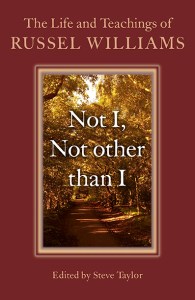
BOOK REVIEW: NOT I NOT OTHER THAN I

Not INot I, Not Other than I is an inspiring story of spiritual awakening. For me, the book has a skilful balance of biography and wisdom in which each throws light on the other. Highly recommended to people involved or interested in contemplative spiritualities.

Russel Williams left school aged 11. Both of his parents were dead and he was too old for Barnado’s.  So he was licensed to work for a living, though in 1932 and the years that followed it was hard to make ends meet. He describes himself in his teenage years as existing but not living. He was angry and aggressive, with no empathy, a quick temper, and prone to getting into fights. What frustrated him most was a sense of his own ignorance.

In 1939 war broke out and Williams joined the British army. He recalls that being a soldier “saved me from a bad end, kept me out of trouble – and most importantly it took away the worry of keeping myself alive. I had regular food and shelter for the first time since my parents died. It was easy, compared me to the life I had before. It also taught me self-discipline to control my emotions”.

After the war he went “walking, walking …” until he making contact with another man, who was starting up a small circus. Williams accepted the job of looking after the horses, and he began to feel a strong connection with them. He wanted to understand them better. “I set my mind to watching and observing every detail, every moment of the day, for days on end”. This process became “more and more concentrated”. He was “not thinking any more”. His mind had “gone quiet”. He was experiencing states of “spontaneity” and “living in the moment”. He began to “look through the horses’ eyes”, as the boundaries fell away, and he became notable for his calming and healing presence when working with them.

Still in his 20’s, Williams began to discern a path in life. Later he framed his life with the horses – 20 hours a day, 7 days a week, for 3 years – as a naturally occurring education in mindfulness meditation: his life a continual service, “with no thought of myself”. He still experienced frustration and disappointment, because he couldn’t find anyone to talk to about this who seemed willing to treat him seriously. But eventually he ran into a small number of kindred spirits, people with whom he could enter into close rapport, and this led to his joining the Manchester Buddhist Society in 1957.

Although the Society made a connection with Thai Buddhism in 1954 (one of their members trained as a monk) Williams himself has kept a distance from formal Buddhism. He has been President of the Society for over 40 years and he still doesn’t call himself a Buddhist. His life and work has included esoteric Christian influences and a resonance with Ramana Maharshi. One of his sayings is that whereas “Buddhism is a belief system … the way of the Buddha is a recognition system”. Acknowledging that Buddha didn’t go beyond dealing with suffering, never mentioning spiritual worlds as such or communicating with other entities, he added “but we do”. Williams’ way of the Buddha is also a way of the free spirit.

Russel Williams is now 93. He is still going strong. My contemplative Druid companion Rosa Davis mentioned this book at our last group meeting. Williams says that his life experience and practice have led him to a “natural state” of oneness with everything, and with the universe itself. “We are part of the unmanifest. We are part of the pure consciousness which has given rise to the whole universe. That consciousness is our true nature, and, when we rest within it, we feel a powerful sense of ease and contentment”. He believes that this is the only meaningful way of understanding the term ‘God’, and what Jesus of Nazareth meant when declaring “I and the Father are one”. This kind of experience, “stillness, pure consciousness, emptiness of being” is the inheritance of us all, and potentially available to us all. It is based on sense-feeling, and on filling the emptiness with loving-kindness.

Williams doesn’t support long meditation practices, though he does believe in frequent ones. He saying “once you get the process going” 10 or 15 minutes should suffice, and recommends doing it 7 times a day. For him, the way in to a full meditative state is through the realm of subtle feeling, and he invites us in with him about a third of the way through the book:

“Feel down here, a little bit above the navel you’ll find the right place. Centre yourself there, in feeling. Observe your breathing, in the sense of the expansion and contraction of the outer part of the body, as if it were a balloon …” From here we are guided to notice the calming and peaceful effects of this “gentle movement, this comfortable gentle movement … absence of agitation, peacefulness … a kind of heartfelt warmth of feeling … it feels homely, as though you belong there … And as though it were a light”.  We then move outwards from the “balloon” to include the whole physical body and then go beyond it. “It reaches out in all directions … and begins to feel at home with all its surroundings, whether it be animate or inanimate … of the same nature” …. And so on into silence for a few minutes. At the end of the meditation the practitioner is asked to draw back into the “very centre”, making sure it is “still peaceful and warm” before returning to normal consciousness.

What I learned from this was the flavour of ‘sense-feeling’, a specifically located warmth, a sense of quiet movement, qualities of gentleness and peace. Nurturing is another favourite Williams word. These qualities fill the body-mind and move beyond it, filling emptiness, engendering loving-kindness. In a group meditation, they can create a deep rapport and subtle meeting place between participants. The aim is to develop “such gentle perception that you could compare it to a finger, soft and warm, touching a snow flake, but so delicate that the flake doesn’t melt”. From there, we begin to see into the nature of things, becoming aware of a different reality, expanding into it until we become “boundless”. This is achieved not by any great effort, but by simply letting go.

‘Sense-feeling’ has already helped me in my own practice. It enriches my experience of ‘presence’ (a key word for me), placing it more clearly beyond witnessing awareness as normally understood. The meditative experience becomes participatory and nurturing in a more complete way, yet one that also seems easy, obvious, almost remembered rather than newly learned. I’m grateful for the recommendation and glad to be passing it on.

Russel Williams (2015) Not I, Not Other than I: the Life and Spiritual Teachings of Russel Williams (Edited by Steve Taylor) Winchester & Washington: O Books


Earth Eclectic

music that celebrates Earth and speaks to the heart

Sarah Fuhro Star-Flower Alchemy

Follow the Moon's Cycle

Muddy Feet

Meeting nature on nature's terms

Rosher.Net

A little bit of Mark Rosher in South Gloucestershire, England

Becoming Part of the Land

A monastic polytheist's and animist’s journal

selkiewife

Selkie Writing…

Charlotte Rodgers

Images and words set against a backdrop of outsider art.

Prof Jem Bendell

living with metacrisis and collapse

Towint

The pagan path. The Old Ways In New Times

The Druids Garden

Spiritual journeys in tending the living earth, permaculture, and nature-inspired arts

The Blog of Baphomet

a magickal dialogue between nature and culture

This Simple Life

The gentle art of living with less

Musings of a Scottish Hearth Druid and Heathen

Thoughts about living, loving and worshiping as an autistic Hearth Druid and Heathen. One woman's journey.

Wheel of the Year Blog

An place to read and share stories about the celtic seasonal festivals

Walking the Druid Path

Just another WordPress.com site

anima monday

Exploring our connection to the wider world

Grounded Space Focusing

Become more grounded and spacious with yourself and others, through your own body’s wisdom

The Earthbound Report

Good lives on our one planet

Hopeless Vendetta

News for the residents of Hopeless, Maine