I am connecting with spring and its urgent affirmation of life – its green shine and fecundity. It is the sunrise season, the season of early growth. For me, where I live, the immediate pre-equinox period often generates a strong feeling of dynamism and emergent potential. I am in sync with the awakening earth.
Elaine’s return from hospital and the enhanced clinical support she is receiving are helping me to live this season more fully. In our joint lives we are both feeling more agency in shaping a new phase in our life together.
In this moment I feel refreshed and optimistic within my Druid contemplative path. I have adjusted my formal practice so that I have two practice sessions in the day, both of them roughly twenty minutes long. The first, at the beginning of the day and standing, is affirmative and dynamic. It includes body and energy work and a theme of healing and rejuvenation. The second, at the end of the day and sitting, is contemplative. It includes breathwork, a mantra meditation using beads, and prayer. In the modern Druid manner it includes a commitment to the collectively imperilled qualities of love, peace and justice. This shift is having a renewing and reinvigorating effect on me, as befits the season: another way of gratefully affirming the gift of a human life.
Sufism is often referred to as the Way of the Heart. Hazrat Inayat Khan was a Sufi teacher and musician from Gujarat, India, who took his teaching to the West in the early 20th century. His combination of spiritual teaching, philosophy and music was normal in this culture and tradition. In his own life and work, Hazrat Inayat Khan created a Universal Sufi movement independent of its Islamic origins, though always inspired by them. Practitioners from his movement created the Dances for Universal Peace.
The image above is the Ace of Cups from Ayeda Husain’s The Sufi Tarot (1). Ayeda Hussain is a teacher in the Ineyatiyya, a global organisation dedicated to Universal Sufism as taught by Hazrat Inayat Khan. She sees Sufism and Tarot as two systems of healing and transformation that can be valuably brought together. She treats Tarot as a vehicle for spiritual teaching, going so far as to include contemplations and affirmations for each card.
Referring to her Ace of Cups, she says: ‘In Sufi poetry, the cup is the heart that must be emptied before the beloved can pour the Divine nectar into it. Just as a cup that is filled cannot be poured into, neither can a heart filled with limiting impressions. The work of the mystic then, is to clear impressions that clutter and cloud the heart, so that it may be able to receive. As the heart opens, we become aware of new offers and opportunities in both love and spiritual growth’.
I came to The Sufi Tarot by an indirect route. When I began working with my Ceile De (2) beads, I didn’t at first expect to use them for mantra meditation and I looked at a collection of fuinn (sacred chants) as an option for working with the beads. Fuinn tend to be brief and I thought that a single fonn might work for me. They are in Scottish Gaelic and frequently use heart language, as in:
Gun tigeadh, solas nan solas
(Goon tee-guch, sol-us nan sol-us)
Air mo chridhe
(Air mo chree)
This translates into English as Come light of lights, to my heart.
I found this fonn beautiful though somehow not right for my purpose. But the phrase air mo chridhe would not leave me. As soon as I heard it, in the old language, it needed no translation, and I felt I had known it forever.
What I did in my own practice, having decided on the Soham mantra for the beads, was to create a version of the modern Druid peace prayer as a love prayer.
Deep within my innermost being, may I find love.
Silently in the stillness of this space, may I nurture love.
Heartfully, in the wider web of life, my I live in love.
Now using this prayer, I felt the desire for friendly guidance in this work of the heart. I felt prompted to search for ‘Sufi Tarot’, and was surprised when came up immediately. When I received the pack, I was quickly reassured that I had had been given what I asked for. I look forward to this new thread within my contemplative inquiry.
(1) Ayeda Husain The Sufi Tarot Carlsbad, CA; New York, NY; London; Sydney; New Delhi: Hay House, 2022. Art team Nazish Abbas, Hassaan Aftab, Momina Khan
“I went to see the Mona Lisa in Paris, only to find that she is now permanently hidden behind a rugby scrum of people from everywhere on earth, all jostling their way to the front, only for them to immediately turn their backs on her, snap a selfie, and fight their way out again. On the day I was there, I watched the crowd from the side for more than an hour. Nobody – not one person – looked at the Mona Lisa for more than a few seconds.”
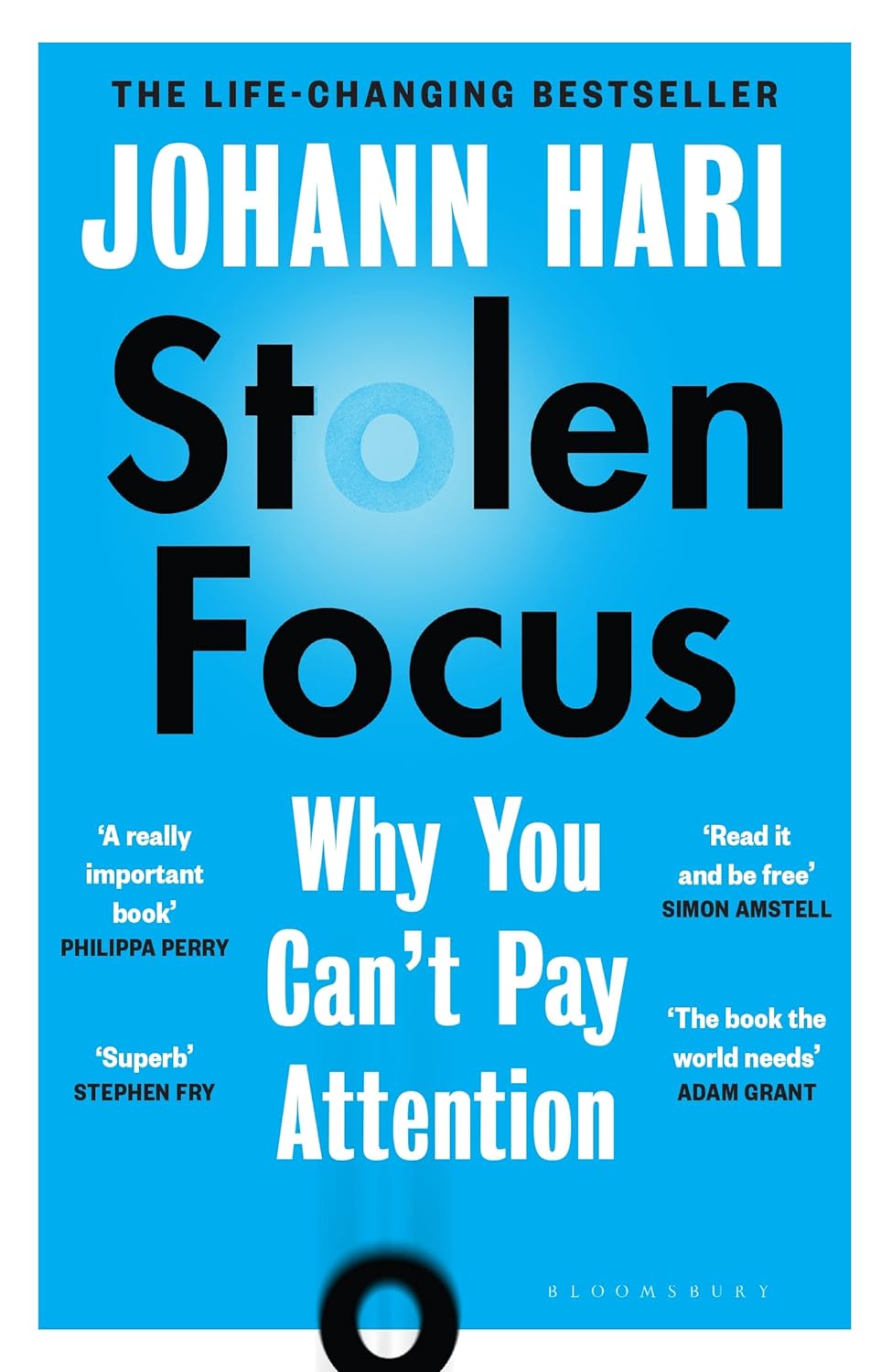
Johann Hari’s Stolen Focus: Why You Can’t Pay Attention (1) explores states of attention, how culture shapes them, and the implications of this shaping. I like Hari’s insistence that this is a collective issue and not just a matter of individual willpower. In this book, Hari identifies 12 causes of ‘stolen focus’. I plan to write a review of Stolen Focus soon. This post is about the first cause, which he describes as an increase in speed, switching and filtering.
Speed
According to Hari, modern culture overvalues speed. “People talk significantly faster now than they did in the 1950’s, and in just 20 years, people have started to walk 20% faster in cities” and “the original Blackberry advertising slogan was ‘anything worth doing is worth doing faster'”. But, argues Hari, “if you go too fast, you overload your abilities, and they degrade”. He reminds us that if we engage in deliberately slow practices, like yoga, or tai chi, or meditation … they improve our ability to pay attention by a significant amount.
Switching
Cognitive speeding has been made worse by the myth of multitasking, a term taken from 1960’s computing, when machines began to have more than one processor and could literally do two or more things at once. The human brain doesn’t have that capacity. It is naturally single-minded and isn’t going to change. So when we ‘multitask’, we are actually switching between different tasks, though we may not notice our switching.
The cost of switching is a degradation of our ability to focus, and a decline in our performance. Hewlett- Packard looked at the IQ of some of their workers in two situations. At first they tested their IQ when they were not being distracted or interrupted. Then they tested their IQ when they were receiving emails and phone calls. “The study found that ‘technological distraction’ – just getting email and calls – caused a drop in the workers’ IQ by an average of 10 points … twice the knock to your IQ that you get when you smoke cannabis”. Overall, if you spend your time switching a lot, the evidence suggests “you’ll be slower, you’ll make more mistakes, you’ll be less creative, and you’ll remember less of what you do”.
Filtering
“Think of your brain as a nightclub where, standing at the front of that club, there’s a bouncer. The bouncer’s job is to filter out most of the stimuli that are hitting you at any given moment – the traffic noise, the couple having an argument across the street, the cellphone ringing in the pocket of the person next to you – so that you can think coherently about one thing at a time.” The bouncer in our brain is the pre-frontal cortex, and it is becoming overwhelmed. There are too many stimuli and in many environments noise pollution in particular is interfering more insistently with the flow of our thoughts.
The crisis in attention that Hari outlines is a threat to our quality of life. It weakens our ability to think creatively or deeply. It tends to make us agitated as well as distracted. This is not a good place from which to build healthy relationships or solve complex problems at either the personal or the public level. I experience my contemplative inquiry as a valuable antidote to ‘stolen focus’. But it doesn’t get me everywhere, because loss of focus is a pervasive cultural problem. Beyond writing a review of the whole book, I intend to delve more deeply into the questions that Stolen Focus raises from a personal and a collective point of view.
(1) Johann Hari Stolen Focus: Why You Can’t Pay Attention London: Bloomsbury Publishing, 2022 (Kindle edition 2023)
Highly recommended to anyone interested in Chinese traditional poetry and culture, and the way it is received in China today. I looked at an aspect of Michael Wood’s In the Footsteps of Du Fu: China’s Greatest Poet (1) in my last post (2). This is a full book review. The back cover provides an accurate basic summary of its contents: “For a thousand years Du Fu (712-70 CE) has been China’s most loved poet. Born into the golden age of the Tang Dynasty, he saw his world collapse in famine, war and chaos. The poet and his family became impoverished refugees, but his profound vision and his empathy for the sufferings of humanity endured, and have endeared him to readers ever since. … Broadcaster and historian Michael Wood follows in Du Fu’s footsteps on a pilgrimage through the physical and emotional landscapes of his life and work”.
The book, lavishly illustrated, is divided into 24 chapters. Many of these are headed by place names. Michael Wood visited most of them on his own journey, talking with scholars and enthusiasts and also taking time to observe the very different China of today. The narrative is somewhat tilted towards the last 15 years of Du Fu’s life, when the War of An Lushan (3) displaced Du Fu and turned him into an internal refugee, constantly on the move, for the rest of his life. It is also seen as the period of his best poetry.
The first chapters of the book emphasise the easy optimism of Du Fu’s early years. A new Emperor, himself a painter, musician and poet, launched a cultural rebirth. He was a patron of libraries and scholars. He ruled a prosperous and peaceful country. Du Fu writes nostalgically of childhood years in which “rice was succulent … the granaries were full, and there was not a robber on the road in all the 9 provinces of China”. Growing up in the city of Gong-yi on the Yellow River, the son of an Imperial official, Du Fu looked forward to a successful life as both official and poet. “I’d read everything and I thought I was superb”. He went to Chang’an and took his exams for the Imperial service.
He failed them. “In the blue sky my wings failed me”. For some years he went on a series of family supported wanderings, honed his poetic skills and became interested in the Chinese version of Mahayana Buddhism. Returning to Chang’an he failed the exams again, but managed to get a lowly official job, married, and began to raise a family. He settled them in Fengxian near the capital, a place that featured hot springs. Although he had to be available at Chang’an, he visited often. At this point his poetry began to show a concern for ordinary people.
Here at the hot spring the emperor entertains his court
And music echoes around the hills.
Only the rich and powerful bathe here.
But the silk they wear was woven by people,
women whose husbands are beaten for their taxes.
In 755, even before war broke out, China was devasted by floods and a resultant famine. Du Fu lost an infant son to starvation and wrote that he was ashamed to be a father. Famine threatened again, on the road, after the rebel victory:
My little girl bit me in her hunger
And fearful that wolves or tigers would hear her cries
I hugged her to my chest, muffling her mouth,
But she struggled free and just cried more.
Michael Wood provides a map of the family’s subsequent movements, generally in the rugged, often spectacular and less populated west of China. They could never settle for very long, as political and military conditions remained volatile and unsafe. I describe Du Fu’s sojourn in Chengdu in my pervious post (2). Towards the end of his life, conditions seemed to be easing and the family began moving back east via the Yangtze river, in gradual steps. This gives Michael Wood the opportunity to describe his own experience of the hyper-modern city of Chongqing, though Kuizhou and the spectacular Three Gorges area are more important to Du Fu and his work. Wood says that, “in the Gorges, though it had been at great cost to himself, Du Fu’s gift was creative and imaginative freedom”. His output was prolific, and drew on a meditatively close encounter with nature.
Crescent moon stilled in the clear night
Half-abandoned to sleep, lamp wicks blossom
In echoing mountains unsettled deer stir
Falling leaves startle locusts.
By this time Du Fu was worn down by asthma, diabetes and years of hardship. Though he got a little further down river, he never made it to his original home. Nonetheless he was able to be defiantly celebratory:
Old and tired, my hair white, I dance and sing out:
Goosefoot cane, no sleep, catch me if you can!
Du Fu died at the age of 58 in Changsha in Hunan Province. Michael Wood went there simply to complete the journey, but was rewarded with a new lens on Du Fu’s work and the creative tradition he came from. He met Professor Yang Wu at the University there. One of her interests is “the living oral tradition of poetry and the possibility of reconstructing the ancient music that might have accompanied it”. Research on ancient poetry and music is an expanding subject in today’s China. Du Fu’s poetry has been preserved in Hunan oral tradition as well as in manuscripts. A local tradition of poetry clubs has survived the early Communist period. Now it is reviving and being encouraged. Professor Wu and her students have been busy with making replica’s of Tang dynasty instruments – for example the qin, a seven-stringed instrument with strings of twisted silk. They are finding manuscript records of early musical settings, and sound-recording local people’s singing. For me this adds another dimension to Du Fu’s work – where he can be understood , in part, as the lyricist for music that was performed in group and public settings.
In the Footsteps of Du Fu is highly informed and engagingly written. For me is also a beautiful artefact, though eminently portable, not at all a coffee table book. I rarely buy printed books now because the print is too small for me. But I was fine with this one and the illustrations are a joy. Another reason for my strong recommendation.
(1) Michael Wood In The Footsteps of Du Fu: China’s Greatest Poet London: Simon and Schuster, 2023
(3) In December 755 An Lushan, a Turkic general in the Imperial service, marched on China’s then capital city, Chang’an, from North China with a quarter of a million men. They inflicted a series of defeats on the Imperial army and occupied Chang’an in July 756. An Lushan was assassinated by his own son in 757 but the war continued for 7 years. Tang dynasty China, whilst nominally lasting for decades longer, was never the same again.
Personal note: Michael Wood’s introduction begins: “if you love literature of any kind, you will have had one of those moments when you encounter a book that opens a window onto a world you never dreamed existed. Mine was at school when I first encountered Du Fu in A. C. Graham’s wonderful Poems of the Late T’ang.” I had my own version of the same experience, and still have my battered old copy. Du Fu is transliterated in that and some other translations as Tu Fu. The price, in the top left corner of the cover (see picture) is 4/- (four shillings, or 20 pence in post-1970 UK money). I have never been a formal student or scholar in this domain, but modern English translations of classical Chinese poetry have left a deep impression on me. Another poem from this collection can be found in this blog at: https://contemplativeinquiry.blog/2016/02/04/poem-a-withered-tree/
Michael Wood In The Footsteps of Du Fu: China’s Greatest Poet London: Simon and Schuster, 2023
This poem welcomes spring and also celebrates arrival at a place of safety. For a brief period in the early 760s the Chinese poet Du Fu (712 – 770 CE) had a cottage and garden in Chengdu, the Brocade City. It was a time of social breakdown in China and although from the landowning and mandarin class, Du Fu and his family had become refugees in their own country. At times, during their wanderings in the rugged terrain of western China, they were shelterless and close to starvation. Nonetheless, Du Fu retained an underlying resilience. Despite everything his capacity to notice, contemplate, feel, care and write were not compromised. One of his earlier poems, written when trapped in the rebel occupied capital Chang’an (City of Eternal Peace, now Xi’an), begins:
“The state is destroyed, but the country remains.
In the City in spring grass and weeds grow everywhere.
Grieving for the times, even the blossom sheds tears
Hating the separation birds startle the heart.”
As part of his following in Du Fu’s footsteps, Michael Wood visited Chengdu and talked to local people and tourists from other parts of China. Why does Du Fu matter to them now? One older local resident said that he came to the garden – now a well kept heritage site – “at least once a month” to reflect on Du Fu’s poetry. “For a long time we suffered, now we are better off, but today society is very materialistic, and spiritual things are going away. But I feel these things still matter, and here in this place you can go right into his mind: the thoughts and feelings of someone from so long ago. To me, this is a miracle. The garden here is big enough to get lost in, away from the public, especially if you come early in the morning. I sit in a corner and recall him, maybe read out one of his poems out loud, and reflect on it”. He described this as his meditation.
Below is an imaginary portrait of Du Fu by the artist Jiang Zhaohe (1904 -1986). It was done in 1959, during Mao’s Great Famine, described by Michael Wood as “one of China’s most shattering disasters”.
In the later stages of a post mostly about the spiritual benefits of ‘deep adaptation’ (1), Jem Bendell discusses “sacred agnosticism, where the mystery of consciousness is surrendered”. I wish that I had come up with ‘sacred agnosticism’ myself, and the use of ‘surrendered’ in that context. I see it as a highly skilful use of language, that tricky medium, and resonant in the present stage of my own life and practice.
Describing his journey to this position, Bendall says: “for many years, I’d ditched religious stories of a soul that exists, like my current consciousness, in an afterlife. I’d also realised that aspects of reality and consciousness are ineffable. Meaning, once we use concept and language to describe the ultimate truth, we are moving away from reality.”
However, he goes on to acknowledge that: “I still had part of me that wanted to know. Will I still be conscious after death? Will I merge, will I reincarnate, will I experience nothing? Will I leave no trace in the universal information field or akashic record? Did I even exist much in the first place?”
Through reflection and meditation Bendall discovered that any narrative of this kind would, for him, “have originated in fear, where the ego needs to map, order and control reality and assert that to others”. In the absence of such stories he suggests that “the mystery itself is an invitation to transcend the ego.” So he decided that: “I wanted to cultivate a way of being where I will actually celebrate that ‘not-knowingness’ and would naturally feel that way at the time of dying”.
The content of the reflections isn’t new to me. Yet I do strongly feel that I’ve been gifted the right words at the right time. I am grateful to Jem Bendall for his post.
I was moved and inspired by Philip Carr-Gomm’s recent Peacemaking podcast on his Tea with a Druid. In the first five minutes he checks in with his live viewers, as is his custom, and finds a theme of anxiety and distress about world events. He speaks of the need for ‘islands of sanity’ – enclosures of calm and peace. He introduces the hope that the people gathered together by the podcast itself can become one. A guided meditation later in the podcast does the job. The gathering becomes an enclosure of calm and peace in real time. It still worked for me well after the event. Such is the magic of Druidry.
Before the meditation, Philip explains the role of Druids, ancient and modern, as peacemakers. The ancient Druids were exempted from military service and had a pan-Celtic authority. A Roman author depicts Druids as walking between warring tribes, urging calm and asking the fighters to put down their weapons: they were “shaming Mars before the Muses”. The God of war and destruction had to bow down before the Goddesses of creativity and inspiration. The Druids of that time were also lawmakers and judges. In Ireland, St. Patrick valued their Brehon Laws so highly that they were written down and continued in force. Peacemaking, peacekeeping and jurisprudence worked together.
In modern Druidry, Philip emphasises the attention given to peace in ritual, where the intention is to begin and end in peace both inward and outward. Our Druid prayer asks for justice, because where there is justice in the world there is also peace. Justice isn’t about killing. It’s about peace: right action, right speech, right thought, right behaviour. We trust the power of prayer and of consciousness directed by love. Sitting in meditation or prayer influences the people involved, and creates a field of consciousness and energy which acts as a patch of calm and peace in bad psychic weather.
I recommend readers to watch the video and, if you are willing, enter into its meditative space. I also include The Modron Prayer (Modron being the Ancient Mother) in this post, as a way of ending it:
“Deep within the still centre of our being,
May we find peace.
Silently, within the quiet of the Grove,
May we share peace.
Powerfully, within the greater circle of humankind,
Forgiving Humanity (1) is an extended essay rather than a book. I found it easy to read and hard to work with. Author Peter Russell is highly skilled at distilling data and making his case. His conclusion is that the near term extinction of the human species is inevitable, and not unnatural or to be faulted. “We are coming to the end of our species’ journey, spinning faster and faster into the center of an evolutionary spiral.”
Russell points to what he sees as our our natural-born drive for exponential growth and development. A dance of genetic and behavioural change led us to an enhanced brain, bi-pedal walking, manual dexterity, and a shift in the position of the larynx to enable complex speech. Cultural evolution then led to organised hunting with the throwing spear and, later, the bow. Later still, at an increasing rate of change, came agriculture, metallurgy, the industrial revolution (from steam to atomic power in not much more than a century) and, most recently, the accelerating information revolution now leading to the rise of AI. Quantum computing is on the horizon.
The problem according to Russell is that exponential growth is inherently predestined to run out of control. This is “the curse of exponential change.” Exponential growth is not like the linear growth that we can more comfortably imagine. In the domain of economics, for example, 3% annual growth rate in the world’s GDP, compounded over 100 years, would lead to a consumption of energy and resources at 20 times today’s rate. Russell started thinking about this problem as a young and gifted mathematician at the end of the 1960s. On his analysis, we would be fatally fouling our own nest even without the specific problem of the climate crisis. Climate change simply exacerbates and dramatises our predicament, hastening the process of breakdown.
Russell is aware of systemic injustices in our socio-economic system, but this book does not explore political mitigations. He expects major breakdown in this century. A remnant population in reduced circumstances will carry on for a while longer. But this human triggered extinction event, which has already claimed many other species, will still be rapid in planetary terms. In the immediate future, Russell sees a likelihood of continuing technological breakthroughs for some decades, in the midst of extensive cultural breakdown and a diminishing global population. I am not certain that he is right, but I fear that he may be. And I find him hard to read, trying to imagine what it would be like for different people in different places, and stepping into their boots down here in the trenches where embodied human life is lived until it’s gone.
Whilst the earlier sections of Forgiving Humanity are presented as if from the perspective of a distant cosmic scientist, there is a later turn to human experience and how to live in the new conditions. Peter Russell becomes one of us and shares his long-held view of consciousness and its possibilities, especially the affirmation that: “beneath our day-to-day experience lies a deeper sense of being, unperturbed by the goings on in the world, and our hopes and fears about them … meditative and self-enquiry processes … lead to greater calm and self-awareness, and … the more in touch we are with our inner being, the more considerate, compassionate, and caring we become – qualities that could prove invaluable in meeting the challenges ahead.” I also like his idea of remaining in service to the earth whenever we can, continuing to do our best for it even when knowing that our species is waning and likely to wink out. The notion of persevering with restorative efforts allows for limited local successes, seems like a healing process in itself and preserves a sense of positive agency in hard times. I am sure that people will continue to work in these ways whenever given half a chance.
For Russell, psycho-spiritual practices and communities are a key resiliency factor for navigating through heart-breaking conditions. We need to “find the acceptance that allows us to move into the unknown with courage and an open heart”. Russell says that facing our collective extinction is like facing our personal deaths, only more so because we are looking at the end of our kind. He borrows from a well-known map of how to work through five stages of grief – denial, anger, bargaining and depression – to a final acceptance. I have to note some reservations about schemes based on normative ideas about how we work through distress. People are very different – though many, it is true, are reassured by maps of this kind. I would also not want these suggestions to be misunderstood as an injunction to put on a mask of serenity when something else is going on in our body/mind. For me, the deeper acceptance is to recognise and accept our confusion and turbulence, if confusion and turbulence are what is happening. The spaciousness of deep acceptance then keeps company with them, avoiding both the false mask of serenity on the one hand, and immersed identification with our distress on the other. Nothing is denied.
I am not sure about the suggestion of ‘forgiving humanity’. If I take ‘humanity’ as simply the name of a species, I don’t feel that it’s my place either to forgive or withhold forgiveness from a species of which I am a member. If I take ‘Humanity’ as an idealised abstraction, or construct, then there’s no-one there to forgive outside my own imagination. For me, working as best as I can at deep acceptance and loving kindness, accepting with self-compassion that I will likely be wayward and inconsistent in my endeavours, is the better way to go. It keeps me in the world of lived interactions with other sentient beings and feels like a more engaged and grounded aspiration.
Despite some reservations, I value this work highly and recommend it to anyone concerned with the issues raised in it. We need voices like this, who move beyond deep adaptation to face into the possibility of no adaptation. Forgiving Humanity offers a distinctive lens on the crisis we are in, and it does so in a concise, readable and sadly persuasive way.
(1) Peter Russell Forgiving Humanity: How the Most Innovative Became the Most Dangerous Las Vegas, NV: Elf Rock Productions, 2023
NB Peter Russell studied mathematics and theoretical physics at the University of Cambridge but later changed to experimental psychology. After learning transcendental meditation (TM) with Maharishi Mahesh Yogi in India, he took up the first academic post ever offered in Britain on the psychology of meditation. He also has a postgraduate degree in computer science. In the 1970s he pioneered senior corporate management courses on meditation, creativity, stress management and sustainable development. Later he coined the term ‘global brain’ with the 1980’s best seller of that name in which he predicted the Internet and the impact it would have on humanity. I have reviewed a more recent book Letting Go of Nothing at:
“Three months after becoming a monk, I took off to the Himalayan foothills behind Dharamsala. I was 21 years old. My backpack contained a sleeping bag, groundsheet, towel, kettle, bowl, mug, two books, some apples, dried food and a 5-liter container of water. Monsoon had just ended: the sky was crystalline, the air cleansed, the foliage luxuriant. After 3 or 4 hours, I left the well-trodden footpath and followed animal trails up the steep, sparsely forested slope until I reached the grassy ledge hidden by boulders and sheltered by branches that I had identified earlier on an earlier foray.
“Inspired by stories of Indian and Tibetan hermits, I wanted to know what it would be like to be cut off from all human contact, alone and unprotected. I would stay here as long as my meager supply of food and water permitted. No one knew where I was. If I fell and broke my leg, was bitten by a cobra or mauled by a bear, I was unlikely to be found. High in this aerie, I could still hear the distant horn blasts and grinding gears of buses and trucks below, which I regarded as an affront.
“I would wake with my sleeping bag covered in dew. After peeing and meditating, I would light a fire, boil water, make tea, then mix it with roasted barley flour and milk powder to form a lump of dough. This was breakfast and lunch – following the monastic rule, I did not eat in the evening.
“My meditations included the sadhanas into which I had been initiated, where I visualised myself either as the furious bull-headed, priapic Yamantaka or the naked, menstruating red goddess Vajrayogini. I alternated these tantric practices with an hour of mindfully ‘sweeping’ my body from head to foot, noticing with precision the transient sensations and feelings that suffused it. When not eating or meditating, I intoned a translation of Santideva’s Compendium of Training, an 8th century Sanskrit anthology of Mahyana Buddhist discourses, which I had vowed to recite in its entirety while up there.
……….
“What remains of that solitude now is my memory of the sweeping panorama of the plains of the Punjab, the immense arc of the heavens, and the embrace of the mountains that harbored this fragile dot of self-awareness. Once, a fabulous multi-colored bird that launched itself from the cliff beneath, floated for an instant in the air, then disappeared from view. A herdsman and his goats came close to discovering me one afternoon. I peeked at them through a lattice of leaves as the animals grazed and the wiry, sun-blackened man in a coarse wool tunic lay on a rock.
“Supplies exhausted and text recited, I trekked back to my room in McLeod-ganj below. During my five days on the mountain I had acquired a taste for solitude that has been with me ever since.”
Stephen Batchelor The Art of Solitude: A Meditation on Being Alone with Others in This World New Haven, CT & London, England: Yale University Press, 2020
Where I live, April 2023 brings qualities and freshness and new growth. My heart meets the moment as I walk in the bracing breeze. Sunny and overcast periods succeed each other. Moving through this enlivening space, I naturally welcome the energy of change it embodies.
But it’s not quite that simple. There’s an underlying turbulence too, which can easily challenge my balance. Slogans like ‘I am the sky. Everything else is weather’ aren’t enough. I, as natural man, have to ground and embody them. They have be be aligned with my felt sense.
I wasn’t sure how to talk about this when I discovered that someone else had done it for me. Philip Carr-Gomm, who until recently led OBOD (Order of Bards, Ovates and Druids), offers a regular podcast: Tea with a Druid. No 249 is about ‘finding calm in chaos’. It is up on YouTube as: https://www.youtube.com/watch?v=Ew4pD3OJen8
Philip suggests that the best way to deal with chaos, turbulence, or the everyday stress of modern life, is to turn to the stillness inside. Then it becomes possible to stay in the moment whilst expecting nothing. It takes work to get there – to identify ways of finding stability and calm even when all around is unstable and unpredictable.
Philip understands modern Druidry as a tradition of ‘mindfulness in natural settings’, whether real or visualised. The stillness found in those settings isn’t a dead stillness but a living one – leaves rustle, waves crash. The refreshment is somewhat different from that of a more abstract meditation where we sit with thoughts and feelings, finding the space beyond. In the podcast, Philip takes us through a meditation of the kind he describes. I thoroughly recommend it to anyone, whether or not involved in Druidry.
Returning to my recent walk, and the record of it, I see branches, buds and sky. I remember the movement in the sky, and a slight quivering of the wood. Records have their limitations. The stillness wasn’t one of complete stasis, as it may appear below. My current response is complicated by the human gift of memory, which is not the original experience. I am also absorbing someone else’s input. I am in a completely different here and now. But I am held within an enlivened tranquility, not at all that of the ‘tranquiliser’, and this is certainly a wonderful resource. Gratitude to the culture that has enabled it.




 Contemplative Inquiry