Contemplative Inquiry

This blog is about contemplative inquiry

Tag: Matthew Fox

BOOK REVIEW: BOURNEBRIDGE OVER TROUBLED WATERS

Highly recommended, especially for readers interested in local initiatives to address the climate crisis. Bournebridge over Troubled Waters (1) is a sequel to Tony Emerson’s Unlikely Alliances, which I reviewed in October 2022  – (https://contemplativeinquiry.blog/2022/10/27/book-review-unlikely-alliances/). Although the new book stands on its own, I think it works best after reading Unlikely Alliances, now republished as Creating Hope in the Valley of the Bourne. The setting continues to be a fictional community  on England’s south coast.

In the new book, we have reached the year 2030. The publisher’s blurb describes it as ‘a story of love and friendship’ as well as commitment to climate action. On my reading, the ways in which people do ‘love and friendship’ are integral to the action itself.

This is shown in a group of leading characters who gradually assemble together in an old rectory building. This is less by design than the need for decent housing and a belief that larger dwellings should be fully occupied. But the rectory evolves into a strong base for its residents’ flourishing.

In many ways they are a diverse group. But they all, sometimes with a little tlc, reveal themselves as naturally affectionate and ethically grounded. The culture of the house nurtures these co-operative qualities.  It is a creative and supportive place to live. As part of the life of the house, the residents develop a system of peer mentoring for their work in the wider world. There’s also a concern, for some of them, about a progressive Christianity that honours the world and the flesh and is ecologically aware. I am reminded of Matthew Fox’s use of the term ‘original blessing’.

As was the case in Unlikely Alliances, the government is committed to climate action. The earlier book describes their Climate Action Plan, which has put  serious wealth taxes in place, rationed fuel and food (especially meat), placed restrictions on air travel, created  a Civilian Community Service Corps to provide training and jobs for the unemployed and 2 years national service for school and college leavers. Housing policy is not all about new build, but also addresses better use of existing resources.

The fields covered by our band of rectory activists and their colleagues include agriculture, hospitality, renewable energy, relevant university research, transport, housing, trades union development, clothing (new and renewed), second hand shops, and renovation, repair and maintenance services of various kinds. These are practical needs and also model a cultural shift away from throwaway consumerism. All of this work is depicted as dynamic and gaining momentum.

Temperatures are continuing to rise, and there is an unprecedented level of flooding to contend with. At the same time, vested interests and violent climate deniers, branded as ‘True Britannia’, continue to undermine the Climate Action Plan. Life goes on. Lovers get together. Children are born. Older people die and are lovingly remembered. Music is made. Rugby is played. Hospitality is exchanged. Events are organised and enjoyed. People maintain contact with family members further away, travelling throughout Britain and Ireland, though rarely further than that. It is not clear what the future will hold, but there are some grounds for optimism.

When I finished reading Bournebridge over Troubled Waters I felt as if pitched back into my own timeline. It’s as though my 2025 couldn’t be the one that led to their 2029-2034. I didn’t feel that way even when I read Unlikely Alliances in 2022. My reading of books like this seems to depend not only on who I am but when I am. If I become timeless, I can respond to these books as parables reminding us that we have the power to be better than we are. We just don’t use it enough. That’s a call to respond to whatever the outward circumstances or likely outcomes.

(1) Tony Emerson Bournebridge over Troubled Waters UK: The Conrad Press, 2O24 (www.the conradpress com)
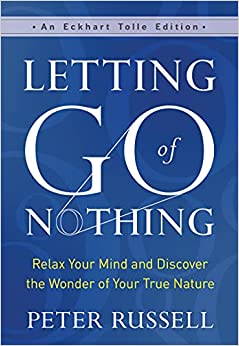
BOOK REVIEW: LETTING GO OF NOTHING

A compassionate and discerning book, drawing on a wealth of experience and understanding. Highly recommended. Peter Russell sets the note of Letting Go of Nothing (1) with the sentence: “The call to let go lies at the heart of the world’s spiritual traditions”. He adds, “Not being attached to outcomes, surrendering desires, accepting the present, opening to a higher power, relinquishing the ego, practising forgiveness – all entail letting go”.

The book is arranged as a series of brief, accessible sections exploring different aspects of the theme. Letting go takes many forms, depending on context. Here, Russell is not primarily concerned with letting go of things, like books, houses, jobs or the grid. His focus is on letting go of fixed beliefs and being right; immutable perspectives on the past or inflexible expectations of the future; the mental/emotional weight of judgements and grievances; disabling attachment to toxic or lost relationships. “We are not letting go of things themselves as much as the way we see them. Hence the title of this book: Letting Go of Nothing. Or, as I sometimes like to put it, ‘Letting Go of No-Thing’.”

Some of the 41 sections that follow are autobiographical. A Change of Mind recalls how a change in perception made space for a change of heart in a close personal relationship. Some are more about method – Letting In and Letting Be deconstruct the widespread notion that letting go of something necessarily means getting rid of it. If we are holding on to a grievance, for example, we are advised to let the experience in and become more aware of its discomforts. Pain, including emotional pain, evolved to let us know that something is wrong. It needs our attention. There are times for ignoring it, but this is not sustainable as our only response.

What we can do is learn to distinguish pain from suffering. Much suffering stems from aversion to pain (physical, mental, emotional), creating a surplus layer of discomfort. To a greater or lesser extent, we can disperse this added level of stress and tension. The work is subtle. It includes a level of not resisting resistance itself, and always finding spaces and possibilities for a degree of inner peace and freedom. Peter Russell is not in the business of sudden transformational release, although this too is possible. His way has more to do with skilful, compassionate engagement with the stream of experience as it happens. It is the work of a lifetime. Sections on Letting Go of Feelings, Letting Go of Story, The Root of Suffering and Fall from Grace explore his core philosophy in more depth.

Some of the sections set out liberating values – Forgiveness, Kindness, Wisdom. Others describe spiritual principles and practices – Sat-Chit-Ananda, Reframing Enlightenment, The Path of No Path. Russell is committed to an understanding of the world that summons us to ‘the deep peace of our true nature’. Matthew Fox (2), in a review, sees a social-ecological dimension in this work. For him, Letting Go of Nothing is an affirmation that our species can “wake up to down-to-earth spiritual wisdom that all our religions, when healthy, call us to – keeping it simple, understandable, and effective so that we and the sacred planet we share might become sustainable once more”. This simple book offers guidance at many levels.

(1) Peter Russell Letting Go of Nothing: Relax and Discover the Wonder of Your True Nature Novato, CA: New World Library, 2021 (Foreword by Eckhart Tolle)

(2) Matthew Fox is the author of Creation Spirituality and Original Blessing. His championship of an earth inclusive spirituality and his denial of original sin led to his excommunication from the Roman Catholic Church and move into the Episcopalian communion. His most recent book is Julian of Norwich: Wisdom in a Time of Pandemic – and Beyond.

See also: https://contemplativeinquiry.blog/2021/08/19/the-support-of-nature/

Earth Eclectic

music that celebrates Earth and speaks to the heart

Sarah Fuhro Star-Flower Alchemy

Follow the Moon's Cycle

Muddy Feet

Meeting nature on nature's terms

Rosher.Net

A little bit of Mark Rosher in South Gloucestershire, England

Becoming Part of the Land

A monastic polytheist's and animist’s journal

selkiewife

Selkie Writing…

Charlotte Rodgers

Images and words set against a backdrop of outsider art.

Prof Jem Bendell

living with metacrisis and collapse

Towint

The pagan path. The Old Ways In New Times

The Druids Garden

Spiritual journeys in tending the living earth, permaculture, and nature-inspired arts

The Blog of Baphomet

a magickal dialogue between nature and culture

This Simple Life

The gentle art of living with less

Musings of a Scottish Hearth Druid and Heathen

Thoughts about living, loving and worshiping as an autistic Hearth Druid and Heathen. One woman's journey.

Wheel of the Year Blog

An place to read and share stories about the celtic seasonal festivals

Walking the Druid Path

Just another WordPress.com site

anima monday

Exploring our connection to the wider world

Grounded Space Focusing

Become more grounded and spacious with yourself and others, through your own body’s wisdom

The Earthbound Report

Good lives on our one planet

Hopeless Vendetta

News for the residents of Hopeless, Maine