Contemplative Inquiry

This blog is about contemplative inquiry

Tag: Marianne Lines

DANCING SEAHORSES II
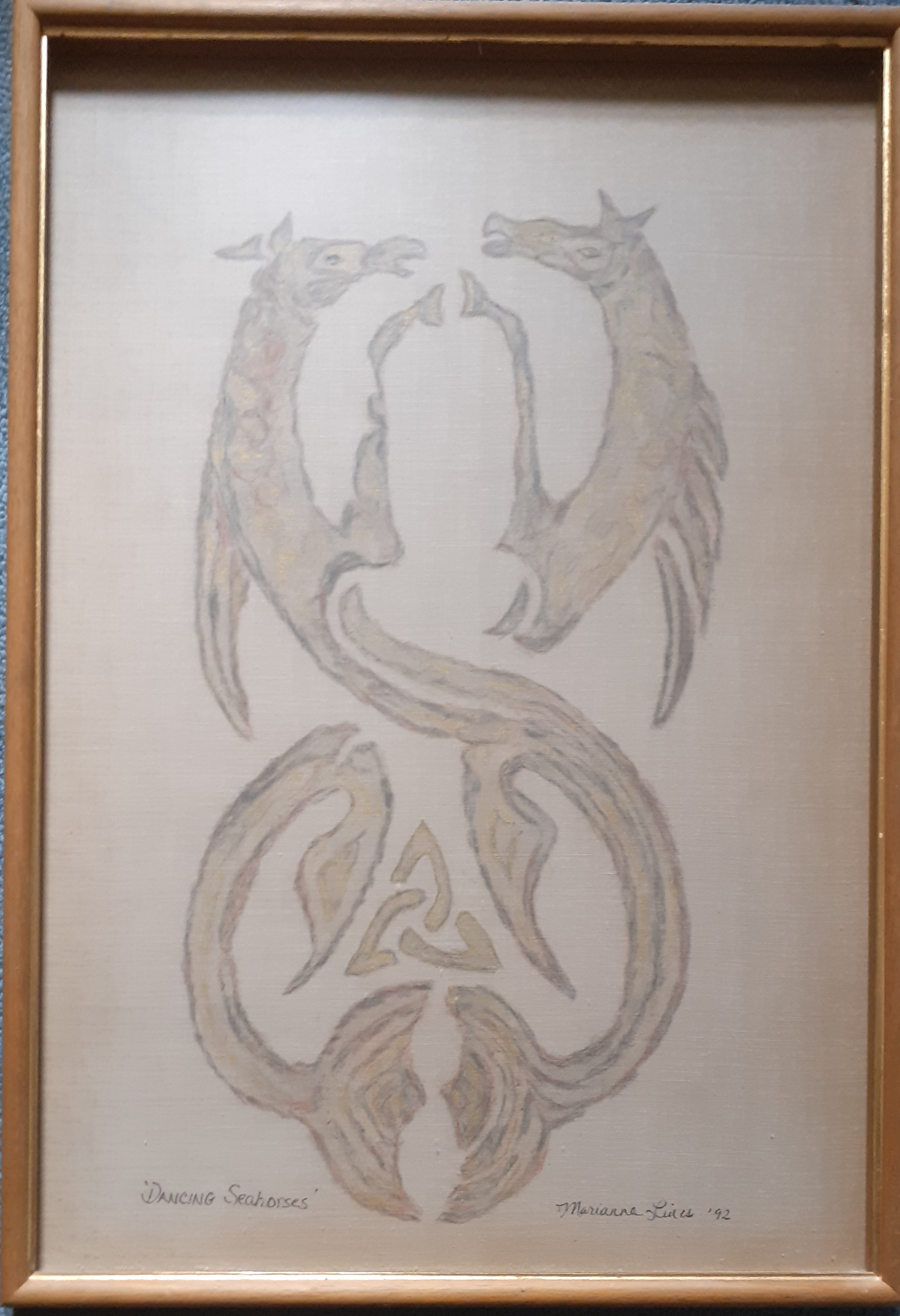
I have already written about the Dancing Seahorses image (1) found on a Pictish stone from Aberlemno in the Scottish county of Angus. After seeing the stone on a visit there, in 1992, I bought Marianne Lines’ painting. I have felt strongly involved with this image ever since. I think of it as a friend and guide. In a sense, this post is about the modern use of archaic images by people, like Druids, who are drawn to them.

I do not know the intentions of the original carver. beyond celebrating beings who are half of this world, half of the otherworld, and who embody powerful water energies for Celtic peoples on the Atlantic coasts of Britain, Ireland and Brittany in ancient times. They are remembered in folklore to this day. I do know that the carving made a strong impression on me, when I first saw it on the stone itself. It stayed in my imagination, and over time has deepened and grown new meanings.

Four years after acquiring the painting, I had the image tattooed on each arm. By that time I knew of the way in which it had influenced the cover design for R. J. Stewart’s The Prophetic Vision of Merlin (2). This variant form was used to refer to the story of the young Merlin at Vortigern’s subsidence prone tower in Snowdonia, prophesying his way out of becoming a human sacrifice, and identifying two contending dragons under the foundations. In the book illustration, there is a yin-yang reference, with a suggestions of interdependent primal forces, each of which already contains the seed of the other, seeking balance and alignment. In the Western Mysteries quest for healing and transfiguration, the energy bodies of the land and of humans are deeply interwoven.

There is another, more recent level of understanding, that I derive from the painting and tattoos, but not evident in The Prophetic Vision of Merlin. I see both the dancing seahorses and a second image, behind and containing the immediately apparent one. As I wrote before, “the space where the horses legs are raised defines a shape, suggesting a head. The very emptiness there is a paradoxical mark of presence. To me it became the head of a goddess, with the seahorses then becoming her body. Still clearly appearing as a water being, her arms – if they are arms – are raised in blessing”. I would now add that in this way, she demonstrates the dance of emptiness and form. They are balanced. Neither is privileged over the other. The Celtic knot points both to interconnection and infinity.

I identified the Goddess whilst gazing directly at the original Dancing Seahorses picture, which hangs of a wall directly above my altar. However I believe I received a subconscious nudge from the High Priestess card in The Druidcraft Tarot (3). She wears the image herself. Her hands are raised. She stands as the Goddess. In the Druidcraft narrative, she “represents the magical power of stillness and depth”. For me, the Goddess in Dancing Seahorses represents the ultimate union of emptiness and form, and the rebirth of the cosmos in each moment. Her representation combines the aware potential of the void and a primal aquatic generativity that can inhabit other elements. The Druidcraft priestess is human, but one who wears an image that bespeaks the divine to me, and her role asks for “stillness and depth”.

In my work, the entry into stillness and depth is, firstly, to enter into I-Thou communion with the primal Goddess (Modron) and then to recognise my own true nature, as (mythically) her divine child (Mabon) – sensitive and busted open to the world. This recognition becomes a prayer of gratitude and a surrender of my passing private concerns to Who I really am.

Words and pictures are not enough, but, cherished and contemplated lovingly over time, together they can point the way..

(1) https://contemplativeinquiry.blog/2020/06/25/dancing-seahorses/

(2) R. J. Stewart The Prophetic Vision of Merlin London & New York: Arkana, 1986

(3) Philip & Stephanie Carr-Gomm The Druidcraft Tarot: Use the Magic of Wicca and Druidry to Guide Your Life London: Connections, 2004 (Illustrated by Will Worthington)

DANCING SEAHORSES

This painting, Dancing Seahorses, is by Edinburgh-based artist Marianne Lines. I bought it in 1992 to support a growing interest in Celtic spirituality. The image is taken from a Pictish standing stone in Aberlemno in the county of Angus (1). To this day, the beings portrayed are well-known to Scottish folklore as sea horses, water horses, kelpies or each-uisge. They are also found in Ireland, the Isle of Man, Wales, Brittany and Cornwall. Manifesting in slightly different forms, they can appear in the sea, lakes, rivers and waterfalls.

For me, the painting evokes the primal energies of water, as embodied in these otherworldly seeming beings, who nonetheless might show up from time to time. The pair in the picture are entwined in ways that suggest many possible forms of connection – dancing, embracing, lovemaking, playing, fighting, competing, joining together in tranquillity, or a combination of the above.

I had owned the painting for some while before I began to see a second image, in a sense behind and containing the immediately apparent one. The space where the horses legs are raised defines a shape, suggesting a head. The very emptiness there is a paradoxical mark of presence. To me it became the head of a goddess, with the seahorses then becoming her body. Still clearly appearing as a water being, her arms – if they are arms – are raised in blessing.

The sea-horse image is clear and naturalistic, though stylised and showing creatures we strongly imagine but rarely meet. By contrast, the goddess image needs more work. I see her as Modron, the primal mother, in a marine guise. She seems to come out of a remote past with little story beyond her parenting of Mabon. I am glad not to have inherited too much lore about her. A sense of unfilled space and of mystery is part of what makes her numinous.

I did not make these connections as part of a plan. They grew up over time, feeling increasingly right. They are my own myth-making. I realise that, for me, meeting with an image is simpler and more direct than meeting with a fully developed narrative. There is an immediate impact, followed by a growing familiarity and a fuller relationship. From this, a story may grow, even one about a relative absence of story that points towards silence. Such images can have a lasting power, as this one has certainly had for me.

(1) There are four such stones from different periods. This is from the one listed as ‘Aberlemno 2’, where this image is on the lower right hand side of the front face. The stone is now thought of as being from the mid-ninth century C. E. – rather later than previously believed. The custodians of the stones place it in a genre of ‘zoomorphic designs’ also found in other Celtic Christian art of the time that draws on indigenous themes – for example in the Book of Kells, and in Celtic influenced Northumbrian work. This is in contrast to many Pictish standing stone images, which seem unique to that culture.

Earth Eclectic

music that celebrates Earth and speaks to the heart

Sarah Fuhro Star-Flower Alchemy

Follow the Moon's Cycle

Muddy Feet

Meeting nature on nature's terms

Rosher.Net

A little bit of Mark Rosher in South Gloucestershire, England

Becoming Part of the Land

A monastic polytheist's and animist’s journal

selkiewife

Selkie Writing…

Charlotte Rodgers

Images and words set against a backdrop of outsider art.

Prof Jem Bendell

living with metacrisis and collapse

Towint

The pagan path. The Old Ways In New Times

The Druids Garden

Spiritual journeys in tending the living earth, permaculture, and nature-inspired arts

The Blog of Baphomet

a magickal dialogue between nature and culture

This Simple Life

The gentle art of living with less

Musings of a Scottish Hearth Druid and Heathen

Thoughts about living, loving and worshiping as an autistic Hearth Druid and Heathen. One woman's journey.

Wheel of the Year Blog

An place to read and share stories about the celtic seasonal festivals

Walking the Druid Path

Just another WordPress.com site

anima monday

Exploring our connection to the wider world

Grounded Space Focusing

Become more grounded and spacious with yourself and others, through your own body’s wisdom

The Earthbound Report

Good lives on our one planet

Hopeless Vendetta

News for the residents of Hopeless, Maine