Contemplative Inquiry

This blog is about contemplative inquiry

Tag: Mabon

THE IMAGE AND THE SONG
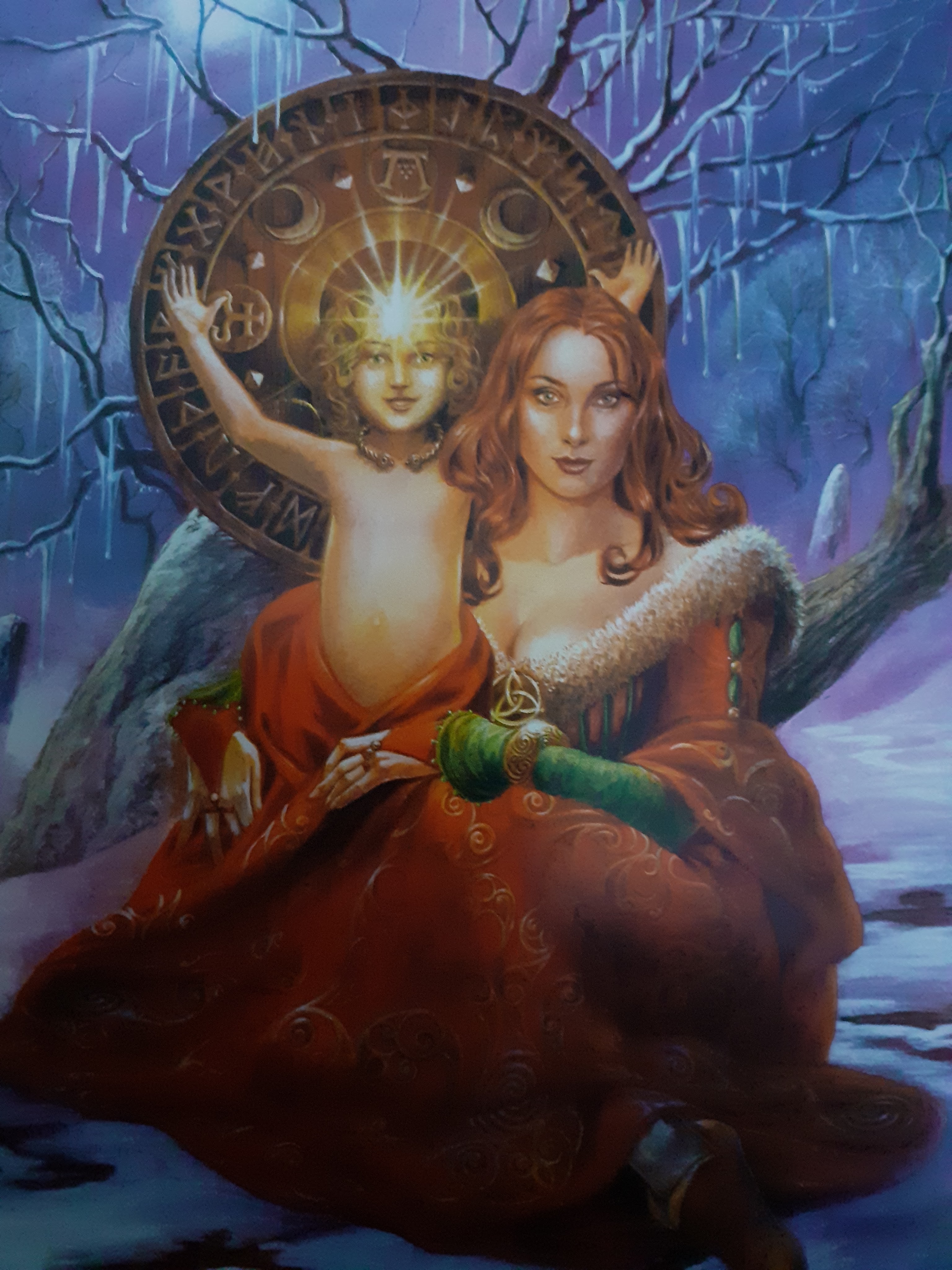
“I am the Mabon. I am the child.

I am YR, the Golden Bough.

I am the dart that the yew lets fly

Three pure rays, the pillars of life.

I am the wren, the King of Birds.

I am the Bard and the teller of lies.

I am a song within the heart.

I am the light that will never die.

I am stars within the Void.

I am the eye of the Aeon.” (1)

For more than a decade, my spiritual practice has been mobilised around a contemplative inquiry. For me, this has been successful in its own terms, but I’m conscious now of something missing. It’s as if, for earnest, intelligent and ethical reasons, I have whitewashed the walls in the church of me. Now I want my murals back. So, recently I have started a course correction.

This course correction includes a glance back at my own pre-inquiry practices, happily well documented. The image of Modron and Mabon used to walk with me: Modron as the primal mother and Mabon as the primal child (2). They were archetypal figures, not everyday humans. My understanding was that these names were from a pre-Celtic language, retained in Brythonic speech. I am not sure if this is true, but for me it offered the possibility that even the surviving Celtic stories (3) were not the first. I was free to dream. In this dreaming I was powerfully influenced by the image at the top of this post (received as a midwinter holiday gift from my wife, then partner, Elaine, in 2007) and by the Silver on the Tree song that follows.

I see the child in the image as androgyne, and not in their earliest infancy. In the song, Mabon is not gendered. The mother in the picture is clearly the Goddess as Mother. Different stories can be drawn from this. In my own journey I tilt the child back somewhat to the masculine. In this pairing, She is Zoe, the life eternal. He is Bios, the life that comes and goes and comes again. Like Taliesin (4), transmuting out of his identity as Gwion, Mabon becomes in a sense his own father. So my midwinter picture appears to reference the Christmas story, but in important ways diverges from it. The image shows a magical midwinter child, who will indeed have an illuminating and transformational influence, but who is not exactly a redeemer in the Christian sense. This is drawn out in the Silver in the Tree song, which includes specifically Celtic references and extends beyond them.

Both Mother and Child live strongly within me, in the imaginal realm. I like and use the old language, Modron and Mabon, because of its sense of ancient mystery. But what it points to is universal. Part of my work now is to re-open my contact with them, who after another fashion I also am.

(1) Silver in the Tree in their 1991 album Eye of the Aeon

(2) NOTE: I am aware that there are divergent visions of Mabon. One centred the Autumn Equinox has become powerful and influential in recent years. Happily modern Druidry is not a religion of the Book though it is enriched by its books. This new literature follows the oral tradition practice of allowing stories to evolve and change in divergent directions. I see this as a strength.

(3) Caitlin Matthews Mabon and the Guardians of Celtic Britain: Hero Myths in the Mabinogion Rochester, VT: Inner Traditions, 2002 (Revised edition of Mabon and the Mysteries of Britain, 1987)

(4) If you visit Loch Maben in Dumfriesshire, in south west Scotland, you may find the feeling-tone similar to the much larger Lake Bala, strongly associated with Taliesin, in north Wales.
DANCING SEAHORSES II

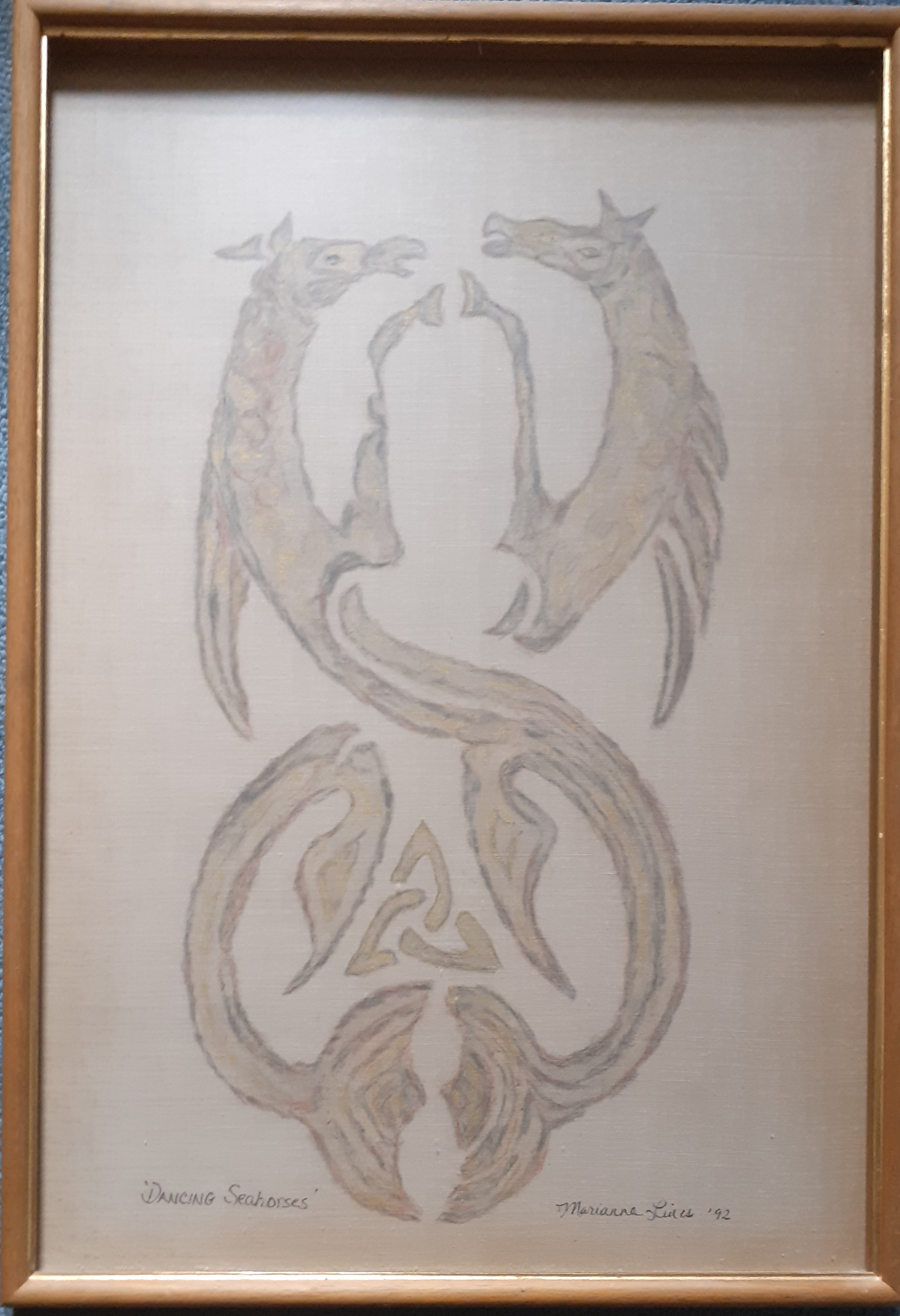
I have already written about the Dancing Seahorses image (1) found on a Pictish stone from Aberlemno in the Scottish county of Angus. After seeing the stone on a visit there, in 1992, I bought Marianne Lines’ painting. I have felt strongly involved with this image ever since. I think of it as a friend and guide. In a sense, this post is about the modern use of archaic images by people, like Druids, who are drawn to them.

I do not know the intentions of the original carver. beyond celebrating beings who are half of this world, half of the otherworld, and who embody powerful water energies for Celtic peoples on the Atlantic coasts of Britain, Ireland and Brittany in ancient times. They are remembered in folklore to this day. I do know that the carving made a strong impression on me, when I first saw it on the stone itself. It stayed in my imagination, and over time has deepened and grown new meanings.

Four years after acquiring the painting, I had the image tattooed on each arm. By that time I knew of the way in which it had influenced the cover design for R. J. Stewart’s The Prophetic Vision of Merlin (2). This variant form was used to refer to the story of the young Merlin at Vortigern’s subsidence prone tower in Snowdonia, prophesying his way out of becoming a human sacrifice, and identifying two contending dragons under the foundations. In the book illustration, there is a yin-yang reference, with a suggestions of interdependent primal forces, each of which already contains the seed of the other, seeking balance and alignment. In the Western Mysteries quest for healing and transfiguration, the energy bodies of the land and of humans are deeply interwoven.

There is another, more recent level of understanding, that I derive from the painting and tattoos, but not evident in The Prophetic Vision of Merlin. I see both the dancing seahorses and a second image, behind and containing the immediately apparent one. As I wrote before, “the space where the horses legs are raised defines a shape, suggesting a head. The very emptiness there is a paradoxical mark of presence. To me it became the head of a goddess, with the seahorses then becoming her body. Still clearly appearing as a water being, her arms – if they are arms – are raised in blessing”. I would now add that in this way, she demonstrates the dance of emptiness and form. They are balanced. Neither is privileged over the other. The Celtic knot points both to interconnection and infinity.

I identified the Goddess whilst gazing directly at the original Dancing Seahorses picture, which hangs of a wall directly above my altar. However I believe I received a subconscious nudge from the High Priestess card in The Druidcraft Tarot (3). She wears the image herself. Her hands are raised. She stands as the Goddess. In the Druidcraft narrative, she “represents the magical power of stillness and depth”. For me, the Goddess in Dancing Seahorses represents the ultimate union of emptiness and form, and the rebirth of the cosmos in each moment. Her representation combines the aware potential of the void and a primal aquatic generativity that can inhabit other elements. The Druidcraft priestess is human, but one who wears an image that bespeaks the divine to me, and her role asks for “stillness and depth”.

In my work, the entry into stillness and depth is, firstly, to enter into I-Thou communion with the primal Goddess (Modron) and then to recognise my own true nature, as (mythically) her divine child (Mabon) – sensitive and busted open to the world. This recognition becomes a prayer of gratitude and a surrender of my passing private concerns to Who I really am.

Words and pictures are not enough, but, cherished and contemplated lovingly over time, together they can point the way..

(1) https://contemplativeinquiry.blog/2020/06/25/dancing-seahorses/

(2) R. J. Stewart The Prophetic Vision of Merlin London & New York: Arkana, 1986

(3) Philip & Stephanie Carr-Gomm The Druidcraft Tarot: Use the Magic of Wicca and Druidry to Guide Your Life London: Connections, 2004 (Illustrated by Will Worthington)

MODRON AND MABON: A VISION

An absence untouched by narrative. Or, perhaps, original presence as an unnameable intimacy of experiencing. Undivided, it cannot know itself as object.

As if ‘then’, there is an appearance of appearances. The knowing of a primal mist and mirk, shot through with luminous flashes. It seems to spread through a dawning space and time which are still malleable, not yet settled or regulated.

Aeons pass, and figures step out of the mist. They emerge into a pale and heart-breaking winter light, softened by gentle rain. There are evergreen leaves and tiny sparkles of light, offered as watery reflections.

The people – there are two of them – come like refugees, suitably attired for the North. One is the Mother of All, here known as Modron, the destined Kali of a cool ambiguous land. The other is Mabon, her magical child. Their purpose here is to remind people of who they really are.

The Modron will not hold her human form for long. She will dissolve into the landscape and the elements, though her energy will still move through them. The Mabon’s task, no small one, is to stand by the Mother, to enjoy her gifts, and to show the way home.

MODRON

An unlocatable darkness, beyond deep time, beyond even the metaphysics of origin. Almost detecting, or so it seems, an ultimate motherhood. A motherhood beyond name and gender, beyond being, beyond even latency. The possibility, perhaps, of Modron. No Word. No Bang. No Mabon.

When Mabon ap Modron (Youth, Son of Mother) appears in Celtic culture, he is in fact already archaic. He can only be traced at all through the memory of the oldest animal – the Salmon of Llyn Lliw (1). Mabon and Modron are embedded in the old Brythonic language, but pre-date it. They may well come from a time when paternity was unknown, and the male primarily recognized as a son.

In a previous post (2) I have described working with prayer beads and saying Ama-Aima. This is an Aramaic phrase, which I got from the Sophian Fellowship (Ecclesia Pistis Sophia). For them, as Christian gnostic kabbalists, there is a reference to Sophia as Binah on the tree. As Ama, – not quite Goddess, not quite Shekinah – she is in her maiden, or latent state; as Aima, she becomes the one who is impregnated, bringing form into being.

Working with the beads, I find myself losing this mythic structure and separating Ama-Aima from Sophia. Both name and experience feel more primal. I take ‘Ama’ to belong to a simple and culturally widespread family of sounds like ‘Ma’ and ‘Mama.’ I don’t feel infantilized by using the term. But it does take the practice beyond meditation, beyond prayer, beyond even devotion. It seems, rather, like an act of recognition, or alignment, and a will to relate to a source beyond existence itself. At a more personal and animal level, I suspect that I am also aligning my conscious self with pre-linguistic and ultimately pre-natal levels of being. These do form part of my physical existence and, however remotely, memory. Here I am at cause with the mystery and miracle of the life I have woken into, often in a simple state of gratitude for the opportunity to be human.

If there is a Sophian connection here, it is indicated in images like ‘The Maiden’ in R.J. Stewart’s Dreampower Tarot (3). As Maiden, she who appears in translucent white, as “the still and pure potential which is ever renewed out of the Mother Deep”, her virginity “a spirit of renewal rather than a physical condition”. The primal Mother within The Maiden, from whom she comes, is shown by a Sheela-na-gig behind her. It is a very faint figure, barely visible, but it seems as if the translucent maiden has appeared out of the vagina. This old image is found in Celtic regions, carved upon stones and early churches. “It is an ancient representation of the Mother of All, with her open vagina from which all comes forth and into which all enters and returns.”

In a sense, Sophia is the whole image. But for me Ama-Aima is more the Sheela-na-gig, herself dissolving into empty invisibility. Sophia is more like Stewart’s Maiden, mostly concerned with “stilling and guarding life energies” and learning to direct them inwardly in new forms of illuminating capacity. This is very much the Wisdom I am working with at the present phase of my life

  • The Mabinogion Sioned Davies (translator) Oxford: OUP, 2007 (The reference is to How Culhwch Won Olwen.)


  • J. Stewart The Dreampower Tarot London: Aquarian Press, 1993 (Paintings by Stuart Littlejohn)

POEM: PRIMARY CHIEF BARD

Gnostic Bardistry from The Book of Taliesin? These are just five of the verses, selected by me from one poem. What interests me is not so much working out what to us seems like a set of puzzles, but how something new and dialogical is created by interweaving indigenous material and biblical references. I say a few words in italics after each verse.

Primary Chief Bard

Primary Chief Bard

Am I to Elffin

And my native country

Is the region of the summer stars.


The first statement is a statement of identity. It begins with a local (though important) role, and goes on to the cosmic and transcendent. This taps into a sense of belonging somewhere else (whether perceived as a place or state). It makes me think that statements like ‘being here now, in the present’ and ‘my native country is the region of the summer stars’ only seem contradictory: meaning depends so much on context and the work that words are doing. If the two statements are separated and polarised, they diminish into limiting slogans. Taken together, they can lead us to a different quality of experience.

I was full nine months

In the womb of the hag Ceridwen.

Before that I was Gwion

But now I am Taliesin.

Taliesin’s current personal identity is explained in terms of a second birth, in this life, triggered by the actions of Ceridwen. This second birth fits him to be a Bard and take the Bardic name ‘Radiant Brow’, one that bespeaks major shifts in energy and consciousness. It also allows the sense of the summer stars as his ‘native country’ to be real within him. It orients him to his true home.

I was patriarch

To Elijah and Enoch.

I was there at the crucifixion

Of the merciful Mabon.

Elijah and Enoch ascended to heaven without dying. They have deep roles in Jewish mysticism. They are in the tradition of so-called ‘ascended Masters’. If we treat these metaphors (insofar as they are metaphors) as concerned with enlightenment, then – as their ‘Patriarch’ – Taliesin is claiming primacy over them. He is in some sense a Christ figure and so can be present at the crucifixion of another Christ figure, referred to here by the name of the magical child of British tradition ‘the Mabon’.


I was at the cross

With Mary Magdalene.

I received the Awen

From Ceridwen’s cauldron.

The poem presented here is a product of the later Middle Ages, likely as late as the fourteenth century. Traditions giving Mary Magdalene the role of major teacher and possibly spouse of Jesus were deep underground, but everyone in Christendom Knew of her witnessing role at both the crucifixion and the resurrection, and so as privileged in some way. She also shares her name with Mary the mother. The two couplets together bring the idea of Christ’s transformation through death on the cross with Taliesin’s transformation from Ceridwen’s cauldron, and the critical role of a feminine power in each.

I was in the larder

In the land of the Trinity

And no one knows whether my body

Is flesh or fish.

Despite all the above, Taliesin remains an enigma – a shape shifter and trickster. He defies definition and description and won’t fit into any box that attracts unwanted piety. Other readers may understand this verse much better than I do, but I see it as very tough minded and unwilling to let me parcel up this poem and tie it with a neat bow. To the extent that I get a sense of medieval Welsh literature, this seems very characteristic. However, in the most obvious ‘Land of the Trinity’ (Western Christendom) people want to know where everyone stands. The accepted narrative is that we’re with Jesus the avatar of Pisces and through the sign of the fish we know him. And yet the old Celtic world has many trinities and many fish, including the salmon of wisdom. And Taliesin’s body might be flesh after all. So we are thrown back on our resources, with riddling words and ambiguous images to reflect them.


The complete poem can be found in Taliesin: Shamanism and the Bardic Mysteries in Britain and Ireland by John Matthews London: The Aquarian Press, 1991.

GWYN, GWYTHYR AND CREIDDYLAD: A STORY FROM THE OLD NORTH

This post reblogged from Peneverdant looks at the traditional stories of the northern British (especially in north west England and southern Scotland) and surviving material from these stories in later Welsh literature.

Lorna Smithers's avatarThe Sanctuary of Vindos

Cherry BlossomCulhwch and Olwen is one of the oldest and most fascinating repositories of ancient British mythology. It originates from two texts; a fragmented version in The White Book of Rhydderch (1325) and full version in The Red Book of Hergest (1400). The main narrative centres on Culhwch’s quest to win Olwen for which he enlists the help of Arthur and his retinue; a medley of historical and mythological characters.

Embedded within it we find fragments of other tales which may be of older origin and have stood alone. These include the hunt for the legendary boar Twrch Twryth and release of Mabon from imprisonment in Gloucester. Most significantly for me as someone who venerates Gwyn ap Nudd, we find the story of his rivalry with Gwythyr ap Greidol for the love of Creiddylad and their battle for her every May Day.

This story is central to understanding Gwyn’s mythology. Because…

View original post 2,230 more words

MABON

Druidry has its own view of the magical, redemptive child or youth: the Mabon. Here is my transcription (and I apologise for any inaccuracies) of Mabon, a song recorded by Silver in the Tree as part of their Eye of the Aeon album in 1991 and re-recorded on Dreaming the God in 2007.

I am the Mabon I am the child
I am YR the golden bough
I am the dart the yew lets fly
Three pure rays the pillars of light
I am the Wren the King of Birds
I am Bard and teller of lies
I am a song within the heart
I am a light that will never die
I am stars within the void
I am the Eye of the Aeon

In Celtic times the reference is always to Mabon, son of Modron (Youth, son of Mother), “the primal child who was in existence at the beginning of things” (1). The story of How Culhwch won Olwen (2) includes a section where a search is mounted to find and rescue the lost and imprisoned Mabon. Roman Britain and Gaul record devotion to a youthful male deity called Apollo Maponus, very well described by Lorna Smithers in a From Peneverdant post on 26 December 2012 http://lornasmithers.wordpress.com/2012/12/26/Maponus/.

In the medieval poem Primary Chief Bard – attributed to Taliesin – Christ is referred to as the “merciful Mabon” and the “Maiden’s Mabon” (3) The Taliesin of the Hanes Taliesin (3) is himself a Mabon figure. The area around Loch Maben in Dumfriesshire is tied to stories of Lailoken, the Scottish Merlin (see also https://contemplativeinquiry.wordpress.com/2014/07/15/merlin) and his interaction with St. Kentigern (aka St. Mungo) at the time of Christian conversion (4).  When I visited the Loch at Lochmaben some years ago, the water’s edge, in morning mist, had some of the numinous feel of Llyn Tegid at Bala, though the Scottish loch is much smaller.

Modern Druidry gained momentum as a spiritual tradition at the beginning of the 20th century, a time when, more widely, a ‘Celtic twilight’ current met that of the Hermetic Order of the Golden Dawn (think of W. B. Yeats). Hence in some iterations of modern Druidry, the Mabon can be understood as a Celtic Hermes, birthed within the practitioner as the fruit of inner alchemical work. It may also be that the “Eye of the Aeon” reference at the end of the Mabon song nods in the direction of Aleister Crowley’s view of our ‘new age’ as being the Aeon of Horus (5). The eye of the Aeon is also the ‘I’ of the Aeon, the you and me of the Aeon, because that’s how this age is understood to work. It’s about transformation of consciousness, and if we want to use such a term, divinisation, within the individual – Jung’s journey of individuation, from self to Self.

The Mabon is a primary archetypal image within Druidry, and we can relate to this image – resonance, presence – in many ways. For me, Mabon, the song has power. Ten brief lines, each one a portal in itself. Silver on the Tree can be found at http://www.last.fm/music/Silver+on+the+Tree

1: Matthews, Caitlin & John The western way: a practical guide to the western mystery tradition (volume 1: the native tradition) (1985) London: Arkana

2: Davies, Sioned The Mabinogion (2007) Oxford: The University Press

3: Matthews, John Shamanism and the bardic mysteries in Britain and Ireland (1991) London: the Aquarian Press

4: http://www.everything2.com/title/Saint+Kentigern+and+Lailoken

5: DuQuette, Lon Milo (2003) Understanding Aleister Crowley’s Thoth tarot San Francisco, CA: Red Wheel/Weiser

Earth Eclectic

music that celebrates Earth and speaks to the heart

Sarah Fuhro Star-Flower Alchemy

Follow the Moon's Cycle

Muddy Feet

Meeting nature on nature's terms

Rosher.Net

A little bit of Mark Rosher in South Gloucestershire, England

Becoming Part of the Land

A monastic polytheist's and animist’s journal

selkiewife

Selkie Writing…

Charlotte Rodgers

Images and words set against a backdrop of outsider art.

Prof Jem Bendell

living with metacrisis and collapse

Towint

The pagan path. The Old Ways In New Times

The Druids Garden

Spiritual journeys in tending the living earth, permaculture, and nature-inspired arts

The Blog of Baphomet

a magickal dialogue between nature and culture

This Simple Life

The gentle art of living with less

Musings of a Scottish Hearth Druid and Heathen

Thoughts about living, loving and worshiping as an autistic Hearth Druid and Heathen. One woman's journey.

Wheel of the Year Blog

An place to read and share stories about the celtic seasonal festivals

Walking the Druid Path

Just another WordPress.com site

anima monday

Exploring our connection to the wider world

Grounded Space Focusing

Become more grounded and spacious with yourself and others, through your own body’s wisdom

The Earthbound Report

Good lives on our one planet

Hopeless Vendetta

News for the residents of Hopeless, Maine